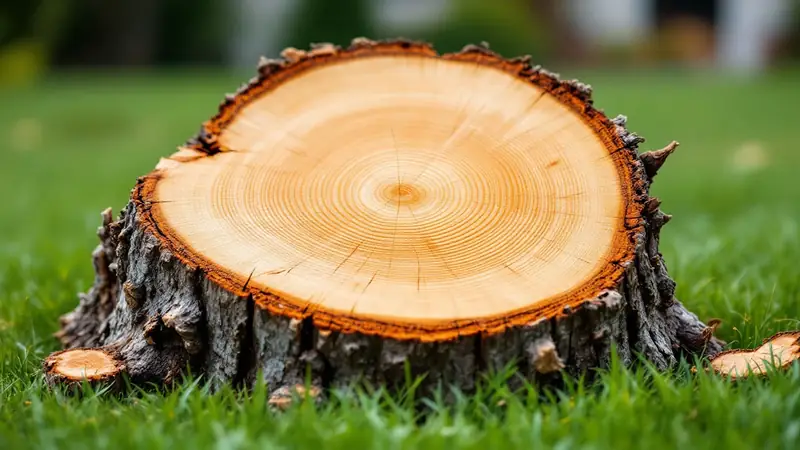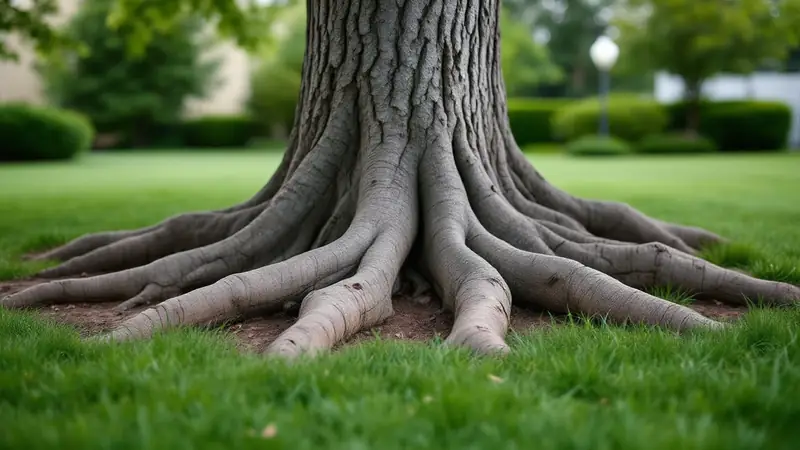
How to get rid of tree roots in lawn: on a living tree, don’t cut or bury them. Mulch 2 to 3 inches out to the dripline or topdress half an inch and reseed. Cut roots under 2 inches, 5 to 6 trunk diameters out.
Most advice on how to get rid of tree roots in lawn areas skips the number that decides it: how far the root is from the trunk. Those roots are the tree’s anchor. In pulling tests on young willow oaks, cutting 1 buttress root cut the force needed to tilt the tree by 12 percent on average, and cutting half of them by 30 percent (Smiley, Arboriculture & Urban Forestry, 2008). Purdue calls cutting or grinding surface roots one of the worst decisions for tree care if done indiscriminately (Purdue FNR-585-W).
This page puts 6 published cut-distance rules on one ruler: for a 12-inch-diameter tree they run from 3 to 18 feet. The calculator does it for your trunk, and a second table sets 7 limits on soil over roots, from half an inch to 2 inches. For most yards the answer is a mulch bed; see our guide to how wide and deep to make a mulch ring around a tree sizes it.
1Is the root only a mowing, tripping or looks problem (not lifting a foundation, pavement or a pipe)?
YesDo not cut. Mulch 2 to 3 inches out to the dripline, or topdress about 0.5 inch and reseed.
NoGo to the next question
2Would the cut be closer to the trunk than 3 times the trunk diameter (3 ft for a 12-inch tree)?
YesDo not cut. Ask an ISA Certified Arborist about bridging the root, rerouting the work or removing the tree.
NoGo to the next question
3Does the tree lean, show decay at the base, or have roots already cut or paved over on another side?
YesDo not cut yourself: Bartlett says even 3 trunk diameters is too close for these trees.
NoGo to the next question
4Is the root thicker than 2 inches?
YesArborist decision: Bartlett says avoid cuts over 3 inches, PNW-ISA says never over 4.
NoGo to the next question
5Would this cut, plus others in the last 2 to 3 years, pass 15 percent of the surface roots, or need cuts on more than one side inside 5 to 6 trunk diameters?
YesSplit the work over several years, or hire an arborist.
NoYou can cut it: late winter or early spring, one clean saw cut on the trunk side, refill the same day, water through dry spells.
Source: Smiley 2008; Bartlett Root Pruning technical report; Davey Tree; PNW-ISA; WSU C137
Why tree roots come up through the lawn
Most tree roots run sideways in the top 4 to 15 inches of soil, where the oxygen is (UW-Madison Extension); Iowa State puts the vast majority in the top 12 to 18 inches (Iowa State, Aug. 2024). Roots thicken every year like the trunk, so one just under the turf eventually breaks through.
Penn State lists pines among the trees sensitive to root disturbance, so our steps for how to grow grass under pine trees seed into the existing surface instead of tilling it.
Three things push them up sooner. Heavy, wet or compacted soil keeps roots shallow (Purdue). Traffic strips soil off them: NC State Extension notes that zero-turn mowers weigh 500 to 1,000 pounds and blow loose soil away, leaving trees on raised islands (NC State Extension, Sept. 2023). In cold climates, freeze and thaw heaves roots upward (Morton Arboretum). Species matters most; for help naming yours, see the common U.S. yard tree species.
Swipe the table sideways to see every column.
| Tree | Named for surface roots by | Tolerance of fill soil (PNW-ISA) | What it means for you |
|---|---|---|---|
| Silver maple | UW-Madison, Kentucky, WSU (fast surface roots), Bartlett (especially) | Maples: most susceptible | The most-named surface rooter; mulch, do not fill |
| Red maple | Kentucky; Purdue and Morton name maples as a group | Maples: most susceptible | Smiley 2014 pull tests used red maples with 6 to 10 buttress roots |
| Norway maple | Kentucky | Maples: most susceptible | Morton: most prone to girdling roots |
| Willows | UW-Madison, Kentucky, Purdue, WSU, Bartlett | Least affected | Wet-site species; roots stay shallow to escape saturated soil (Purdue) |
| Poplars and aspens | UW-Madison, Kentucky | Not listed | Also named by Morton for clogged sewer pipes |
| Sycamore | Kentucky, Purdue, WSU, Bartlett | Least affected | WSU lists it as a poor choice near lawns |
| Beech | Kentucky, WSU, Bartlett | Not listed | WSU: poor choice |
| Ash | Kentucky and Purdue (some ash) | Least affected | Sources split: WSU lists ash as a good choice |
| Pin oak | Kentucky | Oaks: most susceptible | Other oaks are on Kentucky’s deeper-rooted list |
| Elms | WSU (fast surface roots; some elms poor) | Least affected | Fast growers surface sooner (WSU) |
| Spruce, Douglas fir | WSU (early surface roots) | Evergreens: most susceptible | Conifers: no soil over roots |
| Black gum, ginkgo, yellowwood, zelkova, many oaks | Kentucky: deeper roots, better for compacted or clay soil | Oaks: most susceptible | Replanting choices, not a cure for an existing tree |
| Oak, ginkgo, ash, linden | WSU: good choices to delay surface roots | Ash: least affected; oak: most susceptible | Replanting choices |
Read the rows as tendencies: WSU C137 calls ash a good choice while Purdue and Kentucky name some ash as shallow rooters. In the fill column, maples, oaks and evergreens are hurt most by added soil. The full list is in the dataset (CSV).
How close to the trunk can you cut a tree root?
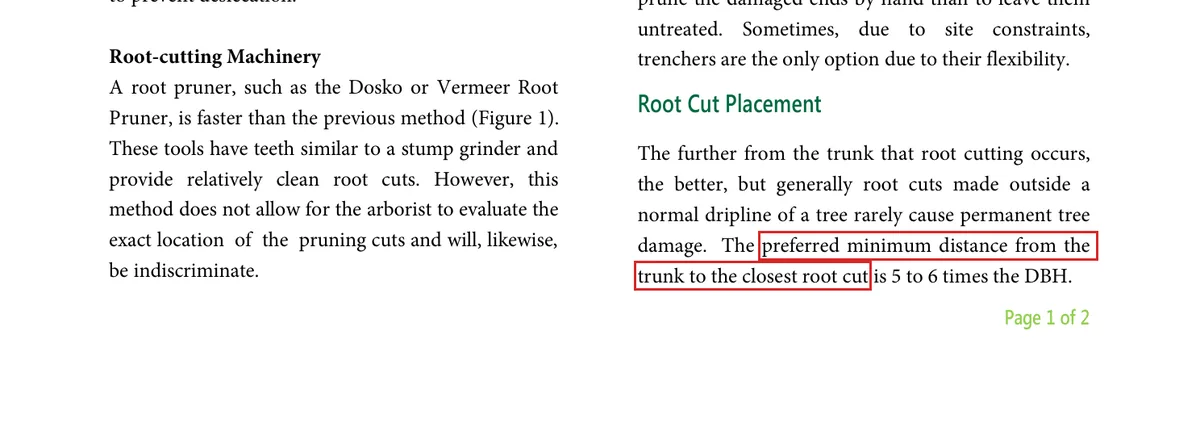
Not closer than 3 trunk diameters, and only on one side. Bartlett Tree Research Laboratories sets its preferred minimum at 5 to 6 times the trunk diameter (DBH, measured 4.5 feet up) for cuts on more than one side, and 3 times DBH for a cut on one side only.
The 3 x figure comes from pulling tests. E. Thomas Smiley pulled young willow oaks to 1 degree from vertical before and after root cuts: force dropped measurably once trench cuts came within 3 trunk diameters, and by 35 percent for a cut tangent to the trunk (Smiley 2008). A 2014 follow-up on red maples with 6 to 10 buttress roots found strength fell in a nearly straight line as roots were cut, up to half the circumference (Smiley, Holmes and Fraedrich 2014).
The critical root zone is a different, larger circle: 1 foot of radius per inch of DBH in the ISA definition quoted by the Pacific Northwest ISA chapter, and 1.5 feet per inch for mature or stressed trees in WSU C137. That is a construction no-disturbance zone; Bartlett’s 5 to 6 x cutting limit sits about halfway out inside it.
| Distance from trunk | 12-inch tree | What the sources allow | Source |
|---|---|---|---|
| 0 to 3 x DBH | 0 to 3 ft | Do not cut. Pull force fell measurably inside 3 x DBH and 35% for a cut at the trunk | Smiley 2008 |
| 3 to 5 or 6 x DBH | 3 to 6 ft | One side only, roots under 3 in, tree upright and sound. Treat as an arborist call | Bartlett technical report |
| 5 or 6 x DBH to 1 ft per inch | 6 to 12 ft | Bartlett’s minimum for cuts on more than one side; expect minimal impact with aftercare. Still inside the ISA critical root zone | Bartlett; ISA via PNW-ISA |
| 1 to 1.5 ft per inch | 12 to 18 ft | Outside WSU’s zone for young or healthy trees, inside it for mature or stressed ones | WSU C137 |
| Past the dripline | Varies | Root cuts here ‘rarely cause permanent tree damage’ | Bartlett |
- No cuts inside, one side only (3 x DBH), feet
- 3.0
- Closest cut on several sides, low end (5 x DBH), feet
- 5.0
- Closest cut on several sides, Bartlett high end (6 x DBH), feet
- 6.0
- Critical root zone radius, young or healthy tree (1 ft per inch), feet
- 12.0
- Critical root zone radius, mature or stressed tree (1.5 ft per inch), feet
- 18.0
Default: 12-inch diameter = 3 ft no-cut zone, closest cuts 5 to 6 ft, critical root zone 12 to 18 ft. Rules: Smiley 2008, Bartlett, Davey Tree, ISA via PNW-ISA, WSU C137.
To size your tree, wrap a tape around the trunk 4.5 feet up and divide by 3.14: a 38-inch circumference is a 12-inch tree. WSU says dividing by 3 is close enough. The areas below show why mulching a big tree’s whole critical root zone is a large bed.
| Trunk diameter | Circumference | No cuts inside (3 x DBH, one side) | Closest cut, several sides (5 to 6 x) | Critical root zone, 1 ft per inch (area) | Critical root zone, 1.5 ft per inch (area) |
|---|---|---|---|---|---|
| 6 in | 19 in | 1.5 ft | 2.5 to 3 ft | 6 ft (113 sq ft) | 9 ft (254 sq ft) |
| 12 in | 38 in | 3 ft | 5 to 6 ft | 12 ft (452 sq ft) | 18 ft (1,018 sq ft) |
| 18 in | 57 in | 4.5 ft | 7.5 to 9 ft | 18 ft (1,018 sq ft) | 27 ft (2,290 sq ft) |
| 24 in | 75 in | 6 ft | 10 to 12 ft | 24 ft (1,810 sq ft) | 36 ft (4,072 sq ft) |
| 36 in | 113 in | 9 ft | 15 to 18 ft | 36 ft (4,072 sq ft) | 54 ft (9,161 sq ft) |
How big a root, and how many, can you cut?
| Rule | Limit | Source |
|---|---|---|
| Root diameter you can cut with hand tools | Under 1 in | Bartlett |
| Largest root to prune | Avoid over 2 in | Davey Tree |
| Largest root to prune | Avoid over 3 in whenever possible | Bartlett |
| Largest root to prune | Never over 4 in: usually structural | PNW-ISA |
| Share of roots at one time | 15% of above-ground roots, then wait 2 to 3 years | Davey Tree |
| Share of roots at one time | 25% of functioning roots under the canopy, spread over several years | WSU C137 |
| One major root near the trunk | Up to 25% of the root system (most trees have 4 to 7) | Morton Arboretum |
| One buttress root, young willow oak | 12% average loss of pull force; half the buttress roots, 30% | Smiley 2008 |
| When to cut | Late winter or early spring, before buds break | WSU C137; Davey |
| When not to cut | Just before or during a drought unless you can irrigate | Bartlett |
Our reading: 2 inches is the do-it-yourself ceiling and 4 inches or more is structural. Per the Morton Arboretum, most trees have only 4 to 7 major roots, so one cut near the trunk can take up to a quarter of the system. Past these lines, hire an ISA Certified Arborist.
If a root must go: the cut, step by step
- Stake the 3 x and 5 to 6 x DBH distances; cut only beyond them.
- Schedule late winter or early spring, before buds break (WSU C137). Skip dry spells unless you can water (Bartlett).
- Dig around the root by hand until it is fully exposed. Roots under 1 inch cut easily with loppers or a pruning saw (Bartlett).
- Make one clean saw cut on the trunk side. Never tear roots with a backhoe or trencher (PNW-ISA).
- Refill the hole the same day: PNW-ISA says exposed small roots can be injured in 30 minutes in hot, dry weather.
- Water through dry spells: ISA puts a tree’s need at about 1 inch of rain every 7 to 10 days (ISA).
- Wait 2 to 3 years before cutting again (Davey Tree).
How much soil can you put over tree roots?
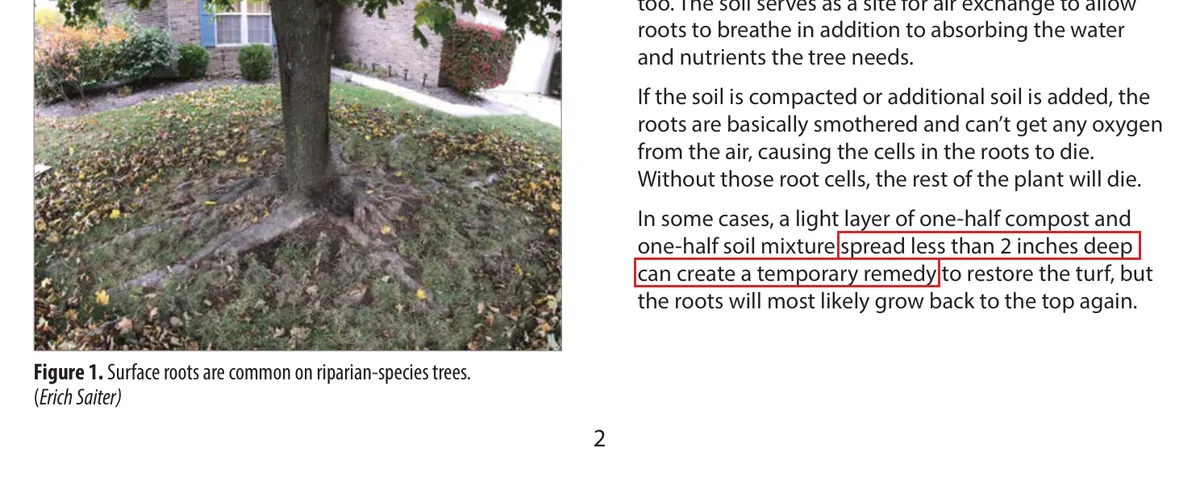
Half an inch to 2 inches at a time, depending on the source, and none against the trunk. Iowa State says 1 to 2 inches gives temporary relief and 4 inches or more may damage or destroy the tree by starving roots of oxygen (Iowa State).
| Source | Most soil over roots | How often | Link |
|---|---|---|---|
| UW-Madison Extension | Just enough to cover roots by about 0.5 in | Repeat when roots resurface | UW-Madison |
| University of Kentucky (2025) | 0.5 in or less, to fill between roots | Every year or two | UKY |
| Purdue FNR-585-W (2020) | Under 2 in of half compost, half soil | Temporary remedy | Purdue |
| Iowa State (2024) | 1 to 2 in is temporary; 4 in or more may damage or destroy the tree | Roots reappear in a few years | ISU |
| Penn State (underplanting) | No more than 2 in; none within 1 ft of the trunk | Once, at planting | Penn State |
| Pacific Northwest ISA | 2 to 4 in may avoid significant damage only if the fill is coarser than the soil | Construction fill | PNW-ISA |
| ISA Trees and Turf (2021) | No depth given: consult an ISA Certified Arborist first | Any fill | ISA |
- Rake out sticks and old leaves (Kentucky Extension).
- Mix about half compost and half screened topsoil, Purdue’s recipe. PNW-ISA notes fill coarser than the existing soil does less harm.
- Spread just enough to cover the roots by about 0.5 inch (UW-Madison), and keep it 1 foot back from the trunk (Penn State).
- Seed a shade-tolerant grass: ISA says most lawn grasses do poorly under 50 percent open sunlight, and our ranking of which grasses grow in shade, by hours of sun sets the floor.
- Repeat a thin layer every year or two rather than burying everything at once (Kentucky).
The thin-pass rule matches lawn leveling, where passes run 1/4 to 1/2 inch; see topdressing passes for leveling a lawn.
Mulch or groundcover where grass will not hold
Purdue’s bulletin calls wood mulch the best solution: 2 to 3 inches, out to the dripline or at least to where roots thin enough for healthy turf (Purdue FNR-585-W). ISA gives 2 to 4 inches under the drip line, and WSU keeps mulch at least 6 inches off the trunk (WSU C137). Strip the turf by hand; UW-Madison and Kentucky both say no rototiller over roots.
To plant instead, dig small pockets between roots by hand. Iowa State suggests hostas, ferns, woodland phlox, wild ginger and barrenwort (Iowa State); WSU names Shuttleworth’s wild ginger (Zones 6 to 9), dwarf Solomon’s seal (Zones 5 to 8) and bunchberry (Zones 2 to 7). Purdue still prefers plain mulch, because planting itself damages roots.
Skip gravel and concrete: Purdue says stone mulch compacts and heats soil, and Davey Tree caps gravel at 2 inches over fabric if used.
Mowing over surface roots without wounding them
Every scalp is a wound. University of Georgia Extension says root suckers most often follow damage from a lawn mower, string trimmer or heavy equipment (UGA Extension, 2015), and Kentucky says cut roots invite decay and insects. NC State’s fixes are specific:
- Raise the deck so the blade clears exposed roots; mow at the top of your grass’s recommended height (ISA).
- Change mowing pattern and direction each time, and lower tire pressure to spread a 500 to 1,000 pound mower’s weight (NC State).
- Join the mulch rings of trees that stand close together, so nothing drives between them (NC State).
Our mowing heights by grass type give the top of each range.
Roots and sprouts from a tree that is gone
If the tree is alive, yours or a neighbor’s, do not spray its root sprouts. UGA Extension warns that systemic herbicides absorbed through suckers can damage the entire tree; the only recourse it gives is to keep cutting them. Mowing does that in turf.
If the tree has been cut down, the roots die only when the stump does, and maples, poplars and willows resprout from both. Our guide to killing a tree stump so its roots stop sprouting gives the 5-minute cut-surface treatment and the label rates, and stump grinding prices per inch of diameter cover grinding out the stump and surface roots.
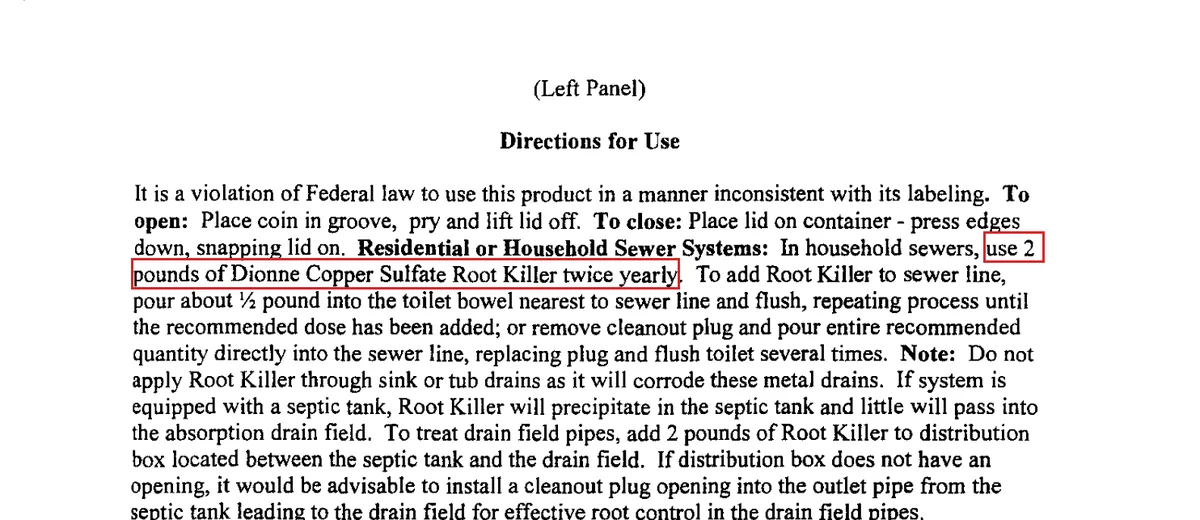
Copper sulfate root killer is not a lawn product. The EPA-accepted label for one, EPA Reg. No. 34797-39, directs 2 pounds twice a year into household sewer lines or a septic distribution box, and says use inconsistent with the labeling violates federal law (EPA label, July 2004).
This page is general information, not pesticide or arborist advice. The label is the law: read the whole label of any product you buy. Before cutting roots of a street tree, check with your city, which may own or regulate it.
How we compiled this
On Nov. 24, 2026 we read 8 extension publications (Purdue FNR-585-W, WSU C137, Iowa State, UW-Madison, Kentucky, Penn State, NC State and UGA), the Morton Arboretum’s root page, 2 peer-reviewed pulling studies by E. Thomas Smiley (2008, 2014; abstracts), a Bartlett Tree Research Laboratories technical report, ISA’s Trees and Turf brochure (2021), the Pacific Northwest ISA chapter’s tree-protection guide, Davey Tree’s published rules and 1 EPA-accepted copper sulfate label. Distances and areas in the calculator and tables are our arithmetic from those rules. We did no field work or testing.
Frequently asked questions
What kills tree roots without killing grass?
For a living tree, nothing you should use: UGA Extension warns that herbicide sprayed on root sprouts can travel into the whole tree. For a tree already cut down, treat the fresh stump within about 5 minutes of cutting and mow the sprouts; a copper sulfate root killer is labeled for sewer lines, not lawns.
Can you grind down exposed tree roots without killing a tree?
Not reliably. Purdue calls it one of the worst decisions for tree care, and in Smiley’s tests cutting half the buttress roots of young oaks cut pull resistance by 30 percent. If a root must go, keep cuts 5 to 6 trunk diameters out (Bartlett) and the root under 2 inches (Davey Tree).
Is it okay to cover exposed tree roots with dirt?
A thin layer, yes: about 0.5 inch (UW-Madison, Kentucky) to under 2 inches (Purdue, Penn State). Iowa State says 4 inches or more may damage or destroy the tree. Expect to repeat it as roots thicken.
Can a tree survive with exposed roots?
Yes. Kentucky Extension says surface roots are not a sign the tree is failing (UKY, 2025). The risk is wounds: mower and trimmer damage invites decay and root suckers, so cover them with 2 to 3 inches of mulch.
What to do with a yard full of tree roots?
Replace turf with a mulch bed out to the dripline, 2 to 3 inches deep (Purdue), and join the beds of neighboring trees so mowers stay off the roots (NC State). Plant shade groundcovers by hand in small pockets.
Sources
- Purdue University Extension (Purcell), Surface Root Syndrome, FNR-585-W, Jan. 2020. Accessed November 2026.
- Washington State University Extension, Spokane County, C137 Tree Surface Roots, Revised 2021, format updated 2024. Accessed November 2026.
- Iowa State University Extension and Outreach, Can I cover large surface roots around my shade tree?, Updated Aug. 29, 2024. Accessed November 2026.
- University of Wisconsin-Madison Extension (Alfuth), How to Deal with Surface Tree Roots, Current page. Accessed November 2026.
- University of Kentucky Extension (Durham), Tree surface roots: why they happen and what to do, Sept. 11, 2025. Accessed November 2026.
- Penn State Extension, Underplanting Trees: Respect the Roots, Current page. Accessed November 2026.
- N.C. Cooperative Extension, Henderson County, Tree Health Alert: Mowers and Tree Roots, Sept. 28, 2023. Accessed November 2026.
- University of Georgia Extension (Pugliese), Prevent root suckers by keeping mowers, trimmers away from trees, July 6, 2015. Accessed November 2026.
- The Morton Arboretum, Tree Root Problems, Current page. Accessed November 2026.
- Bartlett Tree Research Laboratories (Fite and Smiley), Root Pruning, technical report, Undated technical report. Accessed November 2026.
- Bartlett Tree Experts, Addressing tree surface roots, Current page. Accessed November 2026.
- Smiley, Arboriculture & Urban Forestry 34(2), Root Pruning and Stability of Young Willow Oak, March 2008. Accessed November 2026.
- Smiley, Holmes and Fraedrich, Arboriculture & Urban Forestry 40(4), Pruning of Buttress Roots and Stability Changes of Red Maple (Acer rubrum), July 2014. Accessed November 2026.
- Pacific Northwest Chapter, ISA, Protecting Trees from Damage, Current page. Accessed November 2026.
- International Society of Arboriculture, Trees and Turf (TreesAreGood brochure), v02.2021. Accessed November 2026.
- The Davey Tree Expert Company, Removing Tree Roots Above Ground: Will It Harm or Kill the Tree?, Sept. 29, 2021. Accessed November 2026.
- U.S. EPA (Dionne Products / Qualis), Copper Sulfate Root Killer master label, EPA Reg. No. 34797-39, Accepted July 12, 2004. Accessed November 2026.