Soaker hose vs drip irrigation: drip waters evenly, soaker hose waters cheaply. Pressure-compensating drip emitters vary 2 to 8 percent in lab tests and run 155 to 596 feet; soaker hose studies report 9 to 35 percent variation, with runs capped near 100 feet.
Most soaker hose vs drip irrigation comparisons, including the ones published by Rain Bird and Orbit, say soaker hose waters unevenly without putting a number on it. This page does. Cal Poly’s Irrigation Training and Research Center lab-tested 28 pressure-compensating emitter models, and porous-pipe studies reviewed by Salisu and colleagues at Universiti Putra Malaysia (2021) measured soaker hose flow along the line. We set those side by side, then turned each product’s published flow into minutes per inch of water.
The short version for a home bed: soaker hose costs about half as much per 100 feet and needs no emitters, but it only waters evenly on level ground, at 10 to 25 psi, in runs of 100 feet or less. Drip costs more and needs a filter, and in exchange it holds its flow on slopes and over runs several times longer. Building a drip zone, from the faucet parts to the bucket test, is covered step by step in our drip irrigation setup guide; this page is the choice before that.
Soaker hose vs drip irrigation, spec by spec
Every row below comes from a maker’s spec sheet, a design guide or a lab study, read November 16, 2026. Where makers disagree, both numbers are shown, because the spread is the finding.
| Spec | Soaker hose | Drip, pressure-compensating |
|---|---|---|
| How water leaves | Seeps through pores along the whole wall (Iowa State) | Metered emitters at fixed spacing, 12 or 18 in. on Rain Bird XFD, or punched in where plants sit (Rain Bird XF guide) |
| Flow per 100 ft | 50 to 100 GPH, Swan SoakerPRO on level ground (Swan); 58 GPH at 30 psi (A.M. Leonard); 142 GPH at 25 psi (Eaton Brothers) | 40 GPH (XFD 0.6 GPH every 18 in.) to 90 GPH (XFD 0.9 GPH every 12 in.); 100 GPH (DIG Earthline 1 GPH) |
| Response to pressure | Discharge exponent 1.07 to 1.67: flow rises faster than pressure (Amin et al., 1998, via Salisu) | Fixed 0.6 or 0.9 GPH per emitter from 8.5 to 60 psi (Rain Bird XFD) |
| Flow variation (coefficient of variation) | 9 to 15% (Yoder and Mote); 20 to 35% (Teeluck and Sutton) | 1.8 to 2.3% Netafim Techline CV; 7.0 to 7.9% Toro Drip In PC (Cal Poly ITRC) |
| Longest single run | 100 ft (Saving Water Partnership); 150 ft for Eaton 1/2 in. | 155 to 596 ft for XFD by flow, spacing and psi; 232 to 335 ft for DIG 1 GPH at 12 in. |
| Operating pressure | 10 or 12 psi regulator (Saving Water); 10 to 25 psi (Mr. Drip) | 8.5 to 60 psi (XFD); 10 to 45 psi, 25 recommended (DIG); 14.5 to 58 psi (Netafim Techline CV) |
| Filter | None listed on the Swan or Eaton pages; flush at install and a few times a season (Saving Water) | 120 mesh (XFD, Techline CV); 150 mesh (DIG; Rain Bird Xeri-Bug 1 and 2 GPH) |
| Slope | Level ground; Eaton: no more than 2 ft of rise per 100 ft | Pressure compensation holds flow while inlet pressure stays in range |
| Burial | Not in soil; under 2 to 3 in. of mulch (Saving Water) | Subsurface lines with copper root barrier (Rain Bird XFS-CV) or a 15-year root-intrusion warranty (Netafim Techline HCVXR) |
| Warranty | 7 years, Swan SoakerPRO | 7 years, 10 for stress cracking, Netafim driplines |
| Price per 100 ft, Nov. 16, 2026 | $29.20 to $38.89 rubber; $122.95 for a 1 in. pro hose | $60.99 XFD 0.9 GPH; $66.99 blank tubing plus 50 Xeri-Bugs |
How evenly does each one water?
Drip emitters are built to a flow tolerance, and an independent lab has checked it. In Cal Poly ITRC’s tests of 30 emitters per model, Netafim Techline CV dripline varied 1.8 to 2.3 percent and Rain Bird’s AG A5 emitter 2.0 to 4.0 percent; the report found most 0.5 GPH emitters, regardless of maker, under 3 percent. Toro Drip In PC was the loosest dripline tested, at 7.0 to 7.9 percent, against the under 5 percent Toro’s own design manual lists for it.
Soaker hose has no emitter to tolerance. The porous-pipe studies Salisu and colleagues review put the variation at 9 to 15 percent between production lots (Yoder and Mote, 1995) and 20 to 35 percent along 6 m lines at 10 to 20 kPa, about 1.5 to 3 psi (Teeluck and Sutton, 1998). Makavana and colleagues (2018) measured 6.57 to 25.49 percent flow variation on 30 to 60 m lines, rising with pressure.
| Product or study | Lowest reported | Highest reported | Measured by |
|---|---|---|---|
| Netafim Techline CV dripline | 1.8% | 2.3% | Cal Poly ITRC lab test, 30 emitters |
| Netafim Techline 560 dripline | 2.2% | 2.6% | Cal Poly ITRC lab test, 30 emitters |
| Rain Bird AG A5 emitter | 2% | 4% | Cal Poly ITRC lab test, 30 emitters |
| Toro Drip In PC dripline | 7% | 7.9% | Cal Poly ITRC lab test, 30 emitters |
| Porous pipe lots (Yoder and Mote, 1995) | 9% | 15% | as reviewed by Salisu et al., 2021 |
| Porous pipe 30 to 60 m (Makavana et al., 2018) | 6.57% | 25.49% | flow variation, as reviewed by Salisu et al., 2021 |
| Porous pipe 6 m, 10 to 20 kPa (Teeluck and Sutton, 1998) | 20% | 35% | as reviewed by Salisu et al., 2021 |
The hose material is not the whole problem. When Salisu’s team cut a 16 mm soaker hose into 10 cm pieces, the pieces varied only 0.92 to 5.82 percent. Unevenness builds with length and pressure: the same pieces passed 8.5 to 11.2 times more water at 3.0 bar (about 44 psi) than at 0.5 bar (about 7 psi). A 6-fold rise in pressure gave a 9-fold rise in flow, which is why soaker makers ship a flow restrictor (Swan) or require a regulator (Eaton) and why the end nearest the faucet gets the most water.
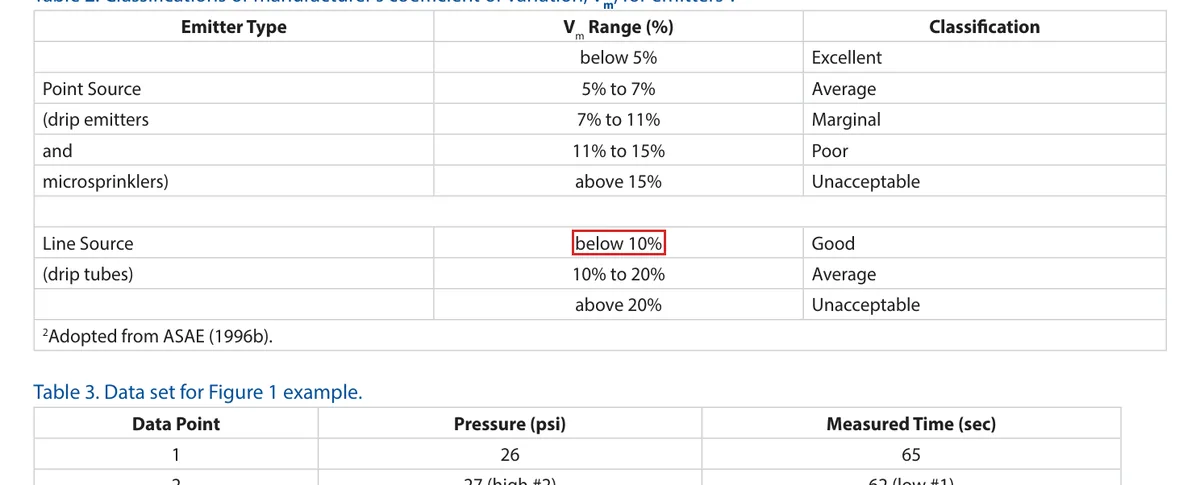
UF/IFAS bulletin AE094 turns variation into a grade: statistical uniformity equals 100 times (1 minus the coefficient of variation). Applied to a whole bed, a 2 percent CV grades 98 percent, which AE094 calls excellent (above 90). A 25 percent CV grades 75, fair, and the 35 percent Teeluck and Sutton recorded grades 65, poor. For drip tubes AE094 reprints the ASAE scale: under 10 percent good, 10 to 20 average, over 20 unacceptable.
How far can one line run, and on what slope?
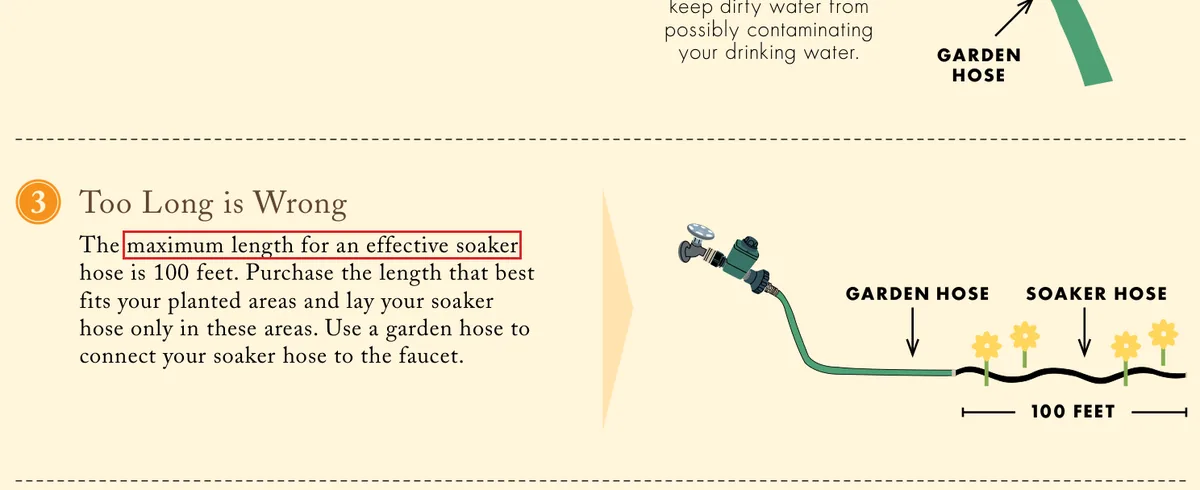
Drip makers publish a run-length table for each product; soaker makers publish one number. Seattle’s Saving Water Partnership fact sheet sets 100 feet as the maximum for an effective soaker hose and tells gardeners to join level beds with solid hose so the total soaker line stays under that. Eaton Brothers rates its 1/2-inch bulk hose to 150 feet a run and 500 feet per water supply.
| Type | Product or publisher | Longest single run | Condition | Source |
|---|---|---|---|---|
| Soaker | Saving Water Partnership fact sheet (Seattle Public Utilities) | 100 ft | Any soaker hose, 10 or 12 psi regulator | SWP fact sheet |
| Soaker | Saving Water Partnership web page | 200 ft | Same partnership, web text | savingwater.org |
| Soaker | Eaton Brothers 1/2 in. bulk hose | 150 ft | 25 psi; 500 ft max per supply | Eaton Brothers |
| Soaker | Orbit blog | 15 to 25 ft “optimal,” 100 ft max | No test or source given | Orbit |
| Drip | Rain Bird XFD, 0.9 GPH every 12 in. | 155 to 290 ft | 15 to 60 psi | Rain Bird XF guide, Table 9 |
| Drip | Rain Bird XFD, 0.6 GPH every 18 in. | 314 to 596 ft | 15 to 60 psi | Rain Bird XF guide, Table 9 |
| Drip | Toro Drip In PC, 0.53 GPH every 12 in. | 360 to 460 ft | 25 to 40 psi | Toro dripline design manual |
| Drip | DIG Earthline Brown PC, 1 GPH every 12 in. | 232 to 335 ft | 25 to 45 psi | DIG |
Two of those soaker numbers conflict. The Saving Water Partnership’s own fact sheet says 100 feet while its web page says lengths “up to 200 feet” work, and Orbit’s 15 to 25 foot “optimal” run comes with no test behind it. We use the 100-foot fact sheet figure, which a second utility, the Whatcom Water Alliance, reprints unchanged.
Slope is where the exponent bites. Water loses 0.433 psi for every foot it climbs, so Eaton’s limit of 2 feet of rise per 100 feet costs 0.87 psi, about 9 percent of a 10 psi soaker inlet. With flow rising at least as fast as pressure, the uphill end gets at least 9 percent less water before any friction loss. The same 2 feet is under 2 percent of a dripline zone run at 50 psi, inside the 8.5 to 60 psi band where XFD emitters hold their rated flow.
How much water per hour, and how long to put down 1 inch?
Per hour, the two overlap: published soaker ratings run 50 to 142 GPH per 100 feet and the dripline in our table 28 to 100 GPH. The water saved by drip comes from evenness and placement, not from a lower flow. To turn flow into run time, divide 37.4 by the gallons per foot per hour, then multiply by the spacing between parallel lines in feet, since 1 inch on 1 sq ft is 0.623 gallons.
| Line | Gal per ft per hour | GPH per 100 ft | Rated at | Minutes for 1 in. at 18 in. spacing |
|---|---|---|---|---|
| Eaton Brothers 1/2 in. bulk soaker hose | 1.42 | 142 | at 25 psi | 40 |
| Swan Element SoakerPRO 3/8 in., upper rating | 1 | 100 | level ground | 56 |
| Swan Element SoakerPRO 3/8 in., lower rating | 0.5 | 50 | level ground | 112 |
| A.M. Leonard Professional Series 1 in. soaker hose | 0.58 | 58 | at 30 psi | 97 |
| DIG Earthline Brown PC dripline, 1 GPH every 12 in. | 1 | 100 | 10 to 45 psi | 56 |
| Rain Bird XFD dripline, 0.9 GPH every 12 in. | 0.9 | 90 | 8.5 to 60 psi | 62 |
| Rain Bird XFD dripline, 0.6 GPH every 12 in. | 0.6 | 60 | 8.5 to 60 psi | 94 |
| Rain Bird XFD dripline, 0.6 GPH every 18 in. | 0.4 | 40 | 8.5 to 60 psi | 140 |
| Netafim Techline CV, 0.4 GPH every 18 in. | 0.282 | 28.2 | 14.5 to 58 psi | 199 |
Line spacing moves run time as much as product choice. Saving Water lays soaker lines 12 to 18 inches apart on sandy soil and 18 to 24 inches on loam or clay, so the same Swan hose at 1.0 gal/ft/hr needs 37 minutes per inch in sand at 12 inches and 75 on clay at 24 inches. Clay takes water in slowly, so split a long clay run into two or three cycles and see our guide to improving clay soil for the structure side; a loam bed sits in the 18 to 24 inch band. The calculator does the arithmetic for any line below.
- Minutes
- 56
- Hours
- 0.9
Default: 1 inch through Swan SoakerPRO at 1.0 gal per ft per hour with lines 18 in. apart = 56 minutes. Run time = inches x 37.4 x spacing (ft) / gal per ft per hour; 1 inch on 1 sq ft is 0.623 gallons. Soaker ratings hold only at the stated pressure on level ground; confirm with a dig test after the first run.
Soaker ratings are conditional: Swan’s 0.5 to 1 gallon applies on level ground behind its built-in restrictor, and A.M. Leonard’s 0.58 gallon at 30 psi. Iowa State’s check works for either system: after the first long soak, dig and confirm water reached 10 to 12 inches, then set the timer to that run (Iowa State Extension).
What does each cost per 100 feet?
| Type | Product | Posted price | Per 100 ft |
|---|---|---|---|
| Soaker | Swan Element SoakerPRO, 3/8 in. x 75 ft | $27.99 | $37.32 |
| Soaker | Swan Element SoakerPRO bulk reel, 3/8 in. x 250 ft | $72.99 | $29.20 |
| Soaker | Mr. Drip #250 bulk soaker hose, 1/2 in. x 100 ft | $30.99 | $30.99 |
| Soaker | Eaton Brothers bulk soaker hose, 1/2 in. x 100 ft (listed sale price; out of stock online) | $38.89 | $38.89 |
| Soaker | A.M. Leonard Professional Series, 1 in. x 100 ft | $122.95 | $122.95 |
| Drip | Rain Bird XFD0912100 dripline, 0.9 GPH every 12 in., 100 ft | $60.99 | $60.99 |
| Drip | Rain Bird T63-100 blank 1/2 in. tubing ($17.49) plus 50 Xeri-Bug XB10PC 1 GPH emitters at $0.99 | $66.99 | $66.99 |
Rubber soaker hose ran $29.20 to $38.89 per 100 feet; pressure-compensating dripline or tubing with PC emitters ran $60.99 to $66.99. Add the parts each needs at Mr. Drip’s prices: a 100-foot soaker run plus a $9.95 25 psi regulator is $40.94, and 100 feet of XFD plus that regulator and an $8.95 200-mesh filter is $79.89, a $38.95 gap before the backflow device both need. Installed prices for a contractor-built drip zone are in our sprinkler system installation cost guide.
Warranty terms are close on paper: Swan backs SoakerPRO for 7 years, and Netafim backs its driplines for 7 years against defects and 10 against environmental stress cracking. Both come with care conditions: Saving Water and Iowa State keep soaker hose under mulch to block sun damage, and Rain Bird requires 120-mesh filtration ahead of XFD dripline.
That filter is the first defense, and if the emitters plug anyway, our guide to clogged drip emitters matches each clog type to its fix.
Which one fits your bed?
Answer the four questions in order; the first yes decides it. Soaker hose is the default only when every answer is no. Iowa State’s caution applies to soaker hose in any bed: it wets the soil between plants, which feeds weeds, so a mulched bed with a preemergent plan, as in our flower bed weed control guide, pairs better with it.
1Does the line climb more than 2 feet per 100 feet, or run longer than 100 feet?
YesPressure-compensating dripline: Rain Bird XFD holds 0.6 or 0.9 GPH from 8.5 to 60 psi over 155 to 596 ft.
NoGo to the next question
2Do plants in the bed need different amounts of water?
YesDrip emitters sized per plant, such as 0.5, 1 or 2 GPH Xeri-Bugs on 1/2-inch tubing.
NoGo to the next question
3Will the line be buried in soil rather than laid under mulch?
YesSubsurface dripline with root protection (Rain Bird XFS-CV, Netafim Techline HCVXR); Saving Water says not to bury soaker hose.
NoGo to the next question
4Is it a vegetable bed and the soaker hose recycled rubber?
YesSaving Water flags recycled-rubber hose for food crops: check for a drinking-water-safe, lead-free statement (Swan lists one) or use dripline.
NoSoaker hose: level bed, runs of 100 ft or less, a 10 or 12 psi regulator and 2 to 3 inches of mulch; $29.20 to $38.89 per 100 ft in November 2026.
Source: Saving Water Partnership; Rain Bird XF guide; Eaton Brothers; Iowa State Extension
Two cases fit neither. Lawns stay on sprinklers; Saving Water says so for soaker hose, and our guide to the best time to water a lawn covers the inches and hours. Trees need water out to the drip line, so a soaker ring or emitters should sit under the mulch ring sized in our tree mulching guide, not against the trunk; Colorado State starts a new 1-inch caliper tree on three 2 GPH emitters (CSU fact sheet 4.702).
Why lawns stay on sprinklers comes down to rate and evenness: audited home spray zones in Utah averaged 1.4 inches an hour and 52 percent uniformity, and our drip irrigation vs sprinkler comparison sets those numbers against buried dripline for turf.
Mulch depth matters for both lines. Saving Water puts 2 to 3 inches over soaker hose; past about 4 inches, trial data show thick layers keeping irrigation out of the soil, as our guide to how deep mulch should be shows from the trial data.
How we compiled this
We read 9 technical documents and 10 product or retailer pages on Nov. 16, 2026: the Rain Bird XF, Netafim Techline and Toro dripline design guides, Rain Bird’s Xeri-Bug sheet, Cal Poly ITRC’s emitter test report, UF/IFAS bulletin AE094, the Salisu et al. (2021) porous-pipe paper and its literature review, the Saving Water Partnership fact sheet, and Iowa State and Colorado State extension pages. Prices are posted online prices from 5 sellers. We did not test any hose or dripline; run times are arithmetic from published flow ratings, and porous-pipe figures cited through Salisu were not re-read in the original papers, two of which sit behind paywalls.
Frequently asked questions
Should I do soaker hose or drip irrigation?
Drip, if the bed slopes more than 2 feet per 100, runs past 100 feet, or holds plants with different water needs. Soaker hose for a level bed under 100 feet where cost matters most: about $29.20 to $38.89 per 100 feet in November 2026 against $60.99 for Rain Bird XFD dripline.
What is the 30/30 rule for drip irrigation?
The name usually refers to the 1/4-inch tubing limit: no run longer than 30 feet and no more than 30 gallons per hour through it. Drip Depot lists 1/2-inch tubing at 200 feet and 200 GPH. It does not apply to soaker hose.
What are the downsides of using soaker hoses for irrigation?
Uneven output: reviewed studies put soaker flow variation at 9 to 35 percent, against about 2 percent for good drip emitters. Makers cap runs near 100 feet on level ground, flow climbs with pressure so a regulator is needed, and the hose wets the gaps between plants, which Iowa State notes feeds weeds.
Should I bury my soaker hose in the ground?
No. The Saving Water Partnership says to cover soaker hose with 2 to 3 inches of mulch and not bury it in soil, and Rain Bird says burying soaker hose often leads to root penetration and leaks. Buried lines should be dripline built for it, such as Rain Bird XFS-CV with copper root protection.
How much water does a soaker hose put out in 1 hour?
About 0.5 to 1 gallon per foot on level ground for Swan SoakerPRO, so 25 to 50 gallons from a 50-foot hose. A.M. Leonard rates its 1-inch hose at 0.58 gallon per foot at 30 psi, and Eaton Brothers its 1/2-inch hose at 142 gallons per 100 feet at 25 psi.
Sources
- Cal Poly Irrigation Training and Research Center (C. M. Burt, K. Feist), Pressure Compensating Emitter Characteristics (Irrigation Association technical paper), 2013. Accessed November 2026.
- A. Salisu, A. Wayayok, A. F. Abdallah, R. M. Kamal, Universiti Putra Malaysia, Discharge Characterization and Variability Determination along Shorter Sections of Soaker Hose Pipe, Basrah J. Agric. Sci. 34 (Special Issue 1): 92 to 99, 2021. Accessed November 2026.
- UF/IFAS Extension (A. G. Smajstrla and others), Field Evaluation of Microirrigation Water Application Uniformity (BUL265, AE094), reviewed December 2024. Accessed November 2026.
- Saving Water Partnership, Seattle Public Utilities, Soaker Hoses fact sheet, 2005. Accessed November 2026.
- Saving Water Partnership, Drip Irrigation and Soaker Hoses, undated web page. Accessed November 2026.
- Rain Bird Corporation, XF Series Dripline Design, Installation and Maintenance Guide, 2020. Accessed November 2026.
- Rain Bird Corporation, XFD0912100 XFD Dripline product page, price read Nov. 16, 2026. Accessed November 2026.
- Rain Bird Corporation, Xeri-Bug Emitters XB, XBCV and XBT technical specifications, undated. Accessed November 2026.
- Rain Bird Corporation, Store search results for XB10PC Xeri-Bug emitters, price read Nov. 16, 2026. Accessed November 2026.
- Rain Bird Corporation, Drip Irrigation vs. Soaker Hoses (blog), undated. Accessed November 2026.
- Netafim USA, Techline HCVXR and CV Design Guide, undated. Accessed November 2026.
- Netafim USA, Landscape and Turf warranty information, January 1, 2019. Accessed November 2026.
- The Toro Company, Landscape Dripline Design manual, undated. Accessed November 2026.
- DIG Corporation, Earthline Brown PC Dripline specifications, undated. Accessed November 2026.
- Swan Products, Element SoakerPRO Soaker Hose product page, price read Nov. 16, 2026. Accessed November 2026.
- A.M. Leonard, Soaker Hose, 1 in. x 100 ft, Professional Series, price read Nov. 16, 2026. Accessed November 2026.
- Eaton Brothers, 1/2 Inch x 100 Feet Bulk Soaker Hose, price read Nov. 16, 2026. Accessed November 2026.
- Mr. Drip, #250 .700 OD x 100 ft Bulk Soaker Hose (with regulator and filter prices), prices read Nov. 16, 2026. Accessed November 2026.
- Mr. Drip, Soaker Hose FAQ, undated. Accessed November 2026.
- Drip Depot, Poly Tubing Buying Guide, modified March 24, 2026. Accessed November 2026.
- Iowa State University Extension and Outreach, Using Drip Irrigation in the Garden, undated. Accessed November 2026.
- Colorado State University Extension, Drip Irrigation for Home Gardens, fact sheet 4.702, reviewed August 2025. Accessed November 2026.
- Orbit Irrigation, Drip Irrigation vs Soaker Hose (blog), November 20, 2025. Accessed November 2026.