A sprinkler head not popping up is either a one-head fault (clogged screen, buried cap, grit in the seal) or low pressure, since spray heads need 15 to 25 psi. Count the failing heads: one, the zone’s far end, one zone or every zone.
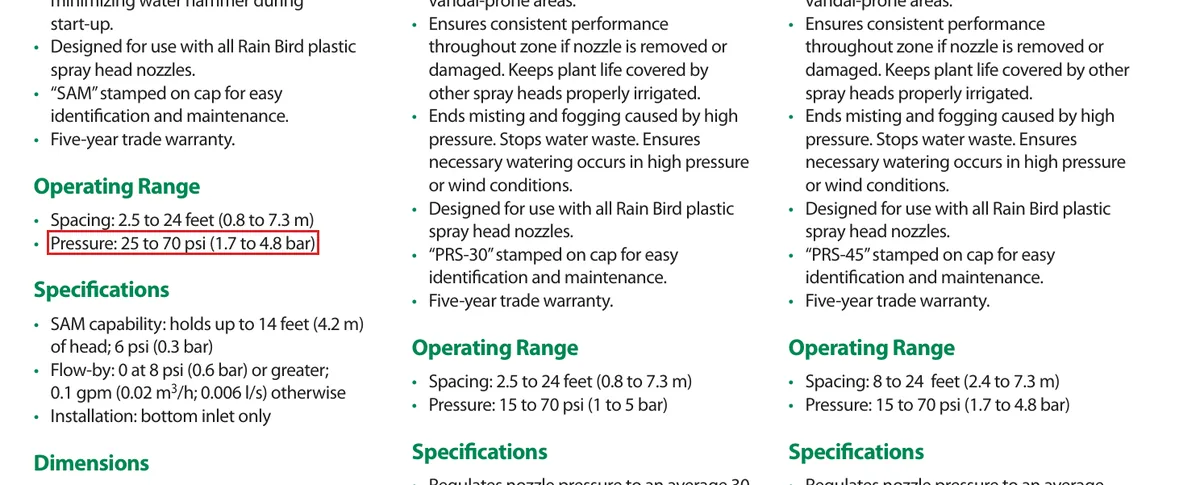
A sprinkler head not popping up gets fixed fastest by counting how many heads fail before you dig. The stem of a pop-up head rises only when water pressure under it beats a stainless steel retract spring, and the makers print how much pressure that takes: Rain Bird rates its 1800 spray body from 15 psi but its 1800 SAM check-valve version from 25 psi (Rain Bird 1800 tech spec), and its 5000 rotor from 25 psi (Rain Bird 5000 tech spec).
None of the top-ranking repair pages puts those numbers next to the symptoms. Below, the causes are sorted by scope, with the published pressure range for 9 common heads, nozzle flows from Rain Bird’s charts, and part prices from Sprinkler Warehouse checked Nov. 21, 2026. Two causes that the top-ranking text pages we read do not mention are in the head itself: a check-valve body that needs 10 psi more than the standard body, and the flow shut-off on top of a Rain Bird 5000 Plus rotor.
How many heads are staying down?
Run the zone from the controller, walk it, and count. The pattern tells you where to work before you touch a tool, and it keeps you from replacing a $1.75 head when the fault is a half-closed ball valve at the backflow. Use the table, then the decision flow below it.
| What you see | Most likely causes | First test | Typical fix |
|---|---|---|---|
| 1 head stays down; its neighbors rise | Clogged filter screen or nozzle, grass or soil over the cap, grit in the wiper seal, broken riser, a rotor’s flow shut-off turned off | Pull the stem up by hand with the zone off; look at the screen | Clean or replace screen and nozzle, dig the head to grade, replace the head ($1.75 to $14.99 part) |
| Heads at the far end of the zone rise partway or not at all | Zone asks for more gpm than the pipe delivers, a lateral leak, valve flow control turned down | Add up nozzle gpm; look for soggy soil or a geyser | Fix the leak, open the flow control, or split the zone |
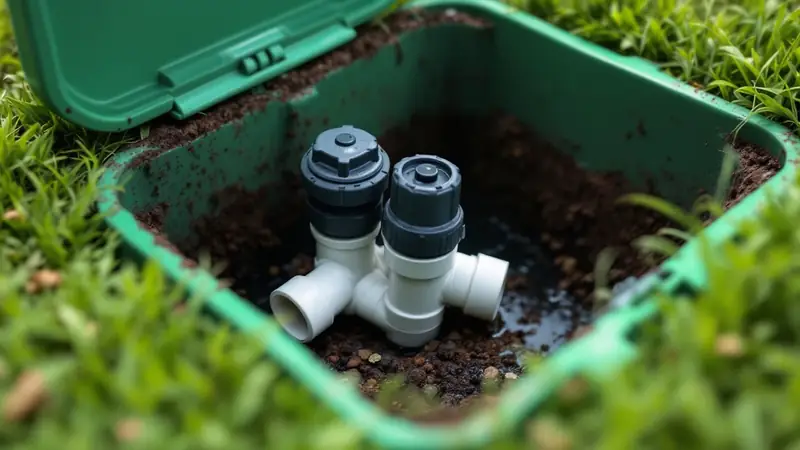
| No head in one zone rises; other zones work | Valve not opening, flow control screwed all the way down, broken wire, broken pipe | Open the valve’s bleed screw or turn the solenoid 1/4 turn | Repair wire or controller, open the flow control, clean the valve |
| No head in any zone rises | Irrigation shutoff or backflow ball valve closed or half closed, controller off or in rain delay, rain sensor tripped | Check handles: in line with the pipe means open | Open the valves fully; reset the controller or sensor |
1Does no head in any zone rise when you run a zone from the controller?
YesSupply side. Open the irrigation shutoff and both backflow ball valves fully (handle in line with the pipe), then check for a rain delay or a tripped rain sensor.
NoGo to the next question
2Does every head in one zone stay down while other zones work?
YesValve side. Open the bleed screw or turn the solenoid 1/4 turn. Heads rise: check the controller and wire. Still down: turn the flow control counterclockwise and look for a broken lateral.
NoGo to the next question
3Do only the heads farthest from the valve stay down or rise partway?
YesPressure and flow. Add up nozzle gpm against what the zone delivers; at 15 psi a Rain Bird 15H passes 1.30 gpm instead of 1.85. Fix leaks, open the flow control or split the zone.
NoGo to the next question
4Is it a Rain Bird 5000 Plus rotor with its flow shut-off set to off?
YesTurn the shut-off on at the top of the rotor.
NoGo to the next question
5Does water gush around the stem of the one head that stays low?
YesGrit in the wiper seal or a broken riser. Step on the running stem to flush it (Rain Bird); replace the seal, internals or head if it continues.
NoClogged screen, buried cap or a check-valve head. Pull the stem up, rinse the screen and nozzle with water, dig the head back to grade, and on SAM heads confirm the zone reaches 25 psi.
Source: Rain Bird Irrigation Troubleshooting Guide, Rain Bird 1800 and 5000 tech specs, Hunter support
If every zone is dead, start at the supply rather than the heads: our guide to turning a sprinkler system back on in spring gives the backflow valve order, and a tripped sensor is covered in how a rain sensor shuts off watering. If one whole zone is dead and you cannot find its valve, use the click test in our guide on finding a buried sprinkler valve box.
One head won’t pop up: the 6 causes at the head
When the neighbors rise and one head does not, the fault is almost always within 12 inches of it. Work through the checks below in order: the first 3 cost nothing, and Rain Bird says every 1800 component lifts out from the top without special tools (Rain Bird 1800 tech spec, p. 1).
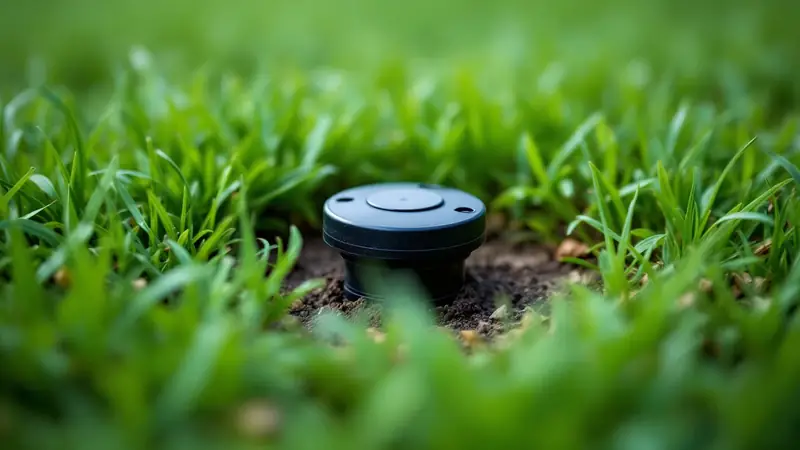
- Clear the cap. Pull grass, thatch and soil off the top of the head. CSU Extension lists heads “buried by surrounding grass or other plant growth” as a routine check and says to raise them to grade on their swing pipe or a threaded riser (CSU 7.239).
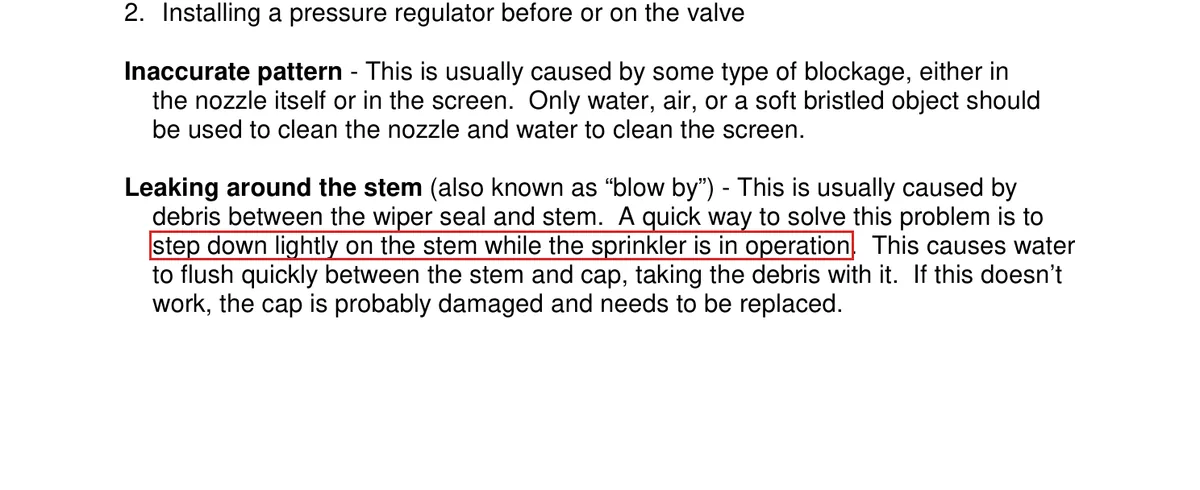
- Flush the stem. With the zone running, step lightly on the stem and let it rise again. Rain Bird’s troubleshooting guide gives this move for grit between the wiper seal and stem, the cause of water leaking around the stem (Rain Bird TSG, p. 2).
- Clean the screen and nozzle. Zone off, pull the stem up (Rain Bird’s PTC-1 pull-up tool holds it, $16.03 on Nov. 21, 2026), unscrew the nozzle and lift out the filter screen. Rain Bird says to clean the nozzle only with water, air or a soft bristle and the screen with water (Rain Bird TSG, p. 2).
- Check a rotor’s shut-off. A Rain Bird 5000 Plus rotor can be turned on or off at the head; a head someone shut off while flushing or nozzling stays down. Turn it back on.
- Look for a broken riser or worn seal. Water gushing from the cap with the stem low means flow is escaping before it can lift the stem. Hunter’s fix for older rotors is a new riser seal and spring seat (Hunter); a cracked spray stem means a new internal assembly or body.
- Check for a check-valve body. Heads marked SAM on the cap hold up to 14 ft of water in the pipe and use a stronger retract spring, and Rain Bird rates them from 25 psi, not 15. A SAM head at the high end of a weak zone can be the only one that stays down.
| Symptom at the one head | Likely cause | Test | Fix | Part price, Nov. 21, 2026 | Source |
|---|---|---|---|---|---|
| Cap flush, lawn grown over it | Grass, thatch or soil holds the stem down | Stem lifts freely by hand | Clear it; raise the head to grade on its swing pipe | $0 | CSU 7.239 |
| Stem rises an inch, water gushes at the cap | Grit in the wiper seal (“blow by”) | Step on the running stem | Flush; replace the cap or head if it persists | $0; 1804 body $1.75 | Rain Bird TSG, p. 2 |
| Stem rises, weak or no spray | Clogged filter screen or nozzle | Remove nozzle and screen | Rinse with water; replace nozzle | 15H nozzle $1.17 | Rain Bird TSG, p. 2 |
| Rotor stays down, nothing at the cap | 5000 Plus flow shut-off turned off | Look at the shut-off on top | Turn it on | $0 | Rain Bird 5000 spec, p. 2 |
| Older rotor rises partway, water at the cap | Worn riser seal (flow-by) | Water around the riser at start-up | New seal and spring seat, or new rotor | PGP Ultra $14.99 | Hunter support |
| SAM head stays down, others rise | Check valve and stronger spring need 25 psi | SAM on the cap | Raise zone pressure or fit a standard body | 1804 $1.75 | Rain Bird 1800 spec, p. 2 |
| Stem cracked, nozzle missing | Mower or vehicle damage | Visible | Replace the body; flush the riser first | Pro-Spray 4 in $2.49 | Rain Bird |
| Rotor rises but does not turn | Debris in the rotor filter or a failed gear drive | Remove nozzle, check the filter | Clean the filter; replace the rotor if it still stalls | 5004-PLPC $12.75 | Hunter SRM page |
Height matters as much as debris. CSU notes that short-rise heads which do not clear the grass blades keep owners from mowing at the recommended 3 inches (CSU 7.239); a 2 in pop-up such as the Rain Bird 1802 sits under turf kept at the 2.5 to 3.5 inches used for tall fescue mowing heights. When you replace one, a 4 in body (1804) or 6 in body (1806) clears it.
Why do the heads at the end of the zone stay down?
Partly risen heads at the far end of a zone are a pressure problem. Each nozzle passes a set flow at a set pressure, and when the zone asks for more gallons per minute than the valve and pipe deliver, pressure falls until the last heads cannot beat the spring. Rain Bird’s 1800 seals with zero flow-by only at 8 psi or more, and leaks 0.1 gpm around the stem below that (Rain Bird 1800 page).
| Head | Type | Published pressure range | Pop-up heights | What it means for a head that stays down | Source |
|---|---|---|---|---|---|
| Rain Bird 1800 | Spray body | 15 to 70 psi | 2, 3, 4, 6, 12 in | Zero flow-by at 8 psi or more | Rain Bird 1800 tech spec |
| Rain Bird 1800 PRS | Spray body, 30 psi regulator | 15 to 70 psi | 4, 6, 12 in | Restricts water loss by up to 70% if a nozzle is removed or damaged | Rain Bird 1800 tech spec |
| Rain Bird 1800 SAM, SAM-PRS, SAM-P45 | Spray body with check valve | 25 to 70 psi | 4, 6, 12 in | Needs 10 psi more than the standard body; holds 14 ft of head | Rain Bird 1800 tech spec, pp. 2 to 3 |
| Hunter Pro-Spray | Spray body | 15 to 100 psi | 2, 3, 4, 6, 12 in | PRS30 and PRS40 versions regulate at 30 and 40 psi | Hunter Pro-Spray page |
| Toro 570Z | Spray body | 20 to 50 psi recommended; 75 psi max | 4, 6, 12 in | Highest floor of the 3 spray bodies listed | Toro 570Z instructions |
| Rain Bird 3500 | Small rotor | 25 to 55 psi | See maker page | Rotor floor is 10 psi above a spray body | Rain Bird 3500 page |
| Rain Bird 5000, 5000 Plus | Rotor | 25 to 65 psi | Shrub, 4, 6, 12 in | Plus models have a flow shut-off at the head | Rain Bird 5000 tech spec |
| Hunter PGP Ultra | Rotor | 25 to 70 psi recommended; 20 to 100 operating | Shrub, 4, 6, 12 in | Hunter says its rotors are designed for zero flow-by | Hunter PGP Ultra page |
| Hunter SRM | Small rotor | 30 to 50 psi recommended; 20 to 100 operating | See maker page | Debris in the filter is the most common reason it stops turning | Hunter SRM page |
The arithmetic is simple: add the gpm of every nozzle on the zone and compare it with what the zone can deliver. Rain Bird’s MPR chart lists a 15 ft half-circle nozzle (15H) at 1.85 gpm at 30 psi but 1.30 gpm at 15 psi, and its throw falls from 15 ft to 11 ft (Rain Bird MPR chart). A zone of 8 of them needs 14.8 gpm to run as designed.
| Zone example | Flow per head at design pressure | Flow per head at the bottom of the range | Zone total at design | Zone total at the bottom | Source |
|---|---|---|---|---|---|
| 8 Rain Bird 15H sprays | 1.85 gpm at 30 psi | 1.30 gpm at 15 psi | 14.8 gpm | 10.4 gpm | Rain Bird MPR chart |
| 4 Rain Bird 15F sprays | 3.70 gpm at 30 psi | 2.60 gpm at 15 psi | 14.8 gpm | 10.4 gpm | Rain Bird MPR chart |
| 8 Rain Bird 15Q sprays | 0.92 gpm at 30 psi | 0.65 gpm at 15 psi | 7.4 gpm | 5.2 gpm | Rain Bird MPR chart |
| 5 Rain Bird 5000 rotors, 3.0 nozzle | 3.09 gpm at 45 psi | 2.26 gpm at 25 psi | 15.5 gpm | 11.3 gpm | Rain Bird 5000 tech spec, p. 3 |
Before splitting a zone, check the cheap causes Hunter lists for rotors that do not fully pop: broken zone pipe near new trees, shrub plantings or fence posts, worn riser seals letting water escape at start-up, and a valve diaphragm held partly closed by debris (Hunter). Measuring static and working pressure and the meter’s available gpm is covered in our sibling guide to low water pressure in a sprinkler system; laterals usually sit at the depths in our sprinkler line depth guide, which is where to probe for a leak.
What if no head in the zone pops up?
A whole zone that stays down while its neighbors run means water is not getting past the zone valve, or is escaping right after it. Rain Bird’s guide says to check the obvious first (water on, controller programmed, isolation valves open) and then open the valve’s manual bleed: if the zone runs on the bleed, the controller or wiring is at fault (Rain Bird TSG, p. 9).
- Open the bleed screw on the valve, or turn an internal-bleed solenoid 1/4 turn counterclockwise. Heads rise: the valve works, so test the controller station and wire. Close the bleed when done.
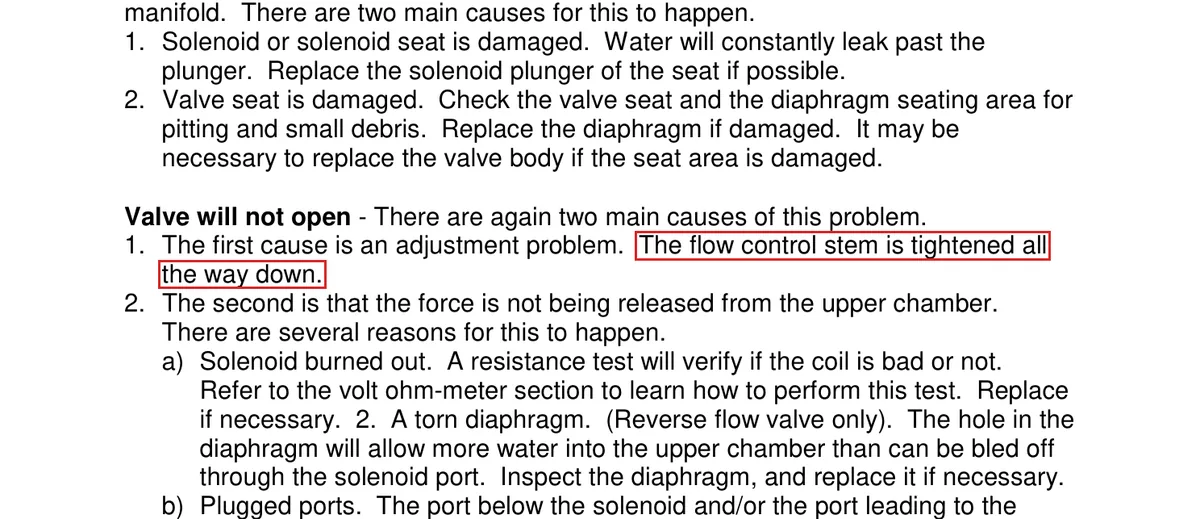
- Heads still down: turn the flow control knob counterclockwise. Rain Bird names a flow control stem tightened all the way down as the first of 2 causes of a valve that will not open (Rain Bird TSG, p. 10).
- Valve opens but heads stay low and the ground is soft or water bubbles up: the lateral is broken. Shut off, dig and repair it before replacing any heads.
- Valve hums but will not open: debris or a damaged diaphragm. Shut off the supply, remove the bonnet and clean it, the same teardown shown in our guide to a sprinkler zone that will not turn off.
Replace the head or just the insides?
Most single-head failures are fixed with parts that cost less than a coffee, and the installed prices on our sprinkler repair cost page show what a visit adds: a median $45 to replace a 4 in spray head and $15 to $65 to raise or straighten one, on top of a median $110 service call. Retail prices below were checked Nov. 21, 2026.
| Part | Model | Price | Use it when | Source |
|---|---|---|---|---|
| 4 in spray body | Rain Bird 1804 | $1.75 | Stem cracked or seal worn | Sprinkler Warehouse |
| 4 in spray body | Hunter Pro-Spray PROS-04 | $2.49 | Same, Hunter zones | Sprinkler Warehouse |
| 15 ft half-circle nozzle | Rain Bird 15H | $1.17 | Nozzle clogged, cracked or chewed | Sprinkler Warehouse |
| 4 in rotor | Rain Bird 5004-PLPC | $12.75 | Rotor will not rise or turn after cleaning | Sprinkler Warehouse |
| 4 in rotor with check valve | Rain Bird 5004-PLPC-SAM | $16.85 | Low head drains the zone; needs 25 psi | Sprinkler Warehouse |
| 4 in rotor | Hunter PGP Ultra PGP-04 | $14.99 | Older PGP with worn seals | Sprinkler Warehouse |
| Pull-up tool | Rain Bird PTC-1 | $16.03 | Holding a stem up to change a nozzle or screen | Sprinkler Warehouse |
To swap a spray head, dig around it to expose the fitting, unscrew the old body from its riser, run the zone for a few seconds to flush grit out of the riser, then thread on the new body hand-tight and level with the soil. Rain Bird says most replacements need no pipe repair once the fitting is exposed and cleaned (Rain Bird). Toro’s 570Z instructions call for PTFE tape only on threaded riser connections (Toro 570Z instructions, p. 2). Reset the pattern with our guide on adjusting sprinkler heads.
If the stem is cracked but the case is sound, you can skip the shovel: our guide on how to replace a sprinkler head shows the internal-assembly swap from the top, plus the inlet sizes and pop-up heights a new body has to match.
How we compiled this
We read 11 maker and extension documents in November 2026: Rain Bird’s 1800 and 5000 tech specs, 3500 and 1800 product pages, MPR nozzle chart and Irrigation Troubleshooting Guide; Hunter’s Pro-Spray, PGP Ultra and SRM pages and 2 support articles; Toro’s 570Z instructions; and Colorado State University Extension fact sheet 7.239. Prices are Sprinkler Warehouse listings checked Nov. 21, 2026. We did not test any head; the zone totals are arithmetic from the published nozzle charts.
Frequently asked questions
How do you fix a sprinkler head that won’t pop up?
Clear grass and soil off the cap, then step lightly on the running stem to flush grit from the wiper seal, the move Rain Bird gives for blow by. If it still stays down, pull the stem up, rinse the filter screen and nozzle with water, and replace the head if the stem is cracked.
Why won’t my sprinklers pop up in one zone?
If no head in the zone rises, open the valve’s bleed screw or turn its solenoid 1/4 turn. Heads that rise on the bleed point to the controller or wire; heads that stay down point to a flow control screwed all the way down (Rain Bird TSG, p. 10), a debris-filled valve or a broken lateral pipe.
How many sprinkler heads can you run off of one zone?
As many as the zone’s measured gpm covers at design pressure. Divide the available flow by each nozzle’s flow: at 30 psi a Rain Bird 15H uses 1.85 gpm, so 10 gpm runs 5 of them, while 8 would drop every head toward 15 psi.
Why won’t my sprinkler head go back down?
Hunter lists debris in the pop-up body, a damaged riser and a worn riser seal. Unscrew the body cap, pull out the assembly, clean it and replace the seal or riser if it is worn.
How do I find a sprinkler head that won’t pop up?
Run the zone and look for the gap in the spray pattern, then probe the turf at that spot. A Rain Bird 1800 cap is 2 1/4 inches across; CSU Extension says heads buried by grass should be dug out and raised to grade.
Sources
- Rain Bird Corporation, 1800 Series Spray Heads tech spec, pp. 1 to 3, 2020. Accessed November 2026.
- Rain Bird Corporation, 1800 Series spray sprinkler bodies product page, current page. Accessed November 2026.
- Rain Bird Corporation, Irrigation Troubleshooting Guide, pp. 2, 9 and 10, current PDF. Accessed November 2026.
- Rain Bird Corporation, 5000 Series Rotors technical specifications, D42380, 2023. Accessed November 2026.
- Rain Bird Corporation, 3500 Series rotor product page, current page. Accessed November 2026.
- Rain Bird Corporation, MPR spray nozzle performance charts, 2020. Accessed November 2026.
- Rain Bird Corporation, 3 Simple Repairs and Upgrades for Your Pop-Up Sprinklers, current page. Accessed November 2026.
- Hunter Industries, Residential Rotors: Rotor Not Fully Popping Up, current page. Accessed November 2026.
- Hunter Industries, Sprays: Spray Head Stays Up After the System Shuts Down, current page. Accessed November 2026.
- Hunter Industries, Pro-Spray spray body product page, current page. Accessed November 2026.
- Hunter Industries, PGP Ultra rotor product page, current page. Accessed November 2026.
- Hunter Industries, SRM rotor product page, current page. Accessed November 2026.
- The Toro Company, 570 Series spray head installation instructions, 2020. Accessed November 2026.
- Colorado State University Extension, Operating and Maintaining a Home Irrigation System, fact sheet 7.239, current page. Accessed November 2026.
- Sprinkler Warehouse, Rain Bird 1804 spray head, price checked Nov. 21, 2026. Accessed November 2026.
- Sprinkler Warehouse, Rain Bird MPR 15H nozzle, price checked Nov. 21, 2026. Accessed November 2026.
- Sprinkler Warehouse, Hunter Pro-Spray PROS-04, price checked Nov. 21, 2026. Accessed November 2026.
- Sprinkler Warehouse, Rain Bird 5000 Plus rotor 5004-PLPC, price checked Nov. 21, 2026. Accessed November 2026.
- Sprinkler Warehouse, Rain Bird 5000 Plus rotor with SAM 5004-PLPC-SAM, price checked Nov. 21, 2026. Accessed November 2026.
- Sprinkler Warehouse, Hunter PGP Ultra PGP-04, price checked Nov. 21, 2026. Accessed November 2026.
- Sprinkler Warehouse, Rain Bird PTC-1 pull-up tool, price checked Nov. 21, 2026. Accessed November 2026.