A backflow preventer leaking tells you its fault by where the water exits: a PVB bonnet points to the vent poppet seal, an RPZ relief port to a fouled first check, a test cock to a valve left open, a cracked body to freeze damage.
A backflow preventer leaking on a lawn sprinkler system leaks from one of about six places, and the makers’ own manuals say what each one means. Febco’s 765 manual separates “minor leakage through air vent”, a damaged poppet seal or debris, from “significant discharge”, which can be a broken poppet or 5 psi or less downstream (Febco RP/IS-F-765, p. 6). Zurn’s 975XL2 sheet says an RPZ relief valve that discharges continuously has a failed part, while one that spits now and then is almost always reacting to supply pressure (Zurn ISSM975XL2, p. 3).
None of the five top-ranking guides puts those tables side by side. The leak map below does it for the four devices on U.S. lawn systems, with the repair kit part number, a price checked Nov. 26, 2026, and the retest rule that applies once the device has been opened. If the leak started the day the water went back on, check the opening order in our guide to turning on a sprinkler system for each backflow type first.
Which backflow device do you have?
Count the test cocks and look for a vent. A pressure vacuum breaker (PVB) such as the Febco 765, Watts 800M4 or Wilkins 720A has a vented bonnet under a canopy on top and 2 test cocks. A spill-resistant vacuum breaker (SVB) such as the Wilkins 460XL has a bonnet, a bleed screw and 1 test cock. A reduced pressure zone assembly (RPZ, also called an RP) such as the Febco 825Y, Watts 009 or Wilkins 975XL2 has a relief port on its underside and 4 test cocks. A double check (DC or DCVA) such as the Febco 850 has 2 shutoff valves, 4 test cocks and no vent (Febco RP/IS-F-850S, p. 2).
Which of the four your system may use is a local rule: Texas allows a double check on irrigation only where there is no health hazard and Illinois requires an RPZ, as our sprinkler system installation cost guide sets out by state. Watts also says to mount a PVB 12 in. above the highest downstream piping, “where discharge or spillage is not objectionable” (Watts RP/IS-800M4, p. 2).
Where is the water coming from? Leak map by device
Look at the device twice: once with the system pressurized and every zone off, then with one zone running. The timing is half the diagnosis. Febco’s 825Y manual separates a fouled first check (the discharge stops when water flows) from a fouled relief valve seat (it discharges with and without flow) by that observation alone (Febco IOM-F-825, pp. 6 and 7).
Swipe the table sideways to see every column.
| Device | Where the water comes out | When | Likely cause (maker’s table) | Fix: part or kit | Source |
|---|---|---|---|---|---|
| PVB (Febco 765, Watts 800M4, Wilkins 720A) | Bonnet vent, short spurt | Only while the device fills at start-up | Normal: the air inlet stays open until body pressure passes 1 psi (ASSE 1020) | Open the inlet ball valve quickly, then the outlet slowly | Watts IS-800M4 |
| PVB | Bonnet vent, steady drip | Whenever the system is pressurized | Damaged poppet seal, debris on the sealing surface, cracked poppet, or cracked bonnet sealing edge | Clean, or rebuild: Febco FE905-211 kit $87.90 (1/2 to 3/4 in.); Watts 0887700 bonnet kit $56.15; Wilkins RK1-720A $81.99 | Febco 765 manual |
| PVB | Bonnet vent, heavy flow | Mostly while a zone runs | Downstream pressure at test cock No. 2 at or under 5 psig, too little inlet volume, or a poppet not properly guided | Find the downstream break or oversized zone; Febco says raise pressure or partly close the outlet ball valve | Febco 765 manual |
| PVB | Bonnet vent, heavy flow after a freeze | First fill in spring | Poppet or bonnet broken by thermal expansion | New bonnet/poppet kit (FE905-211); a cracked body means a new assembly (Febco 765, 3/4 in., $153.95) | Febco 765 manual |
| PVB | Water runs from test cock No. 2 during a test | Tester’s sight-tube or gauge test | Check valve fails to hold 1.0 psid: debris, damaged seat disc, weak or broken spring | Clean the check, or fit the check kit: Watts 0887703 $41.35; Febco FE905-052 $43.25 (1 to 1-1/4 in.) | Febco 765 manual |
| SVB (Wilkins 460XL) | Vent under the canopy, any amount | At start-up or in service | Not normal on an SVB: air inlet O-ring stuck or dirty, or a broken or missing air vent spring | Clean the O-ring and bonnet, or rebuild with a Zurn 460XL repair kit | Zurn IS460XL |
| SVB | Bleed screw | Any time | Bleed screw left open after a test or winter drain | Close the bleed screw | Zurn IS460XL |
| RPZ (Febco 825Y, Watts 009, Wilkins 975XL2) | Relief port, occasional spit | No flow; comes and goes | Inlet pressure drop, or water hammer from a quick-closing valve downstream; device working | Spring-loaded, soft-seated check valve upstream of the device (Watts S-TSG A.1) | Watts S-TSG |
| RPZ | Relief port, steady drip that stops when water flows | No-flow only | Fouled No. 1 check, or a damaged seat or seat disc | Flush, then clean or rebuild the first check: Febco 905111 rubber kit $65.98; check rubber $30.06 | Febco 825Y manual |
| RPZ | Relief port, discharge stops when the No. 2 shutoff is closed | No flow, with backpressure | Fouled No. 2 check | Clean the No. 2 check and turn its seal ring over or replace it (Zurn) | Zurn 975XL2 sheet |
| RPZ | Relief port, continuous with and without flow | All the time | Fouled relief valve seat or passage, stuck main stem, or a seat disc dislodged during a fast refill | Clean the relief seat; seat ring kit $52.16; relief valve assembly $252.20 | Febco 825Y manual |
| RPZ | Relief port after a freeze | Spring start-up | Freezing, backpressure or water hammer has distorted the second check | Thaw, disassemble, inspect, and replace the second check assembly (Watts S-TSG B.4) | Watts S-TSG |
| Double check (Febco 850) | Nowhere you can see | Shows only on a test | Check fails to hold 1.0 psid: debris, leaking shutoff valve, damaged seat or seat disc | Inspect and clean, or replace the seat parts; retest | Febco 850 manual |
| Any testable device | Test cock | Any time | Left partly open after a test or a winter drain, or a worn seat | Close it a quarter turn; replace if it still weeps (Febco 765: 781-074 for 1/2 and 3/4 in., 781-075 for 1 to 2 in.) | Febco 765 manual |
| Any device | Ball valve stem or a split ball valve | Any time, or after a freeze | Worn stem seal, or ice in a ball left fully open or closed | Replace the ball valve (Febco 765, 3/4 in.: 781-048) | Febco 765 manual |
| Any device | Brass body casting | After a freeze | Freeze crack | Replace the assembly; no Febco 765 kit includes the body (new 3/4 in. 765, $153.95) | Febco 765 manual |
1Is water spraying from a crack in the brass body, or from a split ball valve, after a freeze?
YesReplace the assembly, or the ball valve if only it split; no kit includes the body. Have it tested after installation.
NoGo to the next question
2Is a test cock, or the bleed screw on a spill-resistant SVB, dripping?
YesClose it a quarter turn. If it still weeps, replace the test cock (Febco 765: 781-074 for 1/2 and 3/4 in.).
NoGo to the next question
3Is it a PVB bonnet that spurts only for a few seconds while the system fills?
YesNormal: the vent stays open until body pressure passes 1 psi. Open the inlet ball valve quickly and the outlet slowly.
NoGo to the next question
4Is a PVB bonnet dripping or running with the system full?
YesHeavy flow only while a zone runs: look for a downstream break or 5 psi or less at test cock No. 2. Steady drip: poppet seal, debris or a cracked bonnet; rebuild with the bonnet/poppet kit, then retest.
NoGo to the next question
5Is an RPZ relief port spitting now and then and stopping on its own?
YesSupply pressure swings or water hammer; Zurn and Watts say the device is working. A spring-loaded check valve upstream stops it.
NoGo to the next question
6Is the RPZ relief port running steadily with no water flowing downstream?
YesClose the No. 2 shutoff. Discharge stops: service the No. 2 check. It continues: the No. 1 check, the usual culprit. Discharge with and without flow: the relief valve seat.
NoWater on a double check, or at threads and unions, is an external leak: remake the joint or replace the part, then have the assembly retested.
Source: Febco RP/IS-F-765 and IOM-F-825; Watts RP/IS-800M4 and S-TSG; Zurn IS720A, IS460XL and ISSM975XL2
Is some water from a backflow preventer normal?
Yes, in two cases. A PVB’s air inlet stays open until body pressure passes 1 psi, so “some amount of spillage occurs at the atmospheric vent” while it fills; Watts says to close the outlet valve and open the inlet quickly to keep the spill short (Watts RP/IS-800M4, p. 2). Zurn says the 720A’s discharge “should cease by the time the shut-off valve is in the full open position” (Zurn IS720A, rev. E 6/25).
An RPZ may spit now and then when inlet pressure drops or a quick-closing valve downstream sends a pressure wave through the zone between its checks. Zurn says that intermittent discharge “can be almost always assumed” to mean the device is working, and Watts’ fix is a spring-loaded, soft-seated check valve installed just upstream, not a repair (Watts S-TSG, problem A).
Two things are never normal: a steady drip or flow once the device is full, and any water at all from a spill-resistant SVB. Zurn’s 460XL sheet says its air inlet closes immediately after the inlet valve opens, “preventing any discharge from occurring”, and sends you to maintenance if it does not (Zurn IS460XL, rev. G 6/25).
Why is a PVB leaking from the top?
The top of a PVB is the canopy over the bonnet and the spring-loaded air inlet poppet. Febco’s troubleshooting table gives four causes for minor leakage there: a damaged poppet seal, a cracked or damaged poppet, a cracked bonnet or damaged sealing edge, and debris on the sealing surface. All four are reached from the top without taking the body off the pipe, and the Watts 800M4 manual says the same for its internals (Febco 765, p. 6; Watts 800M4, p. 3).
A heavy discharge points elsewhere. Febco lists downstream pressure at test cock No. 2 at or under 5 psig and too little inlet volume, and says to raise the pressure or partly close the outlet ball valve so the poppet seats. On a lawn system that usually means a zone that demands more water than the supply gives, or a broken lateral draining the line: our guide to low water pressure in a sprinkler system has the gauge tests, and our guide to finding a leak in a sprinkler system traces the break.
For the minor-leak causes, Febco’s service procedure for 1/2 to 1-1/4 in. 765s runs as follows; Watts and Wilkins PVBs come apart the same way, with their own kits from the table above. Do it only where your state lets you repair the device, and book the retest (rules further down).
- Close the outlet ball valve, then the inlet ball valve, and open test cock No. 2 to bleed the pressure.
- Remove the canopy nut and canopy. Unscrew the bonnet by hand; Febco warns that a wrench on the bonnet may damage it and force a new bonnet assembly.
- Lift out the poppet assembly. For a check leak, press the retaining bracket down about 1/4 in., turn it 90 degrees, and lift out the spring and check.
- Rinse every part in clean water and inspect seals and seats. Fit the new seal, poppet or bonnet from the kit. No pipe dope, oil, grease or solvent: only a thin film of petroleum jelly on the bonnet O-ring.
- Thread the bonnet in by hand until its flange bottoms, with the bonnet guide pin in the poppet hole. Tighten the canopy nut only until the canopy cannot turn freely.
- Open the inlet ball valve rapidly, then the outlet slowly, and test the unit (Febco 765, p. 4).
Why is an RPZ leaking from the relief valve?
The relief port on the underside is meant to open: it dumps water from the zone between the two checks when that pressure gets too close to inlet pressure. Watts says it discharges during no-flow periods when the first check is fouled or upstream pressure drops, and less often when a fouled second check meets backpressure or water hammer. On a new installation, Watts says a discharge may come from dirt and pipe compound left by inadequate flushing: flush first, and only if that fails remove and clean the first check (Watts RP/IS-009, p. 3).
Zurn’s note on its 975XL2 is blunt: “Most problems occur in the #1 check which is where debris enters the backflow preventer first” (Zurn ISSM975XL2, p. 3). Two observations without a gauge narrow it down. Zurn’s: close the No. 2 shutoff valve; if the discharge stops, the second check needs service, and if it continues, the first. Febco’s: if water flowing downstream stops the discharge, the first check is fouled; discharge with and without flow points to the relief valve seat, its passage or a stuck main stem (Febco IOM-F-825, pp. 6 and 7).
Do not plug the port or pipe it solidly into a drain to stop it. Watts says the discharge must end about 12 in. above the ground or through an air gap above a floor drain, and none of the six continuous-drip causes in its troubleshooting guide calls for replacing the valve (Watts RP/IS-009, p. 3; Watts S-TSG, problem B).
Why is a double check or test cock leaking?
A double check has no vent, so it cannot discharge the way a PVB or RPZ does. Its internal failure shows only on a tester’s gauge, as a check that fails to hold 1.0 psid, caused by debris, a leaking shutoff valve or a damaged seat (Febco RP/IS-F-850S, p. 6). Any water you can see on a double check is external: a test cock, a ball valve stem, a union or a cracked casting.
Test cocks drip when a test or a winter drain leaves them partly open, since Watts and Zurn both tell you to open them for winter. Close each one a quarter turn with a flat screwdriver. If it still weeps, it is a separate part: Febco lists test cock 781-074 for the 1/2 and 3/4 in. 765 and 781-075 for 1 to 2 in., and ball valve 781-048 for the 3/4 in. size (Febco 765 parts list, p. 5). A leak at the threads where the device meets the pipe is a joint, not the device: Febco says to put the wrench only on the ball valve hex ends when threading it in.
Backflow preventer leaking after winter: crack or seal?
Freezing can break the plastic parts without splitting the brass. Febco’s table lists a poppet, and a poppet and bonnet, “broken due to thermal expansion”, each fixed with a new bonnet or poppet. For an RPZ, Watts says to thaw, disassemble and inspect, and replace the second check assembly if ice has distorted it (Febco 765, p. 6; Watts S-TSG, B.4).
A split in the brass body is a replacement: no Febco 765 kit includes the body casting (Febco 765 parts list, p. 5). Price the rebuild against a new unit before you order parts: a new 3/4 in. Febco 765 listed at $153.95 on Nov. 26, 2026, and its bonnet/poppet kit alone at $87.90, 57 percent of that.
Freeze cracks start with water left in the body or the ball valves. Watts and Zurn both say to drain the assembly and leave the test cocks and ball valve handles at 45 degrees, half open, for the winter; Watts says the 45-degree position drains the ball valves and prevents casting damage (Watts 800M4, p. 2; Zurn IS720A). Zurn also says a 720A installed outdoors must be kept above 32°F unless drained. Our guide to winterizing a sprinkler system has the full fall sequence.
In California, depressurizing an assembly for winter is itself a trigger for a field test before it protects the supply again, where the water system requires the assembly (CCCPH §3.3.3(a), adopted Dec. 19, 2023).
Can you repair it yourself, and does it need a retest?
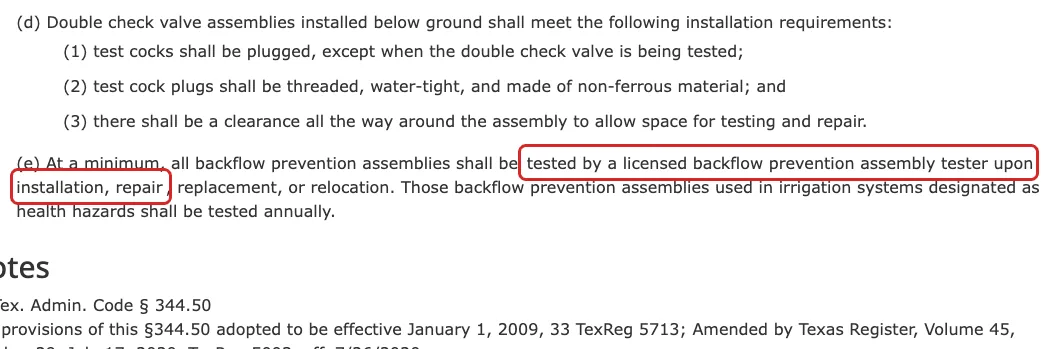
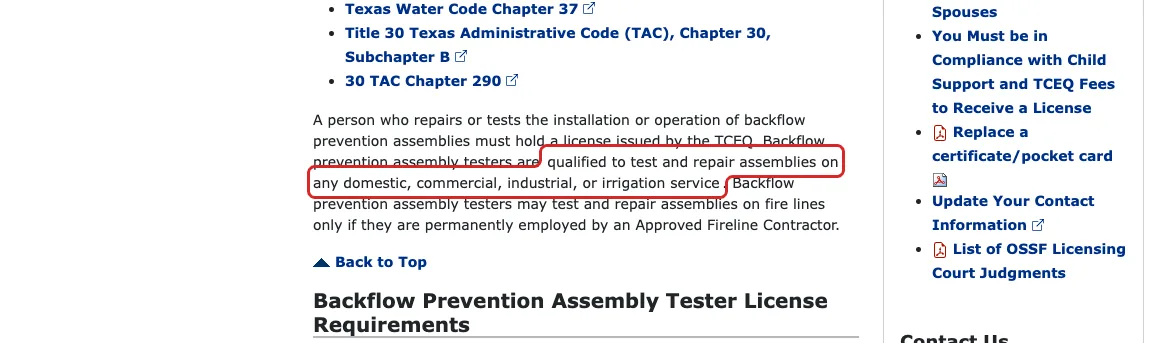
You can close a test cock or bleed screw, open the valves in the right order and fix a leaking pipe joint without touching the device. Repairing the device itself is regulated in many places. In Texas, TCEQ says “a person who repairs or tests” a backflow prevention assembly must hold its license, and 30 TAC §344.50(e) requires a licensed tester to test every irrigation assembly after installation, repair, replacement or relocation (TCEQ; 30 TAC §344.50).
| Where | When the assembly must be tested | Who tests or repairs | Source |
|---|---|---|---|
| Texas (state irrigation rules) | Upon installation, repair, replacement or relocation; every year if the irrigation system is designated a health hazard | A licensed backflow prevention assembly tester (BPAT); TCEQ says a person who repairs or tests an assembly must hold its license | 30 TAC §344.50(e); TCEQ BPAT page |
| California (public water systems) | After installation, repair, depressurization for winterizing or permanent relocation, and at least once a year; a failed assembly repaired or replaced within 30 days | Field tests by a certified backflow prevention assembly tester | Cross-Connection Control Policy Handbook §3.3.3 |
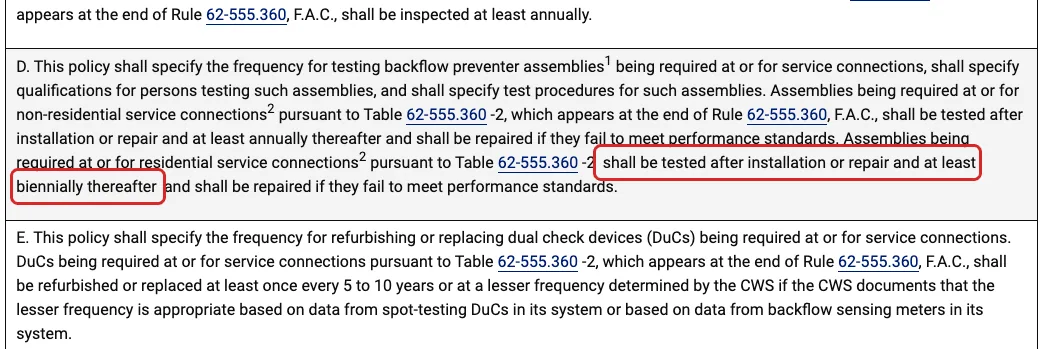
| Florida (public water systems) | Residential service connections (2 in. or less, dwelling units only, including dedicated irrigation): after installation or repair, then at least every 2 years; other connections every year | Set by the utility’s cross-connection program | F.A.C. 62-555.360 |
| Febco and Watts (any state) | At least once a year, or more often as service conditions warrant, and again once maintenance has been performed | Febco: the 765 must be installed by a licensed contractor | Febco 765 manual, p. 1; Watts IS-800M4, p. 1 |
Plan the repair and the retest as one visit. On the published price lists in our backflow testing and repair price survey, a test costs $50 to $150 and a kit repair, installed, $150 to $200, against $995 to $1,600 to replace a testable RPZ or double check. A plumber who is not a certified tester can stop the leak, but in Texas, California and Florida the device is not back in compliance until a tester passes it.
Repair kit or new assembly: what the parts cost
Every kit below fits only the models and sizes named, and the prices were read from the listings on Nov. 26, 2026. The cheapest fix, a $25.03 Watts rubber kit, holds the vent seal, check disc and bonnet O-ring for a 1/2 or 3/4 in. 800M4. The dearest single part, Febco’s $252.20 relief valve assembly, is 21 percent of a new 3/4 in. 825Y at $1,191.99.
Swipe the table sideways to see every column.
| Part | Fits | Price, Nov. 26, 2026 | Seller |
|---|---|---|---|
| Watts RK 800M4 RT total rubber kit (0887706) | Watts 800M4, 1/2 to 3/4 in.: vent seal, check disc, bonnet O-ring | $25.03 (regular $38.50) | Backflow Supply |
| Febco 905042 check rubber | Febco 825Y, 3/4 to 1-1/4 in. | $30.06 (regular $46.25) | Backflow Supply |
| Watts PVB check kit (0887703) | Watts 800M4, 1/2 to 3/4 in. | $41.35 (regular $54.95) | Sprinkler Warehouse |
| Febco FE905-052 PVB check assembly kit | Febco 765, 1 to 1-1/4 in. | $43.25 (regular $80.99) | Sprinkler Warehouse |
| Febco 905113 relief valve seat ring kit | Febco 825Y, 3/4 to 1 in. | $52.16 (regular $80.25) | Backflow Supply |
| Watts PVB bonnet kit (0887700) | Watts 800M4, 1/2 to 3/4 in. | $56.15 (regular $80.95) | Sprinkler Warehouse |
| Febco FE905-212 PVB bonnet/poppet kit | Febco 765, 1 to 1-1/4 in. | $57.34 | Sprinkler Warehouse |
| Febco 905111 complete rubber kit | Febco 825Y, 3/4 to 1-1/4 in. | $65.98 (regular $101.50) | Backflow Supply |
| Wilkins RK1-720A PVB repair kit | Zurn Wilkins 720A, 1/2 to 1 in. | $81.99 | Sprinkler Warehouse |
| Febco FE905-211 PVB bonnet/poppet kit | Febco 765, 1/2 to 3/4 in. | $87.90 | Sprinkler Warehouse |
| Febco 905045 relief valve assembly | Febco 825Y, 3/4 to 1-1/4 in. | $252.20 (regular $388.00) | Backflow Supply |
| New Febco 765 PVB, 3/4 in. | Whole assembly with ball valves and test cocks | $153.95 (regular $238.95) | Sprinkler Warehouse |
| New Watts 800M4QT PVB, 3/4 in. | Whole assembly | $309.19 (regular $312.99) | Sprinkler Warehouse |
| New Febco 825Y RPZ, 3/4 in. | Whole assembly | $1,191.99 | Sprinkler Warehouse |
How much water is the leak wasting?
Hold a kitchen measuring cup under the leak for 1 minute and read the fluid ounces. At 128 fluid ounces to the gallon, each ounce a minute is 11.25 gallons a day if the device leaks around the clock, which a PVB or RPZ under constant supply pressure can do.
- Gallons a day
- 45
- Gallons a month (30 days)
- 1,350
- Gallons a year
- 16,425
Default: 4 fl oz a minute around the clock is 45 gallons a day, 1,350 a month and 16,425 a year (4 x 1,440 minutes / 128 fl oz per gallon). Multiply by your utility's price per gallon for the cost.
How we compiled this
We read 9 maker documents (Febco 765, 825Y and 850 manuals; Watts 800M4 and 009 manuals and the S-TSG troubleshooting guide; Zurn Wilkins 720A, 460XL and 975XL2 sheets), the Texas, California and Florida rules, and part listings at Sprinkler Warehouse and Backflow Supply, checked Nov. 26, 2026. Causes and fixes are the makers’ own, quoted by device; we did not test any device. Prices exclude tax and shipping, and installed prices come from our earlier survey of published contractor price lists.
This page is general information, not legal advice. Who may repair and test a backflow assembly is set by your state and water utility; confirm with your utility’s cross-connection office before you open the device.
Frequently asked questions
Is it common for backflow preventers to leak?
A short spurt is normal from a PVB while it fills, because its vent stays open below 1 psi, and an RPZ may spit when supply pressure drops. A steady drip from either, or any water from a spill-resistant SVB, is a fault the maker’s table can name.
Why would a backflow preventer dump water?
An RPZ dumps through its relief port when the first check is fouled, when inlet pressure drops, or when the relief seat is dirty; Zurn says most cases are the first check. A PVB dumps from its bonnet when downstream pressure falls to 5 psi or less or the poppet is broken.
How much does it cost to replace a backflow valve?
Parts on Nov. 26, 2026: $153.95 for a 3/4 in. Febco 765 PVB, $309.19 for a Watts 800M4QT and $1,191.99 for a 3/4 in. Febco 825Y RPZ. Installed, one published contractor list charges $650 to $750 for a PVB and $995 to $1,600 for a testable RPZ or double check, plus the retest.
What is the life expectancy of a backflow preventer?
No maker we read publishes a body lifespan. Watts’ 800M4 manual says to replace the rubber parts every 5 years, and Watts and Zurn warrant their assemblies for 1 year. A body cracked by freezing cannot be rebuilt with a kit.
Can I fix a leaking backflow preventer myself?
You can close a test cock or bleed screw and fix a leaking pipe joint. Rebuilding the device is licensed work in some states: in Texas only a TCEQ-licensed tester may repair or test it, and Texas, California and Florida require a test after any repair.
Sources
- Watts (FEBCO), Series 765 Pressure Vacuum Breaker Installation, Maintenance, and Repair Manual, RP/IS-F-765 2409, 2024; pp. 1 to 6. Accessed November 2026.
- Watts, Series 800M4 Pressure Vacuum Breaker Installation, Maintenance, and Repair Manual, RP/IS-800M4 2409, 2024; pp. 1 to 3. Accessed November 2026.
- Zurn Wilkins, Model 720A Pressure Vacuum Breaker installation, testing and maintenance instructions, IS720A, rev. E, June 2025. Accessed November 2026.
- Zurn Wilkins, Model 460XL Spill-Resistant Pressure Vacuum Breaker instructions, IS460XL, rev. G, June 2025. Accessed November 2026.
- Watts, Series 009 Reduced Pressure Zone Assemblies Installation, Maintenance, and Repair Manual, RP/IS-009 2543, 2025. Accessed November 2026.
- Watts, Troubleshooting Guide: Reduced Pressure Backflow Preventers, S-TSG, 2013. Accessed November 2026.
- Watts (FEBCO), Series 825Y and 826 Installation, Operation and Maintenance Manual, IOM-F-825_826, 2023; p. 6. Accessed November 2026.
- Zurn Wilkins, Model 975XL2 Reduced Pressure Principle Assembly instructions, ISSM975XL2, rev. E, July 2017; p. 3. Accessed November 2026.
- Watts (FEBCO), Series 850 Small Double Check Valve Assemblies manual, RP/IS-F-850S 2409, 2024; p. 6. Accessed November 2026.
- Texas Administrative Code (via Cornell LII), 30 TAC §344.50, Backflow Prevention Methods, current rule. Accessed November 2026.
- Texas Commission on Environmental Quality, Backflow Prevention Assembly Tester license information, current page. Accessed November 2026.
- California State Water Resources Control Board, Cross-Connection Control Policy Handbook, §3.3.3, adopted Dec. 19, 2023. Accessed November 2026.
- Florida Administrative Code (via Cornell LII), Rule 62-555.360, Cross-Connection Control for Public Water Systems, current rule. Accessed November 2026.
- Sprinkler Warehouse, Febco, Watts and Wilkins kit and assembly listings (8 pages linked in the tables), prices checked Nov. 26, 2026. Accessed November 2026.
- Backflow Supply, Febco 825Y 3/4 in. to 1-1/4 in. repair kit options, prices checked Nov. 26, 2026. Accessed November 2026.
- Backflow Supply, Watts RK 800M4 RT 1/2 in. to 3/4 in. (0887706), price checked Nov. 26, 2026. Accessed November 2026.