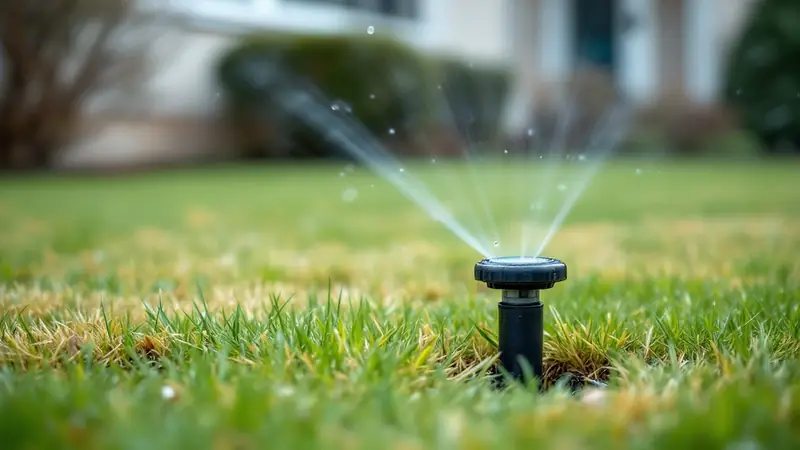
How to find a leak in sprinkler system piping: read the water meter 3 ways before you dig. With everything off, then with the irrigation shutoff closed, then while each zone runs. The reading that moves tells you mainline, valve or one lateral.
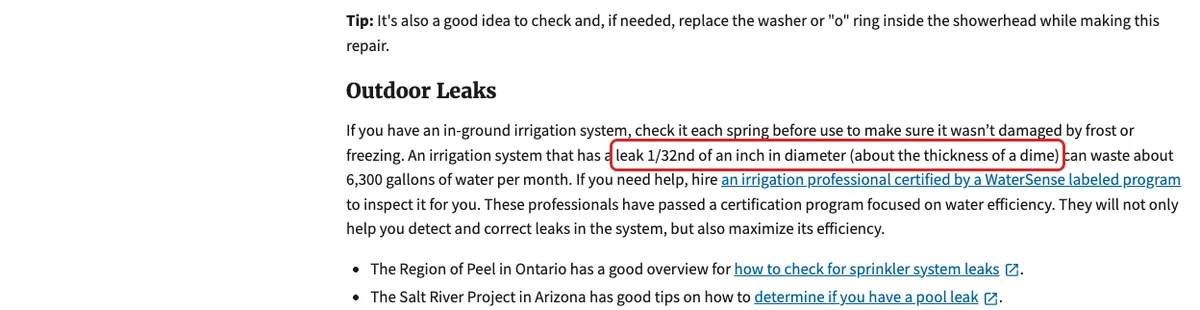
If you are working out how to find a leak in sprinkler system lines, the water meter does most of the locating. The EPA puts the cost of a 1/32 inch leak in an irrigation system, about a dime’s thickness, at roughly 6,300 gallons a month, and the utility guides it points to start the same way: shut off every fixture and watch the meter’s low-flow indicator.
That idle test has a blind spot the top-ranking guides skip. Only the mainline, the zone valves and the backflow preventer hold water while the system is off; Rain Bird’s Landscape Irrigation Design Manual (p. 60) says the main is under constant pressure “even when the system is not in use”. A lateral, the pipe from a valve to its heads, is pressurized only while its zone runs, so a cracked lateral never moves an idle meter. This page adds the reading that catches it: the meter’s gallons per minute while one zone runs, set against that zone’s nozzle total from the maker’s chart.
Which reading points where?
Run the three tests in order and note what the low-flow indicator does each time. The table maps the 10 places a residential system leaks to those three readings and to what you can see in the yard. If a zone also runs weak, our guide to a low water pressure sprinkler system covers the static and working pressure tests that separate a leak from an overloaded zone.
| Where the leak is | Meter, everything off | Irrigation shutoff closed | While a zone runs | What you see | Next step | Source |
|---|---|---|---|---|---|---|
| Toilet, faucet or other fixture in the house | Moves | Keeps moving; stops when the house valve is closed | No change | Nothing in the yard | Dye test the toilets; EPA says color in the bowl after 10 minutes is a leak | EPA WaterSense |
| Service line, meter to house and irrigation tee | Moves | Keeps moving with house and irrigation valves both closed | No change | Wet strip between the meter and the house | Call the utility or a plumber: this pipe is upstream of the sprinkler system | Saving Water Partnership |
| Backflow preventer | Moves | Stops | No change | Water at the bonnet, relief port, a test cock or a cracked body | Match the spot to the part in our backflow preventer leak guide | Castle Rock Water |
| Mainline, backflow to zone valves | Moves | Stops | Every zone can run weaker | A spot that stays wet between cycles, a sunken patch, no head draining | Walk the main’s route from the backflow to the valve boxes, probe, then dig by hand | Rain Bird design manual, p. 60 |
| Manifold fitting or valve bonnet | Moves | Stops | No change | Water standing in the valve box, or seeping where bonnet meets body | Tighten or remake the fitting; Rain Bird lists a bonnet-to-body leak as visible at the joint | Rain Bird TSG, p. 10 |
| Zone valve seeping through | Moves, often slowly | Stops | No change | A puddle at the lowest head of one zone that never dries | Flush or rebuild the valve: see a sprinkler zone that won’t turn off | Rain Bird TSG, p. 10; Hunter |
| Low-head drainage (not a leak in the pipe) | Still | Still | No change | Lowest head drains after the zone stops, then quits once the lateral is empty | Fit a check valve: Rain Bird’s 1800 SAM holds back up to 14 ft of elevation | Hunter; Rain Bird 1800 spec |
| Lateral pipe, valve to heads | Still | Still | Meter reads more than the zone’s nozzle total; far heads weak | Geyser, bubbling or a soggy patch that appears only after that zone runs | Run Test 3 below, mark the wet spot, cut out the break and fit a repair coupling | Rain Bird MPR chart |
| Head, riser or swing joint | Still | Still | Small extra flow | Flooding at one head’s base, or water around the stem | Step on the stem to flush grit past the wiper seal; if the base still floods, replace the head | Rain Bird TSG, p. 2 |
| Drip zone tubing or fitting | Still | Still | Meter reads more than the emitter total | Wet soil or a jet in a bed, a fitting pushed off the tubing | Walk the bed while the zone runs and remake the fitting; if flow is below the emitter total instead, see clogged drip emitters | Test 3 method on this page |
1With every fixture, appliance and zone off, does the meter's low-flow indicator stay still for 2 minutes?
YesNothing under constant pressure is leaking. Run each zone and compare the meter's gpm with the nozzle total (Test 3) to find a lateral, head or drip leak.
NoGo to the next question
2Does the indicator keep moving after you close the irrigation shutoff?
YesThe leak is not in the sprinklers. Close the house valve: if it stops, check toilets and fixtures; if it still moves, the service line leaks (utility or plumber).
NoGo to the next question
3Is water dripping at the backflow preventer?
YesMatch the spot (bonnet, relief port, test cock, body) to the failed part in our backflow preventer leak guide.
NoGo to the next question
4Is water standing in a valve box or seeping where a valve bonnet meets the body?
YesTighten or remake the fitting, or reseat the bonnet; Rain Bird lists a bonnet-to-body leak as visible at the joint.
NoGo to the next question
5Is the lowest head on one zone wet even though no zone has run for hours?
YesThat zone's valve is seeping: flush debris off the diaphragm or replace the diaphragm or solenoid.
NoThe mainline between the backflow preventer and the valves is leaking: look for a spot that stays wet between cycles along its route, call 811, then probe and dig by hand.
Test 1: does the meter move with everything off?
Most meters carry a low-flow indicator, a small triangle, star or dial that spins at flows too small to move the main register (Saving Water Partnership). The City of Mountain View tells customers to watch it “for a couple minutes”; EPA’s longer version compares the register before and after 2 hours with no water used.
- Turn the controller to off and close every faucet, the ice maker line and the washer. Nobody uses water during the test.
- Find the meter: inside, often on the wall facing the street, or outside in a curb box about 15 by 20 inches (Mountain View). Castle Rock Water asks customers not to open meter pits themselves, so check your utility’s rule first.
- Watch the low-flow indicator for 2 minutes. Any turning means water is moving.
- Write down the full register, including the sweep hand, then read it again after 30 minutes or, for a slow leak, 2 hours.
- Convert if needed: a meter that reads in cubic feet moves 7.48 gallons per cubic foot (Mountain View).
Read the sweep hand from your own meter face, because meters differ. On the Neptune meters at Savannah Valley Utility District in Tennessee, one full sweep is 1/10 of a gallon; on other registers one sweep is 1 or 10 gallons or 1 cubic foot. The size of the movement is what the calculator further down turns into gallons a day.
If the indicator stays still for 2 minutes and the register does not change in 2 hours, nothing under constant pressure is leaking. Skip to Test 3: the leak, if there is one, is in a lateral, a head or a drip zone.
Test 2: close the irrigation shutoff. House, service line or sprinklers?
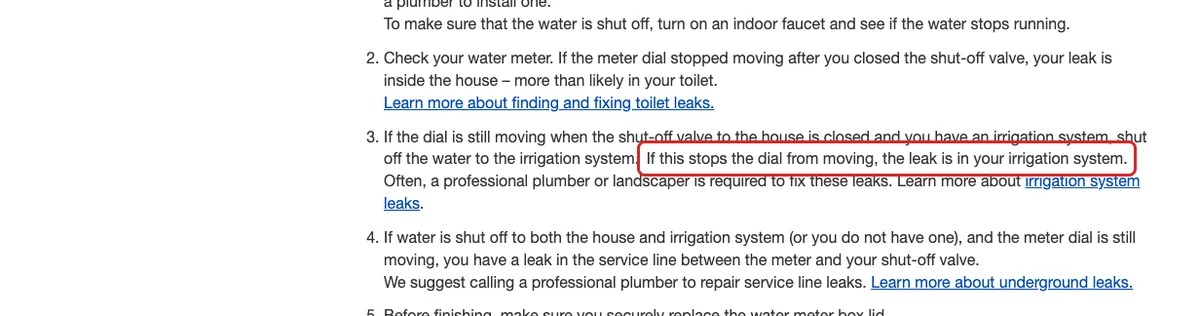
Close the valve that feeds only the sprinkler system: Castle Rock Water describes it on the meter tree, with the handle turned perpendicular to the pipe when off; on other homes it is a ball valve just after the tee to the irrigation line, or either ball valve on the backflow preventer. Then watch the indicator again for 2 minutes.
- Indicator stops: the leak is on the sprinkler side, from the backflow preventer to the zone valves.
- Indicator keeps moving: close the house valve too. If it stops, the leak is inside the house; EPA’s dye test finds a toilet flapper in 10 minutes.
- Indicator moves with both closed: the service line between the meter and the shutoffs leaks (Saving Water Partnership). That is a utility or plumbing job, not an irrigation repair.
Once Test 2 puts the leak on the sprinkler side, three parts are still pressurized with every zone off. Check them in this order, cheapest look first.
Backflow preventer and valve boxes
Look at the backflow preventer first, because it sits above ground. A drip from its bonnet, relief port or a test cock names a part, and our backflow preventer leak guide matches each spot to the maker’s repair kit. Then lift each valve box lid. EPA WaterSense tells homeowners to check the connections inside valve boxes and make sure the valves can shut, and Rain Bird’s troubleshooting guide lists a leak between bonnet and body as one you can see at the joint (p. 10). If you cannot find a lid, our guide on how to find a buried sprinkler valve box works from the controller wires and the mainline route.
A zone valve seeping through
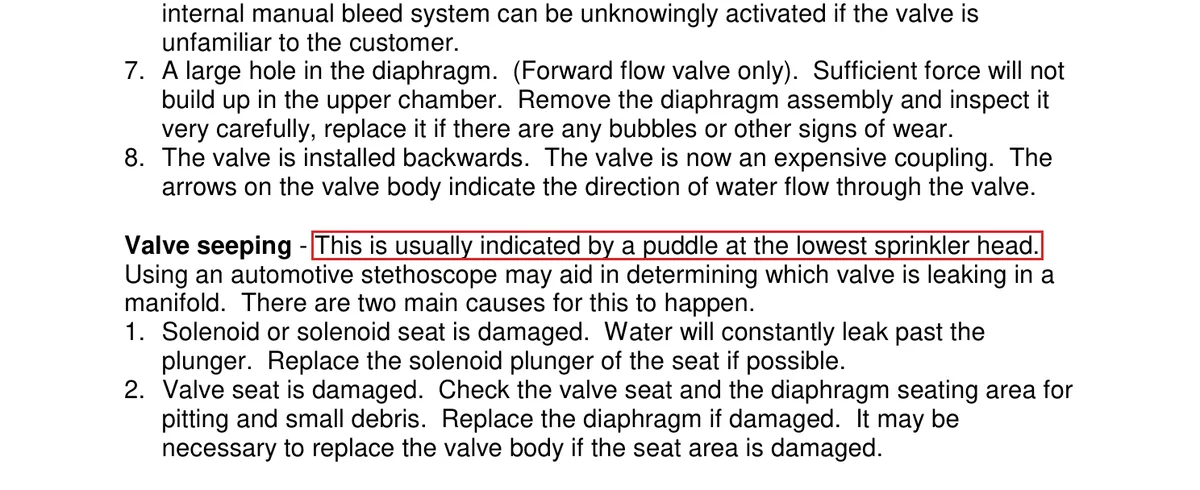
Rain Bird’s Irrigation Troubleshooting Guide says a seeping valve “is usually indicated by a puddle at the lowest sprinkler head” and that an automotive stethoscope held on each valve can find which one in a manifold is passing water (p. 10). The two causes it gives are a damaged solenoid or solenoid seat and a damaged valve seat, and Hunter adds that debris on the diaphragm is the most common.
Do not confuse that with low-head drainage. Hunter says water that drains out of the lowest head after a zone shuts off stops once the lateral is empty, and a check valve in the sprinkler fixes it; a check valve will not fix water coming through the valve. Two clues separate them: low-head drainage does not move the meter, and it stops within the cycle. Rain Bird’s 1800 SAM spray body holds back up to 14 feet of elevation (6 psi).
The mainline itself
If the meter moves with every zone off, the backflow preventer is dry, every valve box is dry and no head is draining, the main is leaking between the backflow and the valves. Expect a spot that stays wet 24 hours after the last cycle, a sunken patch, or a strip greener than the lawn around it along the main’s route. On a slope the wet spot usually sits downhill of the break, because the water follows the trench backfill.
Test 3: run each zone and compare the meter with the nozzle total
This is the test for laterals, and the one the idle meter cannot do. Run one zone, let it settle for 1 minute, then read the register over 2 minutes and divide by 2 for gallons per minute. Add up what that zone’s nozzles should pass from the maker’s chart: Rain Bird’s MPR nozzle chart lists the 15 foot half-circle (15H) at 1.85 gpm, the full circle (15F) at 3.70 gpm and the quarter (15Q) at 0.92 gpm, all at 30 psi.
| Step | Zone 4 (example) | Arithmetic |
|---|---|---|
| Heads on the zone | 6 Rain Bird 15H, 2 Rain Bird 15Q | Counted while the zone runs |
| Nozzle total at 30 psi | 12.94 gpm | 6 x 1.85 + 2 x 0.92 |
| Meter over 2 minutes | 30.2 gallons | Register before and after |
| Measured flow | 15.1 gpm | 30.2 / 2 |
| Unexplained flow | 2.2 gpm | 15.1 minus 12.94 |
| What 2.2 gpm looks like | About a 1/8 in. hole at 60 psi | Hole table below: 2.20 gpm |
Two checks before you blame the pipe. Nozzle charts assume the stated pressure, and at 45 psi a 15H on a body without a pressure regulator passes about 22 percent more than at 30 psi (flow rises with the square root of pressure), so measure working pressure at a head or compare against a zone you trust. And on a meter whose sweep reads 1/10 gallon, a 2 minute reading is good to about 0.05 gpm, so a gap of 1 gpm or more is real water.
When one zone shows the gap, walk it while it runs. Rain Bird’s troubleshooting guide traces water leaking around a spray head’s stem to grit between the wiper seal and stem, fixed by stepping lightly on the running stem (p. 2); water bubbling between heads, a geyser from a snapped riser, or far heads that barely rise point to the lateral. Our page on a sprinkler head not popping up counts how many heads stay down, which narrows a lateral break to the run after the last strong head.
Where does the water surface, and where do you dig?
Mark the wet spot after the zone runs, not during, and let the area drain for a few hours before you probe. Push a steel rod or long screwdriver into the soil along the line between heads: it slides in easily where saturated soil sits over a break. Our guide to how deep sprinkler lines are buried gives the depth to expect; where the maker publishes no depth, Texas rule 30 TAC 344.62 sets a minimum of 6 inches of cover over the pipe.
Contact 811 a few days before you dig, even by hand (Common Ground Alliance). The locate will not mark your sprinkler pipe: MISS DIG 811 lists underground sprinkler systems among the private lines that utility locators leave unmarked and private locators mark for a fee. Dig by hand once you are close to the pipe depth, so a second break is not added to the first.
How much water is the leak losing?
A hole in a pressurized pipe behaves like an orifice, and the U.S. Bureau of Reclamation’s Water Measurement Manual gives the equation and a discharge coefficient of 0.61, measured for its sharp-edged irrigation orifices. The table applies it to round holes at three supply pressures. Real cracks are ragged, so read the rows as an order of magnitude; the EPA and Castle Rock Water figures land within 6 percent of the 60 psi row.
| Hole diameter | gpm at 60 psi | Gallons a day at 40 psi | Gallons a day at 60 psi | Gallons a day at 80 psi | Gallons a month at 60 psi |
|---|---|---|---|---|---|
| 1/64 in. | 0.03 | 40 | 50 | 57 | 1,486 |
| 1/32 in. (a dime’s thickness) | 0.14 | 162 | 198 | 229 | 5,945 |
| 1/16 in. | 0.55 | 647 | 793 | 915 | 23,781 |
| 1/8 in. | 2.20 | 2,589 | 3,171 | 3,661 | 95,122 |
| 1/4 in. | 8.81 | 10,356 | 12,683 | 14,645 | 380,489 |
| Published figure | What it says | This page’s estimate | Source |
|---|---|---|---|
| EPA WaterSense: 1/32 in. leak in an irrigation system | about 6,300 gallons a month | 5,945 a month at 60 psi; 6,865 at 80 psi | EPA Fix a Leak Week |
| Castle Rock Water: 1/16 in. opening | 822 gallons a day | 793 a day at 60 psi; 915 at 80 psi | Castle Rock Water |
| Castle Rock Water: 1 drip a second | 3,000 gallons a year | not modeled (drips are not an orifice) | Castle Rock Water |
| Castle Rock Water: 10 drips a minute | 500 gallons a year | not modeled | Castle Rock Water |
A lateral leak loses far less than the table’s 24 hour figures, because it leaks only while its zone runs. A 2.2 gpm break on a zone that runs 20 minutes, 3 days a week, wastes about 132 gallons a week; the same hole on the mainline wastes 3,171 gallons a day. Use the calculator with your own meter reading and the hours the pipe is under pressure.
- Gallons a day
- 144
- Gallons a month (30 days)
- 4,320
- Gallons a year
- 52,560
Default: 1 gallon in 10 minutes around the clock is 144 gallons a day, 4,320 a month and 52,560 a year (1 x 1,440 / 10). For a lateral, measure the extra gpm over the nozzle total while the zone runs, then pick its run time. Multiply by your utility's price per gallon for the cost.
Fix it yourself or call a pro?
A cracked PVC lateral is a cut-and-glue repair. Sprinkler Warehouse lists a 1 inch telescopic repair coupling (118-10) at $6.60 on Nov. 26, 2026: it closes to 7-1/2 inches, extends to 10 and is rated 150 psi in every position (listing). Cut out the break slightly longer than the closed coupling, prime and cement both ends, and slide it open to fill the gap.
Then wait before you pressurize. Oatey’s cure chart gives 15 minutes for 1/2 to 1-1/4 inch PVC joints at up to 180 psi when it is 60 to 100°F, 20 minutes at 40 to 60°F and 30 minutes at 20 to 40°F, plus 50 percent more in damp weather. Oatey writes the chart for new installations, so run the zone and watch the joint before you backfill.
Call a pro when Tests 1 and 2 put the leak on the mainline under paving, when the meter moves but nothing surfaces after 24 hours, or when the pipe is deeper than you can hand dig. None of the published price lists we read gives a flat fee for locating a leak, and the tools explain why: Leaktronics lists its irrigation leak detection kit, an amplifier with ground probes, at $3,675 (listing, Nov. 26, 2026). Repairs are priced: Genesis charges $190 for a broken pipe below ground and $275 for a broken mainline, and New Zealand Irrigation $225 for a below-ground mainline. Our sprinkler repair cost survey has the full ranges.
Rerun Test 1 each spring as part of the start-up order in our guide to turning on a sprinkler system: the EPA tells owners of in-ground systems to check before first use for frost and freeze damage.
How we compiled this
On Nov. 26, 2026 we read 6 utility and agency leak guides (EPA WaterSense Fix a Leak Week and Sprinkler Spruce-Up, Saving Water Partnership, Castle Rock Water, City of Mountain View, Savannah Valley Utility District), 4 Rain Bird documents (Irrigation Troubleshooting Guide, Landscape Irrigation Design Manual, 1800 spec, MPR chart), Hunter’s valve support page, the USBR Water Measurement Manual, Oatey’s cure chart, Texas rule 30 TAC 344.62, 2 locate-before-you-dig sources and 4 dated price listings. The 10-row leak map, the worked zone example and the hole-size estimates are our compilation and arithmetic; we did not test equipment or run field trials.
Frequently asked questions
Can sprinklers still leak even if the system is shut off?
Yes. The mainline, the zone valves and the backflow preventer stay under pressure while the controller is off, so a break or a seeping valve leaks around the clock. Rain Bird’s design manual says the main is pressurized even when the system is not in use.
How do I find a water leak that isn’t visible?
Use the meter. With every fixture off, a moving low-flow indicator means a leak; closing the irrigation shutoff tells you whether it is on the sprinkler side. For a lateral, compare the meter’s gallons per minute while the zone runs with the nozzle total.
Will a water meter detect a sprinkler leak?
It detects any leak upstream of the valves, because those parts hold pressure 24 hours a day. It cannot see a lateral break with the system off, since that pipe is empty until its zone runs; read the meter during each zone instead.
How much does it cost to repair a sprinkler system leak?
Published price lists we checked on Nov. 26, 2026 charge $190 for a broken pipe below ground and $225 to $275 for a broken mainline, before lawn repair. A DIY PVC fix uses a telescopic repair coupling listed at $6.60 for 1 inch pipe.
How can I find my sprinkler lines without digging?
Trace from each valve box toward its heads, since laterals run head to head, and look for a wet or greener strip after a zone runs. 811 does not mark sprinkler pipe; MISS DIG 811 says private locators mark it for a fee.
Sources
- U.S. EPA WaterSense, Fix a Leak Week (Checking for Leaks; Outdoor Leaks), current page. Accessed November 2026.
- U.S. EPA WaterSense, Sprinkler Spruce-Up, current page. Accessed November 2026.
- Saving Water Partnership (Seattle-area utilities), Use your water meter to check for leaks, current page. Accessed November 2026.
- Town of Castle Rock Water (Colo.), Checking for Leaks, current page. Accessed November 2026.
- City of Mountain View (Calif.), via Valley Water, How to Read a Water Meter and Check for Leaks, current PDF. Accessed November 2026.
- Savannah Valley Utility District (Tenn.), How to read your water meter, current page. Accessed November 2026.
- Rain Bird Corporation, Irrigation Troubleshooting Guide, pp. 2 and 10, 2018 PDF. Accessed November 2026.
- Rain Bird Corporation, Landscape Irrigation Design Manual, p. 60, current PDF. Accessed November 2026.
- Rain Bird Corporation, 1800 Series Spray Heads tech spec (SAM check valve), p. 3, 2020. Accessed November 2026.
- Rain Bird Corporation, MPR spray nozzle performance charts, 15 Series, 2020. Accessed November 2026.
- Hunter Industries, Valves: Weeping/Leaking when valve off, current page. Accessed November 2026.
- U.S. Bureau of Reclamation, Water Measurement Manual, chapter 9, section 1 (orifice equation, Cd 0.61), current edition. Accessed November 2026.
- Texas Administrative Code (via Cornell LII), 30 TAC 344.62, Minimum Design and Installation Requirements (depth coverage), current rule. Accessed November 2026.
- Common Ground Alliance, 811: Before you dig, current page. Accessed November 2026.
- MISS DIG 811 (Michigan), Homeowner FAQ: private utility lines, current page. Accessed November 2026.
- Oatey Co., Solvent Weld Cure Times chart, LCS358G, Nov. 2020. Accessed November 2026.
- Sprinkler Warehouse, Telescopic Coupling 1 in. Slip, 118-10, price checked Nov. 26, 2026. Accessed November 2026.
- Leaktronics, Irrigation Leak Detection Kit, price checked Nov. 26, 2026. Accessed November 2026.
- Genesis Sprinklers and Water Management (Fla.), Pricing List, checked Nov. 26, 2026. Accessed November 2026.
- New Zealand Irrigation (Parrish, Fla.), Sprinkler Repair and Maintenance Price List, checked Nov. 26, 2026. Accessed November 2026.