How to turn on sprinkler system water in spring: wait until the soil is frost-free 12 inches down, close the backflow’s test cocks and outlet valve, open the supply slowly, open the outlet, then run every zone once from the controller.
How to turn on sprinkler system water without cracking anything comes down to two things most guides leave vague: the date and the valve order. For the date, Rain Bird’s test is a shovel: the soil must be frost-free 12 inches deep, and if it is still solid, wait a week and dig again (Rain Bird spring tune-up). For a calendar check, the table below lists the last spring 28°F hard freeze for 27 U.S. cities from NOAA’s 1991 to 2020 climate normals. For the valve order, each backflow device’s maker prints its own start-up sequence, and they are not all “open everything slowly”.
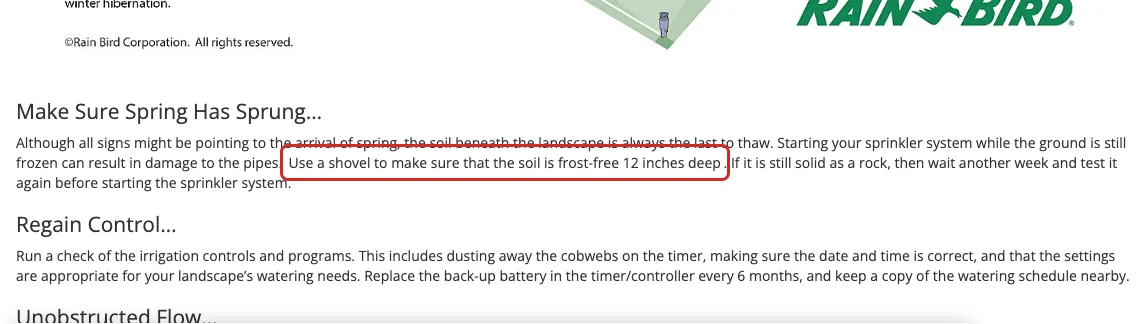
This is the spring half of our guide to how to winterize an irrigation system, which leaves the backflow valves at 45° for winter. Fall freeze dates are in our guide to when to stop watering your lawn. Paid spring start-ups run $55 to $150 in our sprinkler repair cost survey.
When to turn on your sprinkler system
Turn it on after the last hard freeze, not when the grass greens. Denver Water says water left in pipes can freeze and crack them when temperatures drop below 30 degrees, puts Denver’s last freeze typically around May 5, and estimates a leaking zone can lose 10,000 gallons a month. NOAA’s normals agree: Denver International Airport’s median last 32°F date is May 5, and 1 spring in 10 still sees 28°F after May 9 (NCEI station file USW00003017).
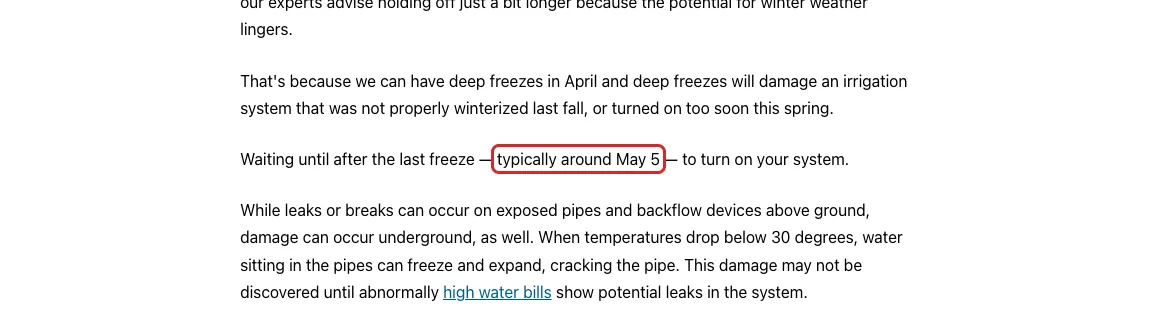
Read column 4 as the safer start date. After it, a 28°F freeze arrives in only 1 year in 10, against 1 in 2 after the column 3 median. Pipe buried 12 inches or deeper is shielded by soil; the parts that freeze first are above ground, which is why the backflow device and the riser feeding it set the risk.
Swipe the table sideways to see every column.
| City (NOAA station) | Median last 32°F frost | Median last 28°F hard freeze | 1 year in 10, a 28°F freeze comes after |
|---|---|---|---|
| Fargo, ND | May 10 | April 30 | May 15 |
| Minneapolis, MN | April 23 | April 13 | April 28 |
| Milwaukee, WI | April 19 | April 6 | April 20 |
| Chicago, IL | April 16 | April 5 | April 19 |
| Detroit, MI | April 20 | April 8 | April 24 |
| Des Moines, IA | April 18 | April 8 | April 22 |
| Omaha, NE | April 18 | April 8 | April 21 |
| Boston, MA | April 4 | March 28 | April 6 |
| New York, NY | March 30 | March 19 | April 2 |
| Philadelphia, PA | April 2 | March 22 | April 3 |
| Columbus, OH | April 18 | April 5 | April 21 |
| Washington, DC | March 24 | March 12 | March 26 |
| Kansas City, MO | April 13 | April 1 | April 18 |
| St. Louis, MO | April 2 | March 23 | April 7 |
| Denver, CO | May 5 | April 25 | May 9 |
| Salt Lake City, UT | April 8 | March 15 | April 8 |
| Boise, ID | April 24 | April 2 | April 25 |
| Spokane, WA | April 26 | April 6 | April 28 |
| Seattle, WA | March 2 | Feb. 4 | Feb. 28 |
| Portland, OR | March 13 | Feb. 16 | March 6 |
| Albuquerque, NM | April 6 | March 17 | April 7 |
| Oklahoma City, OK | April 4 | March 21 | April 7 |
| Dallas-Fort Worth, TX | March 8 | Feb. 25 | March 14 |
| Nashville, TN | March 31 | March 17 | April 4 |
| Charlotte, NC | March 30 | March 17 | April 3 |
| Raleigh, NC | March 31 | March 18 | April 3 |
| Atlanta, GA | March 15 | Feb. 28 | March 20 |
Local water rules can override the calendar. Denver Water’s summer watering rules run May 1 to Oct. 1 (Denver Water, spring 2026), and in 2026 it prohibited lawn spray irrigation from Oct. 1 until further board action under a Stage 1 drought, so check its outdoor water use rules page before a 2027 start-up. Colorado Springs Utilities suggests starting at 1 watering day a week in April and never more than 3 days a week under its Water Wise Rules (Colorado Springs Utilities).
How deep your laterals sit decides how much soil frost they can tolerate; our sibling guide on how deep sprinkler lines should be covers the burial depths codes and makers set.
Open the backflow in the order its maker prints
Every system on drinking water has a backflow preventer between the house supply and the zone valves. Denver Water allows only a pressure vacuum breaker (PVB) or a reduced pressure assembly (RP or RPZ) on irrigation and bans double checks and atmospheric vacuum breakers for that use (Denver Water backflow program); Illinois requires an RPZ on any lawn sprinkler system on potable water (77 Ill. Adm. Code 890.1140(d)). Which device a new system gets, and the $700 to $1,000 some installers charge for the tap and assembly, is covered in our sprinkler system installation cost guide. Find yours above ground near the house, then follow its row:
| Device (example) | How to recognize it | Spring start-up order | Speed the maker sets | Source |
|---|---|---|---|---|
| Pressure vacuum breaker (Watts 800M4) | Domed bonnet on top, 2 ball valves, 2 small test cocks; installed at least 12 in above the highest downstream pipe | 1. Close shutoff No. 2 (outlet). 2. Open No. 1 (inlet) until water discharges from the bonnet. 3. Open No. 1 fully. 4. Open No. 2. | Inlet quickly once it spills: the vent stays open until body pressure passes 1 psi (ASSE 1020) | Watts IS-800M4, p. 2 |
| Pressure vacuum breaker (Zurn Wilkins 720A) | Same layout; must sit above 32°F to work | 1. Both shutoffs and test cocks closed. 2. Open inlet until fully pressurized; a brief vent discharge should stop by full open. 3. Open No. 2. | No. 2 slowly | Zurn Wilkins 720A instructions |
| Any PVB (extension guidance) | As above | Close test cocks and ball valves, turn on the supply, then open the ball valves. | Ball valves slowly, to avoid water hammer | CSU Extension |
| Reduced pressure assembly (Watts 009) | 2 check modules plus a relief valve port underneath that can spit water | 1. Downstream shutoff closed. 2. Open upstream shutoff and fill the valve. 3. Open downstream shutoff and fill the system. | Both slowly, “to avoid water hammer or shock damage” | Watts IS-009, p. 3 |
| RP (extension guidance) | As above | Ball valves fully closed when the system is pressurized, then opened. | Always slowly | CSU Extension |
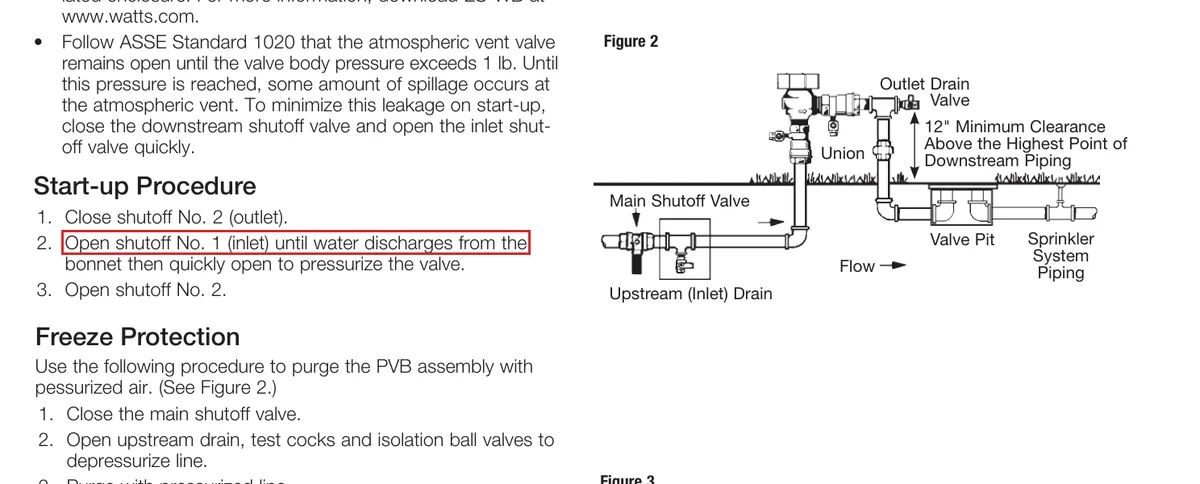
Two points in the table trip people up. First, the Watts PVB sheet tells you to open the inlet quickly once water spills from the bonnet, because the air vent only seals above 1 psi of body pressure; the slow part is the outlet, which feeds the zone pipe. Second, several homeowner guides describe the winter position as test cocks at 45° and ball valves across the pipe. Watts says to leave both the test cocks and the ball valve handles at 45°, and CSU says ball valves left fully open or fully closed trap water that can split the casting (CSU Extension). Either way, spring means the test cock slots go across the line (closed) before any water arrives.
If the bonnet keeps dripping once both valves are fully open, that is no longer the start-up spill: our guide to a backflow preventer leaking matches each leak spot to the worn part, the maker’s repair kit and the retest rule.
Step by step: how to turn on a sprinkler system
The sequence below merges the Rain Bird, Hunter and Toro start-up instructions with the backflow sheets above. You need a flat screwdriver, a pressure gauge that threads onto a hose bib, and the controller manual, and if the supply valve sits in a buried box, a long valve key (CSU says it can be 5 feet down).
- Dig a test hole: frost-free 12 inches down, or wait a week and test again (Rain Bird).
- Close every manual drain valve and refit any bleeder cap opened in the fall; Rain Bird says all manual drains must be closed before water goes back in (Rain Bird).
- Set the controller to OFF or manual, check the date and time, and confirm the dial will not start a program while the pipe fills (Rain Bird).
- At the backflow, turn both test cock slots across the pipe (closed) and close the outlet ball valve, then follow your device’s row in the table above for the inlet.
- Open the main supply valve a little at a time. Toro’s fill table, written for keeping pipe velocity under 2 feet per second, allows about 3 gallons a minute in 3/4-inch pipe and 5 in 1-inch pipe, so watch the water meter and keep the dial slow (Toro start-up procedures).
- Open the backflow outlet slowly. A brief spurt from the PVB bonnet is normal; Zurn says it should stop by the time the valve is fully open.
- Run each zone from the controller’s manual mode, one at a time. On a Rain Bird ESP-TM2, MANUAL STATION then Test All Stations runs every programmed zone in turn (ESP-TM2 manual, p. 7); Hunter says to verify every station valve this way (Hunter spring startup guide).
- Walk each running zone: heads up and turning, spray off the pavement, no bubbling soil, steady pressure. Hunter says low pressure points to a line break or a missing sprinkler; clear grass from any head that does not pop up.
- Open each valve box and look for drips, then check the backflow once more with the system pressurized.
- Reprogram the run times and seasonal percentage (next sections), uncover and clean the rain or freeze sensor, and switch to AUTO.
What pressure should the heads run at?
Measure static pressure at a hose bib with every zone off, then compare it with the head ratings. Rain Bird’s own homeowner pages disagree on the target: its spring tune-up page gives a typical operating range of 40 to 65 psi and suggests a regulator above it (Rain Bird tune-up), while its spring start-up blog says most systems run best at 45 to 75 psi (Rain Bird blog). The head spec sheets settle it zone by zone:
| Head (model) | Rated pressure | Best or regulated pressure | Source |
|---|---|---|---|
| Spray body (Rain Bird 1800) | 15 to 70 psi | “Spray nozzles perform best at 30psi”; PRS bodies hold an average 30 psi with up to 70 psi inlet | Rain Bird 1800 tech spec |
| Spray body with check valve (Rain Bird 1800 SAM) | 25 to 70 psi | Holds back up to 14 ft of elevation (6 psi) so low heads do not drain | Rain Bird 1800 tech spec, p. 2 |
| Gear rotor (Rain Bird 5000) | 25 to 65 psi | PRS model regulates to 45 psi | Rain Bird 5000 tech spec |
| Gear rotor (Hunter PGP Ultra) | Recommended 25 to 70 psi; operates 20 to 100 psi | Not regulated | Hunter PGP Ultra cut sheet |
Misting means too much pressure: Rain Bird’s troubleshooting guide fixes it with the valve’s flow control or a pressure regulator ahead of the valve (Rain Bird troubleshooting guide, p. 2). Large droplets that fall short mean too little, and CSU suggests a lower-pressure nozzle or, in severe cases, a booster pump (CSU Extension 7.239).
If a head stays down at start-up while its neighbors rise, count how many heads fail before you dig: our guide to a sprinkler head not popping up sorts the causes by one head, one zone or every zone.
Once the pressure is right, re-aim any head that sprays the pavement; adjusting sprinkler heads starts with the fixed edge, which is the left side on Rain Bird rotors and the right side on Hunter PGP and I-20 rotors.
What to check when something goes wrong at start-up
Rain Bird’s seminar guide notes that about 25 percent of controllers sent for repair come back with no defect, so test the cheap things first (Rain Bird troubleshooting guide, p. 11). The flow below handles the most common call, a zone that will not come on; the table covers the rest.
A tripped or miswired rain sensor is one of those cheap things: Hunter notes a manual single-station run overrides the sensor, so test it in automatic mode using the steps in how a rain sensor works.
1Are the main supply and the backflow's outlet valve (No. 2) fully open?
Yes
NoOpen them, slowly on the outlet side. Nothing downstream runs until they are (Watts 800M4; Zurn 720A).
2Does any zone run from the controller?
Yes
NoCheck the program: start time, run time and watering day all set, dial in AUTO, rain sensor dry or bypassed, transformer at 24 to 28 VAC (Rain Bird).
3Does the problem zone open when you turn its manual bleed at the valve?
YesElectrical fault: test the solenoid. 20 to 60 ohms is good; outside that, replace it, inside it, trace the wire (Rain Bird).
NoValve fault: back the flow control stem out, clean the solenoid ports with a paper clip, and inspect the diaphragm for tears (Rain Bird).
Source: Rain Bird Irrigation Troubleshooting Guide; Watts IS-800M4; Zurn Wilkins 720A
| Symptom at start-up | Likely cause | What to check or do | Source |
|---|---|---|---|
| No zone runs | Program missing a start time, run time or watering day; dial on OFF; rain sensor wet or active | Fix the program; set the sensor to bypass to test. Transformer output should read 24 to 28 VAC | Rain Bird, p. 11 to 12 |
| One zone will not open | Solenoid dead or not receiving voltage; flow control screwed fully down; plugged ports | Open it with the manual bleed: if it runs, the fault is electrical. A good solenoid reads 20 to 60 ohms | Rain Bird, p. 10, 16 to 17 |
| Zone will not shut off | Debris under the diaphragm, manual bleed left open, plugged diaphragm filter, torn diaphragm | Close the bleed, then clean or replace the diaphragm | Rain Bird, p. 10 |
| Puddle at the lowest head after a zone stops | Low-head drainage, or a seeping valve with a damaged seat or solenoid | Constant seepage is the valve; drainage stops when the pipe empties. Check-valve bodies hold up to 14 ft of elevation | CSU 7.239; Rain Bird 1800 |
| PVB bonnet keeps spitting | Vent cannot seal below 1 psi of body pressure, or a worn poppet | Open the inlet fully; if the discharge continues, the maker’s maintenance steps apply | Zurn 720A; Watts |
| Water gushing at one head | Broken head, riser or nozzle | Replace it before the next run; a PRS body cuts loss up to 70 percent when a nozzle is missing | CSU 7.239; Rain Bird 1800 |
| Water leaking around a spray stem | Grit in the wiper seal (“blow by”) | Step lightly on the running stem to flush it; replace the cap if it persists | Rain Bird, p. 2 |
| Weak pressure across a zone | Supply or backflow outlet only partly open, a line break, or a missing head | Open both fully; walk the zone for a geyser or soggy patch | Hunter |
How should you reset the controller for spring?
Start lower than summer. CSU Extension says bluegrass needs 0.6 to 0.9 inches of water a week in spring against 1.25 to 1.5 inches in midsummer, and suggests setting the controller’s percentage to 60 percent for spring (CSU Extension 7.239). On a zone programmed for 20 minutes at summer settings, 60 percent runs 12 minutes. Rain Bird’s ESP-TM2 adjusts from 5 to 200 percent and Hunter’s X2 from 10 to 200 percent in 5 percent steps, so either can hold a 60 percent spring setting (ESP-TM2 manual, p. 8; Hunter X2 seasonal adjust).
Check the clock after the winter. Rain Bird’s tune-up page says to replace the backup battery every 6 months, but Hunter’s X2 has a non-replaceable 3V CR2032 battery on the circuit board that lasts about 5 years and only keeps the date and time during outages (Hunter X2 battery backup). For how many days a week and what time of day, see our guide to the best time to water a lawn, and for the rest of the season’s tasks, our month-by-month lawn care schedule.
Does the backflow need a test before the season?
In many places, yes. Denver Water requires a certified tester to test irrigation assemblies at installation and every year, schedules irrigation tests from May to September as the water is turned on, and sends a reminder 30 days before the test is due (Denver Water). Watts’ PVB manual says the assembly must be tested at least once a year or as local code requires (Watts IS-800M4, p. 1). Rules by state, and the $50 to $150 per-device test prices we found, are in our sprinkler repair cost guide.
This page is general information. Backflow devices protect drinking water, and some states and utilities require a licensed plumber or certified tester for work on them; check with your water utility before you rebuild or remove one.
How we compiled this
We read 14 maker documents (Rain Bird, Hunter, Toro, Watts and Zurn installation sheets, spec sheets, manuals and support pages), 2 CSU Extension fact sheets and 6 utility or code pages (4 from Denver Water, 1 from Colorado Springs Utilities, the Illinois plumbing code), and pulled the spring freeze fields from NOAA’s 1991 to 2020 normals for 27 stations, all on Nov. 19, 2026. We did not test any device or system; every step and number is attributed to the document it came from.
Frequently asked questions
Can I turn on my sprinkler system myself?
Usually, yes: the start-up is valve work with a screwdriver and a hose-bib pressure gauge. The exception is testing or repairing the backflow assembly, which Denver Water and many other utilities reserve for a certified tester.
How do you manually turn on sprinklers?
From the controller, use the manual or test mode; on a Rain Bird ESP-TM2 that is MANUAL STATION, then a run time. At the valve box, turning the valve’s manual bleed screw or lever opens the zone without power, which Rain Bird uses to tell an electrical fault from a valve fault.
Close that bleed screw or solenoid again when the test is done: a valve left in manual-on is one of 6 causes in our guide to a sprinkler zone that won’t turn off.
When should I start watering my grass again after winter?
When the soil has thawed and rain stops covering the lawn’s need. CSU puts spring bluegrass need at 0.6 to 0.9 inches a week, and Colorado Springs Utilities suggests 1 watering day a week in April. Until the last 28°F date, hand-water dry spells with a hose.
Do you turn your sprinkler system off if it’s going to freeze?
If it is already running, yes: Denver Water says to winterize and shut off a system turned on too early until after the last freeze. At minimum, close the supply and drain the above-ground backflow before a night near 28°F.
How much does sprinkler startup cost?
On the published price lists in our repair survey, a spring start-up costs $55 to $150 for a typical system, about the same as a fall blowout. A backflow test, where required, adds $50 to $150 per device.
Sources
- Rain Bird, Spring Sprinkler Tune-Up, undated page. Accessed November 2026.
- Rain Bird, Is Your Sprinkler System Ready for Spring? Here’s How to Get Started, undated blog post. Accessed November 2026.
- Rain Bird, Irrigation Troubleshooting Guide (PDF), 2018 upload. Accessed November 2026.
- Rain Bird, 1800 Series Spray Heads tech spec (PDF), 2020. Accessed November 2026.
- Rain Bird, 5000 Series Rotors tech spec D42380 (PDF), 2023. Accessed November 2026.
- Rain Bird, ESP-TM2 Controller User Manual (PDF), undated. Accessed November 2026.
- Hunter Industries, Spring Startup Guide: System Activation Checklist, 2026 page. Accessed November 2026.
- Hunter Industries, X2: Seasonal Adjust, support page. Accessed November 2026.
- Hunter Industries, X2: Date and Time Battery Backup, support page. Accessed November 2026.
- Hunter Industries (hosted by DripWorks), PGP Ultra rotor cut sheet (PDF), undated. Accessed November 2026.
- The Toro Company, Irrigation System Start-Up and Winterization Procedures, form 364-0072 (hosted by Midwest Turf), Oct. 1993 Rev. B. Accessed November 2026.
- Watts, IS-800M4 Series 800M4 Pressure Vacuum Breaker installation, maintenance and repair manual (PDF), 2024. Accessed November 2026.
- Watts, IS-009 Series 009 Reduced Pressure Zone Assemblies installation, maintenance and repair manual (PDF), 2025. Accessed November 2026.
- Zurn Wilkins, Model 720A Pressure Vacuum Breaker installation, testing and maintenance instructions (PDF), undated. Accessed November 2026.
- Colorado State University Extension, Home Sprinkler Systems: Preparing Your Sprinkler System for Winter (Fact Sheet 4.719), current page. Accessed November 2026.
- Colorado State University Extension, Operating and Maintaining a Home Irrigation System (Fact Sheet 7.239), current page. Accessed November 2026.
- Denver Water, In spring, let Mother Nature water the lawn, current page. Accessed November 2026.
- Denver Water, Mayday, mayday: stay away from your sprinklers, spring 2026. Accessed November 2026.
- Denver Water, Rules for Outdoor Water Use, Nov. 2026. Accessed November 2026.
- Denver Water, Backflow Prevention Program, current page. Accessed November 2026.
- Colorado Springs Utilities, Sprinkler startup tips, 2025. Accessed November 2026.
- Illinois Department of Public Health (via Cornell LII), 77 Ill. Adm. Code 890.1140, Lawn Sprinklers (d), current rule. Accessed November 2026.
- NOAA National Centers for Environmental Information, U.S. Climate Normals 1991 to 2020, annual/seasonal station files, 1991 to 2020 normals. Accessed November 2026.