
How to adjust sprinkler heads: set the fixed edge first by turning the body or riser, then turn the arc slot clockwise for a wider arc and the radius screw clockwise for a shorter throw, cutting distance by no more than 25 percent.
To learn how to adjust sprinkler heads, start with the one fact most guides skip: which edge of the pattern cannot move. On Rain Bird 5000, 3500 and SA rotors the LEFT edge is fixed (Rain Bird 5000 instructions); on Hunter PGP, PGP Ultra and I-20 rotors and Orbit Voyager II rotors it is the RIGHT edge (Hunter rotor adjustment page). Set the arc against the wrong edge and the head waters the drive no matter how many turns you add.
Two heads also turn the opposite way. The Rain Bird R-VAN rotary nozzle shortens its throw when the radius dial goes counterclockwise, and Hunter Pro Adjustable spray nozzles widen their arc counterclockwise. The table below puts the tool, fixed edge, arc range, turn direction and radius limit for 15 common heads side by side, each copied from the maker’s own instruction sheet or support page and checked Nov. 20, 2026.
The tools are a 3/32 in. hex key and a flat screwdriver; the sprinkler repair price lists we compiled charge $15 to $65 to straighten one tilted head. If a zone keeps running while you work, stop it with our steps for a sprinkler zone that won’t turn off.
Adjustment settings for 15 sprinkler heads, from the manuals
Find your head by the name on the cap, then read across. “Fixed edge” is the side you aim by turning the whole body, ratcheting the riser or rotating the turret; the arc adjustment then moves only the other edge. Rain Bird 5000 and Hunter PGP rotors add or remove 90° per full turn of the key and ratchet at the end of their range (Rain Bird, Hunter).
Swipe the table sideways to see every column.
| Head | Tool | Fixed edge | Arc range | Wider arc | Radius control: shorter throw | Max radius cut | Source |
|---|---|---|---|---|---|---|---|
| Rain Bird 5000 / 5000 Plus (part circle) Gear rotor | Rain Bird rotor tool or flat-blade screwdriver | Left | 40 to 360°, factory 180° | Clockwise (+), 90° per full turn | Nozzle retention screw: Clockwise | Up to 25% | Rain Bird 5000 instructions D42374 |
| Rain Bird 3500 Gear rotor | Flat-blade screwdriver | Left | 40 to 360°, factory 180° | Clockwise (turn right) | Nozzle retention screw: Clockwise | Up to 35% | Rain Bird 3500 instructions D42377 and spec D42378 |
| Rain Bird 32SA / 42SA / 52SA Gear rotor | Flat-blade screwdriver | Left (rotate the whole case) | 40 to 360°, factory 180° | Clockwise (+) | Radius reduction screw: Clockwise | Up to 25% | Rain Bird Simple Adjust operating instructions |
| Hunter PGP Ultra Gear rotor | Hunter wrench: plastic key for arc, 3/32 in. hex for radius | Right | 50 to 360°, factory about 180° | Clockwise, 90° per full turn | Radius (retention) screw: Clockwise | Up to 25% | Hunter residential rotor adjustment page; PGP Ultra product page |
| Hunter PGP-ADJ Gear rotor | Hunter wrench | Right | 40 to 360°, factory about 180° | Clockwise, 90° per full turn | Radius (retention) screw: Clockwise | Up to 25% | Hunter residential rotor adjustment page |
| Hunter I-20 Gear rotor | Hunter wrench or flat-blade screwdriver | Right | 50 to 360° | Clockwise, 90° per full turn | Headed, slotted setscrew: Clockwise | Up to 25% | Hunter I-20 product page; Hunter adjustment page |
| Orbit Voyager II / Saturn IV Gear rotor | Orbit key 55070: plastic tee for arc, 3/32 in. Allen for radius | Right (arc moves the left stop) | Not stated on the key page | Clockwise | Allen screw in the arrow: Clockwise | Not published | Orbit adjustment key 55070 page |
| Rain Bird R-VAN18 / R-VAN1724 Rotary nozzle on a spray body | None: by hand, water on | Left (edge indicator on collar) | 45 to 270° | Push cap down, clockwise | Radius adjustment dial: Counterclockwise (reversed) | Floor 13 ft (R-VAN18) or 17 ft (R-VAN1724) | Rain Bird R-VAN installation guide |
| Hunter MP Rotator Rotary nozzle on a spray body | MP Rotator tool (MPTOOL), screwdriver or hand | Left (flat side of nozzle) | By model; 90 to 210° ships at 180° | Arc ring clockwise, zone running | Radius adjustment screw: Clockwise, about 4 full turns | Up to 25% | Hunter MP Rotator adjustment page |
| Rain Bird VAN (4 to 18 VAN) Spray nozzle | None for arc; screwdriver for radius | Set by rotating the stem | 0 to 360° (10, 12, 15, 18 VAN); 0 to 330° (4, 6, 8 VAN) | Twist center collar | Stainless center screw: Clockwise | 15-VAN spans 12 to 15 ft | Rain Bird VAN tech spec |
| Rain Bird HE-VAN Spray nozzle | None for arc; screwdriver for radius | Set by rotating the stem | 0 to 360°, clicks into place | Twist center collar | Stainless center screw: Clockwise | Up to 25% | Rain Bird HE-VAN tech spec |
| Hunter Pro Adjustable Spray nozzle | Hand; flathead screwdriver for radius | Right (ratchet the riser) | 0 to 360°, factory 90° | Top ring counterclockwise (reversed) | Center screw: Clockwise | 25%, then a smaller nozzle | Hunter spray nozzle arc and radius pages |
| Toro 570 Series nozzles (15 ft) Spray nozzle, fixed arc | Screwdriver; align riser keyway | Pattern indicator Q, H, F | Fixed by nozzle | Change nozzle | Slotted top screw: Clockwise | Down to 3 ft minimum from 15 ft | Toro 570Z and 570S installation instructions |
| Rain Bird 1800 body, any nozzle Spray body | Hand: stem ratchets | Set by rotating the stem | Set by nozzle | Adjustable models: twist collar | Center screw: Clockwise | Up to 25% | Rain Bird spray heads sheet; 1800 tech spec |
| Rain Bird brass and plastic impacts (25PJDA, P5) Impact | Fingers: trip collars; screwdriver for diffuser | Both collars movable | Set by collar position; trip pin up for full circle | Slide collars apart | Diffuser screw, deflector flap: Clockwise into the stream | Up to 25% (diffuser screw) | Rain Bird impact sprinkler troubleshooting guide |

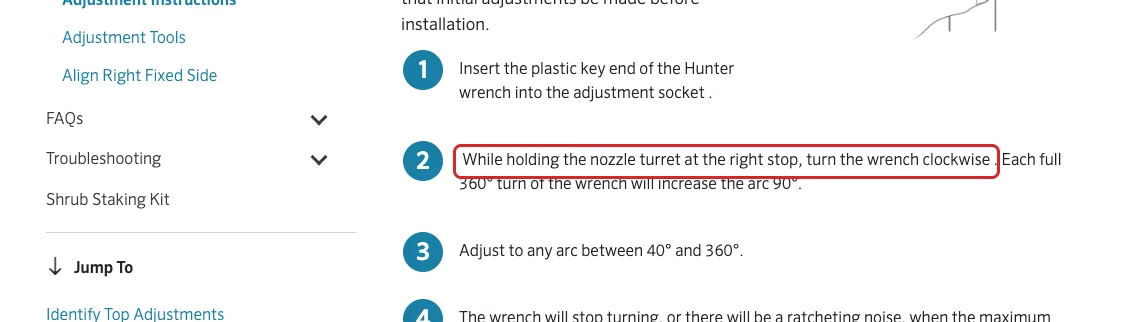
Hunter’s adjustment page prints the PGP Ultra range as both 50 to 360° and “5-360”; the PGP Ultra product page says 50°. Hunter also warns that more than 5 clockwise turns can drop the radius screw out (replacement 180900 for the PGP Ultra, 120300SP for the PGP-ADJ).
How to adjust a rotor sprinkler head, step by step
Gear rotors (slow-turning heads that throw 15 to 50 ft) have two sockets on top: an arc slot marked + and minus, and a radius screw in front of the nozzle. Rain Bird SA and Hunter PGP rotors can be set with the water on or off.
- Read the cap. A Rain Bird 5000 or 3500 has a fixed LEFT edge; a Hunter PGP, PGP Ultra, I-20 or Orbit Voyager II has a fixed RIGHT edge.
- Reset the turret. Rain Bird: turn the turret right until it stops, then left until it stops; that left stop is the fixed edge (Rain Bird SA sheet). Hunter: turn it all the way clockwise, then counterclockwise back to the right stop (Hunter right-side page).
- Aim the fixed edge. Turn the whole case (dig a little soil away to grip it), or unscrew the body cap, lift the internals out, line them up and screw them back.
- Set the arc. Hold the turret at the fixed stop, put the key or screwdriver in the arc slot and turn clockwise to widen or counterclockwise to narrow, about 90° per full turn. Stop at the ratchet: Rain Bird’s minimum is 40°, Hunter’s PGP Ultra 50°.
- If the head is running while you set the arc, turn the arc screw only in the direction the turret is already moving. Rain Bird warns that turning against it can strip the gears.
- Set the radius. Turn the radius screw clockwise into the stream to shorten the throw, by up to 25 percent on the 5000, SA, PGP Ultra and I-20, and up to 35 percent on the 3500 (Rain Bird 3500 spec). For more than that, change the nozzle; a 5000 Plus stops water at that head with a 180° clockwise turn of its flow shut-off slot.
- Run the zone for 2 to 3 minutes and walk it. Each head’s water should reach the next head (EPA WaterSense head-to-head rule).
Do not back the radius screw out past the nozzle: on SA rotors, Rain Bird says water pressure can then push the nozzle out into the lawn (Rain Bird SA sheet, p. 1). On the 5000 the same screw holds the nozzle in.
How to adjust spray heads: aim, arc and the center screw
Spray heads pop up and throw a fan; Rain Bird’s VAN nozzles alone span 3 to 18 ft. Rain Bird’s spray-head sheet gives the three moves: rotate the stem by hand to aim the pattern, twist the threaded collar on adjustable nozzles to set the arc, and turn the center screw clockwise to cut the throw by up to 25 percent (Rain Bird spray heads sheet). The 1800 Series body has a ratchet in the stem so the pattern can be aimed without tools (Rain Bird 1800 tech spec).
- Aim the fixed edge by turning the riser through its ratchet. Hunter sets the RIGHT edge of its Pro Adjustable nozzles this way before touching the arc (factory arc 90°).
- Set the arc. On Rain Bird VAN and HE-VAN nozzles, twist the center collar. On Hunter Pro Adjustable nozzles, hold the nozzle below the top ring and turn the ring counterclockwise to widen and clockwise to narrow (Hunter arc page).
- Set the radius with a small flathead in the center screw: clockwise shortens. Hunter’s limit is 25 percent; past that, it says to fit a smaller-radius nozzle (Hunter radius page).
- If one head throws short, clean the filter screen under the nozzle first, as Rain Bird’s sheet advises.
Rotary nozzles that screw onto spray bodies follow their own rules. The Rain Bird R-VAN needs the water ON for both adjustments: push down and turn the cap clockwise for more arc (45 to 270°), and turn the radius dial COUNTERCLOCKWISE to shorten it, never below 13 ft on the black R-VAN18 or 17 ft on the yellow R-VAN1724 (R-VAN guide, p. 2). Hunter’s MP Rotator takes about 4 full turns of the radius screw for its 25 percent cut and recommends a 30 psi regulated body for the maximum reduction (Hunter MP page).
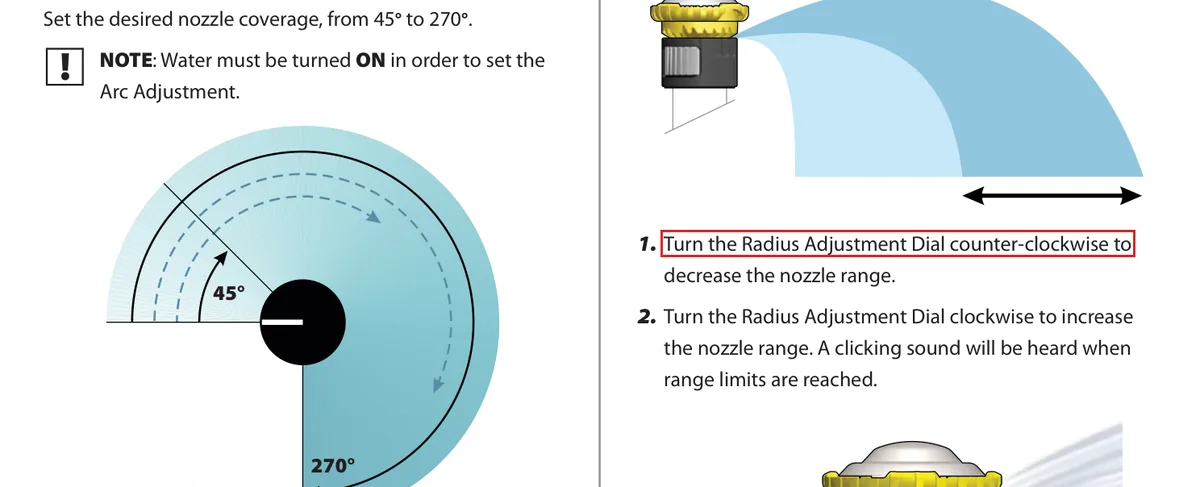
Toro’s 570 screw takes a 15 ft nozzle down to 3 ft, and Toro notes that precipitation rate and gpm fall with it (Toro 570Z instructions), so a nozzle dialed that far no longer matches its catalog rate.
How far can you turn the radius down?
On most heads the 25 percent figure protects uniformity rather than marking a hard stop; Hunter’s MP Rotator is the exception, with a slip clutch that limits the cut. Rain Bird’s 5000 instructions note that disrupting the stream with the screw lowers distribution uniformity, and Rain Bird’s VAN chart notes the screw may be needed just to hit catalog radius when the arc is set below maximum. Enter your nozzle’s catalog radius to see the shortest throw its maker allows before a smaller nozzle is the better fix.
- Shortest throw the maker allows (ft)
- 11.3
Default: a 15 ft nozzle at the 25 percent limit stops at 11.3 ft (15 x 0.75). Shortest throw = catalog radius x (1 minus the limit). Past this point Hunter says to install a smaller-radius nozzle, and Rain Bird notes the screw lowers distribution uniformity.
| Head and nozzle | Catalog radius | Maker limit | Shortest throw | Arithmetic |
|---|---|---|---|---|
| Rain Bird HE-VAN-15 at 30 psi | 15 ft | 25% | 11.3 ft | 15 x 0.75 |
| Rain Bird 5000, 3.0 nozzle at 45 psi | 39 ft | 25% | 29.3 ft | 39 x 0.75 |
| Rain Bird 3500, 2.0 nozzle at 45 psi | 27 ft | 35% | 17.6 ft | 27 x 0.65 |
| Hunter PGP Ultra, top of 17 to 46 ft range | 46 ft | 25% | 34.5 ft | 46 x 0.75 |
| Rain Bird R-VAN18 | 18 ft | 13 ft floor | 13 ft | printed floor |
Pressure moves the radius too. Rain Bird and Hunter both regulate spray bodies to 30 psi (Rain Bird 1800 PRS, Hunter Pro-Spray PRS30); Rain Bird’s 1800 P45 holds 45 psi for rotary nozzles, and the 5000 PRS rotor regulates at 45 psi. Rain Bird’s VAN sheet lists 30 psi as optimum and 15 psi as the bottom of its range, where a 15-VAN throws only 11 ft. If every head in a zone falls short, pressure is the cause, not the screws.
When pressure is so low that the far heads never rise at all, our guide to a sprinkler head that won’t pop up lists each maker’s minimum, from 15 psi for a Rain Bird 1800 to 25 psi for its SAM check-valve version.
Which adjustment fixes your problem?
Match the symptom to the control before turning anything. Most visible faults trace to one of 5 settings, and the order matters: edge first, then arc, then radius, then pressure.
1Is water hitting the drive, walk or wall at one END of the pattern?
YesRe-aim the fixed edge first: left on Rain Bird rotors and R-VAN, right on Hunter and Orbit rotors and Hunter spray nozzles. Turn the whole case or ratchet the riser, then reset the arc.
NoGo to the next question
2Does the head sweep too wide or too narrow?
YesChange the arc: rotors move about 90° per full turn, clockwise for wider on Rain Bird, Hunter and Orbit. Hunter Pro Adjustable spray tops widen counterclockwise.
NoGo to the next question
3Does the water throw past the edge of the lawn?
YesTurn the radius screw clockwise (the R-VAN dial counterclockwise), up to 25 percent, or 35 percent on a Rain Bird 3500. If it still overshoots, fit a shorter-radius nozzle.
NoGo to the next question
4Does the water fall short of the next head?
YesBack the radius screw out to factory full-open and clean the filter screen. If it is still short, check pressure (30 psi sprays, 45 psi rotary nozzles) or fit a longer nozzle.
NoGo to the next question
5Is the head misting or fogging?
YesPressure is too high for the nozzle: fit a 30 psi regulated spray body (Rain Bird 1800 PRS, Hunter PRS30), or a 45 psi body for rotary nozzles.
NoIf every head is set right and the lawn still has dry rings, it is a design problem: each head must reach the next one (EPA WaterSense), and sprays and rotors need separate zones (UF/IFAS AE472).
Source: Rain Bird, Hunter and Orbit adjustment instructions; EPA WaterSense; UF/IFAS AE472
Why one wrong head can flood or starve a whole zone
Adjustment cannot fix a zone that mixes head types. A Rain Bird 15-VAN spray at 30 psi applies 1.58 inches an hour in square spacing, while a 5000 rotor with a 3.0 nozzle at 45 psi applies 0.37 inch, about 4 times slower (VAN chart, 5000 chart). Rain Bird’s rotary nozzle guide says mixing rotary and standard spray nozzles in one zone is not recommended (Rain Bird).
The same numbers decide a repair: our guide to replacing a sprinkler head shows how to pick a nozzle, internal assembly or body that keeps the zone’s precipitation rate matched.
| Head or nozzle | Test pressure | Rate, square spacing | Source |
|---|---|---|---|
| Rain Bird 15-VAN, full circle | 30 psi | 1.58 in/hr | Rain Bird VAN tech spec |
| Rain Bird HE-VAN-15, full circle | 30 psi | 1.58 in/hr | Rain Bird HE-VAN tech spec |
| Toro Precision PSN15-F | 30 psi | 0.9 in/hr | Toro Precision nozzle charts |
| Rain Bird R-VAN (scheduling rate) | 20 to 55 psi | 0.6 in/hr | Rain Bird R-VAN guide |
| Rain Bird 3500, 2.0 nozzle, half circle | 45 psi | 0.51 in/hr | Rain Bird 3500 instructions |
| Hunter PGP Ultra and I-20 | 25 to 70 psi recommended | 0.4 in/hr, approximately | Hunter PGP Ultra page |
| Rain Bird 5000, 3.0 nozzle, half circle | 45 psi | 0.37 in/hr | Rain Bird 5000 tech spec |
Florida’s Urban Mobile Irrigation Labs show how common these faults are. In UF/IFAS publication AE472 (revised August 2024), auditors found mixed sprinkler sizes and unmatched rates in one zone at 65.7 percent of 3,416 homes, and heads “not properly adjusted, causing overflow on paved areas” at 39.0 percent. Adjusting fixes the second, not the first; turf and beds on one zone, found at 70.8 percent of the same homes, are better split, as our comparison of drip irrigation vs sprinkler heads for beds and lawns explains.
| Problem code (UF/IFAS AE472) | Homes affected | Share of 3,416 audits |
|---|---|---|
| 20: Mixed sprinkler sizes, unmatched application rates in one zone | 2,246 | 65.7% |
| 40: Stream of water blocked by vegetation | 2,029 | 59.4% |
| 32: Heads not properly adjusted, overflow on paved areas | 1,333 | 39.0% |
| 21: Mixed sprinkler brands or types in one zone | 1,252 | 36.7% |
| 30: Leaks and broken valves, pipe, emitters or sprinklers | 971 | 28.4% |
| 23: Poor overlap from sprinkler alignment or spacing | 729 | 21.3% |
To check your work, run a catch-can test. New Mexico State’s Guide H-510 uses at least 24 cans on a calm day (wind 5 mph or less), set 5 to 8 ft apart for spray heads in an irregular lawn. Divide the average of the lowest quarter of cans by the overall average: 0.55 rates “good” for fixed sprays and 0.65 for rotors. The run time that follows from the result belongs in the controller; our guide to the best time to water a lawn and how long to run each zone converts inches to minutes.
| Rating | Fixed spray | Rotor |
|---|---|---|
| Excellent | 0.75 | 0.80 |
| Very good | 0.65 | 0.70 |
| Good | 0.55 | 0.65 |
| Fair | 0.50 | 0.60 |
| Poor | 0.40 | 0.50 |
Where popular guides disagree with the manuals
Three of the pages ranking for this query today give directions the makers’ own documents contradict. Each row quotes the guide, then the primary source.
| What the guide says | What the maker says | Maker source |
|---|---|---|
| Sprinkler Warehouse, homeowner guide: on spray nozzles, turning the top screw “clockwise will increase the spray distance” (page) | Clockwise reduces the radius on Rain Bird, Hunter and Toro spray nozzles | Hunter radius page; Toro 570Z |
| Sprinkler Warehouse, Rain Bird page: set the fixed left edge by turning an “adjustment screw or dial” clockwise (page) | No screw moves the left edge: rotate the turret or the whole case to align it | Rain Bird 5000; Rain Bird SA sheet |
| Drip Depot: the spray-nozzle screw also adjusts “the direction of the spray” (page) | Direction is set by rotating the stem by hand; the screw changes distance | Rain Bird spray heads sheet |
| Sprinkler Warehouse, homeowner guide: the rotor tool turns in the arc slot “to move the entire sprinkler assembly”, with no fixed side named (page) | The arc key moves only the adjustable edge; aim the fixed edge (left on Rain Bird, right on Hunter PGP, I-20 and Orbit Voyager II) by turning the case | Hunter; Rain Bird 5000; Orbit |
Impact heads: trip collars, trip pin and diffuser screw
Impact sprinklers have no key. Rain Bird’s guide sets the arc with two arc adjusters (trip collars), one at each side of the pattern: plastic models slide with a thumb, metal ones are pinched together, then slid (Rain Bird impact guide, p. 1). Flip the trip pin up for full-circle operation and down for part circle. The diffuser screw, turned clockwise into the stream, shortens the throw by up to 25 percent; the distance control flap tilts down into the stream for more.
If an impact head stops reversing, check pressure: Rain Bird says most models need at least 25 psi at the last head. Never oil it or drill the nozzle; Rain Bird says to clean it, using vinegar and water on mineral deposits.
Heads that sit crooked or below the grass need a reset, not an adjustment; shallow lines are covered in our page on how deep sprinkler lines should be. After a winter shutdown, set the heads only once the zones are pressurized again, following our checklist to turn a sprinkler system back on; the valve for each zone is easier to find with how to find a sprinkler valve box.
How we compiled this
We read 26 primary documents on Nov. 20, 2026: 12 Rain Bird instruction sheets, tech specs and guides, 8 Hunter support and product pages, 1 Orbit and 2 Toro documents, plus UF/IFAS AE472, NMSU H-510 and EPA WaterSense’s Sprinkler Spruce-Up page. Every turn direction, range and limit in the tables is copied from those documents. We did not test any heads. Where a maker does not publish a figure (Orbit’s radius limit), the table says so.
Frequently asked questions
What is the little screw on the top of the sprinkler head?
It is the radius adjustment screw. Turned clockwise it moves into the water stream and shortens the throw, by up to 25 percent on most Rain Bird and Hunter nozzles. On Rain Bird 5000 rotors the same screw also holds the nozzle in, so Rain Bird calls it the nozzle retention screw (Rain Bird).
How do you adjust a pop-up rotary sprinkler head?
Find the fixed edge (left on Rain Bird, right on Hunter and Orbit), turn the case to aim it, then turn the arc slot clockwise to widen, about 90° per full turn. Shorten the throw with the radius screw, clockwise, up to 25 percent (35 percent on a Rain Bird 3500).
How do I get my sprinkler to spray further?
Back the radius screw out to its factory full-open setting, clean the filter screen and check pressure: 30 psi for sprays, about 45 psi for rotary nozzles. Rain Bird says any increase past the nozzle’s catalog throw needs a different nozzle or more pressure (Rain Bird SA sheet).
How do I adjust the rotation of my sprinkler head?
On a gear rotor, the arc slot sets how far it turns: clockwise adds arc, 90° per full turn, until it ratchets at 360°. If the head is running, turn only in the direction it is already moving; Rain Bird warns that turning against it can strip the gears.
My Rain Bird sprinkler head isn’t rotating. What can I do?
Check pressure and debris first. R-VAN nozzles need 20 to 55 psi (45 recommended) and a clean screen, and in sandy water may take 2 to 4 minutes to flush and start turning (R-VAN guide, p. 3). Impact heads need at least 25 psi at the last head.
How long should I run my sprinklers in each zone?
Long enough to apply your target depth at that zone’s rate. At 1.58 inches an hour, a Rain Bird 15-VAN zone puts down 1/2 inch in about 19 minutes; at 0.6 inch an hour, an R-VAN zone needs 50 minutes for the same depth, which is why Rain Bird says rotary run times can be 2 to 3 times longer.
Sources
- Rain Bird Corporation, 5000 Series Rotors installation instructions, D42374, 10/2023. Accessed November 2026.
- Rain Bird Corporation, 5000 Series Rotors technical specifications, D42380, 2023. Accessed November 2026.
- Rain Bird Corporation, 3500 Series Rotor installation instructions, D42377, 10/2023. Accessed November 2026.
- Rain Bird Corporation, 3500 Series Rotors technical specifications, 2023. Accessed November 2026.
- Rain Bird Corporation, Simple Adjust Series Rotors operating instructions (32SA, 42SA, 42SA+, 52SA), current PDF. Accessed November 2026.
- Rain Bird Corporation, Spray Heads: how to change the nozzle and adjust direction, distance and pattern, current PDF. Accessed November 2026.
- Rain Bird Corporation, Variable Arc Nozzles (VAN) tech spec, current PDF. Accessed November 2026.
- Rain Bird Corporation, High-Efficiency Variable Arc Spray Nozzles (HE-VAN) tech spec, current PDF. Accessed November 2026.
- Rain Bird Corporation, R-VAN Adjustable Rotary Nozzle installation guide, 2018. Accessed November 2026.
- Rain Bird Corporation, Rotary Nozzle installation guide, 2018. Accessed November 2026.
- Rain Bird Corporation, 1800 Series Spray Heads tech spec, 2020. Accessed November 2026.
- Rain Bird Corporation, Impact Sprinkler Troubleshooting Guide, 2018. Accessed November 2026.
- Hunter Industries, Residential Rotor: Adjustment Instructions, current page. Accessed November 2026.
- Hunter Industries, Residential Rotors: Adjusting the Right (Fixed) Side Arc of the PGP Rotor, current page. Accessed November 2026.
- Hunter Industries, PGP Ultra product page, current page. Accessed November 2026.
- Hunter Industries, I-20 product page, current page. Accessed November 2026.
- Hunter Industries, MP Rotator Nozzle: Adjustment, current page. Accessed November 2026.
- Hunter Industries, Spray Nozzle: Arc Adjustment, current page. Accessed November 2026.
- Hunter Industries, Spray Nozzle: Radius Adjustment, current page. Accessed November 2026.
- Hunter Industries, Pro-Spray PRS30 product page, current page. Accessed November 2026.
- Orbit Irrigation, Saturn IV and Voyager II Adjustment Key 55070, checked Nov. 20, 2026. Accessed November 2026.
- The Toro Company, 570Z and 570S Series Sprinklers installation instructions, 2020. Accessed November 2026.
- The Toro Company, Precision Series Spray Nozzles performance data, current PDF. Accessed November 2026.
- UF/IFAS Extension, AE472, Frequency of Residential Irrigation Maintenance Problems (Olmsted, Dukes and Cardenas), revised August 2024. Accessed November 2026.
- New Mexico State University, Guide H-510, How to Perform a Catch Can Irrigation Audit on a Home Lawn Sprinkler System, July 2013. Accessed November 2026.
- U.S. EPA WaterSense, Sprinkler Spruce-Up, current page. Accessed November 2026.