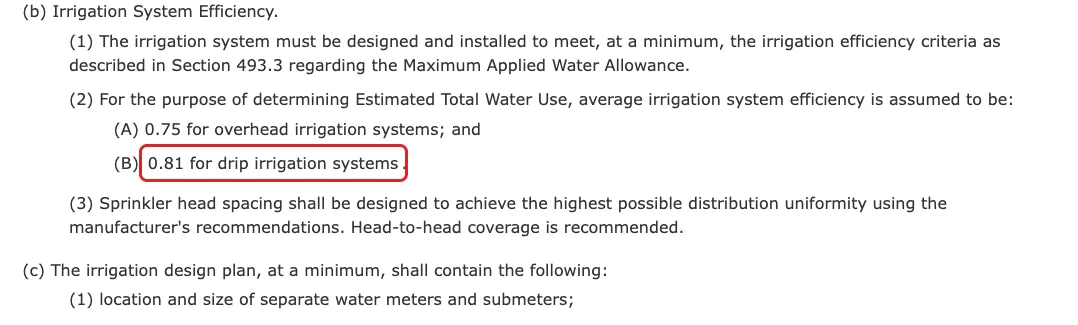
Drip irrigation vs sprinkler comes down to what you water: drip wins in beds, shrubs, trees, narrow strips and slopes; sprinklers still win on open lawn. California code credits drip with 81 percent efficiency against 75 percent for overhead spray.
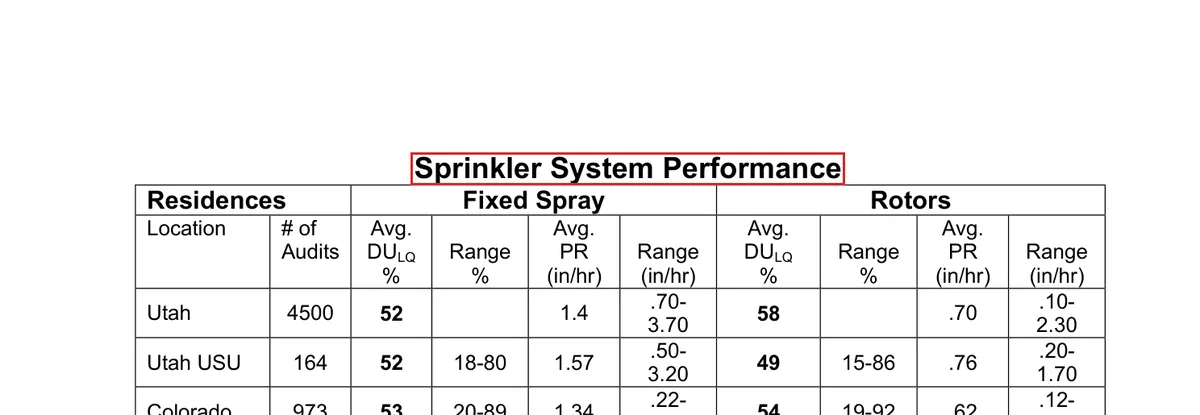
The gap between drip irrigation vs sprinkler systems is wider in real yards than on a spec sheet. In 4,500 Utah home irrigation audits summarized in an Irrigation Association technical paper, fixed spray zones averaged a lower-quarter distribution uniformity of 52 percent while putting down 1.4 inches an hour, and that rate is 7 times what heavy clay can absorb. Drip emitters, by contrast, release water in gallons per hour at the root zone, so wind, overspray and runoff have little to act on.
This page sets those field numbers beside the code and rebate rules that now push beds toward drip. It does not repeat installation: our guide to setting up a drip irrigation system covers parts, zone math and the 10 steps, and the soaker hose vs drip irrigation comparison covers the cheaper hose option.
Drip irrigation vs sprinkler, factor by factor
Fourteen measurable differences, each with the document it comes from. Efficiency figures differ by source because each one measures something different: the California figure is an assumption for code water budgets, the extension figures are rules of thumb, and the EPA WaterSense figure compares whole-system water use.
Swipe the table sideways to see every column.
| Factor | Drip | Sprinkler (spray or rotor) | Source |
|---|---|---|---|
| Efficiency California code assumes | 81% | 75% (overhead) | Cal. Code Regs. tit. 23, §493.2.2(a)(2) |
| Efficiency extension guides cite | Over 90% | 50 to 70% | Colorado State Extension; UAF Extension |
| Water use vs a conventional sprinkler system | 20 to 50% less | Baseline | EPA WaterSense, Microirrigation |
| Water saved per typical home per year | More than 25,000 gal | Baseline | EPA WaterSense, Microirrigation |
| Application rate | 0.15 to 1.48 in/h (Techline CV dripline, by soil and spacing) | 1.58 to 1.76 in/h (HE-VAN spray, 30 psi); 0.24 to 0.70 in/h (5000 rotor, 45 psi) | Netafim subsurface guide p. 8; Rain Bird spray and 5000 charts |
| Measured evenness | Emitter flow CV 1.8 to 2.3% (Techline CV, lab) | Lower-quarter DU 49 to 58% (home audit averages) | IA technical papers 2013 and 2004 |
| Minimum evenness the IA expects | Not rated by catch cans | DU 55% spray, 70% rotor | Mecham, IA 2004, citing IA BMPs Feb. 2004 |
| Filter and pressure regulator | Required | Not needed on city water | Arizona Extension AZ1392 |
| Within 24 in. of pavement (California) | Allowed | Not permitted unless no runoff or an approved alternate design | Cal. Code Regs. tit. 23, §493.2.2(a)(10) |
| Strips under 48 in. wide bordered by pavement (Texas, new systems) | Allowed | No above-ground spray | 30 Tex. Admin. Code §344.62 |
| Slopes over 25% (California) | Allowed at 0.75 in/h or less | Standard sprays exceed the 0.75 in/h cap | Cal. Code Regs. tit. 23, §493.2.2(a)(12) |
| Watering days in Tampa, 2026 | Any day (non-turf), 12 to 8 a.m. or 6 p.m. to midnight | 1 day a week, 12 to 4 a.m. or 8 p.m. to midnight | City of Tampa, effective Apr. 3, 2026 |
| Wets foliage | No | Yes | UGA Extension C1095 |
| Leaks easy to spot | No: water seeps at ground level | Yes | Colorado State Extension |
How much more efficient is drip irrigation?
From 6 to more than 40 percentage points, depending on whose number you use. Colorado State University Extension and University of Alaska Fairbanks Extension both state drip exceeds 90 percent efficiency while sprinkler systems run 50 to 70 percent. EPA WaterSense says microirrigation uses 20 to 50 percent less water than conventional sprinkler systems and can save a typical home more than 25,000 gallons a year.
California’s landscape code is more conservative. For water budgets under the Model Water Efficient Landscape Ordinance, Cal. Code Regs. tit. 23, §493.2.2(a)(2) assumes 0.75 efficiency for overhead irrigation and 0.81 for drip, a 6-point gap. The same section requires every new overhead system to document a lower-quarter distribution uniformity of 0.65 or higher under ASABE/ICC 802-2020, so the code number describes a sprinkler system that has been designed and tested, not a typical one.
Typical ones score lower. The Irrigation Association’s 2004 best management practices set a minimum lower-quarter uniformity of 55 percent for fixed spray and 70 percent for rotors. Brent Mecham of the Northern Colorado Water Conservancy District pooled more than 6,800 audits and found the average sat near 50 percent whatever the head type, even though residential auditors usually tested only 1 or 2 zones that looked best or most typical.
| Audit set | Audits | Spray DU (lower quarter) | Spray rate, in/h | Rotor DU (lower quarter) | Rotor rate, in/h |
|---|---|---|---|---|---|
| Utah, residential | 4,500 | 52% | 1.4 | 58% | 0.70 |
| Utah State Univ., residential | 164 | 52% | 1.57 | 49% | 0.76 |
| Colorado, residential | 973 | 53% | 1.34 | 54% | 0.62 |
| Florida, residential | 576 | 54% | not given | not given | not given |
| IA minimum acceptable DU | 55% | 70% |
Drip is graded differently: by how closely each emitter matches its rated flow, since there is no spray pattern to catch in cans. In Cal Poly ITRC lab tests published by the Irrigation Association in 2013, Netafim Techline CV dripline showed a coefficient of variation of 0.018 to 0.023, about 2 percent. That evenness only holds if the zone has a filter, a pressure regulator and emitters placed where the roots are.
To see what those efficiency figures mean in gallons, set your area and weekly water need below. Gallons equal square feet times inches times 0.623, divided by efficiency.
- Gallons a week
- 769
- Gallons over a 26-week season
- 19,998
Default: 1,000 sq ft needing 1 inch a week through drip at 81 percent takes about 769 gallons a week; through spray at 75 percent, 831; at 50 percent, 1,246. Gallons = sq ft x inches x 0.623 / efficiency.
| Efficiency assumed | Factor | Gallons a week, 1,000 sq ft, 1 in. net |
|---|---|---|
| Drip, 90% (Colorado State Extension) | 0.90 | 692 |
| Drip, 81% (California code) | 0.81 | 769 |
| Overhead spray, 75% (California code) | 0.75 | 831 |
| Sprinklers, 70% (CSU, high end) | 0.70 | 890 |
| Sprinklers, 50% (CSU, low end) | 0.50 | 1,246 |
Why do spray heads run off clay and slopes?
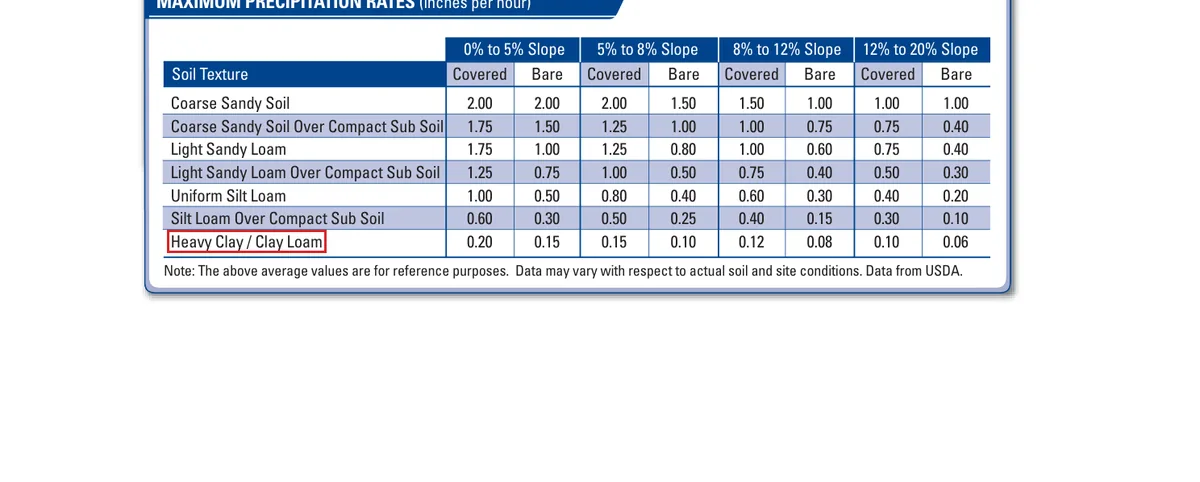
Because they apply water faster than most soils take it in. Rain Bird’s HE-VAN nozzles put down 1.58 to 1.76 inches an hour at 30 psi in square spacing (Rain Bird spray nozzle catalog), and the USDA chart reprinted in Netafim USA’s subsurface dripline guide gives covered heavy clay on a 0 to 5 percent slope an intake of 0.20 inch an hour. Past that point water ponds, then runs to the curb.
| Device or soil | Inches per hour | Minutes to apply 1/2 inch | Source |
|---|---|---|---|
| Rain Bird HE-VAN spray nozzle, 8 to 15 series, 30 psi | 1.58 to 1.76 | 17 to 19 | Rain Bird spray nozzle catalog |
| Home spray zones, audited average | 1.34 to 1.57 | 19 to 22 | Mecham, IA 2004 |
| Rain Bird R-VAN rotary nozzle | 0.6 | 50 | Rain Bird spray nozzle catalog |
| Home rotor zones, audited average | 0.62 to 0.76 | 39 to 48 | Mecham, IA 2004 |
| Rain Bird 5000 rotor, 1.5 to 8.0 nozzle, 45 psi | 0.24 to 0.70 | 43 to 125 | Rain Bird 5000 chart |
| Techline CV dripline under turf, sandy soil (0.6 GPH, 12 in.) | 0.73 to 0.98 | 31 to 41 | Netafim guide p. 8 |
| Techline CV dripline under turf, loam (0.4 GPH) | 0.25 to 0.30 | 100 to 120 | Netafim guide p. 8 |
| Techline CV dripline under turf, clay (0.26 GPH, 18 in.) | 0.15 to 0.19 | 158 to 200 | Netafim guide p. 8 |
| What the soil absorbs: heavy clay, covered, 0 to 5% slope | 0.20 | USDA chart in Netafim guide p. 6 | |
| What the soil absorbs: uniform silt loam, covered, 0 to 5% slope | 1.00 | USDA chart in Netafim guide p. 6 | |
| What the soil absorbs: coarse sandy soil, covered, 0 to 5% slope | 2.00 | USDA chart in Netafim guide p. 6 |
Rotors and rotary nozzles close most of that gap: Rain Bird’s R-VAN is rated at 0.6 inch an hour and its 5000 series rotor at 0.24 to 0.70 at 45 psi (5000 performance chart). Spray zones on clay can still work if you split the run into short cycles; our guide to improving clay soil covers raising the intake rate itself.
On slopes, California writes the limit into code: §493.2.2(a)(12) bars any system applying more than 0.75 inch an hour on slopes steeper than 25 percent unless the designer documents an alternative. Every HE-VAN rate in the Rain Bird catalog exceeds that cap, so on a California slope the realistic choices are drip, rotors or rotary nozzles. The same USDA chart drops covered clay to 0.10 inch an hour at 12 to 20 percent slope.
Can you use drip irrigation for a lawn?
Yes, but only as buried dripline laid in a grid, not as emitters on the surface. Netafim’s guide calls for Techline CV dripline buried evenly 4 to 6 inches deep, with the emitter flow and spacing set by soil: 0.26 GPH at 18-inch intervals in rows 18 to 22 inches apart in clay, 0.4 GPH at 12 inches in loam, 0.6 GPH at 12 inches in rows 12 to 16 inches apart in sand. Where lawns are core-aerated, it says to bury the line 6 inches deep and keep aeration to 4 inches.
The trade-offs are cost and roots. On a 1,000 sq ft sandy lawn at 12-inch rows, that grid is about 1,000 feet of dripline, against a handful of rotor heads. Root intrusion was the historic failure: a 1994 Irrigation Association conference paper by Karen Ruskin Ferguson reported that 10 percent of untreated buried emitters were root-blocked within 3 years and 95 percent within 6 years. The paper’s fixes were chemical and physical root barriers, and Netafim’s guide sells Techline CV on its physical one.
Subsurface dripline also hides problems. A cut line from an edger or a vole tunnel shows only as a brown stripe, and CSU Extension notes that water seeping at ground level makes it hard to know whether the system is working. For most lawns, matched-precipitation rotors on a tuned schedule are the simpler path; our guide to the best time to water a lawn covers the inches and hours, and the batch guide how deep sprinkler lines should be covers burial depth for the pipe.
Where does each system win?
Sort the yard by what grows in each zone, not by the whole property. The decision steps below follow the rules and rates in the tables above; a typical home ends up with rotors on the lawn and 1 or 2 drip zones for beds, the mix priced in our sprinkler system installation cost guide.
1Is the zone open lawn, wider than a parkway strip?
YesRotors or rotary nozzles at 0.6 in/h or less; subsurface dripline only if you accept a 4 to 6 in. buried grid and its cost.
NoGo to the next question
2Is it a strip under 48 inches wide, or within 24 inches of pavement?
YesDrip (Texas bars spray in new systems for such strips; California bars overhead within 24 in. of pavement unless no runoff occurs).
NoGo to the next question
3Is the slope steeper than 25 percent?
YesDrip, or rotors at 0.75 in/h or less (California cap).
NoGo to the next question
4Is it vegetables, flowers, shrubs or trees?
YesDrip: dry foliage, roots-only watering, and often more watering days.
NoMixed planting: split it into a drip zone for beds and a rotor zone for turf on separate valves.
Source: 23 CCR 493.2.2; 30 TAC 344.62; Rain Bird; Netafim; UGA C1095
- Vegetable and flower beds: drip. UGA Extension circular C1095 notes overhead watering wets foliage, which can lead to foliar diseases, while drip keeps leaves dry.
- Shrubs and trees: drip, with emitters 12 inches apart in sand, 18 in loam and 24 in clay (CSU Extension), moved outward as the canopy grows.
- Open lawn: rotors or rotary nozzles at 0.6 inch an hour or less; wet blades at night feed the lawn fungus diseases that need hours of leaf wetness, so water before dawn.
- Parkway strips and side yards: drip. California bars overhead irrigation within 24 inches of pavement unless no runoff occurs or the designer documents an alternative, and Texas bars above-ground spray in new systems for strips under 48 inches wide with pavement on 2 or more sides (30 TAC §344.62).
- Slopes over 25 percent: drip or rotors; standard spray nozzles at 1.58 inches an hour or more exceed the 0.75 inch-an-hour California slope limit.
Do watering restrictions treat drip differently?
Often, yes. Drip is commonly exempt from day-of-week limits, or gets more days than a sprinkler. CSU Extension says many utilities exempt drip-irrigated landscapes from drought restrictions. The 4 rules below were in force when we checked them in November 2026; the Southwest Florida Water Management District applies the same any-day, before 8 a.m. or after 6 p.m. rule for microirrigation district-wide under its Modified Phase III order.
| Utility | Sprinklers | Drip | Source |
|---|---|---|---|
| Tampa, FL (from Apr. 3, 2026) | 1 day a week by address; 12 to 4 a.m. or 8 p.m. to 11:59 p.m. | Microirrigation of beds, shrubs, trees and groundcover any day; 12 to 8 a.m. or 6 to 11:59 p.m.; not lawns | City of Tampa |
| Bozeman, MT (permanent since June 16, 2022) | Overhead spray 3 days a week by address; before 10 a.m. or after 8 p.m. | Low-volume drip exempt for trees, shrubs, perennials, groundcover, annual beds and food gardens | City of Bozeman |
| Austin, TX (Conservation Stage from Sept. 2, 2025) | Automatic systems 1 day a week; midnight to 10 a.m. or 7 p.m. to midnight | Drip 2 days a week in the same hours; drip on vegetable gardens any day, any time | Austin Water |
| Santa Monica, CA | 2 days a week by address; spray heads 10 minutes per station per day | Drip watering a food source every day except 9 a.m. to 5 p.m. | City of Santa Monica |
Read the fine print on what counts as drip. Tampa and Southwest Florida exclude lawns from the microirrigation exemption, and Austin’s any-day rule covers drip on vegetable gardens only. A dripline grid under turf in Tampa is still on the 1-day lawn schedule.
Are there rebates for switching from spray to drip?
In parts of California, yes, and they come and go. East Bay Municipal Utility District pays up to $0.25 per square foot to convert a whole spray zone, and Santa Monica’s guide lists $2.00 per square foot up to $4,000. Orange County’s program closed to new applications on September 8, 2026, and Pasadena’s free kit is paused. EBMUD and Santa Monica both require a working spray system and pre-approval or before photos, so do not dig first.
| Program | Amount | Main conditions | Status, November 2026 | Source |
|---|---|---|---|---|
| EBMUD (East Bay, CA) | Up to $0.25 per sq ft | Rebates capped at $2,000 per 2 years for single-family homes; whole zone converted; apply before buying; 0.4 to 0.6 GPH emitters recommended; mulch, no weed cloth | Open; requirement sheet updated Jan. 2026 | EBMUD |
| City of Santa Monica, CA | $2.00 per sq ft | Up to $4,000 for single-family homes; planter beds and hedges only, not lawn; sprinklers must work before conversion | Program guide dated Sept. 2022 | Santa Monica guide |
| Orange County, CA (MWDOC, via Yorba Linda Water District) | Not listed after closing | Minimum 250 sq ft converted from spray to drip | Closed to new applications Sept. 8, 2026 | YLWD |
| Pasadena Water and Power, CA | Free retrofit kit valued at about $288 | Covers 200 linear ft: 1800 body with filter and regulator, 200 ft of drip coil, 60 emitters | Paused for program review | PWP |
For what the conversion costs before a rebate, the cost guide lists Rain Bird drip zone kits and installer prices for adding or retrofitting a drip zone.
What are the downsides of drip irrigation?
Drip trades water savings for upkeep you cannot see. University of Arizona Extension AZ1392 says drip needs a pressure reducer and a filter to protect emitters from high pressure and clogging, plus its own valve, because sprinklers and drip run at different pressures and rates.
Most of that upkeep is clog prevention: our page on drip irrigation emitters clogged by grit, scale, slime or roots lists the filter mesh, flush speed and chlorine rates extension services publish for each.
- Hidden failures: seepage is hard to see, so CSU suggests a flow indicator that raises a flag while water runs.
- Clogging: grit and hard-water minerals block emitters; AZ1392 says to keep filters clean, flush the system periodically and inspect emitters by eye.
- Run-length limits: UC ANR applies the 30/30 rule to 1/4-inch tubing: no run over 30 feet and no more than 30 gallons an hour on it.
- Damage: CSU notes surface tubing is a trip hazard and easy to cut with tools; mulch over it and stake it every 2 to 3 feet.
- Plants outgrow it: emitters placed at planting must move out from trunks as shrubs and trees grow, or roots stay confined to the wetted spot.
Sprinklers have their own maintenance: broken heads, tilted nozzles and sunken bodies that lower uniformity. Our sprinkler repair cost guide prices both kinds of repair, and winterizing a sprinkler system covers draining drip zones, whose thin tubing splits when water freezes in it. The batch guide on turning a sprinkler system back on covers the spring restart.
Many coverage faults are a screwdriver job rather than a repair: our guide on how to adjust sprinkler heads gives each model’s arc direction and the 25 percent cap on radius reduction.
How we compiled this
We read 24 primary documents in November 2026: 2 California and Texas regulations, 5 utility watering-rule pages, 4 utility rebate pages or guides, 4 Rain Bird and Netafim product documents, 3 Irrigation Association papers and 6 extension publications. We ran no field tests; audit and lab figures are as their authors published them, and calculator results are arithmetic on those published efficiency factors.
Frequently asked questions
Is drip irrigation better than sprinklers?
For beds, shrubs, trees, narrow strips and slopes, yes: drip puts water at the roots at rates the soil can absorb, and EPA WaterSense puts the saving at 20 to 50 percent. For open lawn, rotors or rotary nozzles at 0.6 inch an hour or less are usually the better fit.
What is a major downside to drip irrigation?
You cannot see it fail. CSU Extension notes that water seeping at ground level makes it hard to tell whether the system is working, and clogged or cut lines show only as stressed plants. A filter, a pressure regulator and a flow indicator reduce the risk.
What is the 30/30 rule for drip irrigation?
It is a friction-loss limit for 1/4-inch tubing: no single run longer than 30 feet and no more than 30 gallons per hour on it, per UC ANR, May 2024. Longer runs lose enough pressure that emitters at the far end underwater.
Why are homeowners ditching irrigation sprinklers?
Mostly in beds, not lawns, and mostly where rules and money push them. Bozeman exempts drip from its 3-day spray schedule, Tampa lets microirrigation run any day while lawns get 1, California bars overhead spray within 24 inches of pavement where it would cause runoff, and East Bay and Santa Monica utilities pay $0.25 to $2.00 per square foot to convert.
Can you run drip and sprinklers on the same valve?
No. University of Arizona Extension says sprinkler and drip irrigation apply water at different rates and pressures and need separate valves. Converting a spray zone means removing or capping its spray heads, as Orange County’s program terms required, and fitting a filter and pressure regulator at the head of the drip line.
Sources
- California Office of Administrative Law (via Cornell LII), Cal. Code Regs. tit. 23, §493.2.2, Irrigation Design Plan, current text. Accessed November 2026.
- Texas Commission on Environmental Quality (via Cornell LII), 30 Tex. Admin. Code §344.62, Minimum Design and Installation Requirements, current text. Accessed November 2026.
- U.S. EPA WaterSense, Microirrigation, web page. Accessed November 2026.
- Colorado State University Extension (C. Wilson, M. Bauer), Drip Irrigation for Home Gardens, 1998, reviewed Aug. 2025. Accessed November 2026.
- University of Alaska Fairbanks Cooperative Extension, Drip Irrigation, web page. Accessed November 2026.
- University of Arizona Extension (AZ1392), Basics of Drip Irrigation for Landscaping, March 2016. Accessed November 2026.
- UGA Extension (B. Westerfield), Circular 1095, Drip Irrigation in the Home Vegetable Garden, 2016, reviewed July 2022. Accessed November 2026.
- UC ANR, The Backyard Gardener, Flow Focus: Irrigation Friction Loss, May 20, 2024. Accessed November 2026.
- Irrigation Association (B. Mecham), Using Distribution Uniformity to Evaluate the Quality of a Sprinkler System, 2004. Accessed November 2026.
- Irrigation Association (Cal Poly ITRC), Pressure Compensating Emitter Characteristics, 2013. Accessed November 2026.
- Irrigation Association conference paper (K. R. Ferguson), hosted by K-State, Subsurface Drip Irrigation for Turf, 1994. Accessed November 2026.
- Netafim USA, Subsurface Dripline Guide: Selection, Installation and Operation Guidelines, 2014. Accessed November 2026.
- Rain Bird, Spray Nozzles, Turf Catalog, 2018. Accessed November 2026.
- Rain Bird, 5000/5000 Plus Series Nozzle Performance Chart, 2017. Accessed November 2026.
- City of Tampa Water Department, My Allowed Watering Days and Hours, effective Apr. 3, 2026. Accessed November 2026.
- Southwest Florida Water Management District, District Water Restrictions, Modified Phase III, 2026. Accessed November 2026.
- City of Bozeman, Permanent Watering Restrictions, since June 16, 2022. Accessed November 2026.
- Austin Water, Find Your Watering Day, Conservation Stage from Sept. 2, 2025. Accessed November 2026.
- City of Santa Monica, Watering Restrictions, web page. Accessed November 2026.
- East Bay Municipal Utility District, Irrigation Equipment Rebates, web page. Accessed November 2026.
- East Bay Municipal Utility District, Spray to Drip Conversion Rebate requirements, updated Jan. 2026. Accessed November 2026.
- City of Santa Monica, Spray to Drip Irrigation Conversion Rebate Program Guidebook, Sept. 2022. Accessed November 2026.
- Yorba Linda Water District, Residential Rebates (MWDOC Spray-to-Drip), program closed Sept. 8, 2026. Accessed November 2026.
- Pasadena Water and Power, Spray-to-Drip Residential Retrofit Program, paused, Nov. 2026. Accessed November 2026.