Drip irrigation emitters clogged with grit need a flush at 1 foot per second and a finer filter; white scale needs an acid soak; slime needs chlorine; roots mean replacement. An overnight soak of one emitter in water, vinegar or dilute bleach tells you which.
When drip irrigation emitters are clogged, what is inside the emitter names the fix. Grit leaves with a fast flush, hard-water scale needs acid, slime and algae need chlorine, and roots in buried dripline do not come out at all. Clemson Extension (LGP 1190, 2024) lists the same causes, plus soil sucked back into buried lines.
To tell them apart, use the soak test from Clean WateR3, a federally funded Specialty Crop Research Initiative project on irrigation water. None of the top-ranking pages for this question gives that test, a flush speed, or a chlorine or acid rate with a source; the tables below set those numbers from 10 extension bulletins and 5 maker guides side by side. If you are still building the zone, the filter and regulator order is in our drip irrigation setup guide.
What is clogging your drip emitters?
Open the end cap of the worst line and run the zone into a clean white bucket for 1 to 2 minutes, the check UF/IFAS Bulletin 333 uses. Sand points to grit, red or white slime to bacteria, and white flakes to minerals coming off the tubing walls. Then pull one dead emitter and look at its outlet.
| What you find | Clog type | Where it starts | Fix that matches | Number to use | Source |
|---|---|---|---|---|---|
| Sand or silt that settles in the bucket | Grit (physical) | Ends of the lines, where flow slows to the last emitter’s rate | Flush the ends; check the filter mesh | 1 ft per second at the line end, about 1 gpm in 1/2 to 5/8 in. tubing | UC ANR; UF B333 |
| White or chalky crust on the outlet | Calcium or magnesium carbonate scale (chemical) | Emitter openings, after shutoff as the line dries | Acid soak for removable emitters; acid treatment or new dripline | Severe hazard above pH 7.5 or 300 ppm hardness | UF AE032; OSU BAE-1511 |
| Red, yellow or tan slime (ochre) | Iron bacteria (biological) | Lines fed by well water | Chlorine to oxidize the iron, then filter and flush | Ferrous iron as low as 0.2 ppm adds deposits | UF AE032; Clemson |
| White to yellow stringy slime | Sulfur bacteria (biological) | Shallow wells with a rotten-egg smell | Chlorine, then flush | Over 0.1 ppm sulfides is troublesome | Penn State; UF AE032 |
| Green or brown strands | Algae (biological) | Pond or other surface water; clear or sunlit parts | Filter at the source; chlorine, then flush the dead algae out | 10 to 20 ppm chlorine for 30 to 60 minutes | Penn State; UGA B1130 |
| Gritty, crystalline deposit after feeding | Fertilizer precipitate (chemical) | Downstream of a fertilizer injector | Stop mixing incompatible products; flush after every injection | Calcium nitrate plus diammonium phosphate forms insoluble calcium phosphate | Clemson; UC ANR |
| Hair-fine roots in a buried emitter | Root intrusion | Subsurface dripline, most in under-watered zones | Cut out and replace the section; use root-barrier dripline | 10 percent of untreated emitters root-blocked in 3 years, 95 percent in 6 (1994 data) | Ferguson, IA 1994; Clemson |
| Mud packed into a buried emitter | Soil sucked back (soil ingestion) | Buried lines that drain after shutoff | Air/vacuum relief at the zone’s high point; check-valve dripline | Netafim Techline CV holds back 4.6 ft of water | Ferguson; Netafim |
| Ants, spiders or other insects | Insects | Emitter outlets and open flush valves | Flush; use closed manual flush caps | No rate: flush until the water runs clear | UF B333 |
1Is every emitter on the zone weak, not just some?
YesUpstream fault: clean the filter screen, then check the pressure regulator, valve and supply pressure before touching emitters.
NoGo to the next question
2When you open the line end into a white bucket, does sand or silt settle out?
YesGrit: flush the line ends at 1 ft per second (about 1 gpm from 1/2 to 5/8 in. tubing) until clear, and match the filter mesh to the emitter sheet.
NoGo to the next question
3Is there a white or chalky crust at the outlet, and does it clear in an overnight vinegar soak?
YesMineral scale: soak removable emitters in 0.5 to 1.0 percent citric acid for 24 to 48 hours; replace scaled dripline; consider acid treatment if water is above pH 7.5 or 300 ppm hardness.
NoGo to the next question
4Is the plug slimy: red, tan or yellow, white and stringy, or green?
YesSlime or algae: chlorinate (1 to 2 ppm to prevent, 20 to 50 ppm to clean), then flush the line ends.
NoGo to the next question
5Is the line buried, with fine roots or packed soil inside the emitter?
YesRoots or soil suction: cut out and replace the section; use root-barrier dripline and an air/vacuum relief valve at the zone's high point.
NoInsects or a one-off particle: flush the line, keep flush valves closed between flushes, and replace any emitter that still runs more than 10 percent below its neighbors.
Source: UF/IFAS AE032 and Bulletin 333, UC ANR, Clemson LGP 1190, Oklahoma State BAE-1511
If every emitter on the zone is weak, the cause is upstream: Netafim lists a clogged filter, dirty valve, clogged pressure regulator or line break as the reasons a zone reads low. The static and working pressure tests are in our guide to low water pressure in a sprinkler system.
How do you tell which clog it is? The overnight soak test
Clean WateR3 sorts clogs by what dissolves them. It works on removable button or barbed emitters, not inline dripline.
- Pull 3 clogged emitters and plug each hole with a goof plug, as Drip Depot describes.
- Soak one in warm water. If particles drop out and it clears, the clog is sediment: filter finer and flush.
- Soak one in white vinegar. If it clears, the clog is mineral scale.
- Soak one in dilute bleach, after checking the plastic tolerates it. If it clears, the clog is slime. Clean WateR3 gives no strength; Clemson’s 50 ppm line rate is about 3 mL (0.1 fl oz) of 6 percent bleach per gallon.
- Leave all three overnight, then treat the zone for whichever type cleared.
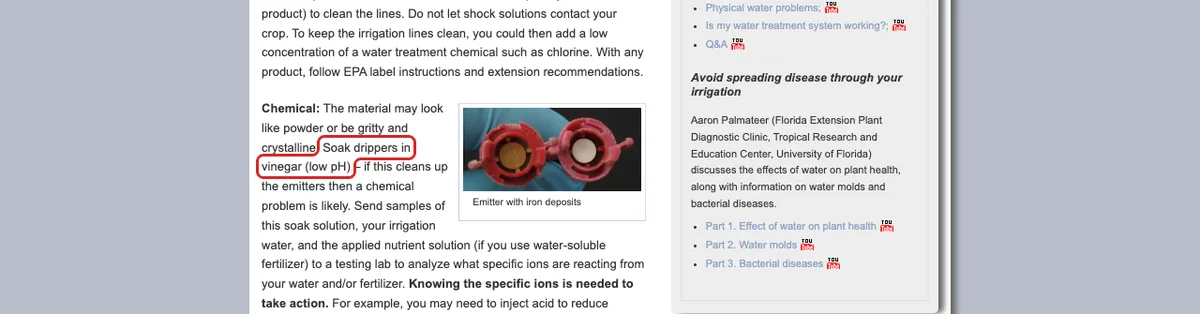
To clean scaled emitters, UF/IFAS HS1202 (revised 2021) soaks them in 0.5 to 1.0 percent citric acid for 24 to 48 hours, about 19 to 38 grams per gallon of water. Retail guides use vinegar for 30 to 60 minutes (Sprinkler Warehouse) or at least 1 hour (DripWorks) without citing a test. Clemson warns that some pressure-compensating emitters’ flexible heads are damaged at pH 4 or lower, so on cleanable PC models unscrew the cap and rinse the parts, keeping the small diaphragm (Drip Depot).
Grit and silt: which filter mesh, and how fast to flush?
Buy the mesh printed on your emitter or dripline sheet. Without one, UF/IFAS AE032 removes particles larger than one-tenth of the emitter’s smallest opening, while UF’s AE61 (revised 2024) says one-fourth. Finer is not always better: Netafim says Techline CV needs only 120 mesh and finer screens need cleaning more often.
| Mesh | Opening (microns) | Smallest soil class it stops | Who specifies it | Source |
|---|---|---|---|---|
| 80 | 180 | Medium sand and the coarser part of fine sand | Drip Depot minimum for rotors and spray nozzles, not drip | Drip Depot, Mar. 2026 |
| 120 | 125 | Most fine sand | Netafim Techline CV and HCVXR; Rain Bird XFD and XFS dripline; Drip Depot minimum for drip emitters; Hunter calls for 120 microns | Netafim; Rain Bird XF guide; Hunter |
| 150 | 105 | Fine sand | Rain Bird Xeri-Bug 1.0 and 2.0 gph (the sheet prints 75 micron); Toro’s detail calls for a 150 mesh Y-filter; CSU: 150 to 200 for city water | Rain Bird Xeri-Bug, 2025; Toro; CSU 4.702 |
| 155 | Not in UF table | Fine sand | Drip Depot minimum for drip tape | Drip Depot |
| 200 | 74 | Coarser half of very fine sand | Rain Bird 1/4 in. landscape dripline (LDQ); Xeri-Bug 0.5 gph | Rain Bird XF guide; Rain Bird Xeri-Bug |
| Any screen | Under 50 | Silt and clay | Screens are not used for these sizes; flushing removes them | UF AE61, Table 2; UC ANR |
No screen stops silt, so lines still need flushing. UC ANR says a 200-mesh filter passes fine sand, silt, clay and fine algae, and that the flush must move at least 1 foot per second at the end of the drip line: 1 gpm out of a 5/8-in. lateral, 2 gpm out of a 7/8-in. line. UF Bulletin 333 lists 1 gpm for 0.5-in. tubing and traces the 1 ft per second minimum to the ASAE EP405.1 design standard.
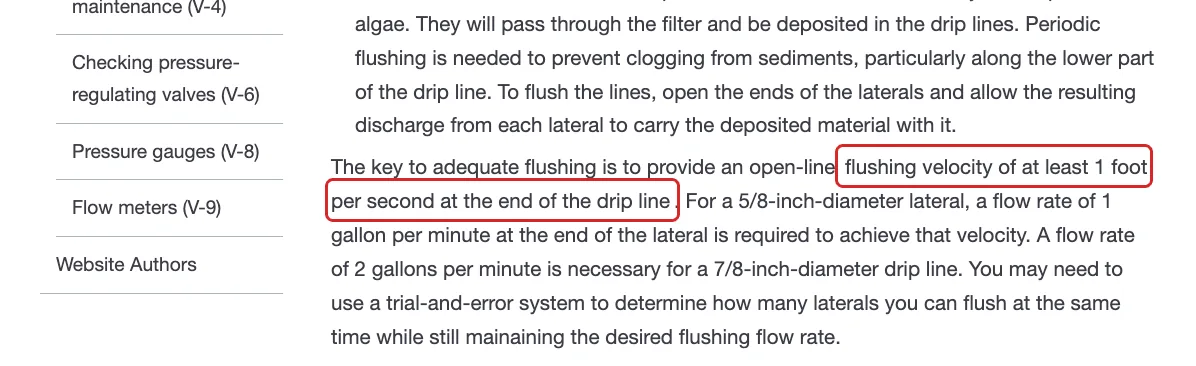
Check the speed with a bucket. Drip Depot’s 1/2-in. tubing is 0.600 in. inside (Drip Depot listing): 0.283 sq in. x 12 in. per second x 60, divided by 231 cubic inches per gallon, is 0.88 gpm. If a 1-gallon bucket at the open end takes longer than about 68 seconds to fill, open fewer line ends at once.
- Flush the mainline first, then headers, then the laterals (UF AE032).
- Open a few line ends at a time; UC ANR uses fewer than 10 at once on tree and vine systems.
- Run each until the water is clear: a minute or two per B333, at least 2 minutes per AE032.
- Repeat every 2 weeks at first, as Rain Bird does for the first 6 weeks of new XF dripline; B333 sets at least monthly in season. Stretch the interval if the bucket stays clean.
Self-flushing end caps give only a short, low-speed flush and can leak if they fail to close (UC ANR). On check-valve dripline such as Techline CV, Netafim prefers manual flush valves, since an automatic one drains the line the emitters hold full.
White crust: is your water hard enough to scale emitters?
Scale is calcium and magnesium carbonate dropping out of hard, alkaline water. UF/IFAS AE032 (revised January 2022) rates the hazard slight below pH 7.0, moderate at 7.0 to 7.5 and severe above 7.5, with hardness lines at 150 and 300 ppm as calcium carbonate. Oklahoma State BAE-1511 adds that water too low in calcium to scale the pipe can still crust the emitter openings as they dry after shutoff. Your utility’s water quality report or a well test gives both numbers.
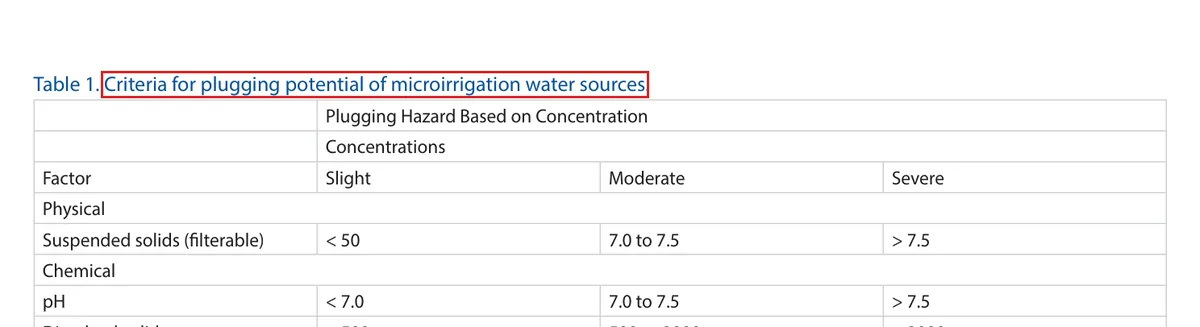
Scaled inline dripline is usually replaced; Utah State Extension says hard-water deposits can build until emitters and tubing need replacing. Growers inject acid instead: UF AE032 holds water just below pH 7.0 to prevent scale, Clemson holds pH 5 in the lines for 24 hours to remove it and warns against pH 4 or lower, and OSU runs acid in the last few minutes of each run when only the openings crust.
Slime and algae: how much chlorine, and for how long?
UF AE032 describes iron-bacteria ochre as red, yellow or tan and sulfur slime as yellow to white and stringy, from wells carrying hydrogen sulfide. Algae needs light, so UGA Bulletin 1130 notes it does not grow in buried pipe or black polyethylene; it arrives in pond water or grows in clear filter bowls.
| Goal | Rate | Contact time or timing | Source |
|---|---|---|---|
| Prevent slime: continuous | 1 to 2 ppm free chlorine at the ends of the laterals | Every run | UF AE032, 2022 |
| Prevent slime: per cycle | 20 ppm | At the end of each run, long enough to reach the last emitter | UF AE032, 2022 |
| Prevent slime: weekly slug | 50 ppm | Once a week at the end of a run, through the whole system | UF AE032, 2022 |
| Hold a residual | 5 to 6 ppm at the injector to keep 1 to 2 ppm at the farthest emitter (1 ppm if pH 7.5 or less, 2 ppm above) | 60 minutes; test with a DPD kit 10 minutes in | UGA B1130, reviewed 2023 |
| Treat bacteria or algae | 1 to 2 ppm residual, or 10 to 20 ppm | 30 to 60 minutes per treatment | Penn State, 2012 |
| Rinse, then clean up slime | 2 ppm rinse; 30 ppm to clean | Rinse at the end of each set | OSU BAE-1511, 2017 |
| Shock a slimed line | 50 ppm | Inject about 2 hours, hold 24 hours, then flush | Clemson LGP 1190, 2024 |
| Iron or manganese deposits | 0.64 x ferrous iron (ppm), or 1.3 x manganese, to hold 1 ppm free chlorine at the line end | Work at pH 6.5 to 7.5 | Clemson LGP 1190, 2024 |
| Prevent scale with acid | Lower water to just below pH 7.0 | Continuous injection | UF AE032, 2022 |
| Remove scale with acid | pH 5 | Hold 24 hours, then flush; do not go to pH 4 or lower | Clemson LGP 1190, 2024 |
| Phosphoric acid limit | Do not inject when calcium is over 50 ppm | Any time | UF HS1202, 2021 |
| Soak scaled emitters | 0.5 to 1.0 percent citric acid | 24 to 48 hours | UF HS1202, 2021 |
The rates span 1 to 50 ppm because they do different jobs: 1 to 2 ppm keeps clean lines clean, 20 to 50 ppm clears slime. Use liquid bleach, injected ahead of the filter; UF AE032 rules out calcium hypochlorite (HTH), which can form precipitates that plug emitters, and calls chlorine relatively ineffective above pH 7.5. Clemson puts vegetable seedlings’ tolerance under 1 ppm, so shock at the end of a run and flush it out.
UF AE032 sizes the dose as gallons of bleach per hour = 0.006 x ppm x zone gpm / percent chlorine. A 2 gpm zone at 50 ppm with 6 percent bleach takes 0.1 gallon (12.8 fl oz) per hour of injection.
- Gallons of bleach per hour of injection
- 0.10
- Fluid ounces per hour
- 12.8
- Milliliters per hour
- 379
Default: a 2 gpm zone at 50 ppm with 6 percent bleach needs 0.006 x 50 x 2 / 6 = 0.10 gallon (12.8 fl oz, 379 mL) per hour. Find zone flow by adding emitter gph and dividing by 60. Check free chlorine at the farthest emitter with a DPD kit and follow the bleach label.
Add acid to water, never water to acid, and never mix or store acid with chlorine, which releases chlorine gas (UF AE032; Clemson). Injecting into a line fed by drinking water also needs a working backflow device; see our backflow preventer leak guide for retest rules.
Roots, soil and insects: why do buried emitters clog?
Clemson says roots grow into emitters when plants get less water than they demand, and soil is pulled in when a line drains after shutoff. A 1994 Irrigation Association paper by Karen Ruskin Ferguson reported 10 percent of untreated buried emitters root-blocked within 3 years, 60 percent within 4 and 95 percent within 6; membrane or labyrinth emitters showed 22 percent intrusion after 5 years.
Whether a lawn should be on buried drip at all is weighed in our drip irrigation vs sprinkler comparison. Current turf dripline builds in a barrier. Netafim adds Cupron copper oxide to Techline HCVXR, warranted 15 years against root plugging (Netafim warranty); Rain Bird puts a copper chip at each XFS emitter and says it lasts over 16 years on average in testing. A root-clogged section is cut out and replaced; for roots lifting the turf, see tree roots in a lawn.
Stop soil suction with an air/vacuum relief valve at each buried zone’s high point (Ferguson) or check-valve dripline: Techline CV holds back 4.6 ft of water (Netafim). UF Bulletin 333 says insects crawl into emitters and enter through flush valves, especially normally open automatic ones.
Should you clean a clogged emitter or replace it?
Replace it when water, chlorine and acid all fail (Clemson). Drip Depot pulls a barbed emitter, goof-plugs the hole and punches a new one nearby; Toro cuts dripline cleanly, lets both ends flush, then joins them with a coupling.
Measure before and after: catch one emitter for 1 minute in a measuring cup. 1 gph is 63 mL (2.1 fl oz) a minute, 2 gph 126 mL, 0.5 gph 32 mL. UF/IFAS AE094 samples at least 18 emitters across the zone: near the inlet, middle, far end, and high and low spots. Oklahoma State designs zones for no more than a 10 percent spread between lowest and highest emitter, so one running more than 10 percent below its neighbors on a level, regulated zone is the one to fix.
A soaked patch with no clog is a leak, covered in finding a leak in a sprinkler system; contractor prices are in our sprinkler repair cost guide. Before winter, Rain Bird allows compressed air only with the flush valve open at 40 psi or less; see how to winterize a sprinkler system.
This page is general information, not chemical-use or safety advice. Bleach, acids and line cleaners carry label directions; follow the product label, wear eye protection, and never mix acid with chlorine.
How we compiled this
On Nov. 26, 2026 we read 10 extension publications (UF/IFAS AE032, AE61, HS1202, AE094 and Bulletin 333; UC ANR; Clemson; UGA; Oklahoma State; Penn State), 3 extension and research web pages (Colorado State, Utah State, Clean WateR3), 5 maker guides (Rain Bird, Netafim, Hunter, Toro) and a 1994 Irrigation Association paper. We did not test emitters or treatments; the bucket, bleach and citric acid figures are our arithmetic from published rates.
Frequently asked questions
Why do emitters get clogged in drip irrigation?
Grit that passes the filter settles at the line ends, hard or iron-rich water leaves scale, bacteria and algae form slime, and buried emitters take in roots or soil. UF/IFAS rates water above pH 7.5 or 300 ppm hardness a severe scaling hazard.
Can you clean drip emitters with vinegar?
Yes, for mineral scale on removable emitters: retail guides soak them 30 to 60 minutes. UF/IFAS HS1202 uses 0.5 to 1.0 percent citric acid for 24 to 48 hours. Vinegar does little for slime, which needs dilute bleach.
How do you unblock blocked drip lines?
Open the line ends and flush at 1 foot per second, about 1 gallon per minute from 1/2 to 5/8 in. tubing, until the water runs clear. If slime or scale comes out, treat with chlorine or acid at the rates above and flush again.
Should drip emitters be buried?
Buried dripline clogs more easily from roots and soil suction, per UF/IFAS. Buried zones use root-barrier dripline such as Netafim Techline HCVXR or Rain Bird XFS and an air/vacuum relief valve at the high point.
Do you need a flushing valve for drip lines?
You need a way to open each line end: a manual flush valve, threaded cap or folded tubing. UC ANR says self-flushing caps give only a short, low-speed flush, and Netafim prefers manual valves on check-valve dripline.
What is the average lifespan of a drip irrigation system?
No maker publishes one figure. Netafim warrants driplines 7 years against defects, 10 against stress cracking and Techline HCVXR 15 years against root plugging; Rain Bird says its XFS copper chip averages over 16 years in testing.
Sources
- University of California Agriculture and Natural Resources, Maintenance of Microirrigation Systems: Flushing, current page. Accessed November 2026.
- UF/IFAS Extension (D. Z. Haman), Causes and Prevention of Emitter Plugging in Microirrigation Systems, BUL258 (AE032), revised January 2022. Accessed November 2026.
- UF/IFAS Extension (D. Z. Haman, F. S. Zazueta), Screen Filters in Drip Irrigation Systems, AE61, revised September 2024. Accessed November 2026.
- UF/IFAS Extension (A. G. Smajstrla, B. J. Boman), hosted by Irrigation Toolbox, Flushing Procedures for Microirrigation Systems, Bulletin 333, July 2002. Accessed November 2026.
- UF/IFAS Extension (G. Liu, G. McAvoy), How to Reduce Clogging Problems in Fertigation, HS1202, revised July 2021. Accessed November 2026.
- UF/IFAS Extension (A. G. Smajstrla and others), Field Evaluation of Microirrigation Water Application Uniformity, BUL265 (AE094), revised 1997, reviewed July 2018. Accessed November 2026.
- Clemson Cooperative Extension (B. S. Jatana, T. G. Sanders III), Micro-Irrigation System Maintenance to Prevent Clogging, LGP 1190, March 2024. Accessed November 2026.
- University of Georgia Extension, Drip Chemigation: Injecting Fertilizer, Acid and Chlorine, Bulletin 1130, reviewed June 2023. Accessed November 2026.
- Oklahoma State University Extension (S. Taghvaeian), Drip Irrigation Systems, BAE-1511, February 2017. Accessed November 2026.
- Penn State Extension (B. Lamont), hosted by Washington State University, Maintaining Drip Irrigation Systems, June 2012. Accessed November 2026.
- Clean WateR3 (Specialty Crop Research Initiative project), What is clogging my irrigation drippers?, site updated May 2024. Accessed November 2026.
- Colorado State University Extension, Drip Irrigation for Home Gardens, fact sheet 4.702, current page. Accessed November 2026.
- Utah State University Extension, The Do-It-Yourself Guide to Backyard Drip Irrigation, current page. Accessed November 2026.
- UF/IFAS Gardening Solutions, Microirrigation, current page. Accessed November 2026.
- Rain Bird Corporation, XF Series Dripline Design, Installation and Maintenance Guide, 2020. Accessed November 2026.
- Rain Bird Corporation, Xeri-Bug Emitters technical specifications, August 2025. Accessed November 2026.
- Netafim USA, Techline HCVXR and CV Design Guide, current version. Accessed November 2026.
- Netafim USA, Landscape product warranty information, 2019. Accessed November 2026.
- Hunter Industries, hosted by Citrus Heights Water District, Drip Irrigation Design and Installation Guide, current version. Accessed November 2026.
- The Toro Company, Landscape Dripline Design manual, current version. Accessed November 2026.
- K. R. Ferguson, Irrigation Association conference paper, hosted by K-State, Subsurface Drip Irrigation for Turf, November 1994. Accessed November 2026.
- Drip Depot, Drip Irrigation System Troubleshooting and Repair Guide, modified March 18, 2026. Accessed November 2026.
- Drip Depot, 1/2 in. polyethylene tubing, 0.600 in. inside diameter, product listing, checked Nov. 26, 2026. Accessed November 2026.
- Sprinkler Warehouse, How to Clean an Emitter, current page. Accessed November 2026.
- DripWorks, How to Clean a Clogged Emitter or Sprayer, current page. Accessed November 2026.