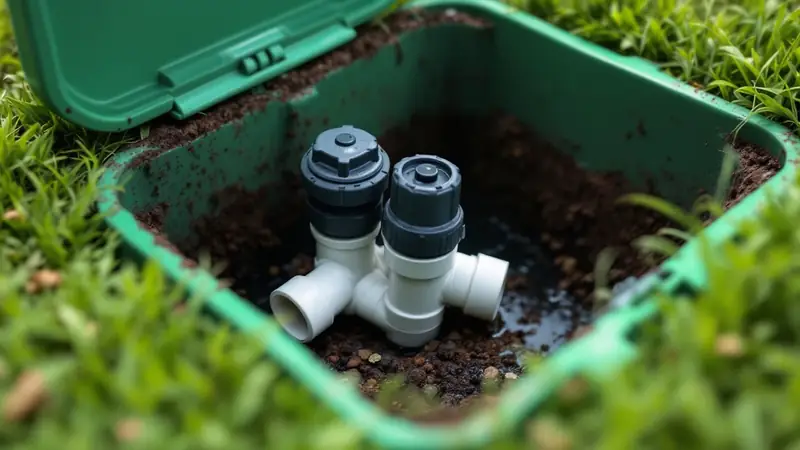
Fix a low water pressure sprinkler system by measuring first: static pressure at a hose bib with no water running, then working pressure at a running head. Sprays are built for about 30 psi and rotors about 45; the gap shows where pressure disappears.
A low water pressure sprinkler system shows itself as heads that rise only partway, spray that falls short of the next head, and donut-shaped brown rings around heads, the symptoms Oklahoma State University Extension fact sheet HLA-6617 lists. Two gauge readings and a 5-gallon bucket sort the cause into one of three places: a supply that is weak before it reaches the yard, a valve or backflow device choking it at the point of connection, or a zone asking its pipe for more gallons per minute than the pipe and meter can carry.
The ranking pages we read list causes but no numbers to choose between them. Here, Rain Bird’s Landscape Irrigation Design Manual gives the flow a 5/8, 3/4 or 1 inch meter can pass and the psi lost per 100 feet of 7 pipes at 4 to 16 gpm, and a calculator adds up a zone’s nozzles against those limits. If one head misbehaves while its neighbors run normally, the fault is at the head: see our guide to a sprinkler head not popping up covers that case.
Step 1: read static pressure at the hose bib
Static pressure is the reading with no water moving. Hunter says to thread a gauge onto the outside faucet closest to the water meter, check that no other water is running at the house, and open the faucet fully. OSU adds two refinements: read it at the same time of day the controller runs, because city pressure moves through the day, and expect to pay $10 to $20 for a hose-thread gauge (HLA-6617, 2019).
Rain Bird’s manual tells designers to use the lowest reading, the summer daytime pressure, because that is the worst case the system must work in (design manual, p. 27).
| Static reading at the hose bib | What it tells you | What to do next | Source |
|---|---|---|---|
| Under 25 psi | Low enough that OSU sends you to the utility | Call the water utility before changing anything in the yard | OSU HLA-6617 |
| 25 to 40 psi | Sprays can work (Rain Bird MPR nozzles run 15 to 30 psi), but about 15 psi of losses leaves rotors short of their 45 psi design point | Favor sprays or regulated bodies; keep zone flow low | Rain Bird MPR chart; OSU |
| 40 to 60 psi | OSU’s ideal residential range | Static is not the cause; go to Step 2 | OSU HLA-6617 |
| 60 to 80 psi | More than enough; misting is the usual problem at this level | Look for a closed valve, a leak or an overloaded zone | OSU HLA-6617 |
| Over 80 psi | IPC §604.8 requires a pressure-reducing valve on the building supply | Have a plumber fit or reset the valve | IPC 2021 §604.8 |
| Over 125 psi | OSU’s upper trigger for a utility call | Call the utility | OSU HLA-6617 |
A low reading on a house with a pressure-reducing valve (the bell-shaped brass fitting where the main enters) may just be the valve’s setting. Watts ships its LF25AUB-Z3 at 50 psi with an adjustable range of 25 to 75 psi, so a valve someone turned down, or one that has drifted, can be the whole story. IPC §604.8 exempts lines to sill cocks, so some hose bibs read street pressure upstream of the regulator; check a faucet on the regulated side too.
Step 2: read working pressure at the heads
Working pressure, which Rain Bird’s manual calls dynamic pressure, is what is left at a given point while water flows, after friction and elevation (design manual, p. 6). It is the number that decides whether heads pop up and throw their rated radius. Run the zone and measure it at the first and last heads on the line.
- Rotors: hold a pitot tube in the main nozzle stream. Hunter’s rotor pitot gauge places the tube directly in front of the primary stream and reads psi on the gauge stem.
- Sprays: swap the nozzle for a gauge adapter on the riser (Hunter sells an MP-GAUGE for MP Rotator nozzles) and run the zone with every other head in place.
- Point of connection: read the hose bib gauge again while a zone runs; the drop from static is what the meter and service line lose at that flow.
- Compare: first-head minus last-head is your pipe and elevation loss; static minus first-head is everything upstream of the zone.
| Head or nozzle | Design or regulated pressure | Published range | Source |
|---|---|---|---|
| Rain Bird MPR spray nozzles | 30 psi optimum | 15 to 30 psi | MPR chart |
| Rain Bird 1800 PRS spray body | Regulates to 30 psi | Body rated 15 to 70 psi | 1800 tech spec |
| Hunter Pro-Spray PRS40 with MP Rotator | Regulates to 40 psi | Built for MP Rotator | Hunter PRS40 page |
| Rain Bird 5000 rotor | PRS model holds 45 psi | 25 to 65 psi | 5000 tech spec |
| Rotors in general | About 45 psi | 25 to 65 psi | OSU HLA-6617 |
| Drip line | About 20 psi | 15 to 30 psi | OSU HLA-6617 |
Regulated bodies only help when there is pressure to spare. OSU says valve-mounted pressure regulators need a reduction of at least 15 psi to work properly (HLA-6617), so on a supply that already reaches the heads at 30 psi there is nothing for a 30 or 40 psi regulator to trim, and a standard body passes whatever pressure arrives.
Step 3: measure how many gallons a minute you have
Pressure is half the budget; flow is the other half. Open the hose bib fully into a 5-gallon bucket and time it: gallons per minute equals 5 divided by the seconds, times 60: 20 seconds means 15 gpm, 30 seconds means 10 gpm. Repeat it and use the slower time.
Then read the size stamped on the meter body or inside its lid: 5/8, 3/4 and 1 inch are the common residential sizes (Hunter). Rain Bird’s water supply design tip sets three limits on irrigation flow and says to use the lowest: meter loss no more than 10 percent of the lowest static pressure, no more than 75 percent of the meter’s maximum safe flow, and service-line velocity no faster than 5 to 7.5 feet per second.
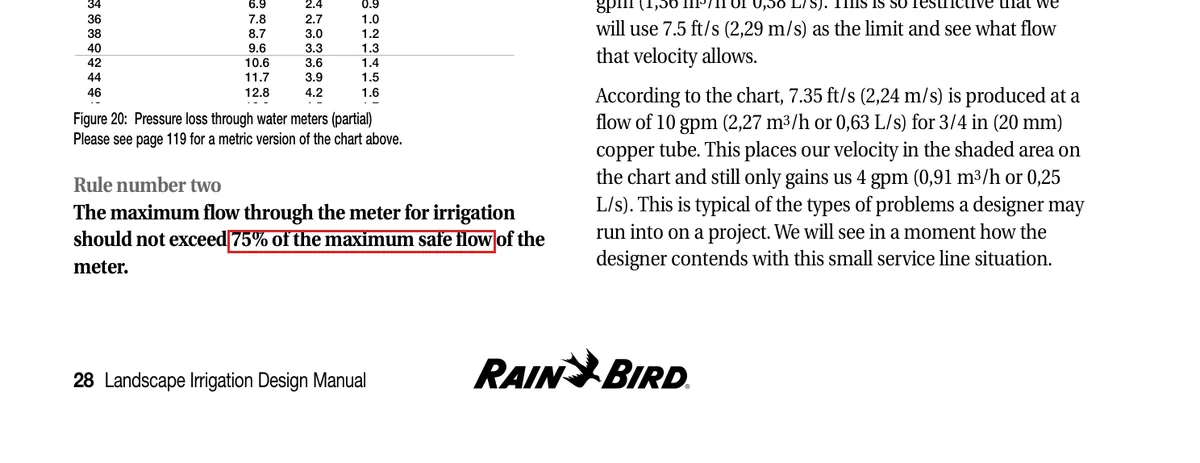
| Meter | Maximum safe flow (AWWA) | Rule 2: 75% of safe flow | Rule 1 at 60 psi static (6 psi meter loss) | Rule 1 at 50 psi static (5 psi loss) | Meter limit at 60 psi static |
|---|---|---|---|---|---|
| 5/8 in | 20 gpm (15.0 psi loss) | 15 gpm (8.3 psi loss) | 12 gpm (5.1 psi) | 11 gpm (4.4 psi) | 12 gpm |
| 3/4 in | 30 gpm (15.0 psi loss) | 22.5 gpm | 19 gpm (5.8 psi) | 17 gpm (4.6 psi) | 19 gpm |
| 1 in | 50 gpm (15.0 psi loss) | 37.5 gpm | 32 gpm (6.0 psi) | 28 gpm (4.6 psi) | 32 gpm |
The service line is often the real limit. Hunter’s capacity chart assumes 100 feet of thick-walled PVC and tells you to deduct 2 gpm for copper and 5 gpm for new galvanized pipe (Hunter). To size an unmarked line, wrap a string around it and measure the string; Rain Bird and Hunter both print the conversion chart. Design to whichever is lower, the bucket test or the meter limit.
Which part of the system is losing pressure?
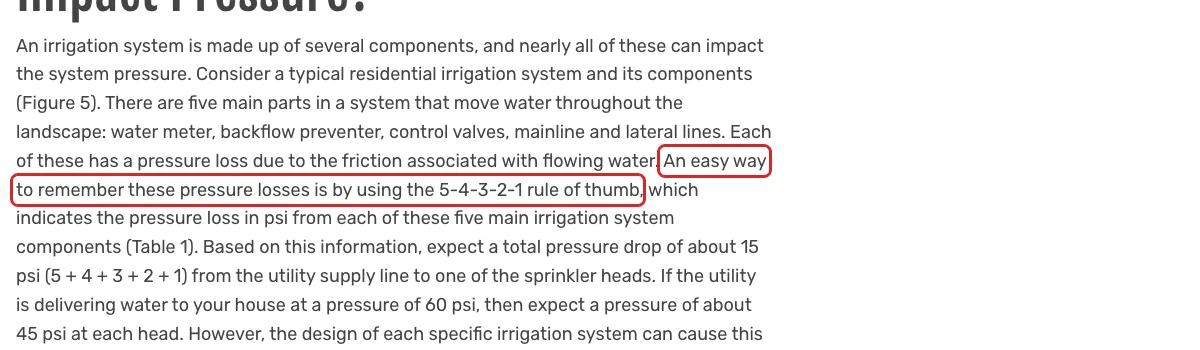
With the three numbers in hand, the pattern of weak heads points to the cause. OSU’s rule of thumb, called 5-4-3-2-1, puts the normal loss through the meter, backflow preventer, zone valves, mainline and laterals at about 15 psi in total, so 60 psi at the street should leave about 45 psi at the heads (HLA-6617). A reading well below that tells you something extra is in the way.
| What you see | Likely cause | Test | Fix | Source |
|---|---|---|---|---|
| Every zone weak; hose bib static under 40 psi | Low city pressure, house regulator set low, or other taps running | Static gauge at the hose bib at watering time with nothing else on | Under 25 psi, call the utility; have a plumber check the regulator (Watts LF25AUB-Z3 range 25 to 75 psi) | OSU; Watts |
| Every zone weak; static is normal | Irrigation isolation valve or backflow ball valves partly closed; dirty backflow | Handles should sit in line with the pipe; compare hose bib and first-head readings | Open both valves fully; have the backflow assembly serviced if the drop stays | OSU HLA-6617 |
| Strong at first, then pressure sags | Zone draws more gpm than the meter and service line deliver | Watch the hose bib gauge with the zone running; do a bucket test | Cut zone gpm: lower-flow nozzles or split the zone | Rain Bird tip |
| One zone weak, others fine | Lateral leak, flow control screwed down, too many heads, or rotors mixed with sprays | Walk the zone for soggy ground or a geyser; open the flow control counterclockwise; add up nozzle gpm | Repair the pipe; open the flow control; re-nozzle or split | OSU; Rain Bird TSG |
| Heads near the valve fine, far heads weak | Friction in undersized pipe, or the zone climbs uphill | First-head vs last-head working pressure; 0.433 psi per foot of rise | Larger or looped lateral, lower-flow nozzles, or a shorter zone | Rain Bird manual |
| One head weak | Clogged screen or nozzle, broken riser | Pull the nozzle and screen | Rinse or replace (see our head-level guide) | Rain Bird TSG, p. 2 |
1Is static pressure at the hose bib under 40 psi at the time the system runs?
YesSupply side. Under 25 psi, call the utility (OSU). Otherwise check that no other water is running and have a plumber check the house pressure-reducing valve (Watts LF25AUB-Z3 ships at 50 psi, adjustable 25 to 75).
NoGo to the next question
2Is every zone weak even though static pressure is normal?
YesPoint of connection. Open the irrigation isolation valve and both backflow ball valves fully (handles in line with the pipe), then compare the hose bib reading with the first head.
NoGo to the next question
3Does the hose bib gauge sag well below static while a zone runs?
YesFlow. The zone draws more gpm than the meter and service line deliver: add up nozzle gpm against your bucket test and the meter limit, then re-nozzle or split the zone.
NoGo to the next question
4Are heads near the valve fine but the far heads weak?
YesFriction or elevation. Compare first-head and last-head working pressure; allow 0.433 psi per foot of rise and use the friction table to see if the lateral is undersized.
NoGo to the next question
5Is only one zone weak?
YesZone side. Look for soggy ground or a geyser, open the valve's flow control counterclockwise, and count the heads against the supply.
NoOne head only: clean its nozzle and screen or replace the head, as in our sprinkler head not popping up guide.
Start the whole-system checks at the backflow device: our guide to turning a sprinkler system on in spring gives the order for opening its 2 ball valves. If one zone is dead rather than weak, the valve itself is suspect, and our guide to finding a buried sprinkler valve box gets you to it.
Why the last heads on a zone run weakest
Every foot of pipe costs pressure, and the cost climbs steeply with flow. Rain Bird’s tables show 10 gpm losing 30.54 psi per 100 feet in 1/2 inch Schedule 40 PVC, 7.77 psi in 3/4 inch and 2.40 psi in 1 inch. The industry ceiling is 5 feet per second; above it, Rain Bird says friction losses rise rapidly and surge damage becomes more likely (design manual, p. 6).
| Pipe | Inside diameter (in) | 4 gpm | 6 gpm | 8 gpm | 10 gpm | 12 gpm | 14 gpm | 16 gpm | Highest listed flow under 5 ft/s |
|---|---|---|---|---|---|---|---|---|---|
| 1/2 in Schedule 40 PVC | 0.622 | 5.60 | 11.86 | 20.20 | 30.54 | 42.80 | 56.94 | 72.92 | 4 gpm (4.22 ft/s) |
| 3/4 in polyethylene (PE) tube | 0.824 | 1.62 | 3.43 | 5.84 | 8.82 | 12.37 | 16.46 | 21.07 | 8 gpm (4.80 ft/s) |
| 3/4 in Schedule 40 PVC | 0.824 | 1.42 | 3.02 | 5.14 | 7.77 | 10.89 | 14.48 | 18.55 | 8 gpm (4.80 ft/s) |
| 3/4 in Class 200 PVC | 0.930 | 0.79 | 1.68 | 2.85 | 4.31 | 6.05 | 8.05 | 10.30 | 10 gpm (4.72 ft/s) |
| 1 in polyethylene (PE) tube | 1.049 | 0.50 | 1.06 | 1.80 | 2.73 | 3.82 | 5.08 | 6.51 | 12 gpm (4.44 ft/s) |
| 1 in Schedule 40 PVC | 1.049 | 0.44 | 0.93 | 1.59 | 2.40 | 3.36 | 4.47 | 5.73 | 12 gpm (4.44 ft/s) |
| 1 in Class 200 PVC | 1.189 | 0.24 | 0.51 | 0.86 | 1.30 | 1.83 | 2.43 | 3.11 | 16 gpm (4.61 ft/s) |
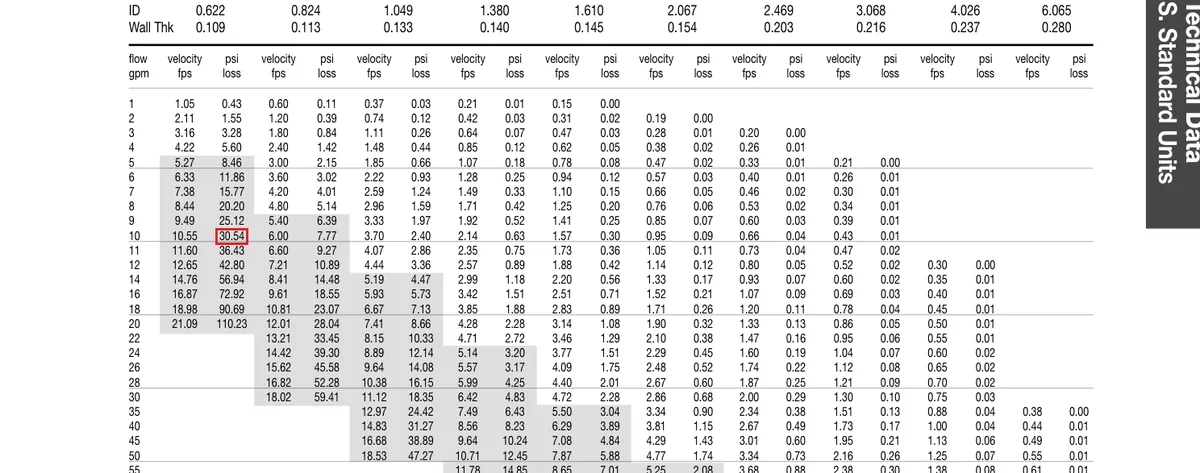
Read the table as an upper bound for a lateral. The full zone flow only travels the first length of pipe; each head takes its share, so the pipe beyond it carries less. A mainline carries full flow, which is why 100 feet of 3/4 inch main at 12 gpm (10.89 psi) can starve every zone behind it.
Hills add their own loss. Each foot of rise costs 0.433 psi (design manual, p. 3), so heads 10 feet above the valve start 4.3 psi behind, and a 20-foot climb to the back of a sloped lot costs 8.7 psi before any friction.
| Step | Pressure left | Basis |
|---|---|---|
| Static reading at the hose bib (example) | 60 psi | Inside OSU’s 40 to 60 psi ideal range |
| Normal losses through meter, backflow, valve, mainline and laterals | About 45 psi | OSU 5-4-3-2-1 rule, about 15 psi (HLA-6617) |
| Same 12 gpm through 100 ft of 3/4 in Schedule 40 instead of 1 in | About 37.5 psi | 10.89 minus 3.36 psi per 100 ft = 7.5 psi extra (Rain Bird) |
| Far heads sit 10 ft above the valve | About 33 psi | 10 x 0.433 = 4.3 psi |
| Verdict | Enough for 30 psi sprays; 12 psi short of a rotor’s 45 psi design | MPR chart; 5000 spec |
Pipe that sits shallow or was patched with smaller fittings adds loss too; our guide to how deep sprinkler lines are buried shows where to probe for the lateral before you dig.
Does the zone ask for more water than you have?
Add up the nozzles. Rain Bird’s MPR chart lists a 15 foot half-circle nozzle (15H) at 1.85 gpm at 30 psi, a full circle (15F) at 3.70 gpm and a quarter (15Q) at 0.92 gpm (MPR chart); a 5000 rotor with the 3.0 nozzle uses 3.09 gpm at 45 psi (5000 spec, p. 3). Multiply by the head count and compare the total with your bucket test and the meter limit.
- Zone demand (gpm)
- 14.8
- Share of a 5/8 in meter at 60 psi static, 12 gpm (%)
- 123
- Share of a 3/4 in meter at 60 psi static, 19 gpm (%)
- 78
- Share of a 1 in meter at 60 psi static, 32 gpm (%)
- 46
- Gallons per 10-minute run
- 148
Default: 8 Rain Bird 15H nozzles x 1.85 gpm = 14.8 gpm, 123 percent of a 5/8 in meter's 12 gpm, 78 percent of a 3/4 in meter's 19 gpm. Compare the gpm with your own bucket test (5 divided by seconds to fill a 5-gallon bucket, times 60); if the zone needs more, re-nozzle or split it.
| Zone | Arithmetic | Zone demand | Share of 5/8 in meter (12 gpm) | Share of 3/4 in meter (19 gpm) | Share of 1 in meter (32 gpm) |
|---|---|---|---|---|---|
| 8 x 15H sprays | 8 x 1.85 | 14.8 gpm | 123% | 78% | 46% |
| 6 x 15H sprays | 6 x 1.85 | 11.1 gpm | 93% | 58% | 35% |
| 8 x 12H sprays | 8 x 1.30 | 10.4 gpm | 87% | 55% | 33% |
| 4 x 15F sprays | 4 x 3.70 | 14.8 gpm | 123% | 78% | 46% |
| 5 x 5000 rotors, 3.0 nozzle | 5 x 3.09 | 15.5 gpm | 129% | 81% | 48% |
| 4 x 5000 rotors, 2.0 nozzle | 4 x 2.07 | 8.3 gpm | 69% | 44% | 26% |
When demand beats supply, pressure falls until the nozzles pass only what is available. That is why an 8-head 15H zone on a 5/8 inch meter runs weak with nothing broken: it asks for 14.8 gpm against roughly 12. 12H nozzles drop it to 10.4 gpm, at the cost of 3 feet of throw per head.
If the meter instead shows a zone drawing more than its nozzle total, the difference is leaving through a break, and our guide on how to find a leak in a sprinkler system turns that gap into a location.
Fixes, from free to a plumber
- Open the supply fully. Check the irrigation isolation valve and both backflow ball valves; OSU’s photos show the handles in line with the pipe when open (HLA-6617). Cost: $0.
- Open the zone’s flow control. Turn the knob on top of the valve counterclockwise; Rain Bird lists a flow control screwed all the way down as a cause of a valve that will not open (TSG, p. 10). Cost: $0.
- Fix leaks. Soggy spots that never dry or a stream from a head base mean water is leaving before it reaches the nozzles. Our sprinkler repair cost survey found a lateral leak at $60 to $190 on published price lists (median $125) and a mainline leak at $195 to $275.
- Cut the zone’s gpm. Re-nozzle to a lower-flow set (15H at 1.85 gpm to 12H at 1.30) or cap heads and move beds to drip; OSU names lower-flow nozzles and fewer heads per zone as the fixes for an overloaded zone. Reset the arcs afterward with our guide to adjusting sprinkler heads.
- Split the zone. A new valve and lateral halve the flow per zone. New-system installers in our sprinkler installation cost survey charge $956 to $1,250 per zone, a useful ceiling for what adding one costs.
- Reset the house regulator. If a pressure-reducing valve sits below 50 psi, a plumber can raise it within its range (25 to 75 psi on the Watts LF25AUB-Z3), never above the 80 psi limit in IPC §604.8.
- Add a booster pump only as a last step. Colorado State says a booster pump may be required in severe low-pressure cases (CSU 7.239). Plumbing code requires a low-pressure cutoff that stops the pump when its suction side drops to 10 psi or less (IPC §606.5.5), and the water utility may require a permit and backflow review before a pump goes on a city service.
A booster raises pressure but not the meter’s flow limit: a 5/8 inch meter still tops out near 12 gpm at 60 psi static, so a 14.8 gpm zone stays overloaded. Check the calculator result before pricing one.
How we compiled this
In November 2026 we read 12 primary documents: Rain Bird’s Landscape Irrigation Design Manual (friction tables for 7 pipes, the AWWA meter table and the 3 water-supply rules), its MPR nozzle chart, 1800 and 5000 tech specs and troubleshooting guide; Hunter’s capacity worksheet and PRS40 page; OSU Extension HLA-6617; CSU Extension 7.239; the Watts LF25AUB-Z3 spec; and IPC §604.8 and §606.5.5. Meter limits, zone totals and the pressure budget are our arithmetic from those tables. We did not measure any system.
Frequently asked questions
Is 40 psi enough for a sprinkler system?
Usually, for sprays. OSU puts normal losses from meter to head at about 15 psi, so 40 psi static leaves about 25 psi at the heads: inside the 15 to 30 psi range of Rain Bird MPR spray nozzles, but well under the 45 psi that rotors such as the Rain Bird 5000 are designed around.
How can I increase the water pressure in my sprinkler system?
Open the isolation and backflow valves and the zone’s flow control fully, and fix leaks. Then cut each zone’s gpm with lower-flow nozzles or a zone split. A plumber can raise a house regulator set below its 50 psi factory setting; a booster pump is the last resort.
What’s the best sprinkler for low pressure?
Spray nozzles, which Rain Bird rates from 15 psi with best results at 30, tolerate low pressure better than rotors designed around 45 psi. On a weak supply, standard bodies make more sense than 30 or 40 psi regulated ones: OSU says valve-mounted regulators need a reduction of at least 15 psi to work properly.
Can you put a booster pump on a sprinkler system?
Yes, where the utility allows it. Plumbing code (IPC §606.5.5) requires a low-pressure cutoff that shuts the pump off when suction pressure falls to 10 psi or less, and CSU Extension reserves pumps for severe low-pressure cases. A pump adds pressure, not meter capacity.
What causes low pressure in one zone of sprinklers?
A leak in that zone’s pipe, a flow control turned down on its valve, too many heads for the supply, or rotors and sprays mixed on one valve. If heads near the valve are strong and the far ones weak, the pipe is undersized or the zone runs uphill, at 0.433 psi per foot of rise.
Why does my sprinkler system lose pressure after a few minutes?
The zone draws more gallons per minute than the meter and service line supply, so pressure sags as flow settles. Compare the zone’s nozzle total (8 15H sprays use 14.8 gpm) with your bucket test.
Sources
- Oklahoma State University Extension, Managing Pressure in the Home Irrigation System, HLA-6617, March 2019. Accessed November 2026.
- Rain Bird Corporation, Landscape Irrigation Design Manual (pp. 3, 6, 27 to 28, 95, 97, 100, 106), current PDF. Accessed November 2026.
- Rain Bird Corporation, Irrigation Design Tip: Determining Water Supply Requirements, current page. Accessed November 2026.
- Rain Bird Corporation, MPR spray nozzle performance charts, 2020. Accessed November 2026.
- Rain Bird Corporation, 1800 Series Spray Heads tech spec, 2020. Accessed November 2026.
- Rain Bird Corporation, 5000 Series Rotors technical specifications, D42380, 2023. Accessed November 2026.
- Rain Bird Corporation, Irrigation Troubleshooting Guide, pp. 2 and 10, current PDF. Accessed November 2026.
- Hunter Industries, Determine System Design Capacity, current page. Accessed November 2026.
- Hunter Industries, Pro-Spray PRS40 product page, current page. Accessed November 2026.
- Sprinkler Warehouse, Hunter ROTOR-PITOT-GAUGE pitot pressure gauge listing, current page. Accessed November 2026.
- Watts, LF25AUB-Z3 water pressure reducing valve, current page. Accessed November 2026.
- International Code Council, 2021 International Plumbing Code §604.8, Water pressure-reducing valve or regulator, 2021 edition. Accessed November 2026.
- International Code Council, 2018 International Plumbing Code §606.5.5, Low-pressure cutoff required on booster pumps, 2018 edition. Accessed November 2026.
- Colorado State University Extension, Operating and Maintaining a Home Irrigation System, fact sheet 7.239, current page. Accessed November 2026.