How to find sprinkler valve box lids buried under grass: check the as-built plan, search within 12 inches of paving and the backflow preventer, trace back from the zone’s heads, then probe. If that fails, a $44.50 chatterer or $59 locator rental pinpoints the solenoid.
If you are working out how to find sprinkler valve box lids that turf, mulch or a past owner has hidden, the order matters more than the tool. The free steps (plan, placement rules, surface clues, the zone’s own heads) narrow a whole yard to a few strips a few feet long. Paid tools only make sense after that, and the cheapest of them, a chatterer that makes the solenoid click, costs less than one hour at the $65 to $150 hourly rates on the price lists in our sprinkler repair cost guide.
What the forum threads and installer blogs leave out is the numbers. Below, 14 methods are ranked by what the tool costs on retailer pages checked Nov. 20, 2026, with what each one actually detects and its rated depth. Alongside them are the placement rules installers are told to follow, from San Diego Regional Standard Drawing I-14 (boxes within 12 inches of paving, flush in turf) to Texas rule 30 TAC 344.63 (the installer must hand the owner an as-built plan and put a sticker with a license number on the controller).
Every locating method, ranked by what the tool costs
Start at row 1 and stop when you find the lid. Rows 1 to 5 cost nothing; rows 6 to 11 cost $44.50 to $79.50; the professional wire locators in rows 13 and 14 cost $399 to $1,028.20 to buy, which is why renting one for $59 ($72 with Armada’s Pro48K solenoid tool, per the Sprinkler Warehouse combo rental) is the usual DIY route.
1Do you have the as-built plan, or (in Texas) a sticker on the controller naming the installer?
YesRead the box locations off the plan or call the license number on the sticker; 30 TAC 344.63 requires the installer to give the owner the as-built drawing.
NoGo to the next question
2Is there a dip, a lid outline or a row of boxes within 12 inches of the driveway, walk or backflow preventer?
YesProbe that strip on a grid narrower than the box: 9 inches for a standard rectangle, 5 inches for a 6-inch round.
NoGo to the next question
3Does the zone still run from the controller?
YesListen for the solenoid click while the zone starts, or fit a $44.50 to $59.50 chatterer and listen for steady clicking, then probe.
NoGo to the next question
4Does the zone wire still have continuity to the valve?
YesRent a wire and valve locator ($59 for 2 days): the signal blooms 2 to 4 feet wide over the solenoid.
NoThe wire is likely cut: a tracer finds the break, where the signal stops. This is the point where a professional locate usually costs less than more digging.
Source: Texas 30 TAC 344.63, San Diego Std. Dwg. I-14, Rain Bird valve guide, Armada Pro800 guide
Swipe the table sideways to see every column.
| Method | Tool cost (checked Nov. 20, 2026) | What it finds | Range or depth | Needs | Source |
|---|---|---|---|---|---|
| 1. As-built plan or the installer’s records | $0 | Every valve box, drawn to scale on Texas plans | Whole yard | The plan, or the installer named on the controller | 30 TAC 344.61, 344.63 |
| 2. Search where standards put boxes | $0 | A short list of strips to probe | Within 12 in. of paving under San Diego drawing I-14 | A tape measure | San Diego Std. Dwg. I-14 |
| 3. Read the surface | $0 | Depressions, a lid outline, the wire bundle leaving the controller | Surface only | Low morning or evening light | Rain Bird valve guide, p. 2 |
| 4. Trace back from the zone’s heads | $0 | The direction the lateral runs back to its valve | Zone footprint | A zone that still runs | Rain Bird valve guide, p. 2 |
| 5. Listen for the solenoid click | $0 | An energized solenoid | Arm’s length; ear or screwdriver handle to the ground | A zone that still runs | Rain Bird valve guide, p. 9 |
| 6. Chat-R-Box CRB1 chatterer | $44.50 | Makes the solenoid chatter so you can hear it | By ear | Intact zone wire | ValveMapper |
| 7. Click-It VL-1 chatterer | $54.75 | Interrupts the zone’s 24 V in short cycles so the solenoid chatters | By ear | Intact zone wire, working controller | Irrigation Outlet |
| 8. Chat-R-Box Pro chatterer | $59.50 | Same principle, 5 to 6 clicks per second | By ear | Intact zone wire | ValveMapper |
| 9. Rent an Armada Pro-700 locator | $59 for 2 days plus a refundable deposit | Wire path, solenoids, wire breaks | Not stated on the rental page | Signed rental agreement, return shipping | Sprinkler Warehouse rental |
| 10. Probe rod (King Innovation 25210, 1/2 in. x 48 in.) | $65.20 | A lid under sod or mulch | Top few inches; lids sit at grade | A grid no wider than the box | Sprinkler Warehouse |
| 11. NF816L/F02 valve locator | $79.50 | Valves, working or not, and wire breaks | Up to 24 in. | Zone wire | ValveMapper |
| 12. Metal detector you already own | Not priced | The solenoid’s metal plunger, brass fittings, any other metal | 10 to 16 in. for typical detectors | Patience with false hits | Garrett |
| 13. Armada PRO-300 wire and valve locator | $399.00 | Wires and valves on residential systems | Up to 4 ft deep | Ground stake, zone wire | Sprinkler Warehouse |
| 14. Armada Pro800 wire and valve locator | $1,028.20 | Wire path, faults; the signal blooms 2 to 4 ft wide over a valve | Up to 8 ft deep (Pro800D) | Ground stake or common wire | Armada; Irrigation Outlet |
Every electronic option in the table works on the zone wire, not the pipe. A chatterer and a wire tracer both need a continuous copper path from the controller to the solenoid, so a cut wire stops them at the cut. The Armada Pro800 user guide (p. 6) turns that into a diagnosis: the trace signal ends at a break, and a nick shows as a drop in signal. If your zone is dead and the wire may be cut, that is the step where a professional locate, priced in our sprinkler repair cost guide, starts to beat more digging.
Where are sprinkler valves usually located?
Installers work from detail drawings, and the drawings put boxes in predictable places. Search these spots first, in this order, before you push a probe into open lawn.
| Document | Where the box goes | Height at grade | Box size |
|---|---|---|---|
| San Diego Regional Standard Drawing I-14, Remote Control Valve (approved 2005) | Set perpendicular to hardscape, no more than 12 in. from its edge; one valve per box; 24 in. of coiled control wire | Flush with grade in turf; 2 to 3 in. above grade in shrub and groundcover beds | Locking-top box approved by the agency |
| Urban Tree Foundation valve box layout detail (open-source CAD on the ISA site) | In a planting area, 1 ft from pavement, wall or building; boxes 1 ft apart, parallel to each other | Flush with finished grade | Jumbo 22 x 16 x 12 in.; standard 18 x 12 x 12 in.; round 10 in. and 6 in. |
| Draper City, Utah, irrigation standard details | Valve box centered on the assembly; at least 30 in. of extra wire | Flush with finish grade | Standard-size box minimum |
| Rain Bird valve guide, pp. 3 to 6 | Manifold where it is easy to reach and you will not be sprayed; separate groups for front and back yards on larger systems; shutoff right after the tee off the house line | In-line valves below ground, preferably in a box; anti-siphon valves above ground, at least 6 in. above the highest head | Not specified |
| Texas 30 TAC 344.61 and 344.63 | Plan drawn to scale shows the location of every component; as-built drawing goes to the owner | Not specified | Valve size shown per zone |
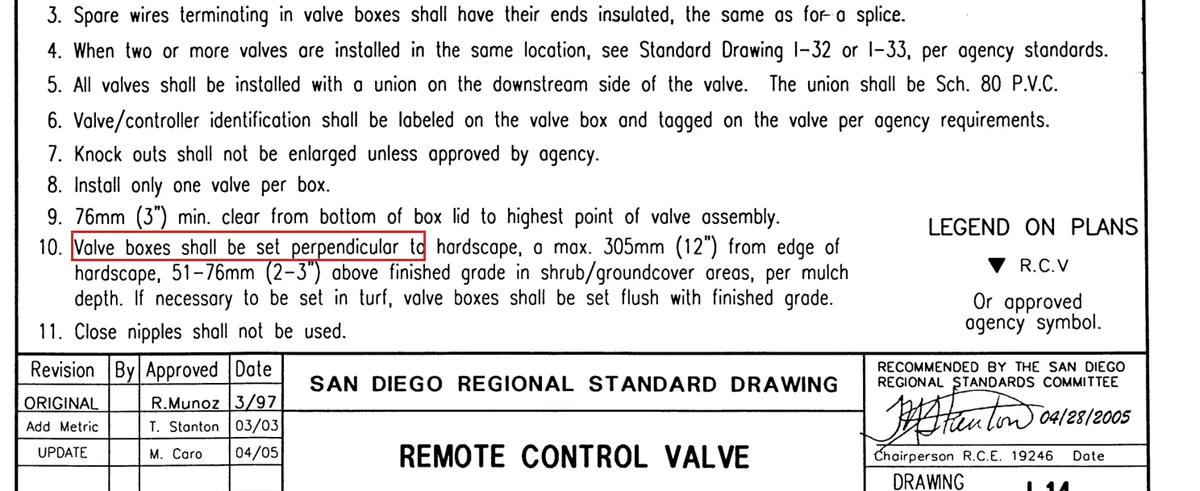
Put those together and the search map is short: the strip within 12 inches of the driveway, walks and patio edges; the bed in front of the backflow preventer; the foundation bed below the controller, where the wire bundle leaves the wall; and, on a larger yard, a second group near the back-yard zones. The Urban Tree Foundation detail spaces boxes 1 foot apart in a row, so finding one tells you where to probe for the next.
A lid that was flush when it went in does not stay visible: topdressing, settling and new sod all add soil on top. If someone has been leveling the lawn with sand or soil, start where the topdressing was thickest. In beds, San Diego’s detail sets boxes 2 to 3 inches above grade to sit at mulch depth, so each fresh layer of mulch covers them.
Free methods: the plan, the surface and the zone’s own heads
- Find the paperwork. In Texas, 30 TAC 344.63 requires the installer to hand the owner the as-built drawing and to fix a waterproof sticker to the controller with the irrigator’s name, license number, company and phone. Rule 344.61 requires that plan to be drawn to scale with every component’s location. Call that number before you dig. Outside Texas, ask the seller, the builder or the company on the controller label.
- Open the controller. Count the wired station terminals: that is the number of valves to find. Note where the wire bundle exits; Rain Bird’s valve guide (p. 2) diagrams the controller wired to the valve box, then the box to the zones.
- Run one zone at a time from the controller’s manual or test mode and flag every head that pops up. Each valve feeds one zone, so its box sits upstream of that group, between the heads and the mainline coming from the backflow preventer. Our guide to turning on a sprinkler system covers the manual-run steps by controller.
- Walk the flagged zone in low light. A round or rectangular outline that dips, browns first in a dry week or mows differently is worth a probe; Rain Bird’s box tops run from 5.7 to 29.4 inches long (table below).
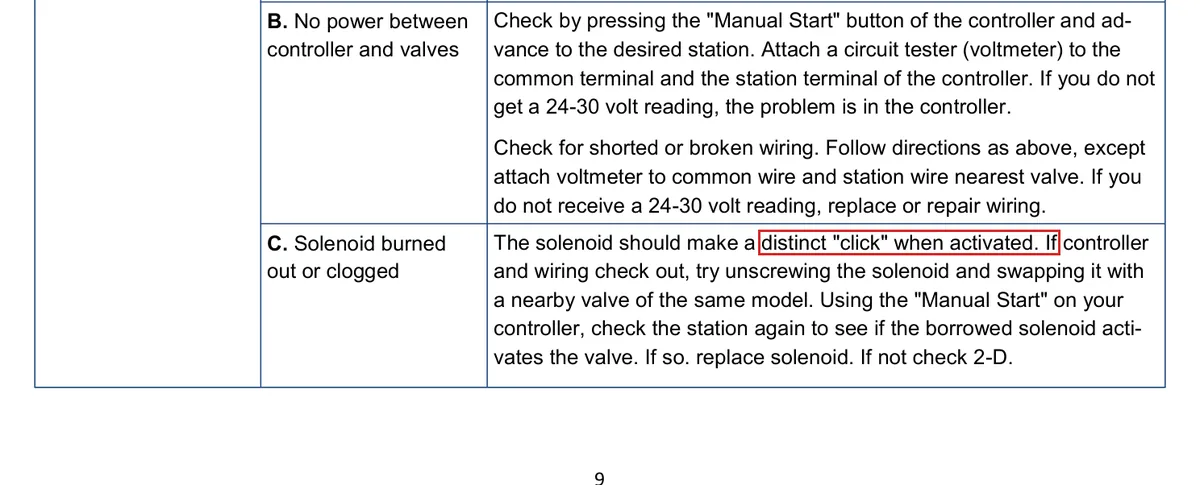
- Listen. Rain Bird’s guide (p. 9) says a solenoid should make a distinct click when it is activated. Have someone start the zone from the controller while you kneel with a screwdriver handle against your ear and the blade tip on the ground; a mechanic’s stethoscope works the same way. The click is a single faint sound per start; a chatterer, below, repeats it several times a second.
How to probe without breaking a pipe or a wire
A probe finds a lid by feel: a flat, even stop a few inches down, where a rock stops abruptly and soil gives. Keep the push shallow. The IRC Table E3803.1 lets 30-volt irrigation control wire run with only 6 inches of cover in the open yard, so the wires leaving a box can be shallower than the box itself; our guide to how deep sprinkler lines should be has the pipe depths by code. Use a blunt rod, never a pointed bar, and stop at the first solid contact.
The grid spacing decides whether you can miss the box. Keep it narrower than the box’s short side, from the Rain Bird VB valve box product sheet: 5 inches for a 6-inch round box, 8 inches for a 10-inch round and 9 inches for a standard rectangle.
| Rain Bird box | Top size | Height | Probe grid that cannot miss it |
|---|---|---|---|
| VB-6RND, 6 in. round | 5.7 in. diameter | 9.0 in. | 5 in. |
| VB-7RND, 7 in. round | 6.6 in. diameter | 9.0 in. | 6 in. |
| VB-10RND, 10 in. round | 8.9 in. diameter (10.7 in. at the flange) | 10.0 in. | 8 in. |
| VB-STD, standard rectangle | 14.5 x 9.4 in. (17.5 x 13.0 in. at the flange) | 12.1 in. | 9 in. |
| VB-JMB, jumbo | 18.7 x 12.2 in. | 12.1 in. | 12 in. |
| VB-SPR, super jumbo | 22.5 x 13.0 in. | 15.0 in. | 12 in. |
| VB-MAX, maxi jumbo | 29.4 x 16.4 in. | 18.0 in. | 12 in. |
- Probe pushes
- 107
Default: a 1.5 x 40 ft strip along a driveway (60 sq ft) on a 9 in. grid is about 107 pushes. Pushes = area x 144 / spacing squared; spacing is at or below the box top's short side from Rain Bird's VB sheet.
The default shows why the free steps come first: a strip 1.5 feet wide along 40 feet of driveway is 60 square feet, or about 107 pushes on a 9-inch grid for a standard box. The same grid across a 1,000 square foot lawn is about 1,778 pushes, and a 6-inch round box on a 5-inch grid needs 5.76 pushes per square foot. When you hit something flat, expose it with a hand trowel from the side, not by stabbing the center.
Probing is shallow, but a shovel is digging. MISS DIG 811 lists underground sprinkler systems as private lines that 811 will not mark, and the public lines it does mark can share the same front-yard strip. Call 811 before you dig past the sod layer.
Chatterers and wire tracers: how the paid tools find a solenoid
A chatterer is the cheap electronic step. The Click-It VL-1 ($54.75 at Irrigation Outlet) wires between the controller and the valve wires and interrupts the 24-volt signal in short cycles so the solenoid chatters; the Chat-R-Box works the same way, and the $59.50 Pro model drives 5 to 6 clicks per second. You still find the box by ear, but a steady chatter is far easier to hear through soil than a single click.
A wire tracer adds a receiver you walk over the ground. The Armada Pro800 guide gives the steps: power off the controller and remove the common and target wires; clip the red lead to the zone wire and the black lead to a ground stake pushed in as far from the transmitter as possible; turn the transmitter up until its meter reads 4 to 8; then follow the null. Over a valve, the signal expands into an area roughly 2 to 4 feet across. For a tighter fix, the guide moves the black lead to the zone’s common wire, so the parallel wires cancel until the receiver nears the solenoid.
The same guide gives a depth check: mark the null, tilt the receiver to 45 degrees with its tip on the mark and walk away until the null returns; that distance is the approximate depth. Ratings vary widely: ValveMapper rates its NF816L/F02 to 24 inches, Sprinkler Warehouse lists the Armada PRO-300 at up to 4 feet and Armada rates the Pro800D at up to 8 feet. Any of them reaches a valve box; Rain Bird’s tallest box in the sizes table is 18 inches.
Renting beats buying for one lost valve. Sprinkler Warehouse rents the Armada Pro-700 for $59 for 2 days, with a deposit refunded on return and return shipping added to the fee; buying the same unit lists at $699.00. The rental requires a signed agreement before it ships, so order it a few days before the weekend you plan to search.
Will a metal detector find a sprinkler valve box?
Not the box itself. Rain Bird’s VB-STD spec makes its bodies and lids from HDPE plastic, which a detector ignores. What a detector can find is the metal inside: Rain Bird’s valve guide (p. 8) describes a small metal plunger in each solenoid, and some systems have brass ball valves or fittings in the box.
Garrett puts typical detection depth at 10 to 16 inches, and roughly the coil diameter for a coin-size target: a 12-inch coil finds a quarter at about 12 inches. A solenoid a few inches under a buried lid is inside that range. The weak point is false hits from wire splices, nails and pipe fittings, so sweep only the strips the placement rules point to and confirm every signal with the probe.
When there is no valve box to find
Not every valve lives in a box. Rain Bird’s valve guide (pp. 3 to 4) describes anti-siphon valves installed above ground, at least 6 inches higher than the highest head they serve, and in-line valves installed below ground, only preferably in a valve box. A previous owner’s add-on zone can be a valve buried straight in the soil, which no probe will feel as a lid; a wire tracer still finds the solenoid.
Once you find it, keep it found. Raise a sunken box with a 6-inch extension (Rain Bird lists VB-STD-6EXT and VB-JMB-6EXT), photograph it with a tape measure from two fixed points such as a driveway corner and a hose bib, and write the station number on the lid’s marking area. If the zone also misbehaves, our guide to a sprinkler zone that won’t turn off starts at that box, and how to adjust sprinkler heads covers the heads it feeds. Before winter, the drain and blowout points in the same box are covered in how to winterize a sprinkler system.
How we compiled this
We read 3 public valve-box detail drawings (San Diego, Urban Tree Foundation, Draper), the Texas irrigation rules 30 TAC 344.61 and 344.63, Rain Bird’s valve guide, troubleshooting guide and valve-box sheets, and the Armada Pro800 user guide, and checked tool prices on 4 retailer or maker pages on Nov. 20, 2026. We did not test any tool; ranges and depths are the sellers’ and makers’ ratings. The probe grid and push counts are our arithmetic from Rain Bird’s published box sizes.
Frequently asked questions
How do I find my sprinkler valve box?
Work from free to paid: the as-built plan or the installer on the controller sticker, then the strips within 12 inches of paving and near the backflow preventer, then the area upstream of the zone’s heads, listening for the solenoid click. Probe on a grid narrower than the box, 9 inches for a standard rectangle. Only then buy a $44.50 to $59.50 chatterer or rent a locator.
What tool can I use to locate a sprinkler valve box?
A blunt probe rod for the lid, a chatterer such as the Click-It VL-1 ($54.75) or Chat-R-Box ($44.50 to $59.50) to make the solenoid audible, or a wire and valve locator. Armada’s Pro-700 rents for $59 for 2 days from Sprinkler Warehouse; the PRO-300 sells for $399.00 and the Pro800 for $1,028.20.
Will a metal detector find a sprinkler valve box?
It will not see the box: Rain Bird boxes are HDPE plastic. It can pick up the solenoid’s metal plunger or brass fittings inside, and Garrett puts typical detector depth at 10 to 16 inches. Expect false hits from splices and nails, so confirm with a probe.
Do all sprinkler systems have a valve box?
No. Anti-siphon valves sit above ground, at least 6 inches above the highest head they serve, per Rain Bird’s guide. In-line valves go below ground and Rain Bird says only that a box is preferable, so some are buried directly; a wire tracer finds those.
Where are sprinkler valves normally located?
Near the backflow preventer and along paved edges. San Diego’s standard drawing I-14 sets boxes no more than 12 inches from hardscape, flush in turf, and the Urban Tree Foundation detail puts them in planting areas 1 foot from pavement and 1 foot apart. Rain Bird notes that larger systems may need a separate valve group for the back yard.
Sources
- City of San Diego / San Diego Regional Standards Committee, Standard Drawings, Sprinkler Irrigation Systems, Drawing I-14 Remote Control Valve, p. 11, approved Apr. 28, 2005. Accessed November 2026.
- Urban Tree Foundation (hosted by ISA), Valve Box Layout detail (open-source CAD), undated PDF. Accessed November 2026.
- Draper City, Utah, Irrigation Systems Standard Details, current PDF. Accessed November 2026.
- Texas Administrative Code via Cornell LII, 30 TAC 344.61, Minimum Standards for the Design of the Irrigation Plan, amended eff. July 26, 2020. Accessed November 2026.
- Texas Administrative Code via Cornell LII, 30 TAC 344.63, Completion of Irrigation System Installation, amended eff. July 26, 2020. Accessed November 2026.
- Rain Bird Corporation, Troubleshooting and Maintenance Guide for Residential Automatic Valves, pp. 2 to 9, 2016. Accessed November 2026.
- Rain Bird Corporation, Irrigation Troubleshooting Guide, current PDF. Accessed November 2026.
- Rain Bird Corporation, VB Series Valve Boxes product sheet, 2011. Accessed November 2026.
- Rain Bird Corporation, VB-STD Standard Rectangular Valve Box tech spec, current PDF. Accessed November 2026.
- Armada Technologies (hosted by Irrigation Outlet), Pro800 Hi-Power Wire and Valve Locator Operating Instructions, pp. 5 to 7, rev. 05/12. Accessed November 2026.
- Armada Technologies, Pro800D Hi-Power Wire and Valve Locator product page, checked Nov. 20, 2026. Accessed November 2026.
- Sprinkler Warehouse, Armada Technologies PRO-300 Wire and Valve Locator, price checked Nov. 20, 2026. Accessed November 2026.
- Sprinkler Warehouse, Armada Tech Rental Wire and Valve Locator (Pro-700), checked Nov. 20, 2026. Accessed November 2026.
- Sprinkler Warehouse, Armada Tech Rental Combo Solenoid Activator and Valve Locator, checked Nov. 20, 2026. Accessed November 2026.
- Sprinkler Warehouse, King Innovation Soil Probe 1/2 in. x 48 in., 25210, price checked Nov. 20, 2026. Accessed November 2026.
- Irrigation Outlet, Click-It Valve Locator VL-1, price checked Nov. 20, 2026. Accessed November 2026.
- ValveMapper LLC, Chat-R-Box and NF816L/F02 valve locators, prices checked Nov. 20, 2026. Accessed November 2026.
- Garrett Metal Detectors, How Deep Do Metal Detectors Detect?, current page. Accessed November 2026.
- MISS DIG 811, Homeowner FAQ: What is a private utility line?, current page. Accessed November 2026.
- International Code Council, 2021 IRC Section E3803.1 and Table E3803.1, minimum cover requirements, 2021 edition. Accessed November 2026.