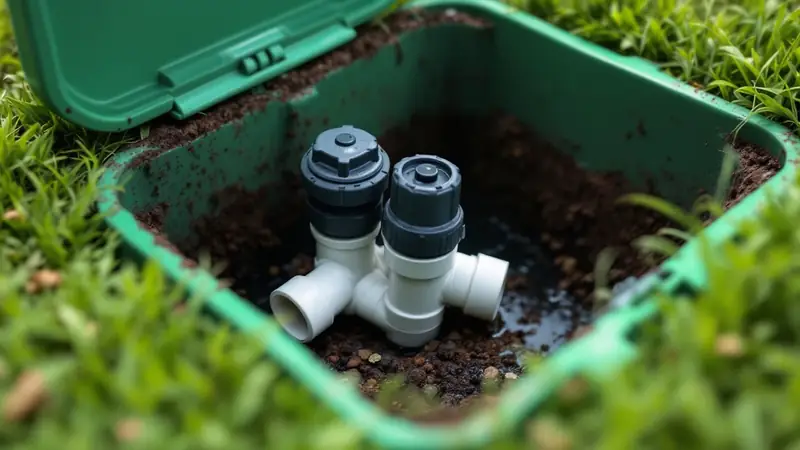
If a sprinkler zone won’t turn off, stop the water first: turn that valve’s solenoid clockwise until snug and close its bleed screw, then shut the irrigation supply or backflow ball valve. Hunter names debris under the diaphragm as the most common cause.
A sprinkler zone won’t turn off for one of 6 reasons, and the valve makers’ own troubleshooting guides list every one: the controller is still sending 24 volts, the valve was left on by hand, debris holds the diaphragm off its seat, the diaphragm is torn, pressure or flow is below the valve’s minimum, or the valve was installed backwards. A seventh look-alike, water draining out of the lowest head after the zone stops, is not a valve fault at all.
What the forum threads and installer pages leave out is the valve itself. Hunter says its valves need at least 20 psi to close (Hunter support); Toro rates its 1-inch 250/260 valve from 5 gpm (Toro spec sheet); Orbit’s 57461 jar-top valve works from 25 psi. Below, we put the shutoff move, minimum pressure and flow, and diaphragm and solenoid part numbers for 8 common valves side by side, with prices from 2 retailers checked Nov. 20, 2026.
Stop the water first: the 4-step order
Rain Bird’s troubleshooting guide for residential automatic valves (p. 10) says that when a valve won’t turn off with the controller, the first goal is to stop the flow of water, and it gives the order. Work through it until the water stops, then diagnose with the water off.
- Set the controller to OFF (Rain Bird’s auto/off). If the zone stops within a minute or two, the fault is in the controller or its program.
- Unplug the controller. If that stops the watering, Rain Bird says the problem is probably the controller; if water keeps running, it is the valve.
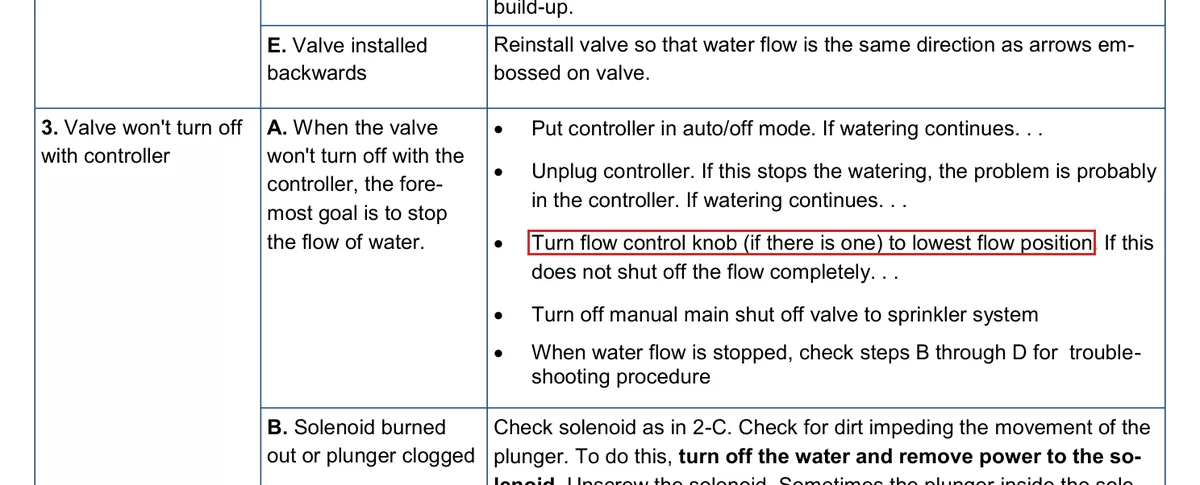
- Open the zone’s valve box and close any manual-on setting: turn the solenoid clockwise until hand-snug and tighten the bleed screw. Then turn the flow control knob, if the valve has one, toward its lowest flow position, stopping when it resists.
- Close the irrigation shutoff: Rain Bird describes a brass gate or ball valve just after the tee where the sprinkler line leaves the house supply. Either ball valve on the backflow preventer works too: a quarter turn puts the handle across the pipe. Use the curb meter only as a last resort, because it cuts water to the house.
| Where to stop it | Usually found | Move to close | What else stops | Source |
|---|---|---|---|---|
| Zone valve solenoid (internal bleed) | On top of the valve, black cylinder with 2 wires | Clockwise until snug; Rain Bird manual-on is only 1/4 turn the other way | That zone only | Rain Bird valve guide, p. 7 |
| External bleed screw or Orbit lever | Top of the bonnet | Clockwise, hand-tight; Toro: until it stops, do not over-tighten | That zone only | Toro 53707 guide |
| Flow control knob | Center of the bonnet, on flow-control models | Clockwise toward lowest flow | That zone, if it seats fully | Rain Bird valve guide, p. 10 |
| Irrigation shutoff (gate or ball valve) | Just after the tee off the house line; basement in cold climates | Ball valve 1/4 turn; gate valve clockwise to the stop | Whole sprinkler system | Rain Bird valve guide, pp. 2, 5 |
| Backflow preventer ball valves | Above ground near the house (PVB, RP) or in a box near the meter | 1/4 turn, handle across the pipe | Whole sprinkler system | our spring start-up guide |
| Curb meter shutoff | Meter box at the street, needs a meter key | Quarter turn | House and sprinklers | Last resort |
Closing the zone valve by hand is the gentle option: the mainline from the backflow to the valves stays pressurized whenever the supply is on, which is why it sits deeper in the ground than the laterals in our guide to how deep sprinkler lines should be. If you cannot find the box, our guide on how to find a buried sprinkler valve box walks the head-to-valve trace and the click test.
Which of the 6 causes is holding the valve open?
Answer these 5 questions in order with the water off between tests. Rain Bird’s Irrigation Troubleshooting Guide (pp. 9 to 10) lists 8 reasons a valve will not close; they collapse into the 6 causes below, and the questions sort them from free to fix to the one that needs the bonnet off.
1Does the zone stop when you set the controller to OFF or unplug it?
YesController side. With that station off, 24 to 30 VAC between COM and its terminal means the controller is still powering it (Rain Bird). If the zone runs whenever any zone runs, check whether its wire sits on the P/MV terminal.
NoGo to the next question
2Is the solenoid backed off, the bleed screw loose or an Orbit lever turned to on?
YesManual-on left set. Turn it clockwise until hand-snug; Rain Bird's DV opens with only 1/4 turn.
NoGo to the next question
3Does water only seep from the lowest head and stop once the pipe has drained?
YesLow-head drainage, not a valve fault. Fit check-valve heads; Rain Bird's 1800 SAM holds back 14 ft of elevation.
NoGo to the next question
4Does the zone run while off but stop when the controller turns it on?
YesInstalled backwards, the exact symptom in Rain Bird's valve guide. Reinstall with the flow arrow toward the heads.
NoGo to the next question
5Is it a small or drip zone, or is supply pressure under 20 psi?
YesBelow the valve's minimum. Hunter valves need 20 psi to close and Toro's 1 in 250/260 is rated from 5 gpm. Close the flow control 2 turns, add a filter or fit a low-flow valve.
NoDebris or a torn diaphragm. Shut off the supply, remove the bonnet, rinse the diaphragm and seat, clear the ports with a wire, and replace the diaphragm if torn ($6.44 to $25.42).
Source: Rain Bird valve guide and Irrigation Troubleshooting Guide; Hunter support pages; Toro 250/260 spec
| Cause | What you see | Test | Fix | Part cost, Nov. 20, 2026 | Source |
|---|---|---|---|---|---|
| Controller still powering the station | Zone stops when the controller is unplugged; solenoid warm and humming | Meter set to VAC across COM and that station: 24 to 30 V with the station off | Move the wire to a spare station or repair the controller | $0 for a spare terminal | Rain Bird TSG, p. 10 |
| Zone wired to the master valve (P/MV) terminal | This zone runs whenever any zone runs | Read which terminal the zone’s wire sits on | Move it to its own station terminal | $0 | Hunter X2 P/MV |
| Manual-on left set | Runs no matter what the controller does | Solenoid backed off, bleed screw loose, lever on | Turn clockwise, hand-tight | $0 | Rain Bird valve guide, 3-E |
| Debris on the seat, plugged port or stuck plunger | Starts after a pipe repair, a new zone or on well water | Water off, remove the solenoid and bonnet, inspect | Rinse; clear ports with a paper clip, never drill | $0; solenoid $11.05 to $19.35 | Hunter |
| Torn diaphragm | Will not close even when clean | Look for tears, bubbles, wrinkles | Replace the diaphragm | $6.44 to $25.42 | Rain Bird TSG, p. 10 |
| Pressure or flow below the valve’s minimum | Small or drip zone, low supply pressure | Hose-bib gauge; count heads x nozzle gpm | Close the flow control 2 turns, add a filter or a low-flow valve | $0 to a new valve | Rain Bird PGA spec |
| Valve installed backwards | Runs when off, stops when the controller turns it on | Flow arrow points toward the supply | Reinstall arrow toward the heads | Valve $24.00 to $55.50 list | Rain Bird valve guide, 9-A |
| Look-alike: low-head drainage | Puddle at the lowest head that stops once the pipe empties | Rain Bird: stop that zone 2 days; the spot dries | Check-valve heads or fittings | Not a valve repair | Rain Bird valve guide, 4-D |
Is the controller still sending 24 volts?
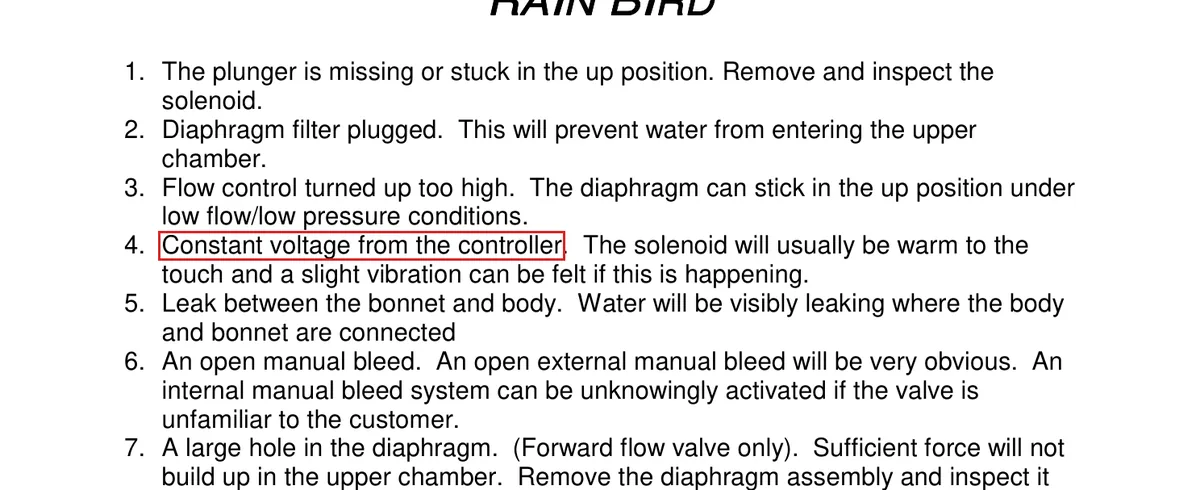
Rain Bird lists “constant voltage from the controller” among the reasons a valve will not close: the solenoid is warm to the touch and you can feel a slight vibration. Its valve guide sets the test: with a meter on AC volts across the COM terminal and the station terminal, a working station reads 24 to 30 volts when on, so a reading there while the controller says the station is off points at the controller.
A zone that runs whenever any other zone runs is usually a wiring choice, not a stuck valve. Hunter’s X2 controller page says the master valve or pump start circuit is ON for all stations by default, so a zone valve wired to the P/MV terminal opens with every station. Off its wires, a solenoid should read 20 to 60 ohms on Rain Bird’s test, and its DV spec narrows that to 42 to 55 ohms; below 20 is a short.
Was the valve left on by hand?
Every valve in our table can be opened by hand without power, which is how a zone gets left on after a test or a blowout. Hunter opens a valve with 1/4 to 1/2 turn of the solenoid counterclockwise or of the bleed screw; Rain Bird’s DV takes 1/4 turn of the solenoid and warns that going past it can release the solenoid under pressure. After a fall blowout, Rain Bird leaves valves in manual-open so they cannot trap water, a step in our guide to winterizing a sprinkler system; any valve not closed in spring runs as soon as the supply opens.
Debris or a torn diaphragm: how to open the valve
Hunter names debris as the most common reason a valve stays on or weeps, usually after a new install that was not flushed, a mainline repair or well water. A torn diaphragm is the other half: on a forward-flow valve, a large hole stops pressure building above it, so it cannot close (Rain Bird TSG, p. 10).
- Shut off the irrigation supply. Hunter: opening a valve under pressure can injure you.
- Unscrew the solenoid counterclockwise and check that the plunger moves freely; Rain Bird pushes a wire into the hole in the solenoid base to test it.
- Remove the bonnet screws or jar-top ring and lift the bonnet slowly so the spring and diaphragm do not drop out; note which way the diaphragm sits.
- Rinse the diaphragm and spring in clean water. Replace the diaphragm if it has tears, wrinkles or bubbles, or if the seal has nicks.
- Clear the small ports in the body and bonnet with a paper clip or thin wire (Rain Bird: never drill them out) and wipe grit off the seat.
- Reassemble with the lip of the diaphragm in its groove and the screws hand-tight, then open the supply slowly and run the zone once from the controller.
Too little pressure or flow to close
A diaphragm valve closes because the area above the diaphragm is about 2.5 times the area below it, so the same water pressure pushes it down harder (Rain Bird TSG, p. 9). Below each valve’s floor that margin is not enough. Hunter says its valves need at least 20 psi to close, and Rain Bird says a flow control turned up too high lets the diaphragm stick open under low flow or low pressure.
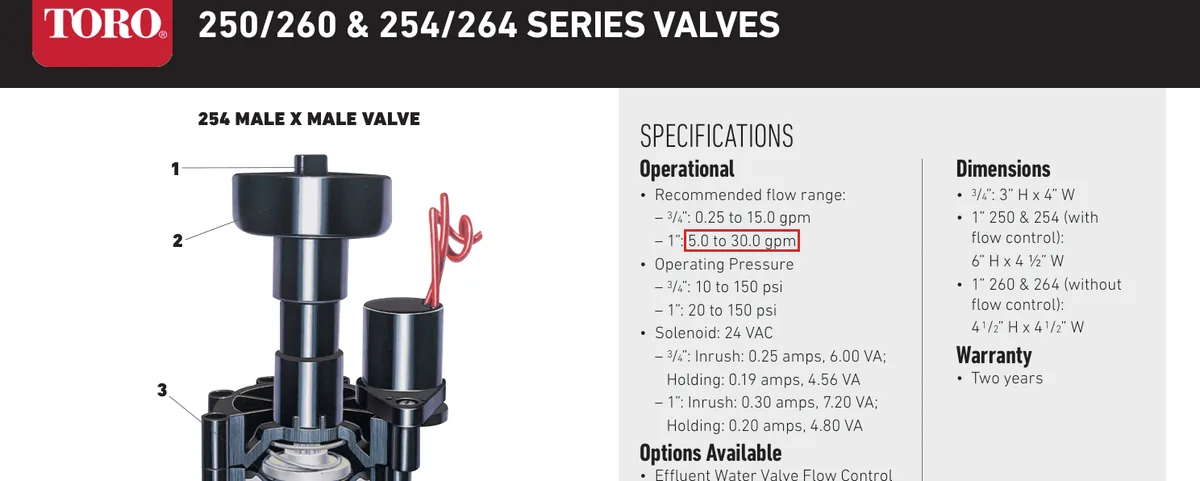
Small zones hit the flow floor first. Toro’s 1-inch 250/260 is rated from 5.0 gpm, so a drip zone of 2 gpm sits below it, while its 3/4-inch 254/264 goes down to 0.25 gpm. Rain Bird tells PGA owners with under 10 gpm to turn the flow control stem down 2 full turns from open and to filter upstream below 5 gpm; the DV wants a 200-mesh filter below 3 gpm. Our drip irrigation setup guide puts a 120 to 200 mesh filter at the head of every drip zone for the same reason.
Installed backwards
Rain Bird’s valve guide gives this its own symptom line: water runs continuously when the valve is not activated and shuts off when it is. The arrows on the body show the flow direction, and Rain Bird’s troubleshooting guide calls a reversed valve “an expensive coupling”. It shows up on new installs and after a valve swap, and the only fix is to cut it out and reinstall it with the arrow toward the heads.
Heads that drip after the zone stops
Water seeping from the lowest head for a while after a zone shuts off is often low-head drainage: the lateral emptying downhill. Hunter says it stops once the pipe is empty and a check valve in the sprinkler fixes it, but a check valve will not fix water leaking through the zone valve. Rain Bird’s 1800 SAM spray bodies hold back up to 14 feet of elevation (1800 Series spec). If the puddle never dries, the valve is weeping: EPA WaterSense puts a 1/32-inch irrigation leak at about 6,300 gallons a month.
If the water meter keeps turning with every zone off, the leak sits before the zone valves; our steps for finding a leak in a sprinkler system separate a mainline break from a seeping valve with three meter readings.
Your valve: closing pressure, manual off and repair parts
Read the model on the bonnet or solenoid, then use its row. Diaphragm and solenoid prices are posted single-unit prices at Sprinkler Warehouse (SW) and Cheap Sprinklers (CS) on Nov. 20, 2026, before shipping and tax; “Not priced” means we did not check a price for that part; ask the retailer by part number.
| Valve | Pressure range | Flow range | Manual on, then off | Diaphragm part and price | Solenoid part and price |
|---|---|---|---|---|---|
| Rain Bird DV/DVF, 1 in | 15 to 150 psi | 0.2 to 40 gpm; filter below 3 gpm | Solenoid 1/4 turn; external bleed 1/2 turn | 210746-03 kit: $17.80 SW | 208588-01: $19.35 SW; $19.16 CS |
| Rain Bird HV, 1 in | 15 to 150 psi | 0.2 to 30 gpm; filter below 3 gpm | Internal and external bleed | 231900 (Rain Bird guide) | 236307 (Rain Bird guide) |
| Rain Bird PGA, 1 in | 15 to 150 psi | 2 to 150 gpm; under 10 gpm close flow control 2 turns | Internal bleed | 209792: $25.42 SW | Not priced |
| Hunter PGV-100/101, 1 in | 20 to 150 psi; needs 20 to close | 0.2 to 40 gpm | Solenoid or bleed screw 1/4 to 1/2 turn | 332100: $7.26 SW; $8.99 CS | 60-6800: $11.05 SW; $13.49 CS |
| Toro 250/260, 1 in | 20 to 150 psi | 5.0 to 30.0 gpm | External bleed screw | Not priced | Not priced |
| Toro 254/264, 3/4 in | 10 to 150 psi | 0.25 to 15.0 gpm | External bleed screw | Not priced | Not priced |
| Irritrol 2400/2600, 1 in | 10 to 150 psi | 0.25 to 30 gpm | Internal and external bleed | 100236: $7.71 SW | Not priced |
| Orbit 57461 jar-top, 1 in | 25 to 80 psi working; 90 max | Not stated as a range | Lever 1/4 to 1/2 turn; bleed screw | 57473: $6.44 SW | Not priced |
Two patterns stand out. The 1-inch valves with the highest floors, Hunter’s PGV and Toro’s 250/260 at 20 psi and Orbit’s 57461 at 25, are the ones to suspect on a weak well or a long run from the meter. And a diaphragm costs $6.44 to $25.42 against $24.00 to $55.50 list for a whole Rain Bird valve, so a rebuild is worth trying before cutting pipe.
How much water is a stuck zone wasting?
Multiply the zone’s flow by the minutes it has run. Rain Bird’s 15 Series HE-VAN spray nozzle uses 3.70 gpm full circle and 1.85 gpm half circle at 30 psi, so a zone of 8 half-circle sprays moves 14.8 gpm, about 888 gallons an hour. For your own zone, read the water meter for 1 minute while only that zone runs.
- Gallons through the zone
- 7,104
Default: 8 hours at 14.8 gpm = 7,104 gallons, about $46 at $6.54 per 1,000 gallons. Gallons = gpm x 60 x hours. Sprays at 30 psi per Rain Bird's nozzle chart; for your zone, read the meter for 1 minute with only that zone on. Sewer charges, if billed on water use, are extra.
| Zone (Rain Bird 15 Series at 30 psi) | Flow | Gallons in 1 hour | Gallons in 8 hours | Cost of 8 hours at $6.54 per 1,000 gal |
|---|---|---|---|---|
| Small drip zone | 2 gpm | 120 | 960 | $6.28 |
| 4 full-circle sprays | 7.4 gpm | 444 | 3,552 | $23.23 |
| 8 half-circle sprays | 14.8 gpm | 888 | 7,104 | $46.46 |
| 6 full-circle sprays | 22.2 gpm | 1,332 | 10,656 | $69.69 |
Fix it yourself or call an irrigation tech?
The first 3 causes cost nothing but a screwdriver and a multimeter, and the $17.80 Rain Bird DV kit ships with the diaphragm, spring and 6 screws. Call a tech when the shutoff handle will not turn, the valve body or bonnet is cracked, the box cannot be found, or the controller reads voltage on an idle station. In our sprinkler repair cost survey, a diaphragm job runs $125 to $250 installed and a buried valve replacement about $550.
Before the visit, write down 3 things the tech will ask: whether the zone stopped when you unplugged the controller, which zone number it is, and whether anyone recently repaired pipe, added a zone or dug nearby, the triggers Hunter ties to debris. If the heads also need resetting after the repair, our guide on how to adjust sprinkler heads covers arc and radius.
How we compiled this
We read 20 manufacturer documents and support pages (Rain Bird, Hunter, Toro, Irritrol and Orbit valve specs, troubleshooting guides and manuals), the Denver Water 2026 rate table and an EPA WaterSense page in November 2026, and took prices from 10 retailer product pages on Nov. 20, 2026. We did not test any valve; every threshold is the maker’s printed figure, and the water-loss arithmetic is shown under its table.
Frequently asked questions
Why are my sprinklers still running when turned off?
Because the controller only opens valves; water pressure closes them. Hunter says a zone that keeps running with the controller unplugged points to debris inside the valve. Close the solenoid clockwise and shut the supply, then clean or replace the diaphragm.
How do I force a sprinkler system to turn off?
Close the irrigation shutoff or either ball valve on the backflow preventer, a quarter turn so the handle crosses the pipe. Rain Bird’s order is controller off, unplug, flow control to lowest, then the main shutoff. The curb meter is the last resort because it cuts water to the house.
Why is one sprinkler zone turning on with other zones?
Check whether its wire sits on the controller’s P/MV terminal. Hunter’s X2 sets the master valve or pump start circuit ON for every station by default, so a zone valve on that terminal opens with each station. Move it to its own station terminal.
How long should you let a sprinkler zone run?
Long enough to apply your weekly target, often about 1 inch. A Rain Bird 15 Series spray nozzle applies 1.58 inches an hour at 30 psi, so 1 inch takes about 38 minutes; rotors take far longer. Our guide to the best time to water a lawn has run times by nozzle type.
Can low water pressure keep a sprinkler valve from closing?
Yes. Hunter says its valves need at least 20 psi to close, Orbit rates its 57461 jar-top from 25 psi, and Rain Bird says a flow control open too far lets the diaphragm stick open under low flow or pressure. Close the flow control 2 turns and test again.
Sources
- Rain Bird Corporation, Troubleshooting and Maintenance Guide for Residential Automatic Valves, pp. 2 to 14, 2016. Accessed November 2026.
- Rain Bird Corporation, Irrigation Troubleshooting Guide, pp. 9 to 10 and 16 to 18, current PDF. Accessed November 2026.
- Rain Bird Corporation, DV Series Valves tech spec, current PDF. Accessed November 2026.
- Rain Bird Corporation, 2018 Turf Catalog, Valves (DV, HV, PGA), 2018. Accessed November 2026.
- Rain Bird Corporation, PGA Series Valves tech spec, current PDF. Accessed November 2026.
- Rain Bird Corporation, Landscape Irrigation Price List 2025, p. 8, effective Jan. 27, 2025. Accessed November 2026.
- Rain Bird Corporation, 1800 Series spray bodies tech spec (SAM check valve), 2020. Accessed November 2026.
- Rain Bird Corporation, 2018 Turf Catalog, Spray Nozzles (15 Series HE-VAN), 2018. Accessed November 2026.
- Hunter Industries, Valves: Valve Not Closing, current page. Accessed November 2026.
- Hunter Industries, Valves: Manually Opening a Valve, current page. Accessed November 2026.
- Hunter Industries, Valves: Weeping/Leaking when valve off, current page. Accessed November 2026.
- Hunter Industries, Valves: Cleaning Debris from an Irrigation Valve, current page. Accessed November 2026.
- Hunter Industries, X2: Pump/Master Valve (P/MV), current page. Accessed November 2026.
- Hunter Industries, 1 in. PGV operating specifications, current page. Accessed November 2026.
- Hunter Industries (hosted by Raintech), PGV Valve Owner’s Manual, LIT-294, parts list p. 11, 2003. Accessed November 2026.
- The Toro Company, 250/260 and 254/264 Series Valves spec sheet, P/N 15-1104-IRC, 2015. Accessed November 2026.
- The Toro Company, 1 in. In-line Valve Models 53707 and 53709 installation guide, current PDF. Accessed November 2026.
- Irritrol (The Toro Company), 2400/2600 Series valves spec sheet, current PDF. Accessed November 2026.
- Orbit Irrigation, 1 in. FPT Jar Top Automatic Sprinkler Valve 57461 product page, checked Nov. 20, 2026. Accessed November 2026.
- Orbit Irrigation, Solenoid will not turn on electrically (help center), 2025. Accessed November 2026.
- Sprinkler Warehouse, Rain Bird DV/DVF/ASVF diaphragm repair kit 210746-03, price checked Nov. 20, 2026. Accessed November 2026.
- Sprinkler Warehouse, Rain Bird DV/JTV replacement solenoid 208588-01, price checked Nov. 20, 2026. Accessed November 2026.
- Sprinkler Warehouse, Rain Bird PGA replacement diaphragm 1 in. 209792, price checked Nov. 20, 2026. Accessed November 2026.
- Sprinkler Warehouse, Hunter PGV replacement diaphragm 1 in. 33-2100, price checked Nov. 20, 2026. Accessed November 2026.
- Sprinkler Warehouse, Hunter replacement solenoid 60-6800, price checked Nov. 20, 2026. Accessed November 2026.
- Sprinkler Warehouse, Orbit jar top valve diaphragm 57473, price checked Nov. 20, 2026. Accessed November 2026.
- Sprinkler Warehouse, Irritrol 2400/2600 replacement diaphragm 100236, price checked Nov. 20, 2026. Accessed November 2026.
- Cheap Sprinklers, Hunter 332100SP 1 in. PGV replacement diaphragm, price checked Nov. 20, 2026. Accessed November 2026.
- Cheap Sprinklers, Rain Bird 208588-01 replacement solenoid, price checked Nov. 20, 2026. Accessed November 2026.
- Cheap Sprinklers, Hunter 60-6800 replacement solenoid, price checked Nov. 20, 2026. Accessed November 2026.
- Denver Water, 2026 Residential Water Rates, 2026. Accessed November 2026.
- U.S. EPA WaterSense, Fix a Leak Week, current page. Accessed November 2026.