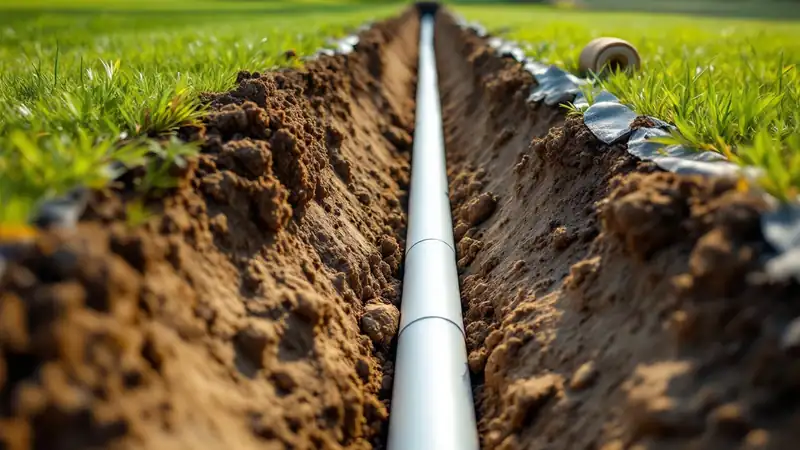
How deep should sprinkler lines be? Usually 6 to 8 inches for laterals and 10 to 12 inches for the mainline, per Hunter. Codes set cover: 6 inches in Texas, 8 and 12 in Hawaii. Lines stay above the frost line and get drained.
The answer to how deep should sprinkler lines be is written down in fewer places than the search results suggest. No national plumbing code sets a lawn-pipe depth. Three states do, plus a handful of cities and the electrical code for the valve wire. We put the depth clauses of 12 documents side by side: Texas rule 30 TAC 344.62(l), Florida Building Code Plumbing Appendix F, the Hawaii Plumbing Code, IRC Table E3803.1, three public-works specs, and the Hunter, Rain Bird, Toro and Purdue Extension install guides.
Two numbers decide most trenches. Where a source splits them, the mainline, which holds pressure all the time, gets 10 to 36 inches; Texas, Dallas and Florida’s small-pipe row stop at 6 inches for everything. Laterals to the heads get 6 to 18 inches, and the head body itself sets the floor: a Rain Bird 1804 spray body is 6 inches tall, so its inlet sits 6 inches below grade when the cap is flush.
Sprinkler line depth by code and spec
Every row below is minimum cover, measured from finished grade down to the top of the pipe, unless the source says trench depth. Read your state or city row first; Texas makes the maker’s published spec the first rule and 6 inches the fallback. Trenching is part of the per-zone price in our sprinkler system installation cost guide.
Swipe the table sideways to see every column.
| Source | Applies to | Mainline | Lateral | Note |
|---|---|---|---|---|
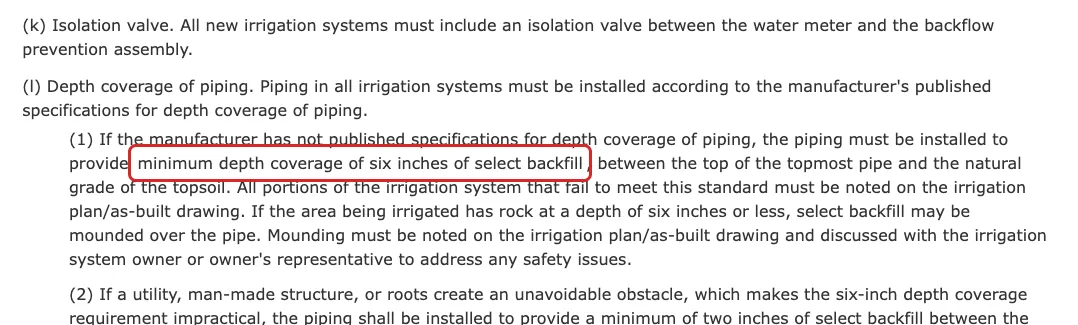
| Texas, 30 TAC 344.62(l) | State rule, all irrigation piping | 6 in | 6 in | Maker’s published spec first; 2 in where a utility, structure or roots block the 6 in |
| Dallas Plumbing Code 2021, G104.5.3 | City code | 6 in | 6 in | Same 6 in of select backfill as the state rule |
| Florida Building Code, Plumbing, App. F, Part V | State code, by pipe size | 12 in (2 to 3 in pipe) | 6 in (1/2 to 1-1/2 in pipe) | 18 to 30 in under vehicle traffic |
| Hawaii Plumbing Code 2021, L 411.12.1 | Landscape up to 10,000 sq ft | 12 in | 8 in | Over 10,000 sq ft: 18 in mains, 12 in laterals |
| IRC 2021 Table E3803.1, column 5 | Valve wire, 30 volts or less | 6 in | 6 in | 18 in under a home driveway, 24 in under streets |
| Texas, 30 TAC 344.62(m)(4) | Controller wire | 6 in | 6 in | Select backfill over the wire |
| Baytown, Texas, spec 02811, 3.03 E | City public-works spec | 18 in | 12 in | Sleeves 24 in; drain piping 12 in |
| Lakeland, Tenn., spec 02830, 3.08 C | City public-works spec | 12 to 18 in | 12 to 18 in | Its trenching clause says 14 to 20 in for mains |
| Mile High Flood District, Colo., 32 80 00, 3.03 C | Regional public-works spec | 36 in | 18 in | 12 in over laterals to pop-ups and rotors |
| Rain Bird Landscape Irrigation Design Manual, p. 60 | Maker design manual | about 12 in (residential) | not given | 24 in of cover on commercial and golf mains |
| Hunter LIT-226, pp. 15 to 16 | Maker homeowner guide (trench depth) | 10 to 12 in | 6 to 8 in | Only where no local code applies |
| Purdue Extension AY-28-W | Extension sod guide | 12 to 18 in | 12 to 18 in | Below normal tillage depth |
| Rain Bird XF dripline guide | Subsurface dripline | n/a | 4 to 6 in | 6 in where aerator tines run 4 in or less |
The spread reflects the job: Texas and Florida set floors for home lots, while the Mile High Flood District’s 36-inch main is written for public sites around Denver. If no row applies to you, Hunter’s 10 to 12 and 6 to 8 inches is the plainest default in print.
Why does the mainline go deeper than the laterals?
The mainline runs from the backflow preventer to the valves and stays pressurized whenever the supply is on. The Rain Bird design manual (p. 60) says the main is under constant pressure, needs heavier-walled pipe and should get enough cover to protect it from traffic overhead, about 12 inches on a residential design. A lateral only holds pressure while its zone runs, so a leak there runs only while that zone does.
That constant pressure is why a mainline break moves the water meter with every zone off, the first reading in our guide to finding a sprinkler system leak before you dig.
Because the mainline ends at the zone valves, the strip between the backflow preventer and the nearest paved edge is the first place to search in our guide on how to find a buried sprinkler valve box.
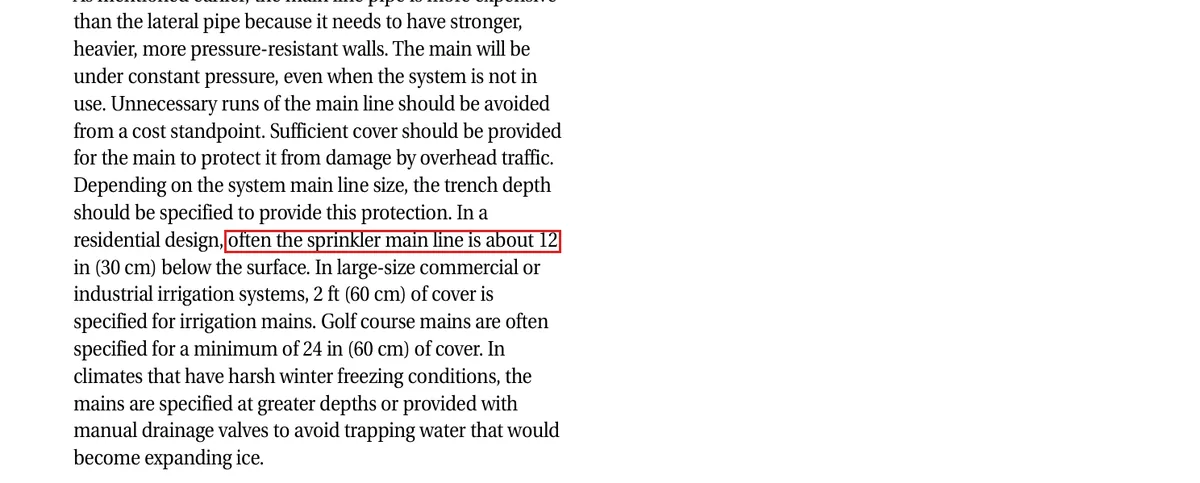
Every source that splits the two puts the main deeper: Hunter by 4 inches (10 to 12 against 6 to 8), Hawaii by 4 to 6 inches, Baytown by 6 inches and the Mile High Flood District by 18 inches. Texas and Lakeland use one figure for both. Depth also tracks repair cost: a mainline leak runs $195 to $275 against $60 to $190 for a lateral in our sprinkler repair cost survey.
Depth by pipe size and under driveways
Florida is the only code we found that ties cover to pipe diameter. Its Appendix F ties the figures to Soil Conservation Service Code 430-DD, and the jump from 6 to 12 inches comes at 2-inch pipe, larger than most home laterals.
| Pipe size | Cover, all areas except vehicle traffic | Cover, vehicle traffic areas |
|---|---|---|
| 1/2 to 1-1/2 in | 6 in | 18 in (1/2 to 2-1/2 in) |
| 2 to 3 in | 12 in | 24 in (3 to 5 in) |
| 4 to 6 in | 18 in | 30 in (6 in and larger) |
| Over 6 in | 24 in | 30 in |
| Valve body (top) | 6 in, nontraffic and noncultivated | 18 in |
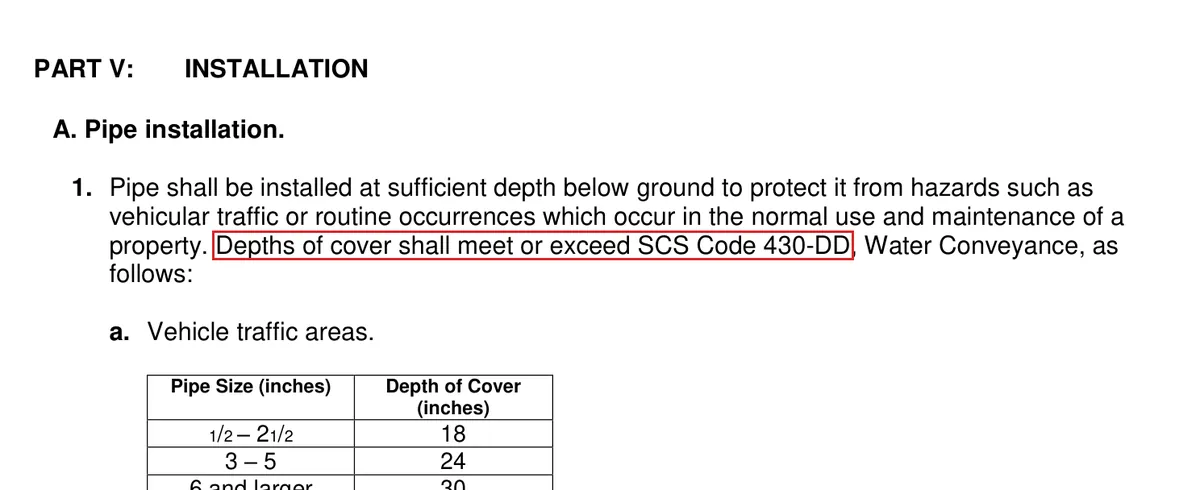
Under paving, sleeve the pipe. Appendix F wants a sleeve two pipe sizes larger than the carrier pipe, at least Schedule 40 wall, running 3 feet past the paved edge; Baytown buries its sleeves 24 inches. The valve wire follows the electrical code: IRC Table E3803.1 allows 6 inches for irrigation control circuits of 30 volts or less in the open yard, 18 inches under a one- or two-family driveway and 24 inches under streets.
How deep are sprinkler heads?
Pop-up heads are set with the cap level with finished grade; Toro’s 570Z instructions say so in those words. That makes the head’s body height the depth of its inlet, and Rain Bird’s catalog prints the body heights for its 1800 series.
| Rain Bird model | Pop-up height | Body height (inlet depth when flush) | Inlet |
|---|---|---|---|
| 1802 | 2 in | 4 in | 1/2 in bottom |
| 1804 | 4 in | 6 in | 1/2 in bottom |
| 1806 | 6 in | 9-3/8 in | bottom or side (not SAM models) |
| 1812 | 12 in | 16 in | bottom or side (not SAM models) |
A 4-inch pop-up such as the 1804 fits a 6 to 8 inch lateral with a short swing pipe. A 12-inch pop-up for tall shrubs would need a 16-inch trench if fed from below, which is why Toro says to mount its 12-inch body on a barbed elbow with thick-walled poly pipe to reduce trench depth, and why Rain Bird puts a side inlet on the 1806 and 1812.
When a head on one of those swing pipes breaks, the fitting is at that same depth; our steps for sprinkler head replacement cover thread tape, setting the cap at grade and flushing before the nozzle goes back on.
Do sprinkler lines need to go below the frost line?
No. None of the 12 depth documents asks for irrigation pipe below the frost line; the deepest home-scale figure is Purdue’s 12 to 18 inches. Irrigation is protected by emptying it. Rain Bird’s manual says that in climates with harsh freezing, mains are set deeper or fitted with manual drain valves so no water is trapped, and Hunter’s guide adds automatic drain valves at the low point of each zone.
Colorado State University Extension explains why: water expands by one-eleventh as it freezes, enough to split pipe, fittings and valves, so winterizing means expelling all the water. Our guide to winterizing a sprinkler system covers the blowout pressures; the spring restart is in how to turn on a sprinkler system.
1Does the pipe or valve wire cross under a driveway, walk or parking pad?
YesSleeve it and go deeper: Florida Appendix F wants 18 in of cover over 1/2 to 2-1/2 in pipe under vehicle traffic, with a sleeve two pipe sizes larger running 3 ft past the paving. IRC Table E3803.1 puts valve wire 18 in under a home driveway.
NoGo to the next question
2Are you in Texas, Florida or Hawaii, or does your city publish an irrigation spec?
YesUse that number: 6 in of select backfill in Texas (30 TAC 344.62(l)), 6 in over pipe up to 1-1/2 in in Florida, 12 in for mains and 8 in for laterals in Hawaii on lots up to 10,000 sq ft.
NoGo to the next question
3Is this the mainline, under pressure whenever the supply is on?
YesTrench 10 to 12 in (Hunter LIT-226) for about 12 in of cover (Rain Bird). In hard-freeze climates add drain valves and blow it out each fall instead of digging below the frost line.
NoGo to the next question
4Is it subsurface dripline under turf that gets core aerated?
YesBury it 6 in and keep aerator tines at 4 in or less (Rain Bird XF guide, p. 42).
NoA lateral to spray heads: trench 6 to 8 in (Hunter), and at least as deep as the head body, 6 in for a Rain Bird 1804 set flush with grade.
How deep should drip lines be, and will an aerator hit them?
Drip tubing in shrub beds can sit on the soil under mulch, which the Rain Bird XF dripline guide allows (p. 13); buried dripline goes 4 to 6 inches deep. Under turf that gets core aerated, Rain Bird recommends 6 inches with tine depth set no deeper than 4 inches (p. 42). Emitter spacing and zone layout are in our guide to setting up drip irrigation, and the choice between the two systems is in drip irrigation vs sprinkler.
Core aerators pull plugs 2 to 3 inches long (Purdue Extension AY-8), so a lateral at 6 inches is out of reach while dripline at 2 inches is not. Heads are what aerators hit most often: flag every head before the machine runs, as our guide on how to aerate a lawn sets out step by step.
Before you dig: 811, old lines and backfill
- Contact 811 a few business days before trenching (Common Ground Alliance); Florida law sets at least 2 full business days (Fla. Stat. 556.105).
- Expect your own sprinkler pipe to stay unmarked. MISS DIG 811 lists underground sprinkler systems as private lines that utility locators do not mark; a private locator does it for a fee.
- Cut sod in a strip about 12 inches wide and 1-1/2 to 2 inches deep, and set it on a tarp 2 feet from the trench (Hunter LIT-226, p. 15).
- Trench mains 10 to 12 inches and laterals 6 to 8 inches where no code applies; for poly pipe a rented pipe puller replaces the trench (Hunter, pp. 15 to 16).
- Backfill with rock-free soil: Florida bars stones over 1 inch in the first layer, and Texas requires every trench compacted back to original grade (344.62(l)(3)).
On a new lawn, trench after rough grading and before final grading, the order in our guide on how to prepare soil for sod. Fill any trench line that settles before the lawn goes down.
Two of the top-ranking pages for this search give limits no code we read uses. One says trenches should be no more than 10 inches deep; Baytown, the Mile High Flood District and Rain Bird’s commercial mains all go deeper. Another says the minimum is the pipe diameter plus 4 inches; Texas sets 6 inches of cover regardless of pipe size.
This page is general information, not code advice. Codes are adopted and amended locally; confirm the depth with your city permit office or the irrigation plan before you trench.
How we compiled this
On Nov. 19, 2026 we read the depth and installation clauses in 13 primary documents: 3 state codes or rules (Texas, Florida, Hawaii), 1 city plumbing code (Dallas), the 2021 IRC electrical table, 3 public-works irrigation specs (Baytown, Lakeland, Mile High Flood District), 4 maker documents (Rain Bird, Hunter, Toro) and Purdue Extension AY-28-W, plus Rain Bird’s 1800 catalog for head heights. Figures are copied as printed; we did not dig or measure any trench. Google results for 5 phrasings were checked the same day.
Frequently asked questions
What is the standard depth for sprinkler lines?
There is no national standard. Where no code applies, Hunter’s homeowner guide trenches mainlines 10 to 12 inches and laterals 6 to 8 inches. Texas requires 6 inches of cover, and Hawaii 12 inches for mains and 8 for laterals on landscapes up to 10,000 sq ft.
What is the 18-inch rule for sprinklers?
It is a fire sprinkler rule, not a lawn one. OSHA 29 CFR 1910.159(c)(10) requires at least 18 inches of vertical clearance between sprinklers and stored material below. For lawn pipe, 18 inches turns up as Florida’s cover for small pipe under vehicle traffic.
How do I find my sprinkler lines without digging?
Start with the irrigation plan or as-built drawing; Texas rule 344.62(l) requires shallow runs to be noted on it. Then trace from the valve box toward each head, since laterals run head to head. 811 will not mark them: MISS DIG 811 lists sprinkler systems as private lines, so hire a private locator.
How deep should drip irrigation lines be buried?
Rain Bird’s XF guide buries dripline 4 to 6 inches, and 6 inches in turf that gets core aerated with tines set at 4 inches or less. In shrub beds the same tubing can sit on the soil under mulch.
How deep should sprinkler lines be in Florida?
Florida Building Code Plumbing Appendix F sets 6 inches of cover for 1/2 to 1-1/2 inch pipe, 12 inches for 2 to 3 inch pipe, and 18 inches for small pipe under vehicle traffic. Valve bodies get 6 inches of cover, 18 in traffic areas.
Sources
- Texas Commission on Environmental Quality (via Cornell LII), 30 Tex. Admin. Code 344.62, Minimum Design and Installation Requirements, subsections (l) and (m), current rule. Accessed November 2026.
- City of Dallas (via UpCodes), Dallas Plumbing Code 2021, Appendix G, G104.5.3 Depth Coverage of Piping, 2021 code. Accessed November 2026.
- Florida Building Commission, Florida Building Code, Plumbing, 7th ed. (2020), Appendix F, as filed in local amendments (Palm Beach County), PDF pp. 111 to 112, filed 2022. Accessed November 2026.
- State of Hawaii (via UpCodes), Hawaii Plumbing Code 2021, Appendix L, L 411.12.1 Landscape Areas, 2021 code. Accessed November 2026.
- International Code Council, 2021 International Residential Code, Table E3803.1 Minimum Cover Requirements, 2021 code. Accessed November 2026.
- City of Baytown, Texas, Technical Specifications, Section 02811 Landscape Irrigation, 3.03 E, current spec. Accessed November 2026.
- City of Lakeland, Tennessee, Section 02830 Irrigation Standard Specifications, current spec. Accessed November 2026.
- Mile High Flood District (Denver area, Colo.), Section 32 80 00 Irrigation, 3.03 C, revised Aug. 2015. Accessed November 2026.
- Rain Bird Corporation, Landscape Irrigation Design Manual, p. 60, current PDF. Accessed November 2026.
- Hunter Industries, Residential Sprinkler System Design and Installation Guide, LIT-226-US H, pp. 15 to 16, May 2020. Accessed November 2026.
- Purdue University Extension, AY-28-W, Establishing a Lawn from Sod, current PDF. Accessed November 2026.
- Rain Bird Corporation, XF Series Dripline Design, Installation and Maintenance Guide, pp. 13, 42, 2020 PDF. Accessed November 2026.
- Rain Bird Corporation, 2018 Turf Catalog, Spray Bodies, 1800 Series, p. 7, 2018. Accessed November 2026.
- The Toro Company, 570Z and 570S Series Sprinklers Installation Instructions, 2020. Accessed November 2026.
- Colorado State University Extension, Home Sprinkler Systems: Preparing Your Sprinkler System for Winter (Fact Sheet 4.719), current page. Accessed November 2026.
- Purdue University Extension, AY-8-W, Mowing, Dethatching, Aerifying and Rolling Turf, current PDF. Accessed November 2026.
- Common Ground Alliance, 811: Before you dig, current page. Accessed November 2026.
- The Florida Senate, Florida Statutes 556.105, Procedures, 2025 Statutes. Accessed November 2026.
- MISS DIG 811 (Michigan), Homeowner FAQ, current page. Accessed November 2026.
- U.S. Occupational Safety and Health Administration, 29 CFR 1910.159, Automatic sprinkler systems, current regulation. Accessed November 2026.