How does a rain sensor work? Its hygroscopic disks swell in rain and push open a switch on the controller’s sensor or common wire, so no valve can open. Common settings are 1/8 to 3/4 inch; UF/IFAS measured about 19 hours to dry out.
How does a rain sensor work in practice? It is a switch in the 24-volt circuit between the controller and the valves, and rain opens it. It never turns sprinklers on. Hunter’s Mini-Clik card says the timer keeps advancing while the sensor is wet; the valves simply cannot open until it dries (Hunter Mini-Clik installation card, 2020).
Three things here are missing from the top-ranking guides we read: settings and Nov. 21, 2026 prices for 7 Hunter and Rain Bird sensors, University of Florida field counts of how often each setting shut irrigation off (81 times at the quickest, 8 at 1 inch), and the code section for 6 state rules, including New Jersey’s Jan. 16, 2024 time-of-sale law. If nothing waters at all, our guide to a sprinkler head not popping up starts with the same check.
What happens inside a rain sensor when it rains?
Most residential sensors hold a stack of hygroscopic disks, a cork-like material that swells in proportion to the rain that lands on it. UF/IFAS publication ABE325 (revised July 2024) explains that the swollen disks press a switch open, and it closes again as they dry (UF/IFAS ABE325). Turning the cap changes how far the disks must swell first.
- Rain falls into the open top of the sensor and soaks the disks.
- The disks swell. At the set depth, 1/8 to 3/4 inch on a Mini-Clik or Rain Bird RSD, they push the spindle into the switch and it clicks open.
- The open switch breaks the circuit. Wired in series with the valve common wire, no valve gets 24 volts; wired to the controller’s sensor (SEN) terminals, the controller suspends watering itself.
- The controller’s clock keeps running, so a skipped cycle is not made up later (Mini-Clik card, p. 1).
- Sun and wind dry the disks. Hunter puts the reset at as little as 4 hours, but cold, damp weather can hold a sensor active for months (Hunter dry-out support page).
ABE325 also describes older cup designs that trip on the weight of collected water or on electrodes, typically set for storms over 1/2 inch; leaves, birds or frogs can trip them. Hunter’s Rain-Clik adds Quick Response, shutting off about 2 to 5 minutes into rain and resetting in about 4 dry, sunny hours (Hunter Rain-Clik page).
Wireless models put the disks in a battery transmitter and wire a receiver to the controller. Hunter’s receiver takes 24 VAC through 2 yellow wires, switches the sensor circuit normally closed or normally open, reaches 800 ft line of sight and has a sealed battery rated for at least 5 years (Wireless Rain-Clik manual, pp. 5 to 14). Rain Bird’s WR2 rates 700 ft, 4 or more years and a 33 to 41°F freeze setting (WR2 spec).
| Sensor | What trips it | Rain setting | Freeze shutoff | Connection | Price, Nov. 21, 2026 | Source |
|---|---|---|---|---|---|---|
| Hunter Mini-Clik (MINI-CLIK) | Hygroscopic disks | 1/8, 1/4, 1/2 or 3/4 in | No | 25 ft wire; normally closed (NO version sold) | $37.49 | Hunter card; Hunter page |
| Hunter Wireless Mini-Clik (WM-CLIK) | Hygroscopic disks | 1/8 to 3/4 in | Yes (rain/freeze model) | Wireless, 800 ft line of sight | $113.49 | Hunter page |
| Hunter Rain-Clik (RAIN-CLIK) | Disks plus Quick Response | No depth dial; vent ring sets reset | No | 25 ft of 20 AWG wire | $39.49 | Hunter page |
| Hunter Wireless Rain-Clik (WR-CLIK) | Disks plus Quick Response | Vent ring only | No | Wireless, 800 ft; sealed battery, 5+ yr | $106.49 | Hunter manual |
| Hunter Wireless Rain/Freeze-Clik (WRF-CLIK) | Disks plus Quick Response | Vent ring only | At 37°F or below | Wireless, 800 ft | Shown only in cart | Hunter manual |
| Rain Bird RSD-BEx | Hygroscopic disks | 1/8 to 3/4 in (5 to 20 mm) | No | 25 ft of #20 wire; N.C. sensor port or in series with common | $28.45 sale ($47.99 list) | Rain Bird spec |
| Rain Bird WR2-RFC | Hygroscopic disks | 1/8 to 1/2 in (3 to 13 mm) | Adjustable 33 to 41°F | Wireless, 700 ft; battery 4+ yr; 72 hr suspend or override modes | $88.95 sale ($172.99 list) | Rain Bird spec |
| Weight cup (generic) | Weight of collected water | Preset weight | No | Wired | Not priced | UF/IFAS ABE325 |
| Electrode cup (generic) | Water level reaches electrodes | Typically over 1/2 in | No | Wired | Not priced | UF/IFAS ABE325 |
| Hunter Soil-Clik (soil moisture) | Probe reads soil moisture | Moisture threshold, not rain | No | Wired | $147.99 | EPA WaterSense |
Wired disk sensors cost $28.45 to $37.49 on Nov. 21, 2026, wireless kits $88.95 to $113.49, and our sprinkler system installation cost guide shows installers often include one. Mount it in open rain near the roofline, clear of roof runoff, trees and sprinkler spray (ABE325, p. 3); extend the 25 ft lead with 18 AWG wire to 100 ft and 16 AWG beyond (Mini-Clik card).
What do the 1/8, 1/4, 1/2 and 3/4 inch settings mean?
The number on the cap is the rain that must fall before the switch opens. On a Mini-Clik you rotate the cap until its pins sit in the 1/8, 1/4, 1/2 or 3/4 inch slot, without forcing it (Mini-Clik card, p. 2). Hunter’s support page says 1/8 to 1 inch, and the 2008 study below used a 1 inch setting, so older caps may show it.
UF/IFAS recommends the smallest set point, 1/8 inch on most devices, and never more than 1/4 inch (ABE325, p. 4). The field data behind that advice comes from a Gainesville, Florida study by Cardenas-Lailhacar and Dukes, who logged a Wireless Rain-Clik and Mini-Clik sensors with the Mini-Cliks set at 3, 13 and 25 mm (Journal of Irrigation and Drainage Engineering, 2008).
| Sensor and setting | Set point | Average rain at shutoff | Times it shut irrigation off | Payback at $2.00 per 1,000 gal |
|---|---|---|---|---|
| Wireless Rain-Clik, vents half open | Quick Response | 1.4 mm (about 1/16 in) | 81 | Under 1 year |
| Mini-Clik | 3 mm (1/8 in) | 3.4 mm | 43 | Under 1 year |
| Mini-Clik | 13 mm (1/2 in) | 10.0 mm | 30 | Under 1 year |
| Mini-Clik | 25 mm (1 in) | 24.5 mm | 8 | Not shown under 1 year |
Each step up cut the shutoffs: the 1 inch sensor skipped irrigation 8 times against 43 at 1/8 inch, because most storms never reach an inch. Some individual units also drifted from their setting, so test a sensor rather than trusting the dial. Our guide to the best time to water a lawn covers how much rain resets the schedule.
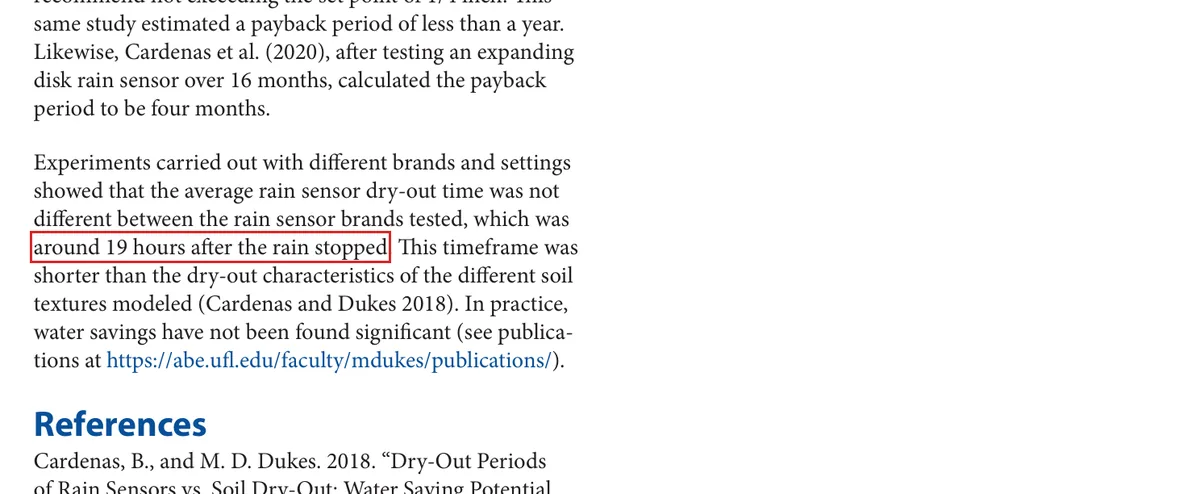
The vent ring sets drying speed: close it for a sunny south wall, open it for a shaded north one (Mini-Clik card). In UF tests the average dry-out was about 19 hours after rain stopped, with no difference between brands (ABE325, p. 4).
How much water does a rain sensor save?
Every skipped cycle saves the water that cycle would have put down: 0.62 gallons per square foot per inch, since 1 inch of rain on an acre is about 27,154 gallons (USGS Water Science School). A 5,000 sq ft lawn programmed for 1/2 inch saves about 1,558 gallons each time the sensor trips. Enter your own area, depth and water price below.
- Gallons not applied
- 1,558
Gallons = sq ft x inches x 0.6234 (USGS: 27,154 gallons per acre-inch). Water prices are your inputs, not survey data. Default: 5,000 sq ft, 1/2 inch, 1 skipped cycle = 1,558 gallons.
| Lawn area | Water per cycle | Gallons per skipped cycle | At $2.00 per 1,000 gal | At $8.00 per 1,000 gal |
|---|---|---|---|---|
| 5,000 sq ft | 1/4 in | 779 | $1.56 | $6.23 |
| 5,000 sq ft | 1/2 in | 1,558 | $3.12 | $12.46 |
| 5,000 sq ft | 3/4 in | 2,338 | $4.68 | $18.70 |
| 1/2 acre (21,780 sq ft) | 1/2 in | 6,788 | $13.58 | $54.30 |
| 1 acre (43,560 sq ft) | 1/2 in | 13,577 | $27.15 | $108.62 |
One correction: ABE325’s example says 1/2 acre at 1/2 inch is 13,576 gallons, worth $27.15 at $2.00 per 1,000 gallons (ABE325, p. 3). At USGS’s 27,154 gallons per acre-inch, that is 1 full acre; 1/2 acre is about 6,788 gallons, or $13.58.
| Study or source | Setting | Rain sensor result | Soil moisture sensor or smart controller result | Source |
|---|---|---|---|---|
| Cardenas-Lailhacar, Dukes and Miller | Bermudagrass plots, Gainesville, Fla., July 2004 to Aug. 2005, wet weather | 34% less water than the same timer without a sensor | 69 to 92% less for 3 of 4 soil moisture sensor brands | J. Irrig. Drain. Eng. 134(2), 2008 |
| University of Arkansas (Sandor) | Bermudagrass plots, Fayetteville, Ark. | 22.1% less water; $87 saved in year 1 | 66.2% less; $200 saved in year 1 | UA Division of Agriculture, Aug. 12, 2022 |
| Cardenas et al. (2020) | Expanding disk sensor tested 16 months | Payback of 4 months | Not stated in ABE325 | UF/IFAS ABE325 |
| U.S. EPA WaterSense | Average home with an automatic system | Not rated | Up to 15,000 gallons a year with a labeled controller | EPA WaterSense |
| Rain Bird SMRT-Y (maker claim) | Soil moisture kit, reads every 10 minutes | Not rated | Typical savings exceed 40% | Rain Bird SMRT-Y spec |
A rain sensor saves water on rainy days only; a soil moisture sensor also skips while the root zone stays wet. ABE325 itself cautions, on dry-out timing, that “In practice, water savings have not been found significant” (ABE325, p. 4). For a new controller, the WaterSense label is the benchmark.
Which states require a rain sensor?
We found 6 state-level rules that require a rain sensor or equivalent shutoff technology on automatic systems, each read in its statute or rule text in November 2026. Florida’s is the oldest, dating to chapter 91-41 in 1991, and its current text puts the duty on whoever purchases and installs the system and on any licensed contractor who works on it (Fla. Stat. 373.62).
| State | Rule | What it requires | Applies from | Penalty or notes | Source |
|---|---|---|---|---|---|
| Florida | Fla. Stat. 373.62(1) and (2) | Install, maintain and operate technology that inhibits or interrupts irrigation during sufficient moisture; a licensed contractor must test each device before other work | 1991 (ch. 91-41); amended 2001 and 2009 | Model ordinance: contractor penalties of at least $50, $100, then $250; repairs within a reasonable time are not a violation | 2026 Florida Statutes |
| Minnesota | Minn. Stat. 103G.298 | All automatically operated landscape irrigation systems; the technology must be adjustable by the user or the professional | 2003 (ch. 44) | No penalty in the section | MN Revisor |
| New Jersey | N.J.S.A. 52:27D-123.13, amended by P.L.2023, c.299 | Systems installed after Sept. 8, 2000: an operational rain sensor or a smart sprinkler. Older systems: commercial, retail and industrial within 12 months, common interest communities within 24 months, home sales within 3 years of Jan. 16, 2024 | Sept. 8, 2000; Jan. 16, 2024 | Seller may escrow the cost; fine up to $500 | NJ State Library, P.L.2023 c.299 history |
| Connecticut | Conn. Gen. Stat. 29-265b | Rain sensor device or switch that overrides the cycle when adequate rain has fallen | State and commercial installs Oct. 1, 2003; residential July 1, 2010 | Towns may require it from 2003 by ordinance | CGA chapter 541 |
| Texas | 30 TAC 344.62(j) | All new automatically controlled systems, and any repair that replaces the controller, need rain or moisture shut-off technology installed per the maker | Jan. 1, 2009; amended July 26, 2020 | Excludes 14 Far West Texas counties, including El Paso, Brewster and Ector | Cornell LII, TCEQ rule |
| Georgia | O.C.G.A. 12-5-6 | No new landscape irrigation system with an electronic controller without a rain sensor shut-off switch | Jan. 1, 2005 | Metropolitan North Georgia Water Planning District only; golf courses and nonpublic water exempt; civil penalty up to $100 | FindLaw, code text |
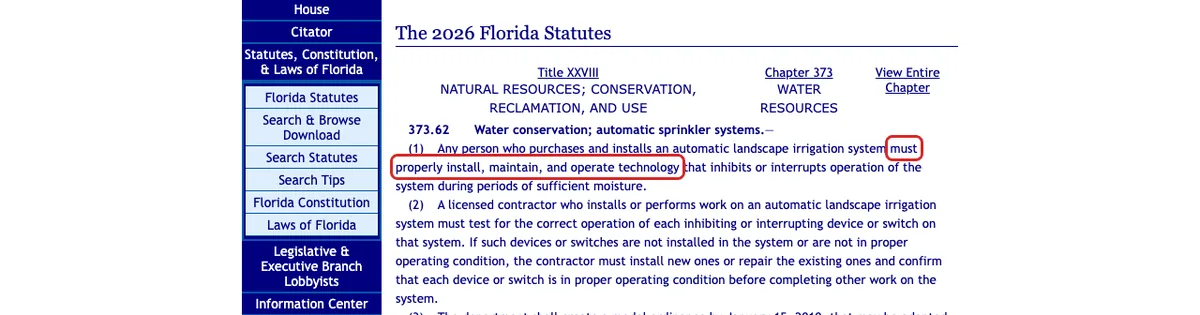
Texas requires moisture shut-off technology, not a freeze sensor. New Jersey and Florida both accept a smart controller or soil moisture system instead of a disk sensor, and Florida’s subsection (7) gives remote-monitored soil moisture systems a variance from local watering-day limits (Fla. Stat. 373.62(7)).
This page is general information, not legal advice. Statutes and local watering rules change; confirm with your state, county or water utility before you remove or bypass a sensor.
How do you test, bypass or reset a rain sensor?
UF/IFAS says to check a sensor at least once a year and to replace the disks at least every 2 years (ABE325, p. 3). For the test you need a garden hose and access to the controller:
- At the controller, set the sensor switch to Active (some controllers say On) and confirm the jumper wire is gone from the SEN terminals.
- Start a run from the controller in automatic or Manual All Stations mode. Hunter notes that a manual single-station start overrides the sensor circuit, so it proves nothing (Hunter support).
- Press and hold the spindle on top of the sensor. The zone should stop at once if the wiring is right (Mini-Clik card, p. 2).
- For a wet test, spray the sensor with the hose. Cup and electrode sensors stop watering almost immediately; disk sensors take a few minutes, per ABE325.
- Release the spindle and watering resumes.
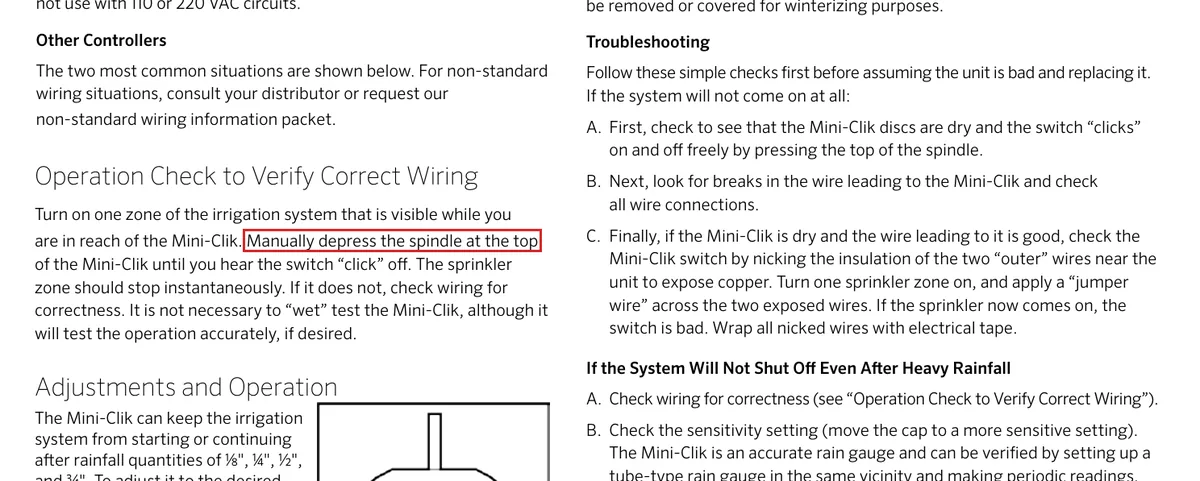
To bypass a sensor for a day, use the controller’s Bypass switch, the bypass button on a wireless receiver, or Rain Bird WR2’s 72-hour override. On non-Hunter controllers the Manual switch typically will not bypass it (Mini-Clik card), and on some Toro and Hydro-Rain timers a manual run overrides it (Orbit). In Florida, a permanent bypass conflicts with 373.62(1).
A sensor cannot reset faster than its disks dry. If it stays tripped for 2 or 3 dry, warm days, open the vent ring one step or replace the disks. Hunter says the Mini-Clik needs no removal or cover for winter, so the sprinkler winterizing steps stay the same.
Why is my rain sensor not working?
A sensor fails in 1 of 2 directions: it never stops the water, or it never lets it run. A dry sensor with an open switch looks like rain to the controller, and the no-zone-runs row in our spring sprinkler start-up guide lists it among the causes.
1Do the sprinklers run during or right after rain?
YesThe sensor is not opening the circuit. Check in order: jumper still on the SEN terminals, sensor switch on Bypass, a manual single-station run, a setting above 1/4 in, a mount under an eave or tree, a staple shorting the wire.
NoGo to the next question
2Does nothing water on dry days, even with start times programmed?
YesThe sensor circuit is staying open. Check that the disks are dry and the spindle clicks freely, look for a broken wire (jumper the 2 leads to test), and on wireless models look for a flashing red bypass LED or a dead transmitter.
NoGo to the next question
3During an automatic run, does pressing the sensor spindle stop the water within seconds?
YesThe sensor and its wiring work. Look at the valve, wire or controller instead.
NoWiring or switch fault. Rewire per the maker's card, then test the switch with an ohmmeter: near 0 ohms dry, infinite with the spindle pressed.
Replace the disks or the sensor. UF/IFAS says to replace the disks at least every 2 years.
Source: Hunter Mini-Clik card and support pages; Orbit troubleshooting; UF/IFAS ABE325
| Symptom | Likely cause | Test | Fix | Source |
|---|---|---|---|---|
| Sprinklers run in the rain | Jumper still across the SEN terminals | Look at the terminal strip | Remove the jumper; wire the sensor leads there | Hunter |
| Sprinklers run in the rain | Controller sensor switch on Bypass | Bypass LED or switch position | Set to Active | Hunter |
| Sprinklers run in the rain | Mounted under an eave, tree or awning, or in sprinkler spray | Is rain reaching the open top? | Move to an open spot near the roofline, clear of roof runoff | ABE325, p. 3 |
| Sprinklers run in the rain | Staple cut into the wire and shorted the 2 conductors | Press the spindle during a run; water keeps flowing | Repair the wire; fasten with clips, not through the jacket | Hunter |
| Sprinklers run in the rain | Set to 3/4 in or 1 in, so most storms never trip it | Read the cap | Set 1/8 or 1/4 in | ABE325, p. 4 |
| Sprinklers run in the rain | Wireless address mismatch or dead transmitter battery | Press the spindle; the sensor LED should flash | Re-learn the address; replace the transmitter if no flash | Hunter manual, pp. 13 and 14 |
| Nothing waters on dry days | Disks still swollen or switch stuck | Disks dry? Spindle clicks freely? | Open the vent ring; replace the disks (every 2 years per UF) | Mini-Clik card |
| Nothing waters on dry days | Broken sensor wire (an open circuit reads as rain) | Ohmmeter on the leads: near 0 ohms dry, infinite with spindle pressed | Splice the break; jumper the leads to confirm | Orbit |
| Nothing waters on dry days | Wireless receiver lost the signal | Bypass LED flashing red | Move the receiver or sensor; check the battery | Hunter manual, p. 12 |
| Nothing waters after a power cut | Receiver status LED shows red until it resyncs | Wait up to 1 hour or hold the test button 5 seconds | Resync; status turns green | Hunter |
If the sensor passes and one zone still will not stop, the fault is at the valve: see our guide to a sprinkler zone that won’t turn off. To hire it out, our sprinkler repair cost lists put a wired rain sensor replacement at $90 to $175 installed.
How we compiled this
On Nov. 21, 2026 we read 9 maker documents and pages (Hunter, Rain Bird, Orbit), UF/IFAS publication ABE325 (July 2024), 2 peer-reviewed study abstracts, 1 university news release, EPA WaterSense and USGS pages, and the statute or rule text for 6 states. Prices are Sprinkler Warehouse listings checked the same day. We did not test any sensor; every setting, result and price is attributed to the document it came from. The dataset is available as a CSV.
Frequently asked questions
How does a rain sensor work to turn on a sprinkler system?
It does not turn the system on. The controller runs the schedule; the sensor only opens the circuit when wet, blocking the valves, and closes it again when the disks dry, so the next scheduled cycle runs.
Can you bypass the rain sensor on a sprinkler system?
Yes, temporarily: set the controller’s sensor switch to Bypass or press the bypass button on a wireless receiver, then set it back to Active. Permanent bypass conflicts with state rules such as Florida Statute 373.62.
How to check if a sprinkler rain sensor is working?
Start a zone in automatic or Manual All Stations mode and press the spindle on top of the sensor; the water should stop within seconds. A hose spray works too: disk sensors stop the system after a few minutes.
How long does it take for a rain sensor to dry out?
About 19 hours after rain stops on average in UF/IFAS tests, with no difference between brands. Hunter says as little as 4 hours in warm, dry weather, or months in cold, damp weather.
Is a rain sensor necessary?
It is required for automatic systems in Florida, Minnesota, New Jersey, Connecticut, Texas and metro Atlanta, Georgia, with dates and exceptions in each rule. Elsewhere, check city and utility rules; a Florida study measured 34% less water applied with one.
Can a rain sensor go bad?
Yes. Disks lose their swell, wires break or short, and wireless transmitter batteries are rated for 4 or more years (Rain Bird WR2) or at least 5 (Hunter Wireless Rain-Clik). UF/IFAS recommends replacing the disks at least every 2 years.
Sources
- The Florida Legislature, 2026 Florida Statutes, section 373.62, Water conservation; automatic sprinkler systems, 2026. Accessed November 2026.
- UF/IFAS Extension (Dukes and Cardenas), ABE325, Residential Irrigation System Rainfall Shutoff Devices, or Rain Sensors, revised July 2024. Accessed November 2026.
- Cardenas-Lailhacar and Dukes, ASCE, Expanding Disk Rain Sensor Performance and Potential Irrigation Water Savings, J. Irrig. Drain. Eng. 134(1), abstract, 2008. Accessed November 2026.
- Cardenas-Lailhacar, Dukes and Miller, ASCE, Sensor-Based Automation of Irrigation on Bermudagrass during Wet Weather Conditions, J. Irrig. Drain. Eng. 134(2), abstract, 2008. Accessed November 2026.
- Hunter Industries, Mini-Clik Rain Sensor Installation Card, LIT-315 F (distributor copy), 2020. Accessed November 2026.
- Hunter Industries, Mini-Clik product page, current page. Accessed November 2026.
- Hunter Industries, Rain-Clik sensor product page, current page. Accessed November 2026.
- Hunter Industries, Wireless Rain-Clik Owner’s Manual (retailer copy), 2020. Accessed November 2026.
- Hunter Industries, Rain Sensor: Dry Out Time, current page. Accessed November 2026.
- Hunter Industries, Rain Clik: Rain Sensor Not Turning Off the Sprinklers, current page. Accessed November 2026.
- Rain Bird Corporation, RSD Series Rain Sensor specification sheet, D39402F, 2012. Accessed November 2026.
- Rain Bird Corporation, RSD Series rain sensor product page, current page. Accessed November 2026.
- Rain Bird Corporation, WR2 Series Wireless Rain/Freeze Sensors specification sheet, 2009. Accessed November 2026.
- Rain Bird Corporation, SMRT-Y Soil Moisture Sensor Kit specification sheet, 2018. Accessed November 2026.
- Orbit Irrigation, Rain/Freeze Sensor Troubleshooting, current page. Accessed November 2026.
- Minnesota Revisor of Statutes, Minn. Stat. 103G.298, Landscape Irrigation Systems, 2026. Accessed November 2026.
- New Jersey State Library, Legislative history and enacted text, P.L.2023, c.299 (A1755), approved Jan. 16, 2024, 2024. Accessed November 2026.
- Connecticut General Assembly, General Statutes chapter 541, section 29-265b, current. Accessed November 2026.
- Texas Commission on Environmental Quality (via Cornell LII), 30 Tex. Admin. Code 344.62, Minimum Design and Installation Requirements, amended July 26, 2020. Accessed November 2026.
- FindLaw (Georgia Code text), O.C.G.A. 12-5-6, rain sensor shut-off switches, current as of March 28, 2024. Accessed November 2026.
- U.S. EPA WaterSense, WaterSense Labeled Irrigation Controllers, current page. Accessed November 2026.
- University of Arkansas Division of Agriculture, Arkansas turf water use research news release, Aug. 12, 2022. Accessed November 2026.
- U.S. Geological Survey, Rain and Precipitation, Water Science School, current page. Accessed November 2026.
- Sprinkler Warehouse, Hunter Mini-Clik, WM-CLIK, WR-CLIK, WRF-CLIK and Hunter sensors listings, prices checked Nov. 21, 2026. Accessed November 2026.
- Sprinkler Warehouse, Rain Bird RSD-BEx and WR2-RFC listings, prices checked Nov. 21, 2026. Accessed November 2026.