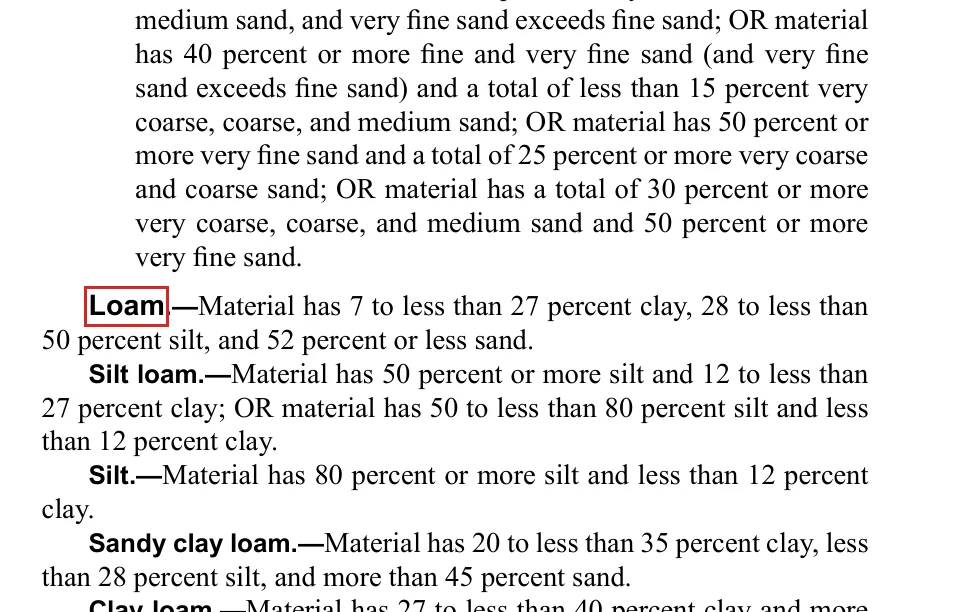
What is loam soil? In USDA terms it is one texture class: 7 to 27 percent clay, 28 to 50 percent silt and 52 percent or less sand, by weight. Sandy loam, silt loam and clay loam are separate neighboring classes with their own limits.
Ask what is loam soil and most answers say “a balanced mix of sand, silt and clay.” The definition that labs and soil maps use is narrower. The USDA Soil Survey Manual (Agriculture Handbook 18, 2017, chapter 3) sorts the mineral part of any soil sample under 2 mm into 12 texture classes by the weight share of sand (0.05 to 2 mm), silt (0.002 to 0.05 mm) and clay (under 0.002 mm). Loam is the class in the middle of the triangle, and 6 of the 12 class names end in “loam.”
We set those boundaries next to the numbers that decide how a yard behaves: water held per foot of soil from the NRCS irrigation guide, nutrient-holding capacity from 2 extension services, and the drainage group NRCS assigns to each texture. Two checks follow that none of the top-ranked pages make. A jar test with three equal layers reads as clay loam, not loam. And the “Loam” sold to the Massachusetts highway spec cannot meet the USDA loam definition. Texture is one input; the lab soil test that reports sand, silt and clay is how you confirm it.
Loam and its neighbors on the texture triangle
Each class is a fenced area on the texture triangle. A sample with 40 percent sand, 40 percent silt and 20 percent clay is loam. Push clay to 27 percent or more and it becomes clay loam; push sand above 52 percent with clay under 20 and it becomes sandy loam; push silt to 50 percent or more and it becomes silt loam. The table gives every boundary from the Soil Survey Manual, with the feel-test result NRCS uses in the field.
| USDA class | Clay % | Silt % | Sand % | Ribbon test (feel chart) |
|---|---|---|---|---|
| Loamy sand | any (set by the other limits) | any (set by the other limits) | 70 to 90; silt + 1.5 x clay 15 or more; silt + 2 x clay under 30 | Ball, no ribbon |
| Sandy loam | 7 to under 20 (or under 7 with silt under 50) | any (set by the other limits) | over 52; silt + 2 x clay 30 or more | Ribbon under 1 in, very gritty |
| Loam | 7 to under 27 | 28 to under 50 | 52 or less | Ribbon under 1 in, neither gritty nor smooth |
| Silt loam | 12 to under 27 (or under 12 with silt 50 to under 80) | 50 or more | any (set by the other limits) | Ribbon under 1 in, very smooth |
| Sandy clay loam | 20 to under 35 | under 28 | over 45 | Ribbon 1 to 2 in, very gritty |
| Clay loam | 27 to under 40 | any (set by the other limits) | over 20 to 45 | Ribbon 1 to 2 in, neither |
| Silty clay loam | 27 to under 40 | any (set by the other limits) | 20 or less | Ribbon 1 to 2 in, very smooth |
| Clay | 40 or more | under 40 | 45 or less | Ribbon 2 in or longer, neither |
Two details trip people up. The percentages are by weight after organic matter is removed, so compost does not change a soil’s texture class. And gravel does not count: the manual measures only particles under 2 mm, which is why a rocky field can still be mapped as a loam (for example, “gravelly loam”). Organic matter is a separate property, covered in our guide to what humus is and how much soils hold.
How much water, nutrients and drainage does loam give?
Loam holds 0.16 to 0.18 inch of plant-available water per inch of soil, about 2.0 inches per foot, in the NRCS irrigation guide table reproduced by University of Minnesota Extension. That is roughly 8 times what sand holds (0.25 in per foot) and 38 percent more than sandy loam (1.45 in). It is not the top of the chart: silt loam, clay loam and silty clay loam each hold about 2.4 inches per foot.
| USDA class | Available water, in per in | Typical in per ft | CEC, meq/100 g | Typical hydrologic group (Ksat of least permeable layer) |
|---|---|---|---|---|
| Sand | 0.01 to 0.03 | 0.25 | 1 to 5 (UGA); 3 to 5 (OSU) | A (over 5.67 in/hr) |
| Loamy sand | 0.06 to 0.08 | 0.85 | not listed | B (1.42 to 5.67 in/hr) |
| Sandy loam | 0.11 to 0.13 | 1.45 | 5 to 10 (UGA, fine sandy loam) | B (1.42 to 5.67 in/hr) |
| Loam | 0.16 to 0.18 | 2 | 5 to 15 (UGA); 10 to 15 (OSU) | C (0.14 to 1.42 in/hr) |
| Silt loam | 0.19 to 0.21 | 2.4 | 15 to 25 (OSU) | C (0.14 to 1.42 in/hr) |
| Silt | 0.16 to 0.18 | 2 | not listed | not typical of a group |
| Sandy clay loam | 0.14 to 0.16 | 1.8 | not listed | C (0.14 to 1.42 in/hr) |
| Clay loam | 0.19 to 0.21 | 2.4 | 15 to 30 (UGA); 20 to 50 (OSU) | C (0.14 to 1.42 in/hr) |
| Silty clay loam | 0.19 to 0.21 | 2.4 | not listed | C (0.14 to 1.42 in/hr) |
| Sandy clay | 0.15 to 0.17 | 1.9 | not listed | D (under 0.14 in/hr) |
| Silty clay | 0.15 to 0.17 | 1.9 | not listed | D (under 0.14 in/hr) |
| Clay | 0.14 to 0.16 | 1.8 | over 30 (UGA); 20 to 50 (OSU) | D (under 0.14 in/hr) |
Nutrient holding follows clay. Ohio State Extension lists loams at 10 to 15 meq/100 g and silt loams at 15 to 25; University of Georgia Extension lists loam at 5 to 15, lower because Georgia clays are mostly kaolinite at 3 to 15 meq/100 g. UGA notes that low-CEC soils lose more fertilizer to leaching and need lime more often, at lower rates, so a loam sits between a sandy loam and a clay loam on feeding and liming.

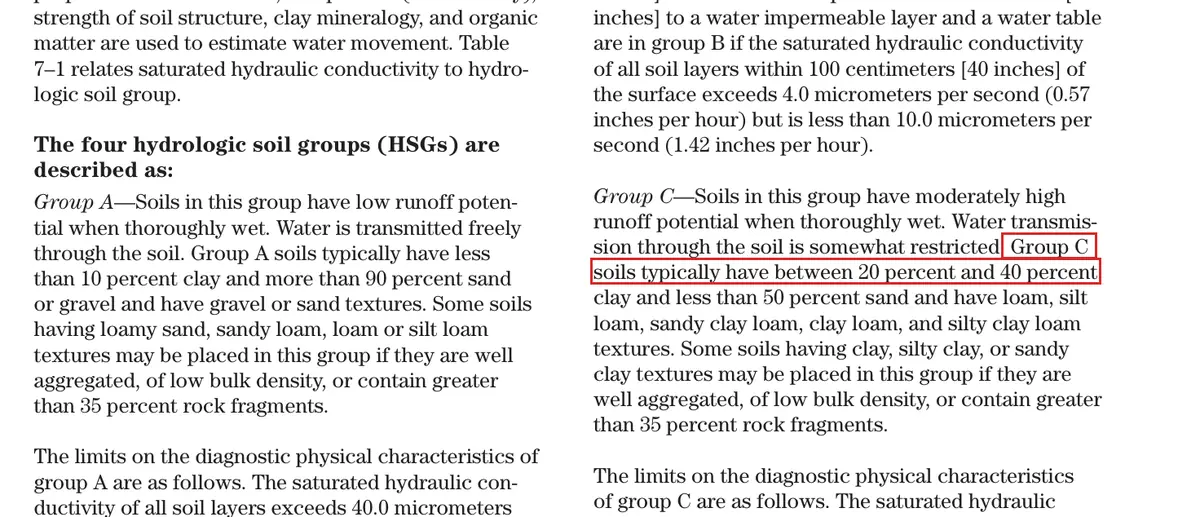
Drainage is where most loam pages overstate. NRCS National Engineering Handbook Part 630, chapter 7 says hydrologic group C soils “typically have between 20 percent and 40 percent clay and less than 50 percent sand and have loam, silt loam, sandy clay loam, clay loam, and silty clay loam textures,” with saturated conductivity of 0.14 to 1.42 inches per hour. Sandy loam sits in group B at 1.42 to 5.67 inches per hour. A loam that drains 6 inches per hour would be faster than the group A floor for sands. Our page on what well-drained soil means and how to test it covers the perc test.
What the water numbers mean for a lawn
Multiply the typical inches per foot by root depth. In a 6-inch turf root zone, sandy loam stores about 0.73 inch of usable water, loam 1.0 inch and silt loam 1.2 inches. Irrigation guides have used a 50 percent depletion trigger (Minnesota Extension), so sandy loam needs water after about 0.36 inch of use and loam after 0.5 inch, about 40 percent more days between waterings on loam. Our guide to the best time of day to water a lawn covers the timing.
How do you tell if you have loam soil?
Use three checks in order of cost: the ribbon test (free, 5 minutes), a jar test (free, 2 days), then a lab particle-size analysis if the result decides a purchase. The ribbon test below follows the Thien (1979) flow chart that NRCS publishes, as laid out by University of Arizona Extension: sieve the soil through a 2 mm screen or kitchen colander, then wet a small ball to the feel of moist putty.
1Wet a small ball of sieved soil to moist putty. Does it fall apart instead of staying in a ball when squeezed?
YesSand. Not loam.
NoGo to the next question
2Does it stay in a ball but refuse to push out into a ribbon between thumb and forefinger?
YesLoamy sand. Not loam.
NoGo to the next question
3Does the ribbon break at 2 in (5 cm) or longer?
YesClay group: sandy clay if very gritty, silty clay if very smooth, clay if neither.
NoGo to the next question
4Does the ribbon break between 1 and 2 in (2.5 to 5 cm)?
YesClay loam group: sandy clay loam if very gritty, silty clay loam if very smooth, clay loam if neither.
NoGo to the next question
5Ribbon under 1 in. Rub a very wet pinch in your palm: does it feel very gritty?
YesSandy loam.
NoGo to the next question
6Does the wet pinch feel very smooth, like flour?
YesSilt loam.
NoLoam: a ribbon under 1 inch where neither grit nor smoothness dominates. Confirm with a jar test or a lab particle-size analysis.
For the jar test, Clemson Extension HGIC 1656 fills a straight-sided jar one-third with sieved soil, tops it with water, shakes it to a slurry, then marks the sand layer at 1 minute, silt at 2 hours and clay at 48 hours. Divide each layer’s height by the total. Two cautions apply. The jar measures layer heights, while the Soil Survey Manual defines texture by weight, so the result is an estimate. And a reading after a few hours misses most of the clay.
| Jar layers: sand / silt / clay | Percent sand / silt / clay | USDA class | Rule that decides it |
|---|---|---|---|
| 1.2 / 1.2 / 0.6 in (3.0 total) | 40 / 40 / 20 | Loam | Clay 7 to under 27, silt 28 to under 50, sand 52 or less |
| 1.0 / 1.0 / 1.0 in (equal thirds) | 33 / 33 / 33 | Clay loam | Clay 27 to under 40 with sand over 20 to 45 |
| 2.0 / 0.6 / 0.4 in | 67 / 20 / 13 | Sandy loam | Clay 7 to under 20, sand over 52, silt + 2 x clay = 46 |
| 0.6 / 2.0 / 0.4 in | 20 / 67 / 13 | Silt loam | Silt 50 or more with clay 12 to under 27 |
| 1.6 / 0.6 / 0.8 in | 53 / 20 / 27 | Sandy clay loam | Clay 20 to under 35, silt under 28, sand over 45 |
If the jar says loam but plants behave like clay, send a sample to a lab. University labs add texture to a routine test for a fee (Texas A&M charges $25 extra), as our comparison of soil test labs and kits lists. Our soil vs dirt comparison names 7 benchmark U.S. soils by series and texture, from Drummer silty clay loam to Miami silt loam.
Can you make loam soil by mixing sand into clay?
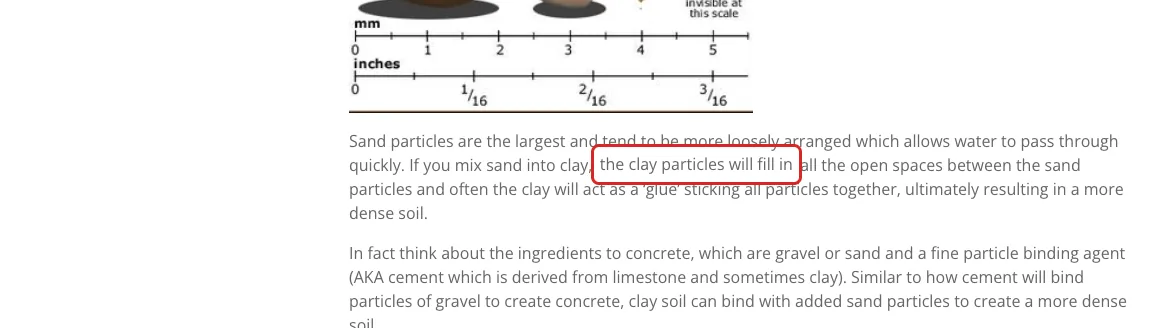
Not in a yard. University of Illinois Extension says sand mixed into clay “creates a soil structure akin to concrete” and that a real change takes a 1:1 ratio of sand to clay; University of Arkansas Extension says the clay fills the open spaces between the sand grains and acts as a glue, giving a denser soil. The triangle shows a second problem: sand dilutes silt as fast as it dilutes clay.
Take a clay loam at 35 percent clay, 35 percent silt and 30 percent sand. Bringing clay under loam’s 27 percent ceiling takes sand equal to 30 percent of the soil’s weight (35 / 1.30 = 26.9). Silt drops to 26.9 percent, below loam’s 28 percent floor, so the mix lands in sandy clay loam, not loam. For a 6-inch layer over 1,000 sq ft, at an assumed bulk density of 1.3 g/cm3 (81 lb per cu ft), that is about 12,000 lb, or 6 tons, of sand for no change in class.
What works is changing structure, not texture: compost mixed 6 to 12 inches deep, as covered in our guide to improving clay soil with compost and gypsum, or importing 4 to 6 inches of soil that already tests as loam or sandy loam. For raised beds, “make sandy loam” recipes that blend sand, topsoil and compost do not say what texture they produce; a jar test on a sample of the finished mix answers it in 2 days.
What does loam mean when you buy it?
In Massachusetts and neighboring states, yards sell topsoil as “loam” or “screened loam” by the cubic yard. Southridge Farm and Nursery in Walpole, Mass., for example, lists screened loam passed through a 1/2-inch screen. The screen size tells you the largest lump, not the texture class. The clearest written standard is the Massachusetts Department of Transportation’s Standard Specifications, Division III, section M1.05.0 Loam (2026), which towns such as Natick require, at 6 inches minimum, for loam placed under street-opening permits.
| Property | MassDOT M1.05.0 “Loam” | USDA loam texture class |
|---|---|---|
| Largest particle | 1 in (roadsides); 1/2 in (lawns) | Under 2 mm counts; gravel is reported separately |
| Passing No. 10 sieve (2 mm) | 85 to 100% | Texture is measured on this fraction |
| Passing No. 200 sieve (0.075 mm) | 10 to 35% | Loam: 48% or more is silt and clay (under 0.05 mm) |
| Finer than 20 micrometers | Under 5% | Loam: at least 7% clay (under 2 micrometers) |
| Organic matter | 4 to 10% by loss on ignition; 4% or more for lawns; 7 to 10% for woody plantings | Not part of texture |
| pH | 5.5 to 7.0 | Not part of texture |
| Salinity | Under 0.1 S/m (1:2 soil to water) | Not part of texture |
Run the numbers and the spec “Loam” cannot be USDA loam. Under 5 percent of it is finer than 20 micrometers, so clay is under 5 percent, below loam’s 7 percent minimum. At most 35 percent passes the No. 200 sieve, so at least 65 percent is sand. By USDA texture, MassDOT Loam is a sandy loam, a loamy sand or, at the coarse end, a sand. That suits highway lawns, which need drainage, and it shows why “loam” on a yard’s listing is a product name.
Before you order, ask the yard for 4 numbers: USDA texture class or a particle-size report, organic matter percent, pH and screen size. Bagged products marked topsoil carry no legal definition, as our topsoil vs garden soil bag comparison found, and prices per yard and per load are in our topsoil cost guide.
What several loam guides get wrong
| Claim | Where it appears | What the primary source says |
|---|---|---|
| Loam drains at about 6 to 12 in per hour | Gardening Know How | Loams typically fall in hydrologic group C, 0.14 to 1.42 in/hr; over 5.67 in/hr is group A, mostly sands (NEH 630 ch. 7) |
| Three roughly equal jar layers mean good loamy soil | Gardening Know How | 33 / 33 / 33 is clay loam: clay 27 to under 40 with sand over 20 to 45 (Soil Survey Manual) |
| Let the jar settle a few hours | Gardening Know How | Clay is marked at 48 hours (Clemson HGIC 1656) |
| All loam is topsoil | Southridge Farm and Nursery | Loam is a texture class recorded for every horizon in a profile description, surface or subsoil (Soil Survey Manual, ch. 3) |
How we compiled this
We read 9 primary documents in November 2026: the USDA Soil Survey Manual (2017) texture definitions, the Thien texture-by-feel flow chart (NRCS copy and Arizona Extension version), NRCS National Engineering Handbook Part 630 chapter 7, the NEH Part 652 water table as published by University of Minnesota Extension, CEC tables from UGA and Ohio State Extension, Clemson’s jar test, Illinois and Arkansas Extension on sand in clay, and MassDOT’s 2026 M1.05.0 Loam specification. The jar examples, the 6-inch root-zone water figures and the sand mass balance are our arithmetic from those numbers; the bulk density of 1.3 g/cm3 is an assumption. No soil was tested for this page.
Frequently asked questions
Is loam the same as topsoil?
No. Topsoil is a position, the surface layer; loam is a texture with 7 to 27 percent clay, 28 to 50 percent silt and 52 percent or less sand. Topsoil can be sand or clay, and New England yards use “loam” as a trade name for topsoil that is often sandy loam.
Can I buy loam soil?
Yes, in bulk from landscape yards, often as screened loam, and in bags labeled topsoil. Ask for a particle-size report or USDA texture class, organic matter percent and pH. MassDOT’s spec Loam, for example, works out to sandy loam or coarser, not USDA loam.
Is potting soil the same as loam?
No. Bagged potting mixes are mostly peat, bark, coir and perlite with little or no mineral soil, so they have no USDA texture class. Loam is mineral soil. Our potting soil vs potting mix label comparison found 9 of 11 bags listed no sand, silt, clay or loam.
What is sandy loam soil?
A USDA class with more than 52 percent sand and 7 to under 20 percent clay (or under 7 percent clay with under 50 percent silt), where silt plus twice the clay is at least 30. It holds about 1.45 inches of water per foot, against 2.0 for loam.
What are the disadvantages of sandy loam soil?
Lower water and nutrient holding: about 1.45 inches of water per foot against 2.0 for loam, and CEC of about 5 to 10 meq/100 g for fine sandy loam. Lawns on it need water and potassium more often, though it drains in hydrologic group B at 1.42 to 5.67 inches per hour.
How do I make my soil loamy?
You cannot change texture practically; adding sand to clay needs about a 1:1 ratio and can still miss loam. Mix in compost to improve structure, or import 4 to 6 inches of soil that tests as loam or sandy loam.
Sources
- USDA NRCS, Soil Science Division Staff, Soil Survey Manual, USDA Handbook 18, chapter 3 (texture classes, p. 120 to 124), GPO copy, 2017. Accessed November 2026.
- University of Arizona Extension, Soil: Determining Soil Texture by Feel (Schalau), after the Thien (1979) flow chart, Feb. 10, 2021. Accessed November 2026.
- USDA NRCS, National Engineering Handbook Part 630, Chapter 7, Hydrologic Soil Groups, January 2009. Accessed November 2026.
- University of Minnesota Extension, Basics of irrigation scheduling (AWC by soil texture, from NRCS NEH 652 ch. 2), current page. Accessed November 2026.
- University of Georgia Extension, Cation Exchange Capacity and Base Saturation, C1040, Table 1, current page. Accessed November 2026.
- Ohio State University CFAES, Calculating Cation Exchange Capacity, Base Saturation, and Calcium Saturation, Table 1, current page. Accessed November 2026.
- Clemson Cooperative Extension, Soil Texture Analysis: The Jar Test, HGIC 1656 (Jeffers), revised Dec. 2023. Accessed November 2026.
- University of Illinois Extension, Does Sand Improve Clay Soil Drainage? (Enroth), Jan. 31, 2018. Accessed November 2026.
- University of Arkansas Division of Agriculture, Adding Sand to Soil (McWhirt), Jan. 19, 2021. Accessed November 2026.
- Massachusetts Department of Transportation, 2026 Standard Specifications for Highways and Bridges, Division III, M1.05.0 Loam, 2026 edition. Accessed November 2026.
- Town of Natick, Mass., Department of Public Works, Street opening permit rules, item J (loam to MassDOT section 1.05, 6 in minimum), last modified April 26, 2016. Accessed November 2026.
- Gardening Know How, What Is Loam Soil (claims checked), page read Nov. 16, 2026. Accessed November 2026.
- Southridge Farm and Nursery, What Is Loam? (screened loam listing), page read Nov. 16, 2026. Accessed November 2026.