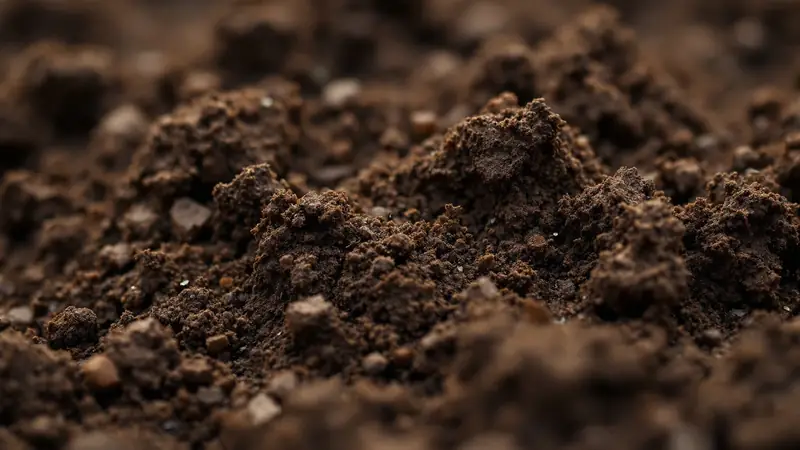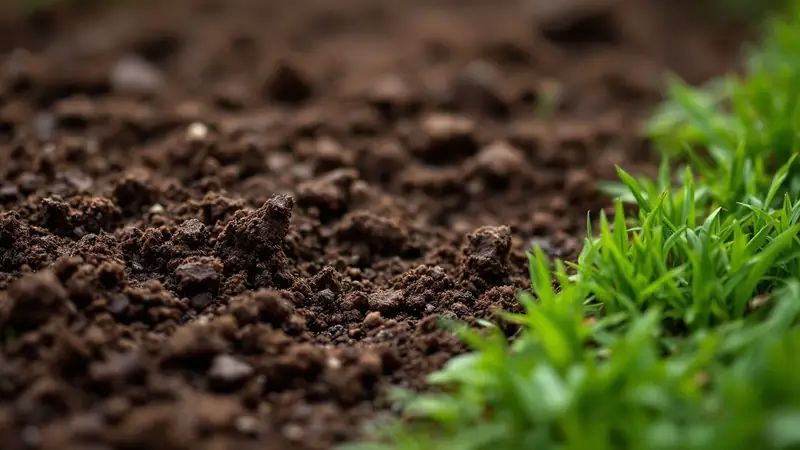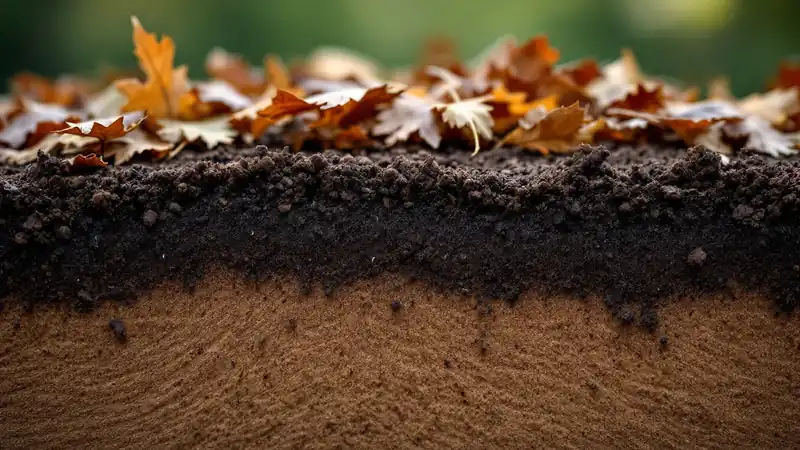
What is humus soil: soil rich in humus, the dark, well-decomposed and stable part of soil organic matter, often 1 to 6 percent of a lawn or garden soil by weight. Bags labeled humus are mostly peat, compost or manure.
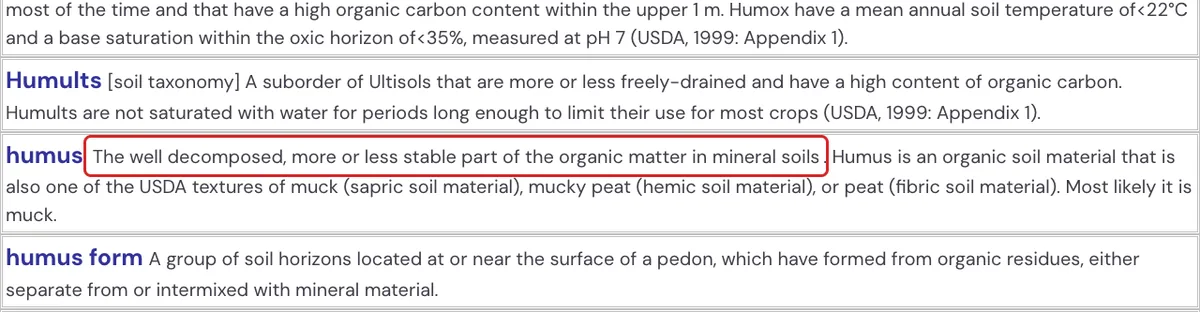
Ask what is humus soil and you get three different answers depending on who replies. The Soil Science Society of America glossary defines humus as “the well decomposed, more or less stable part of the organic matter in mineral soils.” A soil lab reports it as an organic matter percentage, and Cornell puts most productive farm soils at 3 to 6 percent (Cornell Agronomy Fact Sheet 41). A garden center sells it in 40 lb bags.
We separated the three with numbers. On Nov. 14, 2026 we compared 6 bagged products sold with “humus” in the name against the trade definition, and none of the maker or retailer listings we could read printed an organic matter percentage. To see your own number, the organic matter add-on to a routine lawn soil test costs $7 in state at Clemson (Clemson Agricultural Service Laboratory). For the difference between amendments that go into the soil and covers that sit on it, see compost vs mulch, with application depths.
Three things people mean by humus soil
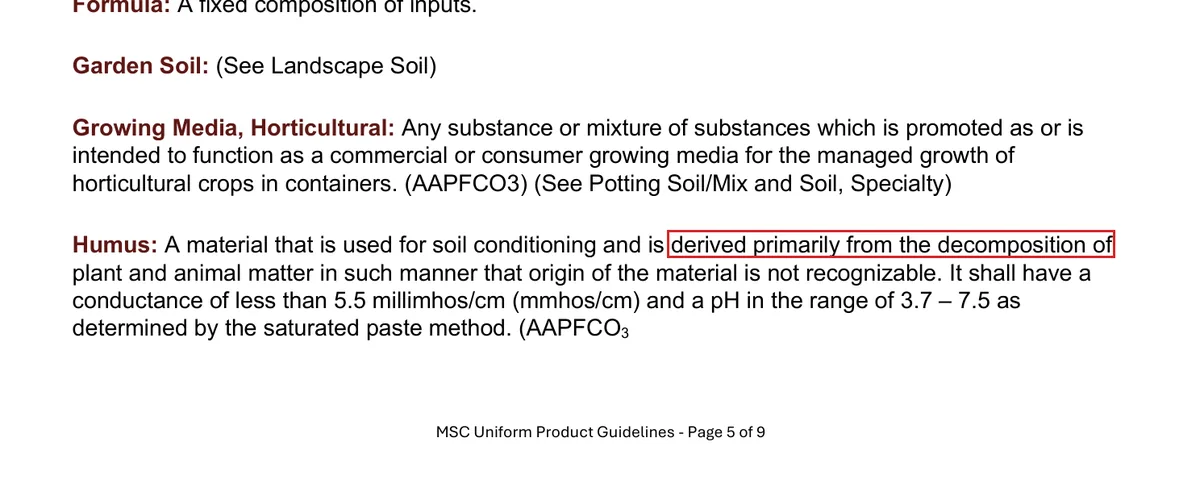
Soil science, soil labs and the bag trade each use the word for a different material, and the numbers below only make sense once you know which one a source means. The Mulch & Soil Council, which writes the U.S. bag-labeling guidelines, copies its humus definition from the Association of American Plant Food Control Officials (AAPFCO): material “derived primarily from the decomposition of plant and animal matter in such manner that origin of the material is not recognizable,” with salts under 5.5 mmhos/cm and pH 3.7 to 7.5 (MSC Uniform Product Guidelines, rev. September 2026).
| Meaning | Who uses it | Definition as printed | How it is measured | Source |
|---|---|---|---|---|
| 1. Soil-science humus | Soil scientists, textbooks | The well decomposed, more or less stable part of the organic matter in mineral soils | Not measured directly; dated by radiocarbon | SSSA Glossary, H |
| 2. Soil organic matter (SOM) | Soil test labs, extension | Plant or animal tissue in various stages of breakdown; humus is its stable fraction | Loss on ignition or dichromate oxidation, reported as % | Cornell FS 41 (2008) |
| 3. Bagged humus | Retail labels, state feed and fertilizer officials | Soil conditioner from decomposed plant and animal matter, origin not recognizable; EC under 5.5 mmhos/cm, pH 3.7 to 7.5 | Saturated paste pH and salts; no organic matter minimum | MSC UPG, citing AAPFCO |
| Humus soil (everyday use) | Gardeners, retail copy | No formal definition; usually a dark topsoil high in organic matter | None | No glossary entry found |
The soil-science meaning has shifted. In a 2015 review in Nature, soil scientists Johannes Lehmann and Markus Kleber argued that “the available evidence does not support the formation of large-molecular-size and persistent humic substances in soils,” and that soil organic matter is “a continuum of progressively decomposing organic compounds” (Lehmann and Kleber, Nature 528:60, 2015). The black “humic acid” a lab pulls out with alkali is, on that view, partly a product of the extraction itself.
What is not in dispute is the age. Michigan State Extension describes the stable pool, “sometimes called the passive pool, or humus,” as material “hundreds to thousands of years old” (MSU Extension Bulletin E-3137, 2011). Using 789 radiocarbon profiles, Shi and colleagues put the mean age of soil carbon in the top 1 meter at 4,830 years, plus or minus 1,730, with older carbon deeper down (Shi et al., Nature Geoscience 13:555, 2020).
Mineral soil builds even more slowly: a global compilation puts median soil production at 0.017 mm a year, about 1,494 years per inch, the figure behind our guide to how soil is formed.
1Is it a bag or bulk product with humus in the name?
YesTrade humus: decomposed plant or animal matter, salts under 5.5 mmhos/cm, pH 3.7 to 7.5 (AAPFCO via MSC UPG). Ask for organic matter % and salts on a lab sheet.
NoGo to the next question
2Is it a percentage on a soil test report?
YesTotal soil organic matter by loss on ignition or Walkley-Black. Compare only results from the same lab and method.
NoGo to the next question
3Is it a textbook or extension page about soil formation?
YesSoil-science humus: the stable, well-decomposed fraction, hundreds to thousands of years old (SSSA; MSU E-3137).
NoEveryday use: a dark, crumbly topsoil high in organic matter. Get a lab organic matter test for a number.
Source: SSSA Glossary; Mulch & Soil Council UPG; Cornell FS 41; MSU E-3137
Humus by the numbers: nutrients, water and carbon
The one property where humus clearly outperforms clay is nutrient holding. University of Georgia Extension Circular 1040 lists cation exchange capacity (CEC) at pH 7 as 200 to 400 meq/100 g for organic matter, against 80 to 100 for montmorillonite clay, 15 to 40 for illite and 3 to 15 for kaolinite (UGA Circular 1040, Table 1). A sand scores 1 to 5.
| Property | Humus or soil organic matter | Comparison | Source |
|---|---|---|---|
| CEC at pH 7 | 200 to 400 meq/100 g | Montmorillonite 80 to 100; kaolinite 3 to 15; sand 1 to 5 | UGA C1040 |
| Age | Hundreds to thousands of years (stable pool) | Active pool turns over in months to years; slow pool in years to decades | MSU E-3137 |
| Mean age of soil carbon, top 1 m | 4,830 years, plus or minus 1,730 | Younger near the surface, older at depth | Shi et al. 2020 |
| Carbon content | About 58% of organic matter (lab factor 1.72); about half, per Oregon State | Organic matter = organic C x 1.72 | NE Soil Test Procedures, Ch. 8; OSU EM 9217 |
| C:N ratio | 10 to 13:1 in eastern South Dakota field soils | Soil microbes prefer food at 24:1 | SDSU Extension, 2024 |
| Plant-available water per 1% more organic carbon | 1.16 mm per 100 mm of soil (average) | 75% of studies: 0.7 to 2 mm per 100 mm | Minasny and McBratney 2018 |
| Typical share of soil weight | 3 to 6% in productive farm soils | 0.75% to 5.5% in the top layer of 7 USDA benchmark soils (our SSURGO table) | Cornell FS 41 |
Water is where most pages overstate it. Wikipedia says humus can hold the equivalent of 80 to 90 percent of its own weight in moisture (Wikipedia, Humus, read Nov. 2026), but a meta-analysis of 60 studies and more than 50,000 measurements found that each 1 percent rise in soil organic carbon (about 1.7 percent organic matter) adds only 1.16 mm of plant-available water per 100 mm of soil (Minasny and McBratney, European Journal of Soil Science, 2018). Across the top 6 inches, that is about 1.8 mm, or 0.07 inch, of extra water.
The gain is larger in sands and smallest in clays, according to the same paper, which is why compost changes a sandy lawn more than a clay one. Our page on growing grass in sandy soil sets the compost rate for that case, and the batch-14 page on what well-drained soil means covers the drainage side.
What is in a bag labeled humus?
Mostly peat, compost, forest products and manure, by the makers’ own descriptions. The Earthgro Organic Humus and Manure listing says its humus is “derived from peat, compost, forest products, manure and other organic materials” and, in Texas, “80% compost and 20% manure” (Saratoga Quality Hardware listing for Earthgro 71451180). Scotts’ own page for Premium Humus and Manure says only that it is “enriched with humus and organic matter” (ScottsMiracle-Gro product page).
| Product (item no.) | Size | What the listing says it contains | Organic matter % printed | Price checked | Per cu ft or lb | Listing |
|---|---|---|---|---|---|---|
| Earthgro Organic Humus and Manure (71451180) | 1 cu ft | Humus from peat, compost, forest products, manure; Texas: 80% compost, 20% manure | No | $4.49 (K&K Hardware) | $4.49/cu ft | K&K; Saratoga |
| Scotts Premium Humus and Manure (71530751) | 0.75 cu ft, 43 lb | “Enriched with humus and organic matter”; no ingredient list on maker page | No | $5.85 to $6.59 (SIM Supply) | $7.80 to $8.79/cu ft | Scotts; SIM Supply |
| Top Choice Organic Humus Garden Compost (Ace 7300734) | 1 cu ft | “Loose crumbly material that results from the decay of organic matter”; no source named | No | $4.59 (Super Arbor) | $4.59/cu ft | Super Arbor |
| Top Choice Peat Humus Compost | 1.25 cu ft | Listed as compost; no source material named | No | $3.99 (Big R) | $3.19/cu ft | Big R |
| All American Peat Humus (300), Markman Peat Co. | 40 lb | Peat humus; no ingredient statement | No | $4.99 (K&K Hardware) | $0.12/lb | K&K |
| Timberline Peat Humus (50050067) | 40 lb | No ingredient statement on listing | No | $5.57 to $6.28 (SIM Supply) | $0.14 to $0.16/lb | SIM Supply |
| Reference: Black Kow Composted Cow Manure | 42 lb | Derived from cow manure; 0.5-0.5-0.5 guaranteed analysis; chlorine 1.0% max | No | Not checked | n/a | 2015 bag label |
| Reference: Timberline Cow Manure and Compost (50055010) | 40 lb | Organic manure and composted forest material | No | $5.63 to $6.34 (SIM Supply) | $0.14 to $0.16/lb | SIM Supply |
Three things follow from that table. First, no listing gives an organic matter percentage, so two “humus” bags at $3.19 and $8.79 a cubic foot cannot be compared on the one number that matters. Second, the “peat humus” bags are peat, which AAPFCO defines separately as “partly decayed vegetable matter of natural occurrence” (MSC UPG, Peat). Third, the bags behave like compost or peat, not like the centuries-old fraction in the SSSA definition.
Bags sold as soil conditioner are no clearer: none of the 9 soil conditioner product pages we read on Nov. 16, 2026 showed a guaranteed analysis, and their contents ran from pine bark to expanded slate, gypsum and lime, as our page on what soil conditioner is shows.
If you want a number, look for the US Composting Council Seal of Testing Assurance on a compost bag or ask a bulk yard for its lab sheet; Oregon State says a screened compost at 50 percent moisture and 50 percent organic matter supplies about 250 lb of organic matter per cubic yard (OSU EM 9217, Oct. 2018). Our bag-by-bag reads of topsoil and garden soil labels and potting soil and potting mix labels found the same base ingredients.
Is humus soil the same as compost or topsoil?
No. Compost is decomposed organic material that is still breaking down, topsoil is mostly mineral soil, and humus is the small, stable organic fraction of soil. Oregon State warns that compost above 65 percent organic matter “may not have been thoroughly composted” and will lose much of it as carbon dioxide after spreading (OSU EM 9217), which is the opposite of the stable pool.
| Criterion | Soil-science humus | Finished compost | Topsoil (dug) | Peat or peat humus | Source |
|---|---|---|---|---|---|
| What it is | Stable, well-decomposed fraction of soil organic matter | Managed decomposition product of yard waste, manure or food scraps | Upper mineral soil layer | Partly decayed vegetable matter from wetlands | SSSA; MSC UPG |
| Organic matter | Is the organic matter | OSU flags compost below 25% or above 65% of dry weight | 0.75% to 5.5% in 7 USDA benchmark soils | Not printed on the bags we read | OSU EM 9217; our SSURGO table |
| How long it lasts in soil | Hundreds to thousands of years | Months to decades; 11% of Broadbalk manure carbon was still there after 157 years | Stable unless eroded | Decomposes once mixed into aerated soil | MSU E-3137; Poulton et al. 2018 |
| Can you buy it? | No; it forms in place | Yes, bag or bulk | Yes, bulk or bag | Yes, bag | Listings above |
| Use | Measure it, protect it | Mix 3 to 4 in into new beds; 1/4 to 1/2 in on lawns after aeration | Fill and grade, cap lawns | Loosens soil; low nutrients | OSU EM 9308 |
Prices for bulk compost and screened topsoil by the yard are in our topsoil and fill dirt cost data, and the measured gap between topsoil and the subsoil sold as fill is in soil vs dirt by the numbers. Making a woody cover from yard waste is a different job, covered in how to make mulch.
How much humus is in your soil?
A lab can tell you, but the number is total organic matter, not humus alone, and the method changes the result. Cornell dries soil at 105°C for 1.5 hours and burns it at 500°C for 2 hours; the Northeastern regional procedure burns at 360°C for 2 hours; and the older Walkley-Black acid method recovered only 60 to 86 percent of organic carbon in its authors’ soils, so labs multiply by a 77 percent recovery factor (Schulte and Hoskins, NE Recommended Soil Testing Procedures, Ch. 8, rev. 2009).
| Method | What happens | Conversion used | Watch for | Source |
|---|---|---|---|---|
| Loss on ignition, Cornell | 105°C for 1.5 h, then 500°C for 2 h; weight lost = organic matter | Direct, or by regression | Use the same lab every year | Cornell FS 41 |
| Loss on ignition, NE regional | 105°C for 2 h, then 360°C for 2 h | Regression against known soils | Clay water and carbonates add false weight loss | NE Ch. 8 |
| Walkley-Black (dichromate) | Acid oxidizes easily oxidized carbon at about 120°C | Divide by 0.77, then x 1.72 (assumes 58% C) | Recovery ran 59% to 94% in later work | NE Ch. 8 |
| Clemson routine add-on | Loss on ignition | Reported as % organic matter | $7 in state, $10 out of state | Clemson ASL, read Nov. 2026 |
For lawns, take every core to the same depth and strip the thatch first, or the result reads high; our soil test guide lists lab fees at 25 state labs. Tracking the number over years matters more than one reading, because Cornell notes that labs do not all use the same method (Cornell FS 41).
How to make humus soil, and how slowly it builds
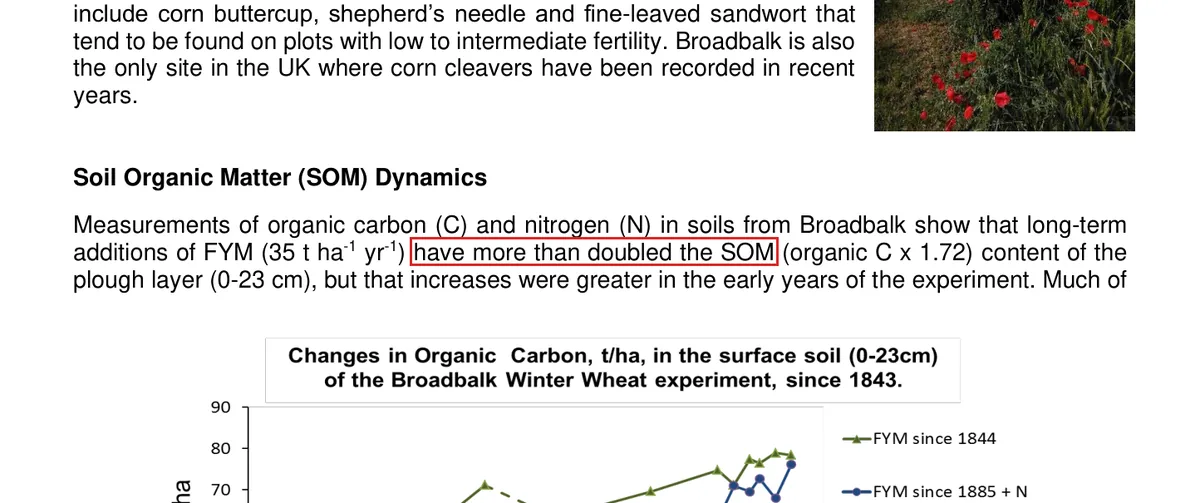
Add organic matter every year and expect years, not a season. The longest record is Broadbalk at Rothamsted in England, where 35 tonnes of farmyard manure per hectare a year since 1843 “more than doubled” the organic matter of the top 23 cm, with most of the gain in the early decades (Rothamsted Broadbalk handout, 2024).
The carbon that stayed is the humus. Poulton and colleagues found that only 11 percent of the roughly 480 tonnes of carbon per hectare added in manure since 1843 was still in the top 46 cm, while plots manured only since 1968 still held 35 percent of theirs (Poulton et al., Global Change Biology, 2018). Starting soil carbon was 1.00 percent, or 28.8 t/ha.
For a yard, Oregon State Extension gives these compost rates (OSU EM 9308):
- New bed: spread 3 to 4 inches of compost and mix it 6 to 8 inches deep (8 to 12 inches for vegetables). One 1 cu ft bag covers 4 sq ft at 3 inches.
- New lawn: mix 1 to 2 inches of compost into the area as you prepare the soil; our batch-14 page on preparing soil for sod sets the grade first.
- Existing lawn: mow short, core-aerate the lawn, spread compost 1/4 to 1/2 inch deep, then overseed.
- Existing beds: add 1/4 to 1 inch of compost a year.
- Heavy clay: follow the rates in our guide to improving clay soil; dry, water-repellent ground is the batch-14 topic fixing hydrophobic soil.
The arithmetic shows why a 1/4 inch topdressing barely moves a lab result. At a bulk density of 1.33 g/cm3, about 83 lb per cubic foot and roughly 50 percent pore space by SDSU Extension’s formula (SDSU, Bulk Density), the top 6 inches of 1,000 sq ft weighs about 41,500 lb, so 1 percentage point of organic matter is 415 lb.
| Step | Value | How |
|---|---|---|
| Soil in top 6 in of 1,000 sq ft | 500 cu ft | 1,000 x 0.5 ft |
| Weight at 83 lb/cu ft | 41,500 lb | 500 x 83 |
| 1 point of organic matter | 415 lb | 41,500 x 0.01 |
| Organic matter per cu yd of compost | 250 lb | 1,000 lb/cu yd x 0.50 dry x 0.50 OM (OSU EM 9217) |
| Compost for +1 point, before any decay | 1.66 cu yd (45 cu ft) | 415 / 250 |
| Same as a layer of | 0.54 inch | 45 cu ft / 1,000 sq ft x 12 |
| What a 1/4 in topdressing adds | 0.47 point in the top 6 in | 20.8 cu ft = 0.77 cu yd x 250 lb = 193 lb / 41,500 |
- Cubic yards of compost
- 1.66
- 1 cu ft bags
- 45
Default: 1,000 sq ft, 6 inches, +1 point, 250 lb OM per cu yd = 1.66 cu yd (45 bags). Soil at 83 lb/cu ft (1.33 g/cm3). Upper bound: most added organic matter decomposes.
Read the calculator as an upper bound. Most of what you add decomposes, which is why Broadbalk needed decades of heavy manuring to double its organic matter, and why the stable share builds only with repeated additions. Turning the soil speeds the loss: Cornell says tillage “exposes the organic matter to air” and lowers stable organic matter (Cornell FS 41); if you must dig, our guide on how to till soil sets the depth by job.
Five claims about humus, checked
| Claim (where we read it) | What the primary source says | Source |
|---|---|---|
| Humus holds 80 to 90% of its weight in moisture (Wikipedia) | Each 1% more soil organic carbon adds 1.16 mm of available water per 100 mm of soil, on average | Minasny and McBratney 2018 |
| Manure “cannot support natural humus formation” (Eco Farming Daily) | 35 t/ha of manure a year more than doubled Broadbalk topsoil organic matter; 11% of the carbon added since 1843 remains | Rothamsted; Poulton 2018 |
| Soils with 2% humus count as top farmland (Eco Farming Daily) | Most productive agricultural soils hold 3 to 6% organic matter | Cornell FS 41 |
| Humus is “roughly 60 percent carbon” (BrightView, 2020) | Labs assume 58%; Oregon State uses about 50% | NE Ch. 8; OSU EM 9217 |
| A bag labeled humus adds humus | AAPFCO humus is any decomposed plant or animal matter with salts under 5.5 mmhos/cm; no organic matter minimum or age | MSC UPG |
How we compiled this
In November 2026 we read the SSSA glossary, the Mulch & Soil Council guidelines and glossary, 2 peer-reviewed papers on soil carbon (Nature 2015, Nature Geoscience 2020), 1 meta-analysis, the Rothamsted Broadbalk handout and a 2018 long-term experiment paper, 6 extension and lab documents (Cornell, UGA, MSU, SDSU, Oregon State, Clemson) and the Northeastern soil test procedures. Bag contents and prices come from 7 public maker and retailer listings and 1 bag label, all read Nov. 14, 2026; we did not buy or test any product or soil.
Frequently asked questions
Is humus soil the same as compost?
No. Compost is still decomposing; Oregon State says compost above 65 percent organic matter loses much of it as carbon dioxide after spreading. Humus is the stable fraction left in soil, hundreds to thousands of years old by MSU Extension’s description.
How do you make humus soil?
Add compost every year and avoid needless tillage: 3 to 4 inches mixed 6 to 8 inches deep in new beds, 1/4 to 1/2 inch on lawns after core aeration (Oregon State EM 9308). Expect years; Broadbalk took decades to double its organic matter.
Is humus soil good for plants?
Yes, mainly for nutrient holding: organic matter carries 200 to 400 meq/100 g of CEC, against 3 to 15 for kaolinite clay (UGA Circular 1040). Its effect on stored water is smaller, about 1.16 mm per 100 mm of soil per 1 percent more organic carbon.
Is humus the same as topsoil?
No. Topsoil is mostly mineral; in 7 USDA benchmark soils the top layer held 0.75 to 5.5 percent organic matter. Humus is part of that small organic share.
Is too much humus bad for soil?
Natural humus rarely reaches excess in mineral soils, but bagged products can carry salts: the trade definition allows up to 5.5 mmhos/cm, and the Mulch & Soil Council certification range for manure runs to 100. Mix bags into soil rather than planting straight into them, and check salts on a lab test.
Does manure add humus to the soil?
Slowly. At Rothamsted, 35 t/ha of manure a year more than doubled topsoil organic matter, but only 11 percent of the carbon added since 1843 remained in the top 46 cm (Poulton et al. 2018).
Sources
- Soil Science Society of America, Glossary of Soil Science Terms, letter H (humus, humic substances, humin), Read Nov. 14, 2026. Accessed November 2026.
- Mulch & Soil Council, Uniform Product Guidelines for Horticultural Mulches, Growing Media & Landscape Soils (Humus and Peat definitions, citing AAPFCO), Revised September 2026. Accessed November 2026.
- Mulch & Soil Council, Glossary of terms and soil characteristics, Read Nov. 14, 2026. Accessed November 2026.
- J. Lehmann and M. Kleber, Nature 528:60, The contentious nature of soil organic matter, December 2015. Accessed November 2026.
- Z. Shi et al., Nature Geoscience 13:555, The age distribution of global soil carbon inferred from radiocarbon measurements, August 2020. Accessed November 2026.
- Michigan State University Extension, Advanced Soil Organic Matter Management, Bulletin E-3137 (hosted by UC ANR), February 2011. Accessed November 2026.
- Cornell University, Agronomy Fact Sheet 41: Soil Organic Matter, 2008. Accessed November 2026.
- University of Georgia Extension, Circular 1040: Cation Exchange Capacity and Base Saturation, Table 1, Updated June 2026. Accessed November 2026.
- B. Minasny and A. B. McBratney, European Journal of Soil Science (FAO AGRIS record), Limited effect of organic matter on soil available water capacity, 2018. Accessed November 2026.
- South Dakota State University Extension, Carbon to Nitrogen Ratio for Healthy Soils, Updated March 14, 2024. Accessed November 2026.
- South Dakota State University Extension, Bulk Density: An Indicator of Soil Health, Current page. Accessed November 2026.
- E. E. Schulte and B. Hoskins, Recommended Soil Organic Matter Tests, Recommended Soil Testing Procedures for the Northeastern United States, Ch. 8, Revised October 2009. Accessed November 2026.
- Clemson University Agricultural Service Laboratory, Soil lab methods: organic matter (LOI) and fees, Read Nov. 14, 2026. Accessed November 2026.
- Rothamsted Research, Broadbalk Wheat Experiment handout, 2024. Accessed November 2026.
- P. Poulton et al., Global Change Biology, Major limitations to achieving 4 per 1000 increases in soil organic carbon stock in temperate regions: evidence from long-term experiments at Rothamsted, 2018. Accessed November 2026.
- Oregon State University Extension, EM 9308: How to use compost in gardens and landscapes, Current page. Accessed November 2026.
- Oregon State University Extension, EM 9217: Interpreting Compost Analyses, October 2018. Accessed November 2026.
- ScottsMiracle-Gro, Scotts Premium Humus and Manure product page, Read Nov. 14, 2026. Accessed November 2026.
- K&K Hardware, Earthgro Organic Humus and Manure 71451180 listing and price, Price checked Nov. 14, 2026. Accessed November 2026.
- Saratoga Quality Hardware, Earthgro Organic Humus and Compost Manure listing (ingredient statement), Read Nov. 14, 2026. Accessed November 2026.
- SIM Supply, Timberline 40 lb Peat Humus 50050067 listing, with Scotts 71530751 and Timberline 50055010 prices, Prices checked Nov. 14, 2026. Accessed November 2026.
- K&K Hardware, All American Peat Humus 40 lb listing and price, Price checked Nov. 14, 2026. Accessed November 2026.
- Super Arbor, Top Choice Organic Humus Garden Compost 1 cu ft listing and price, Price checked Nov. 14, 2026. Accessed November 2026.
- Big R, Top Choice Peat Humus Compost 1.25 cu ft listing and price, Price checked Nov. 14, 2026. Accessed November 2026.
- Black Gold Compost Co. (via DoMyOwn), Black Kow Composted Cow Manure 0.5-0.5-0.5 bag label, Label dated 2015. Accessed November 2026.
- Wikipedia, Humus (cited as the claim we compared), Read Nov. 14, 2026. Accessed November 2026.
- Eco Farming Daily (Acres U.S.A.), Humus: What is it and How is it Formed? (cited as the claim we compared), Read Nov. 14, 2026. Accessed November 2026.
- BrightView, Is it Humus or Hummus? (cited as the claim we compared), June 5, 2020. Accessed November 2026.