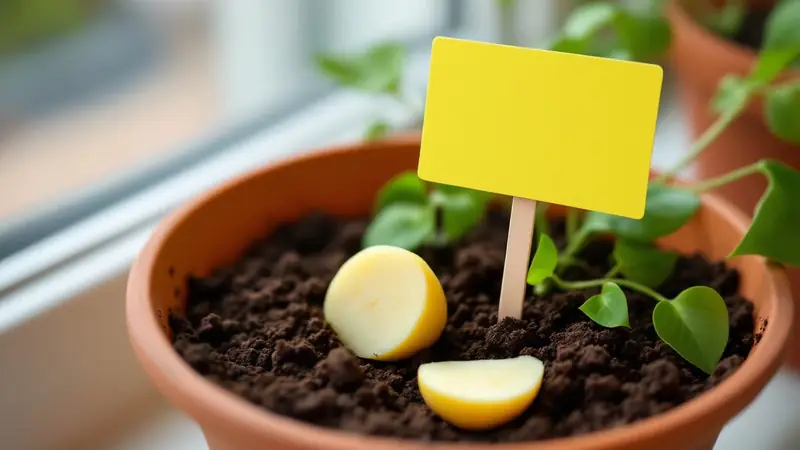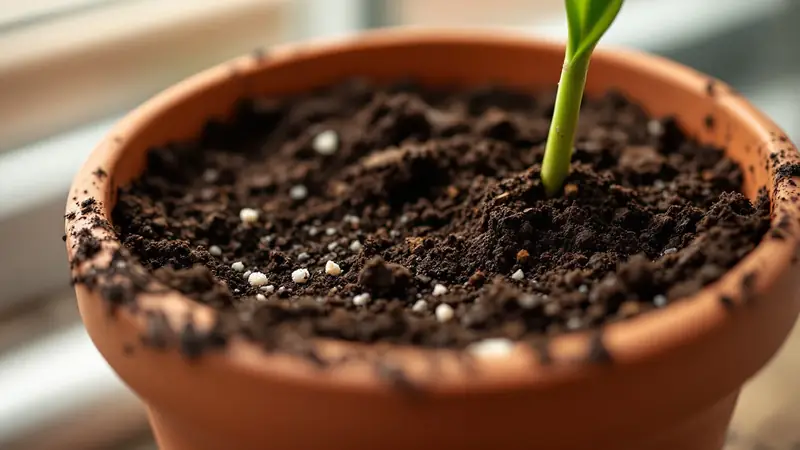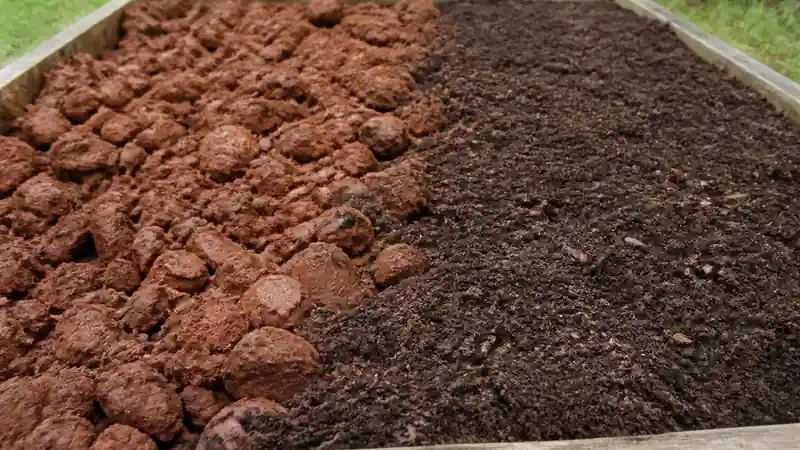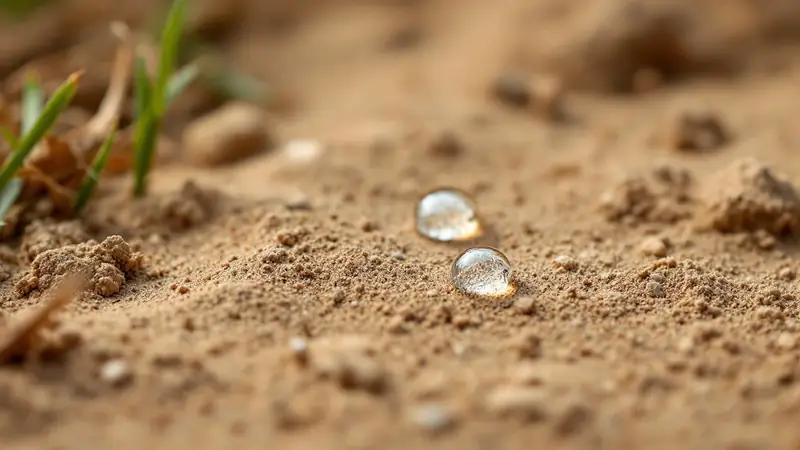
How to fix hydrophobic soil: drop water on a dry sample first; if it sits more than 5 seconds, re-wet slowly. Soak pots until bubbling stops, mix compost into beds and mulch them, and core-aerate lawns before a labeled soil wetting agent.
Most advice on how to fix hydrophobic soil skips the step that decides whether any product will work: a 5-second drop test. Washington State University researchers applied 4 soil surfactants at label rate to a silt loam and a sand with no water repellency and found no difference from plain water in infiltration, water holding or capillary rise (WSU fact sheet FS004E). Ohio State saw no change in root-zone moisture on a native-soil putting green in 2022 (Buckeye Turf, 2023). Wetting agents fix soil that repels water; on soil that wets in under 5 seconds they are wasted money.
Test first: is your soil actually hydrophobic?
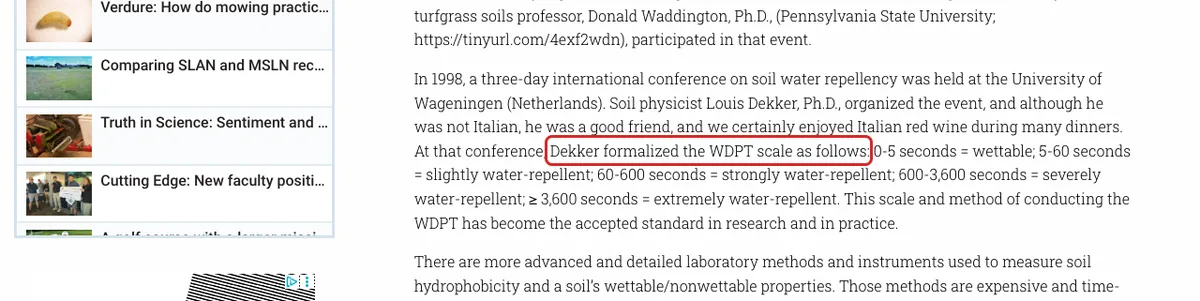
The test is the water drop penetration time (WDPT), which U.S. Forest Service soil scientist Leonard DeBano first described in 1965. Penn State’s Mike Fidanza traces the scale researchers use today to Louis Dekker’s 1998 conference at Wageningen: under 5 seconds is wettable, and the slower classes break at 60, 600 and 3,600 seconds (GCM, January 2023).
- Sample where water runs off or plants wilt. In lawns, cut a core or a narrow trowel slice 3 to 4 inches deep: University of Georgia researchers found repellency worst in the top 2 inches and rare at 3 to 4 inches (Karnok and Tucker, GCSAA).
- Let the sample air-dry and crumble a spoonful onto a plate. WSU’s test uses air-dried, powdered soil (FS004E).
- Put 3 drops of water on it with an eyedropper and start a timer. On a lawn core, place a drop every 1/2 inch down the side, starting at the thatch line, as Fidanza describes.
- Read the slowest drop against the table below. Test a sample from a healthy spot too, so you can compare.
| Drop soaks in within | Class (Dekker scale) | What it means for the fix |
|---|---|---|
| Under 5 seconds | Wettable | Not hydrophobic. Skip wetting agents; look at compaction, drainage or sprinkler coverage. |
| 5 to 60 seconds | Slightly water-repellent | Slow, repeated watering often re-wets it; mulch to keep it from drying out again. |
| 60 to 600 seconds (1 to 10 minutes) | Strongly water-repellent | Soak pots; core-aerate lawns and use a labeled wetting agent. |
| 600 to 3,600 seconds (10 to 60 minutes) | Severely water-repellent | Wetting agent at the label’s initial rate, repeated per label; replace badly dried potting mix. |
| Over 3,600 seconds | Extremely water-repellent | Same as severe; in a pot, repot. In a lawn ring, treat as a Type I fairy ring. |
Why soil stops taking water
Particles get coated with non-polar organic compounds, so water beads instead of sticking. WSU lists sandy soils, soils high in organic matter, soils that swing from wet to very dry, and burned fields and forests as most prone (FS004E). Sand has little surface area to coat, which is why lawns on sand show it first.
Potting mix is the indoor version. Peat moss is hard to re-wet once dry, and water can run down between the pot wall and the root ball, out the drain, leaving the center dry (UC Master Gardeners, Santa Clara County). Bagged mixes ship with a wetting agent, and Sun Gro’s growing-media specialists say heat and sunlight degrade it, giving poor wet-out (Greenhouse Grower); our page on whether potting soil goes bad has the shelf-life numbers.
A thick white fungal mat can do the same thing in a pot: UF/IFAS found saprotrophic mycelium that waterproofs the root ball, and our page on white fungus in soil shows how to tell that mat from harmless surface mold.
That is why a UC handout on succulent soil mix asks for a potting mix whose first ingredient is bark or coir, not peat, cut 2 to 1 with pumice or coarse sand.
In lawns, two causes look alike. Localized dry spot is the general sand-and-thatch problem; a Type I fairy ring is a fungus whose residues make the soil and thatch repellent, killing turf in rings or arcs (NC State Extension). Our guide to mushrooms and fairy rings in lawns covers identifying rings. Mulch can do it too: fungal threads mat dry mulch into a layer that sheds water, which Clemson says to break with a rake (HGIC 1604).
The fix for each setting, with amounts
| Setting | Sign | Fix | Amount or threshold | Source |
|---|---|---|---|---|
| Houseplant or small pot | Water runs out the drain at once; pot feels light | Submerge the whole pot in a bucket and hold it under until air bubbles stop, then drain | Until bubbling stops | UC Master Gardeners |
| Pot too heavy to dunk | Same signs | Bottom-water: stand the pot in a shallow tray of water; do not leave it standing | 1 hour or more; check at 1 to 2 hours | UC Master Gardeners |
| Large fixed container | Wet surface, dry root ball | Trickle a hose on low so water soaks in instead of running off; set a timer | Slow trickle, timed | UC Master Gardeners |
| Bag of dried potting mix or a new raised bed of it | Mix stays dry 1/8 inch down | Wet the mix in a wheelbarrow with hot water before planting; blend it with garden soil | About 50% soil | Extension Foundation, Ask Extension #145504 |
| Mix stored too long or in heat | Poor wet-out from new mix | Use fresh mix; growing-on mixes are meant to be used within months of receipt | 6 to 12 months | Sun Gro, Greenhouse Grower |
| Crusted garden bed | Runoff; dry below the top layer | Sprinkle lightly and repeatedly with no runoff, then mulch with straw, leaves, chips or compost | Repeat until moist | UC Master Gardeners |
| New bed on sandy soil | Drops sit 5+ seconds | Mix compost in, never as a cap, then keep the bed mulched and moist | 3 to 4 in. worked 8 to 12 in. deep | CSU fact sheet 7.235 |
| Matted mulch | Water beads on the mulch | Break the mat with a rake or claw cultivator | Whole layer | Clemson HGIC 1604 |
| Lawn dry patch on sand or thatch | Patch wilts first; drop sits 5+ seconds | Core-aerate, then apply a labeled soil wetting agent and water it in | 20 to 40 holes per sq ft, 2 to 3 in. deep | Purdue AY-8; product label |
| Type I fairy ring | Dead or wilted ring or arc; hard dry soil | Hollow-tine aeration or spiking, soil surfactant and heavy irrigation; hand-water the ring | Hand-water ring only | NC State Extension |
| Lawn or bed that passes the test | Drop soaks in under 5 seconds | No wetting agent: check compaction, drainage and sprinkler coverage | Under 5 seconds | WSU FS004E; Ohio State |
For beds, the compost rate is Colorado State’s routine figure for new gardens; fine mulch then goes on 2 to 3 inches deep, per our page on how deep mulch should be. Compost helps only if it stays moist, because WSU counts high-organic soil among the repellency-prone types; water it in, and see compost rates for clay soil if the bed is heavy rather than sandy.
For a dry bag of mix, the Ask Extension expert’s tip was hot water for the first wetting, noting the more peat in the mix, the worse the problem (Ask Extension #145504). The same answer adds the catch for every setting: no wetting agent stops soil from turning repellent again if it is allowed to dry out.
How to fix hydrophobic soil in a lawn
Lawn dry spots are where wetting-agent research is deepest, because golf greens built on 12-inch sand root zones get localized dry spot every summer (Arkansas Agricultural Experiment Station). Run the drop test on cores from the patch and from green turf, and check that sprinklers reach the patch, before buying anything.
- Core-aerate the patch and a few feet around it. Purdue’s AY-8 sets the target at 2 to 3 inches deep and 20 to 40 holes per square foot (Purdue AY-8); our step-by-step aeration guide lists passes by machine.
- Pick a product sold as a soil surfactant or wetting agent and use its label rate (table below). Wetting agents are not federally registered the way herbicides are, so there is no EPA registration number to look up; the maker’s label is the only rate.
- Treat the whole affected area, not just the worst spot. Karnok and Tucker recommend treating an entire green because repellency varies across it, then spot-treating patches that stay dry (GCSAA).
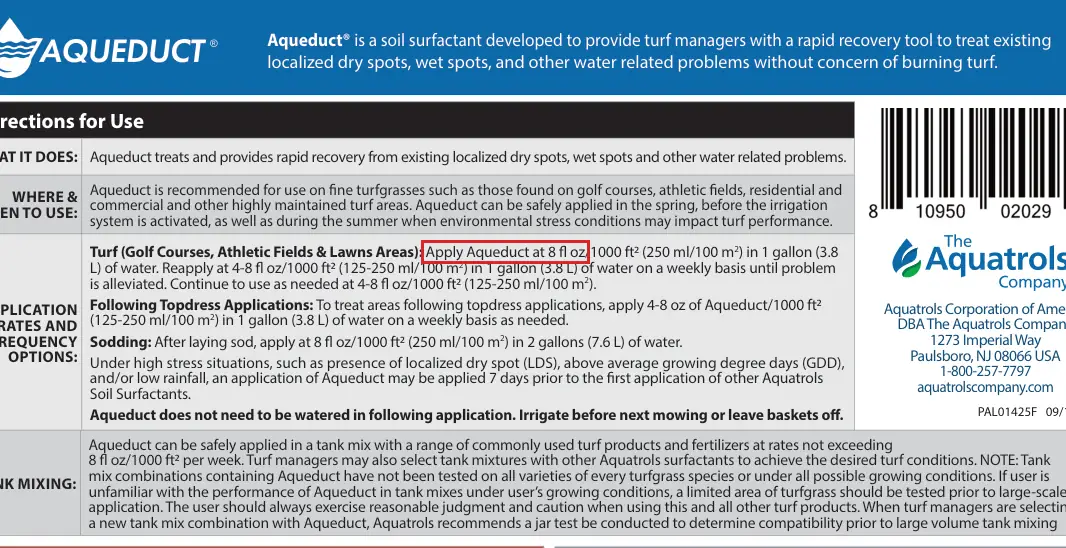
- Water it in as the label says. Revolution must reach 4 inches: about 1/3 inch of water on sand root zones, up to 1/2 inch on other soils (Revolution label). Aqueduct needs no watering-in but asks for irrigation before the next mowing (Aqueduct label).
- Hand-water the patch between irrigation cycles instead of running every zone longer, as NC State advises for fairy rings (NC State). For the rest of the lawn, see the best time of day to water grass.
- Repeat on the label schedule: Aqueduct weekly at 4 to 8 fl oz per 1,000 sq ft until the problem is alleviated; Revolution monthly, starting at least 1 month before summer stress.
| Product (maker) | Label type | Rate per 1,000 sq ft | Water per 1,000 sq ft | Repeat | Label date |
|---|---|---|---|---|---|
| Aqueduct (Aquatrols) | Soil surfactant; 50% nonionic polyols; lawns listed | 8 fl oz first, then 4 to 8 fl oz | 1 gal | Weekly until alleviated | PAL01425F, Sept. 11, 2025 |
| Revolution (Aquatrols) | Soil surfactant; modified alkylated polyol; fine turf | 6 fl oz (or 3 fl oz every 14 days, 4.5 every 21) | 2 gal | Monthly | PAL04125F, Sept. 11, 2025 |
| Penterra (Geoponics) | Soil penetrant and wetting agent; home lawns listed | 4 oz first drench, then 0.5 to 1 oz | 50 gal first drench | Follow-ups as needed | Product sheet, 2015 |
| Hydretain liquid (Ecologel) | Humectant; its sheet says it is not a wetting agent | 9 oz | 15:1 minimum dilution | Every 3 months, or monthly at 1/3 rate | Instructions sheet, 2014 |
- Concentrate (fl oz)
- 8.00
- Concentrate (tablespoons)
- 16.0
- Concentrate (mL)
- 237
Default: 1,000 sq ft of Aqueduct's first application needs 8 fl oz (16 tablespoons, about 237 mL) in 1 gallon of water. Water volume differs by label. Rates read November 2026; your container's label overrides this tool.
What the research shows: Karnok and Tucker found that a wetting agent on hydrophobic soil cut summer root loss in Penncross creeping bentgrass by more than 25 percent, but on a sand green that was not repellent it gave little or no benefit (GCSAA). Arkansas trials in 2021 and 2022 with 6 products found a general trend toward monthly applications, at full or half label rate, giving the best turf quality, with the best schedule differing by product (AAES).
The marketing labels matter less than the soil. In plots in Fayetteville (2018 to 2021) and Lubbock (2019 to 2020), products sold as “penetrants” and “retainers” showed inconsistent differences in root-zone moisture, if any (AAES, July 2025). Ohio State’s 2022 trial of 5 products on a native-soil green found no effect on moisture or firmness and concluded wetting agents work much better in sand-based systems (Buckeye Turf).
Is dish soap a safe wetting agent?
It lowers surface tension, so it can work a little: Colorado State’s Tony Koski wrote that dishwashing soap “may act as a wetting agent” in a dry, thatchy lawn (CSU, April 2013). University of Georgia Extension’s bulletin B1319 explains why it is still not the recommended route: dishwashing liquids mix anionic and nonionic surfactants that together are “very potent,” and none are labeled for use on plants (UGA B1319, 2013).
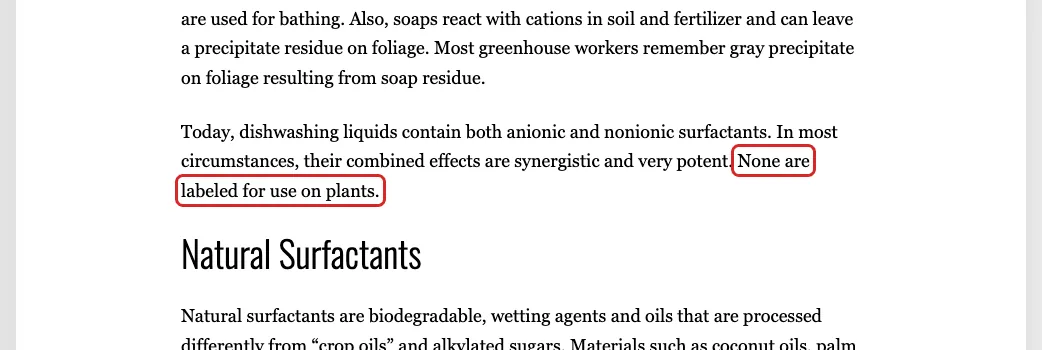
The same bulletin says a wetting agent applied at too high a rate can damage cell membranes and kill roots and leaves. Colorado State adds that some “liquid aeration” sprays are soap-like sodium lauryl sulfate that at best gives a minor wetting effect (PlantTalk 1545). If you try soap anyway, our page on whether dish soap kills grass converts the doses that cause injury.
How long it takes, and keeping it from coming back
A pot is fixed in one soak; UC Master Gardeners give bottom watering an hour or more. Lawns take weeks: Aqueduct’s label repeats weekly until the problem is alleviated, and the Arkansas team says wetting agents lessen localized dry spot rather than eliminate it, so they need reapplying (AAES).
Prevention is moisture. WSU recommends not letting soil get excessively dry, irrigating more often in smaller amounts, and not burning fields (FS004E). Revolution’s label starts treatment at least 1 month before stress, and UC Master Gardeners suggest learning what a well-watered pot weighs so you notice when it dries. For drainage problems that look similar, see the sibling page on what well-drained soil means; for the organic fraction that holds water, what humus is.
1Does a drop of water soak into a dry sample within 5 seconds?
YesNot hydrophobic. A wetting agent will not help (WSU FS004E); check compaction, drainage or sprinkler coverage.
NoGo to the next question
2Is it a pot or container you can move?
YesSubmerge it until air bubbles stop, or bottom-water and check at 1 to 2 hours (UC Master Gardeners).
NoGo to the next question
3Is it a bag of dry mix or an unplanted bed of potting mix?
YesWet it with hot water in a wheelbarrow and blend about 50:50 with garden soil (Ask Extension).
NoGo to the next question
4Is it a planted garden bed or mulched area?
YesSprinkle lightly and repeatedly without runoff, rake apart any matted mulch, then keep 2 to 3 inches of mulch on top.
NoGo to the next question
5Is the dead lawn area a ring or arc?
YesType I fairy ring: hollow-tine aeration, soil surfactant and hand-watering of the ring (NC State).
NoLocalized dry spot: core-aerate to 20 to 40 holes per sq ft, then apply a labeled soil wetting agent, water it in and repeat on the label schedule.
Source: WSU FS004E; UC Master Gardeners; Ask Extension; Clemson HGIC 1604; NC State Extension; Purdue AY-8
How we compiled this
We read 20 primary documents in November 2026: 2 Aquatrols labels dated September 2025, 2 maker instruction sheets, extension publications from WSU, UC, NC State, Purdue, Colorado State, Clemson and Georgia, and university turf research reports from Arkansas, Ohio State and Georgia. We ran no tests of our own. Rates are copied from labels; where an extension source gives no number, the table says so.
Frequently asked questions
Can you revive hydrophobic soil?
Yes. Pots usually re-wet in one soak until the bubbles stop. Beds re-wet with repeated light sprinkling and mulch. Lawns need core aeration at 20 to 40 holes per square foot and a labeled wetting agent repeated on its schedule (Purdue AY-8).
How long do you soak hydrophobic soil?
Hold a submerged pot under until air bubbles stop. Bottom watering in a tray takes an hour or more; UC Master Gardeners say to check at 1 to 2 hours and not leave pots standing in water (UC Master Gardeners).
How do I tell if my soil is hydrophobic?
Put 3 drops of water on an air-dried sample. If the slowest takes more than 5 seconds to soak in, the soil is water-repellent; over 60 seconds is strongly repellent on the Dekker scale.
How do you fix hydrophobic soil without repotting?
Submerge or bottom-water the pot, and repeat whenever it dries out. Repot only if the mix stays repellent after soaking or is past the 6 to 12 month window growers use for stored mix.
Can you put too much wetting agent on a lawn?
Yes. UGA Extension says excess wetting agent can kill roots and leaves. Stay at the label rate: Aqueduct caps tank mixes at 8 fl oz per 1,000 sq ft per week and Revolution at 6 fl oz per month (Revolution label).
Sources
- Washington State University, FS004E, Does Wetter Water Make Fatter Wallets? Using Soil Wetting Agents (Peters, Mobbs, Davenport), Undated fact sheet; cites 2010 thesis. Accessed November 2026.
- Golf Course Management (GCSAA), M. Fidanza, Verdure: Water drops through time, January 2023. Accessed November 2026.
- Golf Course Superintendents Association of America, K. Karnok and K. Tucker, Turfgrass stress, water-repellent soils and LDS, Undated reprint; references through 2001. Accessed November 2026.
- The Ohio State University, Buckeye Turf, Wetting Agents to Prevent or Cure Drought Stress in a Mature, Push-Up Putting Green, May 11, 2023. Accessed November 2026.
- UC Master Gardeners of Santa Clara County, Watering Hydrophobic Soil, Current page. Accessed November 2026.
- Greenhouse Grower (H. Meekins and D. Jacques, Sun Gro Horticulture), Best Practices for Winter Storage and Handling of Growing Media, Current page. Accessed November 2026.
- NC State Extension, Fairy Ring in Turf, Current page. Accessed November 2026.
- Extension Foundation, Ask Extension, Correcting Hydrophobic soils #145504, Current page. Accessed November 2026.
- Colorado State University Extension, Choosing a Soil Amendment, fact sheet 7.235, Current page. Accessed November 2026.
- Clemson Cooperative Extension, Mulch, HGIC 1604, Current page. Accessed November 2026.
- Purdue University and University of Illinois, AY-8-W, Mowing, Dethatching, Aerifying and Rolling Turf, Current PDF. Accessed November 2026.
- Aquatrols, Aqueduct label PAL01425F, Sept. 11, 2025. Accessed November 2026.
- Aquatrols, Revolution label PAL04125F, Sept. 11, 2025. Accessed November 2026.
- Geoponics, Penterra soil penetrant product sheet, 2015. Accessed November 2026.
- Ecologel Solutions, Hydretain Liquid Application Instructions, 2014. Accessed November 2026.
- University of Arkansas Agricultural Experiment Station, Look to the Data, Not the Marketing: Penetrant and Retainer Wetting Agents, July 7, 2025. Accessed November 2026.
- University of Arkansas Agricultural Experiment Station, Turfgrass Wetting Agent Studies Explore Application Rates, 2021 to 2022 trials. Accessed November 2026.
- University of Georgia Extension (Czarnota and Thomas), B1319, Using Surfactants, Wetting Agents, and Adjuvants in the Greenhouse, Jan. 22, 2013. Accessed November 2026.
- Colorado State University Extension (T. Koski), Lawn Tonics, CO-Horts blog, April 2013. Accessed November 2026.
- Colorado State University Extension, PlantTalk Colorado, 1545, Liquid Lawn Aeration, Current page. Accessed November 2026.