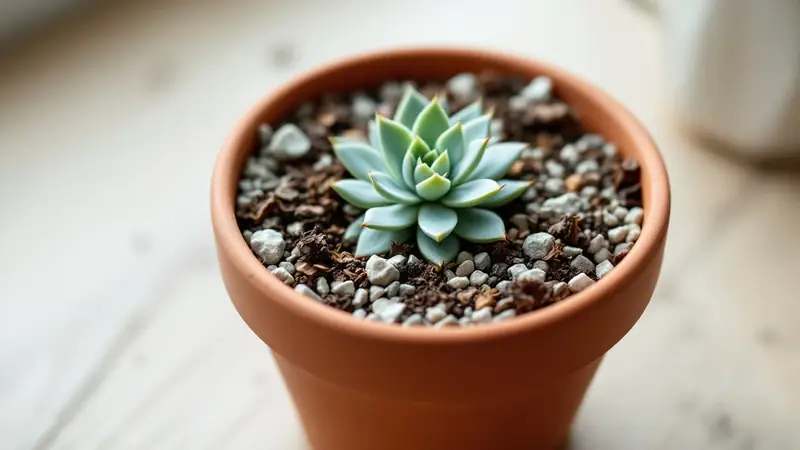
What soil to use for succulents: a fast-draining mix that is one-third to two-thirds mineral grit, such as pumice, perlite or coarse sand, with potting mix or bark making up the rest. 1 to 1 by volume is the most common published ratio.
If you are deciding what soil to use for succulents, the published recipes agree more than forum threads suggest. We put 6 recipes from 3 UC Master Gardener programs, a UC handout, Iowa State Extension and the National Capital Cactus and Succulent Society on one scale, the share of added mineral grit by volume, and they run from 33 to 67 percent. Half of them sit at exactly 50 percent.
That scale is the useful part, because most succulent soil advice gives one grower’s favorite recipe. Below are the recipes side by side, what each grit does, what the bag labels say, a calculator that turns any recipe into quarts for your pot, and the pot and watering rules that decide whether the mix works. For the general difference between bag names, our label comparison of potting soil vs potting mix reads 11 container bags.
Six published succulent soil recipes on one scale
| Recipe | As printed (parts by volume) | Added grit | Grit named | Source, date |
|---|---|---|---|---|
| UC ANR handout | 1 part volcanic pumice or coarse/sharp sand, 2 parts potting mix (bark or coir first, not peat); optional 1/2 part compost | 33% | Pumice, or construction or granite sand | 2012 file |
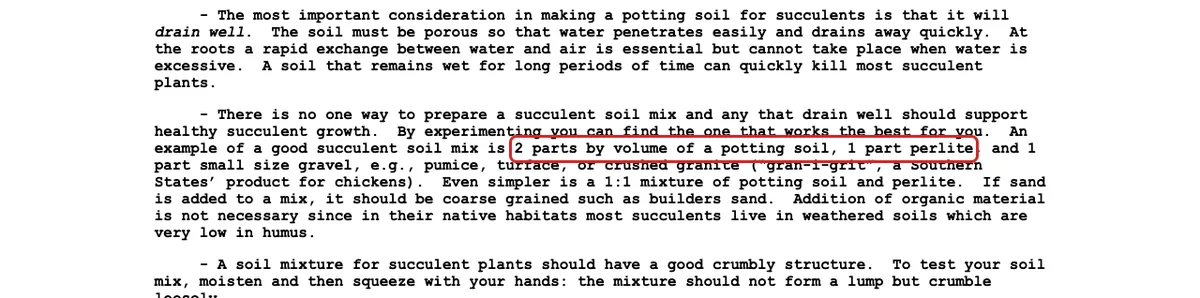
| NCCSS simple | 1 part potting soil, 1 part perlite | 50% | Perlite | Current page |
| NCCSS example | 2 parts potting soil, 1 part perlite, 1 part small gravel | 50% | Perlite plus pumice, Turface or crushed granite | Current page |
| UC MG San Luis Obispo | Half porous material, half organic material | 50% | Pumice, perlite or decomposed granite | Updated Jan. 28, 2026 |
| UC MG Placer | 2 parts potting mix (low to no peat), 2 parts perlite, 1 part volcanic rock (3/16 in) | 60% | Perlite plus 3/16 in volcanic rock | May 1, 2021 |
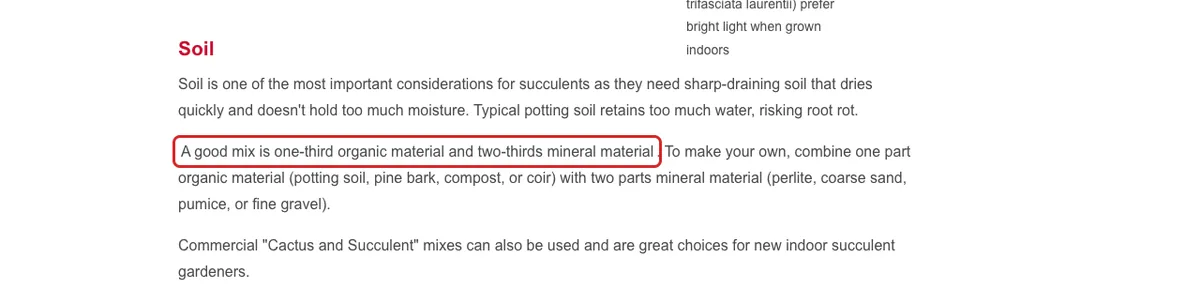
| Iowa State | 1 part organic material, 2 parts mineral material | 67% | Perlite, coarse sand, pumice or fine gravel | Reviewed Dec. 2024 |
Read the spread as a dial, not a contradiction. Iowa State, writing about succulents grown as houseplants, asks for the grittiest mix: one part organic material to two parts mineral material, 67 percent grit. UC Master Gardeners of San Luis Obispo County, writing for gardeners on California’s Central Coast, set it at half porous material and half organic (UC MG San Luis Obispo, updated January 2026). The UC ANR handout sits lowest at 33 percent, but it asks for a bark or coir based potting mix rather than a peat one.
One recipe gives no ratio at all. UC Master Gardeners of Sacramento County say to use a cactus mix and add pumice to increase drainage (Garden Notes GN 175, July 2024). In practice, that is the quickest route: buy an 8 quart bag of cactus mix, add pumice and check the result with the squeeze test in the mixing steps below.
What goes in the gritty half, and why fine sand fails
Grit is there to hold air. Purdue Extension says a container substrate should ideally have 20 to 25 percent air space for proper root growth, and notes that a saturated zone always sits at the bottom of a pot, taking up more of a short pot than a tall one (Purdue HO-287-W). Succulent roots sit in that zone in shallow bowls, which is why every recipe in the table adds grit on top of whatever perlite the potting mix already holds.
The organic half can be a peat-lite blend you mix yourself; the base recipes and their lime rates are in our guide to making your own potting soil.
| Material | What it is | Named by | Verdict |
|---|---|---|---|
| Pumice | Porous volcanic rock; mineral, so it does not decompose | UC ANR handout, UC MG San Luis Obispo, UC MG Sacramento, Iowa State, NCCSS | Use |
| Perlite | Volcanic glass heated until it expands; very light | NCCSS, UC MG Placer, UC MG San Luis Obispo, Iowa State | Use |
| Volcanic rock (lava, scoria) | 3/16 in (4.8 mm) in the Placer recipe | UC MG Placer | Use |
| Coarse or sharp sand | Builder’s, construction or granite sand; NCCSS says it must be coarse grained | UC ANR handout, NCCSS, Iowa State, UC MG Placer | Use coarse only |
| Decomposed granite, crushed granite, Turface | Crushed granite sold as chicken grit; Turface is a calcined clay | UC MG San Luis Obispo, NCCSS | Use |
| Vermiculite | Expanded mica; holds water | UC MG Placer: avoid, holds too much moisture | Avoid |
| Fine, play or plaster sand | Particles small enough to fill the gaps between coarser ones | UF/IFAS: avoid, they create a dense mix; NCCSS: coarse only | Avoid |
Fine sand fails because of particle size, not because it is sand. UF/IFAS Extension says builder’s or coarse sand is best and to avoid plaster and fine sands because they create a dense mix (UF/IFAS, Homemade Potting Mix). L. Art Spomer’s 1980 paper explains the mechanism: fine particles fill the pores between coarse ones, so an insufficient amendment worsens aeration instead of improving it (Journal of Arboriculture 6(12)). Our page on why garden soil drowns in a pot walks through his numbers. Sand is also the heaviest grit, which UF/IFAS notes helps keep top-heavy plants from tipping.
How big is coarse? The only extension recipe that prints a size is Placer’s 3/16 inch volcanic rock, which is 4.8 mm. Grower guides in the current results, such as Mountain Crest Gardens, ask for 1/8 to 1/4 inch grit, or 3.2 to 6.4 mm, and Placer’s size sits inside that band. Sift bagged sand through window screen and keep what stays on top; rinse any grit until the water runs clear so the dust does not clog pores.
The organic half matters too. The UC ANR handout says the first ingredient of the potting mix should be decomposed wood, bark or coir, because peat moss sheds water and is very hard to rewet once dry (UC ANR handout), and Placer asks for potting mix with low to no peat. If a peat mix has already dried into a brick, the soak method in how to fix hydrophobic soil rewets it.
What is in a bag of cactus mix?
| Bag | Ingredients as the maker lists them | Grit named | Sizes | Maker price, Nov. 16, 2026 | Source |
|---|---|---|---|---|---|
| Miracle-Gro Cactus, Palm & Citrus Potting Mix | Forest products, sphagnum peat moss, sand, perlite; plant food added | Sand, perlite | 8 qt | $6.69 (about $0.84/qt), shown out of stock | Maker page |
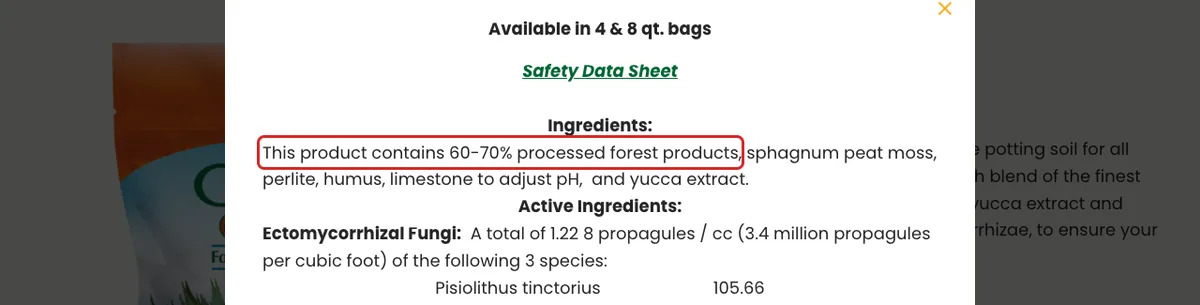
| Espoma Organic Cactus Mix | 60 to 70% processed forest products, sphagnum peat moss, perlite, humus, limestone, yucca extract | Perlite | 4 qt, 8 qt | Not listed | Maker page |
| Black Gold Natural & Organic Succulent & Cactus Potting Mix | Bark, compost, earthworm castings; may include perlite, pumice or cinders; list adds Canadian sphagnum peat moss, calcium silicate | Perlite, pumice or cinders | 8 qt, 1 cu ft | Not listed | Maker page |
Bagged cactus mix is mostly organic. None of the 3 maker pages we read prints a grit share, and Espoma’s states that its Organic Cactus Mix contains 60 to 70 percent processed forest products, plus sphagnum peat moss, perlite, humus, limestone to adjust pH and yucca extract, sold in 4 and 8 quart bags (Espoma, Organic Cactus Mix, checked Nov. 16, 2026). Simple arithmetic follows: perlite, peat, humus and lime share the remaining 30 to 40 percent, so the bag cannot reach the 50 percent grit share of the median recipe on its own.
Miracle-Gro’s page lists forest products, sphagnum peat moss, sand and perlite, with added plant food, and says one 8 quart bag fills two 8 inch containers; it listed the bag at $6.69 on Nov. 16, 2026 (Miracle-Gro, Cactus, Palm and Citrus Potting Mix). Cut 1 to 1 with grit, one bag makes about 16 quarts of mix, enough for four 8 inch pots, and the bag’s share costs about $0.84 a quart before the grit.
That matches the Sacramento advice to add pumice to a cactus mix. Treat the bag as the organic half: 1 part cactus mix to 1 part pumice or perlite reaches the 50 percent recipes, and 1 part to 2 parts reaches Iowa State’s 67 percent. Espoma’s panel lists limestone, and a 1 to 1 cut halves it along with any nutrients in the bag, which suits plants that Iowa State says need only one-half to one-quarter of a label fertilizer rate.
How to make succulent soil: steps and quantities
- Pick the recipe from the first table. For indoor pots, start at 2 parts grit to 1 part organic (Iowa State); for pots outdoors, 1 to 1 (UC MG San Luis Obispo, NCCSS).
- Measure by volume with one container, such as a 1 quart yogurt tub. Use the calculator below to size one part for your pot.
- Rinse the grit in a bucket until the water runs clear, then let it drain.
- Break up any clumps in the potting mix or bark. If it is dry and peat based, moisten it first so it takes water.
- Combine in a tub and turn it until no streaks of grit or mix remain.
- Squeeze test: moisten a handful and squeeze. NCCSS says a good succulent mix crumbles loosely instead of forming a lump (NCCSS, Potting Mixes for Succulent Plants). If it holds a lump, add 1 more part grit.
- Fill a pot with a drainage hole, water until water runs out the bottom, and let the mix dry almost completely before the next watering, as UC Master Gardeners of San Luis Obispo County advise.
- One part (quarts)
- 2.00
- One part (cups)
- 8.0
- One part (liters)
- 1.89
Default: a 4 quart pot with a 1 to 1 recipe needs one part of 2 quarts (8 cups): 2 quarts of grit and 2 of potting mix. Multiply one part by each ingredient's parts in the recipe table.
| Recipe | Total parts | One part | Grit | Organic |
|---|---|---|---|---|
| UC ANR handout | 3 | 1.33 qt (5.3 cups) | 1.33 qt | 2.67 qt |
| NCCSS simple | 2 | 2.00 qt (8.0 cups) | 2.00 qt | 2.00 qt |
| NCCSS example | 4 | 1.00 qt (4.0 cups) | 2.00 qt | 2.00 qt |
| UC MG San Luis Obispo | 2 | 2.00 qt (8.0 cups) | 2.00 qt | 2.00 qt |
| UC MG Placer | 5 | 0.80 qt (3.2 cups) | 2.40 qt | 1.60 qt |
| Iowa State | 3 | 1.33 qt (5.3 cups) | 2.67 qt | 1.33 qt |
The calculator takes the pot’s volume in quarts. Nursery pots sold as gallons often hold less than a liquid gallon; the sibling guide on how much soil a 5 gallon pot holds converts trade sizes to quarts. Default: a 4 quart pot with a 1 to 1 recipe needs 2 quarts of each part, or 8 cups.
Pots, gravel layers and succulents in the ground
The best mix fails in the wrong pot. Iowa State says succulent containers must have drainage holes and that a drainage layer of coarse gravel in the bottom is not a substitute; plants in such pots often stay too wet (Iowa State Extension). Purdue’s perched water explanation is why: gravel raises the wet zone into the mix instead of removing it. UC MG San Luis Obispo suggest terra cotta for beginners and a pot only 1 to 2 inches wider than the plant.
Mixes age. Iowa State notes that soil breaks down over time and holds more water, and NCCSS suggests repotting every couple of years. Pumice and coarse sand do not decompose, so a 67 percent grit mix changes less than a 33 percent one; our page on whether potting soil goes bad covers what fades in the organic half.
In the ground, the container recipes do not apply: you cannot mix your way through a whole bed. Test the site first with the refilled 12 inch hole test in our guide to well drained soil; Iowa State calls 1 to 3 inches per hour desirable and under 1 inch poor (Iowa State, Testing and Improving Soil Drainage). On slow clay, Iowa State says to add organic matter, not sand, so a clay site is usually better served by containers or a raised planter filled with one of the recipes above; improving clay soil gives compost rates.
1Is the plant going into the ground rather than a pot?
YesTest drainage with a refilled 12 inch hole. Under 1 inch per hour (Iowa State: poor), grow in containers or a raised planter instead.
NoGo to the next question
2Does the pot lack a drainage hole?
YesDrill one, or double pot: a smaller pot with a hole set inside it (Iowa State). Gravel in the bottom is not a substitute.
NoGo to the next question
3Is the pot indoors?
Yes2 parts grit to 1 part potting mix or bark, 67 percent grit (Iowa State).
NoGo to the next question
4Are you starting from a bag of cactus mix?
YesAdd pumice (UC MG Sacramento): 1 part mix to 1 part pumice, then squeeze test.
No1 part potting mix or bark to 1 part pumice, perlite or decomposed granite, 50 percent grit (UC MG San Luis Obispo, NCCSS).
Source: Iowa State Extension; UC Master Gardeners of San Luis Obispo and Sacramento counties; NCCSS
Water quality is a second lever. UC Master Gardeners of Sacramento County put the ideal pH of irrigation water for succulents at 5.5 to 6.5 and, for alkaline tap water, suggest 1 to 2 tablespoons of vinegar per gallon, or 1/2 teaspoon of citric acid in place of 2 tablespoons of vinegar (GN 175). A mix with lime in it, such as a bagged cactus mix, pushes the same direction as hard water.
How we compiled this
On Nov. 16, 2026 we read 13 primary documents: 3 UC Master Gardener publications (San Luis Obispo, Placer, Sacramento), a UC ANR handout, Iowa State Extension’s succulent and drainage pages, the National Capital Cactus and Succulent Society’s potting guide, 3 maker pages for bagged cactus mixes (Miracle-Gro, Espoma, Black Gold) and UF/IFAS, Purdue HO-287-W and Spomer (1980) for grit and pore physics. Added-grit percentages are our arithmetic from each recipe’s printed parts. We did not mix, test or grow anything.
Frequently asked questions
Can I put succulents in regular potting mix?
For a short time, yes, but cut it with grit for the long run. Every recipe we compiled adds 33 to 67 percent pumice, perlite or coarse sand to ordinary potting mix; 1 to 1 is the most common ratio.
Is Miracle-Gro potting soil ok for succulents?
As the organic half, yes. Mix it 1 to 1 with pumice or perlite, or 1 to 2 for indoor pots (Iowa State). The UC ANR handout prefers a base listing bark or coir before peat, so read the ingredient panel first.
How do I make my own succulent soil mix?
Combine 1 part potting mix or bark with 1 part pumice, perlite or coarse sand by volume, rinse the grit first, and check that a moist handful crumbles when squeezed (NCCSS). Go to 2 parts grit for indoor pots.
What happens if you use regular potting soil for succulents?
It stays wet longer. Iowa State says typical potting soil retains too much water and risks root rot, and the saturated zone at the bottom of a shallow pot (Purdue HO-287-W) sits right where succulent roots are.
What can I use as a substitute for succulent soil?
Any 1 to 1 blend of potting mix with pumice, perlite, decomposed granite or coarse builder’s sand works (UC MG San Luis Obispo). NCCSS also names Turface and crushed granite chicken grit. Avoid vermiculite and fine sand.
Sources
- Iowa State University Extension and Outreach, Yard and Garden (Aaron Steil), Growing Succulents Indoors, Last reviewed December 2024. Accessed November 2026.
- UC Master Gardeners of Placer County, Selecting and Growing Succulents, May 1, 2021. Accessed November 2026.
- UC Master Gardeners of San Luis Obispo County, Succulents, Updated January 28, 2026. Accessed November 2026.
- UC Master Gardeners of Sacramento County, Garden Notes GN 175, Succulents, July 2024. Accessed November 2026.
- University of California Agriculture and Natural Resources, Make-your-Own Succulent Potting Mix (handout), 2012 file. Accessed November 2026.
- National Capital Cactus and Succulent Society (Donna Kuroda), Potting Mixes for Succulent Plants, Current page. Accessed November 2026.
- Espoma, Organic Cactus Mix product page, Checked November 16, 2026. Accessed November 2026.
- Purdue University Extension (Krishna Nemali), Understanding the Pores of a Soilless Substrate, HO-287-W, Current PDF. Accessed November 2026.
- L. Art Spomer, Journal of Arboriculture 6(12), Container Soil Water Relations: Production, Maintenance, and Transplanting, 1980. Accessed November 2026.
- Iowa State University Extension and Outreach, Testing and Improving Soil Drainage, Current page. Accessed November 2026.
- UF/IFAS Extension, Solutions for Your Life, Homemade Potting Mix, Current page. Accessed November 2026.
- ScottsMiracle-Gro, Miracle-Gro Cactus, Palm and Citrus Potting Mix product page (72078432), Price and ingredients checked November 16, 2026. Accessed November 2026.
- Sun Gro Horticulture, Black Gold Natural and Organic Succulent and Cactus Potting Mix, Checked November 16, 2026. Accessed November 2026.