How much soil for 5 gallon pot filling: 12 to 17 dry quarts. A #5 nursery pot takes 12 to 14, a fabric grow bag 16 and a true 5 gallon bucket 17.2; one 25 quart bag fills one bucket or two nursery pots.
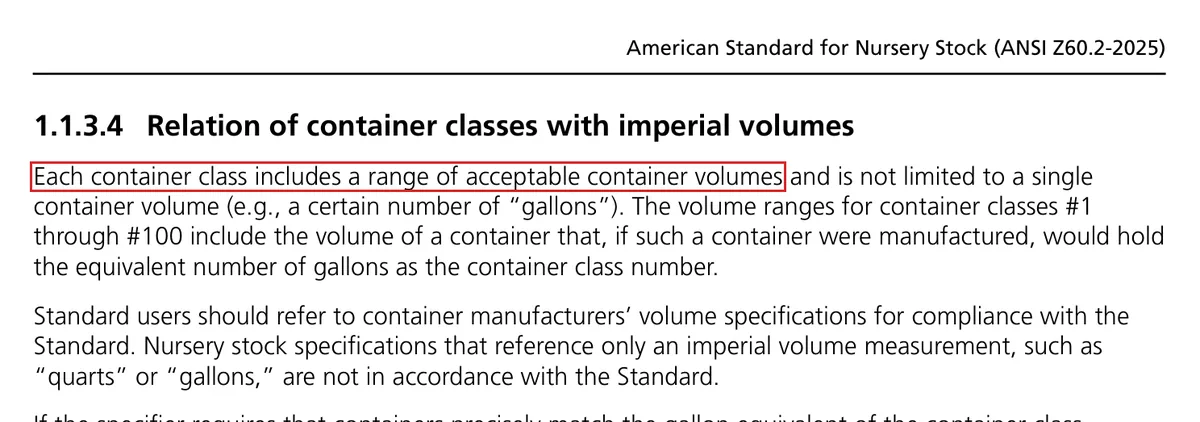
The answer to how much soil for 5 gallon pot planting turns on two unit traps. First, three different containers are sold as “5 gallon”: a trade #5 nursery pot, which the American Standard for Nursery Stock, ANSI Z60.2-2025 lets range from 785 to 1,242 cubic inches (3.4 to 5.4 gallons); a fabric grow bag; and a bucket that really holds 5 gallons. Second, potting mix is sold in dry quarts of 67.2 cubic inches, not the 57.75 cubic inch liquid quarts in a gallon (NIST Handbook 44, Appendix C, 2026). Five liquid gallons are 20 liquid quarts but only 17.2 dry quarts.
We converted the published volumes of 15 CREO Group #5 containers, 4 HC Companies 5 gallon pots and the Smart Pot fabric line into the dry quarts and cubic feet printed on soil bags. None of the top search results does that conversion; most repeat “5 gallons equals 20 quarts”, which overstates a bucket by 2.8 bag quarts and a typical #5 pot by 7.7. Which mix to put in the pot is a separate choice, covered in what 11 potting soil and potting mix labels contain, and the reason yard dirt fails in containers is in garden soil vs potting soil.
What does a “5 gallon” pot actually hold?
Measured in bag quarts, the pots on sale as 5 gallon run from 10.3 to 19.1 dry quarts. The most common listing is 3.58 gallons, shared by 6 of the 15 #5 containers in the CREO Group nursery catalog (CREO Group took in Nursery Supplies Inc., founded in 1919). That pot takes 12.3 dry quarts, so a 25 quart bag fills two.
Swipe the table sideways to see every column.
| Pot | Type | Listed volume | Cubic inches | Dry quarts | Cubic feet | Pots per 25 qt bag |
|---|---|---|---|---|---|---|
| HC Companies NUE005G0 | Injection pot, listed as 5.00 G | 693.23 cu in | 693 | 10.3 | 0.40 | 2.4 |
| CREO GL/EG1400 | #5 egg can | 3.28 gal | 758 | 11.3 | 0.44 | 2.2 |
| ANSI #5 lower limit | Container class floor | 785 cu in | 785 | 11.7 | 0.45 | 2.1 |
| CREO C1600, and 5 other CREO #5 models | #5 blow molded | 3.58 gal | 827 | 12.3 | 0.48 | 2.0 |
| HC Companies NER005G0 | Injection pot, listed as 5.00 G | 866.54 cu in | 867 | 12.9 | 0.50 | 1.9 |
| CREO C2000 | #5 blow molded | 3.84 gal | 887 | 13.2 | 0.51 | 1.9 |
| CREO PF2000 | #5 pressure formed | 4.00 gal | 924 | 13.7 | 0.53 | 1.8 |
| HC Companies NLT00050 | Injection squat, listed as 5.00 G | 945.87 cu in | 946 | 14.1 | 0.55 | 1.8 |
| CREO B5 | #5 blow molded | 4.11 gal | 949 | 14.1 | 0.55 | 1.8 |
| Smart Pot 5 gallon | Fabric planter | 0.622 cu ft | 1,075 | 16.0 | 0.62 | 1.6 |
| True 5 gallons (#5T, a full 5 gallon bucket) | Liquid measure | 1,155 cu in | 1,155 | 17.2 | 0.67 | 1.5 |
| HC Companies BWS00055 | Blow molded true squat | 1,157.63 cu in | 1,158 | 17.2 | 0.67 | 1.5 |
| CREO C2100 | #5 squat | 5.17 gal | 1,194 | 17.8 | 0.69 | 1.4 |
| ANSI #5 upper limit | Container class ceiling | 1,242 cu in | 1,242 | 18.5 | 0.72 | 1.4 |
| CREO GL/EG2800S | #5 squat | 5.56 gal | 1,284 | 19.1 | 0.74 | 1.3 |
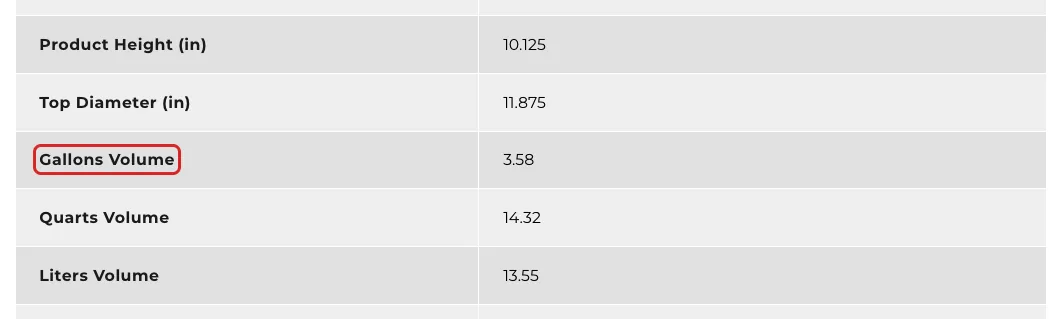
The standard explains the spread. Section 1.1.3.4 says each container class “includes a range of acceptable container volumes” and is not limited to a number of gallons; a buyer who wants a full 5 gallons must specify “#5True” or “#5T” (1,155 cubic inches). Section 1.9 says above-ground fabric bags should fall within the same class ranges, and the Smart Pot 5 gallon, at 1,075 cubic inches, does.
Two listings fall outside the #5 class as printed. HC Companies lists its NUE005G0 under 5.00 G at 693.23 cubic inches, below the 785 cubic inch floor, and CREO’s GL/EG2800S squat at 5.56 gallons, or 1,284 cubic inches, sits above the 1,242 ceiling. The HC Companies NLT00050 page prints 945.87 cubic inches but a 2.91 gallon maximum liquid figure, which works out to 672 cubic inches; the table uses the cubic inch capacity.
1Does the pot or its tag show a # class, such as #5, or the word trade?
YesNursery pot: 785 to 1,242 cu in under ANSI Z60.2. Most CREO #5 listings hold 12.3 to 14.1 dry quarts; a 25 quart bag fills about 2.
NoGo to the next question
2Is it a fabric grow bag?
YesA Smart Pot 5 gallon holds 0.622 cu ft, 16.0 dry quarts. A 1.5 cu ft bag fills about 2.4, a 2 cu ft bag about 3.
NoGo to the next question
3Is it a bucket, or a pot marked #5T or true to size?
Yes17.2 dry quarts (1,155 cu in). One 25 quart bag fills 1; a 2 cu ft bag fills just under 3.
NoMeasure it: count liquid quarts of water to the brim and multiply by 0.86 to get dry quarts of mix.
Source: ANSI Z60.2-2025; Smart Pot; NIST Handbook 44 Appendix C
How much soil for every pot size from 1 to 25 gallons
The same trap scales up: a #10 nursery pot can hold as little as 31 dry quarts against 34.4 for a true 10 gallon container, and a 25 gallon Smart Pot holds 79.9 dry quarts, 6 less than a true 25 gallons. Use the column that matches the label on your pot; if it shows a # sign or “trade”, read the class or CREO columns.
| Size on the label | ANSI class range (dry qt) | CREO listings (dry qt) | Smart Pot fabric (dry qt) | True gallons (dry qt) | True gallons (cu ft) | True-size pots per 2 cu ft bag |
|---|---|---|---|---|---|---|
| 1 gal (#1) | 2.3 to 3.7 | 1.9 to 3.4 (10 models) | 3.4 | 3.4 | 0.13 | 15.0 |
| 2 gal (#2) | 4.8 to 7.1 | 4.9 to 6.9 (7 models) | 5.2 | 6.9 | 0.27 | 7.5 |
| 3 gal (#3) | 9.3 to 11.0 | 8.4 to 10.3 (6 models) | 8.8 | 10.3 | 0.40 | 5.0 |
| 5 gal (#5) | 11.7 to 18.5 | 11.3 to 19.1 (15 models) | 16.0 | 17.2 | 0.67 | 3.0 |
| 7 gal (#7) | 19.9 to 26.6 | 20.9 to 26.6 (6 models) | 21.8 | 24.1 | 0.94 | 2.1 |
| 10 gal (#10) | 31.0 to 39.4 | 27.4 to 36.7 (7 models) | 34.4 | 34.4 | 1.34 | 1.5 |
| 15 gal (#15) | 41.2 to 55.0 | 41.2 to 49.8 (7 models) | 51.1 | 51.6 | 2.01 | 1.0 |
| 20 gal (#20) | 67.3 to 76.7 | 67.0 to 74.4 (4 models) | 72.5 | 68.7 | 2.67 | 0.7 |
| 25 gal (#25) | 85.9 to 102.1 | 77.3 to 94.8 (4 models) | 79.9 | 85.9 | 3.34 | 0.6 |
Three sizes carry most of the confusion. A “1 gallon” #1 pot can hold 2.3 dry quarts, a third less than a true gallon’s 3.4, which is why one bag fills more small pots than the label math predicts. The #3 class tops out at 742 cubic inches, 11.0 dry quarts, so a 3 gallon nursery pot never needs more than half a 25 quart bag. For a raised bed rather than pots, length times width times depth applies instead; our bed volume formula for mulch uses the same cubic foot arithmetic.
How many bags of potting soil for a 5 gallon pot?
One 25 quart bag fills one true 5 gallon bucket with 7.8 quarts to spare, or two 3.58 gallon #5 pots. Bags are labeled two ways: Miracle-Gro Potting Mix sells 8, 16, 25 and 50 quart bags and says the 16 quart bag fills about one 12 inch container, while larger bags print cubic feet. One cubic foot is 25.7 dry quarts, so a 25 quart bag is 0.97 cubic foot and a 50 quart bag 1.95.
| Bag | Dry quarts | #5 pots at 3.58 gal (12.3 qt) | Smart Pot 5 gal (16.0 qt) | True 5 gal bucket (17.2 qt) |
|---|---|---|---|---|
| 8 qt bag | 8.0 | 0.7 | 0.5 | 0.5 |
| 16 qt bag | 16.0 | 1.3 | 1.0 | 0.9 |
| 25 qt bag | 25.0 | 2.0 | 1.6 | 1.5 |
| 1 cu ft bag | 25.7 | 2.1 | 1.6 | 1.5 |
| 1.5 cu ft bag | 38.6 | 3.1 | 2.4 | 2.2 |
| 50 qt bag | 50.0 | 4.1 | 3.1 | 2.9 |
| 2 cu ft bag | 51.4 | 4.2 | 3.2 | 3.0 |
| 2.8 cu ft loose bale (Sun Gro) | 72.0 | 5.9 | 4.5 | 4.2 |
| 3.8 cu ft compressed bale, about 7 cu ft loose | 180.0 | 14.6 | 11.3 | 10.5 |
Compressed bales are the exception to reading the label. Sun Gro’s chart has a 3.8 cubic foot bale filling 65 one gallon nursery pots, 30 two gallon and 23 three gallon, against 26, 12 and 9 for a 2.8 cubic foot loose bag. That ratio of about 2.5 means the bale yields roughly 7 cubic feet once broken up, enough for about 10 true 5 gallon buckets.
A bale is also the base of most homemade potting soil recipes, where peat goes 1 to 1 with perlite or vermiculite plus about 2 oz of limestone per 5 gallon bucket.
Loose bags are checked loose. NIST Handbook 133, section 3.10 has inspectors massage the bag, pour the mix into a measure without tamping, read the level and allow each package a maximum variation of 5 percent of the labeled volume. A single 25 quart bag can measure 23.75 quarts, 5 cups short, and still pass if the inspected lot averages its label, one more reason to round up.
Settling, the watering reservoir and a worked example
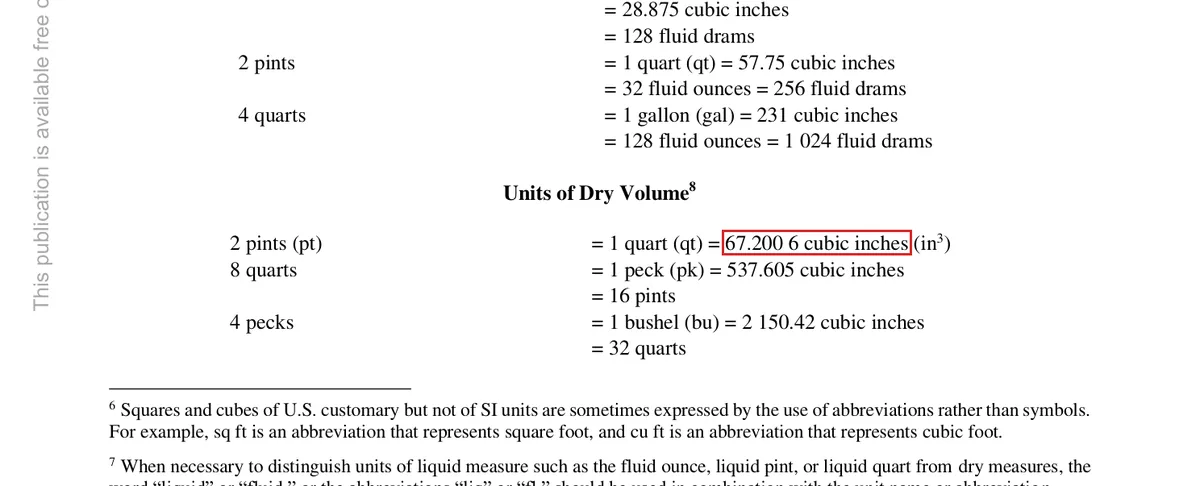
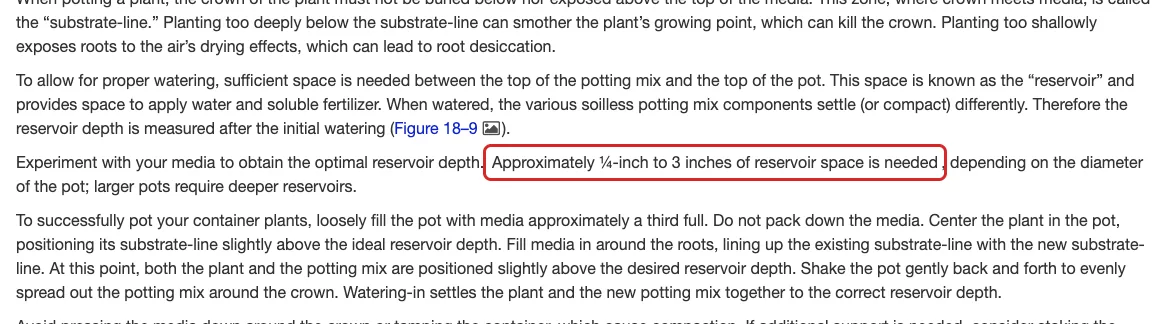
Mix shrinks once it is watered, and you do not fill to the brim, so the two corrections partly cancel. Bonnie Plants, adapting Conrad Fafard soil tables, says packing down can mean 15 to 20 percent more soil, more in taller containers. The NC State Extension Gardener Handbook, chapter 18 calls the gap at the top the reservoir and puts it at 1/4 inch to 3 inches, deeper for wider pots, measured after the first watering.
| Step | Arithmetic | Volume | Dry quarts |
|---|---|---|---|
| Listed volume, CREO C2000 (#5) | 3.84 gal x 231 | 887 cu in | 13.2 |
| Less a 1 in watering reservoir | 3.14 x 5.94 in x 5.94 in x 1 in | 111 cu in | 1.6 |
| Settled mix at the reservoir line | 887 minus 111 | 776 cu in | 11.6 |
| Loose mix to buy, plus 15 percent | 11.6 x 1.15 | 13.3 | |
| Loose mix to buy, plus 20 percent | 11.6 x 1.20 | 13.9 |
The result, 13.3 to 13.9 dry quarts to buy, lands within 0.7 quart of the pot’s 13.2 quart brim volume. For pots up to about 12 inches across with a 1 inch reservoir, buying the brim volume in dry quarts is close enough; add 15 to 20 percent for tall, narrow containers or if you firm the mix by hand. The UW Extension tomato container sheet asks for 1 inch of space at the top after the first watering of a 5 gallon container.
- Dry quarts to buy
- 17.2
- Cubic feet
- 0.67
- Liters
- 18.9
- 16 qt bags
- 2
- 25 qt bags
- 1
- 1.5 cu ft bags
- 1
- 2 cu ft bags
- 1
Default: 1 true 5 gallon bucket at brim volume needs 17.2 dry quarts (0.67 cu ft): one 25 qt, 1.5 cu ft or 2 cu ft bag. Bag counts round up. Volumes from Tables 1 and 2.
The calculator multiplies pot count by the dry quarts in Table 1 or 2 and divides by each bag size, rounding bags up. Default: 1 true 5 gallon bucket at brim volume needs 17.2 dry quarts, 0.67 cubic foot: one 25 quart, 1.5 cubic foot or 2 cubic foot bag.
Gravel, weight and what to plant in a 5 gallon pot
Skip the gravel layer. NC State says never to put gravel or rock beneath potting mix, because water collects in the mix just above it, and University of Maryland Extension says gravel or pot shards can raise the water table and waterlog the mix. Alabama Extension ANR-2663 still lists a 2 to 3 inch gravel layer for 5 gallon buckets; the perched water mechanism behind the NC State advice is explained on our well-drained soil page. Drill holes instead: ANR-2663 spaces them every 3 inches across the bucket bottom.
A filled 5 gallon pot is light dry and heavy wet. The Miracle-Gro Potting Mix 25 quart label prints a net weight of 12.6 pounds for 25 dry quarts, about 8.7 pounds for a 17.2 quart bucket. NC State says wetting a mix takes water equal to 45 to 60 percent of the container volume, 2.5 to 3 gallons for 5 gallons, and water weighs about 8.32 pounds a gallon at 77°F (UGA Extension), so a watered bucket weighs roughly 30 to 34 pounds. Mix that has dried out sheds water at first; rewetting hydrophobic potting soil takes a soak, not a splash.
For crops, NC State lists 5 gallons as the minimum container for one tomato or one eggplant, and 2 gallons for one pepper. Texas A&M AgriLife publication E-545 calls 5 gallon containers the most suitable size for tomatoes, peppers and eggplant. For succulents the volume math is the same but the mix is not; our succulent soil recipes add 33 to 67 percent grit, and leftover bags keep best sealed and dry, as covered in does potting soil go bad.
What the top guides say, checked against the standards
| Guide | What it says | What the units say |
|---|---|---|
| My Garden Life (soil calculator article) | 12 in pot: 5 gallons, 20 quarts, 0.77 cu ft | 20 liquid quarts is 17.2 dry quarts and 0.67 cu ft; 0.77 cu ft is 5.8 gallons |
| Swansons Nursery (soil calculator) | 5-gallon pot = 0.5 cu ft | Matches a #5 nursery pot of about 3.7 gallons, not a bucket |
| Smart Pot (soil calculator data) | 5 gallon fabric planter = 0.622 cu ft | 4.65 gallons, 16.0 dry quarts; the maker says leave watering space and allow for settling |
| Bonnie Plants (Fafard tables) | 5 gallon strawberry jar = 14 dry quarts; add 15 to 20 percent for compression | 14 dry quarts is 941 cu in, inside the #5 class |
| Alabama Extension, ANR-2663 | One 25 quart bag per 5 gallon bucket, over 2 to 3 in of gravel | 25 quarts is 45 percent more than the bucket holds; NC State and Maryland Extension advise against the gravel |
How we compiled this
In November 2026 we read ANSI Z60.2-2025 Table 1 and sections 1.1.3.4 and 1.9, NIST Handbook 44 Appendix C and Handbook 133 section 3.10, the product pages of 15 CREO Group #5 containers (100 nursery pages read in all) and 4 HC Companies 5.00 G pots, the Smart Pot calculator’s volume data, the Sun Gro fill chart, the Miracle-Gro Potting Mix page and 5 extension publications. All quantities are arithmetic from those printed figures. We did not fill, weigh or measure any pots.
Frequently asked questions
How many bags of soil do I need for a 5 gallon pot?
One 25 quart bag fills one true 5 gallon bucket (17.2 dry quarts) or two #5 nursery pots of 3.58 gallons (12.3 dry quarts each). With 1.5 cubic foot bags, one bag fills 2 buckets.
Will 2 cubic feet of soil fill a 5 gallon bucket?
Yes, with plenty left. Two cubic feet is 51.4 dry quarts, almost exactly 3 true 5 gallon buckets at 17.2 quarts each, or 4 nursery #5 pots of 3.58 gallons. Plan on 2 buckets if you add 20 percent for settling.
How many 5 gallon pots will 1.5 cubic feet of soil fill?
A 1.5 cubic foot bag holds 38.6 dry quarts: 2.2 true 5 gallon buckets, 2.4 Smart Pot 5 gallon bags or 3.1 #5 nursery pots of 3.58 gallons, filled to the brim.
How many quarts of soil do I need for a 5 gallon bucket?
17.2 dry quarts, the unit on soil bags. A 5 gallon bucket holds 20 liquid quarts, but a dry quart is 67.2 cubic inches against 57.75 for a liquid quart (NIST Handbook 44).
Can I put 2 tomato plants in a 5 gallon bucket?
NC State Extension lists 5 gallons as the minimum for 1 tomato plant per container, and UW Extension says indeterminate tomatoes need more than a 5 gallon bucket. Plant one determinate tomato per bucket.
How many pounds of soil for a 5 gallon pot?
About 8.7 pounds of bagged potting mix for a true 5 gallon bucket, from the Miracle-Gro label’s 12.6 pounds per 25 quarts. Watered in, the pot gains 2.5 to 3 gallons of water, 21 to 25 pounds.
Sources
- AmericanHort, American Standard for Nursery Stock, ANSI Z60.2-2025, Table 1 and sections 1.1.3.4, 1.9, Approved April 17, 2025. Accessed November 2026.
- National Institute of Standards and Technology, NIST Handbook 44 (2026), Appendix C: General Tables of Units of Measurement, 2026 edition. Accessed November 2026.
- National Institute of Standards and Technology, NIST Handbook 133 (2026), Chapter 3, section 3.10 Mulch and Soils Labeled by Volume, 2026 edition. Accessed November 2026.
- CREO Group, Nursery containers catalog (Classic line product pages, including C1600, C2000 and B5), Checked Nov. 16, 2026. Accessed November 2026.
- CREO Group, About CREO, Checked Nov. 16, 2026. Accessed November 2026.
- HC Companies, 5.00 G injection nursery pot, NUE005G0, Checked Nov. 16, 2026. Accessed November 2026.
- HC Companies, 5.00 G injection nursery pot, NER005G0, Checked Nov. 16, 2026. Accessed November 2026.
- HC Companies, 5.00 G injection squat nursery pot, NLT00050, Checked Nov. 16, 2026. Accessed November 2026.
- HC Companies, 5.00 G blow mold true squat with handles, BWS00055, Checked Nov. 16, 2026. Accessed November 2026.
- Smart Pot, Soil Calculator (planter volume data), Checked Nov. 16, 2026. Accessed November 2026.
- NC State Extension, Extension Gardener Handbook, Chapter 18: Plants Grown in Containers, Current page. Accessed November 2026.
- University of Maryland Extension, Growing Vegetables in Containers and Salad Tables, Current page. Accessed November 2026.
- University of Wisconsin Extension, Marinette County, Growing a Tomato Plant in a Container, 2018 file. Accessed November 2026.
- Texas A&M AgriLife Extension, Vegetable Gardening in Containers, E-545, PDF. Accessed November 2026.
- Alabama Cooperative Extension System, Five-Gallon Bucket Supply List, ANR-2663, Revised June 2023. Accessed November 2026.
- Sun Gro Horticulture, Conversion tables: What One Bale or Bag Fills, 2013. Accessed November 2026.
- Scotts Miracle-Gro, Miracle-Gro Potting Mix product page, Checked Nov. 16, 2026. Accessed November 2026.
- Miracle-Gro Lawn Products, Miracle-Gro Potting Mix label, 25 dry qt (27.53 L), net weight 12.6 lb, ©2013. Accessed November 2026.
- Bonnie Plants, How Many Pots Can You Fill with a Bag of Soil? (adapted from Conrad Fafard tables), Checked Nov. 16, 2026. Accessed November 2026.
- University of Georgia Extension, Weekly Water Fun Fact: Weight of Water, February 2016. Accessed November 2026.
- Swansons Nursery, Soil Calculator, Checked Nov. 16, 2026. Accessed November 2026.
- My Garden Life, A Soil Calculator for Raised Beds and Containers, Checked Nov. 16, 2026. Accessed November 2026.