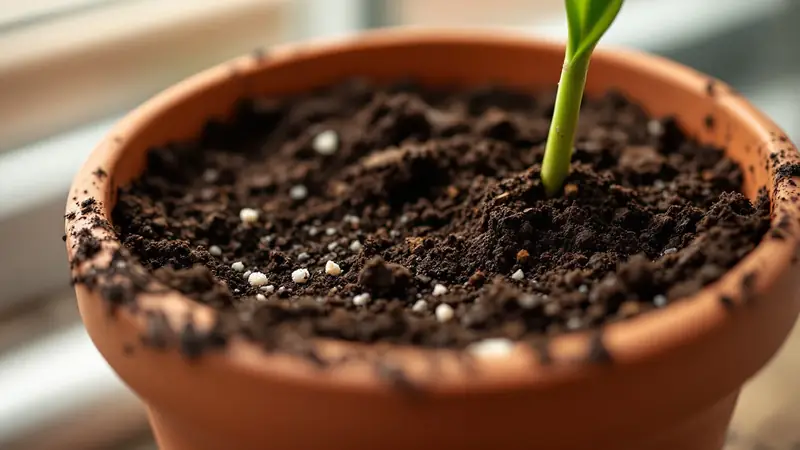
How to get rid of fungus gnats in soil: kill the larvae, not the flies. Let the top 1 to 2 inches dry, drench with Bti (Mosquito Bits, Gnatrol) or Steinernema feltiae nematodes weekly for 3 weeks, and check larvae with raw potato chunks.
Most advice on how to get rid of fungus gnats in soil ranks remedies by one person’s houseplants. This page ranks them by what published trials found: Bti cut larval survival to 8 percent against 84 percent in water in a 1985 lab test (Osborne et al., Journal of Economic Entomology), while sand and diatomaceous earth top layers did nothing in Kansas State trials. The weekly schedule further down is timed to the gnat’s 17 to 28 day generation, so the last drench lands after the last egg laid before treatment has hatched.
Gnats usually arrive in the mix. UC IPM says almost any organic mix that “becomes wet prior to use or has been stored on soil or uncovered” can be infested (UC IPM floriculture guidelines), which is why an old bag is the first suspect in whether potting soil goes bad; yard dirt in a pot stays soggy for the reasons in garden soil vs potting soil, and soggy mix is what larvae need.
Why do fungus gnats keep coming back?
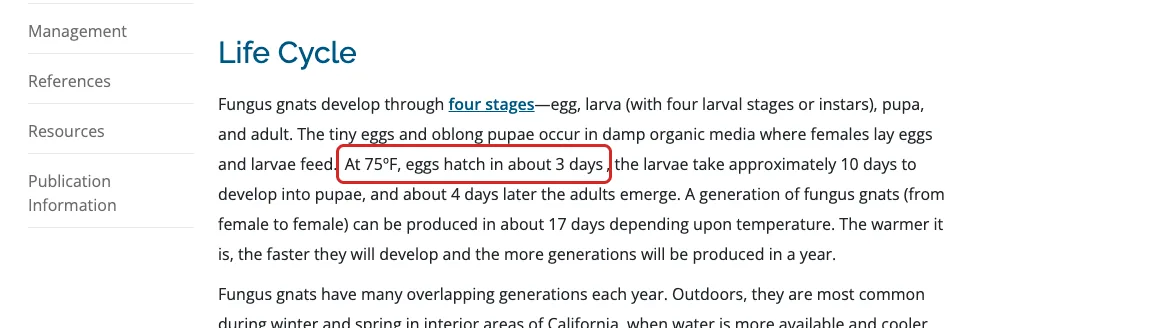
Because the flies you swat are the last 7 to 10 days of a 3 to 4 week life. At 75°F, UC IPM puts egg hatch at about 3 days, larval feeding at about 10 days and pupation at about 4 days, so a new generation appears in about 17 days (UC IPM Pest Notes 7448). Kansas State’s Raymond Cloyd gives 20 to 28 days, with each female laying 100 to 200 eggs into cracks in the mix surface (K-State MF-2937). Cold stretches it: UC IPM’s grower guidelines put a generation at 21 days at 72°F and 40 days at 61°F (UC IPM floriculture).
| Stage | UC IPM, 75°F | UConn, 72°F | K-State (Cloyd) | Where it is | What kills it |
|---|---|---|---|---|---|
| Egg | About 3 days | 4 to 6 days | 100 to 200 per female | Cracks in the top of the mix | Drying the surface (eggs fail to hatch) |
| Larva (4 instars) | About 10 days | About 14 days | Up to 0.24 in long | Top 1 to 2 in of mix | Bti, S. feltiae, predatory mites, drying |
| Pupa | About 4 days | 4 to 5 days | Not stated | In the mix | Nothing in this table reliably (S. feltiae partly) |
| Adult | Not stated | Not stated | Lives 7 to 10 days | On the mix, leaves, windows | Sticky cards, pyrethrins (temporary) |
| Egg to egg | About 17 days | 3 to 4 weeks | 20 to 28 days |
Two consequences follow from those numbers. Killing adults alone fails, because every egg and pupa already in the pot keeps maturing for up to 3 weeks. And no larvicide touches eggs or pupae, so one drench only clears the larvae present that day; Cloyd adds that Bti works better on first and second instars than on third and fourth (MF-2937, p. 3).
Which fungus gnat controls actually work?
Ranked from greenhouse trials down to no trial at all, with Nov. 17, 2026 prices. UC IPM says the larvae and pupae in the mix are the stages worth targeting, so drying the surface ranks first.
Swipe the table sideways to see every column.
| Rank | Method | Stage it hits | Time to effect | Evidence | Cost (Nov. 17, 2026) |
|---|---|---|---|---|---|
| 1 | Let the top 1 to 3 in of mix dry between waterings | Eggs, young larvae | Next watering cycle | Extension consensus; larvae survive best at 52% mix moisture, less in wet or dry mix (MF-2937) | $0 |
| 2 | Steinernema feltiae nematode drench | Larvae; some pupae | Fewer adults emerging 7 to 14 days after (Jagdale 2004) | Greenhouse trials: beat Bti and kinoprene, matched the organophosphate diazinon in poinsettias (Harris 1995) | $40 for 5 million (Arbico) |
| 3 | Bti drench (Mosquito Bits, Gnatrol WDG) | Larvae, mainly young instars | Larvae respond within 24 hours (Gnatrol label) | Mixed: 8% vs 84% survival in a lab test (Osborne 1985); no effect on 2nd and 3rd instars in another (Cloyd and Dickinson 2006) | $10.95 for 8 oz Mosquito Bits; $64.95 for 1 lb Gnatrol WDG |
| 4 | Repot in fresh pasteurized mix | All stages in the old mix | Immediate | UC IPM recommends pasteurized mix; bagged media can carry gnats (MF-2937) | Price of a bag |
| 5 | Stratiolaelaps scimitus predatory mites | Larvae (not eggs or pupae) | Weeks; best before numbers build | 55 or more mites per pot controlled sciarids on cyclamen and poinsettia (Chambers 1993); UC IPM doubts it suits single houseplants | $21 for 12,500 (Arbico) |
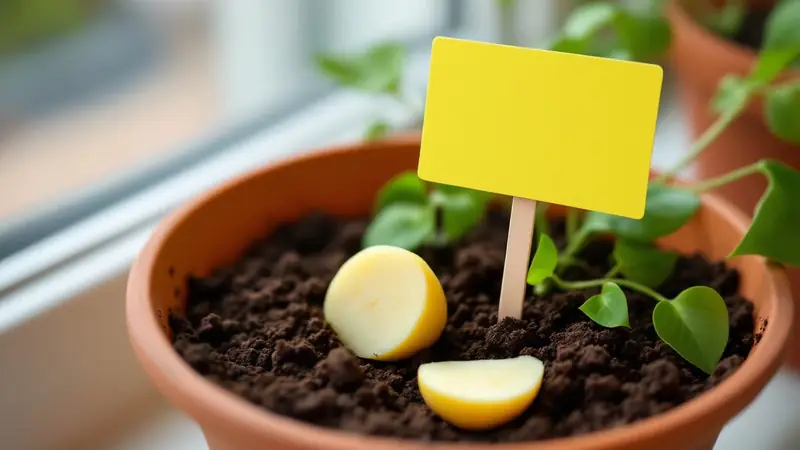
| 6 | Raw potato chunks, cut side down | Larvae (monitor and trap) | Check at 48 hours | Recovered 38% of larvae vs 23% for carrot disks (MF-2937); more reliable than sticky cards (Harris 1995) | Pennies |
| 7 | Yellow sticky cards | Adults only | Same day | Monitoring; card counts do not track larvae in the mix (MF-2937) | $5.50 for 5 cards (Arbico) |
| 8 | Pyrethrin spray on the mix surface | Adults | Fast, temporary | UC IPM: only if Bti or nematodes are unavailable; product must list house plants | Not priced |
| 9 | Coarse glass aggregate top layer | Emerging adults | Over weeks | Reduced adult emergence, depending on layer thickness (reviewed by Cloyd 2015) | Not priced |
| 10 | Hydrogen peroxide, 1 part 3% to 4 parts water | Larvae on contact (claimed) | Not measured | No controlled trial found; recommended by a Cornell county educator | Pharmacy bottle |
| 11 | Cinnamon or chamomile on the mix | Fungi the larvae eat (claimed) | Not measured | No controlled trial found | Pantry |
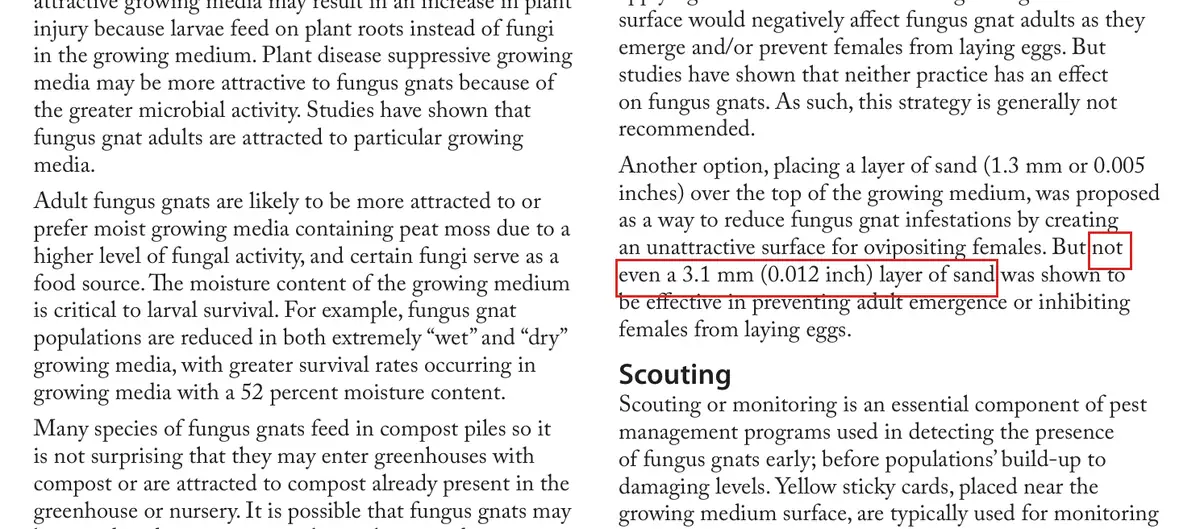
| 12 | Sand top layer | None measured | None | Tested: a 0.12 in (3.1 mm) layer did not stop emergence or egg laying (MF-2937) | Skip |
| 13 | Diatomaceous earth top layer | None measured | None | Tested: 3.1 and 6.3 mm layers, dry or moist, failed; the layer cracked (Cloyd et al. 2007) | Skip |
Nematodes rank above Bti on trial results, not convenience. In the 1995 poinsettia trial, Harris, Oetting and Gardner found S. feltiae cut larvae more than Bti did, and the 2006 lab test found Bti drenches did nothing to second and third instars (Cloyd and Dickinson). Bti still earns its place: UC IPM names Mosquito Bits and Gnatrol as the most convenient home option.
The bottom of the table corrects popular advice. A Learning with Experts home test called diatomaceous earth very effective; in controlled Kansas State trials, the layer swelled and cracked, leaving fissures where larvae pupated and females laid eggs (Cloyd et al. 2007). Sand failed the same way at 3.1 mm.
How long does it take to get rid of fungus gnats in soil?
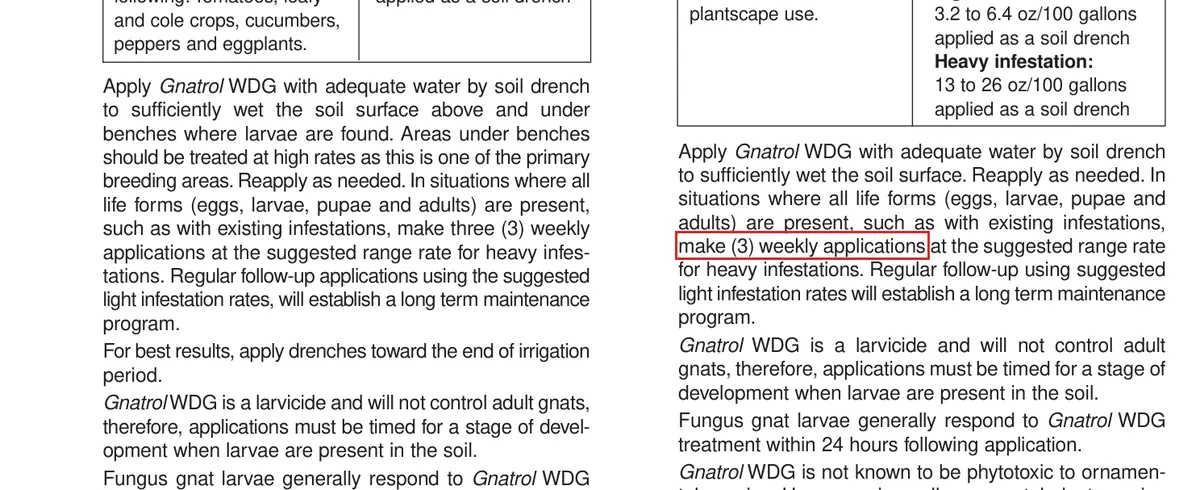
Plan on 3 to 4 weeks. Gnatrol WDG’s label calls for three weekly drenches at the heavy rate when eggs, larvae, pupae and adults are all present (Gnatrol WDG label, EPA Reg. No. 73049-56), and the current Mosquito Bits specimen label says to repeat weekly for three weeks (Summit specimen label). The table shows why that span works for a 17 to 28 day cycle.
| Day | Do this | Why this day |
|---|---|---|
| 0 | Empty saucers; set 1 raw potato chunk per pot and 1 yellow card per group of pots; first Bti or nematode drench; stop watering until the top 1 to 2 in is dry | Kills larvae present now; dry surface stops new eggs hatching |
| 2 | Lift the potato chunks; count larvae underneath; replace with fresh chunks | 48 hours recovers more larvae than 24 (MF-2937) |
| 7 | Second drench; swap and count the card | Eggs laid on day 0 hatched by day 3 to 6 and are now young larvae |
| 9 | Potato check | Should show fewer larvae than day 2 |
| 14 | Third drench; card count | Adults that emerged from day 0 pupae (4 to 5 days) laid eggs that are now larvae |
| 21 | Fourth drench only if the potato or card still shows gnats | Covers the slow end of a 28 day generation; at 61°F a generation takes 40 days (UC IPM), so keep going in a cold room |
| 28 | Stop after two potato checks in a row show 0 larvae | No larvae means no new pupae; any pupae left emerge within 4 to 5 days |
Read the count, not the calendar. Cloyd notes there is no published threshold linking card counts to larvae or to plant damage (MF-2937, p. 3), so a falling card count proves only that fewer adults are flying. Zero larvae under two rounds of potato is the stop signal.
1Do the flies have long antennae and stay near pots and the mix surface?
Yes
NoProbably not fungus gnats. Short bristle-like antennae near algae point to shore flies (UC IPM); flies at the fruit bowl or drain need a different fix.
2Do raw potato chunks show larvae after 48 hours?
Yes
NoAdults only: no larvae in this pot yet. Dry the top 1 to 2 in, set yellow cards, and check other pots, wet mulch and open bags of mix.
3Is it a seed tray, cuttings or seedlings?
YesAct now: replace or heat-treat the mix (180°F for 30 minutes) and drench with Bti or S. feltiae; larvae can carry Pythium (Braun 2012).
NoGo to the next question
4Can the plant tolerate the top 1 to 2 in drying between waterings?
YesDry the surface plus 3 weekly Bti or nematode drenches, checking with potato on days 2, 9 and 16.
NoKeep watering as the plant needs, and rely on S. feltiae or Bti drenches weekly for 3 to 4 weeks; consider repotting into fresh pasteurized mix.
Source: UC IPM Pest Notes 7448; K-State MF-2937; Braun et al. 2012
How much Bti or how many nematodes per pot?
Use the rate printed on your container; the label is the law, and two Mosquito Bits labels give different directions. The EPA-stamped 2016 label (EPA Reg. No. 6218-86) lists a sprinkle-and-water rate by pot size; the specimen label now on Summit’s site lists only the soak method.
| Product (active ingredient) | Rate on label or in trials | Repeat | Source |
|---|---|---|---|
| Mosquito Bits, granules on the surface (Bti strain SUM-6218, 2.86%) | 1 to 2 tsp per pot 6 in or smaller; 1 tbsp per larger pot; 1 tbsp (0.5 oz) per sq ft; water in | If gnats reappear within 3 weeks | EPA-accepted label, Nov. 9, 2016 |
| Mosquito Bits, soaked in water | 2 tbsp per 0.5 gal, wait 5 minutes (2016); or 4 tbsp per gal, soak 30 minutes, skim (specimen) | Weekly for 3 weeks (specimen) | 2016 label; Summit specimen |
| Gnatrol WDG (Bti, EPA Reg. No. 73049-56), indoor ornamentals | Light: 3.2 to 6.4 oz per 100 gal (0.9 to 1.8 g per gal). Heavy: 13 to 26 oz per 100 gal (3.7 to 7.4 g per gal) | 3 weekly drenches for existing infestations | Valent label, 2012 |
| Steinernema feltiae (NemAttack and others) | 125,000 to 250,000 per sq m in trials, about 11,600 to 23,200 per sq ft of mix surface | 2 applications 7 to 10 days apart (Arbico) | Jagdale 2004; Arbico |
| Stratiolaelaps scimitus | 55 or more per pot in trials; 5 to 10 per sq ft general, 30 or more heavy (Arbico) | Weekly until gnats subside (Arbico) | Chambers 1993; Arbico |
Nematode packs are sized for lawns: Arbico lists 5 million S. feltiae for 1,600 sq ft, about 3,100 per sq ft (Arbico, Nov. 17, 2026). The pot trials used 4 to 7 times that density. A 6 in pot has about 0.2 sq ft of surface, so one 5 million pack covers about 215 to 430 sq ft of mix at trial rates, or over 1,000 such pots. S. feltiae infects at 46 to 86°F (MF-2937).
- Tablespoons of granules
- 18.0
- Ounces (1 tbsp = 0.5 oz on the label)
- 9.0
- 8 oz containers to buy
- 2
- Product cost in dollars at $10.95 per 8 oz (Arbico, Nov. 17, 2026)
- 12.32
Default: 6 pots over 6 in, 3 weekly treatments = 18 tbsp (9 oz), two 8 oz containers, about $12.32 of product. Rates from the EPA-accepted Mosquito Bits label (EPA Reg. No. 6218-86, 2016); follow the label on your container.
| Pots | Size | Treatments | Mosquito Bits used | Cost at $10.95 per 8 oz |
|---|---|---|---|---|
| 6 | Over 6 in (1 tbsp each) | 3 | 18 tbsp, 9 oz (two 8 oz containers) | $12.32 |
| 10 | 6 in or smaller (2 tsp each) | 3 | 20 tbsp, 10 oz (two containers) | $13.69 |
| 3 | Over 6 in | 1 | 3 tbsp, 1.5 oz | $2.05 |
This page is general information, not pesticide advice. Read and follow the label on the product you buy; directions differ between label versions, and products labeled for house plants are the only ones to use indoors.
Does hydrogen peroxide kill fungus gnats?
It may kill larvae it touches, but we found no controlled trial of it against Bradysia in the literature indexed by Europe PMC as of November 2026. The usual recipe, 1 part 3 percent peroxide to 4 parts water, comes from extension columns such as Cornell Cooperative Extension Allegany County, not from a study, and the drugstore bottle carries no pesticide directions. Treat it as untested and keep counting larvae with potato.
Cinnamon and chamomile are in the same place: no trial found. Dryer sheets repelled adults in a lab test but killed none (Cloyd 2015), and vinegar traps catch adults only. Gnats in a room with no plants can come from wet mulch, compost or plumbing leaks, all breeding sites on UC IPM’s list, and outdoor beds are covered in whether mulch attracts bugs.
When do fungus gnat larvae actually hurt plants?
Mostly in seedlings, cuttings and young plants. UC IPM says adults do not bite or damage plants and that wilting is more often caused by overwatering or root rot than by larvae (UC IPM). Larvae can carry Pythium: one strain reached seedlings in 65 percent of petri-dish tests but under 6 percent in potting mix plug cells (Braun, Sanderson and Wraight 2012).
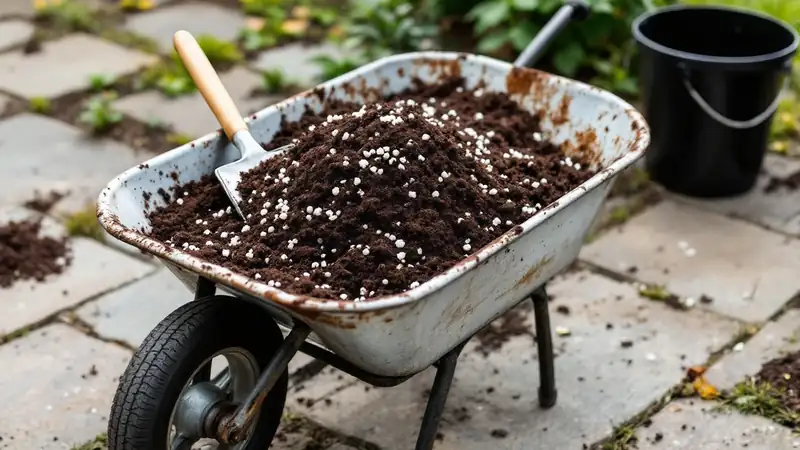
So act at the first larva under a potato chunk in a seed tray, and treat a mature pothos as a nuisance problem. For trays, start clean: heat the mix to 180°F for 30 minutes as described in how to sterilize soil, and keep the surface draining with the coarse grit covered in what perlite does for soil. Tiny white crawlers that are not larvae are more likely mites or springtails (soil mites has the key), and white fuzz on the surface is usually saprophytic mold, covered in white fungus in soil.
Prevention is drainage. Purdue’s target of 20 to 25 percent air space after watering, covered in what well-drained means for soil and pots, keeps the mix from sitting at the 52 percent moisture where Cloyd found larvae survive best. When repotting, pick a bag whose panel lists peat, coir or bark plus perlite, the check laid out in potting soil vs potting mix, and keep it sealed and off the ground.
How we compiled this
On Nov. 17, 2026 we read 21 primary documents: 5 extension publications (UC IPM home and grower pages, K-State MF-2937, UConn, Cornell Allegany County), the abstracts of 7 peer-reviewed studies, Cloyd’s 2015 review in full, 3 product labels (two Mosquito Bits versions and Gnatrol WDG) and 5 retailer price pages. We ran no gnat trials. Evidence ranks reflect study design (greenhouse or lab trial, extension advice, no trial found); prices are retail listings that day.
Frequently asked questions
Will gnats go away if soil dries out?
Partly. Cloyd (K-State MF-2937) says letting the top 1 to 3 inches dry makes the surface less attractive to egg-laying females and eggs laid there fail to hatch. Larvae deeper in the pot and pupae survive, so pair drying with Bti or nematodes for 3 weeks.
What kills fungus gnats but not plants?
Bti (Mosquito Bits, Gnatrol WDG) and Steinernema feltiae nematodes. UC IPM calls both essentially nontoxic to people, and the Gnatrol label says it is not known to be phytotoxic to ornamentals, though it advises testing a few plants first.
Can you permanently get rid of fungus gnats?
In a pot, yes, until wet organic mix brings them back. Stop when two potato checks 48 hours apart show no larvae, then keep the top 1 to 2 inches drying between waterings and store mix sealed and off the ground (UC IPM).
How long does a fungus gnat infestation last?
Without treatment it does not end: generations overlap every 17 to 28 days (UC IPM; K-State). With weekly drenches and drier mix, expect adults to fade in 3 to 4 weeks, the span the Gnatrol label sets for existing infestations.
Why do I suddenly have fungus gnats?
Usually a new bag of mix, a new plant or overwatering. UC IPM says organic mix that got wet before use or was stored uncovered can be infested, and a generation takes about 17 days at 75°F, so the swarm appears 2 to 3 weeks after the cause.
What kills fungus gnats instantly?
Nothing that ends the problem. A pyrethrin spray labeled for house plants knocks down adults fast but UC IPM calls the effect temporary; the larvae in the top 1 to 2 inches of mix keep emerging.
Sources
- UC Statewide IPM Program (Bethke and Dreistadt), Pest Notes: Fungus Gnats, Publication 7448, Current web edition. Accessed November 2026.
- UC Statewide IPM Program, Fungus Gnats, Floriculture and Ornamental Nurseries Pest Management Guidelines, Current web edition. Accessed November 2026.
- Kansas State University (R.A. Cloyd), Fungus Gnat Management in Greenhouses and Nurseries, MF-2937, September 2010. Accessed November 2026.
- UConn Extension (L. Pundt), Biological Control of Fungus Gnats, 2007, revised 2019. Accessed November 2026.
- Cloyd, R.A., Insects 6:325 to 332, Ecology of Fungus Gnats (Bradysia spp.) in Greenhouse Production Systems, 2015. Accessed November 2026.
- Osborne, Boucias and Lindquist, Journal of Economic Entomology 78:922 to 925, Activity of Bacillus thuringiensis var. israelensis on Bradysia coprophila, 1985. Accessed November 2026.
- Cloyd and Dickinson, Pest Management Science 62:171 to 177, Effect of Bti and neonicotinoid insecticides on the fungus gnat Bradysia sp. nr. coprophila, 2006. Accessed November 2026.
- Harris, Oetting and Gardner, Biological Control 5:412 to 418, Use of entomopathogenic nematodes and a new monitoring technique for control of fungus gnats, 1995. Accessed November 2026.
- Jagdale, Casey, Grewal and Lindquist, Biological Control 29:296 to 305, Application rate and timing, potting medium, and host plant effects on the efficacy of Steinernema feltiae, 2004. Accessed November 2026.
- Chambers, Wright and Lind, Biocontrol Science and Technology 3:285 to 293, Biological control of glasshouse sciarid flies with the predatory mite Hypoaspis miles, 1993. Accessed November 2026.
- Cloyd, Dickinson and Kemp, Journal of Economic Entomology 100:1353 to 1359, Effect of diatomaceous earth and Trichoderma harzianum T-22 on the fungus gnat, 2007. Accessed November 2026.
- Braun, Sanderson and Wraight, Phytopathology 102:283 to 289, Larval Bradysia impatiens potential for vectoring Pythium root rot pathogens, 2012. Accessed November 2026.
- U.S. EPA, Pesticide Product Label System, Mosquito Bits, EPA Reg. No. 6218-86, Accepted Nov. 9, 2016. Accessed November 2026.
- Summit Chemical, Mosquito Bits specimen label, Posted January 2021. Accessed November 2026.
- Valent BioSciences (via CDMS), Gnatrol WDG Biological Larvicide label, EPA Reg. No. 73049-56, 2012. Accessed November 2026.
- Cornell Cooperative Extension Allegany County (C. Acosta), A Spooky Houseplant Pest: Fungus Gnats, Undated. Accessed November 2026.
- Arbico Organics, Mosquito Bits; NemAttack S. feltiae; Stratiolaelaps scimitus; Aphid/Whitefly Yellow Sticky Traps (product pages), Prices checked Nov. 17, 2026. Accessed November 2026.
- Organic BTI, Gnatrol WDG 1 lb product page, Price checked Nov. 17, 2026. Accessed November 2026.