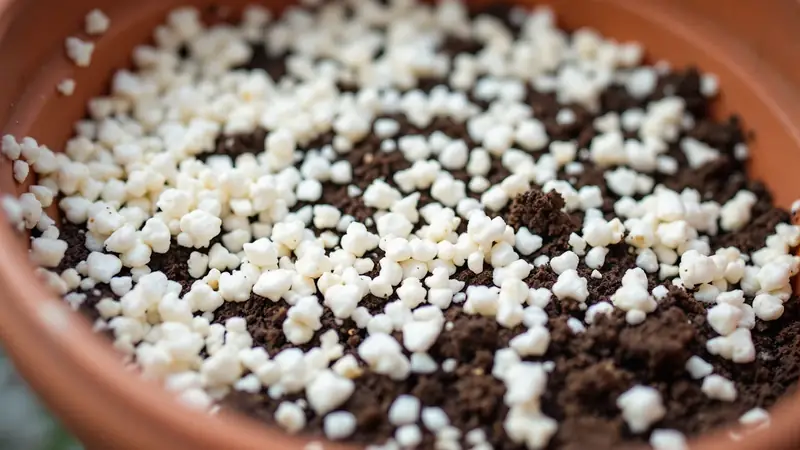
What does perlite do for soil: it opens large pores that drain and refill with air, and its rough surface holds some water. It adds no nutrients, has no cation exchange capacity and sits near neutral, pH 6.5 to 7.5.
What does perlite do for soil once you measure it: it adds air space, but less than most bag copy implies, and the grade decides how much. In a 2007 HortTechnology study, raising perlite from 20 to 60 percent of a peat mix lifted air-filled pore space only from 9.5 to 12.7 percent (Evans and Gachukia, 2007). A Perlite Institute test that blended 75 percent coarse perlite with peat reached 46.1 percent (Matkin, Perlite Institute).
Those two results sit side by side below, with the grade specs, fluoride data and dust limits that explain them. Our label comparison of potting soil vs potting mix found it on 10 of 11 container bags.
What perlite is, in measured properties
Perlite is volcanic glass. Processors grind the ore and heat it to 1,800 to 3,200°F, which makes it expand 4 to 20 times its original volume into a white, porous, sterile aggregate (Purdue Extension HO-255-W, Dec. 2015). NIOSH describes expanded perlite as an amorphous material of fused sodium potassium aluminum silicate (NIOSH Pocket Guide), so it is glass rather than crystal.
| Property | Measured value | What it means in soil or a pot | Source |
|---|---|---|---|
| pH | 6.5 to 7.5; 7.5 in a 1978 Cornell test | Will not acidify or sweeten a mix | Purdue HO-255-W; Sheldrake |
| Cation exchange capacity | None (UF/IFAS); “low” (Purdue) | Holds no fertilizer; nutrients must come from the rest of the mix | UF/IFAS EP623, rev. Oct. 2025 |
| Water held after gravity drainage | 20 to 40% by volume (coarse) to 60 to 90% (extra fine) | Fine grades hold water much like peat | Perlite Institute, 2019 |
| Air-filled pore space, perlite alone | 54% | Large pores refill with air after watering | Hanan (1998), cited in Evans and Gachukia |
| Total pore space, perlite alone | 74% (sphagnum peat: 84%) | Replacing peat with perlite lowers total pore space | Hanan (1998), cited in Evans and Gachukia |
| Dry bulk density, perlite and peat | 4.1 to 8.6 lb per cu ft | Wet peat and perlite mixes weighed 23.3 to 38.1 lb per cu ft; wet soils run over 100 | Matkin, Perlite Institute |
| Releasable fluoride | 9.1 ppm (superphosphate: 1,254 ppm) | Fertilizer, not perlite, was the larger fluoride source | Sheldrake, Cornell, 1978 data |
How much air and water does perlite add to a mix?
The cleanest dose test is the Evans and Gachukia study at the University of Arkansas. They blended Sun Gro horticultural perlite or parboiled rice hulls into sphagnum peat at 20, 30, 40, 50 and 60 percent by volume and measured each mix under the same procedure (HortTechnology 17(3): 312 to 315).
| Share of mix | Material | Total pore space | Air-filled pore space | Water-holding capacity | Bulk density (lb per cu ft) |
|---|---|---|---|---|---|
| 20% | Perlite | 79.4% | 9.5% | 67.9% | 6.74 |
| 30% | Perlite | 76.9% | 10.8% | 68.9% | 6.31 |
| 40% | Perlite | 73.9% | 11.4% | 62.6% | 6.12 |
| 50% | Perlite | 73.9% | 11.9% | 62.8% | 7.18 |
| 60% | Perlite | 71.5% | 12.7% | 59.0% | 7.55 |
| 20% | Rice hulls | 83.2% | 11.5% | 71.7% | 6.12 |
| 30% | Rice hulls | 85.5% | 20.3% | 64.9% | 6.12 |
| 40% | Rice hulls | 86.0% | 28.8% | 56.9% | 6.06 |
| 50% | Rice hulls | 86.7% | 34.0% | 53.9% | 6.49 |
| 60% | Rice hulls | 82.1% | 37.8% | 45.1% | 6.99 |
- Perlite
- Parboiled rice hulls
Source: Evans and Gachukia, HortTechnology 17(3), 2007, Table 1 X axis: share of the mix by volume; remainder sphagnum peat.
Show the numbers
| Perlite | Parboiled rice hulls | |
|---|---|---|
| 20% | 9.50 | 11.50 |
| 30% | 10.80 | 20.30 |
| 40% | 11.40 | 28.80 |
| 50% | 11.90 | 34 |
| 60% | 12.70 | 37.80 |
Read the perlite rows as a slope: the authors’ fitted line was air space = 7.94 + 0.08 x perlite percent, so every 10 points of perlite added about 0.8 point of air. Water held fell from 68.9 to 59.0 percent across the same range. So perlite does lower moisture in a peat mix, but modestly: it trades a little water for a little air, and the mix still holds water in over half its volume.
The Perlite Institute’s own tests, run in 1974 and repeated in 1977 by O.A. Matkin of a Santa Ana soil laboratory, found far more air. Air space after drainage ran from 21 percent with 75 percent fine perlite to 46.1 percent with 75 percent coarse perlite, against a container target of 15 to 25 percent (Perlite Gradation and Peat/Perlite Mixtures). The Institute is the industry’s trade association and the peat source changed between runs, so read those numbers as a ceiling for coarse perlite.
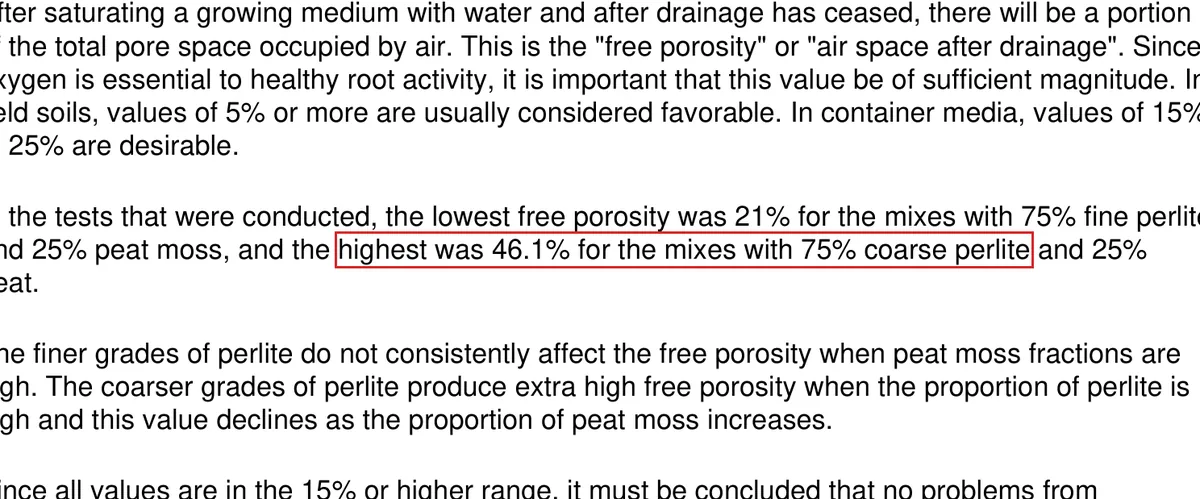
Extension targets land between the two studies. Purdue’s peat and perlite mix measured 61.4 percent porosity with 38 percent of that pore space holding air, about 23 percent of the pot (Purdue HO-287-W). Sun Gro lists 10 to 15 percent air space for propagation mixes, 15 to 25 percent for general greenhouse production and no more than 25 percent for perennial mixes (Sun Gro Horticulture). In a pot, that air space is what well-drained soil means in practice.
Fine, medium or coarse: which perlite grade does what?
Grade moves the numbers more than dose. Matkin’s report defines fine horticultural perlite as mostly smaller than 18 mesh (1 mm), in the coarse sand range, and coarse grades as larger than 1 mm and often larger than 10 mesh (2 mm), in the fine gravel range (Perlite Institute). The Institute’s 2019 sheet then puts a water-holding band on each grade (The Water-Holding Capacity of Perlite).
| Grade | Particle size | Water held after gravity drainage | Drainage rate | Institute’s suggested use |
|---|---|---|---|---|
| Coarse | Mostly over 1 mm, often over 2 mm | 20 to 40% by volume | Very fast | Clay-rich soils; propagation under frequent mist |
| Medium | Not defined in mm in these sources | 30 to 50% | Fast | Balance of air and water |
| Fine | Mostly under 1 mm | 40 to 60% | Slow | Fast-draining sandy soils |
| Extra fine | Not defined in mm in these sources | 60 to 90% | Very slow | Moisture retention |
Most retail bags do not print a grade in millimeters. Espoma’s 8 quart Organic Perlite page lists no particle size (Espoma), while bulk 4 cu ft bags are sold by name, such as FarmTek’s Horticultural Coarse Perlite (FarmTek). Sieve a handful through a kitchen strainer with about 1 mm openings: if most of it stays on top, the bag is a coarse grade by the Institute’s definition.
Does perlite help garden soil or clay?
In a pot of yard soil, a handful of perlite makes drainage worse before it makes it better. L. Art Spomer found that sand or perlite stirred into container soil lowers porosity until the amendment reaches about 10 volumes per 2.5 to 3 volumes of soil, roughly 77 to 80 percent (Journal of Arboriculture, 1980). Below that, fine soil fills the gaps between the granules. Our comparison of garden soil vs potting soil in containers shows why a bagged mix is the cheaper fix.
In beds, the volume problem grows. Espoma’s direction for heavy soil is one part soil to one part perlite (Espoma perlite directions). Applied to the top 6 inches of a 100 sq ft bed, that is 50 cu ft of perlite, or 13 bags of 4 cu ft: $428.87 at Grow Organic’s $32.99 list price on Nov. 17, 2026 (Grow Organic). Extension advice for clay is compost instead, 3 to 4 inches worked 6 to 12 inches deep, as our guide to improving clay soil sets out.
For lawns, the Perlite Institute suggests raking perlite into core aeration holes at up to 1 gallon per sq ft, built up over several seasons, and reports that a perlite layer under sod in the Middle East cut irrigation by up to half (Perlite for Lawns and Gardens). We found no extension trial behind either figure. At 1 gallon per sq ft, a 1,000 sq ft lawn needs about 134 cu ft: 34 bags, or $1,121.66 at the same list price.
1Is it yard or garden soil in a pot?
YesPerlite alone needs about 77 to 80 percent of the volume before porosity improves (Spomer, 1980). Use a bagged potting mix instead.
NoGo to the next question
2Is it a clay bed in the ground?
YesWork in 3 to 4 inches of compost, 6 to 12 inches deep. A 1 to 1 perlite blend over 100 sq ft, 6 inches deep, takes 50 cu ft of perlite.
NoGo to the next question
3Is the plant a Dracaena or spider plant in an unlimed peat mix?
YesRinse the perlite, lime the mix to pH 6.5 to 7 and use non-fluoridated water (PNW handbook; Sheldrake, 1978).
NoGo to the next question
4Are you rooting cuttings or growing succulents?
YesUse a coarse grade at 50 percent or more of the mix (Espoma 1 to 1; succulent recipes 33 to 67 percent grit).
NoGo to the next question
5Is it a seed-starting mix?
YesUse about 20 percent fine or medium perlite (Espoma: 80 percent peat, 20 percent perlite).
NoFor a potting mix that stays wet, add medium perlite at 25 to 33 percent of the volume (Espoma; Purdue HO-255-W).
Source: Spomer (1980); Espoma; Purdue HO-255-W; PNW Plant Disease Management Handbook; Sheldrake (1978)
How much perlite should you add?
Published recipes put perlite at 20 to 50 percent of a container mix, and the share follows the job: less for seed starting and moisture-loving crops, more for heavy soil and cuttings. The column at the right is the perlite for a 10 quart batch.
| Use | Recipe as printed | Perlite share | Perlite in 10 qt of mix | Source |
|---|---|---|---|---|
| Seed starting | 80% peat, 20% perlite | 20% | 2 qt | Espoma |
| Greenhouse peat mix | 3 peat : 1 perlite : 1 vermiculite | 20% | 2 qt | Purdue HO-255-W |
| Homemade potting media | 2 peat : 1 compost : 1 perlite | 25% | 2.5 qt | Espoma |
| Bedding plants, vegetables, potted flowers | 2 peat : 1 perlite | 33% | 3.3 qt | Purdue HO-255-W |
| Patio planters | 1/3 perlite, 1/3 peat, 1/3 composted bark | 33% | 3.3 qt | Perlite Institute |
| Heavy soil | 1 soil : 1 perlite | 50% | 5 qt | Espoma |
- Perlite (quarts)
- 10.0
- 8 quart bags of perlite
- 1.25
Default: 10 quarts of finished mix at 20 percent needs 2 quarts of perlite (0.25 of an 8 quart bag). The rest of the batch is the base mix; see the recipe table for the worked 10 quart example at each share.
Two neighbors cover the rest of the recipe. Succulents sit at the top of the range: 6 published mixes add 33 to 67 percent grit, compared in what soil to use for succulents. Full DIY blends belong in how to make potting soil, and the peat half of most mixes in what peat moss does for soil. To size the batch, a 5 gallon pot takes 12 to 17 dry quarts of mix, per our 5 gallon pot soil math.
What are the disadvantages of perlite?
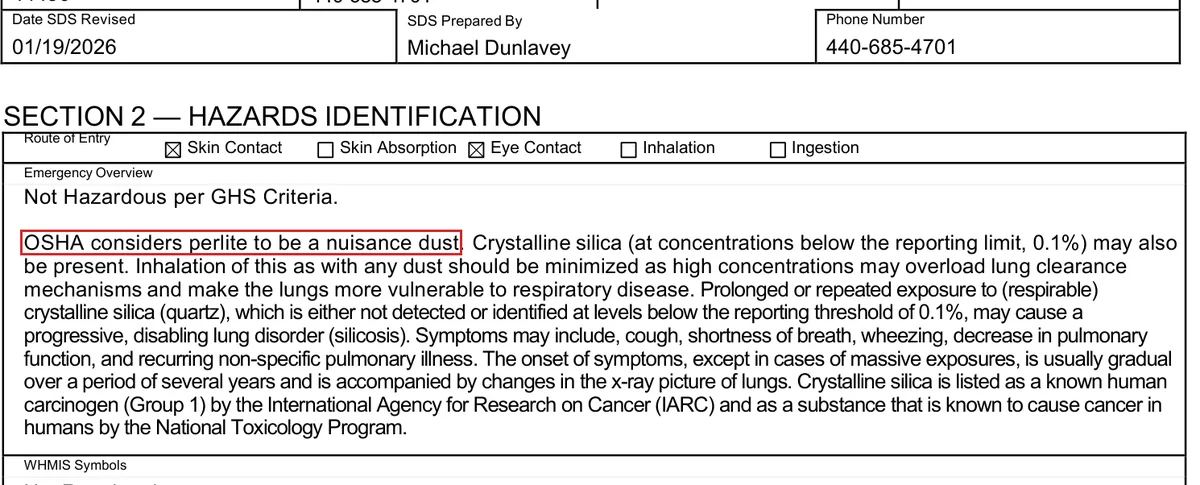
Perlite floats. Purdue notes that perlite tends to float to the top of substrates, while expanded clay pellets do not (Purdue HO-255-W). Expect white granules on the surface of top-watered pots; Purdue names expanded clay as an alternative that stays put, at a higher bulk density and cost.
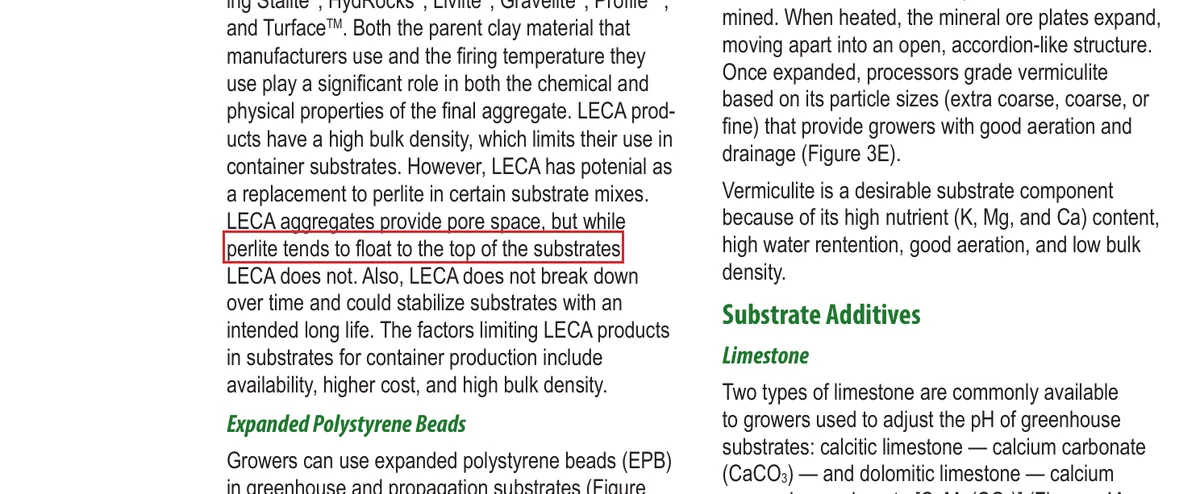
Dry perlite is dusty. NIOSH sets a recommended exposure limit of 10 mg per cubic meter total dust and 5 mg respirable over a work shift, and OSHA’s permissible limit is 15 mg total and 5 mg respirable (NIOSH Pocket Guide). PVP Industries’ safety data sheet, revised Jan. 19, 2026, says OSHA considers perlite a nuisance dust and that crystalline silica below the 0.1 percent reporting limit may be present (PVP perlite SDS). The same sheet says to use a dust suppressant such as water when sweeping; dampening perlite before you pour it and wearing a dust mask indoors follow the same logic.
Fluoride is the old complaint, and the data point at pH more than at perlite. Raymond Sheldrake’s Cornell team grew spinach in a 50 to 50 peat and perlite mix and found leaf fluoride fell from 30.8 to 5.7 ppm as dolomitic lime rose from 0 to 30 lb per cubic yard (The Concern Over Fluorides; J. Amer. Soc. Hort. Sci. 103(2), 1978).
| Dolomitic limestone (lb per cu yd) | Mix pH | Fluoride in mix solution (ppm) | Fluoride in spinach leaves (ppm) |
|---|---|---|---|
| 0 | 5.0 | 44.1 | 30.8 |
| 10 | 7.5 | 7.4 | 10.2 |
| 20 | 7.3 | 5.1 | 7.2 |
| 30 | 7.2 | 3.8 | 5.7 |
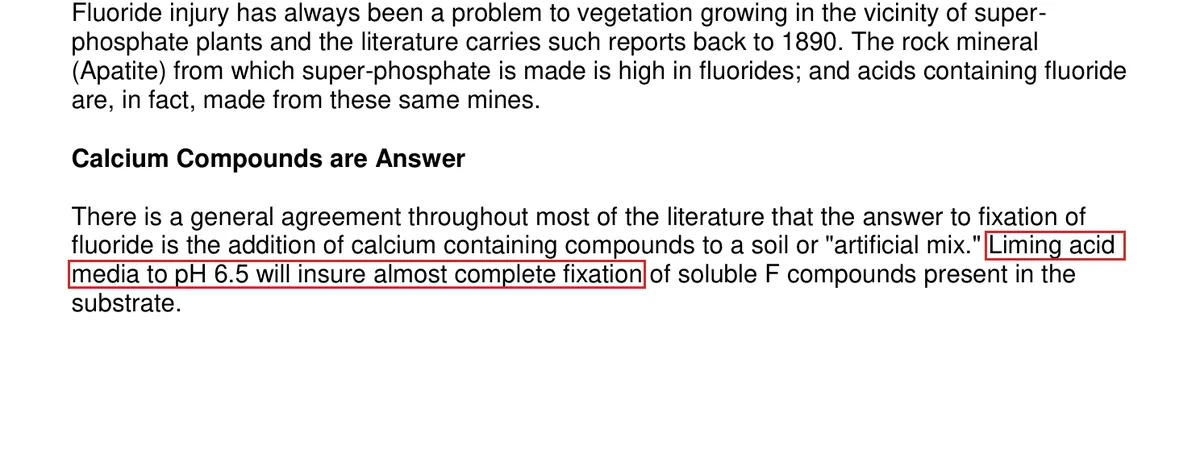
The plants that react are a short list. Oregon State’s PNW handbook names Dracaena deremensis, Dracaena fragrans (corn plant) and spider plant (Chlorophytum comosum) as fluoride sensitive, with brown leaf tips and margins; its controls are high calcium, a mix pH of 6.5 to 7, sparse fertilizer and non-fluoridated water (PNW Plant Disease Management Handbook, rev. March 2026). For those plants, rinse perlite before use and lime a peat-based mix.
Purdue also calls perlite nonrenewable, since it is mined, and lists perlite and vermiculite as two of the most expensive substrate components (Purdue HO-255-W). With no cation exchange capacity (UF/IFAS EP623), it stores no fertilizer either.
Perlite vs vermiculite, pumice and rice hulls
| Amendment | pH | Cation exchange capacity | Water and air evidence | Price per cu ft, Nov. 17, 2026 | Source |
|---|---|---|---|---|---|
| Perlite | 6.5 to 7.5 | None | 9.5 to 12.7% air at 20 to 60% of a peat mix | $8.25 (4 cu ft, $32.99); coarse $6.49 (4 cu ft, $25.95) | Evans 2007; Grow Organic; FarmTek |
| Vermiculite | 7 to 7.5 | Low (UF/IFAS); high (Purdue) | Peat plus vermiculite: 13% air, 81% water; peat plus perlite: 20% air, 73% water | $22.85 (3.5 cu ft, $79.99) | UC ANR, 2019; UF/IFAS; Grow Organic |
| Pumice | Neutral | None | Holds less water than perlite (UF/IFAS) | $16.99 (1 cu ft) | UF/IFAS; Grow Organic |
| Parboiled rice hulls | Not compiled | Not compiled | 11.5 to 37.8% air at 20 to 60% of a peat mix | $64.99 per 50 lb; volume not listed | Evans 2007; Grow Organic |
| Sphagnum peat (base, for scale) | 3.5 | Moderate | 84% total pore space | $13.66 (3 cu ft bale, $40.99) | Sheldrake; UF/IFAS; Grow Organic |
Vermiculite is the moisture choice: in UC ANR’s standardized comparison, peat plus vermiculite held 81 percent water and 13 percent air, against 73 and 20 percent for peat plus perlite (UC ANR Nursery and Flower Grower, April 2019). At Grow Organic’s list prices it also cost 2.8 times as much per cubic foot.
Rice hulls are the cheaper route to air. At 30 percent and above, Evans and Gachukia found rice hulls gave more air space than the same share of perlite, so less is needed. The Perlite Institute’s response, written by C.L. Bethke in 2007, is that flat hulls change watering and nutrient management and should be trialed first (Rice Hulls vs Perlite and Vermiculite).
How we compiled this
On Nov. 17, 2026 we read 17 primary documents: 2 Purdue Extension publications, UF/IFAS EP623, a UC ANR article, Oregon State’s PNW handbook entry, a peer-reviewed HortTechnology study, 4 Perlite Institute reports, the NIOSH Pocket Guide, 2 manufacturer pages and safety data sheets, Sun Gro’s substrate guide, Spomer (1980) and 6 retailer listings. Bulk densities, perlite shares and per cubic foot prices are our arithmetic. Perlite Institute figures are industry data and are labeled as such. We did not mix, measure or grow anything.
Frequently asked questions
What are the disadvantages of perlite?
It floats to the surface (Purdue HO-255-W), it is dusty, it is mined and nonrenewable, and it holds no nutrients because it has no cation exchange capacity. In acid, unlimed mixes it can add to fluoride injury on Dracaena and spider plants (Sheldrake, 1978).
Can you put too much perlite in soil?
Yes, mainly with coarse grades. A Perlite Institute test of 75 percent coarse perlite measured 46.1 percent air space, above the 15 to 25 percent container target, so the mix dries fast. Sun Gro caps perennial mixes at 25 percent air space.
Which plants don’t like perlite?
Fluoride-sensitive foliage plants: Dracaena deremensis, corn plant (Dracaena fragrans) and spider plant, per Oregon State’s PNW handbook. The fix is a limed mix at pH 6.5 to 7, rinsed perlite and non-fluoridated water, not avoiding perlite.
Should I add perlite to my potting soil?
Only if the mix stays wet. Most bagged mixes already contain it: 10 of 11 container bags we read list perlite. For a wet-staying mix, 1 part perlite to 2 or 3 parts mix (25 to 33 percent) matches the published recipes.
Does perlite break down in soil?
No. UF/IFAS says perlite does not break down, though handling can crush it into smaller pieces, which shifts it toward a finer, wetter grade.
Sources
- Purdue Extension (HO-255-W), Evaluating Container Substrates and Their Components, Dec. 2015. Accessed November 2026.
- Purdue Extension (HO-287-W, Krishna Nemali), Understanding the Pores of a Soilless Substrate, Current PDF. Accessed November 2026.
- Michael R. Evans and Mary M. Gachukia, HortTechnology 17(3): 312 to 315, Physical Properties of Sphagnum Peat-based Root Substrates Amended with Perlite or Parboiled Fresh Rice Hulls, 2007. Accessed November 2026.
- O.A. Matkin, Perlite Institute, Perlite Gradation and Peat/Perlite Mixtures, Tests 1974 and 1977. Accessed November 2026.
- Perlite Institute, The Water-Holding Capacity of Perlite, 2019. Accessed November 2026.
- Perlite Institute, Perlite for Lawns and Gardens, Current page. Accessed November 2026.
- Raymond Sheldrake Jr., Cornell University, via Perlite Institute, The Concern Over Fluorides, Data from J. Amer. Soc. Hort. Sci. 103(2), 1978. Accessed November 2026.
- C.L. Bethke, Perlite Institute, Rice Hulls vs Perlite and Vermiculite as a Growing Media Component, April 1, 2007. Accessed November 2026.
- UF/IFAS Extension (EP623, ENH1359), Common Media Used in Hydroponics, Revised October 2025. Accessed November 2026.
- UC ANR Nursery and Flower Grower (Steven A. Tjosvold), Soil Mixes Part 9: Properties of Common Soil Mix Components, April 3, 2019. Accessed November 2026.
- Sun Gro Horticulture, Air Porosity and Water-Holding Ability of Media Components, Current page. Accessed November 2026.
- PNW Plant Disease Management Handbook, Oregon State University, Dracaena: Tip Burn, Revised March 2026. Accessed November 2026.
- NIOSH, Pocket Guide to Chemical Hazards: Perlite, Current page. Accessed November 2026.
- PVP Industries, Perlite Safety Data Sheet, Revised Jan. 19, 2026. Accessed November 2026.
- The Espoma Company, Espoma Organic Perlite product page and directions, Checked Nov. 17, 2026. Accessed November 2026.
- L. Art Spomer, Journal of Arboriculture 6(12), Container Soil Water Relations: Production, Maintenance, and Transplanting, 1980. Accessed November 2026.
- Grow Organic (Peaceful Valley), Perlite (4 Cu Ft) listing, Price checked Nov. 17, 2026. Accessed November 2026.
- Grow Organic (Peaceful Valley), Vermiculite (3.5 Cu Ft Bag) listing, Price checked Nov. 17, 2026. Accessed November 2026.
- Grow Organic (Peaceful Valley), Uni-Gro Pumice (1 Cu Ft) listing, Price checked Nov. 17, 2026. Accessed November 2026.
- Grow Organic (Peaceful Valley), Organic Rice Hulls (50 lb Bag) listing, Price checked Nov. 17, 2026. Accessed November 2026.
- Grow Organic (Peaceful Valley), Black Gold Peat Moss (3 Cu Ft) listing, Price checked Nov. 17, 2026. Accessed November 2026.
- FarmTek, Horticultural Coarse Perlite, 4 Cubic Feet, Price checked Nov. 17, 2026. Accessed November 2026.