How to make potting soil: mix equal volumes of sphagnum peat moss and perlite or vermiculite, and add 2 oz ground limestone plus 2 to 3 oz 10-10-10 per 5 gallon bucket. Cornell’s peat-lite formula: 5 lb and 5 to 8 lb per cubic yard.
Most guides on how to make potting soil give one gardener’s favorite blend in cups and coffee cans. The recipes below are the published originals: Cornell’s 1972 Information Bulletin 43, the 1957 UC Mix tables in UC Manual 23, the John Innes formulas as the Royal Horticultural Society prints them, and current extension mixes from Penn State, UF/IFAS and Oregon State, plus Vermont Extension’s lime rate. Each one keeps its source’s units, then gets converted to the 5 gallon bucket you will actually measure with.
The second thing on this page is a dated price check. On Nov. 17, 2026 we pulled Google Shopping listings for every ingredient and for 3 national bagged mixes. Peat and perlite at Cornell’s 1 to 1 ratio came to $7.91 per cubic foot of finished mix against a $10.45 median for Miracle-Gro Potting Mix, but only once a batch passes about 11 cubic feet. The other 6 recipes landed between $9.31 and $11.54, close to the big Miracle-Gro bag; against FoxFarm Ocean Forest ($21.49) every recipe was cheaper. If you only need to fill a few pots, our table of how much soil a 5 gallon pot holds shows why one bag is often enough.
Published potting soil recipes, side by side
A part is any container you fill level and repeat: a 5 gallon bucket holds 0.67 cubic foot, or 17.2 dry quarts, and one cubic foot is 25.7 dry quarts (NIST Handbook 44, Appendix C). Cornell measured in cubic yards and bushels; 1 cubic yard is 27 cubic feet, about 22 bushels.
Swipe the table sideways to see every column.
| Recipe | Parts by volume | Lime and fertilizer, as published | Source |
|---|---|---|---|
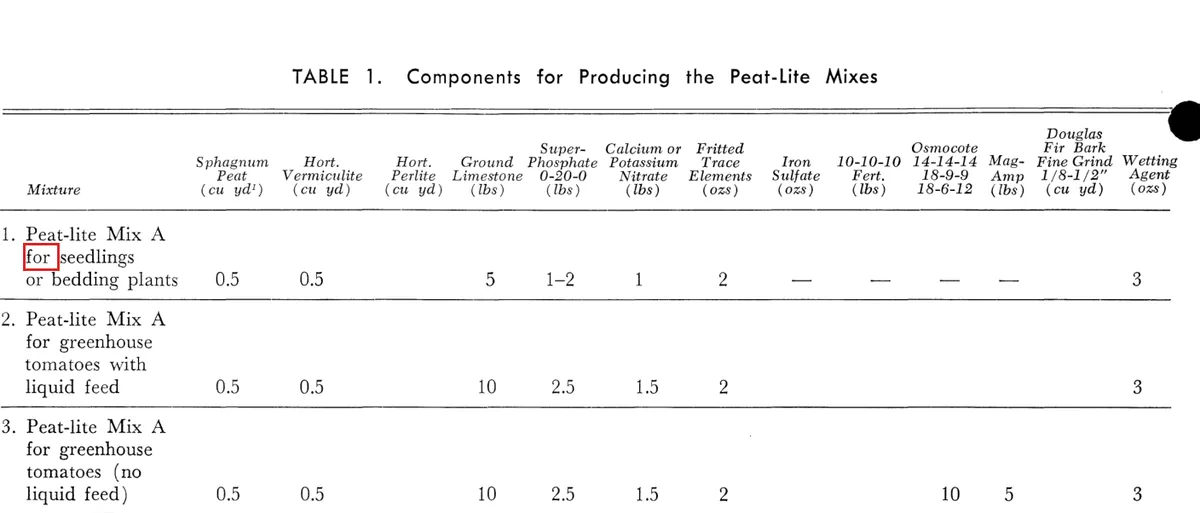
| Cornell Peat-lite Mix A, seedlings and bedding plants | 1 sphagnum peat : 1 horticultural vermiculite (No. 2, 3 or 4) | Per cu yd: 5 lb ground limestone, 1 to 2 lb superphosphate 0-20-0, 1 lb calcium or potassium nitrate, 2 oz fritted trace elements, 3 oz wetting agent | Cornell Bull. 43, Table 1, 1972 |
| Cornell Peat-lite Mix A, farm fertilizer version | 1 peat : 1 vermiculite | Per cu yd: 5 lb ground limestone, 5 lb 10-10-10 | Cornell Bull. 43, Table 1 |
| Cornell Peat-lite Mix B | 1 peat : 1 horticultural perlite | Per cu yd: 5 lb limestone, 2 lb superphosphate, 1.5 lb potassium nitrate, 2 oz trace elements, 3 oz wetting agent; or 5 lb limestone plus 8 lb 10-10-10 | Cornell Bull. 43, Table 1 |
| Cornell Peat-lite Mix A, pot plants | 1 peat : 1 vermiculite | Per cu yd: 10 lb limestone, 1 lb superphosphate, 1.5 lb nitrate, 2 oz trace elements, 5 lb Osmocote 14-14-14, 5 lb MagAmp | Cornell Bull. 43, Table 1 |
| Cornell Foliage Plant Mix | 2 peat : 1 vermiculite : 1 perlite | Per cu yd: 8 lb limestone, 2 lb superphosphate, 1 lb potassium nitrate, 0.75 oz iron sulfate, 2.5 lb 10-10-10 | Cornell Bull. 43, Table 1 |
| Cornell bulb mix (adds weight) | 1 peat : 1 vermiculite : 1 sand | Per cu yd: 5 lb ground limestone only | Cornell Bull. 43, p. 7 |
| UC Mix B, bedding plants and general nursery use | 3 fine sand : 1 peat moss | Per cu yd, Fertilizer I(B): 6 oz potassium nitrate, 4 oz potassium sulfate, 2.5 lb single superphosphate, 4.5 lb dolomite, 1.25 lb calcium carbonate lime, 1.25 lb gypsum | UC Manual 23, Table 3, 1957 |
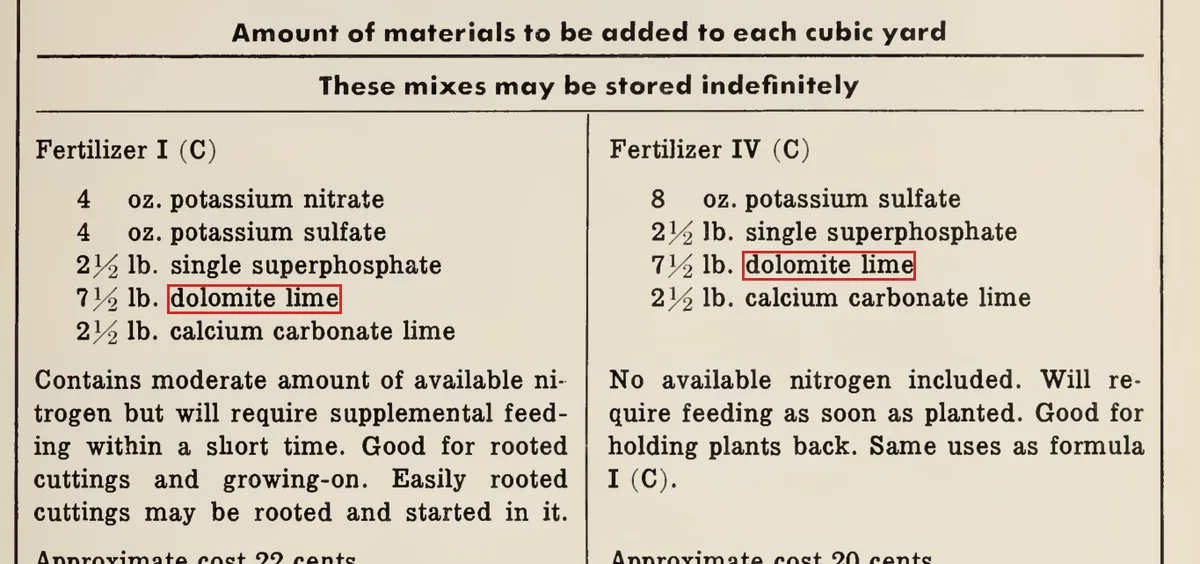
| UC Mix C, pots and benches | 1 fine sand : 1 peat moss | Per cu yd, Fertilizer I(C): 4 oz potassium nitrate, 4 oz potassium sulfate, 2.5 lb single superphosphate, 7.5 lb dolomite, 2.5 lb calcium carbonate lime | UC Manual 23, Table 4 |
| UC Mix D, large plants in small pots | 1 fine sand : 3 peat moss | Per cu yd, Fertilizer I(D): 4 oz potassium nitrate, 4 oz potassium sulfate, 2 lb single superphosphate, 5 lb dolomite, 4 lb calcium carbonate lime | UC Manual 23, Table 5 |
| Penn State standard soilless seed mix | 50 to 75% sphagnum peat, 25 to 50% vermiculite | Per cu yd: 5 lb ground or superfine dolomitic lime; blood meal, rock phosphate and greensand at 5 to 10 lb | Penn State Extension, updated Jan. 2025 |
| Penn State soilless potting mix | 1 compost : 1 vermiculite : 1 peat, screened through 1/4 in mesh | Per gallon: 0.6 oz blood meal, 0.4 oz clay phosphate, 0.4 oz greensand | Penn State Extension |
| Penn State organic potting mix | 1 sphagnum peat : 1 peat humus : 1 compost : 1 builder’s sand | Per 80 qt: 1 cup greensand, 1 cup colloidal phosphate, 1.5 to 2 cups crab or blood meal, 1/2 cup lime | Penn State Extension |
| UF/IFAS seedlings | 2 compost : 2 peat : 1 vermiculite (pre-wet) | None listed | UF/IFAS, modified Aug. 2025 |
| UF/IFAS foliage plants | 2 peat : 1 perlite : 1 coarse sand, or 1 peat : 1 pine bark : 1 coarse sand | None listed | UF/IFAS |
| UF/IFAS soil-based mix | 1 compost : 1 topsoil : 1 sand | None listed | UF/IFAS |
| UF/IFAS blocking mix | 30 qt brown peat, 20 qt sand or perlite, 20 qt compost, 10 qt soil | 3 cups base fertilizer (equal parts blood meal, colloidal phosphate, greensand), 1/2 cup lime | UF/IFAS |
| Oregon State seed-starting mix | 1 pasteurized soil or compost : 1 sand, vermiculite or perlite : 1 coir or peat | None listed | OSU Extension, Jan. 2024 |
| Oregon State container vegetables | 1 well-rotted compost : 1 loamy garden soil : 1 coarse builder’s sand | Slow-release balanced fertilizer; lime to about pH 6.5 | OSU EM 9027 |
| John Innes Seed Compost | 2 sterilized loam : 1 peat or substitute : 1 coarse sand | Per 9 L (2 gal) bucket: 10 g superphosphate, 5 g ground chalk | RHS |
| John Innes No. 1, 2 and 3 | 7 sterilized loam : 3 peat or substitute : 2 coarse sand | Per 9 L bucket: 28, 56 or 84 g John Innes Base (2 hoof and horn : 2 superphosphate : 1 sulfate of potash by weight) plus 5, 10 or 15 g ground chalk | RHS |
Three patterns run through all 20 rows. An organic base (peat, coir, bark or compost) makes up 25 to 80 percent; a mineral (perlite, vermiculite, sand or loam) is the rest; and every peat recipe that lists additives includes lime, because sphagnum peat runs about pH 4 (UVM Extension). Cornell tells first-timers to start with the first row and treat the others as variations.
Peat-free versions swap coir for peat 1 to 1, which Oregon State’s recipe allows. Coir sits near pH 6, holds up to 9 times its weight in water and can carry salt (UVM Extension), and UF/IFAS says to rinse it before use and expect it to need less potassium and more nitrogen (UF/IFAS). Cactus and succulent blends push the grit share to 33 to 67 percent; the 6 published versions are compared in our guide to the best soil for succulents.
How much lime and fertilizer per bucket?
Per-cubic-yard rates turn into small numbers per bucket. One pound per cubic yard is 0.40 oz, or 11.2 g, per 5 gallon bucket of finished mix, so Cornell’s 5 lb of limestone is 2.0 oz (56 g) per bucket. Weigh it on a kitchen scale; a heaped spoon of pelletized lime and a level spoon of powder differ too much to trust.
| Recipe | Lime, lb per cu yd of mix | Per cu ft | Per 5 gal bucket | Source |
|---|---|---|---|---|
| Penn State seed mix (50 to 75% peat) | 5 | 3.0 oz | 2.0 oz (56 g) | Penn State |
| Cornell Mix A or B, bedding plants (50% peat) | 5 | 3.0 oz | 2.0 oz (56 g) | Cornell Table 1 |
| Vermont rate at 50% peat (8.5 lb per cu yd of peat) | 4.25 | 2.5 oz | 1.7 oz (48 g) | UVM |
| UC Mix B (25% peat), plus 1.25 lb gypsum | 5.75 | 3.4 oz | 2.3 oz (65 g) | UC Table 3 |
| Cornell Epiphytic Mix (33% peat) | 7 | 4.1 oz | 2.8 oz (79 g) | Cornell Table 1 |
| Cornell Foliage Plant Mix (50% peat) | 8 | 4.7 oz | 3.2 oz (90 g) | Cornell Table 1 |
| UC Mix D (75% peat) | 9 | 5.3 oz | 3.6 oz (101 g) | UC Table 5 |
| UC Mix C (50% peat) | 10 | 5.9 oz | 4.0 oz (112 g) | UC Table 4 |
| Cornell Mix A, pot plants and tomatoes (50% peat) | 10 | 5.9 oz | 4.0 oz (112 g) | Cornell Table 1 |
The spread from 4.25 to 10 lb is a target choice, not an error. The UC tables pair 7.5 lb of dolomite with 2.5 lb of calcium carbonate lime for a 50 percent peat mix (UC Manual 23, Table 4), while Cornell uses 5 lb for seedlings and doubles it for pot plants and tomatoes. For a coir mix, start at zero: coir arrives near pH 6, and the RHS notes that peat substitutes need less chalk than peat. A soil test lab that offers a greenhouse or soilless media test reports pH and salts in the units these mixes need; Penn State’s target band is pH 5.5 to 6.5.
For fertilizer, the homeowner-friendly rows are Cornell’s farm fertilizer versions: 5 lb of 10-10-10 per cubic yard with vermiculite, 8 lb with perlite, which is 2.0 and 3.2 oz per bucket. Cornell allows 6-12-6 or 5-10-10 at the same weight but warns that ammonium sulfate based blends caused ammonium toxicity; growth was fine when nitrate supplied at least 50 percent of the nitrogen (Bulletin 43, p. 4). Cornell also found that fertilizer leaches from peat and perlite faster than from peat and vermiculite, so plants in Mix B may need more frequent feeding. With 10-10-10 or nitrate instead of a slow-release source, Cornell starts feeding 3 weeks after planting. In-ground beds are limed per 1,000 square feet from a soil test instead, as our page on raising soil pH with lime explains.
How to mix it, step by step
Cornell’s mixing directions are the most specific published, and they scale down to a tarp or wheelbarrow. A 3.8 cubic foot compressed bale fluffs to about 6 cubic feet by Premier’s dealer listing (Greenhouse Megastore) and roughly 7 by Sun Gro’s bale-to-bag fill chart; a 5 kg coir brick expands to about 2.25 cubic feet (Urban Worm).
- Break up and moisten the peat first. Cornell adds 1 gallon of warm water for every 2 bushels (2.5 cu ft) of dry, medium-grade peat to cut dust and speed wetting; a few drops of a non-ionic wetting agent help, at Cornell’s 3 oz per cubic yard. Soak coir bricks until they flake apart.
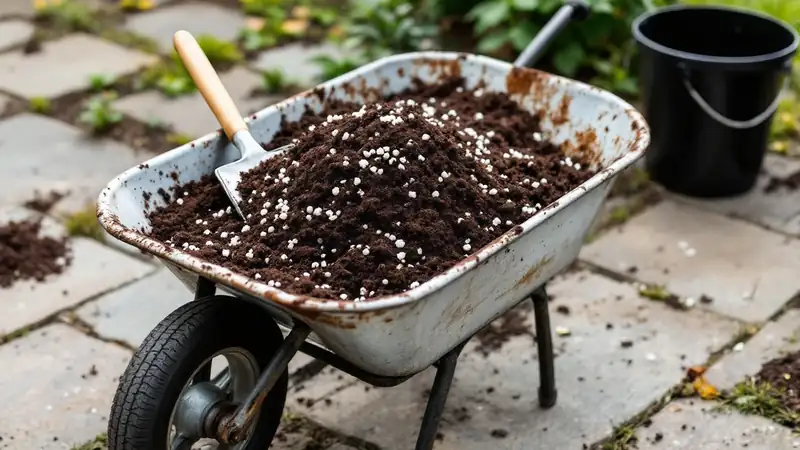
- Measure the parts by volume into a wheelbarrow, mortar tub or onto a tarp. Fill each bucket level without tamping.
- Spread the pile flat and sprinkle the lime and fertilizer evenly over the whole surface, about 2.0 oz of each per bucket of mix at the 5 lb rate.
- Turn the pile about 5 times with a scoop or shovel after everything is in, per Cornell; in a concrete mixer, 3 to 5 minutes is enough.
- At planting, Cornell’s order is: fill the containers, firm the medium at the edges, wet it thoroughly if it is dry, transplant, then water again.
- Plan on shrinkage. Cornell says 15 to 20 percent of the volume disappears in mixing and uses 26 bushels of ingredients for a 22 bushel cubic yard, so mix about 18 percent more than the pots need.
Storage depends on what you added. Cornell says the basic peat-lite mixes keep indefinitely in covered plastic cans or bags, but mixes holding Osmocote should not be stored longer than 7 to 10 days unless kept at 40°F or below. The UC tables split the same way: mineral-fertilizer mixes store indefinitely, while those with hoof and horn or blood meal should be planted within 1 week (UC Manual 23, Tables 3 to 5). Compost and blood meal blends go the other direction: Vermont Extension advises moistening them and holding them warm for 1 to 2 weeks before planting so ammonia and organic acids dissipate (UVM).
- Loose ingredients to measure, with 18% shrink (cu ft)
- 5.9
- Same in level 5 gallon buckets
- 9
- Finished mix in dry quarts
- 129
- Ground limestone at Cornell's 5 lb per cu yd, peat recipes (oz)
- 14.8
- 10-10-10 at Cornell's 8 lb per cu yd, Mix B (oz)
- 23.7
Split the loose volume by the recipe's parts. Cost uses 25th to 75th percentile Google Shopping prices captured Nov. 17, 2026, lime included, fertilizer and leftover packages excluded. Default: 5 cu ft of Mix B needs 5.9 cu ft of ingredients (2.95 each of peat and perlite) and 14.8 oz lime.
The calculator takes finished volume and adds Cornell’s 18 percent shrink to give the loose ingredients to measure. The default 5 cubic feet of Mix B needs 5.9 cubic feet of ingredients, 8.8 buckets, split evenly between peat and perlite, plus 14.8 oz of lime. The dollar range uses the 25th to 75th percentile listing prices below and charges only for the volume you use, not for leftover bags.
Is it cheaper to make your own potting soil?
Per cubic foot, yes against premium and small bags, and only narrowly against a big bag of Miracle-Gro. The table prices each recipe at the median Google Shopping listing for every ingredient on Nov. 17, 2026, adds lime where the recipe calls for it, and applies Cornell’s 18 percent shrink. Fertilizer is left out on both sides: bagged mixes include a starter charge, so a fair DIY total adds the cost of your fertilizer at Cornell’s 5 to 8 lb of 10-10-10 per cubic yard.
| Ingredient | Package | Listings | Range | Median | Median, usable volume |
|---|---|---|---|---|---|
| Peat | 3.8 cu ft compressed bale | 24 | $19.95 to $73.89 | $34.00 | $5.23 per cu ft |
| Perlite | 4 cu ft bag | 16 | $21.90 to $55.00 | $32.32 | $8.08 per cu ft |
| Vermiculite | 4 cu ft bag | 27 | $38.95 to $108.00 | $56.92 | $14.23 per cu ft |
| Coir | 5 kg (11 lb) brick | 21 | $9.99 to $44.99 | $21.38 | $9.50 per cu ft |
| Compost | 1 cu ft bag | 11 | $3.99 to $17.00 | $8.99 | $8.99 per cu ft |
| Sand | 0.5 cu ft bag | 9 | $4.99 to $9.99 | $6.49 | $12.98 per cu ft |
| Lime | 40 lb bag | 13 | $5.59 to $11.69 | $7.99 | $0.20 per lb |
| Mix | Parts or sizes | Median per cu ft | Range | Per dry qt |
|---|---|---|---|---|
| Cornell Peat-lite Mix A | peat 1, vermiculite 1 | $11.54 | $9.40 to $12.54 | 45¢ |
| Cornell Peat-lite Mix B | peat 1, perlite 1 | $7.91 | $6.46 to $9.85 | 31¢ |
| Penn State soilless potting mix | compost 1, vermiculite 1, peat 1 | $11.21 | $8.59 to $13.44 | 44¢ |
| UF/IFAS seedling mix | compost 2, peat 2, vermiculite 1 | $10.09 | $7.58 to $12.52 | 39¢ |
| UF/IFAS foliage mix | peat 2, perlite 1, sand 1 | $9.31 | $7.59 to $11.05 | 36¢ |
| Oregon State seed mix, compost version | compost 1, perlite 1, coir 1 | $10.47 | $7.51 to $14.11 | 41¢ |
| Coir and perlite, 1 to 1 | coir 1, perlite 1 | $10.39 | $7.74 to $13.50 | 40¢ |
| Miracle-Gro Potting Mix, bagged | 6 listings, 2 cu ft, 25 qt, 50 qt | $10.45 | $4.25 to $11.85 | 41¢ |
| FoxFarm Ocean Forest, bagged | 10 listings, 1.5 cu ft | $21.49 | $11.33 to $27.96 | 84¢ |
| Espoma Organic Potting Mix, bagged | 6 listings, 16 qt, 2 cu ft, 4 qt, 8 qt | $40.55 | $9.97 to $98.23 | 158¢ |
Vermiculite is what makes Cornell’s original Mix A the priciest recipe at $11.54 per cubic foot: a 4 cubic foot bag had a median of $56.92, against $32.32 for perlite. Coir and perlite at $10.39 cost about the same as the Miracle-Gro bag. Bag size moves the bagged price as much as brand, and what is inside each bag is read panel by panel in our comparison of potting soil vs potting mix: Espoma’s 4 and 8 quart bags ran $98.23 and $38.54 per cubic foot, its 2 cubic foot bag $9.97.
Cash is the other catch. Peat, perlite and coir come in fixed packages, so a small batch means buying a full bale and bag and storing the rest. Buying whole packages at the median prices, Mix B only beats the Miracle-Gro median per cubic foot from about 11 cubic feet up.
| Finished mix | Mix B: cash for whole packages | Mix B per cu ft made | Coir and perlite: cash | Per cu ft made | Miracle-Gro at median | FoxFarm at median |
|---|---|---|---|---|---|---|
| 1 cu ft | $74.30 | $74.30 | $53.70 | $53.70 | $10.45 | $21.49 |
| 5 cu ft | $74.30 | $14.86 | $75.08 | $15.02 | $52.24 | $107.43 |
| 20 cu ft | $172.94 | $8.65 | $225.24 | $11.26 | $208.95 | $429.73 |
So the cheap route is volume or reuse. A 20 cubic foot batch, enough for about 30 five gallon buckets, brought Mix B to $8.65 per cubic foot. Leftover peat and perlite also serve as amendments, which is the job covered in our sibling pages on what peat moss does for soil and what perlite does for soil.
Can you use garden soil or compost instead?
Not straight. Colorado State Extension says not to use native soil in containers even if you pasteurize it, because clay particles compact and cut the oxygen reaching roots (CSU Extension). The reason is the perched water table: a pot’s shallow column stays saturated at the bottom, and fine soil makes that wet layer thicker, as our comparison of garden soil vs potting soil measures.
Soil-based recipes do exist, and they cap the soil. UF/IFAS uses 1 part topsoil in 3; Oregon State uses 1 part loamy garden soil in 3 for vegetables (EM 9027); John Innes No. 1 is 7 parts loam in 12, about 58 percent, but specifies sterilized medium loam and coarse sand. The RHS sterilizes loam by heating moist, sieved soil 3 inches deep at 160 to 175°F for 10 minutes; our sibling page on how to sterilize soil compares oven and solarization settings. If you want weight to stop a pot tipping, Colorado State’s limit is clean, coarse sand up to 10 percent of the container volume.
Compost works as a part, not the whole. Vermont Extension puts organic mixes at 20 to 50 percent compost by volume and says compost alone holds water poorly and can run high in soluble salts (UVM). Use finished compost only; Penn State says a sour or putrid smell means it should heat again before it goes in a mix, and that compost mixes can be high in salts, so a lettuce or cress germination check of 25 seeds over 5 to 7 days is worth running before you sow a full flat. Compost-rich mixes that stay wet also feed the larvae described in how to get rid of fungus gnats.
Which recipe for seeds, houseplants and vegetables?
Match the recipe to the container and the plant’s time in it. Seeds want fine, low-fertility mix; Cornell says seedling flats in Mix A need no extra feeding, and UF/IFAS specifies medium vermiculite for seedlings and coarse for older plants. Long-term containers and top-heavy plants want the heavier UC Mix C, a sand row or a soil-based John Innes compost.
1Starting seeds or rooting cuttings?
YesCornell Peat-lite Mix A: 1 peat to 1 fine vermiculite, 2 oz limestone per 5 gal bucket, little or no fertilizer. Cornell says seedling flats need no extra feeding.
NoGo to the next question
2Want a peat-free mix?
YesRinse coir, then 1 coir to 1 perlite; skip most of the lime (coir is near pH 6, UVM) and plan to feed nitrogen sooner (UF/IFAS).
NoGo to the next question
3Growing cactus or succulents?
YesAdd 33 to 67 percent grit; see the 6 recipes on our best soil for succulents page. UF/IFAS lists 2 soil, 1 peat, 1 perlite, 1 coarse sand.
NoGo to the next question
4Is the plant top-heavy or the pot likely to tip?
YesAdd weight: Cornell's 1 peat, 1 vermiculite, 1 sand, or UC Mix C (half fine sand, half peat). CSU caps added sand at 10 percent of pot volume in soilless mix.
NoGo to the next question
5Have finished compost and want an organic mix?
YesPenn State: 1 compost, 1 vermiculite, 1 peat, with 3 oz blood meal, 2 oz clay phosphate and 2 oz greensand per 5 gal bucket. Hold it moist 1 to 2 weeks before planting (UVM).
NoGeneral containers: Cornell Peat-lite Mix B, 1 peat to 1 perlite, with 2 oz limestone and 3.2 oz 10-10-10 per 5 gal bucket (5 and 8 lb per cu yd).
Source: Cornell Bull. 43 (1972); UF/IFAS; Penn State Extension; UVM; Colorado State Extension
How we compiled this
We read 9 primary documents: Cornell Information Bulletin 43 (1972), UC Manual 23 Tables 3 to 5 (1957), and current pages from Penn State, UF/IFAS, Oregon State (2), Colorado State, UVM and the RHS. Per-bucket rates are our arithmetic using NIST unit tables. Prices are 143 Google Shopping listings captured Nov. 17, 2026; listings change daily and local garden centers may differ. We did not mix, grow in or test any recipe.
Frequently asked questions
How can I make my own potting soil?
Mix 1 part sphagnum peat moss or coir with 1 part perlite or vermiculite. For peat, add about 2.0 oz of ground limestone and 2.0 to 3.2 oz of 10-10-10 per 5 gallon bucket, Cornell’s 5 to 8 lb per cubic yard. Moisten the peat first and turn the pile 5 times.
Can I turn in ground soil into potting soil?
Only as a minority part. UF/IFAS and Oregon State use 1 part soil in 3 with compost and coarse sand; John Innes uses sterilized loam. Colorado State advises against native soil in containers even after pasteurizing because clay compacts.
Is it cheaper to make my own potting soil?
Against premium bags, yes: recipes ran $7.91 to $11.54 per cubic foot versus a $21.49 median for FoxFarm Ocean Forest (Nov. 17, 2026). Against Miracle-Gro’s $10.45, only peat and perlite wins, and only above about 11 cubic feet.
What are the best ingredients for potting soil?
Every published recipe we compiled uses a water-holding base (sphagnum peat, coir, pine bark or compost) at 25 to 80 percent, an air-holding mineral (perlite, vermiculite or coarse sand) for the rest, plus limestone when the base is peat.
What’s the cheapest way to make potting soil?
Peat and perlite 1 to 1 bought by the bale, about $7.91 per cubic foot at median Nov. 2026 prices. Finished home compost substituted for part of the peat costs nothing but adds salt and nutrient variability; Vermont Extension caps it at 20 to 50 percent.
Sources
- Boodley, J.W. and Sheldrake, R. Jr., Cornell University, Cornell Peat-Lite Mixes for Commercial Plant Growing, Information Bulletin 43, Tables 1 and 3, pp. 3 to 7, July 1972. Accessed November 2026.
- Cornell eCommons, Catalog record for Information Bulletin 43, 1972. Accessed November 2026.
- Baker, K.F. (ed.), University of California, The U.C. System for Producing Healthy Container-Grown Plants, Manual 23, Tables 3 to 5, 1957. Accessed November 2026.
- Penn State Extension (Tianna DuPont), Potting Media and Plant Propagation, Updated Jan. 14, 2025. Accessed November 2026.
- UF/IFAS Extension, Solutions for Your Life, Homemade Potting Mix, Modified Aug. 7, 2025. Accessed November 2026.
- University of Vermont Extension (Vern Grubinger), Potting Mixes for Organic Growers, Current page. Accessed November 2026.
- Oregon State University Extension, Make your own seed-starting mix for winter prep, Published Jan. 2024, reviewed 2025. Accessed November 2026.
- Oregon State University Extension, Growing Your Own, EM 9027, Current page. Accessed November 2026.
- Colorado State University Extension, Container Gardens, Current page. Accessed November 2026.
- Royal Horticultural Society, John Innes potting compost, Current page. Accessed November 2026.
- National Institute of Standards and Technology, NIST Handbook 44 (2026), Appendix C: General Tables of Units of Measurement, 2026. Accessed November 2026.
- Sun Gro Horticulture, Conversion tables: what one bale or bag fills, 2013. Accessed November 2026.
- Greenhouse Megastore, Premier Sphagnum Peat Moss product listing (bale expansion), Checked Nov. 17, 2026. Accessed November 2026.
- Urban Worm Company, Urban Worm Coco Coir 5 kg product page (brick expansion), Checked Nov. 17, 2026. Accessed November 2026.
- Google Shopping listings via the Serper API, captured Nov. 17, 2026; every listing used is in the dataset (CSV). Accessed November 2026.