How to sterilize soil at home: moisten it, then heat it until the coolest spot holds 140°F for 30 minutes to kill most pathogens, or 160 to 180°F for weed seeds and insects. Stop at 180°F; hotter soil can release toxic manganese and ammonium.
The first thing to know about how to sterilize soil is that you should not quite do it. Penn State Extension calls 180°F for 30 minutes pasteurization and says soil only counts as sterile above 212°F (Penn State fact sheet, 2003). Pasteurizing kills damping-off fungi such as Pythium, Rhizoctonia and Fusarium; sterilizing also kills the helpful microbes.
Every method below is judged against Figure 70 of Kenneth Baker’s 1957 UC System for Producing Healthy Container-Grown Plants, Manual 23, the chart most guides quote without naming, plus the time side the top results skip: for weed seed, 140°F needs 3 hours to do what 158°F does in 30 minutes. If the soil is last season’s bag, start with whether old potting soil has gone bad; if it is yard dirt bound for a pot, the drainage problem is in garden soil vs potting soil.
What temperature kills what in soil?
For moist soil held 30 minutes, water molds and nematodes die around 120°F; most pathogenic fungi, bacteria and soil insects fall between 140 and 160°F; most weed seeds need 160 to 175°F; a few resistant weed seeds and plant viruses survive to about 212°F. Baker’s own recommendation for a moving soil mass is 180°F for 30 minutes.
| Moist soil, held 30 minutes | What dies | Source |
|---|---|---|
| About 115 to 120°F | Water molds (Pythium, Phytophthora) | Baker 1957, Fig. 70 |
| 120°F | Nematodes | Baker 1957, Fig. 70 |
| About 122 to 125°F | Sclerotium rolfsii, Sclerotinia sclerotiorum, Rhizoctonia solani | Baker 1957, Fig. 70 |
| 130°F | Botrytis gray mold | Baker 1957, Fig. 70 |
| About 135°F | Fusarium (gladiolus yellows); worms, slugs, centipedes | Baker 1957, Fig. 70 |
| 140°F | Most plant pathogenic bacteria; Phytophthora and other water molds and most pathogenic fungi | Baker 1957; Phytosphere Research, 2021 |
| 140 to 160°F | Most plant pathogenic fungi, soil insects, most plant viruses | Baker 1957, Fig. 70 |
| 160°F | All plant pathogenic bacteria | Baker 1957, Fig. 70 |
| 160 to 175°F | Most weed seeds | Baker 1957, Fig. 70 |
| 180°F | Baker’s working target: pathogens, weeds and insects | Baker 1957, p. 127 |
| About 200 to 212°F | A few resistant weed seeds, resistant plant viruses | Baker 1957, Fig. 70 |
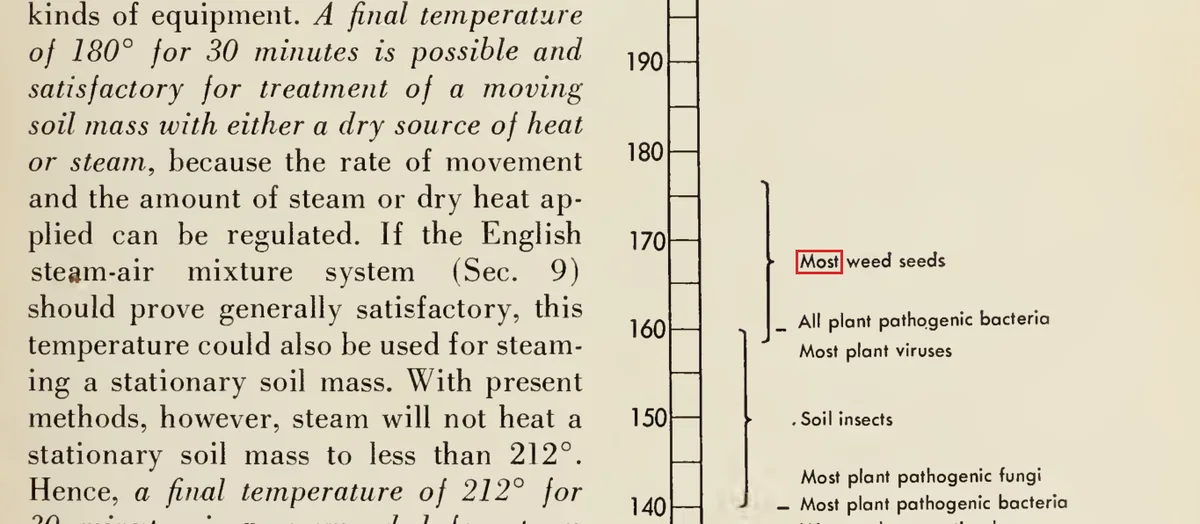
Some guides credit these steps (145, 160, 180 and 212°F) to Colorado State University; we traced them to Baker’s chart, which Phytosphere Research reproduces with the 1957 citation (Phytosphere, Heat treatment of soil for plant propagation). Read your target off the pest you have: damping-off needs 140°F, a weedy yard soil needs the full 180°F.
How long does soil need to stay hot?
Thirty minutes is the standard only at the target temperature, and the clock starts when the coolest spot gets there. Below the target, time stretches fast. In the Ushiki, Kawana and Morita 2007 trial, barnyardgrass, bulrush and weedy rice seed lost germination after 30 minutes at 158°F (70°C) but needed 180 minutes at 140°F (60°C).
| Target | Temperature | Time to kill | Source |
|---|---|---|---|
| Phytophthora, water molds, most fungi | 140°F | 30 min (60 min if unsure the probe is at the coolest spot) | Phytosphere Q1 |
| Same, with margin | 158°F | 30 min | Phytosphere Q1 |
| All soil pests in bagged soil | 158°F or higher | 30 min | UC IPM Pest Notes 74145 |
| All soil pests in black bags in sun | Over 160°F | Within 1 hour | UC IPM Pest Notes 74145 |
| Weed seed (3 rice-paddy weeds) | 158°F (70°C) | Over 30 min | Ushiki 2007 |
| Weed seed (3 rice-paddy weeds) | 140°F (60°C) | Over 180 min | Ushiki 2007 |
| Root-knot nematode juveniles | 111 to 113°F (44 to 45°C) | Within 1 hour | UF/IFAS ENY-902 |
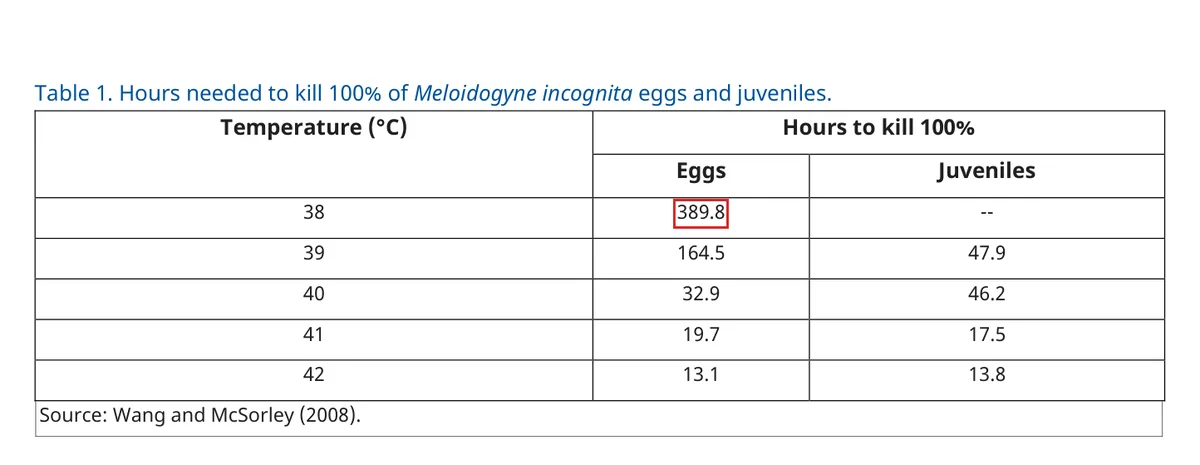
| Root-knot nematode eggs | 107.6°F (42°C) | 13.1 hours | UF/IFAS ENY-902, Table 1 |
| Root-knot nematode eggs | 104°F (40°C) | 32.9 hours | UF/IFAS ENY-902, Table 1 |
| Root-knot nematode eggs | 100.4°F (38°C) | 389.8 hours | UF/IFAS ENY-902, Table 1 |
Source: Wang and McSorley (2008), Meloidogyne incognita, as tabulated in UF/IFAS ENY-902 Table 1 (revised May 2025). °C converted to °F Juveniles: 47.9, 46.2, 17.5 and 13.8 hours at 102.2 to 107.6°F; killed within 1 hour at 111 to 113°F.
Show the numbers
| Eggs | |
|---|---|
| 100.4°F | 389.80 |
| 102.2°F | 164.50 |
| 104.0°F | 32.90 |
| 105.8°F | 19.70 |
| 107.6°F | 13.10 |
The nematode curve explains solarization. Four degrees, from 100.4 to 104°F, cuts the exposure needed for egg kill from 389.8 hours to 32.9, so a tarp that runs a few degrees hotter finishes weeks sooner (UF/IFAS ENY-902, revised May 2025).
Which method should you use? Six home methods compared
Batch size decides most of it: an oven or microwave handles a few quarts for seed starting, and anything past a couple of bags goes to the sun. A boiling-water pour gives no way to confirm a 30-minute hold.
| Method | Target and time | Batch size | Kills | Drawbacks | Source |
|---|---|---|---|---|---|
| Oven, covered pan | Oven 180 to 200°F; hold 30 min after soil center reads 180°F | Soil up to 4 in deep per pan | Fungi, bacteria, insects, most weed seeds | Earthy smell lingers in the oven; a few quarts per load | NDSU PP-744; Penn State |
| Oven, open tray, stirred | 200°F for 20 min, stir every 5 min | Thin layer in a tray | Disease organisms and weeds (UF/IFAS) | Shallow layer only; no hold time stated | UF/IFAS |
| Microwave | 2 lb moist soil, 2.5 min at about 650 W; UC Master Gardeners aim for about 200°F | About 2 lb per load | Fungi in moist soil (Minnesota trial) | Uneven heating; dry soil heats poorly; 200°F overshoots the 180°F limit | NDSU PP-744; UC ANR |
| Steam: covered pan over boiling water, or pressure cooker | 212°F at the pan; about 240°F at 10 psi | Jars or pans 4 in deep or less | Everything Baker lists, including resistant seeds | Overshoots 180°F: age compost-rich mixes before use | Baker 1957; MSU Soil Steaming 101 |
| Solarization in bags or pots | Over 160°F inside black bags in warm areas; 158°F for 30 min | Any amount you can bag and set on pallets | Fungi, bacteria, nematodes, weed seeds | Needs summer sun; check with a soil thermometer | UC IPM |
| Solarization in the ground | 108 to 140°F at 2 in; 90 to 99°F at 18 in; 4 to 6 weeks | Whole beds | Many fungi, bacteria, nematodes, annual weeds | Weak on nutsedge and deep perennials; top 6 in only | UC IPM |
| Boiling-water drench | Japanese trial: 2.9 gal per sq ft at about 194°F, under film, held 140°F+ for 150 min at 2.4 in | Small spots | Weed seed near the surface | Pours cool fast; cannot confirm a 30 min hold | Ushiki 2007 |
| Chemical fumigants | Label rates only | Fields | Nematodes, fungi, bacteria, insects, weeds | Certified applicators, buffer zones; methyl bromide phased out Jan. 1, 2005 | EPA; EPA |
1Is it a fresh, unopened bag of soilless seed-starting mix?
YesSkip heating. UConn says soilless mixes are usually sterilized already; heat would only add the manganese and ammonium risk.
NoGo to the next question
2Is it under about 2 lb (a few quarts) and you own a probe thermometer?
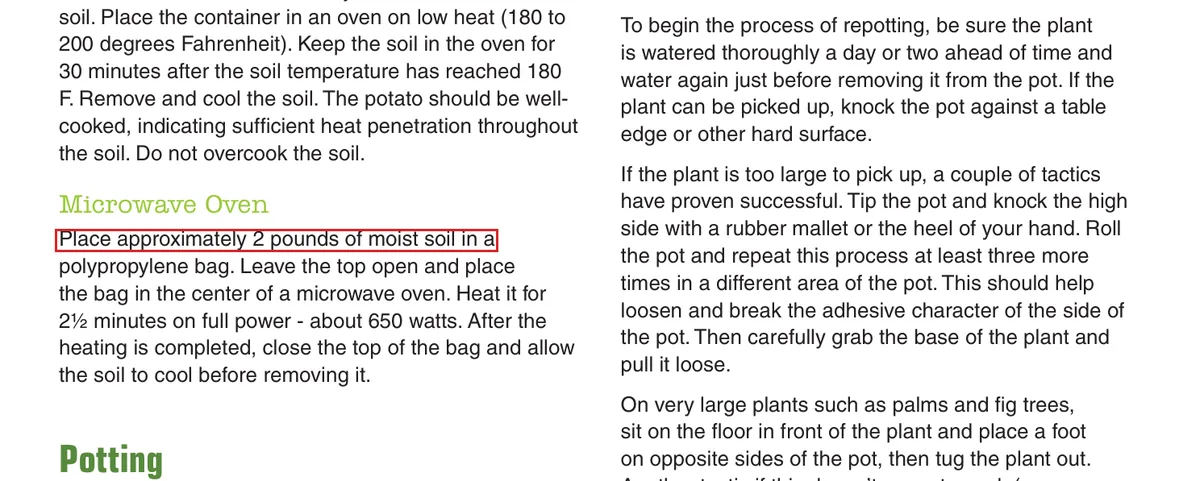
YesMicrowave: 2 lb moist soil in an open polypropylene bag, about 2.5 min at 650 W (NDSU), more at lower power, until it reads 160 to 180°F.
NoGo to the next question
3Is it under one 25 quart bag?
YesOven: pans no deeper than 4 in, 180 to 200°F oven, hold 30 min after the center reads 180°F (NDSU, Penn State).
NoGo to the next question
4Is it June to early September with full sun where you are?
YesSolarize: moist soil in black bags on pallets under a double clear tent until the center holds 158°F for 30 min; beds take 4 to 6 weeks under clear film (UC IPM).
NoBuy fresh soilless mix now, or store the soil dry and solarize it next summer. Chemical fumigants are for certified applicators only (EPA).
Source: NDSU PP-744; Penn State; UC IPM Pest Notes 74145; UConn; EPA
How to sterilize soil in the oven
The oven is the only kitchen method with an extension protocol that times the hold. This sequence combines NDSU Extension PP-744 and Penn State:
- Screen out sticks and clods and moisten the soil until a squeezed handful holds together without dripping; moist heat kills at lower temperatures than dry heat (Phytosphere Q1).
- Spread it level in a glass, aluminum or iron pan, no more than 4 inches deep.
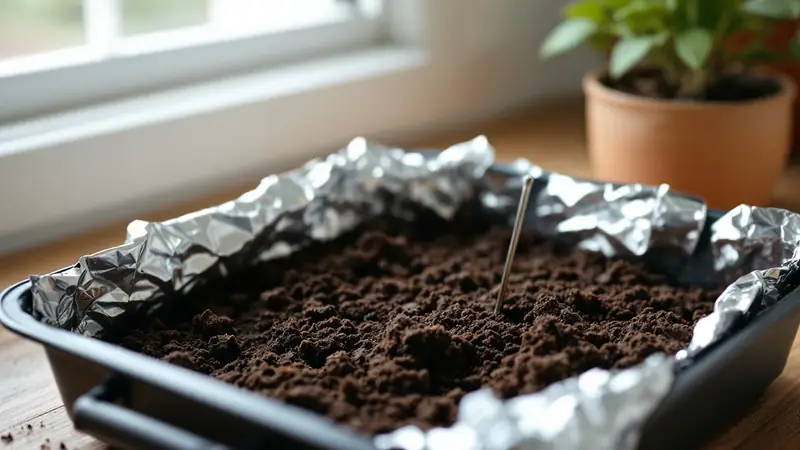
- Bury a 1.5 inch potato in the center, then cover the pan tightly with aluminum foil.
- Push the bulb of a meat or candy thermometer into the soil away from the potato, through a small hole in the foil.
- Set the oven to 180 to 200°F. Start timing when the thermometer reads 180°F and hold 30 minutes.
- Cool it covered. A well-cooked potato shows heat reached the center. Keep the foil on until you use the soil.
A 9 by 13 inch dish filled 2 inches deep holds about 3.5 dry quarts, so a 25 quart bag of mix takes 8 loads. A roasting pan 16 by 12 inches filled 4 inches deep takes 11.4 quarts, 3 loads. The calculator runs that for your volume and pans. For pot volumes in dry quarts, see how much soil a 5 gallon pot holds.
- Oven loads
- 8
- Oven runs with 2 pans at a time
- 4
- Exact loads (fraction)
- 7.2
Default: one 25 quart bag in a 9 x 13 in dish filled 2 in deep takes 8 loads, 4 runs with 2 pans. Each run is heat-up plus 30 minutes after the center reads 180°F (NDSU, Penn State). Volumes: length x width x depth / 67.2 cu in per dry quart.
| Pan, filled depth | Volume per load | Loads for one 25 qt bag | Oven runs, 2 pans at a time |
|---|---|---|---|
| 9 x 13 in dish, 2 in | 234 cu in = 3.5 dry qt | 8 | 4 |
| 11 x 15 in roasting pan, 3 in | 495 cu in = 7.4 dry qt | 4 | 2 |
| 16 x 12 in roasting pan, 4 in | 768 cu in = 11.4 dry qt | 3 | 2 |
Can you sterilize potting soil in the microwave?
Yes, for small batches. NDSU’s rate is 2 pounds of moist soil in an open polypropylene bag, 2.5 minutes on full power at about 650 watts, then close the bag and let it cool. UC Master Gardeners in Inyo and Mono counties, citing the LSU AgCenter, use about 90 seconds in a 600 watt oven at roughly 50 percent moisture, then 30-second bursts until a thermometer reads about 200°F (UC ANR, The Backyard Gardener). That is 20 degrees past the 180°F line where Phytosphere warns of manganese toxicity, so stop at 180°F.
Most microwaves sold today run 1,000 to 1,200 watts, not 650. Scaling NDSU’s 97.5 kilojoules (650 W x 150 s) gives about 89 seconds at 1,100 W. Our arithmetic, using soil heat capacities tabulated by Kodešová and others (2013), says warming 2 pounds of soil holding 25 percent water from 68 to 180°F takes about 89 kilojoules, so the published times leave no margin; the thermometer decides. Moisture matters too: in a University of Minnesota microwave trial, 15 minutes cleared fungi from moist soil, but dry infected seed still grew fungus after 60 minutes.
How to sterilize large amounts of soil without an oven
Use the sun. UC IPM’s container method: moist soil in black plastic bags, pots or flats, set on wooden pallets and covered with a double tent of clear plastic. In warm parts of California the soil inside black bags passes 160°F, and the double layer can add up to 50°F (UC IPM Pest Notes 74145). Push a soil thermometer into the center of the mass and keep going until it holds 158°F for 30 minutes.
For beds, UC IPM uses clear 1 to 4 mil plastic for 4 to 6 weeks in the hottest part of summer, up to 8 weeks in cool or cloudy spots. Wet the soil to 12 inches first, bury the edges in a 4 to 6 inch trench and aim for daily highs of 110 to 125°F in the top 6 inches. Clear film beats black because it traps more heat. For killing a lawn before reseeding, the timing and costs are in how to kill grass before replanting.
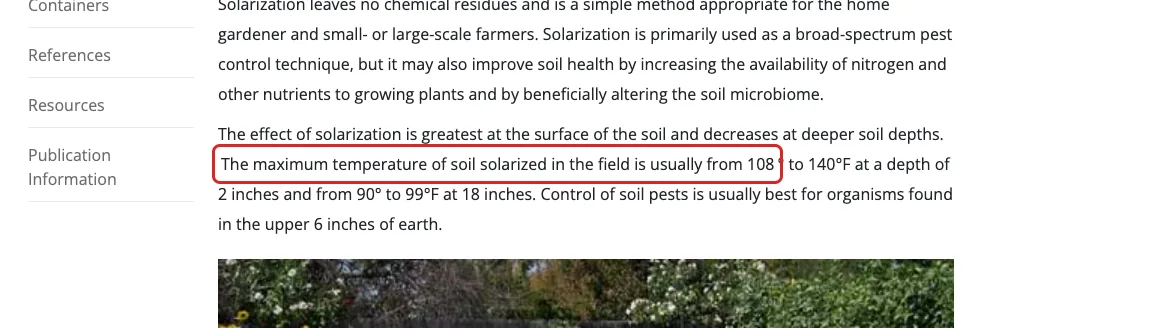
Control fades below 6 inches, and UC IPM rates purple and yellow nutsedge and field bindweed as inconsistent. After removing the plastic, cultivate less than 2 inches deep so untreated seed stays buried.
Field bindweed roots run far below that heated layer, so our guide on how to get rid of bindweed starves them instead, with cutting timed to the 12 to 16 day low in root reserves and fall sprays.
Does pouring boiling water on soil sterilize it?
Only the top inch or so, briefly. The one field trial we found that measured it, Ushiki and others (2007), sprinkled about 194°F water at 120 liters per square meter (2.9 gallons per square foot) on soil covered with plastic film; soil at 2.4 inches peaked at 163°F and stayed above 140°F for 150 minutes. A kettle poured into an open pot has neither. Our boiling water on weeds dose math shows the top inch of moist loam alone absorbs about 0.88 liters per square foot.
Chemical soil sterilants are not a homeowner route. EPA lists chloropicrin, dazomet, 1,3-dichloropropene, dimethyl disulfide and metam sodium or potassium as soil fumigants with buffer zones and certified-applicator training (EPA soil fumigant chemicals). Methyl bromide production and import ended January 1, 2005, apart from critical-use and quarantine exemptions, and EPA names steam as an alternative (EPA, Methyl Bromide). The label is the law for any pesticide.
What can go wrong after you heat soil?
Overheating and recontamination. Above about 180°F, Phytosphere Research cites manganese, ammonium, soluble salts and toxic organics; mixes rich in manure, leaf mold or compost are most at risk. A sand and peat mix tolerates 212°F. If you overshot, let the soil sit before planting so manganese reoxidizes. The Greenhouse Management text, chapter 13, adds that at 180°F the nitrate-forming bacteria die while the ammonium-forming ones survive.
Clean soil recontaminates from dirty pots, tools and splashing water; Penn State soaks pots and tools 30 minutes in 1 part bleach to 9 parts water. Do not bother heating fresh perlite or vermiculite: both are made at high temperatures and are pathogen-free unless contaminated afterward, per Phytosphere. UGA Extension goes further and says not to heat mixes containing perlite at all, citing fluoride release (UGA Bulletin 1318); we found no other extension source repeating that. Most mycorrhizal spores survive 140°F for 30 minutes.
Sometimes the answer is to skip it. UConn notes bagged potting soils may or may not be sterilized, at about 180°F, while soilless seed-starting mixes usually are (UConn Home and Garden Education Center). For seed starting, a fresh bag of soilless mix is less work; our label comparison of potting soil and potting mix shows which bags are soilless. Pests in the mix have their own guides: how to get rid of fungus gnats, soil mites and white fungus in soil.
How we compiled this
In November 2026 we read Baker’s 1957 UC Manual 23 (Fig. 70 and pp. 127 to 129, from the archive.org scan), extension publications from Penn State, NDSU, UF/IFAS (2), UC IPM, UC ANR, Mississippi State, Missouri, UGA and UConn, the Phytosphere Research FAQ, two EPA pages and two peer-reviewed or university trials. Threshold temperatures were read from Baker’s chart to the nearest 5°F. Microwave energy and pan volumes are our arithmetic. We heated no soil ourselves.
Frequently asked questions
What is the best way to sterilize soil?
For a few quarts, a covered pan in a 180 to 200°F oven, held 30 minutes after the center reads 180°F (NDSU, Penn State). For bags or beds, solarize in summer until the center holds 158°F for 30 minutes (UC IPM).
Can I pour boiling water over soil to sterilize?
Not reliably. Boiling water cools as it soaks in, and nothing confirms a 30 minute hold. A Japanese trial needed 2.9 gallons per square foot of 194°F water under plastic film to keep soil above 140°F at 2.4 inches.
How long do you bake soil to sterilize it?
Thirty minutes after a thermometer in the center reads 180°F, with the oven at 180 to 200°F and soil no more than 4 inches deep. UF/IFAS gives an alternative: a thin tray at 200°F for 20 minutes, stirred every 5 minutes.
What temperature kills bacteria in soil?
Most plant pathogenic bacteria die at 140°F held 30 minutes in moist soil, and all of them by 160°F, according to Fig. 70 of Baker’s 1957 UC Manual 23. Spore-forming soil bacteria survive 140°F, per Phytosphere Research.
Is black or clear plastic better for solarization?
Clear, for beds: UC IPM says it traps more heat and black plastic absorbs and deflects part of it. Black works for soil in bags, and in cool coastal areas, where weeds would grow under clear film.
How long does it take to solarize soil?
Four to 6 weeks of full summer sun, per UC IPM, or up to 8 weeks in cool, windy or cloudy spots. UF/IFAS uses 6 to 8 weeks in Florida, ideally June through August.
Sources
- Baker, K.F. (ed.), University of California, The U.C. System for Producing Healthy Container-Grown Plants, Manual 23, Fig. 70 and pp. 127 to 129, 1957. Accessed November 2026.
- Phytosphere Research (Bernhardt and Swiecki), Heat treatment of soil for plant propagation, Version 3/27/2021, updated 3/31/2021. Accessed November 2026.
- Penn State Extension (Lamont, Kelley, Sellmer), How to Pasteurize Medium and Sterilize Containers and Tools (copy hosted by growables.org), April 16, 2003. Accessed November 2026.
- NDSU Extension, Houseplants: Proper Care and Management of Pest Problems, PP-744 (revised), 2010. Accessed November 2026.
- UF/IFAS Extension, Homemade Potting Mix, Accessed 2026. Accessed November 2026.
- UC Statewide IPM Program (Stapleton, Molinar, Wilen and others), Pest Notes: Soil Solarization for Gardens and Landscapes, Publication 74145, Current web edition. Accessed November 2026.
- UF/IFAS Extension (Krueger, McSorley, Desaeger), Solarization for Pest Management in Florida, ENY-902, Table 1, Revised May 2025. Accessed November 2026.
- Ushiki, Kawana and Morita, Journal of Weed Science and Technology 53(2), Germination and survival of paddy weed seeds after soil sterilization with hot water, 2007. Accessed November 2026.
- UC ANR, The Backyard Gardener (UC Master Gardeners of Inyo and Mono Counties), Sterilize Your Seed-Starting Soil, Accessed 2026. Accessed November 2026.
- Mizicko and Pfleger, University of Minnesota (hosted by NC State), Soil Sterilization by Microwave Heating, Undated. Accessed November 2026.
- Kodešová and others, Soil and Water Research 8(4), Thermal Properties of Representative Soils of the Czech Republic, Table 1, 2013. Accessed November 2026.
- Mississippi State University Extension, Soil Steaming 101, Accessed 2026. Accessed November 2026.
- University of Missouri IPM, Soil Steaming to Reduce the Incidence of Soil-borne Diseases, Weeds and Insect Pests, November 24, 2020. Accessed November 2026.
- U.S. EPA, Methyl Bromide (Phaseout of Ozone-Depleting Substances), Accessed 2026. Accessed November 2026.
- U.S. EPA, What Are Soil Fumigants?, Accessed 2026. Accessed November 2026.
- U.S. EPA, Soil Fumigant Chemicals, Accessed 2026. Accessed November 2026.
- UGA Extension, Growing Indoor Plants with Success, Bulletin 1318, Accessed 2026. Accessed November 2026.
- UConn Home and Garden Education Center, Potting Media, Accessed 2026. Accessed November 2026.