How to get rid of bindweed: starve its roots. Cut or hoe the regrowth every 12 to 21 days, or spray a labeled systemic herbicide on vigorous plants in late summer or fall, and keep it up for 2 to 3 years.
Field bindweed (Convolvulus arvensis) keeps its food in roots that UC IPM measures at 20 feet or more deep, with 70 percent of the root mass in the top 2 feet, so one pull or one spray only removes what you can see. The working answer to how to get rid of bindweed comes from Kansas field research: root reserves keep falling until 12 to 16 days after new shoots come up, then refill (K-State MF913). Every cut or spray in the plan below is timed to that number.
Guides quote different numbers for the same plant. We lined up 10 extension and state sources and 6 EPA-stamped labels: published root depths run from 9 to 23 feet, seed life from 20 to 60 years, and cutting advice from weekly to every 3 weeks. The 29-row table below shows who says what, and the timing chart shows why a September spray beat an August one by 53 to 93 points in Dakota trials.
This page summarizes extension research and pesticide labels; it does not recommend a product. The label is the law: read the EPA Reg. No. on the container you buy and follow its rates, sites and limits. Tordon 22K is a restricted-use pesticide sold only to certified applicators.
Is it field bindweed, hedge bindweed or morning glory?
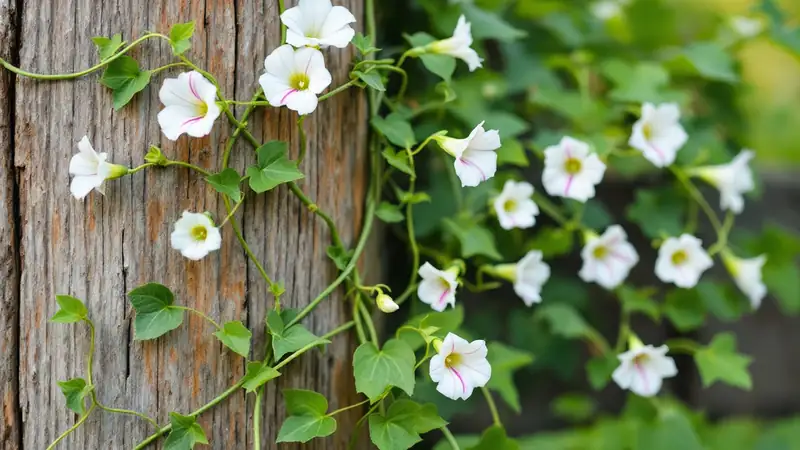
Check before you plan, because only field bindweed has the deep roots. Hedge bindweed (Calystegia sepium) is also a perennial, but Cornell puts its roots at about 1 foot deep; annual morning glory (Ipomoea) dies at frost and returns only from seed (Oregon State). Leaf shape, flower width and the two bracts under each flower settle it.
| Trait | Field bindweed | Hedge bindweed | Annual morning glory | Source |
|---|---|---|---|---|
| Life cycle | Perennial: deep roots plus seed | Perennial: fleshy rhizomes plus seed | Annual: seed only | UC IPM; Penn State; OSU |
| Leaf | Arrowhead, 1/2 to 2 1/2 in., rounded tip, pointed or blunt basal lobes | Arrow or heart, 1 1/2 to 6 in., pointed tip, squared-off basal lobes | Heart-shaped (tall) or 3-lobed (ivyleaf), about 1 1/2 in. wide | UC IPM; Cornell; Iowa State |
| Flower width | 1/2 to 1 in. (Cornell); up to 1 1/2 in. (UC IPM); white to pink, 1 to 5 per leaf joint | 1 1/4 to 3 in.; white or faintly pink; single | About 2 in.; white, blue or purple | Cornell; UC IPM |
| Bracts under the flower | Tiny, under 0.1 in., set below the flower | Two heart-shaped bracts, 1/4 to 3/4 in., that hide the sepals | Not used as an ID trait in these sources | Cornell; Penn State |
| Root system | 20 ft or more; most mass in top 2 ft | About 1 ft deep, spreading to 9 ft | Annual; dies at frost | UC IPM; Cornell; OSU |
| Named on lawn label 2217-896 | Yes (Bindweed, field) | Yes (Hedge bindweed) | Yes (Morningglory) | EPA label 2217-896 |
Published flower sizes for field bindweed do not agree: Penn State (April 2025) tops it at 3/4 inch, K-State’s MF913 gives 3/4 to 1 inch and UC IPM gives 1 to 1 1/2 inches. Any flower 2 inches or wider in blue or purple is morning glory on all three. For other creeping lawn weeds, our common lawn weeds identification chart sorts them by leaf shape and habit.
Why does bindweed keep coming back?
Three numbers explain most failed attempts. Root or rhizome pieces as short as 2 inches form new plants, one plant can spread more than 10 feet across in a single season, and seed with a coat that turns waterproof within a month has germinated after 60 years (UC IPM Pest Notes 7462). UC IPM rates herbicides as relatively effective for suppression and not very effective for eradication.
Trumpet creeper is harder still: Purdue reports its rootstock pieces only 0.8 inch long send up shoots within 8 weeks, which is why pulling its suckers multiplies them, as our guide to killing trumpet vine roots explains.
Japanese knotweed shares the trick at a larger size, regrowing from a rhizome piece of 0.7 g, and our Japanese knotweed removal plan sets out the 3 to 5 years of late-season treatment it takes.
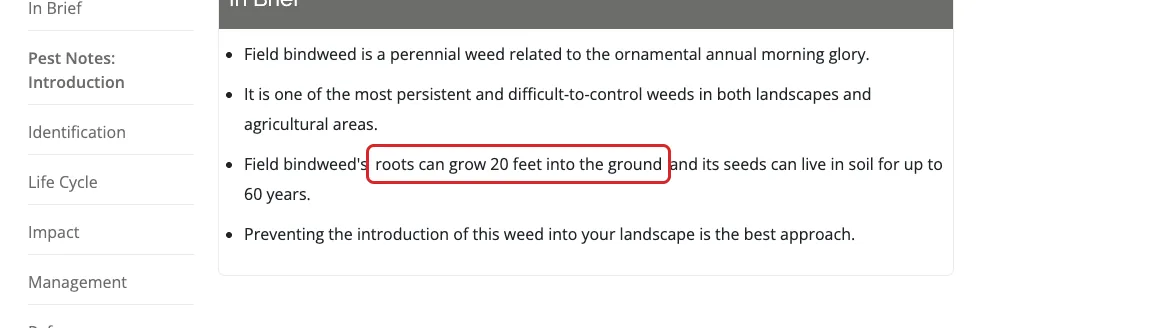
The deep figures are the maximum, not the norm. At Hays, Kansas, where rain averages 23 inches a year, few roots went below 6 feet and more than 60 percent of root weight sat in the top 2 feet; where rain tops 30 inches, roots have been found 30 feet down (K-State MF913). That shallow root mass is what repeated cutting drains. The seed bank is the other clock: our page on where weeds come from explains how buried seed keeps a cleared bed supplied for years.
| Measure | Published figure | Source (date) |
|---|---|---|
| Root depth | 20 ft or more; budding roots found to 14 ft | UC IPM Pest Notes 7462 (rev. Oct. 2011) |
| Root depth | 18 to 20 ft; 30 ft where rain exceeds 30 in. a year; few below 6 ft at Hays | K-State MF913 (Mar. 1989) |
| Root depth | 23 ft after 3 seasons, 16 ft spread (Frazier 1943) | Cornell Weed Profiles |
| Root depth | 20 ft deep, 10 to 18 ft spread in one season | Penn State Extension (Apr. 30, 2025) |
| Root depth | 20 ft or more | CSU PlantTalk 2104 |
| Root depth | Taproot to about 3 m (10 ft); patch up to 6 m across | Colorado Dept. of Agriculture |
| Root depth | As much as 9 ft | Oregon State Extension news (Apr. 1, 2022) |
| Shallow share | 70% of root mass in top 2 ft | UC IPM |
| Shallow share | Over 60% of root weight in top 2 ft (Hays) | K-State MF913 |
| Regrowth piece | 2 in. of root or rhizome forms a plant | UC IPM; Oregon State |
| Regrowth piece | 3 in. piece, even from 14 ft deep | Penn State |
| Regrowth piece | One 2 in. piece made 25 shoots in 4 months | Cornell (Weaver and Riley 1982) |
| Seed life | Viable at 60 years | UC IPM |
| Seed life | Up to 50 years | Colorado Dept. of Agriculture |
| Seed life | 20 to 50 years | Penn State |
| Seed life | More than 30 years | K-State MF913 |
| Seed life | 20 years | CSU PlantTalk 2104 |
| Seed output | About 550 per plant | UC IPM |
| Seed output | Up to 600 a year, 90% may be viable | Penn State |
| Seed output | 25 to 300 per plant a year | Cornell |
| Seedling turns perennial | 3 to 4 weeks after germination | UC IPM |
| Seedling turns perennial | Lateral roots about 6 weeks after emergence | K-State MF913; K-State eUpdate 1107 (June 11, 2026) |
| Cutting interval | 12 to 16 days after shoots re-emerge | K-State MF913 |
| Cutting interval | Every 12 to 20 days, 2 full seasons, to eradicate by tillage alone | Cornell (Timmons and Bruns 1951) |
| Cutting interval | Every 2 to 3 weeks | UC IPM; Oregon State (for 3 to 5 years) |
| Cutting interval | Every 3 weeks | K-State eUpdate 1107 (June 11, 2026) |
| Cutting interval | Weekly, for more than one season | Penn State |
| Light exclusion | More than 3 years; complete death 3 to 5 years | UC IPM |
| Gall mites | Bindweed dies in 1 to several years; often 2 or 3 | CSU PlantTalk 1493; Colorado Dept. of Agriculture |
The 3-year plan to get rid of bindweed
The plan runs on one measurement. After a cut, bindweed spends root reserves to regrow; K-State found root carbohydrates kept falling until 16 days after the new shoots emerged, and new leaves start refilling the roots about 12 days after they form. Destroying the top growth again inside that 12 to 16 day window drains the roots each round instead of letting them recover (K-State MF913, Figure 1).
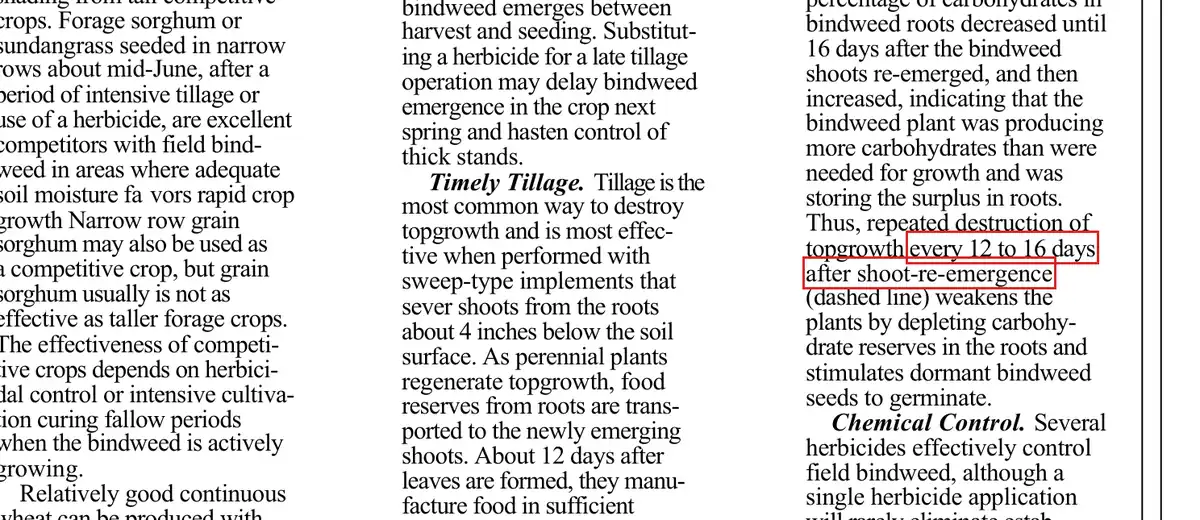
Cornell adds the stage to watch for: reserves hit bottom when shoots are about 12 to 28 inches long with 4 to 6 full leaves, and full eradication by tillage alone took 2 full fallow seasons of cutting every 12 to 20 days (Cornell, citing Timmons and Bruns 1951). Pick one track for each patch: cutting starves the roots, spraying needs leaves to carry herbicide down, so do not cut within 3 weeks after a spray (MF913).
| When | No-spray track | Spray track | Number that sets it (source) |
|---|---|---|---|
| Early to mid-April, shoots emerge | Start the 12 to 21 day cutting clock | Let shoots grow; water if dry | Emergence early to mid-April in Kansas (MF913) |
| Any time seedlings appear | Hoe or pull seedlings | Hoe or pull seedlings | Easy to kill only for 3 to 4 weeks after germination (UC IPM) |
| May to June | Cut, hoe or pull at the soil line every 12 to 21 days | Spray once on vigorous plants with runners 8 to 12 in. long, in mid to full bloom | MF913; Tordon 22K label |
| July to August | Keep cutting; bloom starts seed | Skip sprays on drought-stressed plants | 3 to 40% control from August sprays in ND and SD trials (MF913 Table 5) |
| September to first killing frost | Last cuts | Main spray: regrowth at or past full bloom, before a killing frost | 83 to 96% control from September sprays (MF913 Table 5); label 524-475 |
| After frost | Nothing; roots survive to about 21°F | Nothing | Cornell |
| Years 2 and 3 | Same cycle on thinner, smaller shoots | Respray regrowth in fall | Single sprays rarely eliminate stands (K-State 2026) |
| Year 4 on | Monthly checks for seedlings | Spot-treat survivors | Seed lives 20 to 60 years (table above) |
- Confirm it is field bindweed with the ID table, then mark each patch and note the date shoots appear.
- Do not till or rototill. Tillage cuts roots into 2 inch pieces that each regrow (UC IPM), and K-State found tilled plots lost 24 to 63 points of control within 60 days of a spray.
- No-spray track: cut, hoe or pull every stem at the soil line 12 to 21 days after the last round, before shoots reach 12 inches. Never let a flower set seed; seeds become viable 10 to 15 days after pollination (Cornell).
- Spray track: water a dry patch first, then spray vigorous, unstressed bindweed with the product your label names for the site. Leave it uncut for at least 3 weeks.
- Respray or keep cutting all regrowth from September until a killing frost.
- Repeat for 2 to 3 seasons, then check monthly for seedlings from the seed bank.
The commitment adds up. A 26-week season cut every 14 days is 13 rounds a year, or 39 over 3 years. The calculator scales that to your frost-free weeks and interval; the result rounds up to whole rounds.
- Cutting rounds over the program
- 39
Rounds = weeks x 7 / days between rounds x years. Default: 26 weeks, every 14 days, 3 years = 39 rounds. Worked example: 30 weeks every 21 days for 2 years = 20 rounds. Intervals from K-State MF913, Cornell, UC IPM and Oregon State, read November 2026.
When is the best time to spray bindweed?
Timing moved results more than product choice in the trials K-State summarized. In North and South Dakota from 1978 to 1982, dicamba at 1 lb per acre controlled 40 percent of field bindweed when sprayed in June, 30 percent in August and 83 percent in September, measured 10 to 12 months later. Dicamba plus glyphosate went from 81 percent in June to 3 percent in August and 96 percent in September (K-State MF913, Table 5).
| Treatment (lb active per acre) | Trial | Spring or June | Summer or August | Fall or September |
|---|---|---|---|---|
| Dicamba 1.0 | ND and SD, 1978 to 1982, 10 to 12 months later | 40% | 30% | 83% |
| Dicamba 2.0 | ND and SD | 56% | 33% | 94% |
| Dicamba 0.5 + glyphosate 1.5 | ND and SD | 81% | 3% | 96% |
| Dicamba 1.0 + 2,4-D 3.0 | ND and SD | 60% | 3% | 94% |
| Glyphosate 2.9 | Bushland, Texas, 1976 to 1982, 1 year later | 83% | 77% | 60% |
| Picloram 0.25 + 2,4-D 0.5 | Bushland, Texas, 1 year later | 55% | 56% | 84% |
| Dicamba 1.0 | Bushland, Texas, 1 year later | 56% | 41% | 71% |
Glyphosate is the exception: in the Texas data it did best in spring (83 percent after 1 year) and worst in fall (60 percent), and MF913 concludes that glyphosate and 2,4-D work best on vigorous plants in mid to full bloom, while dicamba and picloram work best in fall. The current Roundup Ultra label (EPA Reg. No. 524-475) splits the difference: spray at or beyond full bloom, with enhanced results in late summer or fall before a killing frost, and not on drought-stressed bindweed. Every source agrees that midsummer sprays on stressed plants fail.
Field rates translate to home sprayers through the label’s per-gallon or per-1,000 sq ft rate, never by scaling the farm numbers. Before a fall spray, check the rain-free time printed on your product; our page on spraying weeds before or after rain lists it by EPA Reg. No.
What kills bindweed but not grass?
In lawns the active that matters is quinclorac. Colorado State PlantTalk 1552 calls it highly effective on bindweed, says 2,4-D alone is largely ineffective, and rates three-way mixes with dicamba as moderate to good. South Dakota State Extension (2022) disagrees on quinclorac alone, calling it suppression, and recommends a 2,4-D, dicamba and MCPP mix repeated 10 to 15 days later, applied in fall after the first light frost.
| Product family (EPA Reg. No.) | Active ingredients | Bindweed on the label | Label rate | Limits | Lawns allowed |
|---|---|---|---|---|---|
| EH-1437, sold as Ortho WeedClear Lawn Weed Killer Concentrate and Trimec Crabgrass Plus (2217-896) | 2,4-D 6.42%, quinclorac 2.13%, dicamba 0.60% | Field and hedge bindweed | 6.4 fl oz per 1,000 sq ft; spot: 2.5 fl oz in 1 gal per 400 sq ft | 2 broadcast sprays a year, 21 days apart; 12.8 fl oz per 1,000 sq ft a season | Bluegrass, ryegrass, tall fescue, bermuda, zoysia, buffalograss; not St. Augustine, centipede, bahia, bentgrass |
| Ortho Weed B Gon Max Plus Crabgrass Control, ready to use (239-2689) | Quinclorac 0.10%, MCPP-p 0.22%, 2,4-D 0.12%, dicamba 0.05% | Field bindweed | Spray to lightly cover each weed; spot only | 2 sprays a year; 45 to 90°F; reseed bare spots after 4 weeks | Bermuda, buffalograss, fescue, bluegrass, ryegrass, zoysia |
| EH-1458, sold by Ortho as Weed B Gon Max for Southern Lawns (2217-910) | 2,4-D 4.01%, MCPP-p 0.49%, dicamba 0.27%, carfentrazone 0.16% | Field and hedge bindweed (control or suppress) | 3.0 fl oz per 1,000 sq ft on southern grasses | 2 broadcast sprays a year, 30 days apart | St. Augustine (not Floratam), centipede, hybrid bermuda, buffalograss, bentgrass |
| Drive XLR8, professional (7969-272) | Quinclorac 18.92% | Field bindweed | 1.45 fl oz per 1,000 sq ft plus 0.55 fl oz methylated seed oil | Not in ornamental beds; spot only in New York | Not bahia, carpetgrass, centipede, St. Augustine, dichondra, colonial or seaside bentgrass |
| Roundup Ultra, 41% glyphosate (524-475) | Glyphosate 41% | Field bindweed | 2% solution for hand-held sprays (2.56 fl oz per gal) | Kills any grass it touches; not on drought-stressed bindweed | None (nonselective) |
| Tordon 22K (62719-6) | Picloram 24.4% | Field bindweed | 2 to 4 pt per acre on rangeland and pasture | Restricted use; max 2 qt per acre a season; manure and hay from treated areas injure broadleaf plants | Pasture and rangeland grasses |
1Is it in a bluegrass, ryegrass, tall fescue, bermuda, zoysia or buffalograss lawn?
YesFeed and mow at 2 1/2 to 3 in. (CSU); spray a lawn label that lists field bindweed, such as quinclorac mixes 2217-896 or 239-2689, on actively growing bindweed; main pass in September to October; max 2 sprays a year.
NoGo to the next question
2Is it a St. Augustine or centipede lawn?
YesThe quinclorac labels above exclude these grasses. EH-1458 (2217-910) lists field bindweed for St. Augustine (not Floratam) and centipede at 3.0 fl oz per 1,000 sq ft, 2 sprays a year, 30 days apart.
NoGo to the next question
3Is it twining through shrubs, perennials or vegetables?
YesNo lawn herbicide. Cut at the soil line every 12 to 21 days, or lay vines on newspaper and paint 2% glyphosate on the leaves (UC IPM); add overlapped fabric under mulch for 3 to 5 years.
NoGo to the next question
4Is it open ground you plan to replant?
YesWater to push growth, spray 2% glyphosate at or past full bloom, leave it 3 weeks, respray regrowth before frost, then plant and mulch or use a preemergent (UC IPM, MF913).
NoGo to the next question
5Is it dry, unirrigated land in Colorado?
YesOrder bindweed gall mites from the Palisade Insectary at $35 per release, June to August; expect 2 to 3 years (CDA).
NoPasture or acreage elsewhere: cut or graze before seed set and ask your county extension office about dicamba or picloram programs; Tordon 22K is restricted use and needs a certified applicator.
Source: UC IPM 7462; K-State MF913; CSU PlantTalk 1552; CDA; labels 2217-896, 239-2689, 2217-910
A thick lawn is part of the control. CSU recommends 2 to 4 nitrogen feedings a year, even irrigation and mowing at 2 1/2 to 3 inches, and says those practices alone can substantially reduce bindweed over a couple of years; it calls pre-emergence herbicides useless for controlling bindweed because of its deep root system (CSU PlantTalk 1552). Our mowing height guide by grass type gives the target for each lawn.
How do you get rid of bindweed in flower beds and vegetable gardens?
Lawn products are out. CSU says quinclorac lawn herbicides cannot legally be used in landscape beds or vegetable gardens, and label 239-2689 bans use in flower beds, gardens and around shrubs. That leaves 3 tools: the cutting schedule, light exclusion and carefully placed glyphosate.
For vines twined through shrubs, UC IPM lays the bindweed on newspaper, paints the leaves with a 2 percent glyphosate solution (2.56 fl oz of a 41 percent concentrate per gallon) and lifts the paper once the leaves dry, keeping it off the shrub’s leaves and green bark. Glyphosate takes 2 to 3 weeks to kill the top growth and leaves no residual, so regrowth needs another round (UC IPM 7462). Our page on how long Roundup stays in soil gives the replanting waits by formula.
Light exclusion works only if it is total. UC IPM says overlapped polypropylene or polyester fabric under bark or rock will likely keep field bindweed from emerging, but stems find every seam and planting hole, and complete death takes 3 to 5 years. Organic mulch alone fails: Cornell reports hedge bindweed shoots coming through an 18-inch pile of bark mulch. The depth trials are on our does mulch prevent weeds page.
Preemergents (trifluralin, oryzalin, pendimethalin, prodiamine) stop seedlings from the seed bank but do not kill established plants (UC IPM Table 1). Seed germinates at 41 to 104°F from the top 2.4 inches of soil, and few seedlings emerge from below 4.7 inches (Cornell), so leave buried seed buried. Before planting a new bed, UC IPM irrigates to push growth, sprays glyphosate, then mulches or uses a preemergent labeled for the crop.
Do bindweed mites work, and what about pastures?
The bindweed gall mite (Aceria malherbae) is the one biological control sold to landowners. The Colorado Department of Agriculture’s Palisade Insectary ships it for $35 per release, which contains thousands of mites, from June to August; orders placed after May 1, 2026 will likely be filled in 2027, and the service is for Colorado land only (CDA, Field Bindweed; Request-A-Bug). Releases outside Colorado need a USDA-APHIS PPQ 526 permit held by the receiver.
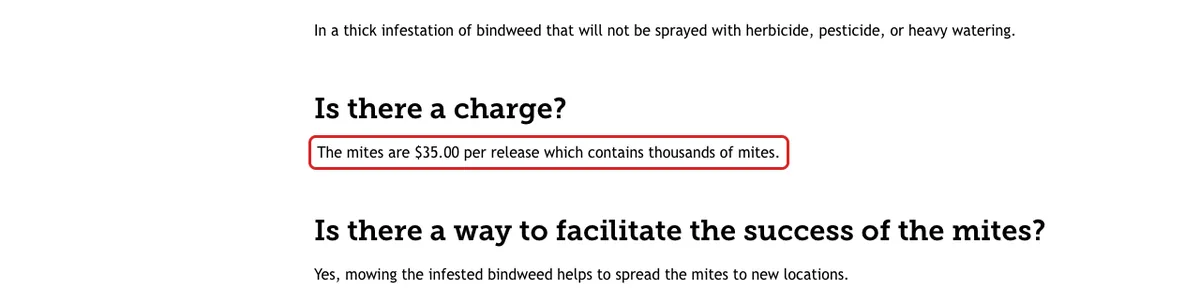
Mites suit dry ground, not lawns. CDA says drought-stressed bindweed can die in the first year but often takes 2 or 3, and CSU says heavy moisture limits mite populations, so releases on sprinkler-irrigated lawns will have little effect (CSU PlantTalk 1493). Mow the patch a few weeks after galls appear to spread the mites.
On pasture and rangeland, the Tordon 22K label lists field bindweed at 2 to 4 pints per acre with annual retreatment at the low end, and caps use at 2 quarts per acre a season. It is a restricted-use pesticide, so the applicator needs certification; our page on pesticide applicator licenses explains the categories. K-State reported in June 2026 that a 2,4-D, dicamba and dichlorprop premix gave 93 percent control 8 months after treatment, similar to picloram plus 2,4-D.
Is it better to pull or cut bindweed?
Neither works once; the schedule does. Pulling snaps roots into pieces that regrow from 2 inches, and Oregon State says dug fragments resprout in about 2 weeks, so a retreat every 3 weeks keeps pace for the 3 to 5 years it advises (Oregon State). Pull seedlings whole; on established vines, cut at the soil line, which removes the same leaves without spreading root pieces. Penn State suggests cutting vines where they meet the ground and leaving twined stems to dry rather than tearing them off host plants (Penn State).
Boiling water and vinegar act like a cut: they kill the leaves and stems they touch and leave the roots. Our vinegar weed killer page gives the measured limits for acetic acid; on bindweed, count each application as one round of the 12 to 16 day schedule, not a cure.
How we compiled this
We read 10 extension and state sources (UC IPM, K-State MF913 and the June 11, 2026 K-State eUpdate, Cornell, Penn State, Oregon State, Colorado State, South Dakota State, Iowa State and the Colorado Department of Agriculture) and 6 EPA-stamped labels from EPA’s Pesticide Product and Label System in November 2026. Control percentages are from field trials summarized in MF913 (1963 to 1987 data); we ran no trials. Product rows report label text, not recommendations.
Frequently asked questions
What is the best thing to kill bindweed?
No single product. In lawns, a lawn label that lists field bindweed and contains quinclorac or a dicamba mix; in open ground, 2 percent glyphosate at or past full bloom. Spray in late summer or fall: September sprays gave 83 to 96 percent control in the Dakota trials in K-State MF913, and stands still needed repeats.
Does Roundup kill bindweed?
Glyphosate does, slowly. The Roundup Ultra label (524-475) lists field bindweed at a 2 percent hand-held solution, and UC IPM says it takes 2 to 3 weeks to kill the top growth, with repeat sprays for regrowth. Roundup is a brand on more than one formula, so check the active-ingredient line on your bottle.
How deep do bindweed roots grow?
UC IPM, CSU and Penn State say 20 feet or more, and K-State found roots 30 feet down where rain tops 30 inches a year. Oregon State gives 9 feet. In all of them most of the root mass sits in the top 2 feet: 70 percent, per UC IPM.
Is morning glory the same as bindweed?
No. Both are in the morning glory family, but annual morning glory (Ipomoea) dies at frost and has flowers about 2 inches wide in white, blue or purple, while field bindweed is a deep-rooted perennial with 1/2 to 1 inch white or pink flowers and arrowhead leaves (UC IPM, Cornell).
What naturally kills bindweed?
Starvation and shade. Cutting every 12 to 20 days for 2 full seasons eradicated it in tillage research cited by Cornell, overlapped fabric kills it in 3 to 5 years (UC IPM), and the 98 percent shade of a dense forage soybean crop killed every shoot in a Minnesota study. In dry Colorado sites, gall mites are a $35 option.
Sources
- UC IPM, Pest Notes: Field Bindweed, UC ANR Publication 7462, updated Oct. 2011. Accessed November 2026.
- Kansas State University (D. Peterson, P. Stahlman), MF913, Field Bindweed Control in Field Crops and Fallow, Mar. 1989. Accessed November 2026.
- K-State Agronomy eUpdate, Management Options for Control of Field Bindweed, Issue 1107, June 11, 2026. Accessed November 2026.
- Cornell University Weed Science, Weed Profiles: Bindweeds, current page. Accessed November 2026.
- Penn State Extension, The Noxious, Persistent, Invasive, and Perennial Bindweeds, Apr. 30, 2025. Accessed November 2026.
- Oregon State University, Controlling perennial bindweed takes persistence, Apr. 1, 2022. Accessed November 2026.
- Oregon State University Extension, Solve Pest Problems: Field Bindweed, updated Apr. 3, 2026. Accessed November 2026.
- Colorado State University Extension, PlantTalk 1552, Bindweed Control in Lawns, current page. Accessed November 2026.
- Colorado State University Extension, PlantTalk 2104, Controlling Bindweed, current page. Accessed November 2026.
- Colorado State University Extension, PlantTalk 1493, Bindweed Mites, current page. Accessed November 2026.
- Colorado Department of Agriculture, Biocontrol: Field Bindweed, current page. Accessed November 2026.
- Colorado Department of Agriculture, Request-A-Bug, current page. Accessed November 2026.
- South Dakota State University Extension, Field Bindweed Control in Yards and Gardens, updated Apr. 8, 2022. Accessed November 2026.
- Iowa State University Extension, Hedge bindweed, current page. Accessed November 2026.
- U.S. EPA PPLS (PBI-Gordon), EH-1437 Herbicide label, EPA Reg. No. 2217-896, Jan. 21, 2026. Accessed November 2026.
- U.S. EPA PPLS (PBI-Gordon), EH-1458 Herbicide label, EPA Reg. No. 2217-910, Sept. 8, 2025. Accessed November 2026.
- U.S. EPA PPLS (The Scotts Company), Lawn Crabgrass and Weed Killer (Ortho Weed B Gon Max Plus Crabgrass Control) label, EPA Reg. No. 239-2689, Sept. 5, 2024. Accessed November 2026.
- U.S. EPA PPLS (BASF), Drive XLR8 Herbicide label, EPA Reg. No. 7969-272, Nov. 1, 2019. Accessed November 2026.
- U.S. EPA PPLS (Bayer CropScience), Roundup Ultra Herbicide label, EPA Reg. No. 524-475, Oct. 18, 2016. Accessed November 2026.
- U.S. EPA PPLS (Corteva), Tordon 22K Specialty Herbicide label, EPA Reg. No. 62719-6, Sept. 20, 2019. Accessed November 2026.