How to kill Japanese knotweed: spray every leaf with glyphosate between bud stage and first frost, or inject 5 mL into each cane, then retreat regrowth after July 1 every year for 3 to 5 years. Cutting alone rarely kills it.
How to kill Japanese knotweed (Reynoutria japonica, also filed as Fallopia japonica and Polygonum cuspidatum) comes down to getting a systemic herbicide into the rhizomes when the plant is sending sugar down to them. In the largest field test of knotweed control published so far, 19 treatments on 58 plots of 225 square meters (2,422 sq ft) each in south Wales, no treatment eradicated the plant in 3 years, and the best results came from glyphosate alone sprayed in summer and again in autumn (Jones et al., Biological Invasions, 2018).
We matched that trial to 3 EPA labels from 2023 to 2025 that name Japanese knotweed, to Penn State Extension and King County, Washington field rules, and to 81 excavations that measured how far rhizomes really run. One label catch most guides skip: at 5 mL per stem, AquaNeat’s per-acre cap covers at most 1,420 stems.
This page is general information, not pesticide or legal advice. The label is the law: read the whole label of the product you buy, and check state rules before you spray near water.
Make sure it is Japanese knotweed
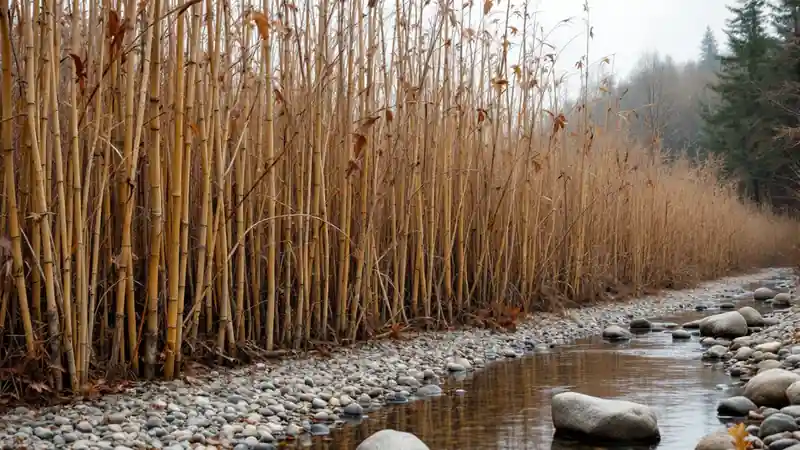
Japanese knotweed grows up to 11 ft tall from jointed, hollow canes with red or purple nodes, zigzag leafy stems and spade-shaped leaves up to 6 in. long with a squared base (Penn State Extension, updated Feb. 24, 2020). The canes die back at the first hard frost and stand brown through winter. Bamboo keeps its narrow, papery leaves year-round and has woodier canes; our page on whether bamboo is a grass and how running bamboo spreads covers that plant.
| Plant | Leaf | Canes in winter | Same plan? | Source |
|---|---|---|---|---|
| Japanese knotweed | 4 to 6 in. long, squared or flat base, short pointed tip | Hollow, die back at first hard frost, stay standing | Yes | King County BMP |
| Bohemian knotweed (hybrid) | 7 to 9 in., heart-shaped to flat base | Same | Yes; hybrids are more genetically varied | Oregon Dept. of Agriculture |
| Giant knotweed | Often over 12 in. across, heart-shaped base | Same | Yes | King County BMP |
| Running bamboo | Slender, papery, kept all year | Woody, stay green | No | Penn State Extension |
| Prostrate knotweed (lawn weed) | Small, on flat wiry mats | Annual, dies | No; a different lawn weed | Common lawn weeds |
The small knotweed in sidewalk cracks and compacted lawns is a different plant: prostrate knotweed, an annual that our guide to common lawn weeds by region lists with lawn sprays. Nothing on this page is meant for a lawn, because every product here kills turf.
How far do knotweed rhizomes really spread?
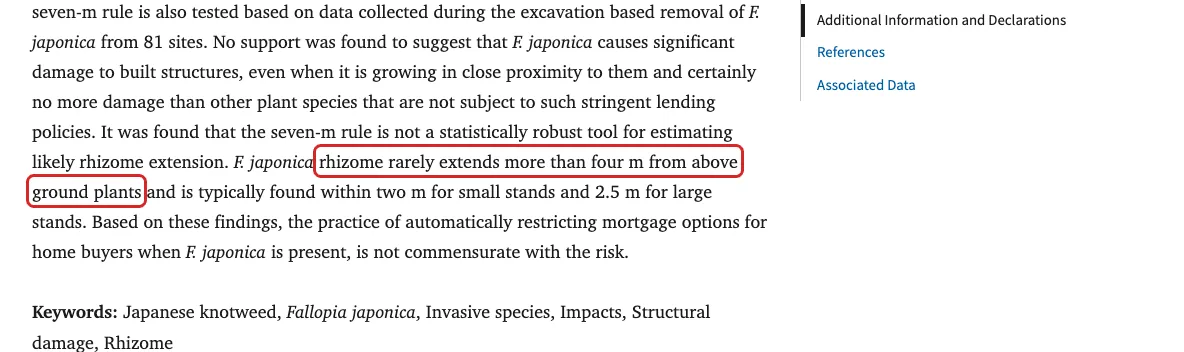
Less far than most guides say. A survey of 81 knotweed excavations found rhizomes rarely ran more than 4 m (13.1 ft) from the stems; 75 percent of small stands stayed within 2 m (6.6 ft) and 75 percent of large stands within 2.5 m (8.2 ft) (Fennell, Wade and Bacon, PeerJ, 2018). The deepest rhizome recorded was 3.2 m (10.5 ft), under a large stand.
| Claim or measurement | Lateral | Depth | Basis | Source |
|---|---|---|---|---|
| King County noxious weed program | At least 23 ft (7 m) | More than 7 ft (2 m); established roots 7 to 10 ft | Program guidance, July 2015 | King County BMP |
| Beerling 1994, cited in the Welsh trial | 65.6 ft (20 m) | 14.8 ft (4.5 m); mostly in the top 3.3 ft | Literature figure | Jones et al. 2018 |
| Small stands, 43 sq ft (4 m2) or less | Mean 4.6 ft; 75% within 6.6 ft; none past 13.1 ft | Mean 3.3 ft; max 6.6 ft | 21 measured stands | Fennell et al. 2018 |
| Large stands, over 43 sq ft | Mean 6.6 ft; 75% within 8.2 ft; 1 outlier past 16.4 ft | Mean 5.4 ft; max 10.5 ft | 60 measured stands | Fennell et al. 2018 |
| Smallest piece that regrows | 0.7 g of rhizome with a node (Brock and Wade 1992); fragments as small as 1/2 in. (1 cm) | n/a | Lab and program figures | Fennell et al.; King County |
So search 20 ft out from the patch for new shoots (King County, 2015), a ring that covers every stand in the 81-site set, and treat soil inside it as contaminated: a 0.7 g rhizome piece with a node can start a new plant.
What 19 treatments did in a 3-year field trial
Swansea University researchers tested physical, chemical and combined treatments from 2012 to 2015 at 3 sites, measuring ground cover and stem count in 348 sampling squares of 4 m2 (Jones et al., 2018). Glyphosate timed to late-season sugar flow beat everything else. The synthetic auxins (2,4-D, picloram, aminopyralid, fluroxypyr), the ALS inhibitor flazasulfuron and the PPO inhibitor flumioxazin did not cut long-term cover or stem count compared with 2 glyphosate sprays.
Dose did not scale with results. Stem injection used 15.07 times more glyphosate per area than spraying and cut-and-fill 20.37 times more, yet neither beat the sprays: glyphosate goes to active buds, and buds dormant at spray time regrow next year. That is why every source below plans years of follow-up.
Swipe the table sideways to see every column.
| Method | Product or active | EPA Reg. No. | Rate | Timing | Result in trials or field guides | Years | Source |
|---|---|---|---|---|---|---|---|
| Foliar spray twice a year (trial treatment a3) | Glyphosate | UK trial product | 2.16 kg ae/ha (1.93 lb ae/acre) per spray | Summer, then autumn, every year | Fastest drop in ground cover and stem count of the 19 treatments; nothing eradicated in 3 years | 3 (trial length) | Jones et al. 2018 |
| Foliar spray once a year (trial a1) | Glyphosate | UK trial product | 3.60 kg ae/ha (3.21 lb ae/acre) | Autumn | Cover fell as fast as a3 and as stem injection; stem count fell more slowly than a3 | 3 | Jones et al. 2018 |
| Foliar spray-to-wet (US label) | Glyphosate 53.8% (Tide Glypho 5) | 84229-68 | 2.0% v/v plus 0.5 to 2.0% nonionic surfactant; or 3 qt/acre broadcast | Bud to early flower until first hard frost; best single spray late Aug. to early Sept. (King County) | Large patches need foliar sprays for at least 3 years (King County) | 3 or more | EPA label 84229-68, May 2025; King County BMP |
| Foliar spray after a June cut (Penn State) | Glyphosate 53.8% aquatic (AquaNeat) | 228-365 | 3 qt/acre, or 96 fl oz per 100 gal (0.75%) spray-to-wet, plus surfactant | At least 8 weeks after a June cut, when regrowth is 2 to 5 ft | Penn State CREP sheet: expect 90 to 95% stand reduction after year 1 | 2 or more, then yearly spot sprays | Penn State Extension; CREP Factsheet 4 |
| Hollow stem injection (label) | Glyphosate 53.8% aquatic (AquaNeat) | 228-365 | Up to 5 mL undiluted per stem, about 6 in. above ground, just below a node | Late July to end of Sept. (King County) | Label cap: 7.5 qt/acre treats at most 1,420 stems per acre | 2 to 3 of follow-up | EPA label 228-365, Nov. 2023 |
| Hollow stem injection (label) | Glyphosate 34% diammonium salt (Imitator DA) | 19713-586 | 6 mL per stem between 2nd and 3rd internode | Per label | Label lists Japanese and Bohemian knotweed | Per label | EPA label 19713-586, Jan. 2025 |
| Hollow stem injection (King County practice) | Glyphosate | Product label | 3 mL per cane; stems over 1/2 in. only; mark each stem | Late July to end of Sept. | Usually 95% or more controlled in year 1; 3 mL as effective as 5 mL in WSU trials; 2,375 canes per acre fit a 7.5 qt cap | 2 to 3 of follow-up | King County BMP, July 2015 |
| Stem injection (trial c1) | Glyphosate, undiluted | UK trial product | 3 to 5 mL per stem (65.00 kg ae/ha, 58.0 lb ae/acre) | Autumn year 1, then autumn foliar | Cover fell as fast as autumn spray but used 15.07 times more glyphosate | 3 | Jones et al. 2018 |
| Cut and fill | Glyphosate 53.8% at 50% solution | 84229-68 | 10 mL into the cut stem below the 2nd or 3rd node | Late summer or early fall (King County) | Label: about 1,500 stems per acre within 8 qt; King County: not very effective; trial: 20.37 times the spray dose, no better | Not advised | EPA label 84229-68; King County; Jones et al. |
| Imazapyr foliar | Imazapyr | Product label | 1% solution plus 0.25 to 1% surfactant, or 0.5 to 1 lb/acre | Midsummer after seed set to first frost | King County rates it most effective; Penn State warns its soil activity can injure nearby trees through their roots | 3 or more | King County BMP; Penn State |
| Broadleaf sprays alone | Triclopyr, 2,4-D, aminopyralid, picloram, dicamba | Product label | Per label | Any | Top growth injury, little rhizome effect (Penn State); 2,4-D not effective (King County); none beat 2 glyphosate sprays in the trial | Not advised alone | Penn State; King County; Jones et al. |
| Cutting only | None | n/a | To the ground twice a month Apr. to Aug., monthly to frost; keep under 6 in. | Every growing season | Penn State: cutting alone is not an effective suppression approach | 3 to 5 | King County; Penn State |
| Digging | None | n/a | Patches of 50 stems or fewer; dig in August; search 20 ft out | 3 consecutive Augusts | Trial: digging to 2.5 m (8.2 ft) with a backhoe plus glyphosate did no better than spraying | 3 or more | King County; Jones et al. |
| Covering | Geotextile or heavy black plastic | n/a | Extend at least 7 ft past the outer stems; stamp down regrowth every 2 to 4 weeks | Leave 5 growing seasons or more | Trial: 300 micron HDPE sheet was the least effective treatment; cover did not fall significantly in 3 years | 5 or more | King County; Jones et al. |
King County rates imazapyr the most effective spray; Penn State warns it “can injure nearby trees through root uptake” (Penn State). Near trees or beds you keep, glyphosate’s lack of soil activity settles it; our page on how long Roundup and imazapic formulas stay in soil gives replanting waits.
The year-by-year plan
This schedule combines the trial’s best timing with Penn State’s and King County’s field rules. The 2 timing numbers that matter: spray only after the plant reaches bud stage in summer, and wait at least 8 weeks after any cut before spraying, because spraying sooner leaves too little leaf to carry herbicide to the rhizomes (Penn State).
- Spring, year 1: map it. Flag the outer stems and mark a ring 20 ft beyond them. Count stems; if there are 50 or fewer, digging or injection is practical (King County).
- About June 1 (optional): cut. Cutting 6 to 10 ft canes on June 1 gave 2 to 4 ft regrowth in Pennsylvania experience (King County, citing Gover et al. 2005). Do it only if the stand is too tall to cover with spray or overhangs water.
- August to first frost: spray. Wet every leaf with a 2.0% v/v glyphosate solution plus nonionic surfactant, the rate on label 84229-68; that is 2.56 fl oz of product per gallon. Leave 3 days before disturbing the stand (EPA label 84229-68). If bees are working the flowers, spray before full bloom or after petal drop (UConn IPM).
- Or late July to end of September: inject. Put up to 5 mL of undiluted aquatic glyphosate into every cane over 1/2 in. thick, about 6 in. above the ground, and paint-mark each one (EPA label 228-365; King County).
- Year 2, after July 1: spot-treat. Expect 90 to 95 percent fewer stems; spraying earlier moves less herbicide to the rhizomes (Penn State CREP Factsheet 4, 2007).
- Years 3 to 5 and on: patrol. King County expects several treatments over 4 to 6 years for an established stand; after year 2, UConn repeats chemical treatment every 2 years and replants with native species.
1Do the canes stay green with narrow leaves all winter?
YesIt is bamboo, not knotweed. See our running bamboo guide; this plan does not apply.
NoGo to the next question
2Could spray reach a stream, pond or wet ditch?
YesUse aquatic-labeled glyphosate (for example 228-365) or inject; start upstream. In Washington, aquatic herbicides are restricted to WSDA-licensed applicators with an aquatic endorsement (King County).
NoGo to the next question
3Are there 50 stems or fewer, and you will not use herbicide?
YesDig every August for 3 years and bag all root pieces, or cut to the ground twice a month April to August for 3 to 5 years (King County).
NoGo to the next question
4Are the stems thicker than 1/2 inch, mixed with plants you keep, and few enough for the stem cap?
YesInject up to 5 mL per cane late July to end of September, within 1,420 stems per acre (label 228-365); spot-spray small regrowth later.
NoSpray every leaf with 2% glyphosate from bud stage to first frost; cut on June 1 first only if the stand is too tall to cover, then wait 8 weeks. Spot-treat after July 1 each year after.
Source: King County BMP 2015; Penn State Extension; EPA labels 228-365 and 84229-68
Rain is the other variable on spray day. The Welsh team sprayed only when no rain was forecast for 8 hours (Jones et al.); our page on how long weed killer needs before rain lists rainfast times by label.
Stem injection: 5 mL per cane, and the per-acre ceiling
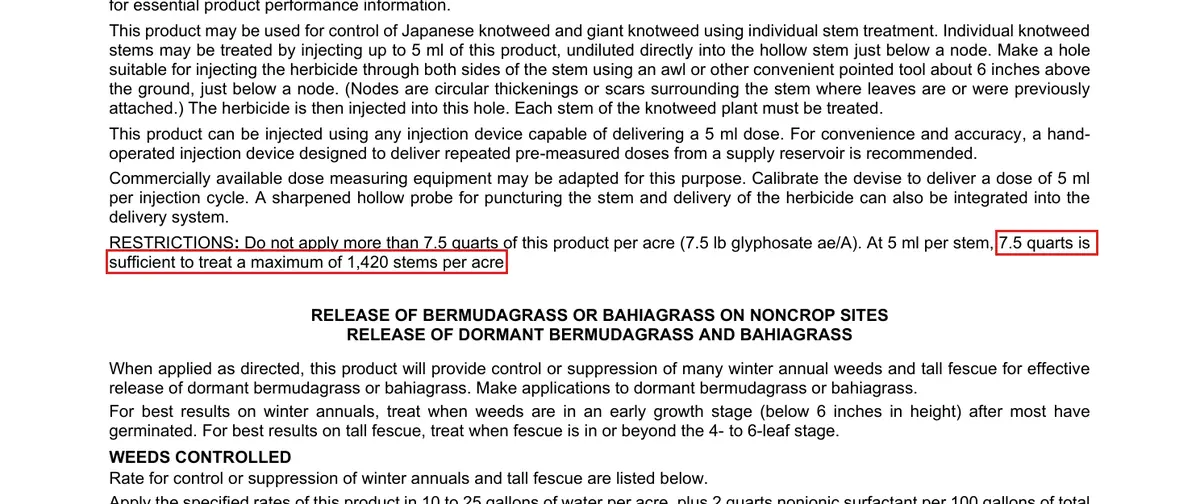
Injection puts herbicide only in the plant, so it suits knotweed growing among plants you want to keep. The catch is volume. AquaNeat’s label caps the product at 7.5 quarts per acre and states that at 5 mL per stem this “is sufficient to treat a maximum of 1,420 stems per acre” (EPA label 228-365, Nov. 2023, p. 22). Tide Glypho 5 puts the figure at about 1,500 stems per acre under its 8 quart cap (EPA label 84229-68).
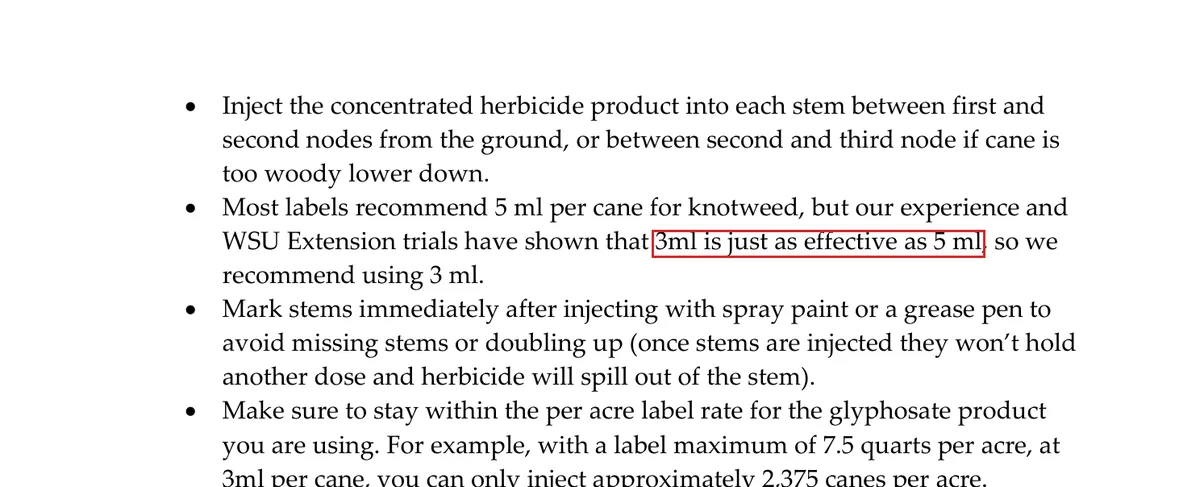
A dense stand blows through that ceiling. In the Welsh trial, injecting 3 to 5 mL into every stem worked out to 65 kg of glyphosate acid per hectare, about 58 lb per acre, nearly 8 times the 7.5 lb ae per acre AquaNeat allows (Jones et al.). King County’s answer is a smaller dose: “our experience and WSU Extension trials have shown that 3ml is just as effective as 5 ml”, which fits about 2,375 canes into a 7.5 quart cap (King County BMP, p. 11). The label you hold sets the dose; Drexel’s Imitator DA, for example, calls for 6 mL per stem (EPA label 19713-586).
Count your stems and enter them below. If your patch is smaller than the area shown, giving every stem the full label dose would exceed the label’s per-acre maximum; foliar spraying the same patch uses a fraction of the product.
- Product at 5 mL per stem (mL)
- 1,500
- Product at 5 mL per stem (fl oz)
- 50.7
- Smallest patch for 5 mL on every stem (sq ft)
- 9,203
- Product at King County's 3 mL (mL)
- 900
- Smallest patch at 3 mL under a 7.5 qt cap (sq ft)
- 5,502
Default: 300 stems take 1,500 mL (50.7 fl oz) at 5 mL each, which the AquaNeat label allows only on 9,203 sq ft or more (1,420 stems per acre). At King County's 3 mL, 900 mL and 5,502 sq ft. Worked example: 50 stems take 250 mL and need 1,534 sq ft. Read your own label's cap; Tide Glypho 5 states about 1,500 stems per acre.
| Stems | Product at 5 mL | Smallest patch at 1,420 stems/acre | Product at 3 mL | Smallest patch at 2,375 stems/acre |
|---|---|---|---|---|
| 50 | 250 mL (8.5 fl oz) | 1,534 sq ft | 150 mL | 917 sq ft |
| 300 | 1,500 mL (50.7 fl oz) | 9,203 sq ft | 900 mL | 5,502 sq ft |
| 1,000 | 5,000 mL (169.1 fl oz) | 30,676 sq ft | 3,000 mL | 18,341 sq ft |
Knotweed on stream banks and wet ditches
Where spray could reach water, use a glyphosate labeled for aquatic sites, such as AquaNeat (EPA Reg. No. 228-365), with an aquatic-approved surfactant (Penn State). Start at the furthest upstream patch, because rhizome and stem pieces float down and root (King County).
Two professional-only limits apply. In Washington, aquatic herbicides are Restricted Use Pesticides that only WSDA-licensed applicators with an aquatic endorsement may buy and apply for aquatic sites, and permits are generally required where herbicide may reach water (King County, 2015). In Pennsylvania, an application directed to the water required a permit from the Fish and Boat Commission when Penn State wrote its 2007 sheet (CREP Factsheet 4); confirm the current rule. Our page on the pesticide applicator license by state explains who can hold one.
Its rhizome mass gives poor erosion control, so replant the bank in year 2 or 3 with help from our guide to erosion control methods for slopes and banks.
Without herbicide: cutting, digging and covering
These work only on small patches and only with years of discipline. King County’s cutting schedule is to the ground twice a month or more from April to August, then monthly until frost, for 3 to 5 years, never letting stems pass 6 in. UConn’s lighter version is 3 cuts a year, the last by August 31, for at least 3 years (UConn IPM, May 2021). Penn State’s verdict is blunt: “Cutting alone is not an effective suppression approach” (Penn State).
Digging suits 50 stems or fewer: dig in August for 3 years in a row, bag every root piece and check for sprouts a week after each dig (King County). UConn advises against digging or pulling established plants because new shoots form on fragments. Covering needs geotextile or heavy black plastic at least 7 ft past the outer stems for 5 growing seasons or more, yet in the Welsh trial a 300 micron HDPE sheet was the least effective of all treatments.
Disposal and state rules
Bag crowns and rhizomes in heavy contractor bags for the trash or a transfer station, never the compost pile (UConn). King County composts stems only once fully dried and broken under 1 inch, notes that big stem piles have self-ignited, and says seeds can stay viable 15 years.
| State | Status | What it means for you | Rule (source) |
|---|---|---|---|
| New York | Prohibited invasive species (Japanese, giant, Bohemian) | No sale, import, purchase, transport, introduction or propagation; possession or transport for control or disposal is exempt | 6 NYCRR 575.3(d)(lx) to (lxii); 575.8(a)(2) and (3) |
| Pennsylvania | Class B noxious weed (Reynoutria spp.) | Violation to distribute, cultivate or propagate; listing notice 50 Pa.B. 801 (2020); research permit order May 16, 2026 | 3 Pa.C.S. 1515(b); 56 Pa.B. 2853 |
| Washington | Class B noxious weed; quarantine regulated article | Control required in designated counties and regions; plants, plant parts and seeds are quarantine regulated articles | WAC 16-750-011 (version effective Jan. 1, 2025); WAC 16-752-610 |
| Oregon | List B noxious weed (Japanese, giant, Bohemian, Himalayan) | State-listed noxious weed; ODA notes giant knotweed rhizomes may spread 65 ft | ODA noxious weed list |
| Connecticut | Invasive, prohibited by statute | No importation, movement, sale, purchase, transplanting, cultivation or distribution | Conn. Gen. Stat. 22a-381d; list updated Oct. 2024 |
| Maine | Do Not Sell list (Fallopia japonica) | Illegal to import, export, buy, sell or intentionally propagate for sale since Jan. 1, 2018 | Chapter 273, Do Not Sell Invasive Plant List |
| Federal | Biocontrol psyllid Aphalara itadori | APHIS found no significant impact for release (2020 lines; Murakami line notice June 22, 2026); releases need APHIS permits | Federal Register 2026-12429 |
New York’s rule bans transporting knotweed but exempts a person who possesses or transports it for control, identification or disposal (6 NYCRR 575.8(a)), so bagging and hauling your own cuttings to disposal is covered. Do not sell or give away soil from a treated patch in any of these states.
How we compiled this
We read 1 peer-reviewed field trial (Jones et al. 2018), 1 peer-reviewed excavation study (Fennell et al. 2018), 4 extension or county guides (Penn State 2020 and 2007, UConn 2021, King County 2015), 3 EPA-stamped glyphosate labels dated 2023 to 2025 that name Japanese knotweed, and 7 state or federal rules, all opened at the source on Nov. 21, 2026. We did not test any method. Metric trial rates are converted at 1 kg/ha = 0.892 lb/acre.
Frequently asked questions
Does vinegar kill Japanese knotweed?
Not to the rhizome. Acetic acid is a contact herbicide that “does not travel throughout the plant” (NPIC), and none of the 4 extension guides or the 19-treatment trial we read lists it. Our vinegar weed killer page gives the measured limits of acetic acid on perennials.
What is the natural enemy of Japanese knotweed?
The knotweed psyllid, Aphalara itadori, a sap-feeding insect from Japan. APHIS found no significant impact for releasing 2 lines in 2020 and a third, from Murakami, Japan, in a notice dated June 22, 2026; releases need APHIS permits (Federal Register 2026-12429).
Can Roundup kill Japanese knotweed?
Only a Roundup that contains glyphosate, and only with repeat treatment. Some Roundup-branded weed killers now contain triclopyr, fluazifop and diquat instead; check the EPA Reg. No. against our Roundup formula table. The 2 best treatments in the Welsh trial were glyphosate alone.
Why shouldn’t you pull Japanese knotweed?
Pulling snaps the rhizome, and each piece with a node can regrow; a fragment as light as 0.7 g has done so (Fennell et al., citing Brock and Wade 1992). UConn recommends hand-pulling for very young plants only.
What kills Japanese knotweed permanently?
No single treatment. In the 3-year Welsh trial nothing eradicated it; glyphosate sprayed in summer and autumn came closest (Jones et al. 2018). Plan on 3 to 5 years of late-season treatment and patrols 20 ft beyond the patch.
Sources
- Jones, Bruce, Fowler, Law-Cooper, Graham, Abel, Street-Perrott and Eastwood, Optimising physiochemical control of invasive Japanese knotweed, Biological Invasions 20: 2091 to 2105, Published Apr. 23, 2018. Accessed November 2026.
- Fennell, Wade and Bacon, Japanese knotweed (Fallopia japonica): an analysis of capacity to cause structural damage and typical rhizome extension, PeerJ 6: e5246, July 25, 2018. Accessed November 2026.
- Penn State Extension (Templeton, Gover, Jackson and Wurzbacher), Japanese Knotweed, Updated Feb. 24, 2020. Accessed November 2026.
- Penn State Vegetation Management (Gover, Johnson and Sellmer), Managing Japanese Knotweed, CREP Technical Assistance Factsheet 4, 2007. Accessed November 2026.
- UConn Extension IPM, Japanese Knotweed, Updated May 2021. Accessed November 2026.
- King County Noxious Weed Control Program, Invasive Knotweeds, Best Management Practices, July 2015. Accessed November 2026.
- U.S. EPA (Nufarm), AquaNeat Aquatic Herbicide label, EPA Reg. No. 228-365, Stamped Nov. 6, 2023. Accessed November 2026.
- U.S. EPA (Tide International), Tide Glypho 5 label, EPA Reg. No. 84229-68, Issued May 22, 2025. Accessed November 2026.
- U.S. EPA (Drexel Chemical), Imitator DA label, EPA Reg. No. 19713-586, Amended Jan. 15, 2025. Accessed November 2026.
- New York (via Cornell LII), 6 NYCRR 575.3, Prohibited invasive species, Current text. Accessed November 2026.
- New York (via Cornell LII), 6 NYCRR 575.8, Exemptions, Current text. Accessed November 2026.
- Pennsylvania Department of Agriculture, Temporary Order for a Research Project on the Noxious Weed Knotweed, 56 Pa.B. 2853, May 16, 2026. Accessed November 2026.
- Washington State Legislature, WAC 16-750-011, Class B noxious weeds, Effective Jan. 1, 2025. Accessed November 2026.
- Washington State Legislature, WAC 16-752-610, Regulated articles, Current text. Accessed November 2026.
- Oregon Department of Agriculture, Oregon noxious weed list, Current list. Accessed November 2026.
- Connecticut Invasive Plants Council (UConn CIPWG), Connecticut Invasive Plant List, Updated Oct. 2024. Accessed November 2026.
- Maine Department of Agriculture, Conservation and Forestry, Invasive Plants, Do Not Sell list, Current list. Accessed November 2026.
- USDA APHIS, Federal Register, Final supplemental EA and FONSI for field release of Aphalara itadori from Murakami, Japan, June 22, 2026. Accessed November 2026.
- National Pesticide Information Center, Vinegar (acetic acid) as an herbicide, Current page. Accessed November 2026.