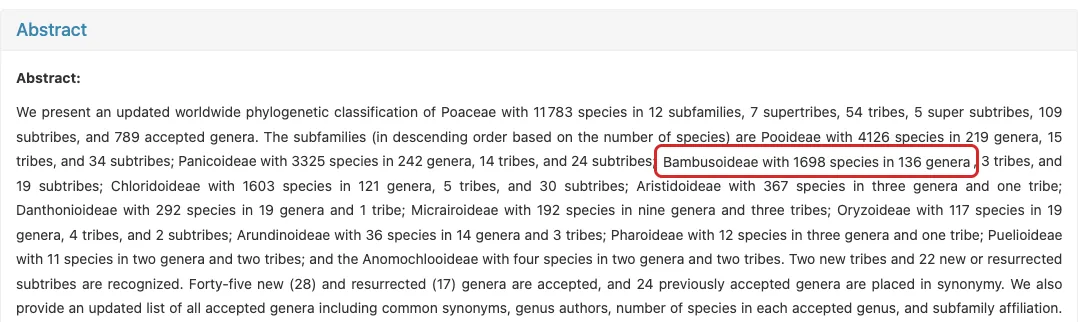
Is bamboo a grass? Yes. Bamboo is Bambusoideae, a subfamily of the grass family Poaceae with 1,698 species in 136 genera. It is not a tree: its canes have no vascular cambium, so they never thicken after they emerge.
The answer to “is bamboo a grass” has no hedge in it. The 2022 worldwide classification of the grasses by Soreng and 10 co-authors puts bamboo in subfamily Bambusoideae, the third largest of the 12 grass subfamilies, behind the subfamily that holds Kentucky bluegrass and the one that holds St. Augustinegrass (Journal of Systematics and Evolution, 2022). A 70-foot timber bamboo and a lawn of bermudagrass are cousins in the same family.
Most pages stop at that yes. This one adds two tables we compiled from primary documents: where bamboo sits among the grass subfamilies next to the lawn grasses you know, trait by trait against a tree, and the 10 U.S. state and local rules that decide whether you can plant it, from Connecticut’s 40-foot setback to the Montgomery County, Maryland, planting ban that started in July 2026.
Where does bamboo sit in the grass family?
Poaceae holds 11,783 species in 789 accepted genera, split into 12 subfamilies (Soreng et al. 2022). Bamboo is one of those subfamilies, not a separate family, so every bamboo is a grass in the same sense that every Kentucky bluegrass is. The USDA’s Germplasm Resources Information Network (GRIN) files the running bamboo genus Phyllostachys under Poaceae, subfamily Bambusoideae, tribe Arundinarieae (USDA GRIN, updated Aug. 2025).
| Grass subfamily | Species | Genera | Lawn or garden grass in it | Source |
|---|---|---|---|---|
| Pooideae | 4,126 | 219 | Kentucky bluegrass (Poa) | GRIN, Poa |
| Panicoideae | 3,325 | 242 | St. Augustinegrass (Stenotaphrum) | GRIN, Stenotaphrum |
| Bambusoideae (bamboos) | 1,698 | 136 | Golden, yellow groove and moso bamboo (Phyllostachys) | GRIN, Phyllostachys |
| Chloridoideae | 1,603 | 121 | Bermudagrass (Cynodon dactylon) | GRIN, Cynodon dactylon |
| Aristidoideae | 367 | 3 | Not checked | Soreng et al. 2022 |
| Danthonioideae | 292 | 19 | Not checked | Soreng et al. 2022 |
| Micrairoideae | 192 | 9 | Not checked | Soreng et al. 2022 |
| Oryzoideae | 117 | 19 | Not checked | Soreng et al. 2022 |
| Arundinoideae | 36 | 14 | Not checked | Soreng et al. 2022 |
| Pharoideae | 12 | 3 | Not checked | Soreng et al. 2022 |
| Puelioideae | 11 | 2 | Not checked | Soreng et al. 2022 |
| Anomochlooideae | 4 | 2 | Not checked | Soreng et al. 2022 |
Bamboo splits into three tribes. The tropical woody bamboos (Bambuseae) number about 800 species, the temperate woody bamboos (Arundinarieae) about 500, and the herbaceous bamboos (Olyreae) about 120, nearly all in the Americas, according to Lynn Clark’s bamboo lab at Iowa State University. The Olyreae are the surprise: about 124 species in 22 genera that look like broad-leaved forest grasses, with no woody canes at all (Wang et al. 2018). The grasses we cover in our comparison of 14 lawn grass types come from Pooideae, Panicoideae and Chloridoideae, the other three big subfamilies.
Bamboo is also native to the United States. The University of Maryland Extension counts three native American bamboos in the genus Arundinaria, called switch cane or river cane, which are very rare in Maryland and worth protecting where found (UMD Extension, updated Nov. 3, 2026). The bamboo in most U.S. yards is not one of them: it is usually an Asian Phyllostachys.
Why is bamboo not a tree?
A tree trunk gets wider every year because a layer of dividing cells, the vascular cambium, lays down new wood under the bark. Bamboo has no vascular cambium, so it shows “no secondary thickening growth,” as a 2011 study of moso bamboo fibers puts it (Wang et al., PLoS ONE 2011). Palms are the other familiar plants built this way; both are monocots, the seed-plant group that includes every grass.
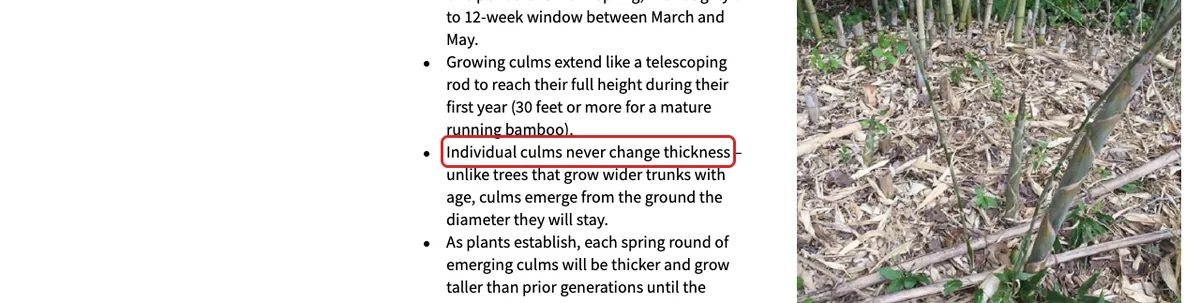
The practical sign is the cane. UMD Extension says individual culms “never change thickness”: a culm comes out of the ground at the diameter it will keep, telescopes to full height in its first year, and stops (UMD Extension). New culms emerge in a 6 to 12 week window between March and May, and a mature running bamboo reaches 30 feet or more. A grove gets taller only because each spring’s culms come up thicker than the last, fed by older, larger rhizomes.
| Trait | Lawn grass (e.g. bermudagrass) | Woody bamboo | Tree (e.g. oak, maple) | Source |
|---|---|---|---|---|
| Plant family | Poaceae | Poaceae, subfamily Bambusoideae | Many families, none of them Poaceae | Soreng 2022 |
| Vascular cambium (makes wood) | None | None | Yes | Wang 2011 |
| Stem gets thicker with age | No | No: a culm keeps its emergence diameter | Yes, one growth ring a year | UMD Extension |
| Stem structure | Jointed stems with nodes | Hollow internodes, solid nodes | Solid wood with bark | UMD Extension |
| When height is added | Every season, from the crown | First season only, in a 6 to 12 week spring flush | Every year, from shoot tips | UMD Extension |
| Largest size | Kept at mowing height | Up to 45 m (148 ft) tall and 36 cm (14 in) across | Varies by species | Iowa State bamboo lab |
| Fastest growth measured | Bermuda sprigs cover bare soil in 5 to 8 weeks | 114.5 cm (45 in) a day, moso bamboo | Hybrid poplar, 4 to 6 ft a year | Chen 2022; our fastest-growing trees ranking |
| Flowering | Most years | Whole stands at once, every few years to 120 years, then often die | Repeatedly once mature | Iowa State bamboo lab |
| How it spreads | Rhizomes, stolons or seed | Rhizomes, up to 15 ft a year in running types | Mostly seed | Fairfax County |
The “tree” label sticks because woody bamboos lignify. A 2022 study in The Plant Cell measured a single fast-growing moso internode depositing about 28 mg of lignin per gram of dry weight each day (Chen et al. 2022). That hardens the cane enough for flooring and scaffolding, but the cane is still a grass stem: no bark, no growth rings, and no new wood after its first year. If you are choosing a tall screen, our fastest-growing trees ranking covers real trees by measured growth.
How fast does bamboo grow?
The fastest measured rate is 114.5 cm (about 45 inches) in a day, recorded for moso bamboo (Phyllostachys edulis) by a team that examined more than 12,750 internodes on more than 510 culms from 17 populations (Chen et al., The Plant Cell 2022). The peak came when shoots were about 340 to 463 cm tall. The paper notes it beats the Guinness World Records figure of 91 cm (35 inches) a day for certain bamboo species (Guinness World Records).
That speed is a spring event, not a year-round rate. Each culm does all its height growth in a few weeks and then stops for life, so a grove does not keep adding 3 feet a day. What does keep moving is underground: Fairfax County and Montgomery County, Maryland, both say running bamboo rhizomes spread as much as 15 feet a year (Fairfax County; Montgomery County Council, Apr. 7, 2026).
How often does bamboo flower?
Rarely, and all at once. Woody bamboos show gregarious monocarpy: a whole population flowers together, with cycles from a few years to 120 years, and the culms often die afterward (Iowa State bamboo lab). Your lawn grass, by contrast, can send up seedheads every year.
Japan is watching one of those cycles now. Phyllostachys nigra var. henonis flowers about every 120 years; a stand that bloomed in 2020 had more than 80 percent of its culms flower over 3 years, set no seed, and was entirely dead 3 years after flowering, with no regeneration found (Yamada et al., PLOS ONE 2023). The authors expect wider flowering of the species across Japan in the 2020s.
Is bamboo invasive? Running versus clumping
Running bamboo can be; clumping bamboo usually is not. UMD Extension calls running types leptomorph: their rhizomes run with culms spaced apart and keep going until the growing tip is damaged. Clumping types are pachymorph, with short rhizomes and culms packed tight, and UMD considers them non-invasive, naming Fargesia (fountain bamboo) as the main clumping genus hardy in Maryland (UMD Extension). Lawn grasses spread the same two ways, by rhizomes and stolons, as our guide to which grasses spread on their own measures.
Clemson’s Home and Garden Information Center says running bamboo rhizomes can travel more than 100 feet from the parent plant but stay shallow, under 1 foot deep (Clemson HGIC 2320). In Maryland the invasive bamboos come from four genera, Phyllostachys, Pleioblastus, Pseudosasa and Bambusa, and the state regulates two species, golden bamboo (Phyllostachys aurea) and yellow groove bamboo (P. aureosulcata), with Bisset bamboo and arrow bamboo queued for assessment in 2026 (UMD Extension).
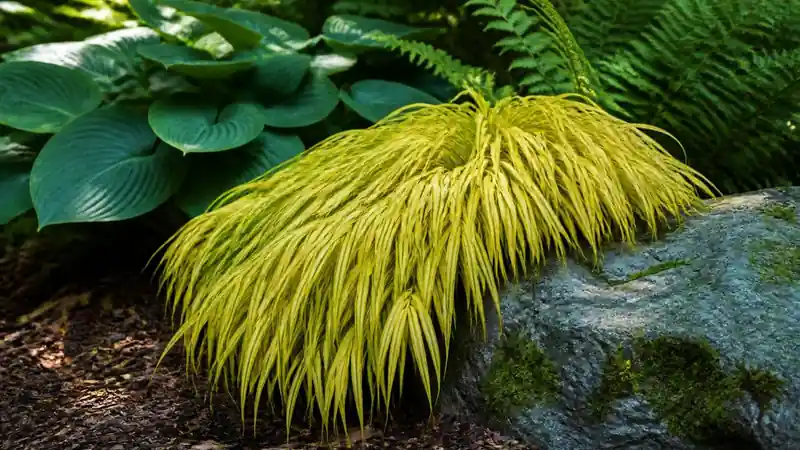
Several “bamboos” are not bamboo or not even grasses. UMD’s look-alike list: heavenly bamboo (Nandina domestica) is a barberry relative, lucky bamboo (Dracaena sanderiana) is a houseplant, and Japanese knotweed dies to the ground each winter. Nimblewill, a native lawn grass, looks like miniature bamboo but never forms woody culms; our sibling page on getting rid of nimblewill covers it. Japanese forest grass, whose leaves are often called bamboo-like, is a slow-spreading shade grass in our Hakonechloa guide.
Knotweed’s hollow, jointed canes turn brown at the first hard frost while running bamboo stays green, and the two need different plans: our year-by-year guide on how to kill Japanese knotweed times glyphosate to the late-summer sugar flow that a 19-treatment field trial found most effective.
1Does it die back to the ground every winter, with jointed stems and broad oval leaves?
YesLikely Japanese knotweed (Reynoutria japonica), an invasive perennial that is not a grass.
NoGo to the next question
2Does it have compound leaves, white flowers or red berries?
YesHeavenly bamboo (Nandina domestica), a barberry relative, not a grass; Maryland regulates it as invasive.
NoGo to the next question
3Is it a houseplant with fleshy, jointed green stems?
YesLucky bamboo (Dracaena sanderiana), not a true bamboo.
NoGo to the next question
4Is it a low lawn grass with wiry stems that never turn woody?
YesProbably nimblewill, a native perennial grass that looks like miniature bamboo.
NoGo to the next question
5Do new canes come up feet away from the clump, spaced out along underground runners?
YesRunning (leptomorph) bamboo such as Phyllostachys: contain it with a 60 to 80 mil HDPE or polypropylene barrier set 22 to 30 in deep, or remove it, and check your state and town rules.
NoClumping (pachymorph) bamboo such as Fargesia: UMD Extension considers clumping bamboos non-invasive; it widens slowly from a tight clump.
Source: University of Maryland Extension, Containing and removing bamboo (updated Nov. 3, 2026)
Is it illegal to grow bamboo in your yard?
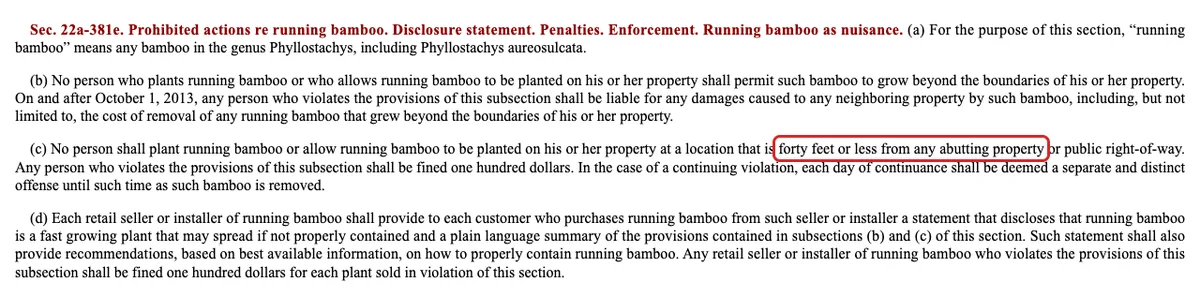
Not in most places, but the rules are tightening, and every one of them targets running bamboo, chiefly Phyllostachys. Of the 10 rules below, 3 restrict planting outright (Connecticut within 40 feet of a line, Montgomery County, Lexington), 1 requires containment (Fairfax County), 2 restrict sale of named species statewide (New York and Maryland), 2 let localities write ordinances (Virginia and Maryland), and 2 are advisory invasive lists with no legal force.
| Where | Rule | What it requires | Penalty or date | Source |
|---|---|---|---|---|
| Connecticut (statewide) | Conn. Gen. Stat. §22a-381e | No planting running bamboo (any Phyllostachys) 40 ft or less from an abutting property or public right-of-way; owner liable for damage and removal cost if it spreads; spread is a nuisance; sellers must hand buyers a containment disclosure | $100 fine, each day a separate offense; sellers $100 per plant | CGA, Chapter 446i |
| Virginia (statewide) | Va. Code §15.2-901.1 | Lets any locality require containment (barriers or trenching) and bar spread onto rights-of-way or neighbors | Up to $50 first violation, $200 later ones, $3,000 cap per 12 months | Virginia LIS |
| Fairfax County, Va. | Vegetation Ordinance | Owners must contain running bamboo on their own lot; no duty to treat bamboo that already spread next door; growing and selling stay legal | In force Jan. 1, 2023; civil penalties | Fairfax County, Oct. 18, 2022; Fairfax County running bamboo page |
| Maryland (statewide) | Md. Code, Local Gov’t §1-1318 | Lets counties and towns ban sale and planting of invasive bamboo, require barriers or trenches, order damage mitigated and set civil fines | Enabling law; the current text also covers tree of heaven and listed invasive trees | Maryland General Assembly |
| Maryland (statewide) | Prohibited Invasive Plant List | Golden bamboo and yellow groove bamboo may not be added to nursery stock | Effective Jan. 15, 2026; potted stock out by Jan. 15, 2027, in-ground by Jan. 15, 2028 | Maryland Dept. of Agriculture |
| Montgomery County, Md. | Bill 26-25, Native Plant Protection Act | Bans sale, planting and transplanting of invasive running bamboo; existing bamboo does not have to be removed | Passed Apr. 7, 2026; ban starts July 2026 | Montgomery County DEP, June 4, 2026; Bethesda Magazine, Apr. 8, 2026 |
| New York (statewide) | 6 NYCRR §575.3 | Golden bamboo and yellow groove bamboo are prohibited invasive species: no sale, import, purchase, transport, introduction or propagation | Adopted Sept. 10, 2014 | 6 NYCRR 575.3 via Cornell LII |
| Lexington, Mass. | Town Code Chapter 131, Running Bamboo Control | No planting, replanting or transplanting; existing running bamboo must be fenced with a barrier or grown in a planter | $100 a day while unconfined; spread after June 15, 2021 is enforceable | Town of Lexington |
| South Carolina | SC Invasive Pest Council list (advisory) | Golden bamboo listed Category II in all regions of the state | No legal penalty; list updated July 2024 | SC-IPC 2024 list |
| Georgia | Georgia Invasive Species Council plant list (advisory) | Golden bamboo listed in the same group as bermudagrass and bahiagrass | No legal penalty | GA Invasive Species Council |
Connecticut’s law has changed twice. Public Act 13-82 set a 100-foot setback in 2013, Public Act 14-100 cut it to 40 feet in 2014, and Public Act 16-89 removed the remaining reference to containment by a barrier system in 2016. The current text has no barrier exception, so in Connecticut a barrier does not make a planting inside 40 feet legal (Conn. Gen. Stat. §22a-381e, history note). Pages that still quote the 100-foot figure are citing the 2013 version.
This section is general information, not legal advice. Town and county codes change and many are not listed in the 10 rows above; check your municipal code and your state agriculture department before you plant, sell or remove bamboo near a property line.
How do you contain or remove bamboo?
Containment means a vertical rhizome barrier around the whole grove, and the public sources do not agree on its depth. Clemson HGIC says about 18 inches, because rhizomes stay in the top foot. UMD Extension says a 30 to 36 inch roll with 6 to 8 inches left above ground, which puts 22 to 30 inches below, in at least 60 mil polypropylene or HDPE and 80 mil for vigorous groves. Fairfax County says 36 inches with 30 below and 6 above. If you follow the deepest figure, 30 inches below ground satisfies all three.
UMD Extension rules out wood, concrete and sheet metal because they are more prone to developing holes and failing, while Clemson’s 2021 sheet still lists concrete and pressure-treated wood, then warns that wood rots and concrete cracks. Both agree a barrier deflects rhizomes rather than stopping them, so walk the lip each year and cut anything crossing it. A container is not a fix: UMD says rhizomes escape through drain holes and eventually break the pot.
Removal takes 2 to 5 years in the Fairfax County guidance and 2 to 3 years in Clemson’s. A short version of the published steps:
- Cut every culm as close to the ground as you can. Fairfax County says to treat the cut tops within 1 minute with a 20 to 25 percent glyphosate or triclopyr brush killer; UMD allows up to 5 minutes (Fairfax County).
- Let the stand regrow until the new leaves expand, then spray the leaves. Clemson’s rate is a 5 percent glyphosate solution mixed from a 41 percent concentrate; UMD finds systemic sprays most effective from mid-September to mid-October, repeated after 14 days (Clemson HGIC; UMD Extension).
- Without herbicide, mow the regrowth weekly at the lowest deck setting (Fairfax County), or knock over spring shoots every week during the 2-month emergence window (UMD Extension); Clemson expects 2 to 3 years of regular mowing.
- Dig or machine-lift rhizomes for the fastest result. Fairfax County requires an erosion and stormwater review under Chapter 124.1 if removal disturbs more than 2,500 sq ft, and a Virginia 811 call before digging.
- Dispose of culms and rhizomes in the trash, cut to 6 ft or shorter, not with yard waste (Fairfax County). In Montgomery County, Md., loads under 500 lb go free to the Shady Grove Transfer Station yard trim area.
Glyphosate is non-selective and kills any lawn grass it touches, so shield turf near the grove; our page on whether Roundup kills grass covers the label rates and regrowth timing. The label is the law: mix and apply any herbicide only at the rates and sites its EPA-registered label allows, and near water use only a product labeled for aquatic sites. Bermudagrass removal follows the same repeat-and-regrow logic; see how to kill bermuda grass.
If you want the look without the rhizomes, our ornamental grasses guide ranks 32 clumping and running grasses by size and zone, including natives that reach 75 inches.
How we compiled this
In November 2026 we read 26 documents, all but two of them primary (the exceptions are a Bethesda Magazine report and the Guinness record page): the 2022 Poaceae classification abstract, USDA GRIN genus records, three peer-reviewed bamboo papers (Chen 2022, Wang 2011, Yamada 2023), the Iowa State bamboo lab page, extension publications from the University of Maryland and Clemson, the Connecticut, Virginia and Maryland statute texts, New York’s Part 575 rule, Maryland’s 2026 prohibited plant list, county and town pages from Fairfax, Montgomery and Lexington, and the South Carolina and Georgia invasive lists. We did not grow, measure or treat any bamboo. Tribe species counts are rounded figures from the Iowa State lab and differ from the 2022 total because the sources use different years.
Frequently asked questions
Is bamboo considered a tree or a grass?
A grass. All 1,698 bamboo species belong to subfamily Bambusoideae of the grass family Poaceae. Tall woody bamboos look like trees, but their culms have no vascular cambium, form no growth rings and keep the diameter they emerged with.
What type of plant is bamboo?
A perennial, flowering, monocot grass. The 1,698 species fall into three tribes: tropical woody bamboos (about 800 species), temperate woody bamboos (about 500) and herbaceous bamboos (about 120), which have no woody canes.
Is bamboo considered a wood?
Not botanically. Wood comes from a vascular cambium, which bamboo lacks. The culm is a lignified grass stem; moso bamboo deposits about 28 mg of lignin per gram of dry weight a day while it grows, hard enough for flooring and building.
Is it hard to get rid of bamboo in a yard?
Yes, for running types. Fairfax County expects 2 to 5 years of cutting and herbicide, Clemson 2 to 3 years, because any rhizome piece left in the soil can resprout. Clumping bamboo can often be dug out.
Is bamboo considered a weed?
Where it escapes, yes. Clemson calls running bamboo a weed that needs 2 to 3 years of control; Connecticut’s statute declares bamboo that grows past a property line a nuisance; and New York and Maryland ban sale of golden and yellow groove bamboo.
What type of bamboo is non-invasive?
Clumping (pachymorph) bamboo, whose culms stay packed in one clump. UMD Extension (2026) considers clumping types non-invasive and names Fargesia as the main clumping genus hardy in Maryland. Avoid running Phyllostachys, Pleioblastus and Pseudosasa near a property line.
Sources
- Soreng RJ, Peterson PM et al., Journal of Systematics and Evolution 60(3):476 to 521, A worldwide phylogenetic classification of the Poaceae (Gramineae) III: An update, May 1, 2022. Accessed November 2026.
- USDA ARS, GRIN Taxonomy, Genus Phyllostachys, updated Aug. 1, 2025. Accessed November 2026.
- USDA ARS, GRIN Taxonomy, Genus Poa, updated Aug. 13, 2009. Accessed November 2026.
- USDA ARS, GRIN Taxonomy, Genus Stenotaphrum, updated Feb. 3, 2017. Accessed November 2026.
- USDA ARS, GRIN Taxonomy, Cynodon dactylon, current record. Accessed November 2026.
- Clark Lab, Iowa State University, Bamboo biology and systematics, undated. Accessed November 2026.
- Wang W et al., International Journal of Molecular Sciences, via PMC, Whole-genome comparison of chloroplast genomes of herbaceous bamboos (Olyreae), 2018. Accessed November 2026.
- Wang X et al., PLoS ONE, via PMC, Cell wall structure and mechanical properties of moso bamboo fibres, 2011. Accessed November 2026.
- Chen M et al., The Plant Cell 34(10), via PMC, Rapid growth of Moso bamboo (Phyllostachys edulis): cellular roadmaps, transcriptome dynamics, and environmental factors, 2022. Accessed November 2026.
- Guinness World Records, Fastest growing plant, undated. Accessed November 2026.
- Yamada T et al., PLOS ONE 18(6):e0287114, Does monocarpic Phyllostachys nigra var. henonis regenerate after flowering in Japan?, June 2023. Accessed November 2026.
- University of Maryland Extension, Containing and removing bamboo, updated Nov. 3, 2026. Accessed November 2026.
- Clemson Cooperative Extension, Home and Garden Information Center, Bamboo control, HGIC 2320, updated July 16, 2021. Accessed November 2026.
- Fairfax County, Va., Running bamboo, 2026. Accessed November 2026.
- Fairfax County, Va., News Center, 5 things to know about new running bamboo ordinance, effective Jan. 1, Oct. 18, 2022. Accessed November 2026.
- Montgomery County Council, Md., Montgomery County Council passes Native Plant Protection Act, Apr. 7, 2026. Accessed November 2026.
- Montgomery County Department of Environmental Protection, Md., New law prohibits invasive bamboo (bulletin), June 4, 2026. Accessed November 2026.
- Bethesda Magazine, Oh shoot! County Council votes to ban invasive running bamboo, Apr. 8, 2026. Accessed November 2026.
- Connecticut General Assembly, General Statutes Chapter 446i, Sec. 22a-381e, current through 2026. Accessed November 2026.
- Virginia General Assembly, LIS, Code of Virginia § 15.2-901.1, current Nov. 2026. Accessed November 2026.
- Maryland General Assembly, Local Government Article § 1-1318, current Nov. 2026. Accessed November 2026.
- Maryland Department of Agriculture, Maryland prohibited invasive plant law and regulations, list updated Jan. 2026. Accessed November 2026.
- New York State DEC, via Cornell Legal Information Institute, 6 NYCRR § 575.3, Prohibited invasive species, adopted Sept. 10, 2014. Accessed November 2026.
- Town of Lexington, Mass., Running bamboo (Chapter 131), 2021 bylaw. Accessed November 2026.
- South Carolina Invasive Pest Council, SCIPC invasive exotic plant list, July 2024. Accessed November 2026.
- Georgia Invasive Species Council, Invasive plants list, current Nov. 2026. Accessed November 2026.