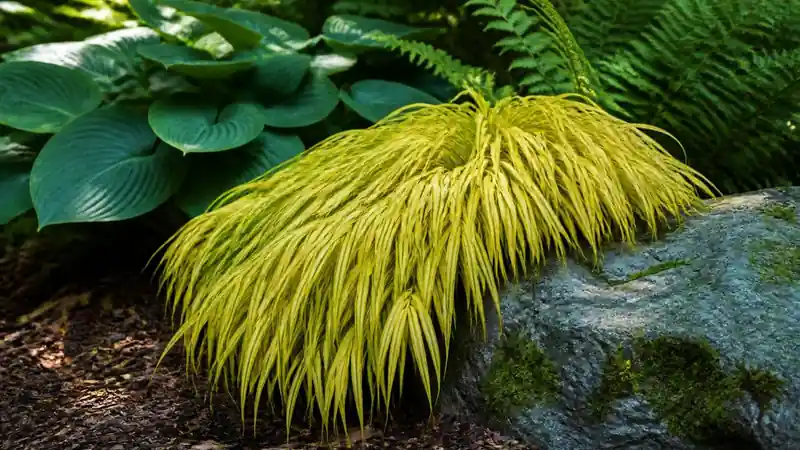
Japanese forest grass (Hakonechloa macra) is a slow-spreading, deciduous shade grass from Japan’s Mt. Hakone area that grows 12 to 18 inches tall in USDA zones 5 to 9 and needs moist, well-drained soil and afternoon shade.
Key takeaways
- The Missouri Botanical Garden lists Hakonechloa macra for zones 5 to 9 at 12 to 18 inches tall and up to 24 inches wide, in part shade and “consistently moist, well-drained soils” (MBG Plant Finder).
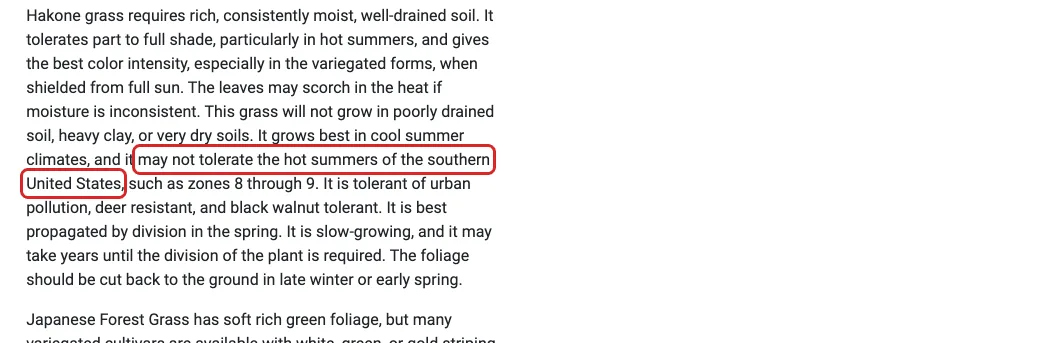
- NC State rates it for dappled light, partial shade (2 to 6 hours of direct sun) and deep shade (under 2 hours), and warns it “may not tolerate the hot summers” of zones 8 and 9 (NC State Extension).
- Cultivar sizes differ by source: ‘All Gold’ is 14 inches tall in MBG’s record and 9 to 14 inches at the grower Walters Gardens, and the ‘Nicolas’ plant patent measured foliage about 15 cm (6 inches) tall at 3 years (US PP19,898).
- Rutgers rates Hakonechloa macra “A, Rarely Damaged” by deer (Rutgers NJAES), and MBG, NC State and UW all say its rhizomes spread slowly and it is not considered invasive.
- Illinois Extension spaces it 10 to 18 inches apart (Illinois Extension): 144 plants per 100 sq ft at 10 inches, 45 at 18 inches. Quart and small-pot plants were listed at $17.32 to $25.00 on Oct. 30, 2026.
What is Japanese forest grass?
Japanese forest grass, Hakonechloa macra, is a deciduous perennial grass that spreads by rhizomes and is the only species in its genus. It grows wild on wet, rocky cliffs and in moist woods of central Japan, including the area around Mt. Hakone that gives the genus its name, and forms cascading mounds 12 to 18 inches tall with leaves up to 10 inches long (MBG).
UW Extension places its home in the Tokaido district of southeast Honshu, where its Japanese name is urahagusa, and rates the green species hardy to zone 4 while most cultivars are listed to zone 5 (UW Extension). On the USDA Plant Hardiness Zone Map, zone 5 means an average coldest winter night of minus 20 to minus 10°F.
| Measure | Japanese forest grass (green species) | Source |
|---|---|---|
| Botanical name | Hakonechloa macra, family Poaceae; the genus has 1 species | MBG; UW |
| Native range | Wet rocky cliffs and moist woods, central Japan (Mt. Hakone; Tokaido district, Honshu) | MBG; UW |
| USDA zones | 5 to 9 (MBG, NC State, Morton); species to zone 4 (UW) | MBG; NC State; UW |
| Height | 12 to 18 in (MBG, NC State); 12 to 24 in (Morton) | MBG; Morton |
| Spread | 12 to 24 in | MBG |
| Leaf | To 10 in long and 3/8 in wide, papery, bamboo-like | NC State |
| Flowers | Yellow-green panicles, July to August, often hidden by leaves | NC State; MBG |
| Light | Part shade; dappled, 2 to 6 hours or under 2 hours of direct sun | MBG; NC State |
| Soil | Humus-rich, consistently moist, well-drained; pH acid (under 6.0) to neutral | MBG; NC State |
| Growth rate | Slow | NC State |
| Deer | A: rarely damaged | Rutgers |
| Tolerates | Black walnut, urban air pollution | MBG |
| Award | ‘Aureola’: Perennial Plant Association 2009 Perennial Plant of the Year | Purdue Extension |
Which Japanese forest grass cultivar should you choose?
Pick by color first, then by light. ‘All Gold’ and ‘Aureola’ give the brightest gold but burn soonest in sun; the green species and ‘Beni-kaze’ hold up best in shade; ‘Albostriata’ grows tallest, to about 3 ft, and takes the most sun (UW Extension). The sizes below come from the Missouri Botanical Garden, the wholesale grower Walters Gardens and, for 3 cultivars, the U.S. plant patents.
| Cultivar | Leaf color | Height x spread | Light and behavior | Zones | Source |
|---|---|---|---|---|---|
| Species (green) | Bright green; red to pink blush in fall | 12 to 18 x 12 to 24 in | MBG: hardier and better in full sun than ‘Aureola’ | 5 to 9 (MBG); 4 (UW) | MBG; NC State |
| ‘Aureola’ | Gold with narrow green stripes; red to pink in fall | 15 in tall (MBG); 12 to 18 in (Illinois); 1 to 2 ft x 2 to 3 ft (Walters); 2 x 3 ft (UK Extension) | Morton: foliage more likely to burn in hot sun | 5 to 9 | MBG; Illinois; Walters; UK |
| ‘All Gold’ | Solid golden yellow | 14 x 18 in (MBG); 9 to 14 x 18 to 24 in (Walters); 12 to 15 in (Morton) | UW: more upright and spiky, slow growing | 5 to 9 | MBG; Walters; Morton |
| SUNFLARE (‘HABsf1007’) | Gold with burgundy-red streaks; chartreuse in low light | 30 to 45 cm x 45 to 60 cm (about 12 to 18 x 18 to 24 in) at 3 to 5 years | Patent: vigorous; MBG: brightest with morning sun and afternoon shade | At least 5 | US PP27,734; MBG |
| ‘Beni-kaze’ | Green; red and gold in fall | Up to 18 x 36 in | PP27,734 calls it less cold hardy and less vigorous than SUNFLARE, with a high rate of reversion | 5 to 9 (MBG) | MBG; US PP27,734 |
| ‘Nicolas’ | Green to yellow-green; orange and red in fall | Foliage about 15 cm (6 in), 24 cm (9.5 in) in bloom, 61 cm (24 in) wide at 3 years; 8 to 16 x 16 to 22 in (MBG) | Patent: dwarf, relatively vigorous | 5 to 9 | US PP19,898; MBG |
| ‘Fubuki’ | Green and white stripes; orange to bronze in fall | 14 x 18 in (MBG); 28 cm (11 in) culm plus top leaf on 9-month plants | Patent: more compact than its parent ‘Aureola’ | At least 5 | MBG; US PP21,757 |
| ‘Albostriata’ | Green with creamy white stripes | Up to 3 ft | UW: more sun tolerant and faster than gold forms; may be hardier | Not given | UW; NC State |
| ‘Stripe It Rich’ | Gold and white stripes | 6 to 10 in | Smallest listed by Morton | Not given | Morton |
| ‘Naomi’ | Yellow and green; red-purple in fall | Similar height to ‘Nicolas’ (PP19,898) | Selected by the ‘Nicolas’ breeder in France | Not given | Morton; US PP19,898 |
Treat any single height as a midpoint. MBG’s header gives 1 to 1.5 ft for every cultivar, its own ‘Nicolas’ text says 8 to 16 inches, and the ‘Nicolas’ patent measured foliage about 15 cm (6 inches) on 3-year plants (US PP19,898). Kentucky, which gave ‘Aureola’ its 2005 Theodore Klein Plant Award, lists it at 2 ft by 3 ft (UK Nursery Crop Extension).
Is ‘All Gold’ or ‘Aureola’ better?
‘Aureola’ is the more forgiving plant and ‘All Gold’ the brighter one. ‘Aureola’, gold with green stripes, was the Perennial Plant Association’s 2009 Perennial Plant of the Year (Purdue Extension) and reaches 1 to 2 ft at Walters Gardens. ‘All Gold’ is solid gold, upright and slower at 9 to 14 inches, better for edging and pots.
How much sun can Japanese forest grass take?
Two to six hours of direct sun, mostly in the morning, suits most gardens. NC State lists dappled light, partial shade (2 to 6 hours of direct sun) and deep shade (under 2 hours) as workable (NC State), and MBG says foliage burns in full sun and loses color in full shade, especially on variegated cultivars (MBG). Full sun works only where summers stay cool (UW).
| Climate or region | Light that works | What happens outside it | Source |
|---|---|---|---|
| Cool summers (upper Midwest, Wisconsin) | Light to heavy shade; full sun tolerated | In full sun, variegation bleaches to creamy white | UW Extension |
| Northern Illinois and Chicago (zones 5 and 6) | Light to moderate shade; partial sun, 4 to 6 hours | ‘Aureola’ foliage more likely to burn in hot sun | Illinois; Morton Arboretum |
| St. Louis | Part shade | Gold striping turns lime green in deeper shade; leaves burn in full sun | MBG |
| North Carolina (mountains, piedmont and coast) | Dappled light, 2 to 6 hours, or under 2 hours of direct sun | Leaves scorch in heat if moisture is inconsistent | NC State |
| Hot-summer South, zones 8 and 9 | Close to full shade | NC State: may not tolerate the hot summers at all | MBG; NC State |
| Grower rating, all cultivars sold | Part shade (4 to 6 hours of direct sun) to full shade | Not rated for full sun | Walters Gardens |
| United Kingdom (maritime) | Full sun, partial shade or full shade | Rated H7, hardy below minus 20°C | RHS |
Leaf color tracks light, so the right spot depends on the cultivar. MBG reports that ‘Aureola’ striping shows gold in part shade in St. Louis and turns lime green in deeper shade (MBG), and the SUNFLARE patent describes burgundy-red streaks under higher light that fade to chartreuse at lower light (US PP27,734). Give gold or red cultivars morning sun.
Why is my Japanese forest grass turning brown?
Summer browning is almost always scorch: MBG and NC State both say leaves scorch in hot summers when soil moisture is inconsistent, and MBG adds that foliage burns in full sun (MBG). Fall browning is normal: the leaves turn orange to reddish, then light brown, and collapse for winter (UW Extension). Bare patches in spring usually mean slow emergence or frost heaving, not a dead plant.
| What you see | Likely cause | What to do | Source |
|---|---|---|---|
| Crisp tan tips and edges in July or August | Sun scorch plus uneven moisture | Water to keep soil evenly moist; move to morning sun or dappled shade in spring | MBG; NC State |
| Stripes faded to creamy white | Full sun in a cool-summer climate | Move to partial or dappled shade | UW |
| Gold cultivar turned lime green | Too much shade | Give 2 to 6 hours of morning sun | MBG; NC State |
| Whole clump orange, then tan, in fall | Normal deciduous dormancy | Leave it standing; cut back in late winter | UW; Morton |
| No shoots by mid-spring | Warm-season grass; slow to reappear | Wait before replacing; new divisions also “sit” for several weeks | UW |
| Crown pushed out of the soil after winter | Root heaving from freeze and thaw | Press back in; put a thick mulch layer over crowns before next winter | NC State; MBG |
| Yellowing, sparse growth in wet clay | Poor drainage | Replant in raised, organic soil; NC State says it will not grow in poorly drained soil or heavy clay | NC State |
Consistent water matters most in the first season. UW says the grass performs best in evenly moist soil, especially during its first spring flush and hot weather (UW), and Walters Gardens tells growers that Hakonechloa is slow to root, so water management stays critical until plants establish (Walters Gardens). Our drip irrigation setup guide covers a timer-run line for shade beds.
How far apart should you plant Japanese forest grass?
Space plants 10 to 18 inches apart, the range Illinois Extension gives for Hakone grass as a ground cover (Illinois Extension). At 12 inches on center that is 100 plants per 100 sq ft, and at 18 inches about 45. The grass spreads slowly by rhizomes, so tight spacing closes a bed sooner; RHS puts time to maturity at 2 to 5 years (RHS).
| Spacing on center | Sq ft per plant | Plants per 100 sq ft | Plants for a 4 x 10 ft border (40 sq ft) | Plant cost at $18.99 per quart |
|---|---|---|---|---|
| 10 in | 0.69 | 144 | 58 | $1,101.42 |
| 12 in | 1.00 | 100 | 40 | $759.60 |
| 15 in | 1.56 | 64 | 26 | $493.74 |
| 18 in | 2.25 | 44.4 (45) | 18 | $341.82 |
| 24 in | 4.00 | 25 | 10 | $189.90 |
- Plants needed
- 40
Plants = bed area ÷ (spacing in feet squared), rounded up. Default: a 40 sq ft border at 12 in = 40 plants; at $17.32 to $25.00 per quart or small pot, $692.80 to $1,000. The $56.95 Garden Goods Direct 1 gal listing is left out of the range.
Plant price depends mostly on pot size and on whether the cultivar is patented. On Oct. 30, 2026, quarts and 3 to 4.5 inch pots listed at $17.32 to $25.00 and 1 gallon pots at $19.95 to $32.00, plus one $56.95 outlier. The top small-pot prices were for patented SUNFLARE, and most listings were sold out until spring.
Swipe the table sideways to see every column.
| Cultivar | Pot size | Price | Seller | Stock on Oct. 30, 2026 |
|---|---|---|---|---|
| ‘Beni-kaze’ | Quart | $17.99 | Great Garden Plants | Sold out |
| ‘Aureola’ | Quart | $18.99 | Garden Crossings | Sold out |
| ‘All Gold’ | Quart | $18.99 | Garden Crossings | Sold out |
| ‘All Gold’ | 3 in pot | $17.32 | American Meadows | Discontinued |
| ‘All Gold’ | 4.5 in pot | $18.00 | NH Hostas | In stock |
| SUNFLARE | 3 in pot | $24.99 | Spring Hill Nursery | Sold out |
| SUNFLARE | 3.5 in pot | $25.00 | Plant Delights Nursery | Sold out on page |
| ‘Aureola’ | 1 gal | $19.95 | Singtree | In stock |
| Species (green) | 1 gal | $19.95 | Singtree | Sold out |
| ‘All Gold’ | 1 gal | $22.99 | Mandy’s Nursery | In stock |
| ‘Albostriata’ | 1 gal | $22.99 | Plant Detectives | In stock |
| ‘Beni-kaze’ | 1 gal | $24.58 | ServeScape | Sold out |
| ‘All Gold’ | 1 gal | $32.00 | BB Barns | Sold out |
| ‘All Gold’ | 1 gal | $56.95 | Garden Goods Direct | Low stock |
How do you plant, cut back and divide Japanese forest grass?
Plant or divide in spring as new shoots appear, keep the soil evenly moist through the first summer, mulch over the crowns before winter and cut old leaves to the ground in late winter before new shoots emerge (MBG). UW Extension notes that new divisions “sit” for several weeks while they root before putting on top growth (UW).
- Pick the spot: 2 to 6 hours of morning sun or dappled shade, with afternoon shade where summers are hot, as in zones 8 and 9 (NC State).
- Check the soil: NC State lists pH under 6.0 to neutral and high organic matter. A soil test costs less than replacing a bed of plants; in heavy clay, follow our clay soil guide or plant in a raised bed, since the grass will not grow in poorly drained clay.
- Plant in spring, 10 to 18 inches apart (Illinois Extension), at the depth the plant sat in its pot. Purdue notes fall division also works (Purdue).
- Water to keep the root zone evenly moist, especially during the first spring flush and hot spells (UW).
- Before winter, put a thick mulch layer over the crowns to stop frost heaving (NC State); our mulch calculator converts bed area and depth to bags or cubic yards.
- Cut the dead leaves to the ground in late winter to early spring, before new shoots emerge (MBG). Morton Arboretum leaves them standing through winter for interest (Morton).
- Divide in spring just as new foliage emerges, every 2 to 3 years or when you want more plants (UW). NC State says it may take years before division is needed.
Can you grow Japanese forest grass in a pot?
Yes, and the cascading habit suits containers, which MBG lists among its uses (MBG). Winter is the catch: UW Extension says it will not overwinter in an exposed container above ground, so bury the pot in late fall or move it to a cool, sheltered spot such as an unheated garage (UW). ‘All Gold’ at 9 to 14 inches fits a pot better than ‘Albostriata’ at up to 3 ft.
Can you divide a patented cultivar?
Not for sale or for giving away while the patent runs. A U.S. plant patent gives the holder the right to exclude others from asexually reproducing the plant and from using or selling plants so reproduced (35 U.S.C. 163), and a patent lasts 20 years from filing (35 U.S.C. 154). Division is asexual reproduction. ‘Aureola’, ‘All Gold’ and ‘Beni-kaze’ are described as unpatented in the patents themselves.
| Cultivar | U.S. plant patent | Filed | Granted | Anticipated expiration (Google Patents) |
|---|---|---|---|---|
| ‘Nicolas’ | PP19,898 | March 31, 2008 | April 7, 2009 | March 31, 2028 |
| ‘Fubuki’ | PP21,757 | Dec. 7, 2009 | March 1, 2011 | Dec. 7, 2029 |
| SUNFLARE (‘HABsf1007’) | PP27,734 | Dec. 2, 2015 | Feb. 28, 2017 | Dec. 2, 2035 |
| ‘Aureola’, ‘All Gold’, ‘Beni-kaze’ | None (“not patented” or “unpatented” in PP19,898 and PP27,734) | n/a | n/a | n/a |
This section is general information, not legal advice. Patent status and licensing terms can change; read the plant tag and ask the patent holder before propagating a patented cultivar for sale.
Is Japanese forest grass deer resistant or invasive?
It is deer resistant and not considered invasive. Rutgers rates Hakonechloa macra “A, Rarely Damaged” in its landscape plants rated by deer resistance (Rutgers NJAES), and MBG says deer tend to avoid it. MBG, NC State and UW all say the rhizomes spread slowly and the plant is not considered invasive, and UW adds that cultivars do not produce viable seed (UW).
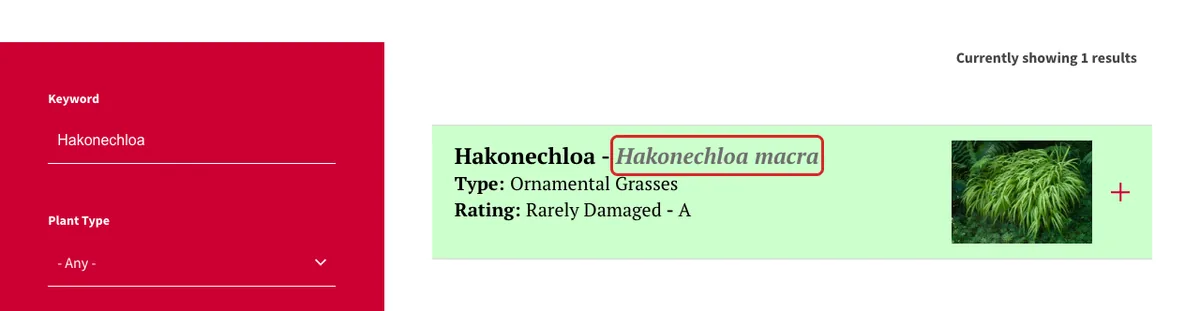
Hakonechloa does not appear on the federal noxious weed list (7 CFR 360.200), and MBG reports no serious insect or disease problems plus tolerance of black walnut and urban air pollution (MBG). Rutgers notes no plant is deer proof; none of the extension pages we read rates rabbit resistance.
Which “Japanese grass” is which?
“Japanese grass” points to at least 4 different plants. EDDMapS lists it as a common name for Japanese stiltgrass, an invasive annual weed (EDDMapS); Japanese bloodgrass is a red form of cogongrass, a federal noxious weed; Zoysia japonica is Japanese lawngrass; and Hakonechloa macra is the shade ornamental on this page. Check the botanical name on the tag before you buy or pull anything.
| Name you saw | Botanical name | What it is | Status | Source or our guide |
|---|---|---|---|---|
| Japanese forest grass, Hakone grass | Hakonechloa macra | Slow, deciduous shade ornamental, 12 to 18 in | Not considered invasive | MBG |
| Japanese stiltgrass, also “Japanese grass”, Nepalese browntop | Microstegium vimineum | Invasive annual grass of shady woods and lawns; seed stays viable in soil up to 5 years | Invasive | EDDMapS; Penn State Extension; our lawn weed guide |
| Japanese bloodgrass | Imperata cylindrica ‘Rubra’, ‘Red Baron’ | Red-leaved ornamental form of cogongrass | I. cylindrica is a federal noxious weed; a federal permit is required to move it interstate | 7 CFR 360.200; UW Extension |
| Japanese lawngrass | Zoysia japonica | Warm-season lawn grass | Lawn species | our zoysia guide |
| Mondo grass | Ophiopogon japonicus | Grass-like ground cover, not a true grass | Ground cover | our monkey grass guide |
A sprawling annual with a silvery, off-center stripe on each leaf is stiltgrass (Penn State Extension). Our ornamental grass guide compares Japanese forest grass with sun-loving clump grasses.
What grows well with Japanese forest grass?
Plants that share its moist, part-shade conditions and contrast with its fine, arching leaves. UW Extension pairs it with large green or blue hostas, ferns and mugo pine, and suggests dark-leaved heuchera such as ‘Obsidian’, ‘Plum Pudding’ or ‘Cathedral Windows’ to set off gold forms (UW Extension). NC State lists Brunnera macrophylla and Phlox stolonifera as plants that fill a similar niche (NC State).
| Companion | Why it pairs | Source |
|---|---|---|
| Hosta, including ‘Sum and Substance’ | Broad leaves contrast with fine blades; gold hosta echoes ‘All Gold’ | UW |
| Heuchera ‘Obsidian’, ‘Plum Pudding’, ‘Cathedral Windows’ | Dark leaves behind gold or variegated grass | UW |
| Ferns | Same moist, shady site | UW |
| Pulmonaria (green mottled) and Brunnera (green or silver) | Spring-flowering shade perennials with bold leaves | UW; NC State |
| Bleeding heart ‘Goldheart’ | Gold color echo | UW |
| Astilbe ‘Burgundy’, ‘Queen of Night’ tulips | Dark flowers against gold or cream leaves | UW |
| Phlox stolonifera | Low shade ground cover in the same niche | NC State |
Which claims about Japanese forest grass do guides disagree on?
Five points recur in care guides with different answers, and the primary sources split too. The largest is winter: Morton Arboretum says the grass stays standing and gives winter interest (Morton), while UW Extension says it does not provide winter interest and dies back to the ground (UW). Both cut it back in late winter or early spring.
| Question | One source says | Another source says | What to do |
|---|---|---|---|
| Winter interest? | Stays standing; leave for winter interest (Morton) | Collapses; no winter interest (UW) | Leave leaves on until late winter either way; they shelter the crown |
| How often to divide? | Every 2 to 3 years (UW) | May take years before division is needed (NC State); rarely needed (Purdue) | Divide only for more plants or a crowded center |
| Is ‘Aureola’ the same as ‘Alboaurea’? | “Sometimes listed as ‘Alboaurea’” (UW) | Separate cultivars; ‘Alboaurea’ has creamy white, yellow and green stripes (NC State) | Buy by the cultivar on the tag; expect white in ‘Alboaurea’ |
| Full sun? | Full sun, partial or full shade (RHS, UK climate) | Foliage burns in full sun (MBG); full sun only in cool summers (UW) | Outside cool-summer areas, give afternoon shade |
| Hardiest zone? | Zone 5 (MBG, NC State) | Species to zone 4; cultivars often zone 5 (UW) | In zone 4, plant the green species with winter mulch |
| Toxic to dogs? | “Nontoxic to dogs” (Almanac, no source cited) | Not rated on any extension page we read | Treat as unrated; call a veterinarian if a pet eats a lot |
Where should you plant Japanese forest grass?
In a moist, well-drained, part-shade bed where afternoon sun does not reach it in hot-summer zones 8 and 9. Skip it in poorly drained clay, very dry soil or all-day sun outside cool-summer regions, where NC State and MBG both expect scorch or failure (NC State). The table and flowchart below hold the same logic.
| If your situation is | Do this | Why (source) |
|---|---|---|
| Zone 4 winter (minus 30 to minus 20°F) | Plant the green species, not a cultivar; mulch the crowns | Species hardy to zone 4, cultivars often zone 5 (UW) |
| Heavy clay, standing water or very dry soil | Fix drainage and add organic matter first, or choose another plant | Will not grow in poorly drained, heavy clay or very dry soils (NC State) |
| Afternoon sun in zones 8 and 9 or another hot-summer area | Move to morning sun or dappled shade | Leaves scorch; may not tolerate zone 8 and 9 summers (NC State) |
| Under 2 hours of direct sun | Plant the green species or ‘Beni-kaze’ | Gold striping turns lime green in deep shade (MBG) |
| 2 to 6 hours of morning sun, cool or moderate summers | Plant ‘All Gold’, ‘Aureola’ or SUNFLARE | Brightest color with morning sun and afternoon shade (MBG) |
| Want a ground cover fast | Plant 10 to 12 in apart and accept 100 to 144 plants per 100 sq ft | Spacing range 10 to 18 in (Illinois) |
| Container on a patio in zone 5 or 6 | Use ‘All Gold’ and move the pot to an unheated garage for winter | Will not overwinter in an exposed container (UW) |
| Heavy deer browsing | Plant it | Rated A, rarely damaged (Rutgers) |
1Is your winter low below minus 20°F (USDA zone 4)?
YesPlant the green species, which UW rates to zone 4, and mulch the crowns; most cultivars are rated to zone 5.
NoGo to the next question
2Is the soil heavy clay, poorly drained or very dry?
YesFix the soil or choose another plant: NC State says it will not grow in those soils.
NoGo to the next question
3Does the spot get afternoon sun in zones 8 and 9 or another hot-summer area?
YesMove it to morning sun or dappled shade; NC State says it may not tolerate zone 8 and 9 summers.
NoGo to the next question
4Does the spot get under 2 hours of direct sun?
YesPlant the green species or 'Beni-kaze'; gold cultivars turn lime green in deep shade (MBG).
NoPlant 'All Gold', 'Aureola' or SUNFLARE 10 to 18 in apart in 2 to 6 hours of morning sun with evenly moist soil.
Source: UW Extension; NC State Extension; Missouri Botanical Garden; Illinois Extension
Japanese forest grass is one of few ornamental grasses NC State rates for deep shade, under 2 hours of direct sun; for full sun, our ornamental grass guide and fountain grass guide cover grasses that need it. More plant profiles sit in our turf and trees section.
How we compiled this
In October 2026 we read 7 Missouri Botanical Garden records, 6 extension services’ pages (NC State, UW Madison, Illinois, Kentucky, Purdue, Penn State), Morton Arboretum, RHS and Rutgers profiles, 3 U.S. plant patents, 2 Walters Gardens grower pages, EDDMapS, 7 CFR 360.200 and 14 retailer listings. We grew and measured nothing; patent sizes are the inventors’, and each figure names its source.
| Question | Short answer | Source |
|---|---|---|
| Zones | 5 to 9; green species to zone 4 | MBG; UW |
| Size | 12 to 18 in tall, 12 to 24 in wide | MBG |
| Light | 2 to 6 hours of morning sun or dappled shade; full sun only in cool summers | NC State; UW |
| Spacing | 10 to 18 in | Illinois |
| Cut back | To the ground in late winter, before new shoots | MBG |
| Deer | A, rarely damaged | Rutgers |
Frequently asked questions
Does Japanese forest grass come back every year?
Yes. It is a deciduous perennial hardy in USDA zones 5 to 9 (MBG), with the green species rated to zone 4 by UW Extension. The leaves die back in fall and the crown regrows each spring, though UW notes it is slow to reappear because it is a warm-season grass. Container plants need a sheltered spot to survive winter.
Is Japanese forest grass toxic to dogs?
No source we read rates it. The Almanac calls it nontoxic to dogs without citing a source, and the MBG, NC State, UW and Morton profiles carry no toxicity warning. If a pet eats a large amount and shows symptoms, call a veterinarian or the ASPCA Animal Poison Control Center at (888) 426-4435, the number the ASPCA publishes (ASPCA).
How fast does Japanese forest grass spread?
Slowly. NC State rates its growth rate slow (NC State), Morton Arboretum says the rhizomes spread “very slowly”, and RHS gives 2 to 5 years to maturity. The ‘Nicolas’ patent measured 3-year-old plants about 61 cm (24 inches) wide in 26 cm containers, and Illinois Extension spaces plants 10 to 18 inches apart so a bed closes in.
Is Japanese forest grass drought tolerant?
No. NC State says it will not grow in very dry soil and its leaves scorch in heat when moisture is inconsistent (NC State). UW Extension says it performs best in evenly moist soil, especially during its first spring growth and hot weather. In a dry shade bed under maples, plan on drip irrigation or choose a different ground cover.
When should you cut back Japanese forest grass?
In late winter to early spring, before new shoots emerge, cutting the old leaves to the ground (MBG). Morton Arboretum recommends leaving the foliage standing through winter rather than cutting it in fall, and NC State gives the same late-winter to early-spring timing. Cutting after new shoots appear risks clipping the new growth.
Sources
- Missouri Botanical Garden, Plant Finder: Hakonechloa macra, Current record. Accessed October 2026.
- Missouri Botanical Garden, Plant Finder: ‘Aureola’, ‘All Gold’, ‘Beni-kaze’, ‘Nicolas’, ‘Fubuki’ and ‘HABsf1007’ SUNFLARE records, Current records. Accessed October 2026.
- NC State Extension, Plant Toolbox: Hakonechloa macra, Japanese forest grass, Current page. Accessed October 2026.
- University of Wisconsin Madison Extension, Hakone grass, Hakonechloa macra (Susan Mahr; updated by Bruce Spangenberg), Updated 2025. Accessed October 2026.
- University of Illinois Extension, Hakone grass, ground covers, Current page. Accessed October 2026.
- University of Kentucky Nursery Crop Extension, Hakonechloa macra ‘Aureola’, 2005 Theodore Klein Plant Award winner, Current page. Accessed October 2026.
- Purdue Extension, Hakonechloa grass named 2009 Perennial Plant of the Year, 2009 article. Accessed October 2026.
- The Morton Arboretum, Japanese forest grass, Current page. Accessed October 2026.
- Royal Horticultural Society, Hakonechloa macra plant profile, Current page. Accessed October 2026.
- Walters Gardens, Hakonechloa macra ‘All Gold’ and ‘Aureola’ variety pages, Current pages. Accessed October 2026.
- Rutgers NJAES Cooperative Extension, Landscape plants rated by deer resistance: Hakonechloa macra, Current database. Accessed October 2026.
- USPTO, via Google Patents, US PP19,898, Hakonechloa plant named ‘Nicolas’, Granted April 7, 2009. Accessed October 2026.
- USPTO, via Google Patents, US PP21,757, Hakonechloa plant named ‘Fubuki’, Granted March 1, 2011. Accessed October 2026.
- USPTO, via Google Patents, US PP27,734, Hakonechloa plant named ‘HABsf1007’, Granted Feb. 28, 2017. Accessed October 2026.
- Cornell Legal Information Institute, 35 U.S.C. 163, Grant (plant patents), Current text. Accessed October 2026.
- Cornell Legal Information Institute, 35 U.S.C. 154, Contents and term of patent, Current text. Accessed October 2026.
- USDA Agricultural Research Service, Plant Hardiness Zone Map, 2023 map, 1991 to 2020 data. Accessed October 2026.
- EDDMapS, University of Georgia, Japanese stiltgrass, Microstegium vimineum, Current record. Accessed October 2026.
- Penn State Extension, Japanese stiltgrass, Updated July 16, 2020. Accessed October 2026.
- University of Wisconsin Madison Extension, Japanese bloodgrass, Imperata cylindrica var. rubra, Current page. Accessed October 2026.
- eCFR, 7 CFR 360.200, Designation of noxious weeds, Current. Accessed October 2026.
- ASPCA, Fall plants: hazardous or harmless? (Animal Poison Control Center number), Oct. 19, 2022. Accessed October 2026.
- Old Farmer’s Almanac, Japanese forest grass care guide (cited for its toxicity claim only), Current page. Accessed October 2026.
- Retailers, Garden Crossings, Great Garden Plants, American Meadows, NH Hostas, Spring Hill, Plant Delights, Singtree, Mandy’s Nursery, Plant Detectives, ServeScape, BB Barns and Garden Goods Direct product pages, Checked Oct. 30, 2026. Accessed October 2026.