Ornamental grass is any grass or grass-like plant grown for looks, not lawn. Choose by measured size: Chicago Botanic Garden gave 22 of 109 trialed grasses five stars, and Maryland and Massachusetts are phasing out Chinese silvergrass sales.
Key takeaways
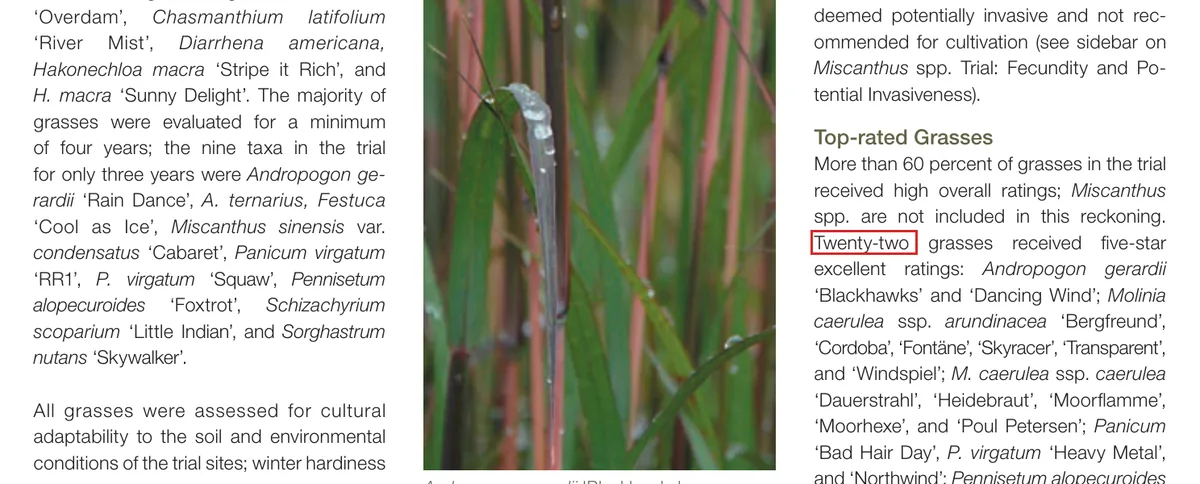
- Chicago Botanic Garden grew 109 ornamental grass taxa in USDA zone 5b from 2006 to 2017 and gave 22 its top five-star rating, including switchgrass ‘Northwind’, little bluestem ‘Carousel’ and prairie dropseed ‘Tara’ (CBG Plant Evaluation Notes 43, 2018).
- Trial plants outgrew catalog spreads: fountain grass ‘Red Head’ measured 80 inches wide at CBG, against a 2 to 3 ft spread in the Missouri Botanical Garden Plant Finder.
- Miscanthus sold as sterile mostly is not: 30 of 34 Miscanthus taxa x-rayed at CBG in 2010 carried viable seed, up to 349,327 seeds per plant for ‘Kleine Silberspinne’ (CBG Table 2).
- Maryland prohibited Chinese silvergrass and Chinese fountain grass from July 15, 2026, with potted stock sold through by July 15, 2027 (Maryland Department of Agriculture); Massachusetts ends all Miscanthus sinensis sales on Dec. 31, 2026 (MDAR).
- Cut deciduous grasses in late winter before new shoots, to about 4 inches (CBG) or 6 to 8 inches (K-State MF3048), and space each plant at its mature height, center to center.
What counts as an ornamental grass?
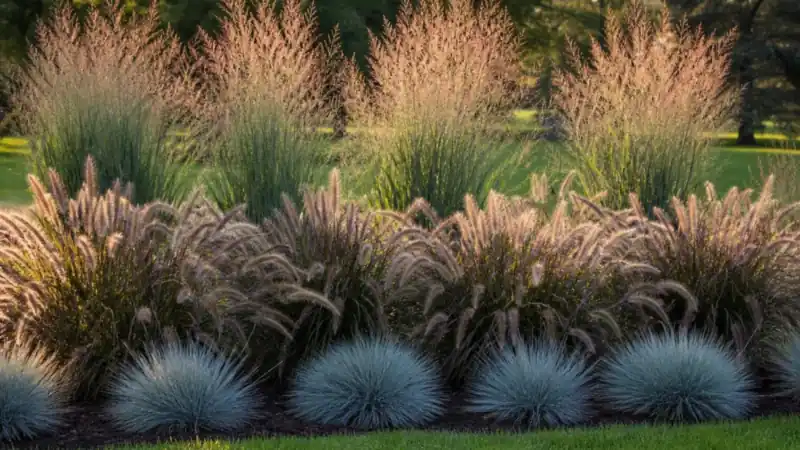
An ornamental grass is a grass or grass-like plant grown for foliage, flowers and form rather than for turf or forage. UF/IFAS counts true grasses (Poaceae) plus four grass-like families: rushes (Juncaceae), sedges (Cyperaceae), sweetflags (Acoraceae) and horsetails (Equisetaceae) (UF/IFAS ENH976, revised September 2023). Lilyturf and mondo grass look grass-like but belong to the asparagus family, Asparagaceae (MBG).
The true grasses alone are a big pool: Chicago Botanic Garden counts more than 600 genera and 10,000 species in Poaceae (CBG PEN 43). Two traits sort the garden kinds. Clumping grasses form discrete crowns and stay put; running grasses spread by rhizomes or stolons, and giant reed (Arundo donax) is CBG’s example of a runner that can take over more space than intended.
| Group | Plant family | Examples in this guide | How it spreads | Source |
|---|---|---|---|---|
| Warm-season true grasses | Poaceae | Switchgrass, big and little bluestem, prairie dropseed, fountain grass | Mostly clumps; several reseed | CBG PEN 43 |
| Cool-season true grasses | Poaceae | Feather reed grass, purple moor grass, blue fescue | Clumps | CBG PEN 43; K-State MF3048 |
| Sedges | Cyperaceae | Pennsylvania sedge (Carex pensylvanica) | Rhizomes | UF/IFAS ENH976; MBG |
| Rushes | Juncaceae | Soft rush (Juncus effusus) | Clumps | UF/IFAS ENH976 |
| Lilyturfs (not grasses) | Asparagaceae | Liriope muscari, mondo grass (Ophiopogon japonicus) | Short stolons or slow rhizomes | MBG Plant Finder |
Turf species that get mowed, from tall fescue to zoysiagrass, are a separate decision; our types of lawn grass comparison covers 14 of them. Ornamental grasses sit in beds and are cut once a year.
Which ornamental grasses did best in trials?
In Chicago Botanic Garden’s 2006 to 2017 evaluation, 22 grasses earned five stars and 25 earned four. The garden assigned no rating to its 34 Miscanthus taxa because it deems them potentially invasive. Five-star winners were mostly natives (big bluestem, switchgrass, little bluestem, prairie dropseed) plus 11 purple moor grasses and two fountain grass cultivars (CBG PEN 43, 2018).
The full-sun garden in Glencoe, Illinois (zone 5b) got at least 10 hours of sun a day on clay-loam soil at pH 7.4, in beds raised 8 inches. Plants were not fertilized, winter-mulched or sprayed, and stems stood until late winter. Most taxa stayed in the trial at least four years, and the coldest night was -17°F in January 2009 (CBG PEN 43, Table 1).
Low scores came from floppy stems and winter injury. Every plant of split-beard broomsedge (Andropogon ternarius), broomsedge (A. virginicus) and little bluestem ‘Prairie Blues’ died before its trial ended, and fountain grass ‘Red Rocket’ lost two plants in 2016. Nine switchgrass cultivars, among them ‘Thundercloud’ and ‘Warrior’, lost points for lax habit.
Swipe the table sideways to see every column.
| Cultivar | CBG rating | CBG measured height x width, in | MBG listed height | MBG listed spread | Years in trial |
|---|---|---|---|---|---|
| Switchgrass ‘Northwind’ | 5 of 5 | 75 x 48 | 4 to 5 ft | 2 to 2.5 ft | 2007 to 2010 |
| Switchgrass ‘Heavy Metal’ | 5 of 5 | 58 x 56 | 4 to 5 ft | 1 to 2 ft | 2007 to 2010 |
| Switchgrass ‘Dallas Blues’ | 4 of 5 | 86 x 100 | 4 to 6 ft | 2 to 3 ft | 2007 to 2010 |
| Switchgrass ‘Cheyenne Sky’ | 4 of 5 | 58 x 48 | 2 to 3 ft | 1.5 to 2 ft | 2010 to 2013 |
| Switchgrass ‘Shenandoah’ | 3 of 5 | 52 x 38 | 3 to 4 ft | 3 to 4 ft | 2007 to 2010 |
| Big bluestem ‘Blackhawks’ | 5 of 5 | 62 x 24 | 4 to 5 ft | 1 ft | 2014 to 2017 |
| Big bluestem ‘Dancing Wind’ | 5 of 5 | 75 x 38 | 4.5 to 5.5 ft | 2.5 ft | 2014 to 2017 |
| Big bluestem ‘Red October’ | 4 of 5 | 70 x 42 | 4 to 6 ft | 2 ft | 2012 to 2015 |
| Little bluestem ‘Carousel’ | 5 of 5 | 32 x 30 | 2 to 2.5 ft | 2 to 2.5 ft | 2007 to 2011 |
| Little bluestem ‘Jazz’ | 5 of 5 | 36 x 30 | 2 to 2.5 ft | 1 to 1.5 ft | 2009 to 2013 |
| Little bluestem ‘Prairie Munchkin’ | 5 of 5 | 22 x 19 | 2.5 to 3 ft | 1.5 to 2 ft | 2012 to 2016 |
| Little bluestem ‘The Blues’ | 3 of 5 | 50 x 30 | 2 to 4 ft | 1.5 to 2 ft | 2007 to 2011 |
| Prairie dropseed ‘Tara’ | 5 of 5 | 24 x 24 | 2 to 3 ft | 2 to 3 ft | 2010 to 2015 |
| Fountain grass ‘Red Head’ | 5 of 5 | 60 x 80 | 3 to 4 ft | 2 to 3 ft | 2007 to 2011 |
| Fountain grass ‘Red Rocket’ | 3 of 5 | 45 x 50 | 2.5 to 3 ft | 2 to 2.5 ft | 2014 to 2017 |
| Purple moor grass ‘Skyracer’ | 5 of 5 | 78 x 68 | 6 to 8 ft | 2 to 4 ft | 2013 to 2017 |
| Blue grama ‘Blonde Ambition’ | 4 of 5 | 36 x 42 | 0.75 to 2.5 ft | 0.75 to 1.5 ft | 2012 to 2016 |
| Indian grass ‘St. Louis’ | 4 of 5 | 76 x 45 | 4 to 6 ft | 2 to 3 ft | 2013 to 2016 |
| Feather reed grass ‘Overdam’ (part shade) | 4 of 5 | 48 x 38 | 2.5 to 3 ft | 1.5 to 2 ft | 2009 to 2012 |
| Japanese forest grass ‘Stripe It Rich’ (shade) | 4 of 5 | 23 x 38 | 1 to 1.5 ft | 1 to 1.5 ft | 2008 to 2011 |
Two patterns stand out. Measured height ran past the listing for switchgrass ‘Cheyenne Sky’ (58 inches against a 3 ft maximum) and feather reed grass ‘Overdam’ (48 inches against 3 ft), while ‘Prairie Munchkin’ (22 inches) and ‘Tara’ (24 inches) stayed below theirs. Widths diverged further: ‘Red Head’ covered 80 inches and ‘Dallas Blues’ 100 inches against listed spreads of 2 to 3 ft, so leave trial-size room next to paths and windows.
Ornamental grass comparison: 32 species by zone, size, sun and deer rating
The table lists 32 grasses and grass-like plants with USDA zones, height, sun and water from Missouri Botanical Garden’s Plant Finder, deer ratings from Rutgers NJAES, and the state or federal flags we found as of October 2026. Zones are species ratings: fountain grass ‘Red Head’ earned five stars in zone 5b although MBG rates the species to zone 6.
Swipe the table sideways to see every column.
| Grass | USDA zones | Height | Sun | Water | Deer (Rutgers) | Watch-outs | Our guide |
|---|---|---|---|---|---|---|---|
| Big bluestem, Andropogon gerardii | 4 to 9 | 4 to 6 ft | Full sun | Dry to medium | A (genus) | Native; reseeds freely (MBG) | None yet |
| Little bluestem, Schizachyrium scoparium | 3 to 9 | 2 to 4 ft | Full sun | Dry to medium | A | Native; flops in shade or rich soil (MBG) | None yet |
| Switchgrass, Panicum virgatum | 5 to 9 | 3 to 6 ft | Full sun to part shade | Medium to wet | A | Native; CBG saw deer eat a seedling | None yet |
| Prairie dropseed, Sporobolus heterolepis | 3 to 9 | 2 to 3 ft | Full sun | Dry to medium | Not rated | Native; slow to establish (MBG) | None yet |
| Indian grass, Sorghastrum nutans | 4 to 9 | 3 to 5 ft | Full sun | Dry to medium | A | Native; may self-seed (MBG) | None yet |
| Blue grama, Bouteloua gracilis | 3 to 10 | 0.75 to 2 ft | Full sun | Dry to medium | Not rated | Native; freely self-seeds (MBG) | None yet |
| Sideoats grama, Bouteloua curtipendula | 4 to 9 | 1.5 to 2.5 ft | Full sun | Dry to medium | Not rated | Native; may self-seed (MBG) | None yet |
| Pink muhly, Muhlenbergia capillaris | 5 to 11 | 2 to 3 ft | Full sun to part shade | Dry to medium | Not rated | Native; no rhizomes (MBG) | pink muhly guide |
| Northern sea oats, Chasmanthium latifolium | 3 to 8 | 2 to 5 ft | Full sun to part shade | Medium to wet | A | Native; self-seeds, may spread aggressively (MBG) | None yet |
| Purple lovegrass, Eragrostis spectabilis | 5 to 9 | 1 to 2 ft | Full sun | Dry to medium | Not rated | Native; self-seeds, roots at nodes (MBG) | None yet |
| Big sacaton, Sporobolus wrightii | 5 to 9 | 80 in measured (‘Windbreaker’) | Full sun | Dry; drought tolerant | Not rated | Native to the Southwest; pampas substitute (CBG) | None yet |
| Maiden grass, eulalia, Miscanthus sinensis | 4 to 9 | 4 to 9 ft | Full sun to part shade | Medium | A | Prohibited in MD (July 15, 2026); MA sales end Dec. 31, 2026 | None yet |
| Fountain grass, Pennisetum (Cenchrus) alopecuroides | 6 to 9 | 2.5 to 5 ft | Full sun to part shade | Medium to wet | A | Prohibited in MD (July 15, 2026); on CBG watch list (2017) | fountain grass guide |
| Purple fountain grass, Pennisetum setaceum ‘Rubrum’ | 9 to 10 | 3 to 5 ft | Full sun to part shade | Medium | Not rated | Annual north of zone 9; green species Cal-IPC Moderate | fountain grass guide |
| Oriental fountain grass, Pennisetum orientale ‘Karley Rose’ | 5 to 8 | 2 to 3 ft | Full sun to part shade | Medium | A | Crown injury at CBG in 2007 | None yet |
| Pampas grass, Cortaderia selloana | 8 to 10 | 8 to 12 ft | Full sun | Dry to medium | A | WA Class C; Cal-IPC High; invasive in FL (UF/IFAS) | pampas grass guide |
| Ravenna grass, Saccharum (Tripidium) ravennae | 5 to 9 | 6 to 12 ft | Full sun | Dry to medium | A | WA Class B; Cal-IPC Moderate | pampas grass guide |
| Japanese forest grass, Hakonechloa macra | 5 to 9 | 1 to 1.5 ft | Part shade | Medium | A | Rabbits browse it (CBG) | Japanese forest grass guide |
| Japanese blood grass, Imperata cylindrica ‘Rubra’ | 5 to 9 | 2 to 4 ft | Full sun to part shade | Medium | A | Species is a federal noxious weed; banned in FL; illegal to sell in SC | None yet |
| Feather reed grass, Calamagrostis x acutiflora ‘Karl Foerster’ | 5 to 9 | 3 to 5 ft | Full sun | Medium to wet | A (genus) | Rabbits browse it (CBG) | Karl Foerster guide |
| Korean feather reed grass, Calamagrostis brachytricha | 4 to 9 | 3 to 4 ft | Full sun | Medium to wet | A (genus) | Takes heavy clay (MBG) | None yet |
| Blue fescue, Festuca glauca | 4 to 8 | 0.75 to 1 ft | Full sun | Dry to medium | A | Centers die out; divide (MBG) | None yet |
| Blue oat grass, Helictotrichon sempervirens | 4 to 8 | 2 to 3 ft | Full sun | Dry to medium | A | Blue color best in dry soil (MBG) | None yet |
| Purple moor grass, Molinia caerulea | 5 to 8 | 2 to 3 ft | Full sun | Medium to wet | A | Not drought-tolerant (CBG) | None yet |
| Tufted hair grass, Deschampsia cespitosa | 4 to 9 | 2 to 3 ft | Part shade | Medium | Not rated | Few flowers in deep shade (MBG) | None yet |
| Autumn moor grass, Sesleria autumnalis | 5 to 8 | 0.75 to 1 ft | Full sun to part shade | Dry to medium | Not rated | Dislikes high heat and humidity (MBG) | None yet |
| Mexican feather grass, Nassella tenuissima | 7 to 10 | 1 to 2 ft | Full sun to part shade | Dry to medium | Not rated | Cal-IPC Limited; self-seeds (MBG) | Mexican feather grass guide |
| Pennsylvania sedge (sedge), Carex pensylvanica | 3 to 8 | 0.5 to 1 ft | Part shade to full shade | Dry to medium | A (genus) | Native; spreads by rhizomes (MBG) | None yet |
| Lilyturf (not a grass), Liriope muscari | 5 to 10 | 1 to 1.5 ft | Full sun to part shade | Medium | B | On Georgia council invasive list (GISC) | monkey grass guide |
| Mondo grass (not a grass), Ophiopogon japonicus | 7 to 10 | 0.75 to 1 ft | Part shade to full shade | Medium | B | Evergreen; spreads slowly (MBG) | monkey grass guide |
| Reed canary grass, ribbon grass, Phalaris arundinacea | 4 to 9 | 3 to 6 ft | Full sun to part shade | Medium to wet | B | WA Class C; invasive in FL (UF/IFAS) | None yet |
| Giant reed, Arundo donax | 6 to 10 | 12 to 20 ft | Full sun to part shade | Medium to wet | A | Cal-IPC High; GA council list | None yet |
Every row, with its source URL, is in our ornamental grass dataset (CSV), along with the CBG trial measurements and Miscanthus seed counts.
Rutgers rates nearly every grass on its list A, rarely damaged; lilyturf, mondo grass and reed canary grass get B, seldom severely damaged. Rabbits are the larger threat to young plants: CBG recorded rabbits grazing feather reed grass, American beakgrain, Japanese forest grass and switchgrass (Fine Gardening trial report, December 2013) and caged its ‘River Mist’ sea oats in hardware cloth after repeated browsing.
Cool-season or warm-season: what changes in care?
Cool-season grasses such as feather reed grass start growing in late winter, bloom by early summer and can stall in heat. Warm-season grasses such as switchgrass and little bluestem wake late, grow best at 80 to 95°F air temperatures and 70 to 90°F soil, and bloom in late summer (K-State MF3048, April 2012). The type sets planting, cutting and dividing dates.
| Task | Cool-season grasses | Warm-season grasses | Source |
|---|---|---|---|
| Main growth | Late winter to early spring, again in fall | Late spring through summer | K-State MF3048 |
| Plant in Kansas | March to April, or September | May to early June | K-State MF3048 |
| Plant in South Carolina | Fall | Spring | Clemson HGIC |
| Bloom | Late spring to early summer | Late summer | K-State MF3048 |
| Divide | Early spring or early fall | Early spring, just before growth | K-State MF3048; Clemson HGIC |
| Examples (CBG) | Feather reed grass, purple moor grass | Fountain grass, switchgrass, prairie dropseed, big and little bluestem | CBG PEN 43 |
The references do not always agree on type. CBG files grama (Bouteloua) and purple moor grass as cool-season, but the Missouri Botanical Garden records call blue grama and purple moor grass warm-season (MBG), and CBG’s own report calls ‘Blonde Ambition’ blue grama a warm-season grass. K-State’s table sides with CBG on purple moor grass ‘Skyracer’.
Swipe the table sideways to see every column.
| Grass (K-State Olathe trial) | Season | Height to top of foliage | Height to top of flower | Width | First bloom |
|---|---|---|---|---|---|
| Feather reed grass ‘Avalanche’ | Cool | 18 in | 38 in | 21 in | Week 23 |
| Feather reed grass ‘Karl Foerster’ | Cool | 24 in | 56 in | 20 in | Week 23 |
| Feather reed grass ‘Overdam’ | Cool | 25 in | 43 in | 26 in | Week 23 |
| Oriental fountain grass ‘Karley Rose’ | Warm | 36 in | 44 in | 59 in | Week 25 |
| Purple moor grass ‘Skyracer’ | Cool | 29 in | 78 in | 28 in | Week 25 |
| Lovegrass ‘Wind Dancer’ (Eragrostis elliottii) | Warm | 40 in | 53 in | 30 in | Week 26 |
| Prairie dropseed | Warm | 15 in | 38 in | 16 in | Week 28 |
| Switchgrass ‘Northwind’ | Warm | 51 in | 60 in | 30 in | Week 31 |
| Switchgrass ‘Cloud Nine’ | Warm | 78 in | 93 in | 90 in | Week 31 |
| Variegated giant reed (Arundo donax ‘Variegata’) | Warm | 156 in | 168 in | 84 in | Week 31 |
| Switchgrass ‘Dallas Blues’ | Warm | 78 in | 80 in | 78 in | Week 32 |
| Little bluestem | Warm | 16 in | 30 in | 14 in | Week 32 |
| Maiden grass ‘Graziella’ | Warm | 43 in | 72 in | 39 in | Week 32 |
| Maiden grass ‘Cabaret’ | Warm | 63 in | 87 in | 48 in | Week 33 |
| Hardy pampas (Saccharum ravennae) | Warm | 64 in | 148 in | 63 in | Week 33 |
| Maiden grass ‘Malepartus’ | Warm | 39 in | 73 in | 36 in | Week 34 |
| Maiden grass ‘Little Zebra’ | Warm | 51 in | 51 in | 72 in | Week 36 |
In that Kansas trial, cool-season feather reed grass bloomed in week 23 (early June) and the Miscanthus cultivars in weeks 32 to 36 (August to early September). Bloom date matters beyond looks: CBG found that many of the least fertile Miscanthus were late-flowering cultivars that may not finish setting seed in a zone 5 season.
When and how should you cut back ornamental grasses?
Cut deciduous grasses back once a year, in late winter or early spring before new shoots show; Chicago Botanic Garden also allows late fall to early winter. K-State sets February to March for Kansas, and UF/IFAS sets February to March for north and central Florida and January to February for south Florida (UF/IFAS ENH976). Evergreen grasses and sedges get a comb-out or tip trim instead.
- Sort the plant: deciduous grasses (switchgrass, Miscanthus, little bluestem) take a hard cut; evergreen grasses such as pink muhly, blue fescue and sedges do not, and UF/IFAS warns that removing all green foliage from evergreen grasses in fall causes severe losses.
- Time it before green shoots appear: February to March in Kansas (K-State) and in north and central Florida, January to February in south Florida (UF/IFAS). Purple moor grass is the exception: CBG recommends cleaning it up in late season because its stems flop and break before winter ends.
- Pick the tool by crown size: hand pruners or hedge shears for small grasses; electric hedge shears, a string trimmer or a chainsaw for Miscanthus and switchgrass; a lawn mower for loose, low crowns such as Japanese forest grass (CBG PEN 43). Wear heavy gloves and long sleeves, since CBG notes leaf margins can be razor-sharp.
- Cut to height: about 4 inches (CBG) to 6 to 8 inches (K-State) for deciduous clumps. Comb sedges and sweetflag with gloved hands instead, because Clemson says they recover slowly from cutting.
- Divide when the center hollows out, in spring before new leaves; if you miss that window, CBG says to cut an actively growing clump back by a third before dividing.
- Skip fertilizer: CBG calls it unnecessary, and the lush growth it produces flops.
| Practice | CBG PEN 43 (Illinois, 2018) | K-State MF3048 (Kansas, 2012) | Clemson HGIC (South Carolina) | UF/IFAS ENH976 (Florida, 2023) |
|---|---|---|---|---|
| When to cut | Late fall to early winter, or late winter to early spring | Late winter to early spring (February to March) | Late winter or early spring | February to March north and central; January to February south |
| Cut height | About 4 in | 6 to 8 in | A few inches above ground | Within inches of soil for deciduous grasses; tips only on evergreen muhly |
| Divide every | 5 to 7 years, or when hollow | 3 to 5 years, when the center dies | 3 to 4 years | Not required for performance |
| Divide when | Spring, before new leaves | Early spring; cool-season also fall | Warm-season early spring; cool-season early fall | At pruning time |
The spread reflects climate and plant mix, not error: Florida’s evergreen muhly and Illinois switchgrass need different cuts. CBG adds that grasses need dividing only when clumps are overgrown or hollow, so a full, upright clump can go the 7 years its report allows.
Which ornamental grasses are invasive, and where are they restricted?
As of October 2026, Maryland prohibits Chinese silvergrass (Miscanthus sinensis) and Chinese fountain grass (Cenchrus alopecuroides), Massachusetts ends Miscanthus sinensis sales on Dec. 31, 2026, cogongrass (Imperata cylindrica) is a federal noxious weed, and Washington lists pampas grass, reed canary grass and Ravenna grass. Cal-IPC and Georgia council ratings are advisory, not law.
Swipe the table sideways to see every column.
| Grass | Where | Rule or list | Status and dates | Source |
|---|---|---|---|---|
| Chinese silvergrass, Miscanthus sinensis | Maryland | Prohibited Invasive Plant List | Effective July 15, 2026; potted stock sold through by July 15, 2027, in-ground stock by July 15, 2028 | MDA |
| Chinese fountain grass, Cenchrus (Pennisetum) alopecuroides | Maryland | Prohibited Invasive Plant List | Same dates as Chinese silvergrass | MDA |
| Chinese silvergrass, Miscanthus sinensis | Massachusetts | Prohibited Plant List (MDAR) | No new import or propagation after Dec. 8, 2025; all sales end Dec. 31, 2026 | MDAR |
| Cogongrass, Imperata cylindrica (Japanese blood grass is a cultivar) | Federal | 7 CFR 360.200 noxious weed list | Federal permit needed to move it between states | eCFR |
| Japanese blood grass, Imperata cylindrica ‘Rubra’ | South Carolina; Florida | State bans reported by extension | Illegal to sell, distribute or plant in South Carolina; banned in Florida | Clemson HGIC; UF/IFAS |
| Pampas grass, Cortaderia selloana | Washington | Class C noxious weed, WAC 16-750-015 | Version effective Jan. 1, 2026 | WAC |
| Reed canary grass, Phalaris arundinacea | Washington | Class C noxious weed, WAC 16-750-015 | Version effective Jan. 1, 2026 | WAC |
| Ravenna grass, Tripidium (Saccharum) ravennae | Washington | Class B noxious weed, WAC 16-750-011 | Current rule text, Oct. 2026 | WAC |
| Pampas grass; giant reed, Arundo donax | California | Cal-IPC Inventory (advisory) | Both rated High | Cal-IPC |
| Ravenna grass; tender fountain grass, Pennisetum setaceum | California | Cal-IPC Inventory (advisory) | Both rated Moderate | Cal-IPC |
| Mexican feather grass, Nassella tenuissima | California | Cal-IPC Inventory (advisory) | Rated Limited; PlantRight lists it as do not plant | Cal-IPC |
| Tender fountain grass, Pennisetum setaceum | Hawaii | HAR Title 4, Chapter 68 noxious weed list | Listed (list dated June 18, 1992) | HDOA |
| Miscanthus sinensis; Arundo donax; Liriope muscari; Imperata cylindrica | Georgia | Georgia Invasive Species Council list (advisory) | All four listed | GISC |
This page is general information, not legal advice. Plant lists change; confirm a species with your state department of agriculture before you buy, sell or install it.
The federal list in 7 CFR 360.200 names Imperata cylindrica but none of the common border grasses: its Pennisetum entries are kikuyugrass (P. clandestinum), African feathergrass (P. macrourum) and two other tropical species, not fountain grass. Missouri Botanical Garden notes cogongrass needs a federal permit to move between states (MBG).
Climate changes the verdict. UF/IFAS still lists Miscanthus sinensis cultivars for north and central Florida while calling pampas grass and ribbon grass invasive there, and Florida banned Japanese blood grass because it flowers in Florida’s long season. Arizona and Nevada rules on tender fountain grass are cited in our purple fountain grass guide.
Are sterile Miscanthus cultivars safe to plant?
Mostly no. Chicago Botanic Garden x-rayed seed from 34 Miscanthus taxa in October 2010 and found viable seed on 30. Counts ran from 138 per plant for ‘Yaku Jima’ to 349,327 for ‘Kleine Silberspinne’; only ‘Hinjo’, ‘Silberpfeil’, ‘Cabaret’ and giant miscanthus (M. x giganteus) set none, and ‘Hinjo’ later set seed in a University of Minnesota study (CBG PEN 43).
| Miscanthus taxon (M. sinensis unless named) | Bloom time, 2010 | Viable seeds per plant |
|---|---|---|
| ‘Kleine Silberspinne’ | Mid (Aug. 21) | 349,327 |
| ‘Rotsilber’ | Mid (Aug. 24) | 339,462 |
| ‘Autumn Light’ | Mid (Sept. 6) | 221,500 |
| ‘Malepartus’ | Mid (Aug. 23) | 203,699 |
| ‘Blutenwunder’ | Early (Aug. 13) | 177,144 |
| ‘Nippon’ | Early (Aug. 8) | 150,120 |
| ‘Graziella’ | Early (Aug. 8) | 133,122 |
| ‘Huron Sunrise’ | Mid (Aug. 31) | 94,612 |
| ‘Minuett’ | Mid (Sept. 14) | 91,817 |
| ‘Andante’ | Mid (Sept. 6) | 53,323 |
| ‘Adagio’ | Early (Aug. 8) | 52,632 |
| ‘Silberturm’ | Mid (Aug. 23) | 28,941 |
| ‘Purpurascens’ | Mid (Aug. 23) | 24,957 |
| ‘Autumn Red’ | Mid (Aug. 23) | 24,185 |
| ‘Puenktchen’ | Mid (Sept. 7) | 16,974 |
| ‘Zebrinus’ (zebra grass) | Late (Sept. 16) | 16,621 |
| ‘Goliath’ | Mid (Aug. 27) | 13,920 |
| ‘Ferner Osten’ | Early (July 31) | 8,954 |
| ‘Gracillimus’ (maiden grass) | Late (Oct. 4) | 6,103 |
| ‘Silberfeder’ | Late (Sept. 27) | 3,975 |
| ‘Sarabande’ | Mid (Sept. 7) | 3,278 |
| ‘Little Zebra’ | Mid (Sept. 8) | 2,704 |
| ‘Gold Bar’ | Late (Sept. 20) | 2,061 |
| ‘Morning Light’ | Late (Oct. 2) | 1,936 |
| ‘Super Stripe’ | Mid (Sept. 15) | 1,226 |
| ‘Strictus’ (porcupine grass) | Late (Sept. 18) | 907 |
| M. sacchariflorus | Early (Aug. 12) | 746 |
| ‘Dixieland’ | Late (Sept. 25) | 497 |
| ‘Variegatus’ | Late (Sept. 25) | 211 |
| ‘Yaku Jima’ | Early (Aug. 7) | 138 |
| ‘Hinjo’ | Late (Sept. 25) | 0 |
| ‘Silberpfeil’ | Late (Sept. 27) | 0 |
| var. condensatus ‘Cabaret’ | Late (Oct. 7) | 0 |
| M. x giganteus (giant miscanthus) | Late (Oct. 8) | 0 |
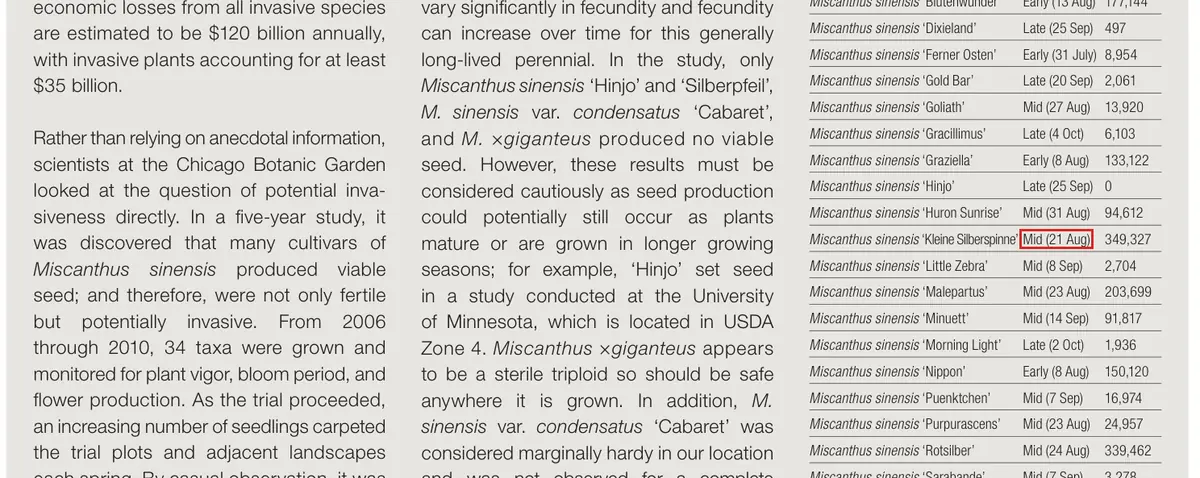
One correction: the report’s text and CBG’s 2013 Fine Gardening summary both call ‘Dixieland’ (497 seeds) the lowest producer, but Table 2 lists ‘Yaku Jima’ at 138 and ‘Variegatus’ at 211. We use the table values. CBG removed all Miscanthus from its display gardens between 2010 and 2017 and says the sterile triploid giant miscanthus should be safe anywhere it is grown.
Fountain grass is the next concern. CBG found Pennisetum seedlings regularly and prodigiously in the turf paths beside its plots and put Pennisetum alopecuroides and its cultivars on its invasive plant watch list in 2017, the same species Maryland prohibited in 2026.
Which ornamental grass should you plant?
Start with the site, then the size. In shade, plant Japanese forest grass or Pennsylvania sedge; in wet clay, switchgrass or feather reed grass; in dry, alkaline ground, blue grama or big sacaton. For screens over 5 ft, the CBG trial’s 75 inch big bluestem ‘Dancing Wind’ and switchgrass ‘Northwind’ stand in for Miscanthus where it is restricted.
| If your situation is | Plant this | Why (source) |
|---|---|---|
| Part to full shade | Japanese forest grass (zones 5 to 9) or Pennsylvania sedge (zones 3 to 8) | MBG rates both for part shade; the sedge also takes full shade (MBG) |
| Wet or heavy clay soil | Switchgrass or feather reed grass ‘Karl Foerster’ | MBG: switchgrass tolerates occasional flooding; ‘Karl Foerster’ does well in heavy clay |
| Dry, rocky or alkaline soil in full sun | Blue grama (zones 3 to 10), little bluestem, or big sacaton ‘Windbreaker’ | MBG drought ratings; CBG: big sacaton takes alkaline, saline soil |
| Zone 3 or 4 winters | Little bluestem, prairie dropseed (zone 3), big bluestem or Indian grass (zone 4) | MBG zone ratings; MBG rates fountain grass only to zone 6 |
| Screen over 5 ft in Maryland or Massachusetts | Big bluestem ‘Dancing Wind’ (75 in) or switchgrass ‘Northwind’ (75 in) | CBG five-star, measured; Miscanthus sinensis prohibited (MDA; MDAR) |
| Bed edge under 2 ft in sun | Blue fescue (9 to 12 in), little bluestem ‘Prairie Munchkin’ (22 in), prairie dropseed ‘Tara’ (24 in) | MBG listing; CBG measured heights |
| Want burgundy color in zone 9 to 11 | Purple fountain grass ‘Rubrum’ | MBG zones 9 to 10; Cal-IPC rates the green species Moderate |
| California yard | Skip pampas grass, giant reed, Ravenna grass and Mexican feather grass | Cal-IPC High, High, Moderate and Limited |
| Washington yard | Skip pampas grass, reed canary grass and Ravenna grass | WAC 16-750-015 Class C; WAC 16-750-011 Class B |
| Rabbits browse the yard | Cage new feather reed grass, Japanese forest grass and switchgrass the first season | CBG recorded rabbit grazing on all three |
1Is the spot in part or full shade most of the day?
YesPlant Japanese forest grass (zones 5 to 9) or Pennsylvania sedge (zones 3 to 8), both rated for shade by MBG.
NoGo to the next question
2Does the soil stay wet or is it heavy clay?
YesPlant switchgrass, which MBG says tolerates occasional flooding, or feather reed grass 'Karl Foerster', which does well in heavy clay.
NoGo to the next question
3Are winters zone 3 or 4?
YesPlant little bluestem or prairie dropseed (zone 3), or big bluestem or Indian grass (zone 4); skip fountain grass, rated only to zone 6 by MBG.
NoGo to the next question
4Do you need a screen taller than 5 ft?
YesPlant big bluestem 'Dancing Wind' or switchgrass 'Northwind', both 75 in and five-star at CBG; skip Miscanthus sinensis in Maryland and Massachusetts.
NoGo to the next question
5Is the bed an edge under 2 ft in dry sun?
YesPlant blue fescue (9 to 12 in), little bluestem 'Prairie Munchkin' (22 in) or prairie dropseed 'Tara' (24 in).
NoGo to the next question
6Are you in zone 9 to 11 and want burgundy leaves?
YesPlant purple fountain grass 'Rubrum' (MBG zones 9 to 10); avoid the green species where Arizona, Nevada or Hawaii list it.
NoFor a mid-size sunny bed in zones 5 to 9, plant switchgrass 'Heavy Metal' (58 in, five stars at CBG), or fountain grass 'Red Head' outside Maryland.
Source: MBG Plant Finder; Chicago Botanic Garden PEN 43 (2018); Maryland Department of Agriculture; MDAR
On sunny slopes, NC State and Purdue Extension plant lists name native bunch grasses such as little bluestem and switchgrass; our erosion control methods guide pairs them with shade ground covers. Species details sit in our Turf and Trees hub.
How many ornamental grasses do you need for a bed?
Space each grass at its mature height, center to center: K-State’s rule puts a 36 inch grass 36 inches apart, and Clemson HGIC gives the same rule. On a square grid that is 25 plants per 100 sq ft at 24 inches, 11.1 (buy 12) at 36 inches and 6.25 (buy 7) at 48 inches.
| Spacing on center | Plants per sq ft | Plants per 100 sq ft | Plants in a 20 ft single row |
|---|---|---|---|
| 12 in | 1 | 100.0 (buy 100) | 20.0 (buy 20) |
| 18 in | 0.4444 | 44.4 (buy 45) | 13.3 (buy 14) |
| 24 in | 0.25 | 25.0 (buy 25) | 10.0 (buy 10) |
| 36 in | 0.1111 | 11.1 (buy 12) | 6.7 (buy 7) |
| 48 in | 0.0625 | 6.2 (buy 7) | 5.0 (buy 5) |
| 60 in | 0.04 | 4.0 (buy 4) | 4.0 (buy 4) |
- Plants needed
- 25
Plants = bed area / (spacing in feet squared), rounded up. Cost uses the unrounded count. Default: 100 sq ft of 'Karl Foerster' at 24 in = 25 plants, $398.75 to $748.75. Prices are the 1 gal listings recorded on our species guides; your nursery's price will differ.
The rule does not say whether height means foliage or flowers. K-State’s own table shows ‘Karl Foerster’ at 24 inches of foliage and 56 inches in flower; spacing by foliage height gives the tighter 24 inch grid, which fills faster. At 24 inches, a 100 sq ft bed takes 25 plants, or $398.75 to $748.75 at the $15.95 to $29.95 one-gallon prices our Karl Foerster and pink muhly guides recorded on Oct. 29, 2026.
How we compiled this
We compiled 17 primary documents in October 2026: Chicago Botanic Garden’s Plant Evaluation Notes 43 (109 taxa, 2006 to 2017) and its 2013 trial summary, K-State MF3048, Missouri Botanical Garden Plant Finder records for 31 species and 24 cultivars, the Rutgers NJAES deer list, UF/IFAS ENH976, Clemson HGIC, Purdue Extension, and list or rule texts from Maryland, Massachusetts, Washington (two rules), the eCFR, Hawaii, Cal-IPC (two pages) and the Georgia Invasive Species Council. We did not grow or measure plants; sizes are the trial gardens’ measurements or the publishers’ listings, and prices come from our species guides’ Oct. 29 to 30, 2026 listing checks.
| Key number | Value | Source |
|---|---|---|
| Grasses in CBG’s 2006 to 2017 trial | 109 taxa; 22 five-star, 25 four-star | CBG PEN 43 |
| Viable seed per Miscanthus plant, 2010 | 0 to 349,327 | CBG PEN 43, Table 2 |
| Maryland prohibition (Miscanthus sinensis, Chinese fountain grass) | Effective July 15, 2026; potted sell-through July 15, 2027 | MDA |
| Massachusetts Miscanthus sinensis sales end | Dec. 31, 2026 | MDAR |
| Cut height for deciduous grasses | About 4 in to 6 to 8 in | CBG; K-State |
| Spacing rule | Equal to mature height, center to center | K-State; Clemson |
| Ideal soil temperature, warm-season grasses | 70 to 90°F | K-State MF3048 |
Frequently asked questions
Do ornamental grasses come back every year?
Most do. The species in this guide’s table are perennials within their USDA zones; cold limits run from zone 3 for little bluestem and prairie dropseed to zone 8 for pampas grass (MBG). Purple fountain grass is the common exception: MBG rates it hardy only in zones 9 to 10 and says it will not survive a St. Louis winter, so most buyers grow it as an annual.
Should you cut back ornamental grasses in fall or spring?
Spring is the default: cut deciduous grasses in late winter or early spring before new shoots, February to March in Kansas (K-State). Chicago Botanic Garden also allows late fall, and recommends it for purple moor grass, whose stems flop early. Leave evergreen grasses such as pink muhly alone in fall; UF/IFAS warns a hard fall cut causes severe losses.
How far apart should you plant ornamental grasses?
Space each plant at its mature height, center to center, per K-State and Clemson: a 36 inch grass goes 36 inches apart. On a square grid that is 25 plants per 100 sq ft at 24 inches and 12 at 36 inches. Check trial widths too: CBG measured ‘Red Head’ fountain grass 80 inches across.
What is the most popular ornamental grass?
No public sales ranking exists, so we cannot name one. Two grasses carry the Perennial Plant Association’s Perennial Plant of the Year title: feather reed grass ‘Karl Foerster’ in 2001 (Purdue Extension) and switchgrass ‘Northwind’ in 2014 (CBG PEN 43). ‘Northwind’ also earned five stars in Chicago Botanic Garden’s 2006 to 2017 trial.
Are ornamental grasses deer resistant?
Mostly. Rutgers NJAES rates nearly every grass on its list A, rarely damaged, and lilyturf, mondo grass and reed canary grass B, seldom severely damaged. No grass is browse-proof: CBG saw deer eat a switchgrass seedling growing inside a big bluestem clump, and rabbits grazed feather reed grass, Japanese forest grass and switchgrass in its trial beds.
What ornamental grasses grow in shade?
Japanese forest grass (zones 5 to 9) and tufted hair grass (zones 4 to 9) are rated for part shade by MBG, and Pennsylvania sedge handles part to full shade in zones 3 to 8. CBG grew ‘Stripe It Rich’ Japanese forest grass in deep shade, where its gold leaves faded to lime green by midsummer, so give gold forms morning sun.
What ornamental grass stays small?
Blue fescue (9 to 12 inches), autumn moor grass (9 to 12 inches) and Pennsylvania sedge (6 to 12 inches) stay under a foot in MBG’s listings. In Chicago Botanic Garden’s trial, little bluestem ‘Prairie Munchkin’ measured 22 inches and prairie dropseed ‘Tara’ 24 inches to the flower tops, both five-star plants.
Is Karley Rose oriental fountain grass invasive?
We found no listing for Pennisetum orientale on the Maryland, Massachusetts, Washington, federal or Cal-IPC lists checked in October 2026; Maryland’s 2026 rule names Chinese fountain grass, P. alopecuroides. In CBG’s trial ‘Karley Rose’ bloomed earliest of the fountain grasses, measured 49 inches and scored three stars after crown injury in 2007.
Sources
- Chicago Botanic Garden (R. G. Hawke), Plant Evaluation Notes Issue 43: An Evaluation Study of Hardy Ornamental Grasses, 2018. Accessed October 2026.
- Chicago Botanic Garden, An Evaluation Study of Hardy Ornamental Grasses (study page), 2018. Accessed October 2026.
- Chicago Botanic Garden (R. Hawke), Fine Gardening, Battle of the grasses: plant trial results, December 2013. Accessed October 2026.
- Kansas State University Research and Extension (R. St. John), MF3048, Ornamental Grasses, April 2012. Accessed October 2026.
- Missouri Botanical Garden, Plant Finder species and cultivar records (32 species, 24 cultivars), Records accessed Oct. 30, 2026. Accessed October 2026.
- Rutgers NJAES Cooperative Extension, Landscape Plants Rated by Deer Resistance, Current list. Accessed October 2026.
- UF/IFAS Extension (M. Thetford, M. Salinas), ENH976 (EP233), Considerations for Selection and Use of Ornamental Grasses, Revised September 2023. Accessed October 2026.
- Clemson Cooperative Extension, HGIC, Ornamental Grasses factsheet, Current page. Accessed October 2026.
- Maryland Department of Agriculture, Maryland Prohibited Invasive Plant Law and Regulations, List effective July 15, 2026. Accessed October 2026.
- Massachusetts Department of Agricultural Resources, Massachusetts Prohibited Plant List, Last updated Feb. 27, 2026. Accessed October 2026.
- eCFR, 7 CFR 360.200, Designation of noxious weeds, Current as of October 2026. Accessed October 2026.
- Washington State Legislature, WAC 16-750-015, Class C noxious weeds, Effective Jan. 1, 2026. Accessed October 2026.
- Washington State Legislature, WAC 16-750-011, Class B noxious weeds, Current rule. Accessed October 2026.
- California Invasive Plant Council, The Cal-IPC Inventory, Current inventory. Accessed October 2026.
- California Invasive Plant Council, Nassella tenuissima (Stipa tenuissima) profile, Current page. Accessed October 2026.
- Hawaii Department of Agriculture, HAR Title 4, Chapter 68, Noxious Weed Rules, List dated June 18, 1992. Accessed October 2026.
- Georgia Invasive Species Council, Invasive Plants list, Current list. Accessed October 2026.
- Purdue University, Ornamental Grass Named Perennial of the Year for 2001, 2001. Accessed October 2026.