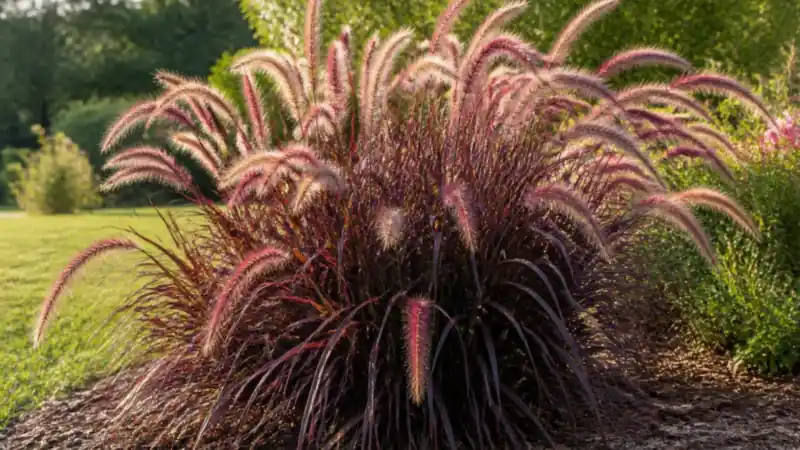
Purple fountain grass is a burgundy hybrid grass, sold as Pennisetum setaceum ‘Rubrum’, that survives winter only in USDA zones 9 to 11; colder gardens grow it as an annual or carry it indoors above freezing.
Key takeaways
- UF/IFAS rates purple fountain grass hardy in USDA zones 9 through 11, 4 to 6 ft tall with 12 inch plumes from early summer to frost (UF/IFAS FPS464, revised Oct. 2023); Iowa State says it will not survive an Iowa winter (ISU Extension).
- The purple plant is not the weedy green species. EPPO files it as Cenchrus x cupreus, an artificial hybrid (EPPO Global Database), and Cal-IPC says the red cultivar is sterile while the green species carries a Moderate invasive rating in California (Cal-IPC).
- Fountain grass (Pennisetum setaceum) is a Class C noxious weed in Arizona’s Table 6 under R3-4-245, and Hawaii lists it as a noxious weed for Maui, Molokai, Lanai, Oahu and Kauai (HAR chapter 4-68 list, June 18, 1992). Nevada makes it a Category A weed, subject to eradication from nursery premises (NAC 555.010). It is not on the federal list (7 CFR 360.200).
- Maryland added Chinese (hardy) fountain grass, Cenchrus alopecuroides, to its Prohibited Invasive Plant List on July 15, 2026: potted stock must be sold through by July 15, 2027 and in-ground stock by July 15, 2028 (Maryland Department of Agriculture).
- Hardy fountain grass is a different species. In Kansas State’s Olathe trial, ‘Hameln’ (sold as 18 to 30 inches) measured 28 inches tall in year 1 and 32 inches in year 2, and ‘Little Bunny’ (sold as 10 to 12 inches) measured 16 to 17 inches (K-State ornamental grass trial).
- Cut hardy fountain grass to 3 to 6 inches before spring growth starts and divide it about every 3 years, per University of Wisconsin Extension; purple fountain grass outside zone 9 is dug before frost or composted.
What is purple fountain grass, and why are there three names for it?
Purple fountain grass is the burgundy-leaved fountain grass sold at garden centers as Pennisetum setaceum ‘Rubrum’. Botanists now treat it as a hybrid: the EPPO Global Database lists it as Cenchrus x cupreus, with Pennisetum x advena Wipff & Veldkamp as a synonym, and describes it as an artificial cross of Cenchrus elegans and C. setaceus. Nurseries, extension sheets and state weed lists still use the old name.
The name matters because the hybrid and the species behave differently. Singapore’s National Parks Board says the cultivar “seldom sets seed” and records grass taxonomist J. K. Wipff’s breeding work showing it is a P. macrostachyum x P. setaceum hybrid (NParks Flora and Fauna Web). The green species, Cenchrus setaceus, is the seeding plant that Arizona and Hawaii regulate.
Separately, Pennisetum has been folded into Cenchrus, so the green species is now Cenchrus setaceus, a name whose “use is inconsistent across online resources” (UF/IFAS Center for Aquatic and Invasive Plants), and hardy fountain grass is Cenchrus alopecuroides (UW Extension).
| Measure | Purple fountain grass (‘Rubrum’) | Source |
|---|---|---|
| Current botanical name | Cenchrus x cupreus (syn. Pennisetum x advena) | EPPO |
| Trade name | Pennisetum setaceum ‘Rubrum’ | UF/IFAS FPS464 |
| USDA hardiness zones | 9 through 11 (9a to 11b) | UF/IFAS; Proven Winners |
| Height | 4 to 6 ft (UF/IFAS); 30 to 36 in (Proven Winners Graceful Grasses); 48 in measured in Kansas | UF/IFAS; PW; K-State |
| Spread | 2 to 4 ft | UF/IFAS |
| Plume | 12 in long, purple-pink to copper, on a 3 ft nodding stalk | UF/IFAS |
| Bloom | Early summer to frost | UF/IFAS |
| Spacing | 36 to 60 in (UF/IFAS, in-ground); 18 to 24 in (Proven Winners) | UF/IFAS; PW |
| Light | Full sun; grows poorly in partial shade | UF/IFAS |
| Drought tolerance | Moderate | UF/IFAS |
| Pet toxicity | Non-toxic (Pennisetum setaceum) | ASPCA, Oct. 19, 2022 |
Is purple fountain grass a perennial or an annual?
Purple fountain grass is a perennial only where winter lows stay above about 20°F: UF/IFAS lists it for zones 9 through 11 and grows it as a perennial in most of Florida, noting it “may grow back from the roots in the spring in north Florida” (UF/IFAS FPS464). Where winters drop below 20°F, Proven Winners says to treat it as an annual, and it labels its Graceful Grasses version an annual (Proven Winners).
The zone line comes from the USDA Plant Hardiness Zone Map, where each zone spans a 10°F band of average coldest winter night (1991 to 2020 data). Zone 9a means a typical low of 20 to 25°F. Sources do not agree on zone 8: Missouri State University calls it “hardy only to Zone 8” and still grows it as an annual in Springfield (Missouri State), while UF/IFAS and Proven Winners start at zone 9.
| USDA zone | Average coldest night (PHZM) | What purple fountain grass does | Source |
|---|---|---|---|
| 10 and 11 | 30 to 50°F | Perennial; UF/IFAS lists year-round planting | UF/IFAS |
| 9b | 25 to 30°F | Perennial (UF/IFAS: perennial in most of Florida, zones 9 to 10) | UF/IFAS |
| 9a | 20 to 25°F | Perennial at the margin; may regrow from roots in spring | UF/IFAS (north Florida) |
| 8a to 8b | 10 to 20°F | Treat as annual; Missouri State lists zone 8 as its limit | Missouri State |
| 7 and colder | 0°F to below 0°F | Annual: dig and store above freezing, or replace each spring | Iowa State; Missouri State |
Hardy fountain grass flips the map. ‘Hameln’ is listed for zones 5 through 8 by UF/IFAS FPS461 and 5a to 9b by NC State Extension, and UF/IFAS calls it “unsuited for the deep South.” If a plant labeled “fountain grass” came back after a zone 6 winter, it was a hardy species such as Cenchrus alopecuroides or oriental fountain grass (‘Karley Rose’, zones 5 to 8 per MBG), not the purple hybrid.
How is purple fountain grass different from crimson and hardy fountain grass?
Three plants share the fountain grass name. Purple fountain grass is the burgundy hybrid. Crimson (or green, or tender) fountain grass is the species Cenchrus setaceus, with green leaves and pink to burgundy plumes, the plant Arizona and Hawaii regulate. Hardy fountain grass, Cenchrus alopecuroides, is a green-leaved East Asian and Australian perennial that survives zone 5 winters (UW Extension).
| Trait | Purple fountain grass | Crimson (green) fountain grass | Hardy fountain grass | Source |
|---|---|---|---|---|
| Botanical name | Cenchrus x cupreus; sold as P. setaceum ‘Rubrum’ | Cenchrus setaceus (P. setaceum) | Cenchrus alopecuroides (P. alopecuroides) | EPPO; UF/IFAS; UW |
| Leaf color | Purple to red | Green | Deep green, orange-bronze in fall | UF/IFAS; UW |
| Plumes | Purple-pink to copper, 12 in | Pink to burgundy, 3 to 12 in | White, pink, copper or purple, 5 to 7 in (‘Hameln’) | FPS464; AZ Invasive Plants; FPS461 |
| USDA zones | 9 to 11 | 9a to 11b | 5 to 8 (‘Hameln’, UF/IFAS); 5a to 9b (NC State) | UF/IFAS; NC State; NC State |
| Seed | Seldom sets seed (NParks); “sterile” (Cal-IPC); “will re-seed” (UF/IFAS) | Wind, water and animals carry seed; viable in soil at least 6 years | Species self-seeds in warm areas; ‘Hameln’ does not (UF/IFAS) | NParks; NPS; FPS461 |
| Regulated | Not named separately; sold under the P. setaceum name that state rules list | Arizona Class C; Nevada Category A; Hawaii noxious (5 islands); Florida FISC Category II | Maryland Prohibited Invasive Plant List from July 15, 2026 | HAR 4-68; NAC 555.010; MDA |
| Sold as | Annual, 1 gal and up | Rarely sold under this name | Perennial, quart to 3 gal | Trees.com; PW |
Two more plants get sold beside them. Graceful Grasses Vertigo is Pennisetum purpureum, a napier grass with black-purple leaves that grows 4 to 8 ft and carries a “May Be Aggressive” flag on the maker’s own page (Proven Winners). Oriental fountain grass, P. orientale ‘Karley Rose’, is a pink-plumed perennial that K-State lists for zone 6 (K-State). Our ornamental grass comparison sets them beside other clump grasses by zone, size and invasive status.
How big do fountain grass cultivars get?
Most fountain grasses finish 2 to 4 ft tall, and labels miss in both directions. Kansas State University measured 9 fountain grasses in an ornamental grass trial started in 2007 at the Olathe Horticulture Research Center (K-State). ‘Little Bunny’, sold as 10 to 12 inches, measured 16 inches in year 1 and 17 in year 2; ‘Hameln’, sold as 18 to 30 inches, measured 28 and 32 inches.
Swipe the table sideways to see every column.
| Cultivar | Type | Label height | Measured height x width (K-State) | Zones | Seeding note | Source |
|---|---|---|---|---|---|---|
| ‘Rubrum’ (purple) | Hybrid; annual north of zone 9 | 3 to 5 ft (MBG); 30 to 36 in (PW); 60 in (K-State label) | Yr 1: 48 x 38 in | 9 to 10 (MBG); 9 to 11 (UF, PW) | “Rarely sets seed” (MBG) | MBG; PW; K-State |
| ‘Rubrum Dwarf’ | Hybrid | 2.5 to 3 ft | Not trialed | 9 to 11 | Not stated | UF/IFAS |
| ‘Fireworks’ | Variegated purple, annual | 24 to 30 in (PW); 3 to 4 ft (MBG) | Not trialed | 9a to 11b | “Does not set viable seed” | PW; MBG |
| ‘Sky Rocket’ | Green and white sport, annual | 24 to 30 in | Not trialed | 9a to 11b | Plumes “sterile” (MBG) | PW; MBG |
| ‘Cherry Sparkler’ | Cream, green and pink sport | 36 to 40 in | Not trialed | Not stated | “Seed set was not observed” | USPP22538 |
| Vertigo | P. purpureum, annual | 48 to 96 in | Not trialed | 8a to 11b | “Does not produce pollen or seeds” (MBG) | PW; MBG |
| Tender fountain grass (green) | C. setaceus species | 3 to 4 ft (MBG); 24 to 36 in (K-State label) | Yr 1: 40 x 18 in | 9 to 10 (MBG) | “Readily self seeds” in warm areas | MBG; K-State |
| ‘Hameln’ | C. alopecuroides | 1.5 to 2.5 ft (MBG); 18 to 30 in (K-State label) | Yr 1: 28 x 36; Yr 2: 32 x 24 in | 5 to 9 (MBG); 5 to 8 (UF) | “Does not re-seed itself” (UF) | MBG; K-State; UF |
| ‘Little Bunny’ | C. alopecuroides | 1 to 1.5 ft (MBG); 10 to 12 in (K-State label) | Yr 1: 16 x 20; Yr 2: 17 x 14 in | 5 to 9 | Not stated | MBG; K-State |
| ‘Burgundy Bunny’ | C. alopecuroides | 1 to 1.25 ft | Not trialed | 5 to 9 | Not stated | MBG |
| ‘Red Head’ | C. alopecuroides | 3 to 4 ft | Not trialed | 5 to 9 | Not stated | MBG |
| ‘Moudry’ (black) | C. alopecuroides | 2 to 2.5 ft (MBG); 2 to 3 ft (NC State) | Not trialed | 5 to 9 | “Prolific self seeder in warm climates” (NC State) | MBG; NC State |
| ‘National Arboretum’ | C. alopecuroides | 24 in (K-State label) | Yr 1: 24 x 36; Yr 2: 30 x 36 in | 6 | Seed “can potentially invade” irrigated turf | K-State |
| ‘Karley Rose’ | P. orientale | 2 to 3 ft (MBG); 48 in (K-State label) | Yr 1: 30 x 16; Yr 2: 42 x 30 in | 5 to 8 (MBG); 6 (K-State) | Not stated | MBG; K-State |
The gap is largest on the dwarf hardy types: ‘Little Bunny’ measured 33 to 60 percent taller than its 10 to 12 inch label in year 1 (16 inches), and ‘Hameln’ measured 28 inches in year 1, near the top of its 18 to 30 inch label, then 32 inches in year 2. Purple fountain grass went the other way, reaching 48 inches against a 60 inch label (K-State). Plan beds on measured width.
Is fountain grass invasive, and which states list it?
The green species is. Crimson fountain grass (Cenchrus setaceus) is a Class C noxious weed in Arizona, a Category A weed in Nevada, a noxious weed on 5 Hawaiian islands, a Category II invasive in Florida and a Moderate-rated invasive in California. Hardy fountain grass joined Maryland’s prohibited list on July 15, 2026. The federal list (7 CFR 360.200) names 4 other Pennisetum species but not P. setaceum.
Mexican feather grass, often sold beside fountain grass as a xeric filler, moved from Cal-IPC’s Watch list to a Limited invasive rating in 2025 and is banned in Victoria, Australia; our Mexican feather grass status table lists each jurisdiction.
| Jurisdiction | Status of Pennisetum setaceum | What it means | Rule or source |
|---|---|---|---|
| Arizona | Class C noxious weed (Table 6) | “No Class A, B, or C Noxious Weed” may be admitted into the state unless the Associate Director authorizes it | A.A.C. R3-4-245(B)(1); Table 6 amended effective Feb. 4, 2024 |
| Arizona (seed) | Listed prohibited noxious weed seed | Not allowed in seed sold under the state seed rules | A.A.C. R3-4-403, item 52 |
| Hawaii | Noxious weed; islands free or relatively free: Maui, Molokai, Lanai, Oahu, Kauai | Targeted for eradication or control where not yet established | HAR chapter 4-68 list, June 18, 1992 |
| Nevada | Category A noxious weed (“Green fountain grass”) | Subject to active exclusion from the state, eradication wherever found and eradication from nursery dealer premises | NAC 555.010(1)(a)(15); R152-17, Aug. 30, 2018 |
| Maryland | Chinese fountain grass (Cenchrus alopecuroides, P. alopecuroides) and its cultivars prohibited from July 15, 2026 | No new stock after July 15, 2026; potted stock phased out by July 15, 2027, in-ground stock by July 15, 2028 | Maryland Department of Agriculture |
| California | Cal-IPC rating: Moderate; CDFA rating: none | Advisory, not a legal ban; Cal-IPC says the red cultivar is sterile and not considered invasive | Cal-IPC profile |
| Florida | FISC Category II | Established in Palm Beach, Miami-Dade and Monroe counties; advisory list | UF/IFAS CAIP |
| Federal | Not listed | 7 CFR 360.200 lists P. clandestinum, P. macrourum, P. pedicellatum and P. polystachion only | eCFR |
| Maine | Fountain grasses not on the Do Not Sell list | Extension still “gently” steers buyers to switchgrass | UMaine Extension, Sept. 13, 2024 |
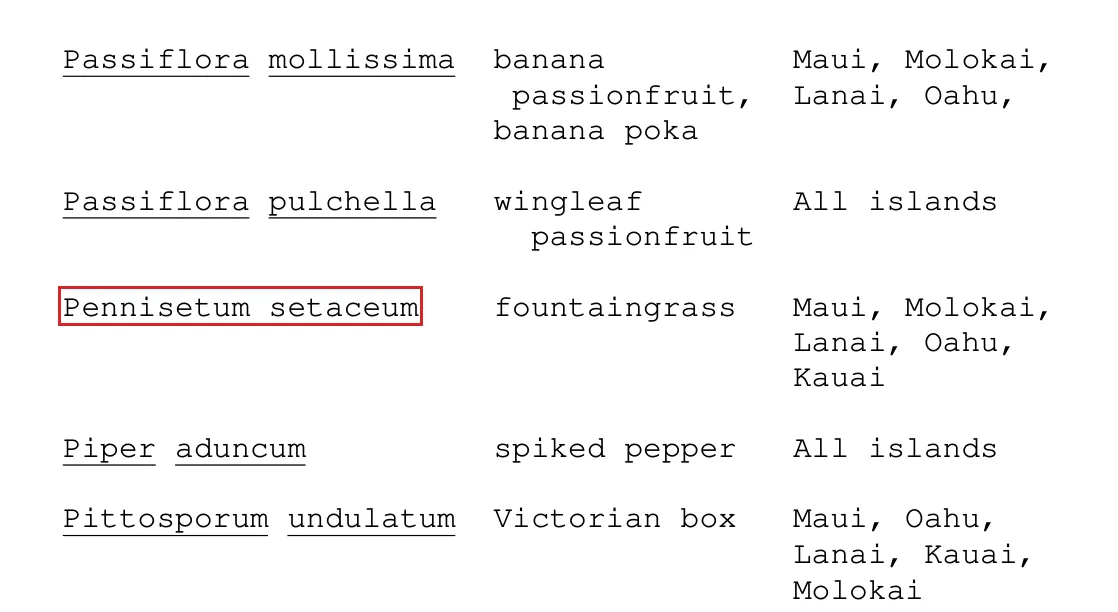
Arizona’s and Nevada’s listings are the ones with teeth. Table 6 of R3-4-245 was created by rulemaking at 25 A.A.R. 3357, effective Jan. 4, 2020, and amended effective Feb. 4, 2024; Section B bars any listed weed from being admitted into the state; it does not, on its face, ban sale or planting of plants already there. The rule text names Pennisetum setaceum with no cultivar exception written in, so a nursery shipping purple fountain grass into Arizona under that name should ask the Arizona Department of Agriculture’s Plant Services Division before it ships.
Why the concern: the National Park Service says fountain grass seed was sold in the U.S. by about 1880, was planted in Tucson from 1940, and was establishing in the Santa Catalina Mountains by 1946. Its seed stays viable in soil for at least 6 years, and stands burn hot enough to kill native plants that did not evolve with fire (NPS, Saguaro National Park). In Hawaii, the Invasive Species Council counts more than 200,000 infested acres on the Kona side of the Big Island and gives the plant a Hawaii Pacific Weed Risk Assessment score of 26, High Risk (HISC).
What several guides say vs what the primary source says
Six claims recur across the guides that rank for fountain grass, and each one can be checked against a state rule text or an extension sheet. Each row below pairs the claim with the primary text it should have quoted.
| Claim in guides | What the primary source says | Source |
|---|---|---|
| Fountain grass is invasive in AZ, CA, FL, HI and NV (maker’s care guide) | Only Arizona, Hawaii and Nevada list it by rule; California and Florida ratings are advisory | Proven Winners guide vs HAR 4-68, Cal-IPC |
| It is regulated as a noxious weed only in Hawaii | Arizona lists it as Class C (R3-4-245 Table 6, effective Jan. 4, 2020) and Nevada as Category A (NAC 555.010, 2018) | NPS Saguaro page, updated May 6, 2025 vs A.A.C. Table 6, NAC 555.010 |
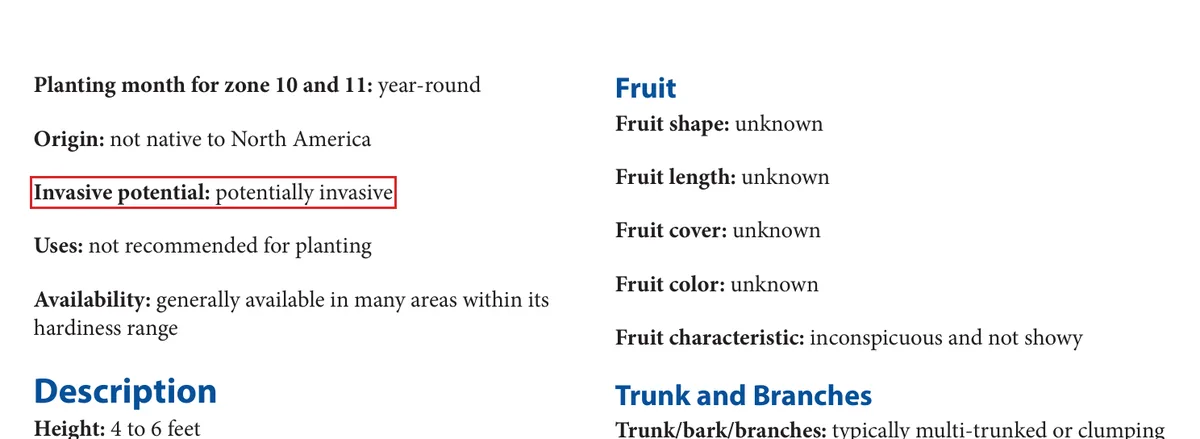
| ‘Rubrum’ is sterile, so you get no seeds | UF/IFAS rates it “potentially invasive”; NParks says it “seldom sets seed”; NPS says “sterile” plants “still produce a small percentage of viable seeds” | UF/IFAS FPS464; NParks; NPS |
| Purple fountain grass is Pennisetum setaceum | EPPO treats it as a separate hybrid, Cenchrus x cupreus | EPPO |
| Hardy fountain grass is not invasive anywhere | UF/IFAS rates ‘Hameln’ “not known to be invasive”, but Maryland prohibits C. alopecuroides and its cultivars from July 15, 2026 | FPS461 vs MDA |
| Hardy fountain grass never seeds | UF/IFAS says ‘Hameln’ does not re-seed, “unlike the species”; NC State calls ‘Moudry’ a prolific self seeder in warm climates | FPS461; NC State |
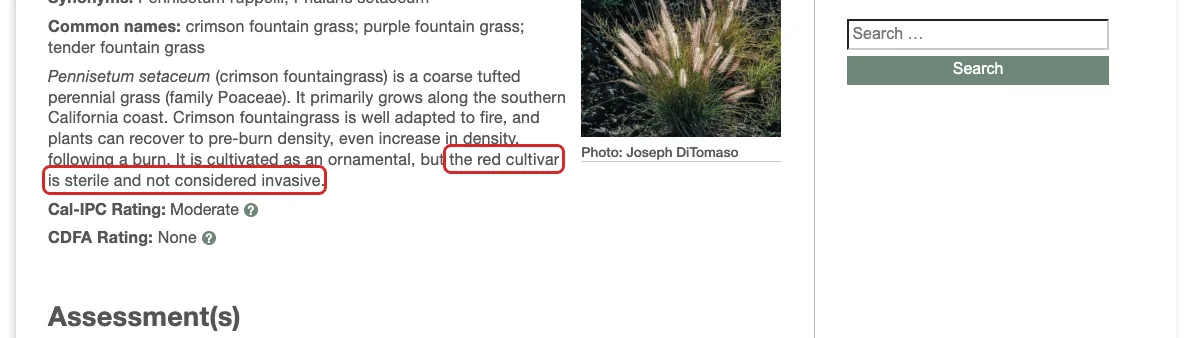
The two Florida-and-California documents disagree about the purple plant itself. Cal-IPC says “the red cultivar is sterile and not considered invasive” (Cal-IPC), while UF/IFAS FPS464, revised in October 2023, says its seeds “volunteer to form small plantlets nearby” (UF/IFAS). If you garden in zone 9 to 11 near open land, pull volunteer seedlings around a purple clump while they are small; UF/IFAS notes seedlings pull easily by hand and larger plants need a pick or shovel (UF/IFAS CAIP). Pampas grass, a Class C noxious weed in Washington, is the other ornamental grass that western weed lists name; its rule-by-rule status is in our pampas grass guide.
How far apart should you plant fountain grass, and what will a bed cost?
Space purple fountain grass 36 to 60 inches apart in the ground, the range UF/IFAS gives for both ‘Rubrum’ and ‘Hameln’ (UF/IFAS FPS464, FPS461); Proven Winners prints 18 to 24 inches for its smaller Graceful Grasses plant, which suits containers and one-season beds (Proven Winners). At 36 inches on a square grid, a 100 sq ft bed takes 12 plants.
- Pick full sun. UF/IFAS says ‘Rubrum’ “grows poorly in the partial shade” (UF/IFAS), and Proven Winners defines full sun as 6 or more hours a day (Proven Winners).
- Wait until after the last spring frost for purple fountain grass, which MBG sells as a spring annual in St. Louis (MBG). Plant hardy fountain grass in spring or at least 6 to 8 weeks before the first fall frost (Proven Winners guide).
- Dig a hole about twice as wide as the root ball (Proven Winners guide) and set the crown at or slightly above grade; UW Extension plants the crown above ground level to prevent crown rot in moist sites (UW Extension).
- Space on the grid you chose: plants = bed area in sq ft divided by (spacing in feet squared), rounded up.
- Water to establish, then when the top 2 inches of soil are dry (Proven Winners guide); MBG asks for “consistent water throughout the growing season” for ‘Rubrum’ (MBG).
| Seller (checked Oct. 30, 2026) | Plant | Pot size | Price | Stock note | Source |
|---|---|---|---|---|---|
| Planet Desert | Purple fountain grass | 1 gal / 5 gal | $22.50 / $35.00 | In stock | product page |
| Trees.com | Purple fountain grass | 1 gal | $26.95 | In stock | product page |
| American Meadows | Purple fountain grass | 3 in pot | $7.99 sale (reg. $10.65) | Ships in spring | product page |
| Plant Addicts | Graceful Grasses purple | Quart / #1 | $29.99 / $41.49 | Sold out; no shipping to AZ, AK or HI | product page |
| Brighter Blooms | Purple fountain grass | 1 gal / 3 gal | $79.99 / $119.99 | In stock; 1 gal listed above its 2 gal ($72.99) | product page |
| American Meadows | ‘Hameln’ | 3.5 in pot | $11.99 sale (reg. $15.99) | Ships in spring | product page |
| Garden Goods Direct | ‘Hameln’ | 1 / 2 / 3 gal | $29.95 / $39.95 / $59.95 | Available | product page |
| Moana Nursery (Reno) | ‘Hameln’ | #1 | $8.00 sale (reg. $15.99) | In store | product page |
| Spacing on center | Plants per 100 sq ft | Purple, 1 gal at $22.50 to $26.95 | ‘Hameln’, 1 gal at $29.95 |
|---|---|---|---|
| 18 in (Proven Winners, containers) | 100 ÷ 2.25 = 44.4, so 45 | $1,012.50 to $1,212.75 | $1,347.75 |
| 24 in | 100 ÷ 4 = 25 | $562.50 to $673.75 | $748.75 |
| 36 in (UF/IFAS low end) | 100 ÷ 9 = 11.1, so 12 | $270.00 to $323.40 | $359.40 |
| 48 in | 100 ÷ 16 = 6.25, so 7 | $157.50 to $188.65 | $209.65 |
| 60 in (UF/IFAS high end) | 100 ÷ 25 = 4 | $90.00 to $107.80 | $119.80 |
- Plants needed
- 12
Plants = bed area ÷ (spacing in feet squared), rounded up. Cost uses the unrounded count. Default: 100 sq ft at 36 in = 12 plants; at $22.50 to $26.95 per 1 gal purple plant, $250 to $299 unrounded ($270 to $323.40 for 12 whole plants, as in the worked table).
The annual habit is what makes purple fountain grass the dearer bed over time. Twelve 1 gallon purple plants at $22.50 cost $270 every spring north of zone 9; twelve 1 gallon ‘Hameln’ at $29.95 cost $359.40 once, and UW Extension’s division every 3 years adds plants instead of costs (UW Extension). By year 5 the purple bed has cost $1,350 against $359.40. Mulch is the next line: a 100 sq ft bed at 3 inches takes 0.93 cubic yards or 13 two-cubic-foot bags, per our mulch calculator.
- Purple fountain grass replaced yearly ($22.50 per 1 gal)
- 'Hameln' planted once ($29.95 per 1 gal)
Source: GIR arithmetic from Planet Desert and Garden Goods Direct prices, Oct. 30, 2026; spacing from UF/IFAS FPS464 and FPS461 Excludes tax, shipping, mulch and labor. Values match the cumulative cost table.
Show the numbers
| Purple fountain grass replaced yearly ($22.50 per 1 gal) | 'Hameln' planted once ($29.95 per 1 gal) | |
|---|---|---|
| Year 1 | $270 | $359.40 |
| Year 2 | $540 | $359.40 |
| Year 3 | $810 | $359.40 |
| Year 4 | $1,080 | $359.40 |
| Year 5 | $1,350 | $359.40 |
| Year | Purple fountain grass, 12 plants replaced yearly | ‘Hameln’, 12 plants planted once |
|---|---|---|
| 1 | 12 x $22.50 = $270.00 | 12 x $29.95 = $359.40 |
| 2 | $540.00 | $359.40 |
| 3 | $810.00 | $359.40 (first division due, UW Extension) |
| 4 | $1,080.00 | $359.40 |
| 5 | $1,350.00 | $359.40 |
When should you cut back fountain grass?
Cut hardy fountain grass in late winter, before new shoots appear: UW Extension trims it to 3 to 6 inches above the ground, and MBG cuts it to the ground at the same point (UW Extension, MBG). Purple fountain grass outside zone 9 needs no cutback; Proven Winners says it can be removed as soon as it turns brown or in spring (Proven Winners).
- Leave the foliage standing through winter. UW Extension says the leaves stay fairly upright for winter interest, and the warm-season clump does not start growing until conditions “warm considerably” (UW Extension).
- Tie the clump with string first so the cut leaves come away as one bundle, as UW Extension suggests (UW).
- Cut with hedge trimmers at 3 to 6 inches above the soil before green shoots show. Proven Winners prints 4 to 6 inches (PW guide).
- If the center has died out into a ring, divide the clump right after the cut. UW Extension suggests division about every 3 years; UF/IFAS says every 5 to 10 years for ‘Hameln’ (UF/IFAS FPS461).
- For ‘Moudry’ or the species in warm areas, cut plumes before seed matures; NC State’s ‘Moudry’ page says that in warm climates it “should be cut back before seeds mature” (NC State).
In zones 9 to 11, where purple fountain grass lives through winter, Proven Winners says that once it turns brown “you can cut it back to the ground whenever you would like” (Proven Winners), and UF/IFAS lists year-round planting there (UF/IFAS).
How do you overwinter purple fountain grass?
Dig it before frost and keep it above freezing. MBG says plants “can be dug in fall, trimmed and overwintered in greenhouses or indoors in sunny cool areas” (MBG); Missouri State stores dug clumps dormant in a dry garage or basement “away from freezing temperatures” (Missouri State). Proven Winners treats it as an annual anywhere colder than 20°F (Proven Winners).
| Method | Where | Temperature | Light and water | Spring step | Source |
|---|---|---|---|---|---|
| Keep it growing | Greenhouse, sunroom or cool sunny window | Above freezing; growers hold finished plants at 50 to 65°F | High light; moderate to moist water (grower sheet) | Plant out after the last spring frost | MBG; PW grower culture sheet |
| Store it dormant | Dry garage or basement | Away from freezing | Keep dry; no light level given | Begin watering in early spring, divide, replant after frost | Missouri State |
| Replace it | Compost the plant | Not applicable | Not applicable | Buy new plants; MBG says many gardeners do | MBG |
- Before the first fall frost, dig the clump with as much root ball as the pot will hold, or move the container plant you already have.
- Trim the leaves back so the plant fits its pot and space indoors; MBG’s method says “trimmed” without a set height.
- Pot it in a container with drainage holes and well-drained mix; UF/IFAS lists ‘Rubrum’ as needing a well-drained site (UF/IFAS).
- Keep it in a sunny, cool room above freezing. The Proven Winners grower sheet holds finished plants at 50 to 65°F and lists the light requirement as high (PW grower culture sheet).
- For dormant storage instead, keep the pot dry in a garage or basement that never freezes, then begin watering and divide the clump in early spring (Missouri State).
- Move it outdoors after the last spring frost date, the same timing MBG gives for new plants (MBG).
No extension service we found publishes an indoor temperature for purple fountain grass; 50 to 65°F is a greenhouse holding range, not a survival limit. The hard limit is freezing: Iowa State says annual fountain grass “will not survive the winter in Iowa” outdoors (Iowa State Extension, March 1, 2022).
Why is my purple fountain grass turning brown or green?
In fall, brown is normal: purple fountain grass is a warm-season grass, and Proven Winners says it “will usually turn shades of brown for the winter” where it is grown as an annual (Proven Winners). Green leaves in summer point to shade: the ‘Cherry Sparkler’ plant patent describes ‘Rubrum’ foliage as burgundy in full sun and green in full shade (USPP22538).
| What you see | Likely cause | What to do | Source |
|---|---|---|---|
| Whole plant tan after the first frost | Cold: below about 20°F it is an annual | Compost it, or dig and store above freezing next year | Proven Winners |
| Purple leaves turning green | Too little sun | Move to 6 or more hours of direct sun | USPP22538; UF/IFAS |
| Brown leaf tips in a dry spell | Drought stress | Water deeply when the top 2 in of soil is dry | UW Extension; PW guide |
| Yellow-brown base, clump declining in a wet year | Crown rot in poorly drained soil | Replant with the crown above grade in well-drained soil | UW Extension |
| Hardy clump with a dead, brown center | Old clump | Divide in spring after the cutback | UW Extension |
| Hardy fountain grass orange-bronze, then beige, in fall | Normal dormancy | Leave standing; cut back in late winter | UW Extension |
Brown tips during a summer drought are documented for hardy fountain grass: UW Extension notes leaf tips “may turn brown if not watered in drought conditions” (UW Extension). UF/IFAS lists no serious pests and moderate drought tolerance for ‘Rubrum’, so check water, drainage and sun hours before treating for pests (UF/IFAS). For a bed with under 6 hours of sun, a shade grass fits better; see our Japanese forest grass guide.
Which fountain grass should you plant?
Match the plant to your winter and your county. In Arizona, Nevada or Hawaii, skip the green species and ask before planting the purple hybrid; in Maryland, skip hardy fountain grass. Elsewhere north of zone 9, choose ‘Rubrum’ as a 1-season accent or ‘Hameln’, which UF/IFAS lists for zones 5 through 8 and says “does not re-seed itself” (UF/IFAS FPS461).
| If your situation is | Do this | Why (source) |
|---|---|---|
| Arizona or Nevada, any zone | Avoid green fountain grass; check with the state agriculture department before bringing purple plants in | Class C in Arizona, R3-4-245(B)(1) bars entry (A.A.C. R3-4-245); Category A in Nevada (NAC 555.010) |
| Maryland, want a hardy perennial | Skip Chinese fountain grass (‘Hameln’, ‘Little Bunny’, ‘Moudry’); plant switchgrass or another native | Prohibited from July 15, 2026; potted stock phased out by July 15, 2027 (MDA) |
| Maui, Molokai, Lanai, Oahu or Kauai | Do not plant fountain grass; report escapes | Listed noxious weed for islands free or relatively free of it (HAR 4-68) |
| Zone 9 to 11 elsewhere, want purple color | Plant ‘Rubrum’, ‘Fireworks’ or ‘Sky Rocket’; pull volunteer seedlings | MBG: ‘Rubrum’ rarely sets seed; UF/IFAS: may re-seed (MBG, UF/IFAS) |
| Zone 8 or colder, want purple for one season | Plant ‘Rubrum’ after last frost; compost or overwinter above freezing | Not hardy below about 20°F (Proven Winners) |
| Zone 5 to 8 outside Maryland, want a perennial | Plant ‘Hameln’ or ‘Little Bunny’ 36 to 60 in apart | Zones 5 to 8 and no re-seeding for ‘Hameln’ (UF/IFAS) |
| Zone 4 or northern zone 5 | Pick a hardier grass or accept crown loss | UW Extension: marginally hardy, crowns die out in some winters (UW) |
| Warm climate, considering ‘Moudry’ | Cut plumes before seed matures or choose ‘Hameln’ | NC State: prolific self seeder in warm climates (NC State) |
| Pets dig or chew in the bed | Fountain grass is acceptable | ASPCA lists Pennisetum setaceum as non-toxic (ASPCA) |
1Are you in Arizona or Nevada, or on Maui, Molokai, Lanai, Oahu or Kauai?
YesSkip fountain grass. Arizona lists Pennisetum setaceum as Class C (R3-4-245), Nevada as Category A (NAC 555.010), and Hawaii lists it for those islands (HAR 4-68).
NoGo to the next question
2Are you in Maryland and want a perennial?
YesSkip Chinese fountain grass, prohibited from July 15, 2026 (MDA); plant a native such as switchgrass.
NoGo to the next question
3Do you want the plant to return every year in zone 8 or colder?
YesPlant hardy fountain grass such as 'Hameln', zones 5 to 8, which UF/IFAS says does not re-seed.
NoGo to the next question
4Are you in USDA zone 9, 10 or 11?
YesPlant 'Rubrum' as a perennial, 36 to 60 in apart, and pull volunteer seedlings (UF/IFAS, MBG).
NoGo to the next question
5Do you have a sunny cool room or a frost-free garage?
YesGrow 'Rubrum' for the summer, dig it before frost and keep it above freezing (MBG, Missouri State).
NoGrow 'Rubrum' as a 1-season annual and replace it each spring after the last frost.
Native alternatives fill the same space where fountain grass is unwelcome. The National Park Service at Saguaro suggests sacaton (Sporobolus wrightii) or deer grass (Muhlenbergia rigens) (NPS), and UMaine Extension suggests switchgrass (Panicum virgatum) for northern gardens (UMaine). Our pink muhly grass guide and Karl Foerster feather reed grass guide cover two more clump grasses with sizes and prices, and our turf and trees section holds the rest of our plant profiles.
How we compiled this
In October 2026 we read 6 rule texts and lists (Arizona’s A.A.C. R3-4-245 and its Table 6, Arizona’s R3-4-403 seed list, Nevada’s NAC 555.010, Hawaii’s HAR chapter 4-68 list, Maryland’s Prohibited Invasive Plant List and 7 CFR 360.200), 3 UF/IFAS fact sheets, the K-State ornamental grass trial pages for 9 fountain grasses, 12 Missouri Botanical Garden Plant Finder records, NC State, UW, Iowa State, Missouri State and UMaine extension pages, the Cal-IPC and UF/IFAS invasive-plant profiles, 1 plant patent, 5 maker pages and 8 retailer listings checked Oct. 30, 2026. We did not grow, measure or test any plants; measured sizes are K-State’s, and seed claims are attributed to whoever made them.
This page is general information, not legal advice. State noxious weed lists change; confirm with your state department of agriculture before you buy, ship or plant fountain grass, and read any herbicide label before you treat an escaped plant.
| Question | Short answer | Source |
|---|---|---|
| Perennial or annual? | Perennial in zones 9 to 11; annual below about 20°F | UF/IFAS; PW |
| Botanical name | Cenchrus x cupreus (sold as P. setaceum ‘Rubrum’) | EPPO |
| Invasive? | Green species listed in AZ, NV, HI; hardy species prohibited in MD; purple hybrid rarely sets seed | HAR 4-68; MBG |
| Spacing | 36 to 60 in in the ground; 18 to 24 in in pots | UF/IFAS; PW |
| Hardy alternative | ‘Hameln’, zones 5 to 8, 28 to 32 in measured | UF/IFAS; K-State |
| Overwinter | Dig before frost; keep above freezing in a sunny cool room or a dry garage | MBG; Missouri State |
Frequently asked questions
Does purple fountain grass come back every year?
Only in USDA zones 9 to 11, where UF/IFAS grows it as a perennial and notes it may regrow from roots in north Florida (UF/IFAS). Proven Winners treats it as an annual anywhere colder than 20°F, and Iowa State says it will not survive an Iowa winter. North of zone 9, dig it before frost or buy new plants each spring.
Is purple fountain grass toxic to dogs?
No. The ASPCA lists fountain grass (Pennisetum setaceum) as non-toxic to pets in its October 2022 fall-plants roundup (ASPCA). The same ASPCA article tells owners whose pet has eaten a plant and shows symptoms to contact a veterinarian or call the ASPCA Animal Poison Control Center at (888) 426-4435.
Is red fountain grass the same as purple fountain grass?
Yes. UF/IFAS lists “red fountain grass” and “purple fountain grass” as common names for the same plant, Pennisetum setaceum ‘Rubrum’ (UF/IFAS FPS464). Crimson or green fountain grass is different: that name belongs to the seeding species, Cenchrus setaceus, which Arizona lists as a Class C noxious weed.
Can you grow purple fountain grass in a pot?
Yes. Proven Winners sells its Graceful Grasses purple fountain grass as a container “thriller” at 30 to 36 inches tall with 18 to 24 inch spacing (Proven Winners). A pot also makes overwintering easier: move the whole container into a sunny, cool room before the first frost, as MBG describes (MBG).
Does fountain grass spread?
Hardy clumps grow a little larger each year, Proven Winners says, and spread mainly by seed: MBG says the green species “readily self seeds” in warm areas (MBG), NC State calls ‘Moudry’ a prolific self seeder in warm climates, and UF/IFAS says ‘Hameln’ does not re-seed. Cut plumes before seed matures if seedlings appear; in Maryland, hardy fountain grass is now a prohibited plant.
How fast does purple fountain grass grow?
Fast. UF/IFAS rates its growth rate as fast (UF/IFAS), and in Kansas State’s Olathe trial a first-year ‘Rubrum’ reached 48 inches tall and 38 inches wide in one season (K-State). At that width, plants on UF/IFAS’s 36 inch spacing touch by the end of their first summer.
Is fountain grass a sun or shade plant?
Sun. UF/IFAS says ‘Rubrum’ grows poorly in partial shade, and UW Extension says hardy fountain grass tolerates part shade but will not flower well there (UW Extension). In shade, ‘Rubrum’ foliage can also turn green: the ‘Cherry Sparkler’ patent describes it as burgundy in full sun and green in full shade.
When should you plant purple fountain grass?
After the last spring frost in zone 8 and colder, the timing MBG gives for new plants (MBG). In zones 9 to 11, UF/IFAS lists year-round planting. For hardy fountain grass, Proven Winners says spring or at least 6 to 8 weeks before the first fall frost so roots establish before winter.
Sources
- UF/IFAS Extension, FPS464, Pennisetum setaceum ‘Rubrum’ Purple Fountain Grass (Gilman, Klein, Hansen), Revised Oct. 2023. Accessed October 2026.
- UF/IFAS Extension, FPS461, Pennisetum alopecuroides ‘Hameln’ Dwarf Fountain Grass, Revised Oct. 2023. Accessed October 2026.
- UF/IFAS Center for Aquatic and Invasive Plants, Pennisetum setaceum, fountaingrass (FISC Category II), Current page. Accessed October 2026.
- California Invasive Plant Council, Pennisetum setaceum profile (Cal-IPC rating: Moderate), Current page. Accessed October 2026.
- Hawaii Department of Agriculture, HAR Title 4, Chapter 68, list of plant species designated as noxious weeds, List dated June 18, 1992. Accessed October 2026.
- Arizona Administrative Code, via Cornell LII, A.A.C. R3-4-245, Noxious Weeds, Current rule. Accessed October 2026.
- Arizona Secretary of State, via Internet Archive, 3 A.A.C. 4, Department of Agriculture, Plant Services Division (Table 6; R3-4-403), Supp. 25-1, March 31, 2025. Accessed October 2026.
- Nevada Administrative Code, via Internet Archive, NAC 555.010, Designation and categorization of noxious weeds, As amended by R152-17, Aug. 30, 2018; captured May 10, 2026. Accessed October 2026.
- Maryland Department of Agriculture, Maryland Prohibited Invasive Plant Law and Regulations, List additions effective July 15, 2026. Accessed October 2026.
- Hawaii Invasive Species Council, The target: fountain grass (Cenchrus setaceus), Current page. Accessed October 2026.
- eCFR, 7 CFR 360.200, Designation of noxious weeds, Current. Accessed October 2026.
- EPPO Global Database, Cenchrus x cupreus (PESAD), Current record. Accessed October 2026.
- National Parks Board, Singapore, Cenchrus x cupreus ‘Rubrum’, Flora and Fauna Web, Record updated April 15, 2025. Accessed October 2026.
- National Park Service, Fountain Grass, Saguaro National Park, Updated May 6, 2025. Accessed October 2026.
- University of Arizona, AZ Invasive Plants: Fountain grass, Current page. Accessed October 2026.
- Kansas State University, Ornamental grass trial, Olathe Horticulture Research Center (9 Pennisetum pages), Pages updated March 27, 2026. Accessed October 2026.
- Missouri Botanical Garden, Plant Finder: Pennisetum setaceum ‘Rubrum’ and 11 related records, Current records. Accessed October 2026.
- NC State Extension, Plant Toolbox: Cenchrus setaceus; Cenchrus alopecuroides ‘Hameln’ and ‘Moudry’, Current pages. Accessed October 2026.
- University of Wisconsin Extension, Fountain grass, Cenchrus (Pennisetum) alopecuroides, Revised July 18, 2025. Accessed October 2026.
- Iowa State University Extension, I planted fountain grass in the garden this spring. Will it survive the winter?, March 1, 2022. Accessed October 2026.
- Missouri State University, Purple Fountain Grass, plant identification page, Current page. Accessed October 2026.
- University of Maine Cooperative Extension, Is Redhead Fountain Grass invasive?, Sept. 13, 2024. Accessed October 2026.
- ASPCA, Fall Plants: Hazardous or Harmless?, Oct. 19, 2022. Accessed October 2026.
- USDA Agricultural Research Service, Plant Hardiness Zone Map, 2023 map, 1991 to 2020 data. Accessed October 2026.
- Proven Winners, Graceful Grasses Purple Fountain Grass, ‘Fireworks’, ‘Sky Rocket’ and Vertigo plant pages, Checked Oct. 30, 2026. Accessed October 2026.
- Proven Winners, Fountain grass care guide, Checked Oct. 30, 2026. Accessed October 2026.
- Proven Winners, Grower plant culture: Pennisetum setaceum ‘Rubrum’, Checked Oct. 30, 2026. Accessed October 2026.
- U.S. Patent and Trademark Office, via Google Patents, USPP22538, Pennisetum plant ‘Cherry Sparkler’, Granted patent. Accessed October 2026.
- Retailers, Planet Desert, Trees.com, American Meadows, Plant Addicts, Brighter Blooms, Garden Goods Direct and Moana Nursery product pages, Checked Oct. 30, 2026. Accessed October 2026.