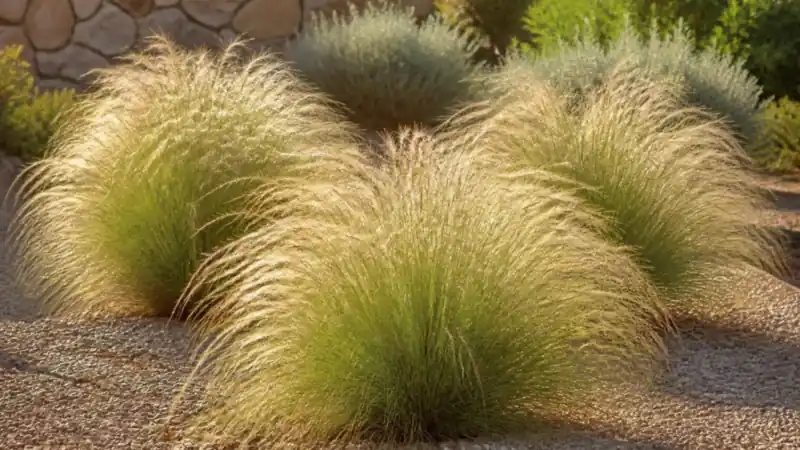
Mexican feather grass (Nassella tenuissima) is a 1 to 2 ft, thread-leaved bunchgrass for USDA zones 7 to 10 that self-sows heavily: Cal-IPC rates it invasive in California, and Victoria, Australia, bans it as a State prohibited weed.
Key takeaways
- NC State Extension rates Mexican feather grass for USDA zones 7a to 10b at 1 to 2 ft tall and wide (NC State Plant Toolbox); Proven Winners says to grow it as an annual where winters drop below 20°F (Proven Winners).
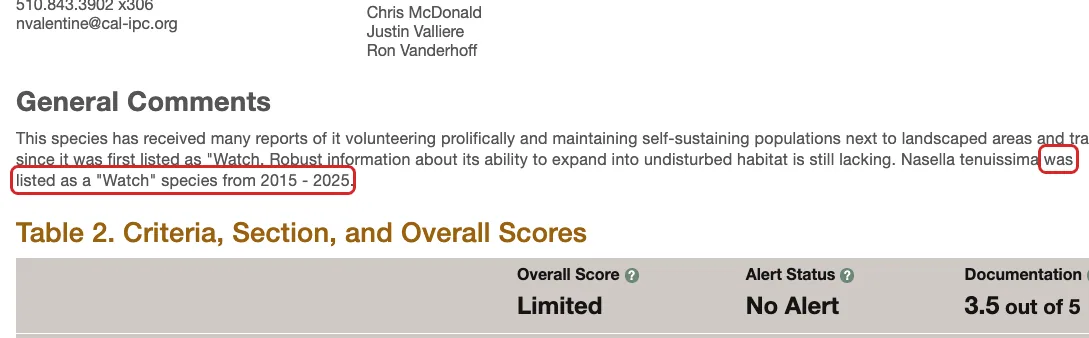
- The California Invasive Plant Council moved it from its Watch list (2015 to 2025) to a Limited invasive rating after a review evaluated May 10, 2024 and approved April 4, 2025 (Cal-IPC Plant Assessment Form).
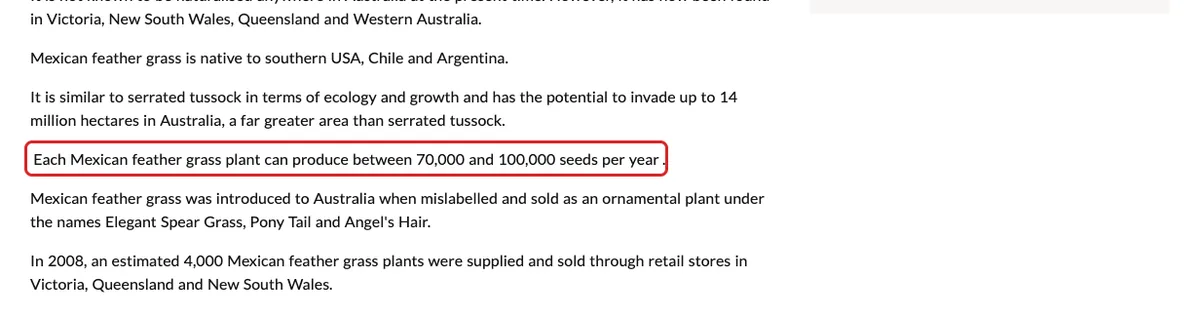
- One plant can shed 70,000 to 100,000 seeds a year (Northern Territory Government) that live at least 7 years in soil (Humphries and Florentine, 2021); Texas A&M gives 70,000 per lifetime and 4 years (ERM-039).
- It is not a U.S. federal, Oregon or Washington noxious weed (USDA PLANTS NATE3; OAR 603-052-1200), but its look-alike, serrated tussock (Nassella trichotoma), is on the federal list at 7 CFR 360.200.
- Prune lightly: Oklahoma State says remove only the top third, never cut to the ground (Oklahoma Proven); the Arizona-Sonora Desert Museum calls the plant “fairly short-lived” (ASDM).
- PlantRight’s California substitutes are alkali sacaton, blue grama, purple three-awn, pine muhly, ‘White Cloud’ muhly and autumn moor grass (PlantRight, archived 2021).
What is Mexican feather grass, and what is its botanical name?
Mexican feather grass is a perennial needlegrass named Nassella tenuissima (Trin.) Barkworth in Taxon 39: 612 in 1990, per the International Plant Names Index. Nurseries still sell it as Stipa tenuissima, its 1836 name, and IPNI records a third combination, Jarava tenuissima (Trin.) D.L.Fu. USDA’s PLANTS Database files it under symbol NATE3 as finestem needlegrass, native to the lower 48 states.
| Measure | Mexican feather grass | Source |
|---|---|---|
| Botanical name | Nassella tenuissima (Trin.) Barkworth, Taxon 39: 612 (1990) | IPNI; USDA PLANTS |
| Synonyms | Stipa tenuissima Trin.; Jarava tenuissima (Trin.) D.L.Fu | IPNI; USDA PLANTS |
| USDA symbol, common name | NATE3, finestem needlegrass | USDA PLANTS |
| Native range | Far west Texas, southern New Mexico to central Mexico; Argentina, Chile | Texas A&M ERM-039; PlantRight |
| USDA hardiness zones | 7a to 10b | NC State; Proven Winners |
| Height x spread | 1 to 2 ft x 1 to 2 ft (NC State); 12 to 24 in x 20 to 24 in (Proven Winners) | NC State; PW |
| Leaf | Thread-like, 0.25 to 0.5 mm across, about 60 cm (24 in) long | Queensland Government |
| Seed awn | 4.5 to 9 cm long | NSW WeedWise; Agriculture Victoria |
| Sun | Full sun (6+ hours) to partial shade (2 to 6 hours) | NC State |
| Water | Low to moderate; may go dormant in hot, dry months | ASDM; NC State |
| Cold limit | Hardy to minus 10°F (ASDM); annual below 20°F (Proven Winners) | ASDM; PW |
| Seed per plant | 70,000 to 100,000 per year | NT Government; Cal-IPC PAF |
Its home range is narrow. Texas A&M AgriLife calls it one of the most common grasses of the Trans-Pecos, naming Jeff Davis, Brewster, Culberson, Presidio, Pecos, Val Verde and King counties (ERM-039, Russell and Rector, 10/17). PlantRight adds a separate native population in Argentina and Chile. Calflora records it as not native to California (Calflora).
Which plant does “feather grass” mean?
“Feather grass” covers at least 4 plants. Feather reed grass ‘Karl Foerster’ is a seed-sterile hybrid 5 to 6 ft tall in bloom, covered in our Karl Foerster feather reed grass guide. Giant feather grass reaches 6 to 8 ft (NC State), and serrated tussock is a federal noxious weed.
| Common name | Botanical name | Height | Zones | Status | Source |
|---|---|---|---|---|---|
| Mexican feather grass | Nassella tenuissima | 1 to 2 ft | 7a to 10b | Cal-IPC Limited; banned in parts of Australia | NC State; Cal-IPC |
| Feather reed grass ‘Karl Foerster’ | Calamagrostis x acutiflora | 5 to 6 ft in bloom | 4 to 7 reliable | Seed-sterile hybrid | Our guide (CBG, Hoffman) |
| Giant feather grass | Celtica (Stipa) gigantea | 6 to 8 ft | 5a to 8b | Not listed | NC State |
| Serrated tussock | Nassella trichotoma | About 45 cm (18 in) | n/a | U.S. federal noxious weed | 7 CFR 360.200; NSW |
What zones, sun and water does Mexican feather grass need?
Mexican feather grass is rated for USDA zones 7a to 10b by NC State Extension and Proven Winners, which means average winter lows of 0°F or warmer on the USDA Plant Hardiness Zone Map. It wants full sun, sharp drainage and little water: NC State warns that overly wet soils cause root rot and that it “will not do well in the hot humid conditions of the southeast.”
The zone numbers do not line up. Proven Winners prints 7a to 10b yet tells growers to treat the plant as an annual below 20°F, which is the bottom of zone 9a. PanAmerican Seed sells its ColorGrass ‘Pony Tails’ strain for zones 6a to 10b (PanAmerican Seed), and Kansas State’s trial page lists an advertised zone of 5 and 6 for ‘Pony Tails’ (K-State).
| Source | Zones or cold limit | Height x spread | Type of source |
|---|---|---|---|
| NC State Plant Toolbox | 7a to 10b | 1 to 2 ft x 1 to 2 ft | Extension |
| Oklahoma Proven (OSU) | Zone 7 | Almost 2 ft x 3 ft | Extension |
| Arizona-Sonora Desert Museum | Hardy to minus 10°F | 2 ft x 2 ft | Botanic garden |
| Proven Winners | 7a to 10b; annual below 20°F | 12 to 24 in x 20 to 24 in | Maker |
| PanAmerican Seed, ColorGrass Pony Tails | 6a to 10b | 16 to 24 in x 24 in | Seed breeder |
| Kansas State trial, Stipa Pony Tails | Advertised zone 5 and 6 | 20 in x 8 in, year 1 | University trial |
| RHS (UK) | H4, minus 10 to minus 5°C | 0.5 to 1 m x 0.1 to 0.5 m | Horticultural society |
Water need is low once roots establish. The Desert Museum rates it “low to moderate water use” and warns it “can be invasive in wetter landscapes” (ASDM). Texas A&M describes a plant that “can go dormant during drought” and regrows after extended dry spells, and NC State places that dormancy in the hottest months.
Is Mexican feather grass invasive?
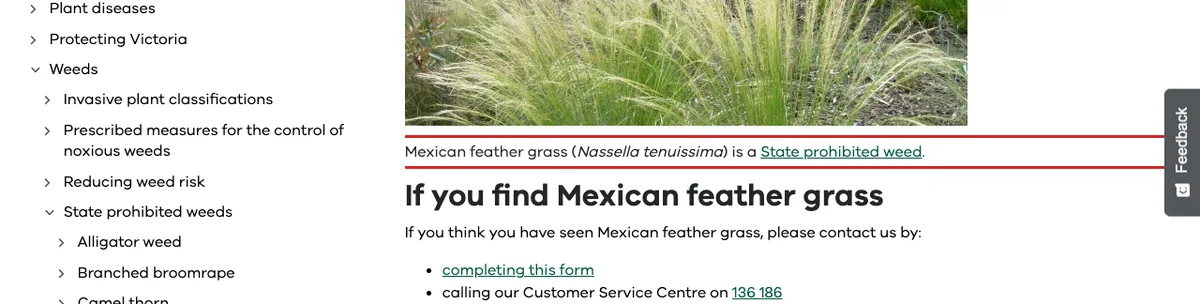
Yes, in some places, and the legal answer depends on where you stand. As of October 2026, Cal-IPC rates Mexican feather grass Limited in California, Victoria and New South Wales prohibit it outright, New Zealand bans its sale under the National Pest Plant Accord, and South Africa lists it as Category 1b. USDA PLANTS records no federal or state noxious listing for it, and Oregon’s and Washington’s weed lists omit it.
California’s rating changed in 2025. Cal-IPC’s Plant Assessment Form says the species “was listed as a ‘Watch’ species from 2015 to 2025” and now scores Limited, with a documentation score of 3.5 out of 5 (Cal-IPC PAF; 2025 inventory update). The same form records that it “appears primarily as a waif in California wildlands,” with the earliest record from 1998 and sightings mostly along the coast from the Bay Area to San Diego.
Swipe the table sideways to see every column.
| Jurisdiction | Status of Nassella tenuissima | Rule or listing | Source |
|---|---|---|---|
| United States (federal) | Not listed | 7 CFR 360.200 names serrated tussock only | eCFR; USDA PLANTS |
| California | Invasive, Limited (Watch 2015 to 2025); PlantRight do-not-plant | Cal-IPC Inventory, 2025 update | Cal-IPC PAF |
| Florida | High risk, score 21 (not a legal listing) | UF/IFAS Assessment, March 22, 2018 | UF/IFAS WRA |
| Oregon | Not listed | OAR 603-052-1200, amended Oct. 1, 2024 | OAR 603-052-1200; ODA |
| Washington | Not listed | WAC 16-750 Class A, B and C lists | WSNWCB list |
| Texas | Native to the Trans-Pecos; escapes onto disturbed rangeland | No listing; Extension advisory | Texas A&M ERM-039 |
| Victoria, Australia | State prohibited weed | Catchment and Land Protection Act 1994 | Agriculture Victoria |
| New South Wales | Prohibited matter; must not be sold | Biosecurity Act 2015 | NSW WeedWise |
| Queensland | Prohibited invasive plant; report sightings | Biosecurity Act 2014 | Business Queensland |
| South Australia | Declared category 1; State Alert Weed | Landscape South Australia Act 2019, policy dated March 28, 2021 | SA policy |
| Tasmania | Declared; import, sale and distribution prohibited | Biosecurity Act 2019 | NRE Tasmania |
| Northern Territory | Class A declared weed | NT declared weed list | NT Government |
| New Zealand | National Pest Plant Accord species; no breeding, sale or distribution | NPPA 2020 | Auckland Council; NZPCN |
| South Africa | Category 1b (as “white tussock”) | NEM:BA Alien and Invasive Species Lists, Notice 1003, Sept. 18, 2020 | Government Gazette 43726 |
| Europe (EPPO) | Observation List, re-prioritized 2022/23 | EPPO prioritization summary | EPPO |
Australia treats it hardest because its close relative, serrated tussock, is “widely regarded as Australia’s worst pasture weed.” Agriculture Victoria estimates that 14 million to several 100 million hectares of Australian land could be vulnerable, and records that about 4,000 plants were supplied to Victorian stores between January and May 2008 under other names (Agriculture Victoria). Its staff still remove plants at no cost to the owner.
How many seeds does one plant make?
One plant can shed 70,000 to 100,000 seeds a year, according to the Northern Territory Government and Cal-IPC, and Humphries and Florentine’s 2021 review in Plants gives “up to 100,000 seeds per plant annually” (Plants 10(6):1036). The figures that circulate in care guides are often garbled, so the table below sets each source beside its exact claim.
| Claim | Source says | Source |
|---|---|---|
| Seeds per plant | About 70,000 “in a lifetime” | Texas A&M ERM-039 (2017) |
| Seeds per plant | 70,000 to 100,000 per year | NT Government; Cal-IPC PAF |
| Seeds per plant | Up to 100,000 per year | Humphries and Florentine 2021 |
| Seed-bank life | Up to 4 years | Queensland Government; Texas A&M |
| Seed-bank life | At least 7 years | Cal-IPC PAF; Humphries and Florentine 2021 |
| Germination of one nursery seed lot | 20% at 23°C | Humphries and Florentine 2021 |
| Active buds per tiller | 12 to 20 | Texas A&M ERM-039 |
Even at the 20% germination measured in one nursery seed lot, which the authors suspected had low viability, one plant’s yearly seed implies 14,000 to 20,000 potential seedlings.
| Input | Low case | High case | Basis |
|---|---|---|---|
| Seeds shed by 1 plant in 1 year | 70,000 | 100,000 | NT Government; Humphries and Florentine |
| Germination rate applied | 20% | 20% | Mount Macedon nursery seed lot (Humphries and Florentine) |
| Potential seedlings (seeds x 20%) | 14,000 | 20,000 | GIR arithmetic |
| Years those seeds can stay viable | 4 | 7 | Queensland, Texas A&M; Cal-IPC, Humphries and Florentine |
How do you tell Mexican feather grass from serrated tussock?
Check the seed tail. Mexican feather grass seeds carry an awn 4.5 to 9 cm long and the flower heads stand upright, while serrated tussock (Nassella trichotoma) has a 2.5 to 3.5 cm awn and drooping heads, per Agriculture Victoria and NSW WeedWise. The Northern Territory says the two can only be told apart when flowering.
| Feature | Mexican feather grass (N. tenuissima) | Serrated tussock (N. trichotoma) | Source |
|---|---|---|---|
| Awn (seed tail) | 4.5 to 9 cm | 2.5 to 3.5 cm (NSW: 25 mm) | Agriculture Victoria; NSW WeedWise |
| Flower heads | Upright | Drooping | NSW WeedWise |
| Height | About 70 cm | About 45 cm | Victoria; NSW |
| Leaf color | Brighter green | Duller green | Auckland Council |
| Seed | 2 to 3 mm, narrower | Wider | NSW WeedWise |
| U.S. legal status | Not listed | Federal noxious weed; Arkansas noxious | 7 CFR 360.200; USDA PLANTS NATR3 |
| South Africa | Category 1b | Category 1b | Gazette 43726 |
Leaves alone will not settle it. Mexican feather grass blades are rolled tight and feel coarse when you slide your fingers down them, per Agriculture Victoria, but that only separates it from flat-leaved fountain grass and native Poa, which Victoria lists among plants commonly reported in error. Fountain grass has its own profile in our fountain grass guide.
The legal gap between the two is wide. Serrated tussock is a federal noxious weed under 7 CFR 360.200(c), and Oregon’s quarantine rule bars every plant on that federal list by reference (OAR 603-052-1200).

Will Mexican feather grass spread, and how do you keep it in the bed?
It will spread by seed wherever the seed lands on open, disturbed ground, and Texas A&M records seed moving by wind, water, soil, vehicles and animal droppings. Cal-IPC says it escapes residential plantings along urban roadways and sidewalks. Containment means removing seed heads before they ripen and pulling seedlings every spring.
- Site it away from open land. Texas A&M advises against planting it near rangeland or agricultural land with soil disturbance (ERM-039).
- Shear off flowering stems once they emerge, before seed sets, as Arkansas Extension’s Gerald Klingaman advises when reseeding is a concern (UACES, March 23, 2007).
- Bag the clipped heads and put them in the trash, not the compost, because seed can stay viable 4 to 7 years.
- Pull or dig seedlings while they are small, roots included; Cal-IPC notes plants can resprout if roots are not fully removed (Cal-IPC PAF).
- Do not mow or string-trim escaped patches. Texas A&M says mowing and haying are more likely to spread the seed.
- For large rangeland escapes, Texas A&M cites Australian research showing 76 to 100 percent kill from 1.5 percent glyphosate sprayed on individual plants.
This page is general information, not pesticide advice. The label is the law: confirm the site, rate and any applicator license your state requires before spraying.
Should you cut back or comb out Mexican feather grass?
Comb or trim it, but do not scalp it. Oklahoma State says the grass “does not like to be cut to the ground in spring like other grasses” and to remove only the top third to rejuvenate it (Oklahoma Proven). The Arizona-Sonora Desert Museum cuts it back in early spring, and the RHS says wait until early spring rather than late autumn.
| Source | What it says | When |
|---|---|---|
| Oklahoma State (Oklahoma Proven) | Remove only the top third; do not cut to the ground | Spring |
| Arizona-Sonora Desert Museum | Cut back to remove dormant foliage and dried seed heads | Early spring |
| University of Arkansas Extension | Shear for a tidier look; delay if reseeding is a concern | Late winter, before new growth |
| RHS | Cut leaves back when they die off | Early spring, not late autumn |
| Proven Winners | Remove brown growth now or in spring; divide in spring only | Any time; spring |
| Henderson County Master Gardeners (Texas) | “Prune off or rake out dead foliage” | Before new foliage emerges |
- Late winter: rake or comb dead blades out of the clump with gloved fingers or a fan rake.
- If the clump stays flat or brown, shear off the top third, per Oklahoma State.
- Early summer: clip flowering stems once they emerge if you want to stop seed.
- Spring, every few years: lift and divide crowded clumps (Proven Winners, RHS), or replace them.
How long does Mexican feather grass live?
Expect a short life. The Arizona-Sonora Desert Museum calls it “fairly short-lived, but will reseed in the landscape,” and the RHS lists 2 to 5 years to maturity (RHS). No extension source we found gives a lifespan in years. Plan to replace or divide clumps rather than counting on decades from one plant.
Is Mexican feather grass deer resistant, pet safe and fire safe?
NC State lists deer, drought and erosion as conditions it resists (NC State), but Rutgers’ deer ratings do not include it, the ASPCA plant lists have no entry, and fire sources disagree. Cal-IPC judges it “likely only minor wildfire hazard” in California wildlands, while Texas A&M calls it “fire prone.”
| Question | Finding | Source |
|---|---|---|
| Deer | Listed as deer resistant | NC State |
| Deer (Rutgers ratings) | Not rated; little bluestem and blue fescue rated “Rarely Damaged” | Rutgers NJAES |
| Dogs and cats | No entry on the ASPCA toxic or non-toxic lists | ASPCA |
| Seed hazard | Florets “very sharp with long awns” | Texas A&M ERM-039 |
| Livestock | Unpalatable; avoids grazing pressure | Texas A&M; Cal-IPC |
| Fire (California wildlands) | Fine leaves add fuel, but “likely only minor wildfire hazard” | Cal-IPC PAF |
| Fire (Australia) | Dry build-ups “can increase fire risk and hazard” | SA policy, 2021 |
What can you plant instead of Mexican feather grass?
For California, PlantRight lists alkali sacaton, blue grama, purple three-awn, pine muhly, ‘White Cloud’ muhly and autumn moor grass as substitutes (PlantRight, archived 2021). Elsewhere, prairie dropseed and little bluestem survive to zone 3a, four zones colder than Mexican feather grass, and NC State lists both as deer and drought resistant.
| Plant | USDA zones | Height x spread | Water | Native range | Source |
|---|---|---|---|---|---|
| Mexican feather grass (Nassella tenuissima), for comparison | 7a to 10b | 1 to 2 ft x 1 to 2 ft | Low to moderate | Far west Texas, New Mexico, Mexico; Argentina, Chile | NC State; ASDM |
| Prairie dropseed (Sporobolus heterolepis) | 3a to 9b | 2 to 3 ft x 2 to 3 ft | Dry to occasionally dry; drought resistant | Canada to U.S. | NC State |
| Little bluestem (Schizachyrium scoparium) | 3a to 9b | 2 to 4 ft x 1.5 to 3 ft | Drought and dry soil resistant | Eastern North America | NC State |
| Blue grama (Bouteloua gracilis) | 3a to 10b | 6 in to 2 ft x 1.5 to 2 ft | Tolerates very dry soil | West and central Canada to Mexico | NC State; PlantRight |
| ‘Blonde Ambition’ blue grama (PP 22,048) (Bouteloua gracilis) | 4 to 9 | 30 to 36 in x 30 to 36 in | Moderate to xeric | Species native to 22 states | Plant Select |
| Pink muhly (Muhlenbergia capillaris) | 5a to 9b | 2 to 3 ft x 2.3 to 3 ft | Drought, heat and humidity resistant | Central and eastern U.S. to Guatemala | NC State |
| UNDAUNTED ruby muhly (Muhlenbergia reverchonii ‘PUND01S’) | 5 to 10 | 15 to 18 in (30 in in flower) x 18 to 24 in | Moderate to dry | Selected from a north-central Texas population | Plant Select |
| Pine muhly (Muhlenbergia dubia) | Not stated | 2 to 3 ft x 2 to 3 ft at maturity; 2.5 x 4.8 ft after 2 years at Davis | Low (WUCOLS region 2) | Southwestern U.S. to northern Mexico | UC Davis UCLPIT; PlantRight |
| Alkali sacaton (Sporobolus airoides) | Not stated | 2 to 3.5 ft tall | Drought tolerant rangeland grass | South Dakota to Washington, south to Texas and Mexico | USDA NRCS Plant Guide; PlantRight |
Pink muhly, rated for zones 5a to 9b with heat and humidity resistance, is the closest match for a fine, airy clump in the Southeast, where NC State says Mexican feather grass struggles; our pink muhly grass guide covers spacing and cultivars. For the full field of options by zone and sun, see our ornamental grasses guide.
UC Master Gardeners in Tulare and Kings counties pair Mexican feather grass with pampas grass as the two ornamental grasses to avoid there, citing fire danger and crop damage, and suggest ‘Blonde Ambition’ and ‘Karl Foerster’ instead (UC Master Gardeners, April 26, 2025). Pampas grass has its own page: pampas grass plant guide.
How many plants does a bed take, and what do they cost?
Proven Winners spaces Mexican feather grass 20 to 24 in apart, so a 100 sq ft bed takes 25 to 36 plants. At B.B. Barns’ listed online price of $16.99 per 1 gal pot on Oct. 30, 2026 (B.B. Barns), that is $424.75 to $611.64 before tax; pink muhly listed at the same $16.99 and prairie dropseed at $17.99.
| Spacing on center | Sq ft per plant | Plants per 100 sq ft | Cost at $16.99 each | Cost at $17.99 each |
|---|---|---|---|---|
| 18 in | 2.25 | 45 (44.4 rounded up) | $764.55 | $809.55 |
| 20 in (Proven Winners low end) | 2.78 | 36 | $611.64 | $647.64 |
| 24 in (Proven Winners high end) | 4.00 | 25 | $424.75 | $449.75 |
| 30 in | 6.25 | 16 | $271.84 | $287.84 |
- Plants needed
- 36
Plants = bed area divided by (spacing in feet squared), rounded up. Cost uses the unrounded count. Default: 100 sq ft at 20 in = 36 plants; at $16.99 per 1 gal Mexican feather grass, $611.64, as in the worked table. Listings were shown out of stock on Oct. 30, 2026.
CSU Extension’s weed-control depth for inorganic mulch is about 3 inches, as our river rock cost guide details; our mulch calculator guide converts that depth to cubic yards for a 100 sq ft bed. More species profiles sit in our Turf and Trees section.
Should you plant Mexican feather grass?
Plant it only in a dry, sunny bed in zones 7 to 10, away from open land, in a state where it is legal, and only if you will clip seed heads every year. In the six Australian states and territories in the status table, New Zealand and South Africa, weed law bars or restricts it. In California, Proven Winners itself says it is “not recommended for California gardens.”
| If your situation is | Do this | Why (source) |
|---|---|---|
| You live in Victoria, NSW, Queensland, Tasmania, South Australia or the NT | Do not plant; report plants you find | State prohibited, prohibited matter or declared weed (Agriculture Victoria; NSW) |
| You live in New Zealand or South Africa | Do not plant or sell it | NPPA species (Auckland Council); NEM:BA Category 1b (Gazette 43726) |
| You garden in California | Plant blue grama, alkali sacaton or pine muhly instead | Cal-IPC Limited rating; PlantRight do-not-plant list (Cal-IPC) |
| The bed borders rangeland, pasture, open grassland or a wildland trail | Choose a native grass for your region | Escapes onto disturbed rangeland (Texas A&M ERM-039) |
| Winter lows fall below 0°F (zone 6 or colder) | Plant prairie dropseed or little bluestem (zone 3a) | Rated from zone 7a (NC State) |
| Hot, humid Southeast summers | Plant pink muhly (zones 5a to 9b) | “Will not do well in the hot humid conditions of the southeast” (NC State) |
| Heavy or irrigated soil that stays wet | Skip it or regrade for drainage | Root rot in overly wet soils (NC State) |
| Zones 7 to 10, dry sunny bed, outside California and away from open land | Plant at 20 to 24 in; clip seed stems each summer; pull seedlings each spring | Spacing (Proven Winners); seed control (UACES) |
1Are you in Australia, New Zealand or South Africa?
YesDo not plant it. It is prohibited or declared in Victoria, NSW, Queensland, Tasmania, South Australia and the NT, an NPPA species in New Zealand and Category 1b in South Africa. Report plants you find.
NoGo to the next question
2Are you in California?
YesSkip it. Cal-IPC rates it Limited invasive and PlantRight lists it do-not-plant; try blue grama, alkali sacaton or pine muhly.
NoGo to the next question
3Does the bed border rangeland, pasture, open grassland or a wildland trail?
YesSkip it. Texas A&M AgriLife advises against planting it near rangeland or disturbed agricultural land.
NoGo to the next question
4Do winter lows fall below 0°F (USDA zone 6 or colder)?
YesPlant prairie dropseed or little bluestem, rated to zone 3a; NC State rates Mexican feather grass from zone 7a.
NoGo to the next question
5Are your summers hot and humid, as in the Southeast?
YesPlant pink muhly (zones 5a to 9b); NC State says Mexican feather grass does poorly in hot, humid Southeast summers.
NoPlant it 20 to 24 in apart in a dry, sunny bed, clip the flower stems before seed ripens each summer and pull seedlings each spring.
How we compiled this
In October 2026 we compiled this page from the 44 sources listed below: extension and botanic-garden plant pages, the Cal-IPC assessment form, a Florida weed risk assessment, U.S., Oregon and Washington rule texts, Australian, New Zealand and South African government listings, a peer-reviewed review and maker spec sheets. Pages that blocked scripts were read in a browser or through dated Internet Archive copies. We grew and tested no plants.
| Question | Short answer | Source |
|---|---|---|
| Zones | 7a to 10b; annual below 20°F | NC State; PW |
| Size | 1 to 2 ft tall and wide | NC State |
| Seeds | 70,000 to 100,000 per plant per year | NT Government |
| California status | Cal-IPC Limited since 2025 | Cal-IPC PAF |
| Banned | Victoria, NSW, Queensland, Tasmania, SA, NT; New Zealand; South Africa | Victoria; Auckland; South Africa |
| Pruning | Comb or remove the top third in spring | Oklahoma State |
| Look-alike | Serrated tussock: 2.5 to 3.5 cm awn, federal noxious weed | Victoria; 7 CFR 360.200 |
Frequently asked questions
Is Mexican feather grass invasive?
It is in some regions. Cal-IPC rates it Limited invasive in California after a 2025 review, and Victoria, New South Wales, Queensland, Tasmania, South Australia and the Northern Territory ban or declare it. No U.S. federal, Oregon or Washington noxious weed list names it. In its native Trans-Pecos Texas it still escapes onto disturbed rangeland (Texas A&M).
Will Mexican feather grass spread?
Yes, by seed, not by runners. One plant can shed 70,000 to 100,000 seeds a year (NT Government), carried by wind, water, soil, vehicles and animals. Cal-IPC reports it escaping residential plantings along roads and sidewalks. Clipping flower stems before seed ripens and pulling seedlings each spring keeps it in place.
Should you cut back Mexican feather grass?
Trim it lightly rather than scalping it. Oklahoma State says to remove only the top third and not to cut it to the ground in spring (Oklahoma Proven). The Arizona-Sonora Desert Museum and the RHS cut old foliage in early spring. Combing dead blades out with gloved fingers works between those two approaches.
Is Mexican feather grass a perennial?
Yes, a perennial bunchgrass rated for USDA zones 7a to 10b by NC State. Proven Winners says to treat it as an annual where winter drops below 20°F, and the Arizona-Sonora Desert Museum calls it “fairly short-lived, but will reseed,” so individual clumps may last only a few seasons (ASDM).
Why is my Mexican feather grass turning brown?
Summer heat and drought are the usual cause. NC State notes it “may go dormant during the hottest months in drought conditions,” and Texas A&M says it regrows after dry spells. Brown, mushy bases point the other way: NC State warns that overly wet soils cause root rot (NC State).
Is Mexican feather grass toxic to dogs?
The ASPCA toxic and non-toxic plant lists have no entry for Nassella or Stipa as of October 2026 (ASPCA), so there is no rating either way. The physical risk is the seed: Texas A&M describes florets that are “very sharp with long awns,” so keep dogs out of seeding clumps in summer.
Is ‘Pony Tails’ a sterile Mexican feather grass?
No. PanAmerican Seed sells ColorGrass Stipa ‘Pony Tails’ as multi-seed pellets, which means it is grown from seed (PanAmerican Seed), and the RHS treats ‘Pony Tails’ as a synonym of the species. None of the maker, extension or RHS pages we checked describes a sterile Mexican feather grass.
Is Mexican feather grass native to the United States?
Yes, in a small area. USDA PLANTS lists it as native to the lower 48 under symbol NATE3 (USDA PLANTS), and Texas A&M places its natural range in far west Texas, chiefly the Trans-Pecos. Calflora records it as not native to California, which is why California treats it as an invader.
Sources
- NC State Extension, Gardener Plant Toolbox: Nassella tenuissima, and pages for Sporobolus heterolepis, Schizachyrium scoparium, Bouteloua gracilis, Muhlenbergia capillaris and Stipa gigantea, Current pages. Accessed October 2026.
- California Invasive Plant Council, Plant Assessment Form: Nassella tenuissima (evaluated May 10, 2024; list committee April 4, 2025), 2025. Accessed October 2026.
- California Invasive Plant Council, Cal-IPC Inventory updates (2025 modifications), 2025. Accessed October 2026.
- California Invasive Plant Council, Stipa tenuissima (Nassella tenuissima) profile, Current page. Accessed October 2026.
- Calflora, Nassella tenuissima taxon page, Current page. Accessed October 2026.
- PlantRight, via Internet Archive, Stipa/Nassella tenuissima, Mexican feathergrass: plant these instead, Capture of May 5, 2021. Accessed October 2026.
- Texas A&M AgriLife Extension, ERM-039, Mexican Feathergrass (M.L. Russell and Barron S. Rector), library listing, 10/17; listing Dec. 7, 2021. Accessed October 2026.
- Texas A&M AgriLife Extension, via Internet Archive, ERM-039 PDF, Mexican Feathergrass, Capture of Aug. 6, 2024. Accessed October 2026.
- Oklahoma State University Extension, Oklahoma Proven plant profile: Mexican feather grass, Current page. Accessed October 2026.
- University of Arkansas Cooperative Extension, Plant of the Week: Mexican Feathergrass (Gerald Klingaman), March 23, 2007. Accessed October 2026.
- Arizona-Sonora Desert Museum, Plant care sheet: Nassella tenuissima, 2019. Accessed October 2026.
- Royal Horticultural Society, Nassella tenuissima plant details, Current page. Accessed October 2026.
- Henderson County Master Gardeners (Texas), Mexican feather grass handout, May 2020. Accessed October 2026.
- Proven Winners, Mexican Feather Grass, Nassella (formerly Stipa) tenuissima, Checked Oct. 30, 2026. Accessed October 2026.
- PanAmerican Seed, ColorGrass Stipa Pony Tails, Checked Oct. 30, 2026. Accessed October 2026.
- Kansas State University, Ornamental grass trial: Stipa ‘Pony Tails’, Updated March 27, 2026. Accessed October 2026.
- USDA NRCS, PLANTS Database: Nassella tenuissima (NATE3), Current record. Accessed October 2026.
- USDA NRCS, PLANTS Database: Nassella trichotoma (NATR3), noxious status, Current record. Accessed October 2026.
- International Plant Names Index, Nassella tenuissima (Trin.) Barkworth, Taxon 39: 612 (1990), Current record. Accessed October 2026.
- International Plant Names Index, Jarava tenuissima (Trin.) D.L.Fu, comb. nov., Current record. Accessed October 2026.
- eCFR, 7 CFR 360.200, Designation of noxious weeds, Current. Accessed October 2026.
- Oregon Administrative Rules, via Cornell LII, OAR 603-052-1200, Quarantine; Noxious Weeds, Amended Oct. 1, 2024. Accessed October 2026.
- Oregon Department of Agriculture, Noxious weed profiles and designations, Current page. Accessed October 2026.
- Washington State Noxious Weed Control Board, Printable noxious weed list, 2026 list. Accessed October 2026.
- UF/IFAS Assessment, Nassella tenuissima weed risk assessment (Young and Lieurance), March 22, 2018. Accessed October 2026.
- Agriculture Victoria, Mexican feather grass, State prohibited weed, Updated July 4, 2025. Accessed October 2026.
- NSW Department of Primary Industries, NSW WeedWise: Mexican feather grass, Reviewed 2024. Accessed October 2026.
- Queensland Government, Mexican feather grass, prohibited invasive plant, Updated June 29, 2026. Accessed October 2026.
- Department of Natural Resources and Environment Tasmania, Mexican feather grass, declared weed, Current page. Accessed October 2026.
- Government of South Australia, via Internet Archive, Declared Plant Policy: Mexican feathergrass, March 28, 2021. Accessed October 2026.
- Northern Territory Government, Mexican feather grass, Class A declared weed, Current page. Accessed October 2026.
- Auckland Council, Pest search: Mexican feather grass (NASTEN), Current page. Accessed October 2026.
- New Zealand Plant Conservation Network, Nassella tenuissima, Current page. Accessed October 2026.
- Republic of South Africa, Government Gazette 43726, Notice 1003: Alien and Invasive Species Lists, 2020, Sept. 18, 2020. Accessed October 2026.
- EPPO, Prioritization process summary: Nassella tenuissima, 2022/23. Accessed October 2026.
- Humphries and Florentine, Plants 10(6):1036, A Comparative Review of Six Invasive Nassella Species in Australia, May 21, 2021. Accessed October 2026.
- UC Davis, UC Landscape Plant Irrigation Trials: pine muhly, Current page. Accessed October 2026.
- USDA NRCS, Plant Guide: alkali sacaton, 2002. Accessed October 2026.
- Plant Select, Bouteloua gracilis ‘Blonde Ambition’ PP 22,048 and UNDAUNTED ruby muhly, Checked Oct. 30, 2026. Accessed October 2026.
- UC Master Gardeners, Tulare and Kings counties, Don’t Plant This: Plant That (Sharon Plein), April 26, 2025. Accessed October 2026.
- Rutgers NJAES, Landscape plants rated by deer resistance, Current list. Accessed October 2026.
- ASPCA, Toxic and non-toxic plant list: dogs, Current list. Accessed October 2026.
- USDA Agricultural Research Service, Plant Hardiness Zone Map, 2023 map. Accessed October 2026.
- B.B. Barns, Nassella tenuissima, Muhlenbergia capillaris and Sporobolus heterolepis 1 gal listings, Checked Oct. 30, 2026. Accessed October 2026.