How to get rid of nimblewill: spray green patches with mesotrione (Tenacity) at 5 fl oz per acre plus surfactant, up to 3 times 2 to 3 weeks apart, or kill them with glyphosate in summer and reseed in late August. Recheck next spring.
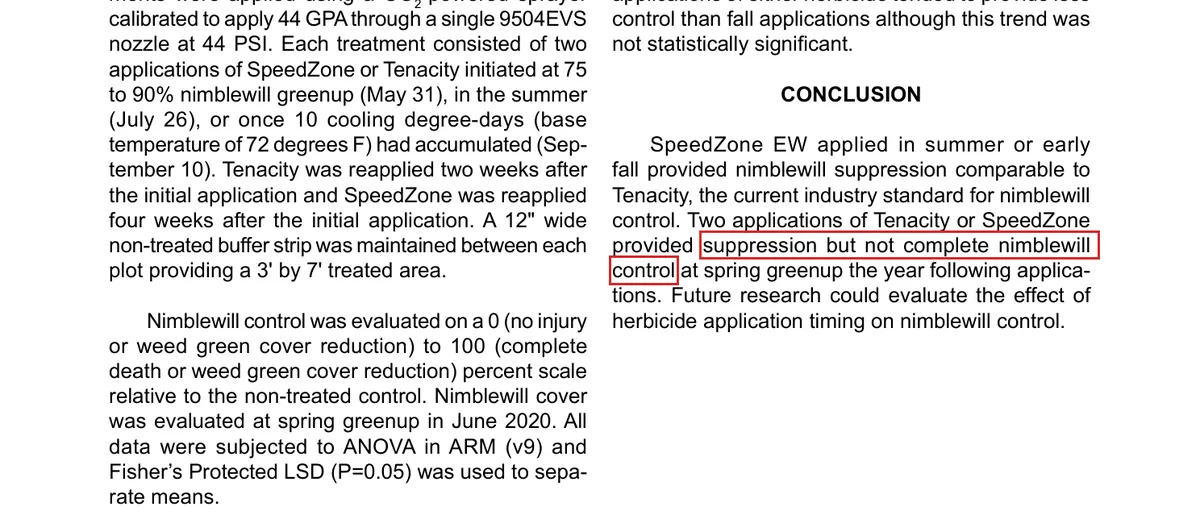
How to get rid of nimblewill is mostly a question of when, because this warm-season grass is only green and sprayable from late spring to the first frost. In a Rutgers trial in Adelphia, New Jersey, untreated plots still had 31 percent nimblewill cover the next June; 2 Tenacity sprays started at spring green-up left 4 percent, and 2 started on Sept. 10 left 1 percent. Even those plots were not clean: the Rutgers authors call the result suppression, not complete control.
No top result reports how much nimblewill survives each program or where published timing advice contradicts the label; the trial table, 5-label table and calendar below do. If you are not sure the brown patches are nimblewill, start with the grassy-weed rows of our lawn weed identification table.
This page summarizes pesticide labels and university research; it is not a product endorsement. The label is the law: read the current label of the exact product you buy, and check whether your state requires a pesticide applicator license before anyone treats a lawn for pay.
Is it nimblewill? Check the calendar, then the ligule
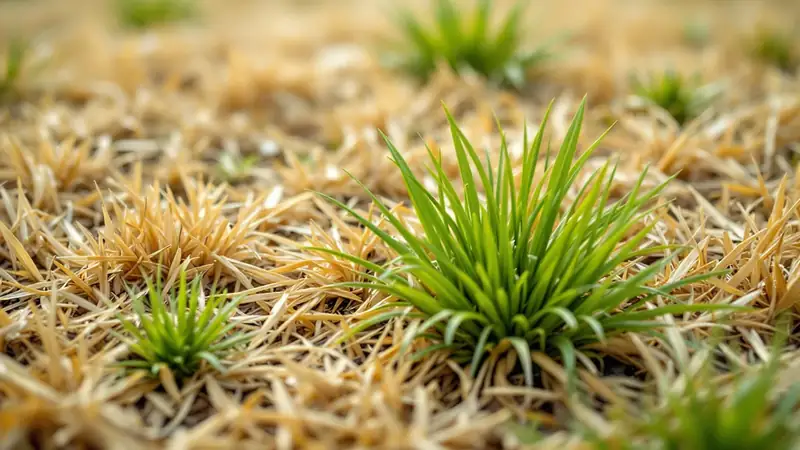
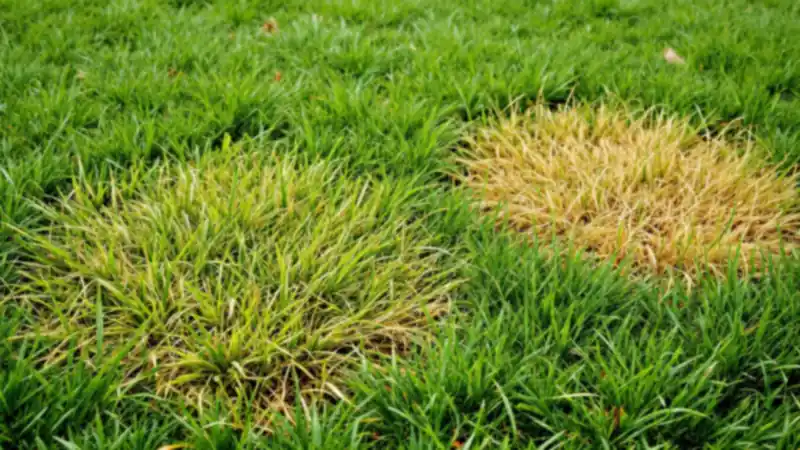
Nimblewill (Muhlenbergia schreberi) is the patch that stays tan when the rest of a bluegrass or fescue lawn greens up, because it breaks dormancy late, typically in May in Iowa, and browns again at the first frost. Penn State Extension describes gray-green leaves 0.75 to 2 inches long, wiry stems and a very short membranous ligule; dead stems stay upright, bleached to straw color, through winter.
| Grass | Ligule | Spread | Color clue | Where it grows | Source |
|---|---|---|---|---|---|
| Nimblewill | Very short membrane, jagged on top | Thin stolons; stems recline and root at nodes; no rhizomes | Tan from first frost to late spring; gray or blue-green in summer | Shade and moist soil, also sun north of the transition zone | Penn State; Virginia Tech |
| Bermudagrass | Fringe of hairs | Stolons plus rhizomes | Tan from first frost to spring | Sun; does not tolerate shade | Rutgers; Fairfax MGA |
| Creeping bentgrass | Tall membrane | Thin creeping stolons | Green in early spring (cool-season) | Forms denser patches than nimblewill | Virginia Tech; Purdue AY-11 |
| Zoysiagrass | Use dormant color instead | Similar patch-forming habit | Golden tan when dormant, vs very light tan nimblewill | Rarely appears unless planted | Illinois Extension |
| Japanese stiltgrass | Use the leaf instead | Compare leaves, not runners | Wider leaf, often a silver midrib stripe | Shade | Penn State |
Then dig. Bermudagrass rhizomes run 1 to 6 inches deep; nimblewill has none, only shallow roots that pull easily. Shade is the second clue: nimblewill thrives where Kentucky bluegrass thins under trees, and our shade grass ranking by hours of sun shows which lawn grasses can hold those spots once the weed is gone.
1Is the patch green in early spring while the lawn is green too?
YesNot nimblewill. A clump green in April is a cool-season grass such as creeping bentgrass, quackgrass or tall fescue (Purdue AY-11); see our sibling page how-to-kill-quackgrass.
NoGo to the next question
2Is the ligule a fringe of hairs, with white rhizomes under the patch?
YesBermudagrass, not nimblewill: rhizomes run 1 to 6 inches deep (UC IPM). Follow a bermudagrass program instead.
NoGo to the next question
3Is the lawn itself bermudagrass, zoysia, St. Augustine or centipede?
YesBermuda or zoysia: SpeedZone EW Lawn Weed Killer (2217-1064) at 1.5 fl oz per 1,000 sq ft, 2 sprays 30 days apart. St. Augustine or centipede: SpeedZone is barred; spot spray glyphosate and replug, or use Tenacity on centipede.
NoGo to the next question
4Only a handful of small plants?
YesHand pull after leaves emerge and before seedheads (Penn State), removing every stolon.
NoGo to the next question
5Does nimblewill cover more than half the area?
YesGlyphosate 2 to 3 times after regrowth from early summer, then seed Aug. 15 to Sept. 15 (Iowa State, Purdue AY-3).
NoGo to the next question
6Are you reseeding this fall anyway?
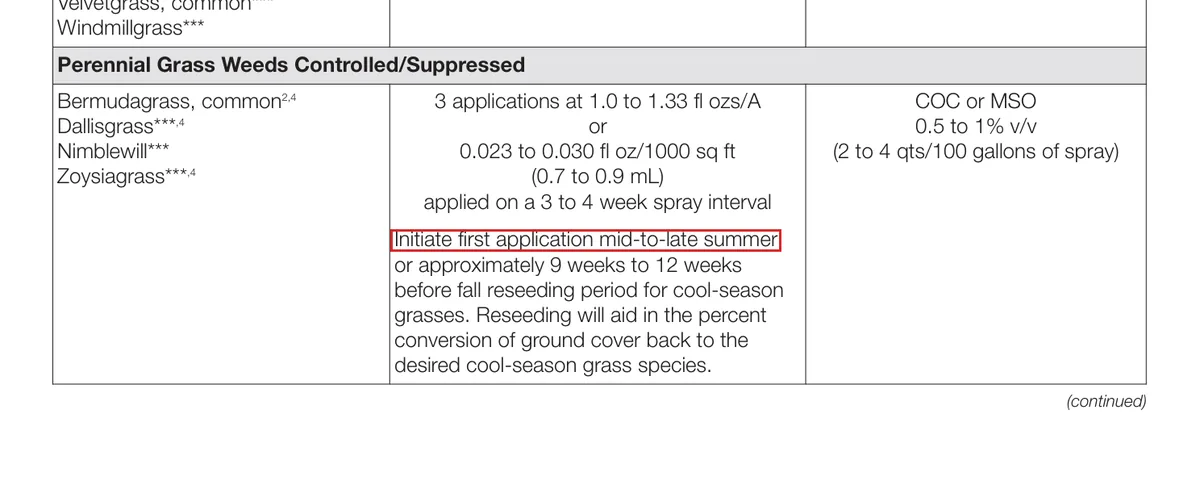
YesPylex 3 times at 1.0 to 1.33 fl oz/A, 3 to 4 weeks apart, starting 9 to 12 weeks before seeding; no Pylex for 28 days after seeding.
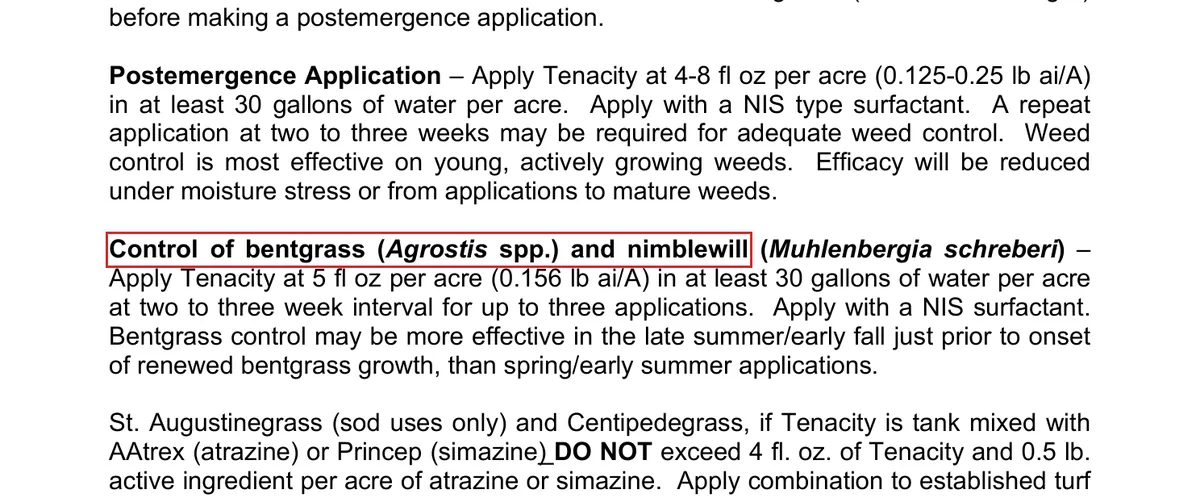
NoTenacity at 5 fl oz/A plus non-ionic surfactant, up to 3 sprays 2 to 3 weeks apart, starting at spring green-up or early September; recheck next May.
Source: Labels 100-1267, 7969-327, 2217-1064; Penn State; Iowa State; UC IPM; Purdue AY-3 and AY-11
What the trials measured: control fades by next spring
Rutgers researchers Matthew Elmore and Daniel Tuck sprayed a naturally infested cool-season stand mowed at 2.5 inches and watered by rain only, in 4 replicates of 3 by 7 ft plots (2021 Rutgers Turfgrass Proceedings, p. 161). Each program was 2 sprays: Tenacity at 5 fl oz/A with non-ionic surfactant at 0.25 percent, repeated after 2 weeks, or SpeedZone EW at 4 pints/A, repeated after 4 weeks.
| Program (2 sprays) | Started | Control, Oct. 22, 2019 | Nimblewill cover, June 20, 2020 | Cover vs untreated |
|---|---|---|---|---|
| Untreated | None | 0% | 31% | Baseline |
| Tenacity 5 fl oz/A, 2 weeks apart | May 31 (75 to 90% green-up) | 99% | 4% | 87% less |
| SpeedZone EW 4 pt/A, 4 weeks apart | May 31 | 86% | 20% | 35% less |
| Tenacity 5 fl oz/A | July 26 | 61% | 13% | 58% less |
| SpeedZone EW 4 pt/A | July 26 | 92% | 13% | 58% less |
| Tenacity 5 fl oz/A | Sept. 10 | 89% | 1% | 97% less |
| SpeedZone EW 4 pt/A | Sept. 10 | 69% | 6% | 81% less |
Spring Tenacity held 100 percent control from 6 to 14 weeks and still lost ground over winter. Mid-summer Tenacity was the weakest mesotrione timing, 61 percent by late October, while SpeedZone did as well in summer as in spring. Early-fall starts left the least nimblewill the next June: 1 percent for Tenacity, 6 for SpeedZone.
- Tenacity 5 fl oz/A, 2 sprays
- SpeedZone EW 4 pt/A, 2 sprays
Source: Rutgers Turfgrass Proceedings 2021, Elmore and Tuck, Table 2 Visual control relative to untreated plots. By June 20, 2020 cover was back to 4% (Tenacity) and 20% (SpeedZone) against 31% untreated.
Show the numbers
| Tenacity 5 fl oz/A, 2 sprays | SpeedZone EW 4 pt/A, 2 sprays | |
|---|---|---|
| Jun 14 | 58% | 46% |
| Jun 24 | 93% | 65% |
| Jul 16 | 100% | 90% |
| Aug 7 | 100% | 90% |
| Aug 22 | 100% | 80% |
| Sep 10 | 100% | 81% |
| Oct 10 | 97% | 87% |
| Oct 22 | 99% | 86% |
An older Virginia and Tennessee study agrees that one spray is not enough. Willis and colleagues (Weed Technology, 2007) found that no single mesotrione rate from 28 to 280 g ai/ha, the top end equal to 8 fl oz of Tenacity per acre, controlled more than 80 percent 8 weeks after treatment, while 2 sprays at 28 g ai/ha 10 days apart reached 80 percent. They did not measure long-term control.
Which herbicides are labeled for nimblewill?
Four selective lawn registrations name nimblewill; glyphosate names it too but kills the lawn with it. Tenacity and Pylex block leaf pigments, so treated nimblewill turns white and dies back over 2 to 3 weeks; our explainer on selective and nonselective herbicides covers the modes of action.
| Product (EPA Reg. No.) | Active ingredient | Nimblewill direction | Per 1,000 sq ft | Sprays and limits | Lawn grasses | Seeding | Label |
|---|---|---|---|---|---|---|---|
| Tenacity (100-1267) | Mesotrione 40% | 5 fl oz/A in 30+ gal water, with non-ionic surfactant | 0.115 fl oz (about 3.4 mL) | Up to 3, 2 to 3 weeks apart; at least 14 days; max 8 fl oz/A per spray, 16 fl oz/A per year | Kentucky bluegrass, tall fescue, centipede, buffalograss; ryegrass and fine fescue at 5 fl oz only. Bentgrass, Poa annua, zoysia, bermuda listed as sensitive | May be applied at seeding (5 to 8 fl oz/A; not fine fescue); post spray on seedlings after 2 mowings or 4 weeks | Sept. 28, 2022 |
| Pylex (7969-327) | Topramezone 29.7% | 3 sprays at 1.0 to 1.33 fl oz/A, 3 to 4 weeks apart, with crop oil or methylated seed oil at 0.5 to 1% | 0.023 to 0.030 fl oz (0.7 to 0.9 mL) | Max 2.0 fl oz/A per spray, 4.0 fl oz/A per year, 3 per season. Listed as controlled or suppressed; not for California | Kentucky bluegrass, tall and fine fescue, perennial ryegrass, centipede; bermuda marginal; zoysia is on its weed list | Start mid-to-late summer, 9 to 12 weeks before fall reseeding; no spray for 28 days after seeding | Sept. 12, 2018 |
| SpeedZone EW (2217-1053) | 2,4-D, MCPP-p, dicamba, carfentrazone | Grassy weeds: 4 to 5 pt/A; repeat at the same rate after 30 days if needed | About 1.5 to 1.8 fl oz | 2 broadcast sprays per year, 30 days apart; max 10 pt/A per year. Not for California | Cool-season grasses, bermuda, zoysia; not St. Augustine, bahia, centipede, seashore paspalum | Reseed 1 week after | June 29, 2023 |
| SpeedZone EW Lawn Weed Killer (2217-1064) | Same 4 actives, consumer label | 1.8 fl oz per 1,000 sq ft (cool-season); 1.5 (bermuda, zoysia, buffalograss) | 1.5 to 1.8 fl oz | 2 broadcast per year, 30 days apart; 3.6 fl oz per 1,000 sq ft per year. Not for California | As above; not St. Augustine, bahia, centipede | Delay seeding 1 week | Aug. 23, 2021 |
| Roundup Weed & Grass Killer Super Concentrate (71995-25) | Glyphosate 50.2% | Nonselective; 2.5 fl oz (5 Tbsp) per gallon, 1 gallon per 300 sq ft | About 8.3 fl oz | Reapply if green after 7 days; kills lawn grass too | None: kills every grass it wets | Plant lawn grass 3 days after the last spray | Jan. 28, 2021 |
The yearly caps decide the program. Three Tenacity sprays at 5 fl oz/A total 15 fl oz, inside the 16 fl oz/A cap; Purdue Turf offers 6, 6 and 4 fl oz as an alternative that lands exactly on the cap, though the label’s nimblewill direction names 5. Pylex at 1.33 fl oz/A three times totals 4.0 fl oz, its full year. Both SpeedZone EW labels list only 2 grassy weeds, nimblewill and the annual covered on our page about getting rid of goosegrass.
How much Tenacity goes in a backyard sprayer?
At the label’s 5 fl oz/A and 1 gallon of spray per 1,000 sq ft, each gallon needs 0.115 fl oz, about 3.4 mL or 0.69 teaspoon. The label’s spot table gives 1 teaspoon per 2 gallons instead, which works out to about 3.6 fl oz/A, below both the 5 fl oz nimblewill rate and the 4 fl oz minimum of its general postemergence range. A 250 sq ft patch at the nimblewill rate takes 0.85 mL, so a 1 mL oral syringe measures it better than a kitchen spoon.
- Product per spray (mL)
- 3.39
- Product per spray (teaspoons)
- 0.69
- Product per spray (fl oz)
- 0.115
Default: 1,000 sq ft of Tenacity at 5 fl oz/A takes 3.40 mL (0.69 tsp), mixed into about 1 gallon of water with non-ionic surfactant. Worked example: 250 sq ft takes 0.85 mL. Rates from the EPA-stamped labels on this page, read Nov. 2026; your container's label overrides this tool.
The mesotrione program, step by step
- Flag the patches while they are tan in early spring, then extend the spray zone beyond them: Illinois Extension warns creeping stems lurk past the visible edge.
- Wait until patches are 75 to 90 percent green, May 31 in the New Jersey trial.
- Mix Tenacity at 5 fl oz/A (0.115 fl oz per 1,000 sq ft) with a non-ionic surfactant; Purdue uses 0.25 percent by volume, about 0.32 fl oz per gallon. Use a flat-fan nozzle for even coverage.
- Spray 2 more times, 2 to 3 weeks apart and never sooner than 14 days (Tenacity label). The label says whitening shows 5 to 7 days after a spray and can last several weeks on the lawn grass too.
- Keep people and pets off until the spray dries; do not mulch gardens with treated clippings (label restrictions).
- Overseed thin spots in late summer, Aug. 15 to Sept. 15 in northern Indiana and Illinois (Purdue AY-3). The Tenacity label allows a spray at seeding, 5 to 8 fl oz/A, except on fine fescue.
- Recheck at green-up next May and repeat on regrowth: the Rutgers plots still carried 1 to 20 percent cover.
When should you spray nimblewill? A dormancy calendar
Nimblewill can be sprayed only while it is green: Purdue AY-11 puts the window for warm-season grassy weeds at June through early September in the Midwest. Inside that window the trial data favor 2 starts, spring green-up and early fall, and the late-summer start also lines up with the cool-season seeding window.
| Period (cool-season lawn, Midwest and Mid-Atlantic) | What nimblewill is doing | What to do | Source |
|---|---|---|---|
| First frost to May | Dormant; tan stems stay upright | Flag patches. No spray: there is no green leaf to absorb it | Penn State; Rutgers |
| May to early June | Green-up; new seedlings emerge late spring | Start Tenacity at 75 to 90% green-up; hand pull small plants | Rutgers 2021; Iowa State |
| June to early September | Active growth, while cool-season grass slows in heat | Glyphosate spot sprays, 2 to 3 rounds after regrowth; summer Tenacity was weakest in the trial | Purdue AY-11; Iowa State |
| Mid-to-late summer, 9 to 12 weeks before seeding | Still green | Start a 3-spray Pylex program, 3 to 4 weeks apart | Pylex label |
| August to October | Seedheads with awned seed | Pull or spray before seed drops | Virginia Tech; Penn State |
| Early September | Green; cool-season grass regaining vigor | Early-fall Tenacity start (Sept. 10 in the trial left 1% cover next June); feed the lawn up to 2 times at 0.9 lb N per 1,000 sq ft | Rutgers 2021; Rutgers |
| Aug. 15 to Sept. 30 | Green until frost | Seed cool-season grass: Aug. 15 to Sept. 15 north, Sept. 1 to 30 south in Indiana and Illinois | Purdue AY-3 |
When is glyphosate and reseeding the better route?
When nimblewill covers most of an area, or the lawn is bermudagrass or zoysia that Tenacity would injure, killing the patch and reseeding can be faster than 2 years of selective sprays. Iowa State says at least 2 and often 3 glyphosate applications are needed, each only after regrowth appears, starting early to mid summer so the area can be seeded in late summer.
- Spray actively growing, unstressed nimblewill. On the 71995-25 label the lawn-renovation rate is 2.5 fl oz per gallon for each 300 sq ft; check that your bottle’s active ingredient line reads glyphosate, since some Roundup-branded concentrates contain none.
- Spray well outside the visible edge or blanket the whole area, as Purdue AY-11 advises for warm-season patches.
- Wait for green regrowth from surviving stolons, then spray again; Purdue Turf says 3 or more rounds may be needed.
- Seed 3 days after the last spray per the label, or 5 to 7 days per Purdue. Our overseeding guide has the seed rates, and the guide to killing grass before replanting compares glyphosate with smothering and solarizing.
Can you pull or dig nimblewill out?
Yes, for a few plants. Penn State says hand pulling works after leaves emerge and before seedheads form, because the roots are shallow. For an established patch, Fairfax County Master Gardeners recommend digging a 6 to 12 inch perimeter around it at least 6 inches deep, refilling with soil and reseeding; patches grow 1 to 2 feet across a year, and a stolon left behind restarts one.
Denser turf slows reinvasion; Penn State says it may not suppress an established stand. Preemergence crabgrass products do nothing to established perennial runners, as our crabgrass control page explains; Tenacity’s own weed table marks nimblewill as tested postemergence only.
Where guides and labels disagree
| Question | What a guide says | What the label or trial says | What we would follow |
|---|---|---|---|
| When to start Tenacity in spring | Late April (Iowa State, Purdue) | Iowa State itself says nimblewill greens up in May; Rutgers started at 75 to 90% green-up (May 31 in NJ) | Start when patches are mostly green, not by calendar date |
| When to start Pylex | Late April (Purdue) | Mid-to-late summer, 9 to 12 weeks before fall reseeding (Pylex label, Table 2) | The label |
| Late-season mesotrione | Initiate by August (Purdue) | Sept. 10 start left 1% cover the next June (Rutgers) | Early September works if patches are green; stop before first frost |
| Homeowner spot rate | 1/2 teaspoon per 1,000 sq ft (Fairfax MGA); label spot table 1 tsp per 2 gal | Nimblewill direction is 5 fl oz/A, about 0.69 tsp per 1,000 sq ft (Tenacity label) | The nimblewill direction, measured in mL |
| Can homeowners buy Tenacity? | Not available to homeowners (older Purdue Turf post) | General-use registration; Illinois Extension notes 8 oz turf bottles | Not a restricted-use product; check your state’s rules and the label |
| Do broadleaf herbicides work? | 2,4-D-type products do not control it (NC State CEFS) | SpeedZone EW lists nimblewill; Rutgers measured 69 to 92% control by October | Only the SpeedZone EW labels, at their grassy-weed rate |
How we compiled this
On Nov. 20, 2026 we read 5 EPA-stamped labels from the Pesticide Product and Label System, the 2021 Rutgers Turfgrass Proceedings trial report, the 2007 Weed Technology abstract by Willis and colleagues, and 9 extension or university pages (Iowa State, Penn State, Rutgers, Illinois, Purdue x3, Virginia Tech, NC State) plus a Fairfax County Master Gardeners fact sheet. Trial numbers are transcribed from the report tables; percentage reductions and per-1,000-sq-ft rates are our arithmetic. We did not test any product.
Frequently asked questions
What kills nimblewill but not grass?
Mesotrione (Tenacity, 100-1267) and topramezone (Pylex, 7969-327) in Kentucky bluegrass, tall fescue, perennial ryegrass and fine fescue, plus the SpeedZone EW labels, which also allow bermudagrass and zoysia. None is safe on every lawn grass: Tenacity lists bermuda and zoysia as sensitive.
Will Tenacity kill nimblewill?
It suppresses it. In the Rutgers trial, 2 spring sprays cut next-June cover from 31 to 4 percent. The label allows up to 3 sprays at 5 fl oz/A, 2 to 3 weeks apart.
Can you spray your entire lawn with Tenacity?
Yes on tolerant grasses, within 16 fl oz/A a year, but expect several weeks of whitened grass tips. Illinois Extension advises spot treatment unless you are reseeding, with the spray extended past each patch.
Is nimblewill a good grass?
It is a native grass and some people keep it as low-mow cover. In a 2-year Oklahoma State trial in dry shade, nimblewill established quickly but declined in coverage and fell short of El Toro zoysia and bermudagrass on cover and quality.
Does pre-emergent stop nimblewill?
Not established patches, which return from stolons and crowns. The Tenacity label marks nimblewill as tested postemergence only.
Why is nimblewill so hard to get rid of?
Surviving stolons regrow after one spray, and seed in the soil reseeds the patch. Rutgers recommends a multi-application program over 2 years to hit both.
Sources
- Rutgers NJAES (Elmore and Tuck), Postemergence Nimblewill Control with SpeedZone Herbicide, 2021 Rutgers Turfgrass Proceedings, pp. 161 to 163, Trial 2019 to 2020; published Dec. 2021. Accessed November 2026.
- Rutgers Center for Turfgrass Science, Fall Brings Opportunities for Perennial Weed Control, Current page. Accessed November 2026.
- Willis, Beam, Barker, Askew and McElroy, Selective Nimblewill (Muhlenbergia schreberi) Control in Cool-Season Turfgrass, Weed Technology 21(4): 886 to 889, Dec. 2007. Accessed November 2026.
- U.S. EPA PPLS (Syngenta), Tenacity label, EPA Reg. No. 100-1267, Sept. 28, 2022. Accessed November 2026.
- U.S. EPA PPLS (BASF), Pylex herbicide label, EPA Reg. No. 7969-327, Sept. 12, 2018. Accessed November 2026.
- U.S. EPA PPLS (PBI-Gordon), SpeedZone EW Broadleaf Herbicide for Turf label, EPA Reg. No. 2217-1053, June 29, 2023. Accessed November 2026.
- U.S. EPA PPLS (PBI-Gordon), SpeedZone EW Lawn Weed Killer label, EPA Reg. No. 2217-1064, Aug. 23, 2021. Accessed November 2026.
- U.S. EPA PPLS (Monsanto), Roundup Weed & Grass Killer Super Concentrate master label, EPA Reg. No. 71995-25, Jan. 28, 2021. Accessed November 2026.
- Iowa State University Extension, How to Control Nimblewill in Lawns, Current page. Accessed November 2026.
- Penn State Extension, Lawn and Turfgrass Weeds: Nimblewill, Current page. Accessed November 2026.
- University of Illinois Extension, Selective Control for Nimblewill, Home, Yard and Garden Newsletter, Current page. Accessed November 2026.
- Purdue University Turfgrass Science, Weed of the Month: Nimblewill, Current page. Accessed November 2026.
- Purdue University Turfgrass Science, What’s that brown spot: Nimblewill in lawns, Undated; cites Tenacity’s April 2, 2011 lawn registration. Accessed November 2026.
- Purdue Extension, AY-11-W, Identification and Control of Perennial Grassy Weeds, Current PDF. Accessed November 2026.
- Purdue Extension, AY-3-W, Lawn Improvement: seeding windows, Current PDF. Accessed November 2026.
- UC IPM, Pest Notes: Bermudagrass, Current page. Accessed November 2026.
- Virginia Tech Weed Identification Guide, Nimblewill, Muhlenbergia schreberi, Current page. Accessed November 2026.
- NC State CEFS, Weed Focus: Nimblewill, Undated PDF. Accessed November 2026.
- Fairfax County Master Gardeners Association, Nimblewill: One Tough Lawn Weed, 2022. Accessed November 2026.
- HortTechnology 32(6) (Oklahoma State University), Evaluation of Sedges and Nimblewill as Low-input, Shaded Turf, 2022. Accessed November 2026.