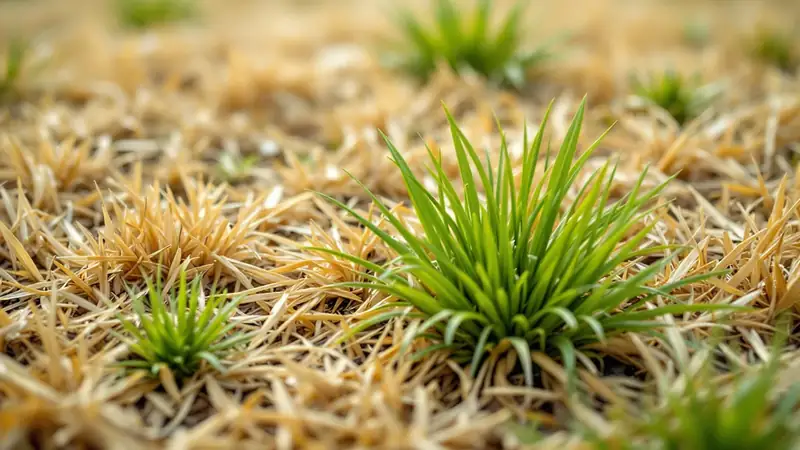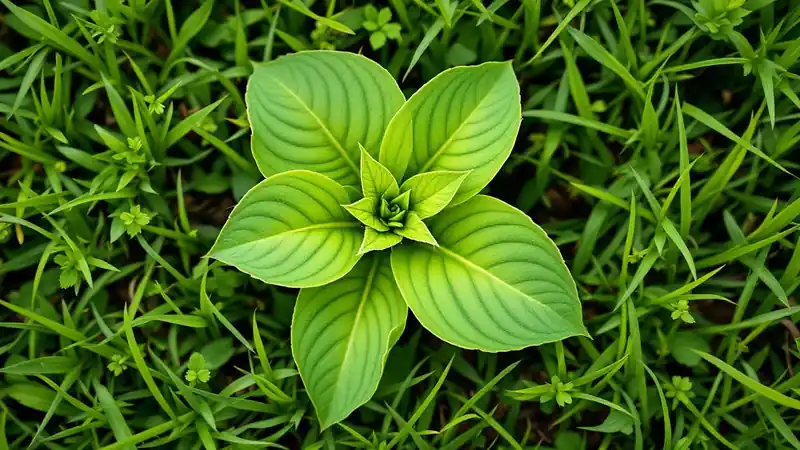
How to get rid of plantain weeds: spray a lawn herbicide containing 2,4-D in fall while plants are green, or dig out each whole crown. Dicamba alone does not control plantain. Then core-aerate compacted soil and mow cool-season grass 3 to 4 inches high.
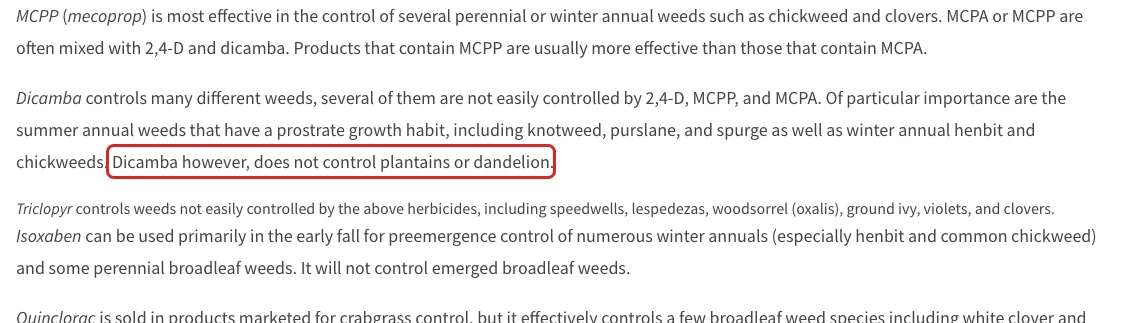
How to get rid of plantain weeds comes down to one active ingredient and one season. Broadleaf plantain (Plantago major) and buckhorn plantain (Plantago lanceolata) are perennials that regrow from a crown at the soil line, so mowing never removes them and pulling only works if the crown comes out (UC IPM Pest Notes: Plantains). For herbicides, Rutgers FS385 says 2,4-D alone gives excellent plantain control, while dicamba “does not control plantains or dandelion”.
That split matters because dicamba sits in all 4 lawn sprays in the label table below, and the PNW Weed Management Handbook table rates both plantains resistant to it. Below are both species side by side with measured traits, every common active rated against each, 5 EPA labels that list plantain with their rate for each lawn grass, and the seed figures checked against Cornell, since one top-ranking page says 14,000 seeds a plant and 60+ years in the soil. For other lawn weeds, our lawn weed identification chart covers ID.
This page summarizes EPA labels and extension research; it is not a product endorsement or legal advice. The label is the law: read the current label of the product you buy, and check whether your state requires a pesticide applicator license before anyone treats a lawn for pay.
Broadleaf or buckhorn plantain: which one do you have?
Look at the leaf width and the seed spike. Broadleaf plantain has oval leaves up to 4 inches wide on long stalks and pencil-thin spikes seeded along their whole length; buckhorn has lance-shaped leaves under 1.6 inches wide and a short cone of seeds only at the tip of each stalk (Cornell weed profile). A third species, blackseed plantain, looks like broadleaf but has a purplish-red stalk base, and Purdue Turf notes many lawn plants may be crosses of the two. One plan kills all three.
| Trait | Broadleaf plantain | Buckhorn plantain | Blackseed plantain | Source |
|---|---|---|---|---|
| Latin name | Plantago major | Plantago lanceolata | Plantago rugelii | Cornell |
| Other names | Common, dooryard, rat-tail plantain, white-man’s foot | English, narrowleaf or ribwort plantain, ribgrass | Pale, red-stalked or Rugel’s plantain | Cornell |
| Leaf | Oval to egg-shaped, 0.8 to 8 in long, 0.4 to 4 in wide, 3 to 7 veins | Lance-shaped, 3.1 to 12 in long, 0.4 to 1.6 in wide, 3 to 7 ridged veins | Oval, 0.8 to 8.7 in long, 0.5 to 5.6 in wide, 5 to 9 veins | Cornell |
| Leaf stalk | About as long as the leaf; green, sometimes pink at the base | Short or absent; silky hairs at the leaf base | About as long as the leaf; pink to purplish red at the base | Cornell |
| Crown and root | Thick crown up to 6 to 10 in across, fibrous roots | Stout taproot; crown covered in tan woolly hairs | Fibrous roots, short taproot | UC IPM; Cornell |
| Seed spike | Cylinder up to 10 in long, up to 400 flowers, seeds along the whole spike | Cone or short cylinder 0.8 to 3.2 in long on a stalk up to 18 in; stamens stick out | Cylinder up to 12 in, up to 300 flowers | Cornell |
| Seeds per capsule | 6 to 30 | 1 to 2 | 4 to 9 | Cornell |
| Flowers | June to September | June to September | June to fall | Purdue; Purdue; Cornell |
| Favored spots | Moist, compacted, irrigated, often-mowed turf | Drier, less-watered, less-mowed turf | Overgrazed or disturbed ground | UC IPM; Cornell |
| Foot traffic | Highly tolerant | Somewhat less tolerant (more upright) | Highly tolerant | Cornell |
Why does plantain take over a lawn?
Compaction and close mowing, mostly. Cornell rates all three plantains highly tolerant of compacted soil and foot traffic, and UC IPM calls broadleaf plantain an indicator of compacted, low-fertility soil, which is why it lines paths and play areas. Purdue found broadleaf plantain still sets viable seed at a 2-inch mowing height, so scalped lawns feed it twice: thin grass plus seed.
| What you see | Likely cause | Fix | Source |
|---|---|---|---|
| Plantain along paths, dog runs, play areas | Compacted soil | Core-aerate when the grass is growing; a screwdriver that will not push in marks compaction (Clemson HGIC 1200) | Cornell; UC IPM |
| Plantain across a thin, short-mown lawn | Mowing under 3 in | Raise cool-season grass to 3 to 4 in | Rutgers FS385; Purdue |
| Plantain plus clover in an unfed lawn | Low fertility | Soil test, then feed at the rate for your grass | UConn IPM; UC IPM |
| Plantain on a just-tilled or reseeded area | Buried seed brought to the surface | Wait until new grass is mowed 3 times, then spray | UMaine Extension; EPA 239-2744 label |
| “Plantain means acid soil” | Sources conflict | Test pH before liming; Cornell ties both plantains to fields at pH 6.5 to 7.8 | Cornell; UC IPM; UConn |
Fix the cause in the same season you spray. Our guide on when to aerate your lawn gives the window for each grass type, and the core aeration steps cover tine depth and spacing. Skip lime unless a soil test asks for it: UC IPM files broadleaf plantain under alkaline soil while UConn files it under acid soil, and our page on whether lime kills weeds shows liming is not a reliable fix.
What kills plantain weeds?
2,4-D. The PNW handbook rates broadleaf and buckhorn plantain susceptible to 2,4-D alone and to both of its mix columns (with and without triclopyr), intermediate to MCPP and MCPA, and resistant to dicamba. Purdue Turf says 2,4-D “does most of the work” in 2- and 3-way mixes, and UC IPM says products with 2,4-D work best on mature plants. Our page on whether 2,4-D kills grass covers lawn safety.
| Active ingredient | Broadleaf plantain (PNW) | Buckhorn plantain (PNW) | What other extension sources add |
|---|---|---|---|
| 2,4-D | S | S | Alone gives excellent control (Rutgers); does most of the work in mixes (Purdue) |
| Dicamba | R | R | “Does not control plantains” (Rutgers) |
| MCPP (mecoprop) | I | I | Suppresses, does not kill (UC IPM) |
| MCPA | I | I | Suppresses, does not kill (UC IPM) |
| Mixes with triclopyr | S | S | Triclopyr ester or triclopyr plus 2,4-D gives good control in cool-season grass (Purdue) |
| Mixes without triclopyr | S | S | Lawn three-ways pair 2,4-D with MCPP and dicamba (labels below) |
| Quinclorac | Not rated | Not rated | Fair on buckhorn, poor on broadleaf (UC IPM) |
| Clopyralid | Not rated | Not rated | Needs the highest label rate for broadleaf plantain (UC IPM) |
| Isoxaben, atrazine, indaziflam, mesotrione (preemergent) | Not rated | Not rated | Limit seedlings only; no effect on established plants (UC IPM) |
| Iron HEDTA | Not rated | Not rated | Needs repeat sprays; weed control “yet to be well documented” (Purdue) |
| Corn gluten meal | Not rated | Not rated | Preemergent only, no effect on established weeds; plantain is not on Iowa State’s list of weeds it controls (Iowa State) |
| Acetic acid (vinegar), pelargonic acid | Not rated | Not rated | Kill small seedlings; only damage the tops of mature plants (UC IPM) |
Check the active ingredient panel before you buy. The 5 labels below all list plantain and all contain 2,4-D, except the preemergent. Rates are per 1,000 sq ft from the EPA-stamped label copies; the grass column matters most, because St. Augustine and centipede take a quarter of the cool-season rate on 239-2744 and are excluded outright on 2217-896. For brand categories beyond these, see our lawn weed killer comparison.
| Product (EPA Reg. No.) | Actives | Plantains on label | Rate per 1,000 sq ft | Limits on the label |
|---|---|---|---|---|
| Ortho Weed B Gon Weed Killer for Lawns Concentrate (239-2744) | 2,4-D, mecoprop-p, dicamba | Broadleaf, buckhorn, narrowleaf, blackseed, bracted, hoary, slender | 4 fl oz cool-season; 2 fl oz bahia, common bermuda, zoysia; 1 fl oz centipede, St. Augustine | Not Floratam; not above 90°F; no rain within 24 hours; reseed after 3 to 4 weeks |
| BioAdvanced Weed Killer for Lawns and Southern Weed Killer for Lawns Concentrate (92564-4) | 2,4-D, mecoprop-p, dicamba | Broadleaf, buckhorn, narrowleaf, blackseed, bracted, hoary, slender | 2 fl oz per 500 sq ft (4 per 1,000) on northern grasses, bermuda, buffalo, zoysia; 1 fl oz per 500 (2 per 1,000) on bahia, centipede, St. Augustine | Not Floratam, carpetgrass or dichondra |
| Spectracide Weed Stop for Lawns Concentrate2 (9688-342-8845; registrant label Chemsico Lawn Weed Killer Concentrate, 9688-342) | 2,4-D, mecoprop-p, dicamba, sulfentrazone | Plantain | 4 fl oz cool-season; 2 fl oz bahia, bentgrass, bermuda, centipede | Apply between 45 and 90°F; not Floratam or Bitterblue; 2 broadcast sprays and 8 fl oz a year at most |
| Ortho Weed B Gon MAX Plus Crabgrass Control and Trimec Crabgrass Plus (2217-896) | 2,4-D, quinclorac, dicamba | Broadleaf, buckhorn, narrowleaf, blackseed, bracted, hoary, slender | 6.4 fl oz on bluegrass, ryegrass, fescues, bermuda, zoysia, buffalograss | Not bahia, bentgrass, centipede, St. Augustine; not on bermuda above 85°F; 2 broadcast sprays a year, the second at least 21 days after the first |
| Gallery SC (62719-658), preemergent | Isoxaben | Broadleaf, buckhorn, bracted | 0.5 fl oz (16 mL) | Stops seedlings only; sold mainly to professionals |
St. Augustine lawns need the reduced warm-season rate and never Floratam on these labels; our St. Augustine lawn guide covers which cultivar you have. On a lawn that also has clover or black medic, a triclopyr mix covers more weeds, and our guide to getting rid of black medic covers that case; for plantain alone a 2,4-D three-way is enough.
- Product per application (mL)
- 118.3
- Product per application (teaspoons)
- 24.0
- Product per application (fl oz)
- 4.00
Default: 1,000 sq ft at the Ortho 239-2744 cool-season rate takes 118.3 mL (4 fl oz). Worked example: a 400 sq ft patch of tall fescue takes 47.3 mL (1.6 fl oz) of 239-2744 or 75.7 mL (2.56 fl oz) of 2217-896; 2,000 sq ft of centipede takes 59.1 mL (2 fl oz) of 239-2744. Rates from the labels on this page, read Nov. 24, 2026.
When should you spray plantain?
Fall. Ohio State’s 2025 weed control update explains that perennials move sugars down into their roots in fall, so a fall spray travels with that flow into the crown, while a spring spray works against the upward flow. UC IPM says the best plantain control comes from a fall application and that a repeat may be needed for weakened plants and new seedlings.
| Season | What plantain is doing | What to do | Source |
|---|---|---|---|
| March to May | Old crowns regrow leaves; seedlings emerge from soil at 50°F and up, peaking in late spring | Spot-spray actively growing plants on a day under 90°F; dig scattered plants | UC IPM; Cornell; labels |
| June to September | Flowering; seed ripens 2 to 3 weeks after flowers open | Bag seed spikes; hold broadcast sprays above 85 to 90°F; raise the mower | Purdue; Cornell; 2217-896 |
| Mid-September to November | Storing sugars in the crown for winter | Broadcast or spot-spray a 2,4-D label; core-aerate cool-season lawns | Ohio State; UC IPM |
| Late October to early December (pasture) | Rosettes still green | UT Extension sprays buckhorn in pasture now, after 3 days that reach 60°F | UT Extension W 322 |
| Winter | Frost-tolerant rosettes sit dormant | Nothing to spray; plan aeration and seeding | Cornell |
Two label rules decide the day. Ortho 239-2744 says not to spray if rain is expected within 24 hours and not to mow for 2 days before or after; our guide to spraying weeds before or after rain explains why. And if you plan to overseed thin spots, the same label says to wait 3 to 4 weeks after spraying before you reseed.
1Only a few plants?
YesDig each crown from moist soil with a forked weeder, bag seed spikes, reseed the hole and recheck for several months (UC IPM; Purdue).
NoGo to the next question
2Is it in a flower or vegetable bed?
YesPull or cut just below the crown, then mulch 2 to 4 inches deep (UC IPM). Lawn herbicides on this page are not labeled for beds.
NoGo to the next question
3Is the lawn St. Augustine, centipede or bahia?
YesUse a label that lists your grass at its reduced rate, such as Ortho 239-2744 at 1 fl oz per 1,000 sq ft on St. Augustine or centipede (never Floratam). Do not use 2217-896 on these grasses.
NoGo to the next question
4Is it summer, or will it top 85 to 90°F?
YesWait. Labels bar spraying above 90°F (85°F on bermuda for 2217-896). Bag seed spikes and raise the mower now; spray in fall.
NoGo to the next question
5Is it mid-September to November and the plants are green?
YesSpray a 2,4-D three-way now on a day with no rain forecast for 24 hours (UC IPM; Ohio State; 239-2744 label). Core-aerate compacted cool-season lawns the same fall.
NoSpring: spot-spray actively growing plants with a 2,4-D label below 90°F, expect some crowns to regrow, and plan a fall follow-up spray.
Source: UC IPM; Purdue Turf; Ohio State 2025; EPA labels 239-2744 and 2217-896
Can you dig plantain out by hand?
Yes, for a few plants, if the crown comes out. UC IPM warns that plantain crowns can regrow even when cut off at or below the soil surface, and UT Extension says the same of buckhorn’s taproot. Cornell adds that a cut just below the crown works better than deeper digging that leaves roots attached to the top.
- Water the patch the day before so the soil is moist; dry, compacted soil snaps the crown off.
- Push a forked weeder or narrow trowel in beside the rosette, angled under the center.
- Lever up the whole crown: for buckhorn, the woolly-haired base and the top of the taproot; for broadleaf, the thick crown with its fibrous roots.
- Bag any seed spikes, since ripe capsules hold 6 to 30 seeds each on broadleaf (Cornell).
- Press soil into the hole and seed it: broadleaf seedlings come only from the top 0.2 inch of soil, so bare spots invite them (Cornell).
- Check the spot every few weeks for several months; UC IPM says repeat removal over months is what works in a home lawn.
In flower beds, UC IPM says organic mulch 2 to 4 inches deep can stop plantain seedlings, and because mulch breaks down, reapply it as needed. Vinegar is no fix for established plants: UC IPM says acetic acid products kill small seedlings but only damage the tops of mature plants. Corn gluten meal is no shortcut either: Illinois Extension notes its 20 lb per 1,000 sq ft herbicide rate adds about 2 lb of nitrogen, twice the 1 lb it recommends per feeding, and it will not touch existing plants.
How many seeds does plantain make, and how long do they last?
Fewer than the headline figures on average, but they last. Cornell cites an average of 565 seeds a year per broadleaf plant in an Ontario pasture and 15,000 to 36,000 in favorable conditions. Broadleaf seed can stay viable 50 to 60 years, yet in worked soil it drops 33 to 43 percent a year; buckhorn drops 60 to 67 percent a year.
| Figure | Broadleaf plantain | Buckhorn plantain | Source |
|---|---|---|---|
| Scotts’ claim | 14,000 seeds a year; seed viable 60+ years | Not given | Scotts Miracle-Gro page, read Nov. 24, 2026 (no source cited) |
| Seeds per plant, average in a pasture | 565 a year (Ontario) | 127 a season (dry grassland) | Cornell |
| Seeds per plant, favorable conditions | 15,000 to 36,000 | More than 10,000 (fertile field); 4,000 (Britain) | Cornell |
| Seeds per plant, other extension figure | 20,000 | Not given | NC State Plant Toolbox |
| Seed life in soil | 50 to 60 years; up to 10% alive after 40 years undisturbed | 8% alive after 10 years buried | Cornell |
| Yearly loss in cultivated soil | 33 to 43% | 60 to 67% | Cornell |
| Depth seedlings come up from | Top 0.2 in only | Best from top 0.8 in; none from 3.1 in | Cornell |
| Emergence to flowering | 6 to 10 weeks without competition | Varies widely | Cornell |
- Broadleaf, 33% lost a year
- Buckhorn, 60% lost a year
Source: Our arithmetic on Cornell CALS Weed Profile, Plantains (Froud-Williams et al. 1984; Popay et al. 1994: 33 to 43% and 60 to 67% loss a year in cultivated soil) Uses the slow end of each published range. Undisturbed soil keeps far more: up to 10% of broadleaf seed was alive after 40 years buried (Cornell).
Show the numbers
| Broadleaf, 33% lost a year | Buckhorn, 60% lost a year | |
|---|---|---|
| Start | 100% | 100% |
| Year 1 | 67% | 40% |
| Year 2 | 44.90% | 16% |
| Year 3 | 30.10% | 6.40% |
| Year 4 | 20.20% | 2.60% |
| Year 5 | 13.50% | 1% |
The practical reading: broadleaf seedlings only emerge from the top 0.2 inch, so seed thin spots instead of tilling them, and remove seed spikes before they ripen. In worked soil, buckhorn’s 60 percent yearly loss leaves about 6 percent of its seed after 3 years; broadleaf’s 33 percent leaves about 30 percent, so expect broadleaf seedlings for longer.
Is plantain weed edible?
Yes, with limits. Cornell notes young broadleaf leaves have been cooked like spinach and dried leaves brewed as tea, and the NC State Plant Toolbox lists young leaves as edible raw, older ones boiled, and the seeds as edible, adding that eating large quantities “can cause a drop in blood pressure”. NC State CEFS says the raw seeds have a laxative effect.
Two lawn cautions. Do not pick from turf that has been sprayed: the 2217-896 label keeps people off treated areas until sprays dry and bars use in vegetable gardens. And plantain’s windborne pollen can set off hay fever in sensitive people (Cornell). NC State records old medicinal uses for bites, stings and cuts; that is history, not evidence a remedy works, and nothing here is health advice.
How we compiled this
We read 11 extension and university sources (Cornell, UC IPM, Purdue, Rutgers, PNW Handbook, Ohio State, UT, NC State, Iowa State, Illinois, UMaine) and 5 EPA PPLS label copies in November 2026, and took every rate, temperature limit and grass restriction from the label text itself. We did not test any product; ratings are the publishers’ own. Seed figures are quoted with the study Cornell cites.
Frequently asked questions
Does plantain come back every year?
Yes. Both broadleaf and buckhorn plantain are perennials that regrow from the crown each spring, and new seedlings keep coming from the seed bank, which for broadleaf can stay alive 50 to 60 years (Cornell).
How do you get rid of buckhorn plantain?
The same way as broadleaf: a 2,4-D product in fall, or dig out the crown with the top of the taproot. UT Extension adds that heavy pasture stands may need a fall spray and a spring follow-up.
How do you get rid of broadleaf plantain naturally?
Dig each crown out of moist soil, bag the seed spikes, reseed the hole, and core-aerate compacted areas. UC IPM says repeated removal over several months works in home lawns; vinegar and corn gluten meal do not kill established plants.
What is the best herbicide for plantain?
Any lawn product whose label lists plantain and your grass and contains 2,4-D. Rutgers says 2,4-D alone gives excellent plantain control; dicamba alone does not control it.
Is broadleaf plantain edible for humans?
NC State lists the young leaves as edible raw and older leaves boiled, and warns that large quantities can lower blood pressure. Only pick from unsprayed ground.
Sources
- Cornell CALS Weed Science, Weed Profiles: Plantains, Current page. Accessed November 2026.
- UC Statewide IPM Program, Pest Notes: Plantains (herbicide table compiled 2019), Current page. Accessed November 2026.
- Purdue University Turfgrass Science (Patton, Beck), Broadleaf Plantain, Weed of the Month, Sept. 30, 2014. Accessed November 2026.
- Purdue University Turfgrass Science, Buckhorn Plantain, Weed of the Month, Nov. 26, 2014. Accessed November 2026.
- Rutgers Cooperative Extension (Elmore), FS385, Broadleaf Weed Control in Cool Season Lawns, April 2025. Accessed November 2026.
- PNW Weed Management Handbook, Susceptibility of Broadleaf Weeds in Turf to Common Herbicides, Current table. Accessed November 2026.
- Ohio State University (Gardner), Weed Control Update 2025, July 2025. Accessed November 2026.
- University of Tennessee Extension (Israel, Rhodes), Buckhorn Plantain, W 322, Feb. 2015. Accessed November 2026.
- NC State Extension Gardener Plant Toolbox, Plantago major, Current page. Accessed November 2026.
- NC State Center for Environmental Farming Systems, Weed focus: Plantains (buckhorn and broadleaf), Jan. 25, 2022. Accessed November 2026.
- Iowa State University Extension, How to Use Corn Gluten Meal as Herbicide in the Lawn and Garden, Current page. Accessed November 2026.
- University of Illinois Extension, Corn Gluten Meal: Can it naturally prevent weeds and feed your lawn?, March 27, 2026. Accessed November 2026.
- University of Maine Cooperative Extension (Fitzgerald), What can I do about a wild plantain infestation in my newly seeded lawn?, Sept. 13, 2021. Accessed November 2026.
- UConn Extension IPM, Weeds as Indicators of Soil and Growing Conditions in Turf, Updated March 2018. Accessed November 2026.
- Clemson HGIC, HGIC 1200: Aerating Lawns, Revised April 29, 2020. Accessed November 2026.
- U.S. EPA PPLS, Ortho Weed B Gon Weed Killer for Lawns Concentrate, EPA Reg. No. 239-2744, Aug. 23, 2023. Accessed November 2026.
- U.S. EPA PPLS, BioAdvanced Weed Killer for Lawns Concentrate, EPA Reg. No. 92564-4, June 25, 2026. Accessed November 2026.
- U.S. EPA PPLS, Chemsico Lawn Weed Killer Concentrate, EPA Reg. No. 9688-342, June 29, 2021. Accessed November 2026.
- Spectrum Brands, Spectracide Weed Stop For Lawns Concentrate2, 32 fl oz (product page, EPA Reg. No. 9688-342-8845), Current page. Accessed November 2026.
- U.S. EPA PPLS, EH-1437 Herbicide (Ortho Weed B Gon MAX Plus Crabgrass Control, Trimec Crabgrass Plus), EPA Reg. No. 2217-896, Jan. 21, 2026. Accessed November 2026.
- U.S. EPA PPLS, Gallery SC, EPA Reg. No. 62719-658, May 8, 2017. Accessed November 2026.