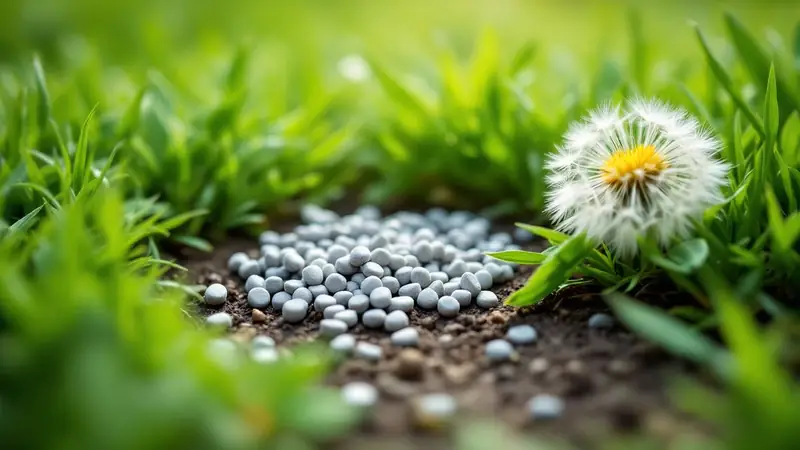
Does lime kill weeds? No. Garden lime (ground, dolomitic or pelletized limestone) only raises soil pH, slowly, and kills no plant. Hydrated lime and quicklime are caustic and burn grass as readily as weeds. Liming thins a few acid-soil weeds slowly and favors others.
Does lime kill weeds is a fair question, because lime bags sit next to weed killers and lawn services sell both in one visit. Penn State Extension answers it in one line: “weeds cannot be controlled with lime applications” (Penn State, Liming Turfgrass Areas). What lime does is move soil pH, and pH changes which plants win. The short answers online stop there. This page goes product by product, from ag lime to hydrated lime and lime-sulfur, then weed by weed through 11 records of what happened when pH went up, including a 3-year Missouri trial where broomsedge nearly tripled without lime and a 26-year English turf trial where lime increased weeds.
Two numbers decide whether lime belongs in your weed plan at all: your soil test pH and your grass’s target, 6.0 to 7.0 for most lawns. Rates, timing and bag math are in our guide to how much lime a lawn needs and when to spread it, and the full weed ID chart with soil signals is in our common lawn weeds guide.
Which lime are you holding, and what does it do to plants?
“Lime” on a bag can mean five different chemicals. Only the carbonates, calcitic and dolomitic limestone, are lawn products; Ohio State caps them at 50 lb per 1,000 sq ft per pass and caps hydrated lime at 20 lb and burned lime at 10 lb because the oxide and hydroxide forms are, in its words, “hazardous, difficult to apply” (Ohio State HYG-4026, Table 1). None of the seven products below carries weed-control directions.
| Product | Strength (CCE, %) | Kills weeds? | Hurts grass? | Max per pass, per 1,000 sq ft (Ohio State) | Source |
|---|---|---|---|---|---|
| Ground calcitic limestone (calcium carbonate; sold as ag lime or garden lime) | 100 when pure; 70 to 95 for retail products (Ohio State) | No. Penn State: weeds “cannot be controlled with lime” | Not at soil-test rates; Kentucky keeps single passes at 100 lb or less per 1,000 sq ft to avoid burn | 50 lb | Penn State; Ohio State; Kentucky AGR-214 |
| Dolomitic limestone (calcium magnesium carbonate) | 109 when pure (Penn State); 70 to 95 retail | No | Same as calcitic; Penn State uses it only when the test shows low magnesium | 50 lb | Penn State; Ohio State |
| Pelletized limestone (fine limestone bound into pellets) | 70 to 95 | No | No; Arkansas says it is not quicker than ag lime at equal neutralizing rates | 50 lb | Ohio State; Arkansas FSA2201 |
| Liquid lime (limestone suspended in water) | Supplier rates of a few gallons per acre | No | No; at those rates Arkansas says it “will not raise soil pH to desired values” | None published | Arkansas FSA2201 |
| Hydrated lime (slaked lime, calcium hydroxide) | 136 (Penn State) to 140 (Ohio State); a saturated solution reads pH 12.4 | Not labeled for weeds; the caustic dust burns any leaf it lands on | Yes: Penn State says it “can cause turfgrass burning”; Kentucky reports leaf burn | 20 lb | National Lime Association; NIOSH; Kentucky |
| Quicklime (burned or burnt lime, calcium oxide) | 179 to 180 | Not labeled for weeds; reacts with water and gives off heat (NIOSH) | Yes: Penn State rules it out for established turf and seedbeds | 10 lb | NIOSH; Penn State; Ohio State |
| Lime-sulfur (29 percent calcium polysulfide, EPA Reg. No. 61842-30) | Not a liming material | No: an EPA-registered fungicide whose label covers fruit, nut and ornamental uses and apple blossom thinning, with no weed directions | Signal word DANGER; not a lawn product | Per label, by crop | EPA-stamped label, 2018 |
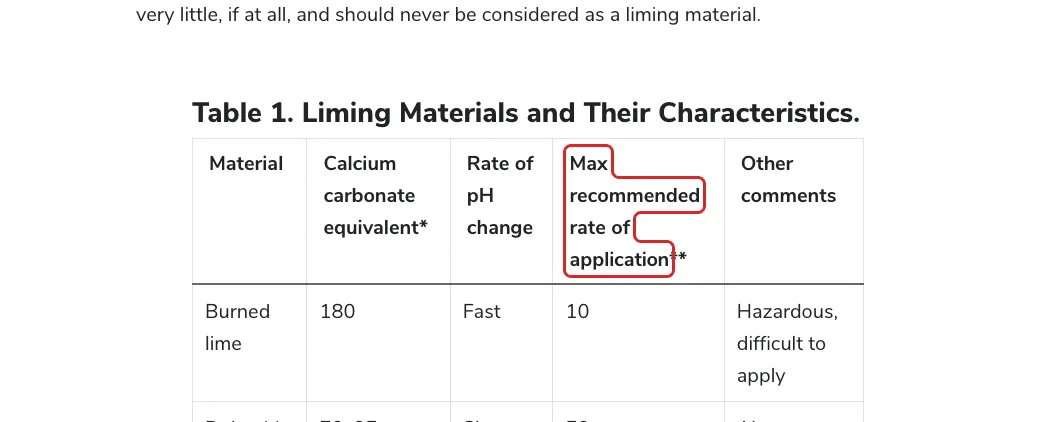
The pattern in the caps is the point: the stronger the neutralizing power, the smaller the safe pass. Quicklime neutralizes 1.8 times as much acid per pound as pure limestone, and Ohio State allows one fifth as much of it per pass. The chemistry that would make a lime “kill” anything is the same chemistry that burns grass.
Why can’t garden lime kill a weed?
Calcium carbonate is barely soluble. It neutralizes acid in the soil it touches, and Arkansas Extension says it “does not move down into the soil profile much once applied” (Arkansas FSA2201). Particles passing a 200-mesh screen react in about 1 month, 60-mesh particles can take a year, and full reaction can take 12 to 18 months. Ohio State tells homeowners to expect “several months” before pH changes at all.
Nothing in that reaction touches a leaf or a root crown, and most lawn weeds span the pH a lawn is limed to. Cornell gives common chickweed a working range of pH 5.2 to 8.2 and dandelion 4.0 to 8.0 (Cornell Weed Science), and crabgrass seed germinated equally from pH 4.8 to 7.8 in a calcium carbonate pot study (Pierce et al. 1999). Any product sold with a claim that it kills weeds is a pesticide and must be registered with EPA before sale under 7 U.S.C. 136a(a). Limestone is sold under state liming-material laws instead, with a CCE guarantee on the bag and no pest claims.
What happens to each weed when lime raises the pH?
Some weeds lose their edge, some gain one, and extension services do not always agree on which is which. The table lines up the measured pH figure for each weed with what raising pH toward 6.5 does to it, and flags where two sources point opposite ways. Where a row says “slows”, no source we read reports lime killing established plants.
| Weed | Soil pH figure | What raising pH does | Source |
|---|---|---|---|
| Red sorrel (sheep sorrel) (Rumex acetosella) | Prefers below 6.0 | Slows it: Penn State says raise pH to 6.5 to 7.0; Maryland says it grows more abundantly in acid soil | Penn State; UMD Extension |
| Broomsedge (Andropogon virginicus) | Thrives below 5.5 | Slows its spread: in a Missouri pasture at pH 4.6 it nearly tripled in 3 years without lime; lime limited the increase but did not remove it | NC State; Blevins et al. 2018 |
| Moss (Bryophytes) | More common in moderately to strongly acid soil | No direct effect: Penn State links moss to acid soil yet says weeds cannot be controlled with lime | Penn State |
| Large crabgrass (Digitaria sanguinalis) | Best emergence and growth at 4.8 to 5.8 | Smaller seedlings, same germination: raising pH from 4.8 to 7.8 with calcium carbonate did not change germination in pots | Cornell; Pierce et al. 1999 |
| Broadleaf plantain (Plantago major) | Penn State and UConn: acid indicator. Cornell: fields at 6.5 to 7.8 | Sources conflict; liming is not a reliable fix | Penn State; UConn; Cornell |
| Shepherd’s purse (Capsella bursa-pastoris) | Penn State: acid indicator. Cornell: prefers neutral, tolerates 5 | Sources conflict; liming toward neutral may suit it | Penn State; Cornell |
| Hawkweed, silver cinquefoil (Hieracium spp., Potentilla argentea) | UConn acid-soil indicators; no pH figure given | UConn says raise pH so turf can compete; no trial data | UConn |
| Dandelion (Taraxacum officinale) | Tolerates 4.0; growth rises up to 8.0 | Favors it: pH 7.1 gave 45 percent more fresh weight and 67 percent more plants than pH 6.2; “excessive liming also promotes dandelion” | Cornell |
| Common chickweed (Stellaria media) | Grows well 5.2 to 8.2; severely depressed below 5.2 | Favors it when liming lifts a very acid soil past 5.2 | Cornell |
| Annual bluegrass (Poa annua) | Best at 5.5 to 6.5; rarely below 5.3 | Favors it when liming lifts very acid soil into its band; acidifying ammonium sulfate discouraged it at Bingley | Cornell; Escritt and Legg, via UDel |
| Weeds overall in fine turf (Festuca and Agrostis turf, Bingley, England) | Not reported | Increased them: “Lime increased weeds, worms, soil moisture, pH and available phosphate” (1937 to 1963 trial) | Escritt and Legg, via UDel |
The Missouri trial is the closest thing to a direct test (Blevins et al., Crop, Forage and Turfgrass Management, 2018). Researchers limed a tall fescue pasture at pH 4.6 at 0, 0.5, 1 and 2 times the soil-test rate of 3.67 tons per acre, which is about 168 lb per 1,000 sq ft at the 1x rate and 337 lb at 2x. Over 3 years, broomsedge nearly tripled on unlimed plots; 50 lb of phosphorus per acre alone held it at its starting count, and lime plus phosphorus limited the increase most. Tall fescue more than doubled at the two highest lime rates. Even at twice the recommended dose, the weed was contained, not killed.
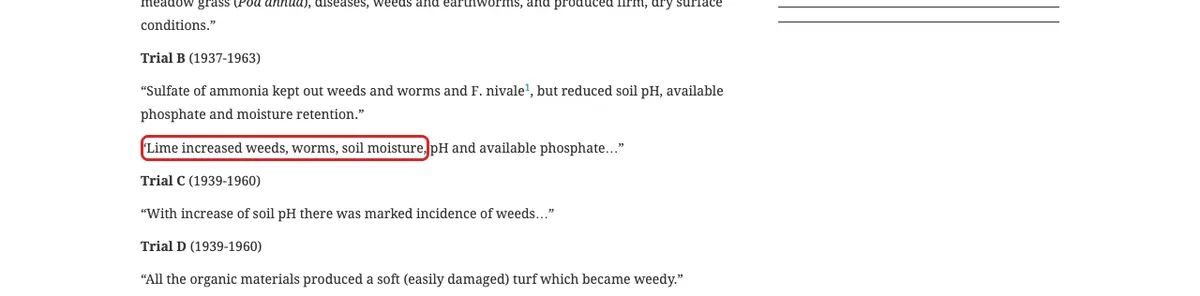
The Bingley results run the other way. In long-term trials at the Sports Turf Research Institute in England, reported by Escritt and Legg in 1969, lime “increased weeds, worms, soil moisture, pH and available phosphate” from 1937 to 1963, and in a 1939 to 1960 trial “with increase of soil pH there was marked incidence of weeds” (as quoted by University of Delaware turf researcher John Emerson Jr., UDel, May 2024). Those plots were fine fescue and bentgrass, species that tolerate acid soil, so liming helped the weeds more than the grass. Our page on whether fertilizer kills weeds covers the acidifying ammonium sulfate side of the same trials.
Crabgrass shows why calcium is not the lever either. In the 1999 Weed Technology pot study (Pierce et al.), calcium carbonate raised pH from 4.8 to 7.8 without changing crabgrass germination, gypsum added calcium with no effect, and only magnesium carbonate cut germination as pH rose. Seedlings did grow smaller at higher pH, so liming acid soil can tilt competition toward the lawn, but a spring preemergent timed to soil temperature is what stops seeds; our crabgrass guide has the dates.
Does hydrated lime or quicklime kill weeds?
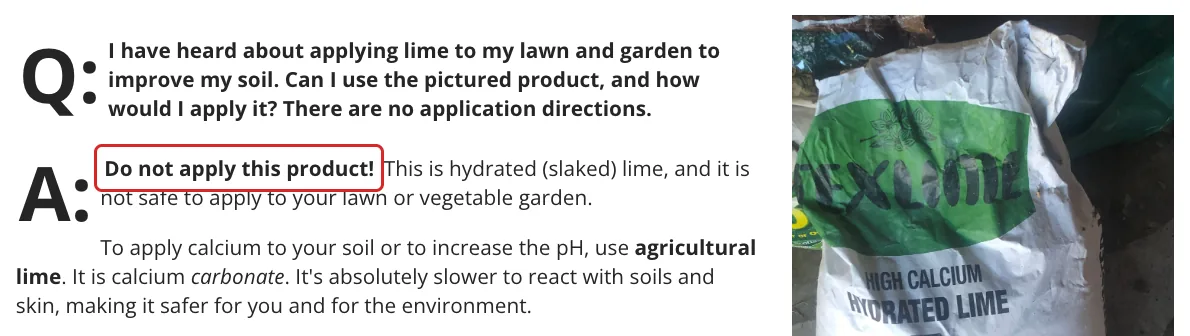
They can burn weeds, the same way they burn grass and skin, which is why no extension service we read recommends either for weed control. A saturated hydrated lime solution reads pH 12.4 (National Lime Association, Properties of Lime), and NIOSH lists eye and skin burns and pneumonitis among the symptoms of exposure to calcium hydroxide (NIOSH Pocket Guide). Quicklime adds heat: it reacts with water and “liberates heat” (NIOSH, calcium oxide). Oregon State’s answer to a gardener holding a bag of hydrated lime is “Do not apply this product!” (Oregon State Extension, April 2025).
On a lawn there is no selective dose. Kentucky’s AGR-214 says leaf burn “may occur” with both products and limits them to bare soil before a lawn is established (Kentucky AGR-214); Penn State says never on established turf or seedbeds. In gravel or a patio, the dust tracks onto shoes and indoors, Penn State adds, and the weeds’ roots survive a surface burn. Tested options for hard surfaces, from flame to labeled herbicides, are compared in our guide to killing weeds in gravel, and the household shortcuts have their own pages: vinegar as a weed killer and the batch-17 sibling on whether ammonia kills weeds.
This page is general information, not safety or pesticide advice. Hydrated lime and quicklime are caustic; follow the product’s safety data sheet. Any weed killer you use is governed by its EPA label: the label is the law.
When does liming cut weeds, and how long does it take?
Only when the soil is acid enough to hold the grass back, and only on the grass’s schedule. Penn State’s wording is that applying lime before soils become too acid is “one means of preventing severe weed infestation”. UConn puts turf’s working range at pH 6.0 to 7.2 and says weeds return after any removal if the soil condition is not changed (UConn Extension). That makes the order of work: a lab soil test with a lime requirement, lime at that rate, then weed control that matches the weed.
1Do you need the weeds dead this season?
YesLime cannot do that. Use a selective herbicide matched to the weed, or pull young annuals.
NoGo to the next question
2Has a lab soil test from the past 3 years shown pH below your grass's target?
Yes
NoDo not lime for weeds. Liming soil that is not acid can favor dandelion, which Cornell says excessive liming promotes.
3Is the grass centipedegrass (target pH 5.0 to 6.0)?
YesLime only below 5.0, to the lab rate; treat weeds with a herbicide labeled for centipedegrass.
NoLime at the lab rate, 50 lb per 1,000 sq ft per pass at most, and control the weeds on their own schedule. Expect acid-soil weeds such as red sorrel and broomsedge to thin over 1 to 3 seasons.
Source: Penn State; Ohio State HYG-4026; Blevins et al. 2018; Cornell Weed Science
- Test first. Lime only if the lab pH sits below your grass’s target. Centipedegrass is the exception that bites: its target is 5.0 to 6.0, so liming it to 6.5 creates a problem; see our centipedegrass care guide.
- Spread the lab rate, not a bag rate. Divide the report’s pounds of calcium carbonate by the bag’s CCE and keep each pass at 50 lb per 1,000 sq ft (Ohio State). The full math, including buffer pH, is in our guide to raising soil pH with lime.
- Kill the existing weeds separately. A selective herbicide matched to the weed, sprayed in its window: fall for perennial broadleaf weeds in cool-season lawns, a preemergent before crabgrass germinates. Our lawn weed killer guide sorts products by active ingredient.
- Give it seasons, not weeks. The Missouri plots needed 3 years to separate, and Arkansas puts full lime reaction at 12 to 18 months.
- Retest before liming again. Cornell’s dandelion data and the Bingley trials both show over-liming recruits a new set of weeds.
Moss is the weed people most often lime for. It does favor acid soil, but shade, wet soil and thin turf matter as much; our moss in lawn guide lists the iron and soap products whose EPA labels carry lawn moss directions.
How we compiled this
In November 2026 we read 14 extension publications and weed profiles (Penn State, Ohio State, Oregon State, Kentucky, Arkansas, Maryland, NC State, UConn, Cornell), the abstracts of 2 peer-reviewed studies (Blevins et al. 2018; Pierce et al. 1999), the 1969 Bingley trial results as quoted by a University of Delaware researcher (the original proceedings were not available to us), 2 NIOSH chemical entries, a National Lime Association fact sheet and 1 EPA-stamped label. Per-1,000 sq ft conversions are our arithmetic (tons per acre times 2,000, divided by 43.56). We applied no lime and ran no trials.
Frequently asked questions
Will lime kill my grass?
Ground and pelletized limestone at soil-test rates will not; Ohio State caps a pass at 50 lb per 1,000 sq ft and says to water it off the leaves. Hydrated and burned lime can burn turf, so Penn State rules both out. Over-liming harms grass slowly by pushing pH above 8.0 (Ohio State).
Does lime kill moss?
No. Penn State ties moss to moderately and strongly acid soil but says weeds cannot be controlled with lime (Penn State). Lime to the soil-test rate so grass can compete, then remove the moss and overseed.
Does liquid lime kill weeds?
No. It is fine limestone in water, and Arkansas Extension says at supplier rates of a few gallons per acre it will not even raise soil pH to desired values (Arkansas FSA2201).
Should I water my lawn after I put lime on it?
Yes. Ohio State says turf “should be irrigated after application in order to wash lime off the turfgrass leaves” (Ohio State HYG-4026), unless rain is due.
What does lime do to soil?
It neutralizes acidity and adds calcium, plus magnesium if dolomitic. Arkansas says 200-mesh particles react in about 1 month and 60-mesh particles in up to a year, with full effect in 12 to 18 months (Arkansas FSA2201).
Sources
- Penn State Extension, Liming Turfgrass Areas, current page. Accessed November 2026.
- Penn State Extension, Soil Acidity and Aglime, current page. Accessed November 2026.
- Penn State Extension, Indicator Weeds Provide Insight into Growing a Better Lawn, current page. Accessed November 2026.
- Penn State Extension, Sheep Sorrel a Perennial Weed, current page. Accessed November 2026.
- Ohio State University Extension, Lime and the Home Lawn, HYG-4026, Sep. 1, 2021. Accessed November 2026.
- Oregon State University Extension, Applying hydrated lime to my garden?, April 2025. Accessed November 2026.
- University of Kentucky (G. Munshaw), Liming Kentucky Lawns, AGR-214, issued July 2014. Accessed November 2026.
- University of Arkansas Division of Agriculture (L. Espinoza and others), Not All Liming Materials Are Created Equal, FSA2201, PD-3-2022R. Accessed November 2026.
- Blevins, Hamilton, Remley, Massie, Naumann, Miles, Lime or Phosphorus: Which is Best to Limit Broomsedge in Tall Fescue Pastures?, Crop, Forage and Turfgrass Management, Aug. 2018. Accessed November 2026.
- Pierce, Warren, Mikkelsen, Linker, Effects of Soil Calcium and pH on Seed Germination and Subsequent Growth of Large Crabgrass, Weed Technology, June 1999. Accessed November 2026.
- NC State Extension, Clay County (T. Osborn), Broomsedge: The Poor Man’s Grass, June 13, 2025. Accessed November 2026.
- University of Maryland Extension, Red Sorrel: Identification and Management, current page. Accessed November 2026.
- UConn Extension (V. Wallace, A. Siegel-Miles), Weeds as Indicators of Soil and Growing Conditions in Turf, current page. Accessed November 2026.
- Cornell Weed Science, Weed profile: Dandelion, current page. Accessed November 2026.
- Cornell Weed Science, Weed profile: Common chickweed, current page. Accessed November 2026.
- Cornell Weed Science, Weed profile: Annual bluegrass, current page. Accessed November 2026.
- Cornell Weed Science, Weed profile: Plantains, current page. Accessed November 2026.
- Cornell Weed Science, Weed profile: Shepherd’s-purse, current page. Accessed November 2026.
- Cornell Weed Science, Weed profile: Large crabgrass, current page. Accessed November 2026.
- University of Delaware (J. Emerson Jr.), Is Ammonium Sulfate the Undisputed Champion of Nitrogen Sources for Turfgrass Systems? (quoting Escritt and Legg, Fertilizer Trials at Bingley, 1969), May 8, 2024. Accessed November 2026.
- CDC NIOSH, Pocket Guide to Chemical Hazards: Calcium hydroxide, current page. Accessed November 2026.
- CDC NIOSH, Pocket Guide to Chemical Hazards: Calcium oxide, current page. Accessed November 2026.
- National Lime Association, Fact Sheet: Properties of Lime, January 2007. Accessed November 2026.
- U.S. EPA, Lime-Sulfur Solution Agricultural Fungicide, EPA Reg. No. 61842-30, stamped label, Nov. 5, 2018. Accessed November 2026.
- Cornell Legal Information Institute, 7 U.S. Code 136a, Registration of pesticides, current text. Accessed November 2026.