Does fertilizer kill weeds? Not at lawn rates: it feeds them too. It crowds them out by thickening grass, slowly. In one bluegrass trial, dandelion cover fell from 40 percent to under 10 percent only at 12 lb of nitrogen per 1,000 sq ft yearly.
Does fertilizer kill weeds? No plain lawn fertilizer does: nitrogen reaches the weed’s roots as readily as the grass roots, and Cornell’s weed profile notes that dandelion growth rises with phosphorus when grass is not competing (Cornell Weed Science). What fertilizer does is shift the contest. Purdue says unfertilized lawns gradually lose density, and crabgrass, dandelion and clover move into the gaps (Purdue AY-22). The weeds die only when a herbicide comes with the bag, which is what separates a lawn fertilizer chosen by its nitrogen from a weed and feed.
Most answers stop at “thick grass chokes weeds.” The table below puts numbers on it from 15 trials and labels, with every nitrogen rate converted to pounds per 1,000 sq ft a year so you can hold it against your own bag. Purdue’s normal feeding is 0.5 to 1 lb per application, and the Pacific Northwest weed handbook puts yearly needs at 2 lb for tall fescue and 4 to 6 lb for Kentucky bluegrass (PNW Weed Management Handbook, Section U). Several of the trials that cleared weeds used 6 to 12 lb.
What did the turf trials actually measure?
Swipe the table sideways to see every column.
| Trial or label | Turf | What was applied (per 1,000 sq ft a year) | Weed result | Source |
|---|---|---|---|---|
| Johnson and Bowyer 1982 | Kentucky bluegrass | 0, 6.1 and 12.3 lb N | Dandelion about 40%, about 30% and under 10% of plots | Hahn et al. 2020 |
| Calhoun et al. 2005, 4 years | Bluegrass, ryegrass, red fescue mix | 3.1 lb N | White clover density cut 61 to 88% | Hahn et al. 2020 |
| DeBels et al., 2009 to 2010 | 5 lawn grasses, Madison, Wis. | 0, 2.0 and 4.0 lb N | Unfertilized plots 29% weeds both years; 19% at 2.0 lb in 2009, not a statistically separate result | DeBels et al. 2011 |
| DeBels et al., mowing | Same plots | Mowed 1.4, 2.4 and 3.3 in | Most weeds at 1.4 in: 31% (2009), 38% (2010) | DeBels et al. 2011 |
| DeBels et al., grass choice | Same plots | Same rates | ‘Grande II’ tall fescue 6% and 12% weeds; ‘Kenblue’ bluegrass 31% and 28% | DeBels et al. 2011 |
| Dernoeden et al. 1993 and 6 other trials | Bluegrass, tall fescue, Chewings fescue | 2.0 vs 4.0 lb N (Dernoeden) | More N cut crabgrass significantly; none gave full control | Hahn et al. 2020; study record |
| Dunn et al. 1981 | Kentucky bluegrass | Timing | Spring plus fall feeding: lower crabgrass than fall-only or summer feeding | Hahn et al. 2020 |
| Hall 1980 | Tall fescue | Two fall feedings of 1.5 lb vs one spring 1.5 lb | Fall split more competitive against weeds | Hahn et al. 2020 |
| Adams 1980 | Perennial ryegrass turf | 0 to 7.2 lb N | Annual bluegrass cover up 12 to 17% | Hahn et al. 2020 |
| Tilman et al. 1999; Dodd et al. 1994 | Grassland (not lawn) | Potassium | Dandelion growth 17 to 20 times unfertilized | Hahn et al. 2020 |
| Escritt and Lidgate 1964; Thompson et al. 1995 | Turf | Years of ammonium sulfate | Soil acidified; broadleaf weeds fell, some plots weed-free | Hahn et al. 2020 |
| Agamalian 1988, 13 field tests | Broccoli and cauliflower rows, Calif. | Undiluted 20% ammonium nitrate, 1.1 to 1.4 gal per 1,000 sq ft | 92 to 99% kill of most small broadleaf weeds; 0% on annual bluegrass, barnyardgrass, purslane | California Agriculture |
| Rutgers 2017 | Tall fescue with white clover, N.J. | Granular weed and feed (herbicide in it) | Under 30% clover control on every rating date; liquid sprays 90% or more by 10 weeks | Elmore and Tuck |
| Corn gluten meal, Iowa State work | Established turf | 20 lb product (about 2 lb N) | 50 to 60% weed prevention in year 1; no effect on existing weeds | Stier, UW-Madison 1999 |
| Scotts Weed and Feed label | Lawns | 2,4-D 1.22% + dicamba 0.081% on fertilizer | Kills listed broadleaf weeds; will not prevent new ones from seed | EPA 538-333 |
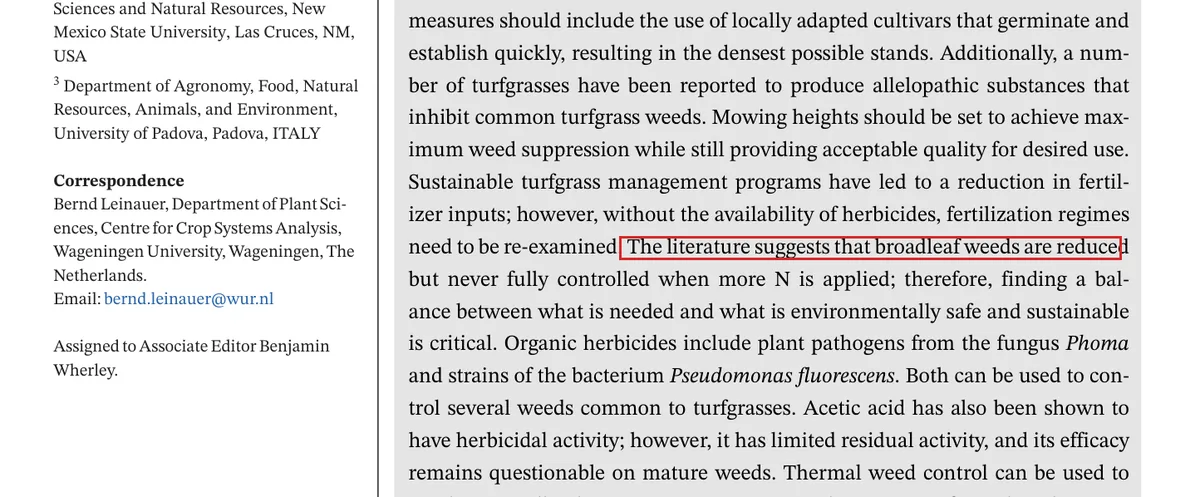
Three patterns run through the rows. More nitrogen lowers weed cover, but the big drops came at rates two to six times what Purdue suggests for a home lawn. Grass choice and mowing height moved weeds as much as fertilizer did: in the Wisconsin plots, cultivar alone separated 6 percent weeds from 31 percent. And no trial reached zero; the 2020 review by Hahn and colleagues concludes broadleaf weeds are reduced but never fully controlled when more nitrogen is applied (Hahn et al., Crop Science, 2020).
The Wisconsin numbers also show why a feeding program is slow. The plots were seeded in 2007, and the unfertilized ones still held 29 percent weeds in their third and fourth years. If you mow at 1.4 inches, nitrogen is fighting your mower: the lowest cut carried 31 to 38 percent weeds. Our guide to mowing height by grass type gives the ranges that keep turf dense, and whether thin areas will fill in on their own depends on the species.
Which weeds does fertilizer starve, and which does it feed?
| Weed | Effect of more nitrogen | Evidence |
|---|---|---|
| White clover, black medic | Falls; both fix their own nitrogen and win in underfed turf | Clover cut 61 to 88% at 3.1 lb N (Hahn); both on UConn’s low-fertility list (UConn IPM) |
| Dandelion | Falls at high N; rises with potassium and phosphorus | 40% to under 10% at 0 to 12.3 lb N; K boosted growth 17 to 20 times (Hahn; Cornell) |
| Crabgrass | Falls, never to zero; timing matters | 7 trials (Hahn); listed as a low-fertility weed by UConn IPM |
| Red sorrel, plantain | Indicators of low fertility | UConn IPM list; no rate trial found |
| Annual bluegrass | Rises | Cover up 12 to 17% from 0 to 7.2 lb N; high P and K also favored it (Hahn) |
So nitrogen does starve clover and black medic, which supply their own nitrogen and lose that edge once the grass is fed: our clover control ladder starts with 0.5 lb N per growing month for that reason. Phosphorus and potassium are different. Hahn’s review advises adding them only when a soil test shows low levels, because annual bluegrass and dandelion compete better when soil P and K are high, and the University of Connecticut lists red sorrel and plantain alongside clover as signs of low fertility (UConn IPM).
Black medic shows how big that head start is: University of Minnesota Extension measured 25 to 45 lb of fixed nitrogen per acre a year in pure stands, and our guide on how to get rid of black medic sets that against the annual rate for each lawn grass.
Feeding will not remove plantain that is already established, since it regrows from its crown each spring; our guide to getting rid of plantain weeds covers the dig-or-spray plan for broadleaf and buckhorn plantain.
Can fertilizer burn kill weeds?
Yes, on crops with waxy leaves, and the data show its limits. In 13 California field tests from 1982 to 1987, undiluted 20 percent ammonium nitrate sprayed at 50 to 60 gallons an acre, about 1.1 to 1.4 gallons per 1,000 sq ft, killed 92 to 99 percent of most broadleaf weeds at the 1 to 4 leaf stage and much less at 5 to 7 leaves (Agamalian, California Agriculture, 1988). It killed none of the annual bluegrass, barnyardgrass, lambsquarters or purslane.
That selectivity came from broccoli’s waxy cuticle. Lawn grass has no such protection, the trial’s two zero-percent grasses are lawn weeds, and on turf the same salt load is what scorches grass; our page on fertilizer burn limits gives the per-feeding caps. The one slow version that worked in turf was decades of ammonium sulfate, which lowered soil pH until broadleaf weeds thinned (Escritt and Lidgate 1964, via Hahn et al.). Without a soil test, that route risks acid soil the grass dislikes too.
Lime pushes pH the other way, and the trial record on whether lime kills weeds shows it slows acid-soil weeds such as broomsedge while favoring dandelion, with no plant killed outright.
Which fertilizer products actually kill weeds?
| Product type | Kills weeds already up? | Stops new weeds? | Label timing and limits | Source |
|---|---|---|---|---|
| Plain lawn fertilizer | No | No; thickens turf over seasons | 0.5 to 1 lb N per feeding | Purdue AY-22 |
| Broadleaf weed and feed (2,4-D 1.22% + dicamba 0.081%) | Yes, listed broadleaf weeds; granules must stick to wet leaves | No; the label says it will not prevent weeds from seed | 60 to 90°F; no rain within 24 h; no watering or mowing for 24 h; 2 uses a year; seed after 1 month; not on St. Augustine, bentgrass, carpetgrass | EPA 538-333 |
| Fertilizer + dithiopyr 0.13% (Greenview) | Only seedling crabgrass, up to 4 weeks after it sprouts | Yes, crabgrass and listed weeds up to 4 months | 3.4 to 4.4 lb per 1,000 sq ft; reseed after 8 weeks | EPA 961-392 |
| Corn gluten meal (about 10% N) | No | Partly: 50 to 60% in year 1 at 20 lb | Early spring; not during seeding | Stier 1999; UConn calls efficacy unsubstantiated |
| Iron HEDTA 26.52% (Fiesta) | Yes, broadleaf weeds and moss; grass may darken for days | No | Below 85°F; rainfast in 3 h; reseed after 1 day; not on bentgrass | EPA 67702-26 |
| Liquid nitrogen sprayed undiluted | Small broadleaf weeds, and lawn grass with them | No | Not a labeled lawn use | Agamalian 1988 |
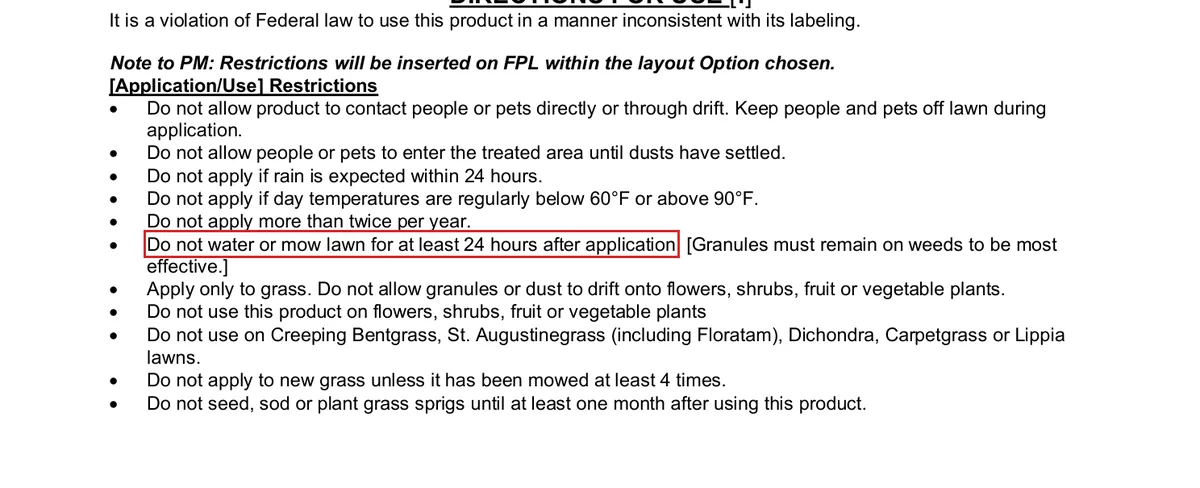
The granule format is the weak point. The Scotts label tells you to spread on grass wet from dew or watering so particles stick to weed leaves, then keep water off for 24 hours (EPA 538-333). In Rutgers’ 2017 trial, a Scotts weed and feed gave under 30 percent clover control on every rating date while liquid sprays passed 90 percent (Rutgers Turfgrass Proceedings). Our comparison of weed and feed against liquid sprays prices both per 1,000 sq ft.
Weed and feed, preemergent fertilizers and iron HEDTA are pesticides. The label is the law: read the one on the bag you buy, including the grasses it excludes, before you spread it.
Should you fertilize or kill weeds first?
Time each job to its own best date, which is why Illinois Extension calls weed and feed a product of convenience that compromises the timing of the fertilizer or the herbicide (Illinois Extension). For crabgrass the clash is in spring: central Illinois puts preemergent down in early April, which Illinois says is too early for spring feeding. Our crabgrass preventer dates by city key it to soil at about 55°F.
Fall is the one window where both jobs line up for cool-season lawns. Illinois recommends broadleaf weed and feed for fall, and Purdue puts most nitrogen from late August to early December (Purdue AY-22). For warm-season grass, feeding waits until 4-inch soil holds 65°F, so our guide to when to fertilize by grass type sets that date separately from any spray.
1Is your target crabgrass that has not come up yet, or sprouted within the last 4 weeks?
YesUse a preemergent fertilizer such as a dithiopyr product (EPA 961-392) as soil nears 55°F; it also stops seedlings up to 4 weeks old. Reseed no sooner than 8 weeks later.
NoGo to the next question
2Are dandelion, clover or other broadleaf weeds spread across most of the lawn?
YesA broadleaf weed and feed can work: spread on wet grass at 60 to 90°F, no rain or watering for 24 hours (EPA 538-333). For clover, a liquid spray did better in Rutgers' trial.
NoGo to the next question
3Are the broadleaf weeds in a few patches only?
YesSpot-spray a liquid broadleaf herbicide listed for the weed and your grass, and fertilize separately on the grass's own schedule.
NoGo to the next question
4Is the turf thin or pale, with soil showing between plants?
YesFeed and raise the mower first: 0.5 to 1 lb N per feeding (Purdue AY-22). Expect weed cover to fall over seasons, not weeks.
NoFertilize on schedule and recheck in fall, Illinois Extension's window for broadleaf weed control in cool-season lawns.
Source: EPA labels 961-392 and 538-333; Purdue AY-22; Illinois Extension; Rutgers 2017
How we compiled this
In November 2026 we read a 2020 Crop Science review of cultural weed control, a 2011 conference abstract of the Wisconsin lawn trial, a 1988 California Agriculture field report, a 2017 Rutgers trial, 5 extension publications and 3 EPA-stamped pesticide labels. Where an original paper is paywalled we report its figures as the review states them and say so. Rate conversions are our arithmetic. We did not test any product or lawn.
Frequently asked questions
Will fertilizer make weeds grow too?
Yes. Nitrogen feeds any green plant it reaches, and Cornell notes dandelion growth rises with phosphorus when grass is not competing. In a dense lawn the grass uses most of it, which is why weed cover falls over several seasons rather than right away (Cornell).
Does nitrogen kill clover?
No, it starves it slowly. In a 4-year trial, 3.1 lb of nitrogen per 1,000 sq ft a year cut white clover density 61 to 88 percent (Calhoun et al., via Hahn et al.). Existing plants die only from a herbicide whose label lists clover.
What is the best fertilizer to kill weeds?
One with a herbicide in it, matched to the weed: a broadleaf weed and feed such as EPA 538-333 for dandelion and clover, or a dithiopyr fertilizer such as EPA 961-392 for crabgrass before or just after it sprouts. Plain fertilizer kills nothing.
Should you pull weeds before fertilizing?
Pulling helps only for young annuals; perennials regrow from roots. Fertilize on the grass’s schedule and treat existing broadleaf weeds in fall for cool-season lawns, when Illinois recommends broadleaf weed and feed (Illinois Extension).
Will grass killed by fertilizer come back?
Often, if the crowns survived: burned leaves stay brown, but firm crowns push new leaves once the salts are flushed with water. Reseed only spots that pull up with no roots; our fertilizer burn guide covers the recovery steps.
Sources
- Crop Science (Hahn, Sallenave, Pornaro and Leinauer), Managing cool-season turfgrass without herbicides: Optimizing maintenance practices to control weeds (doi:10.1002/csc2.20175), open copy at Wageningen University, 2020. Accessed November 2026.
- ASA, CSSA and SSSA Annual Meetings (DeBels et al., UW-Madison), Evaluation of Mowing Height and Fertilizer Regime on Quality and Weed Invasion of Five Lawn Grasses (abstract), Oct. 17, 2011. Accessed November 2026.
- U.S. EPA HERO database, Dernoeden, Carroll and Krouse, Weed management and tall fescue quality as influenced by mowing, nitrogen and herbicides, Crop Science 33 (record and abstract), 1993. Accessed November 2026.
- California Agriculture (Agamalian), Weed control in crucifer crops with nitrogen fertilizers, Nov. to Dec. 1988. Accessed November 2026.
- Rutgers Center for Turfgrass Science (Elmore and Tuck), White Clover Control with EH1626, EH1580, and Switchblade, 2017 Rutgers Turfgrass Proceedings, p. 157, 2017. Accessed November 2026.
- University of Wisconsin-Madison (J. C. Stier), Corn Gluten Meal and Other Natural Products for Weed Control in Turfgrass, December 1999. Accessed November 2026.
- University of Connecticut IPM, Weeds as Indicators of Soil and Growing Conditions in Turf, undated. Accessed November 2026.
- Cornell University Weed Science, Dandelion (Taraxacum officinale) weed profile, undated. Accessed November 2026.
- Purdue University Extension, AY-22-W, Fertilizing Cool-Season Lawns, undated. Accessed November 2026.
- University of Illinois Extension, Fertilizing Your Lawn, undated. Accessed November 2026.
- Pacific Northwest Pest Management Handbooks, Weed Management Handbook, Section U: Turfgrass, 2026. Accessed November 2026.
- U.S. EPA PPLS, Scotts Turf Builder Weed and Feed, EPA Reg. No. 538-333, Sept. 17, 2026. Accessed November 2026.
- U.S. EPA PPLS, Greenview Green Power Crabgrass Prevention and Control, EPA Reg. No. 961-392, Dec. 10, 2025. Accessed November 2026.
- U.S. EPA PPLS, NEU1173H Concentrate (Fiesta Turf Weed Killer), EPA Reg. No. 67702-26, April 10, 2025. Accessed November 2026.