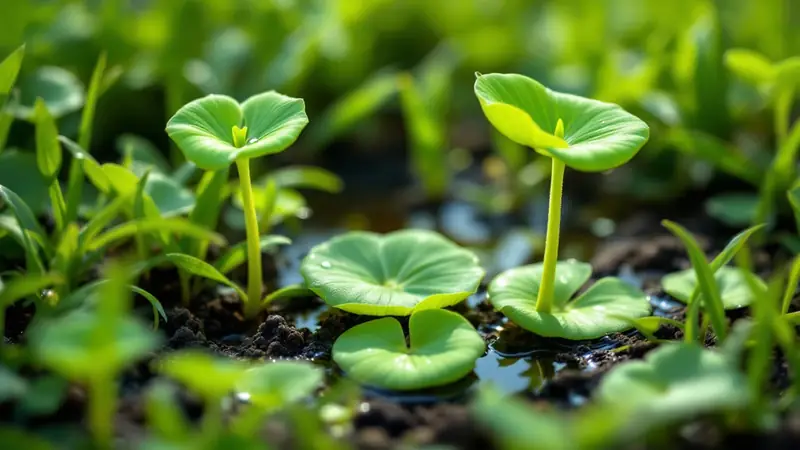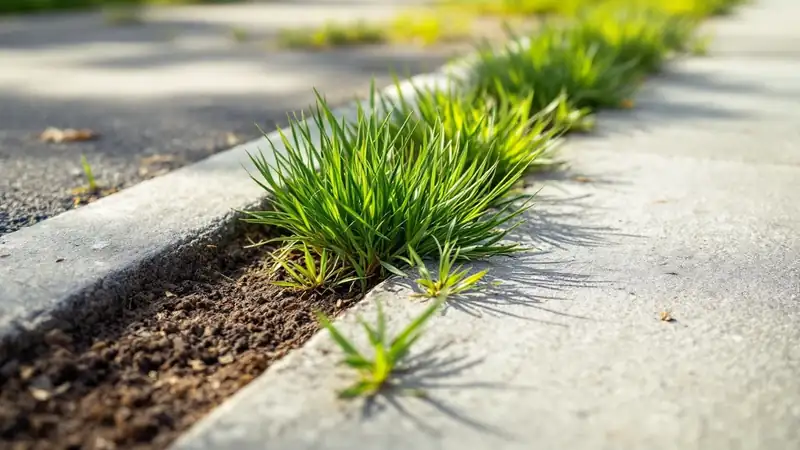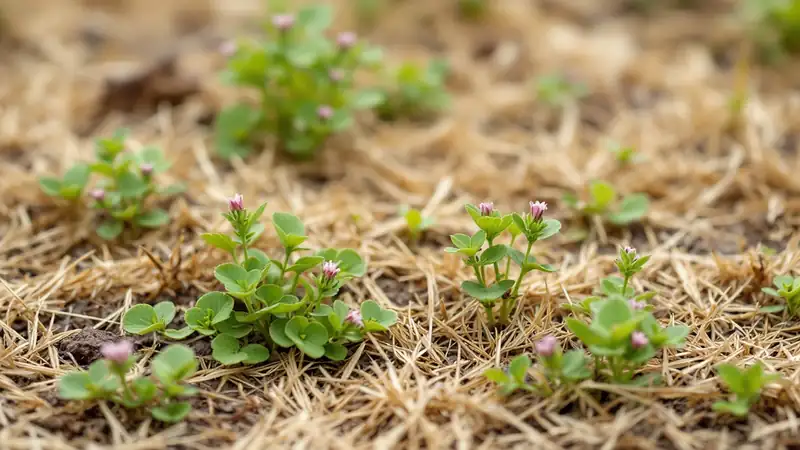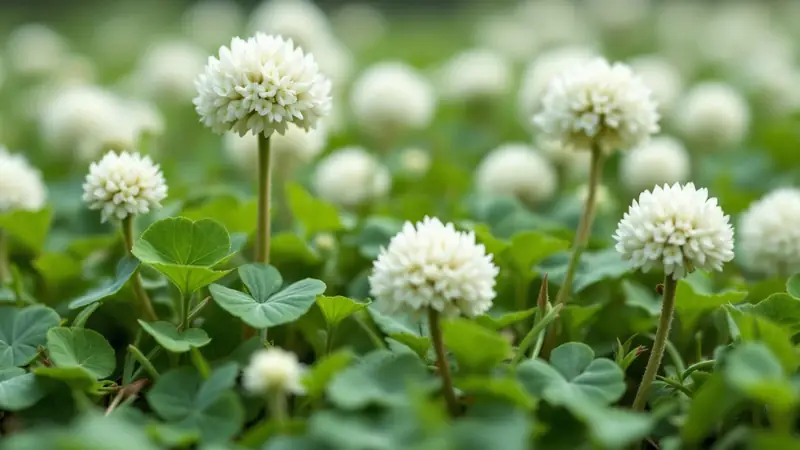
How to get rid of clover in lawn grass: feed 0.5 lb of nitrogen per 1,000 sq ft per growing month, mow at 3 inches, pull young plants, then spray a liquid herbicide whose label lists white clover and your grass, in fall.
Clover is a symptom first: white clover fixes its own nitrogen, so it wins where the grass is underfed (Penn State Extension). The form of the spray matters as much as the bottle. In 2017 Rutgers trials on a clover-infested tall fescue lawn, a granular 2,4-D and mecoprop weed and feed gave 17 percent clover control at 10 weeks, while a liquid three-way spray (Triplet) gave 99 percent and a fluroxypyr mix 100 percent. Below we rank 7 control steps by measured effect and sort 12 EPA labels that list white clover by the grass they allow. Download the label matrix (CSV).
General information, not pesticide or legal advice, and no product endorsement. The label is the law: the label on your container overrides this page, and a retail package may list fewer weeds or grasses than the EPA master label.
The clover control ladder: what each step does
Work down the ladder and stop where the clover stops. Steps 1 to 4 cost little and change why clover is there; steps 5 to 7 kill what is already growing. Skipping to step 6 works for a season, but Rutgers FS385 calls herbicides an aid, not a cure, when low mowing or low nitrogen keep the turf thin.
| Step | What to do | Measured effect or rule | Source |
|---|---|---|---|
| 1. Confirm it is white clover | Look for 3 leaflets with a pale V watermark and round white heads of 20 to 40 flowers. Heart-shaped leaflets mean oxalis; a longer middle leaflet stalk means black medic or hop clover | Quinclorac controls white clover but not woodsorrel (oxalis), so the ID changes the product | Penn State; Rutgers FS385 |
| 2. Feed the grass | 0.5 lb nitrogen per 1,000 sq ft for each month of active growth, spread over the season | Fertilized microclover fell from 17% to 1% of the stand over 2 seasons, against 14% to 5% unfertilized | U. of Idaho BUL 1125; Macke, Purdue |
| 3. Mow higher | 2.5 to 3 in (Idaho) or 3 to 4 in for most cool-season grasses (Rutgers) | Low mowing thins grass and lets light reach clover seedlings | U. of Idaho; Rutgers FS385 |
| 4. Pull young plants | Hand-pull seedlings and small patches, lifting the runners | Not realistic once clover is established: stolons root at every node | U. of Idaho; Penn State |
| 5. Iron HEDTA (non-synthetic) | Spray every 2 to 4 weeks, below 85°F | Repeat sprays controlled white clover as well as two three-way herbicides in a ryegrass trial | Rutgers FS385; Carroll and others |
| 6. Selective liquid herbicide, fall | Spot-spray triclopyr, or a mix with dicamba, MCPP, fluroxypyr or quinclorac, mid-September to early November | 97 to 100% control at 7 to 10 weeks for liquid mixes in the Rutgers trial | Iowa State; Rutgers 2017 |
| 7. Repeat | Second spray at 4 to 6 weeks (2 to 3 weeks on the Ortho triclopyr label) | Clover often needs 2 sprays unless the product contains triclopyr or quinclorac | Rutgers FS385; EPA 239-2491 |
Why is there so much clover in my lawn?
Low nitrogen is the usual reason. Iowa State calls white clover a sign of low nitrogen fertility (Iowa State Extension), and the University of Idaho uses it as an indicator plant: if the grass around a clover patch is darker green than the rest of the lawn, the lawn needs more nitrogen. Penn State adds that clover grows best in full sun but also colonizes fertilized, partly shaded turf.
Common lespedeza is the summer legume that reads the same signal in thin, underfed turf, and our guide on how to get rid of lespedeza pairs the nitrogen fix with the lawn labels that list it.
Black medic, the yellow-flowered legume often mistaken for clover, sends the same low-nitrogen signal but responds differently to sprays: our guide on getting rid of black medic shows why 2,4-D alone rates only intermediate to resistant on it.
Feeding works slowly. In a 2-season Purdue thesis, microclover in turf given 98 kg of nitrogen per hectare a year (about 2 lb per 1,000 sq ft) fell from 17 percent to 1 percent of the stand; in unfertilized turf it fell from 14 to 5 percent. A Penn State field study found that fertility treatments alone did not reduce white clover over the trial period (Carroll and others, 2021), so nitrogen is the long fix, not this month’s.
How much to feed depends on the grass. A tall fescue lawn typically takes 2 to 3 lb of nitrogen per 1,000 sq ft a year, mostly from early September through October (University of Maryland TT-121). The calculator turns a target dose into pounds of product for 5 bag grades; our guide to adding nitrogen to lawn soil compares sources by price per pound of nitrogen, and our fertilizer timing guide sets the months.
- Fertilizer product (lb)
- 5.4
- Share of a 50 lb bag
- 0.11
Default: 5,000 sq ft at 0.5 lb N from 46-0-0 needs 5.4 lb of urea. Product lb = area / 1,000 x lb N x 100 / bag N%. Your bag's label rate and state fertilizer rules win.
| Bag grade (N-P-K) | Product per 1,000 sq ft for 0.5 lb N | For 1 lb N | 5,000 sq ft lawn at 0.5 lb N |
|---|---|---|---|
| 46-0-0 (urea) | 1.1 lb | 2.2 lb | 5.4 lb |
| 32-0-4 | 1.6 lb | 3.1 lb | 7.8 lb |
| 21-0-0 (ammonium sulfate) | 2.4 lb | 4.8 lb | 11.9 lb |
| 16-4-8 | 3.1 lb | 6.3 lb | 15.6 lb |
| 6-4-0 (Milorganite-type organic) | 8.3 lb | 16.7 lb | 41.7 lb |
What kills clover but not grass?
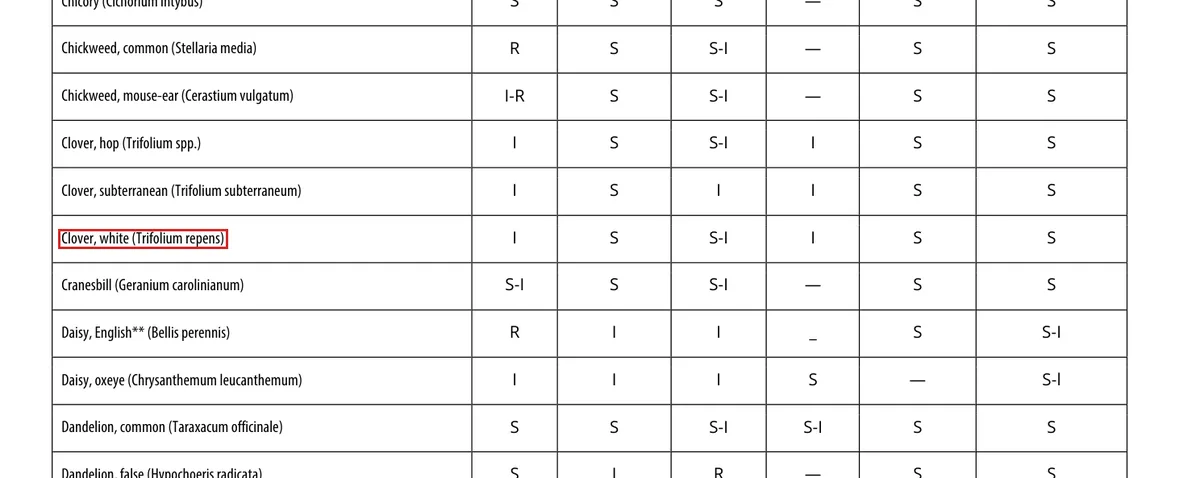
Dicamba, MCPP, triclopyr, fluroxypyr and quinclorac do; 2,4-D on its own mostly does not. The PNW Weed Management Handbook rates white clover susceptible to dicamba and to mixtures with or without triclopyr, susceptible to intermediate for MCPP, and only intermediate for 2,4-D and MCPA, meaning several sprays may be needed. Rutgers names triclopyr the most effective clover active (FS385).
| Active ingredient | White clover rating or result | Where you find it | Source |
|---|---|---|---|
| Triclopyr | Most effective on clover and woodsorrel; PNW: mixtures with triclopyr S | Ortho Weed B Gon Chickweed, Clover & Oxalis (cool-season, buffalo, zoysia only) | Rutgers; PNW |
| Dicamba | S (susceptible) | Most three-way lawn concentrates | PNW; Penn State |
| MCPP (mecoprop-p) | S to I; most effective on chickweed and clovers | Three-way concentrates | PNW; Rutgers |
| Quinclorac | Effective on white clover, not on oxalis | Crabgrass-plus-weed products; Roundup For Lawns1 | Rutgers; Penn State |
| Fluroxypyr | 98 to 100% control (Escalade 2, Switchblade) in 2017 Rutgers trials | Mostly professional products | Rutgers 157; Rutgers 161 |
| 2,4-D alone | I (intermediate); Rutgers lists white clover among weeds 2,4-D does not control well | Single-active 2,4-D amine | PNW; Rutgers |
| MCPA | I (intermediate) | Mixes | PNW |
| Clopyralid | Penn State rates it among the best clover actives | Not for home lawns: residential lawn uses were canceled | Penn State; EPA 2020 |
| Iron HEDTA | Controlled white clover with multiple sprays 2 to 4 weeks apart | Sunday, Fiesta-type iron products | Rutgers; EPA 67702-27 |
Penn State’s list includes clopyralid products such as Lontrel and Confront, but they are for non-residential turf only, and EPA’s 2020 clopyralid review decision states that residential lawn uses have been canceled. If an online answer points you to a clopyralid product for a home lawn, pick a triclopyr or dicamba label instead.
Does weed and feed kill clover?
Poorly, in the Rutgers trials. On a tall fescue lawn at Adelphia, New Jersey, a granular Scotts weed and feed (2,4-D plus mecoprop-p at 125 lb of product per acre, about 2.9 lb per 1,000 sq ft) gave 10 to 26 percent clover control over 10 weeks, while the liquid three-way Triplet and the fluroxypyr mix Switchblade reached 95 percent or more by week 3 and 99 to 100 percent by week 10 (Elmore and Tuck, 2017). A second trial on perennial ryegrass recorded 16 percent for the same granular at 8 weeks (Rutgers 153).
| Product tested (form) | Actives | 3 weeks | 7 weeks | 10 weeks |
|---|---|---|---|---|
| Scotts Turf Builder W&F (granular) | 2,4-D + mecoprop-p | 26% | 10% | 17% |
| Triplet (liquid) | 2,4-D + mecoprop-p + dicamba | 95% | 97% | 99% |
| Switchblade, 2 pt per acre (liquid) | Fluroxypyr + dicamba + halauxifen | 97% | 98% | 100% |
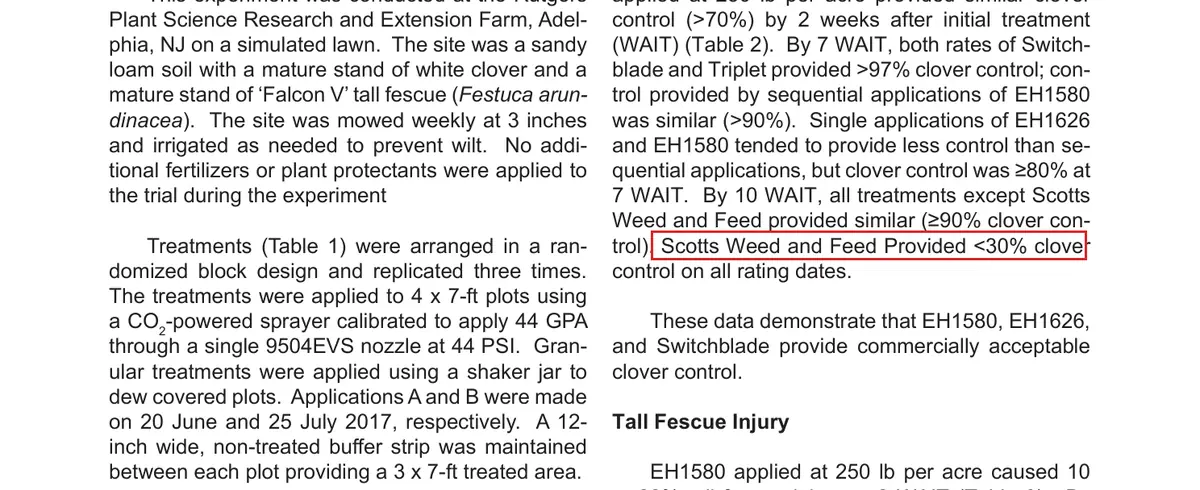
Two cautions on reading this. The trial went down in late June, and the weed and feed tested was a 2,4-D and mecoprop formula, while the current Weed & Feed5 label (538-333) pairs 2,4-D with dicamba and lists white clover. Scotts’ own clover page recommends a liquid concentrate for widespread clover, and Rutgers found granular weed and feed less effective than sprays on clover.
Which clover killers are safe on your grass?
All 12 EPA master labels below list white clover; the grass column decides which you may use. Several also bar use on lawns with desirable clover, which is the point here. Read the exclusions before the price: the same Ortho concentrate goes on at 4 fl oz per 1,000 sq ft on fescue and 1 fl oz on St. Augustine.
| Product (EPA Reg. No.) | Actives | Do not use on | Rate per 1,000 sq ft | Heat limit |
|---|---|---|---|---|
| Ortho WeedClear / Weed B Gon Weed Killer for Lawns concentrate (239-2744) | 2,4-D, MCPP-p, dicamba | Bentgrass, carpetgrass, dichondra, lippia, Floratam St. Augustine, lawns with desirable clover | 4 fl oz cool-season; 2 fl oz bahia, common bermuda, zoysia; 1 fl oz centipede, St. Augustine (pressure sprayer) | Below 90°F; 85°F on hybrid bermuda |
| Spectracide Weed Stop For Lawns Concentrate2 (9688-342) | 2,4-D, MCPP-p, dicamba, sulfentrazone | Floratam and Bitterblue St. Augustine, carpetgrass, dichondra | 4 fl oz cool-season and zoysia; 2 fl oz bahia, bentgrass, bermuda, centipede; 1.5 fl oz St. Augustine | 45 to 90°F |
| Gordon’s Trimec Lawn Weed Killer (2217-539) | 2,4-D, MCPP-p, dicamba | Carpetgrass, dichondra; Floratam St. Augustine in Florida | 4 fl oz cool-season, bahia, bermuda, zoysia; 2 fl oz centipede, St. Augustine | 60 to 90°F |
| BioAdvanced Weed Killer for Lawns concentrate (92564-4) | 2,4-D, MCPP-p, dicamba | Carpetgrass, dichondra, Floratam St. Augustine | 4 fl oz cool-season, bermuda, buffalo, zoysia; 2 fl oz bahia, centipede, St. Augustine | Most of the day below 90°F |
| Preen Lawn Weed Control granules (961-418) | 2,4-D, MCPP-p, dicamba | Carpetgrass, dichondra, St. Augustine | 2 lb granules | Not when consistently above 90°F |
| Scotts Turf Builder Weed & Feed5 (538-333) | 2,4-D, dicamba, fertilizer | Creeping bentgrass, St. Augustine (including Floratam), dichondra, carpetgrass, lippia | 2.82 lb granules on wet grass | 60 to 90°F |
| Scotts Turf Builder Bonus S (538-18) | Atrazine, fertilizer | Bahia, bluegrass, fine and tall fescue, ryegrass, bentgrass, dichondra | 3.45 lb granules | 60 to 90°F |
| Roundup For Lawns1, Northern (no glyphosate) (2217-917) | MCPA, quinclorac, dicamba, sulfentrazone | Bentgrass, St. Augustine, bahia, centipede, carpetgrass, dichondra, lawns with desirable clover | Ready to use; spot spray | 45 to 90°F; 85°F on bermuda |
| Roundup For Lawns Southern concentrate (no glyphosate) (2217-1010) | 2,4-D, dicamba, penoxsulam, sulfentrazone | Bentgrass, carpetgrass, dichondra (Floratam allowed) | 5.2 to 8.6 fl oz St. Augustine; 7.2 to 10.6 fl oz Kentucky bluegrass | 45 to 90°F; 85°F on St. Augustine and centipede |
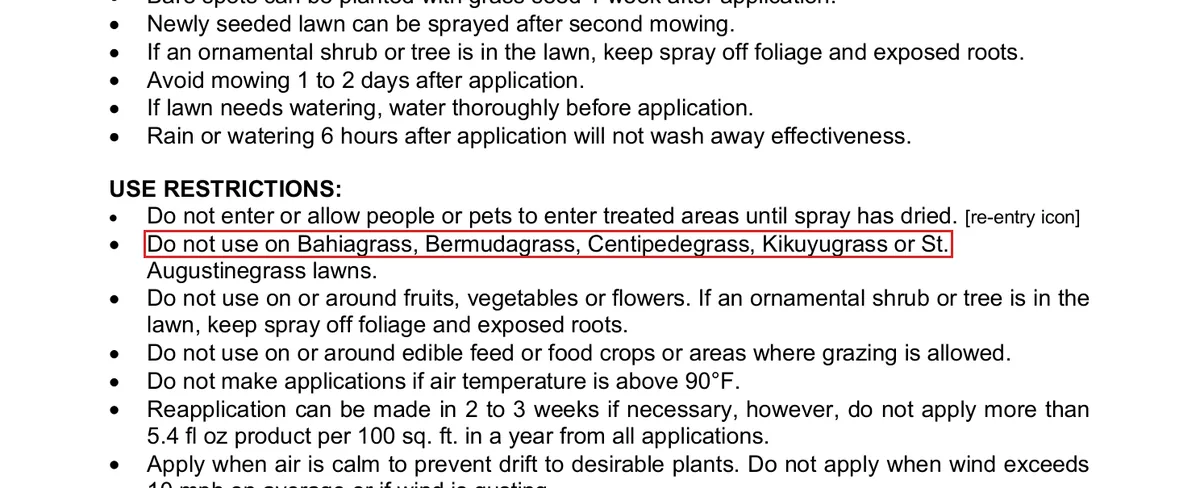
| Ortho Weed B Gon Chickweed, Clover & Oxalis Killer (239-2491) | Triclopyr | Bahia, bermuda, centipede, kikuyu, St. Augustine (allowed: buffalo, fescues, bluegrass, ryegrass, zoysia) | 5 fl oz (1 fl oz per 200 sq ft); repeat in 2 to 3 weeks if needed; yearly cap 5.4 fl oz per 100 sq ft | Below 90°F; wind under 10 mph |
| Sunday Dandelion Doom (67702-27) | Iron HEDTA 1.5% | Bentgrass; drought-stressed grass | Ready to use; wet the weeds; repeat in 3 to 4 weeks, up to 4 times a year | Daytime below 85°F |
| SpeedZone EW (professional) (2217-1053) | 2,4-D ester, MCPP-p, dicamba, carfentrazone | St. Augustine, bahia, centipede, seashore paspalum, carpetgrass, dichondra | Up to 1.8 fl oz (5 pt per acre) | 90°F unless injury is acceptable |
Cool-season lawns have the most choice, and triclopyr is the clover specialist: the Ortho triclopyr label allows buffalograss, fescues, Kentucky bluegrass, ryegrass and zoysia, lets you reseed bare spots 1 week after spraying and caps use at 5.4 fl oz per 100 sq ft a year. Roundup For Lawns1 adds quinclorac and works on bermuda and zoysia too, but not above 85°F on bermuda.
St. Augustine and centipede are the risk. Three-way concentrates drop to 1 to 2 fl oz per 1,000 sq ft there, and only Roundup For Lawns Southern (85°F or cooler) and Bonus S atrazine granules name Floratam as allowed. Triclopyr is off the table on bahia, bermuda, centipede and St. Augustine. Our St. Augustine guide and centipede guide cover those grasses.
The same gap trips up the clover lookalike: in a UC Cooperative Extension trial on bermudagrass, fluroxypyr rated 7.9 of 10 on oxalis 3 weeks after a November spray, and our guide on how to get rid of oxalis in a lawn matches each oxalis label to the grasses it allows.
1Do you want to keep some clover?
YesSkip broadleaf sprays: most list clover as a target. Dig other weeds and see our clover lawn guide.
NoGo to the next question
2Is it a few young plants or small patches?
YesPull them with the runners, then feed 0.5 lb N per 1,000 sq ft per growing month and mow at 3 in.
NoGo to the next question
3Do you want a non-synthetic product?
YesIron HEDTA (Sunday 67702-27): spray every 3 to 4 weeks below 85 F, up to 4 times a year; not on bentgrass.
NoGo to the next question
4Is the lawn St. Augustine or centipede?
YesA three-way concentrate at 1 to 2 fl oz per 1,000 sq ft, or Roundup For Lawns Southern (2217-1010) if it is Floratam; 85 F or cooler. No triclopyr.
NoGo to the next question
5Is it bermuda or bahia?
YesA three-way concentrate at the label's bermuda or bahia rate; Roundup For Lawns1 (2217-917) on bermuda below 85 F, not on bahia. No triclopyr.
NoCool-season or zoysia lawn: triclopyr (Ortho 239-2491, 5 fl oz per 1,000 sq ft) or a three-way at 4 fl oz, mid-September to early November; repeat at 2 to 3 weeks for triclopyr or 4 to 6 weeks for other mixes.
Source: EPA labels 239-2491, 2217-1010, 2217-917, 67702-27, 239-2744; Rutgers FS385; U. of Idaho BUL 1125
When is the best time to kill clover?
Fall. Iowa State says sprays from mid-September to early November beat late spring or summer ones (Iowa State), Rutgers gives late September through October with May as the spring window (FS385), and Penn State notes foliage often regrows after spring sprays. Heat is the hard stop.
| Condition | Limit | Source |
|---|---|---|
| Best window, cool-season lawns | Mid-September to early November; second choice May | Iowa State; Rutgers |
| Air temperature, most liquids | Below 85°F (extension advice); labels allow up to 90°F | Rutgers; EPA 239-2744 |
| Heat near trees, shrubs and gardens | Take extra care if 85°F is forecast within 72 hours | U. of Idaho |
| Iron HEDTA | Daytime below 85°F; no rain or irrigation for 3 hours | EPA 67702-27 |
| Wind | Under 10 mph average, no gusts | EPA 239-2491 |
| Rain after triclopyr | Rain or watering 6 hours after will not wash it off | EPA 239-2491 |
| Mowing | Avoid mowing 1 to 2 days after (triclopyr label) | EPA 239-2491 |
- Water a dry lawn the day before; labels warn against spraying drought-stressed grass (EPA 67702-27).
- Measure the patch area and mix only the label rate; the triclopyr label rate is 1 fl oz per 200 sq ft.
- Spot-spray the clover until wet, not dripping, and keep spray off shrub and tree roots.
- Keep people and pets off until the spray has dried (EPA 239-2491).
- Look again at 4 weeks and respray surviving runners at the label’s interval: 2 to 3 weeks for triclopyr, 4 to 6 weeks for other mixes (Rutgers).
How do you get rid of clover naturally?
Only iron HEDTA and hand-pulling are both grass-safe and measured to work. In a Penn State trial on perennial ryegrass, chelated iron controlled dandelion and white clover as well as two 2,4-D, MCPP and dicamba herbicides with minimal turf injury, while acetic acid, ammonium nonanoate and sodium chloride gave some control but injured the grass too much (Carroll and others). Rutgers notes chelated iron is a registered biopesticide but not OMRI organic.
| Method | Result on white clover | Safe for grass? | Source |
|---|---|---|---|
| Iron HEDTA, repeated | Control equal to two three-way herbicides | Yes; not on bentgrass | Carroll and others; EPA 67702-27 |
| Hand-pulling | Works on young plants only | Yes | U. of Idaho |
| Vinegar (acetic acid) | Some control | No: too injurious to turf | Carroll and others |
| Salt (sodium chloride) | Some control | No | Carroll and others |
| Corn gluten meal | Not effective on broadleaf weeds | Yes | Rutgers FS385 |
| Fertilizer alone | No reduction in the trial period | Yes | Carroll and others |
Kitchen remedies burn grass along with the clover; our pages on vinegar weed killer, salt and dish soap have the numbers. If you would rather keep the clover, our clover lawn guide weighs that trade, and our lawn weed killer comparison covers products for other weeds.
How we compiled this
We confirmed white clover on the weed list of 12 EPA master labels from EPA’s Pesticide Product Label System and re-read the triclopyr, iron HEDTA and Roundup For Lawns1 directions; other rate and grass fields match our November 2026 dandelion label matrix, read from the same PDFs. Results come from 3 Rutgers field trials (2017), 1 Penn State field study, 1 Purdue thesis abstract, the PNW Handbook rating table and 5 extension publications. We did not test any product. Sources accessed November 2026.
Frequently asked questions
How do you kill clover without killing grass?
Use a selective broadleaf herbicide whose label lists white clover and your grass: triclopyr on cool-season lawns, or a dicamba and MCPP mix at the reduced rate on St. Augustine or centipede. Spray in fall below 85°F. In Rutgers trials, liquid mixes reached 97 to 100 percent control.
Is there a spray that kills clover but not grass?
Yes. All 12 EPA labels in our matrix list white clover and spare listed grasses. The Ortho triclopyr label (239-2491) is made for clover but excludes bahia, bermuda, centipede, kikuyu and St. Augustine.
What time of year is best to kill clover?
Mid-September to early November, according to Iowa State Extension; spring sprays often see foliage regrow (Penn State). Stay under 85°F and under the label’s heat limit.
Will Dawn dish soap kill clover?
We found no trial of dish soap on clover, and contact sprays that burn clover also burn grass: in a Penn State trial, acetic acid and salt sprays injured ryegrass too much. Our dish soap page covers the soap side.
Should you get rid of clover in your lawn?
Only if it bothers you. Clover feeds bees and fixes nitrogen, and University of Maryland research credits microclover with replacing 1 to 2 lb of nitrogen per 1,000 sq ft a year (TT-121). If you keep it, skip broadleaf sprays; our clover lawn guide covers both sides.
Sources
- EPA, Ortho WBG 553 Concentrate (Weed B Gon Weed Killer for Lawns) label, Reg. 239-2744, Aug. 2023. Accessed November 2026.
- EPA, Spectracide Weed Stop For Lawns Concentrate2 label, Reg. 9688-342, June 2021. Accessed November 2026.
- EPA, Gordon’s Trimec Lawn Weed Killer label, Reg. 2217-539, Aug. 2021. Accessed November 2026.
- EPA, BioAdvanced Weed Killer for Lawns label, Reg. 92564-4, June 2026. Accessed November 2026.
- EPA, Preen Lawn Weed Control label, Reg. 961-418, July 2020. Accessed November 2026.
- EPA, Scotts Turf Builder Weed & Feed5 label, Reg. 538-333, Sept. 2026. Accessed November 2026.
- EPA, Scotts Turf Builder Bonus S label, Reg. 538-18, March 2025. Accessed November 2026.
- EPA, Roundup For Lawns1 (EH-1462) label, Reg. 2217-917, Sept. 2025. Accessed November 2026.
- EPA, Roundup For Lawns Southern (EH-1573) label, Reg. 2217-1010, June 2024. Accessed November 2026.
- EPA, Ortho Weed B Gon Chickweed, Clover & Oxalis (triclopyr) label, Reg. 239-2491, Aug. 2024. Accessed November 2026.
- EPA, Sunday Dandelion Doom (iron HEDTA) label, Reg. 67702-27, Sept. 2026. Accessed November 2026.
- EPA, SpeedZone EW label, Reg. 2217-1053, June 2023. Accessed November 2026.
- EPA, Clopyralid Interim Registration Review Decision, Dec. 2020. Accessed November 2026.
- Penn State Extension, Lawn and Turfgrass Weeds: White Clover, Oct. 28, 2025. Accessed November 2026.
- Rutgers Cooperative Extension, FS385, Broadleaf Weed Control in Cool Season Lawns, current. Accessed November 2026.
- PNW Weed Management Handbook, Susceptibility of Broadleaf Weeds in Turf to Common Herbicides, current. Accessed November 2026.
- Iowa State University Extension, How do I control white clover in my lawn?, March 3, 2022. Accessed November 2026.
- University of Idaho Extension, BUL 1125, Integrated Pest Management of White Clover, 2026. Accessed November 2026.
- Rutgers Turfgrass Proceedings (Elmore and Tuck), White Clover Control with EH1626, EH1580, and Switchblade, 2017, 2017. Accessed November 2026.
- Rutgers Turfgrass Proceedings (Elmore and Tuck), White Clover Control with EH1608 and EH1609, 2017, 2017. Accessed November 2026.
- Rutgers Turfgrass Proceedings (Elmore and Tuck), White Clover Control with GameOn Herbicide, 2017, 2017. Accessed November 2026.
- Purdue University (Macke), Evaluation of a Cool-Season Grass-White Clover Mixture for Low-Nitrogen Input Lawns, M.S. thesis abstract, 2016. Accessed November 2026.
- Carroll, Kaminski and Borger, International Turfgrass Society Research Journal, Efficacy of natural herbicides on dandelion and white clover populations, 2021. Accessed November 2026.
- University of Maryland (Maryland Turfgrass Council), TT-121, Microclover and Tall Fescue Lawns in the Mid-Atlantic, current. Accessed November 2026.