Does dish soap kill grass? Rarely at kitchen strength: extension services pour 1 to 2 tablespoons per gallon on lawns to flush insects. Undiluted or mixed heavy, it can burn the blades it coats; even labeled soap herbicides often only top-kill established grass.
So does dish soap kill grass at the dose you actually used? That depends on one number nobody in the top results gives: the percent of detergent in the water. We converted 15 published rates into that number, from the 1 tablespoon per gallon LSU AgCenter pours at the edge of brown patches to find chinch bugs, to the 10 percent herbicidal soap solution an EPA-registered label (Reg. No. 67702-8) uses to burn down turf before overseeding. The gap between them is roughly 14 to 22 times in active ingredient. Use the calculator below to place your own spill or spray on that ladder.
The dose ladder: from a soap flush to a grass burndown
Every row below is a published rate converted to two numbers: percent product by volume, and the percent of active soap or detergent that reaches the leaf. For dish soap rows we used the October 2015 Dawn Ultra safety data sheet, which lists 15 to 20 percent alkyl sulfate, 5 to 10 percent alcohol ethoxysulfate and 5 to 10 percent amine oxide: 25 to 40 percent surfactant in all, at a relative density of 1.04. For soap pesticides we multiplied the label dilution by the active ingredient percent printed on the label.
Swipe the table sideways to see every column.
| Mix or product | What it is for | Rate as published | Product in the water, % by volume | Active soap or detergent, % | Applied to turf? | Source |
|---|---|---|---|---|---|---|
| Household graywater, Colorado home | Measured laundry and shower water | Measured, 3 samples | n/a | 0.0014 (14.2 mg/L) | Yes, years of irrigation | CSU/WERF 2012, Table 2-6 |
| Root-zone injury threshold, lettuce | Hydroponic test of a detergent surfactant | 250 mg/L | n/a | 0.025 | No (roots in solution) | Bubenheim 1997 |
| Chinch bug flush | Bring insects up to count them | 1 tbsp per gal | 0.39 | 0.10 to 0.16 | Yes, poured at the patch edge | LSU AgCenter |
| Soapy-water flush | Count mole crickets, armyworms, webworms | 1 to 2 tbsp in 1 to 2 gal, over 1 sq yd | 0.20 to 0.78 | 0.05 to 0.33 | Yes; dilute further on bentgrass | NC State Turf Bugs |
| Mole cricket flush | Count mole crickets | 3/4 fl oz (1.5 tbsp) per gal, over 4 sq ft | 0.59 | 0.15 to 0.25 | Yes | UF/IFAS IN1021 |
| Drench test | Count armyworms, cutworms, chinch bugs | 1 to 2 fl oz per gal, over 1 sq yd | 0.78 to 1.56 | 0.20 to 0.65 | Yes | UC IPM |
| Online dish soap weed spray | Sold as a weed killer | 1 tbsp per quart | 1.56 | 0.41 to 0.65 | Aimed at weeds | The Spruce, Jun 2025 |
| Registered insecticidal soap | Kill soft-bodied insects | Label dilution | 1 to 2 (soap) | 1 to 2 | Plants; label lists sensitive species | UF/IFAS Gardening Solutions |
| Soap moss killer, lawn rate | Kill moss in turf, label says grass unharmed | 4 fl oz per gal, 1 gal per 50 sq ft | 3.1 | 1.25 | Yes, at or below 85°F, rinse after 30 min | EPA Reg. No. 59913-4 |
| Herbicidal soap, moss rate | Kill moss and algae | 1 part to 19 water | 5 | 1.1 | Not on desired grass | EPA Reg. No. 67702-8 |
| Herbicidal soap, grass burndown | Burn down grass before overseeding | 1 part to 9 water, 1.8 gal per 1,000 sq ft | 10 | 2.2 | Yes, to kill it | EPA Reg. No. 67702-8 |
| Herbicidal soap, spot spray | Top-kill weeds and grasses | 32 fl oz in 1.5 gal of mix | 16.7 | 3.3 | Shield lawn grass | EPA Reg. No. 42697-35 (2002 label) |
| Herbicidal soap, ready to use | Weeds, grass, moss | Spray as sold | 100 | 3.68 | Not on desired grass | EPA Reg. No. 67702-18 |
| Herbicidal soap, perennial rate | Established weeds | 1 part to 5 water | 16.7 | 3.7 | Not on desired grass | EPA Reg. No. 67702-8 |
| Dawn Ultra straight from the bottle | Dishwashing | Undiluted | 100 | 25 to 40 | Not a lawn product | P&G SDS, Oct 2015 |
Read the ladder from the top. The four extension insect flushes sit at 0.05 to 0.65 percent detergent, and all four are poured straight onto living turf: UF/IFAS pours a full gallon over 4 sq ft, which is 250 gallons per 1,000 sq ft. The only turf caution among them is NC State‘s note to dilute further on bentgrass to limit stress. The registered soaps that do kill grass start at 2.2 percent active and go on at 1.8 to 5 gallons per 1,000 sq ft.
The popular weed spray of 1 tablespoon per quart lands at 1.56 percent product, the same strength as the top of the UC IPM drench test that California’s lawn guide pours on a square yard of grass to count cutworms. A recipe cannot be a lawn-safe insect survey and a weed killer at the same concentration.
- Dish soap in the water (% by volume)
- 0.39
- Surfactant, low (mg per liter)
- 1,016
- Surfactant, high (mg per liter)
- 1,626
- Surfactant, high (% active, compare 2.2% grass burndown)
- 0.16
1 gallon = 256 tablespoons; surfactant uses the 2015 Dawn Ultra SDS (25 to 40 percent, density 1.04). Extension insect flushes run 0.2 to 1.56 percent product; Finalsan burns down grass at 2.2 percent active.
Worked example: the Reddit question at the top of this search is a kiddie-pool scrub dumped on the lawn. A 2-tablespoon squirt in 5 gallons of rinse water is 0.16 percent product, about 400 to 650 mg of surfactant per liter: under half the strength of LSU’s chinch bug flush. Straight Dawn Ultra is 25 to 40 percent surfactant, about 11 to 18 times the 2.2 percent level that burns down grass on the Finalsan label.
Why dish soap is harder on leaves than true soap
Dish soap is a detergent. Iowa State Extension puts it plainly: soap is a salt of fatty acids, detergents are made from petrochemicals, and dish soap “is also much more likely to cause damage to the plant, such as phytotoxicity.” The Dawn sheet above confirms the chemistry: its surfactants are sodium alkyl sulfates and ethoxysulfates, not potassium salts of fatty acids.
The mechanism is the leaf’s wax. UF/IFAS Gardening Solutions explains that detergents strip oils and lipids, and the waxy cuticle that keeps a grass blade from drying out is made of lipids, so even watered-down detergent can leave dry, crispy leaves. Kansas State entomologist Raymond Cloyd adds that registered insecticidal soaps are less likely to dissolve plant waxes than household cleaners. UF also says not to treat plants with any soap under drought stress, high humidity or heat above 90°F.
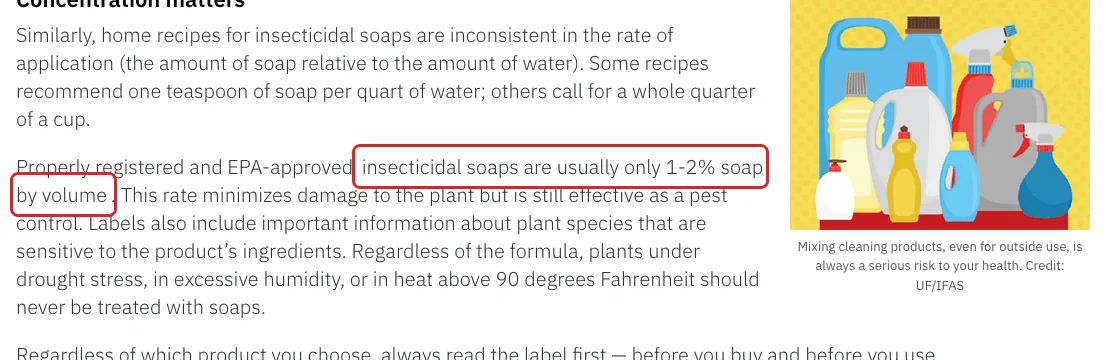
Registered insecticidal soaps run 1 to 2 percent soap by volume, per UF. Household recipes range from 1 teaspoon per quart, about 0.5 percent, to a quarter cup per quart, about 6.3 percent. UC Cooperative Extension says plant injury drops when sprays are diluted below 2 to 3 percent and when plants are rinsed within a couple of hours, and that injury accumulates with repeat sprays.
What it takes for soap to kill grass on purpose
Soap herbicides exist, and their labels are the best dose-response data a homeowner can read. They are contact killers: the Finalsan Herbicidal Soap label says it burns only the plant parts the spray coats, damage shows within a few hours to 2 days, and it works best on young weeds under 5 inches tall.
| Label | Active ingredient | Rate that kills grass | What the label says about grass |
|---|---|---|---|
| Finalsan Herbicidal Soap, EPA Reg. No. 67702-8 | Ammoniated soap of fatty acids, 22% | 10% v/v at 1.8 gal per 1,000 sq ft (2.2% active) | Over-seeding burndown; areas can be re-sown 5 days after treatment |
| Safer Sharpshooter, EPA Reg. No. 42697-35 (2002) | Potassium salts of fatty acids, 19.56% | 32 fl oz in 1.5 gal of mix (3.3% active) | Several treatments may be needed for grasses; regrowth possible in 1 to 2 weeks; sow 2 days after |
| Finalsan ready to use, EPA Reg. No. 67702-18 | Ammoniated soap, 3.68%, plus maleic hydrazide 0.50% | Spray as sold | Lists annual bluegrass, large crabgrass and barnyardgrass among targets |
| Safer Moss and Algae Killer, EPA Reg. No. 59913-4 | Potassium salts of fatty acids, 40% | None: lawn rate is 1.25% active | Label claims it leaves grass unharmed; no turf use above 85°F; rinse after 30 minutes |
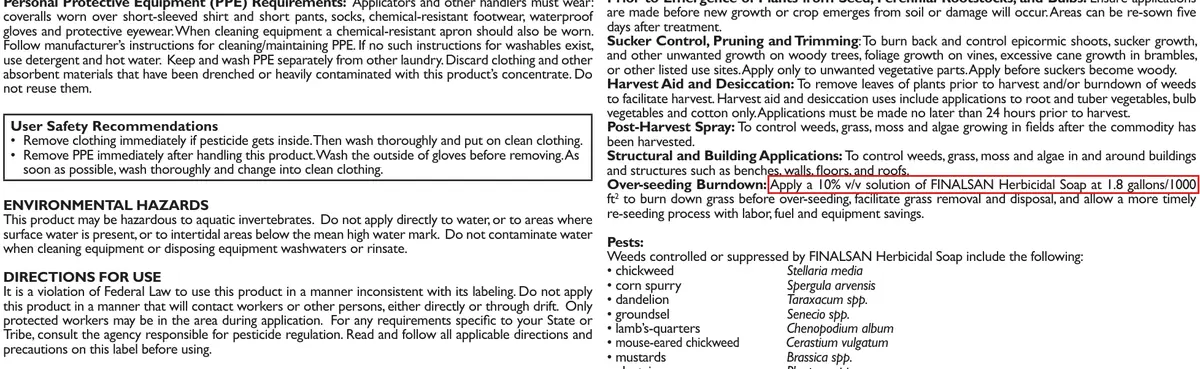
Two things follow. First, the line between lawn-safe and grass-killing soap is a narrow band: Safer’s lawn moss rate is 1.25 percent active and Finalsan’s grass burndown is 2.2 percent. Second, even at 3.3 percent the Sharpshooter label promises top kill, not root kill, and warns that grasses may need several treatments. A soap that coats the blades rarely reaches the crowns and rhizomes.
Spilled soapy water on the lawn: what to do
1Was it undiluted soap, or stronger than about 1 cup per gallon?
YesRinse the spot with a hose for 10 to 15 minutes now. At 1 cup per gallon a Dawn mix holds about 1.6 to 2.6 percent surfactant, close to the 2.2 percent level Finalsan uses to burn down grass.
NoGo to the next question
2Is it above 85 F, or is the lawn drought-stressed?
YesWater first and rinse the spot; soap labels bar turf use above 85 F and UF/IFAS says no soap on stressed plants above 90 F.
NoGo to the next question
3Was it 4 tablespoons per gallon or less?
YesNo action beyond normal watering: that is inside the 0.2 to 1.56 percent range extension services pour on turf to flush insects.
NoWater normally and judge at 1 to 2 weeks: green shoots from the crowns mean the grass is recovering; bare soil means reseed after rinsing.
- Estimate the dose. Count the tablespoons and the gallons, then use the calculator above. Under about 4 tablespoons per gallon (1.56 percent) you are inside the range extension services pour on turf.
- Rinse heavy spills now. The Sharpshooter label tells users to wash desired vegetation “immediately with water” after contact, and UC Cooperative Extension rinses plants within a couple of hours. Run a sprinkler or hose for 10 to 15 minutes over the spot.
- Skip the hot afternoon. Safer’s lawn label bars turf use above 85°F and UF says no soap on plants above 90°F or under drought stress, so water a stressed lawn first.
- Wait 1 to 2 weeks before judging. Soap herbicide labels show damage within hours to 2 days and regrowth within 1 to 2 weeks; new green shoots from the crown mean the grass lived.
- Reseed bare spots after a short wait. The soap herbicide labels allow sowing 2 to 5 days after treatment, and our guide on reviving dead grass covers the tug test and reseeding.
Soil residue is short-lived. In a NASA life-support study grown in nutrient solution, a detergent surfactant killed lettuce roots at 250 mg per liter, but the toxicity was gone within 3 days as microbes on the roots broke it down (Bubenheim and others, 1997). Colorado State’s 2012 graywater study found more than 90 percent of applied surfactants biodegraded in planted soil columns (CSU/WERF).
Soap flushes for lawn insects: the dose extension services pour on turf
A soap flush is a survey, not a treatment. The soap irritates insects so they crawl up within 3 to 10 minutes, and you count them against a threshold. UC IPM sets action thresholds of 5 armyworms or cutworms per square yard and 15 sod webworms; UF/IFAS acts on mole crickets when 2 or more surface on 4 sq ft within 3 minutes.
Extension flush recipes for sod webworms run from 0.5 to 2 tablespoons of soap per gallon, and the thresholds they feed run from 9 to 54 larvae per square yard; our guide on how to get rid of sod webworms converts 7 recipes and 6 thresholds to one unit.
For armyworms, Texas A&M AgriLife treats 3 to 5 larvae per square foot as the point to consider spraying, and our guide on how to get rid of armyworms converts 7 published flush recipes into that per-square-foot count.
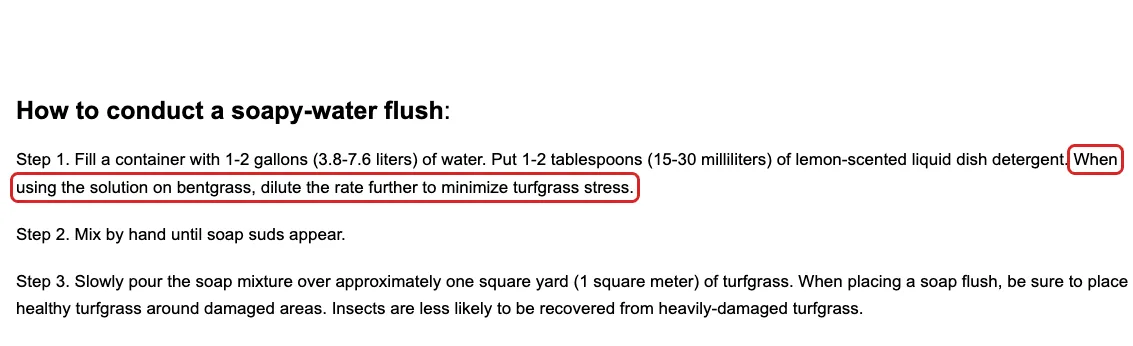
It does not work on everything. Cornell IPM says salt or soapy water forces caterpillars to the surface but “won’t work with white grubs”; you have to dig. Our lawn grubs guide covers the per-square-foot dig and the treatment thresholds. Dish soap may have some activity on soft-bodied insects at 1 to 2 percent in Kansas State‘s review, but it is not a registered insecticide, so UF and Colorado State both advise against using it as one.
The vinegar, salt and Dawn recipe: what the soap adds
In the viral weed killer the soap is the sticker, not the killer. An Ask Extension expert in Oregon answered in October 2024 that dish soap acts as a surfactant to hold the vinegar on the leaf, “but its not the best surfactant.” UF/IFAS EP580 adds that most homemade mixes of salt, vinegar, soaps and bleach have not been tested and that commercial applicators may not legally use them.
| Claim you will read | What the primary source says | Source |
|---|---|---|
| Dawn dries out weeds on its own | A 1 tbsp per quart spray is 1.56% product, the strength UC IPM pours on lawns to count insects | UC IPM |
| Soap makes vinegar and salt work | Soap only helps the spray stick, and it is not the best surfactant for the job | Ask Extension, Oct. 2024 |
| Dish soap is a gentle, natural soap | It is a detergent; Dawn Ultra is 25 to 40% sulfate and amine oxide surfactants | P&G SDS, 2015 |
| Spraying Dawn opens up hard soil | Colorado State says it may act as a wetting agent on dry, thatchy turf, but recommends against lawn tonics | CSU Extension, 2013 |
| Dish soap is a safe pesticide | Household soaps are not FIFRA 25(b) minimum-risk pesticides and are not recommended for insect control | CSU Fact Sheet 5.547 |
The vinegar and the salt do the damage in that mix, and each has its own page: vinegar weed killer covers acetic acid strength and does salt kill weeds and grass covers the 77 g per liter salt load and how long it stays. Bleach mixes are on our bleach page, and boiling water is the option with no residue at all.
Dishwater and graywater on the lawn
Kitchen dishwater is not legal graywater in several states. Texas rule 30 TAC 210.82 defines graywater as water from showers, tubs, lavatories, clothes washers and sinks “not used for food preparation or disposal”, and Hawaii Department of Health guidelines class kitchen sinks as blackwater because of pathogens. Check your state rule before plumbing a sink to the yard.
Laundry and shower graywater is far weaker than any spray mix. Colorado State’s study measured 14.2 mg per liter of total surfactant in one Colorado home’s graywater, against 1,000 to 1,600 mg per liter in a 1 tablespoon per gallon Dawn mix (CSU/WERF 2012). In its greenhouse trial, synthetic graywater with 26.4 mg per liter of surfactant raised tall fescue quality to 6.25 versus 4.56 on tap water, credited to its nutrients. Across the household sites, 19 of the 22 plant species evaluated showed no sensitivity to graywater.
The long-term risks are sodium and boron, not the surfactant. Hawaii’s guidelines list borax, sodium perborate, bleach and softeners among the ingredients to avoid, and say excess boron causes leaf tip burn and yellowing. Hawaii also names bermuda grass and seashore paspalum among the grasses that tolerate graywater.
This page is general information, not pesticide advice. The label is the law: use only a product whose EPA-registered label lists your site and target, and follow it.
How we compiled this
We read 4 EPA pesticide labels, the 2015 Dawn Ultra safety data sheet, 13 extension pages and publications, 2 state graywater rules or guidelines, a 1997 surfactant study and the Colorado State graywater report, then converted every published rate to percent by volume and percent active ingredient, accessed November 2026. Dish soap surfactant percentages use the 2015 Dawn Ultra sheet; current formulas may differ. We found no published trial that sprayed dish detergent on turfgrass at measured concentrations, so the ladder uses extension flush rates and soap herbicide labels as the benchmarks. We did not test anything ourselves.
Frequently asked questions
Is dish soap harmful to grass?
At 1 to 2 tablespoons per gallon, extension services pour it on turf without listing injury, apart from NC State’s advice to dilute further on bentgrass. Undiluted or heavy mixes, at 25 to 40 percent surfactant straight from the bottle, can burn blades; rinse with water. Iowa State rates detergent as more likely than true soap to injure plants.
Is there any soap that doesn’t kill grass?
No soap is guaranteed safe on every lawn, but potassium salts of fatty acids are the soaps with turf directions. Safer’s moss label, EPA Reg. No. 59913-4, applies 1.25 percent active at 1 gallon per 50 sq ft and claims grass is unharmed, with no turf use above 85°F.
What does Dawn dish soap do for your lawn?
Little. Colorado State Extension says it may act as a wetting agent on a dry, thatchy lawn, but it supplies no nitrogen or iron; our greener grass guide has the feeding rates that change color.
Will dish soap kill grass seed?
No study we found tested it. The soap herbicide labels allow sowing 2 to 5 days after spraying, and a detergent surfactant lost its root toxicity within 3 days in Bubenheim 1997. Rinse the spot and wait a few days before seeding.
How fast does dish soap kill grass?
Registered soap herbicides show damage within about 4 hours to 2 days, per the Sharpshooter and Finalsan labels, and the same window is a fair guide for a heavy detergent spill. Judge recovery at 1 to 2 weeks, when those labels warn regrowth appears.
Sources
- Iowa State University Extension, Yard and Garden, Can I use dish soap instead of insecticidal soap to treat for insect pests?, Dec. 12, 2025. Accessed November 2026.
- UF/IFAS Gardening Solutions (after Dale and Borden), Soaps, Detergents and Pest Management, current page. Accessed November 2026.
- Colorado State University Extension, Fact Sheet 5.547, Insect Control: Insecticidal Soap, current page. Accessed November 2026.
- Kansas State University (R. Cloyd), Fundamentals of Using Soaps as Insecticides, June 12, 2020, updated Sept. 2026. Accessed November 2026.
- University of California Cooperative Extension (S. Oneto), Soap Sprays as Insecticides, undated. Accessed November 2026.
- Procter & Gamble (Purdue University copy), Safety Data Sheet, Dawn Ultra Dishwashing Liquid, Lemon Scent, Oct. 5, 2015. Accessed November 2026.
- U.S. EPA PPLS, Label, EPA Reg. No. 59913-4, Safer Brand Moss and Algae Killer, Oct. 13, 2008. Accessed November 2026.
- W. Neudorff GmbH KG, Label, Finalsan Herbicidal Soap, EPA Reg. No. 67702-8, Dec. 3, 2018. Accessed November 2026.
- U.S. EPA PPLS, Label, EPA Reg. No. 67702-18, ammoniated soap of fatty acids ready to use, Jan. 31, 2013. Accessed November 2026.
- U.S. EPA PPLS, Label, EPA Reg. No. 42697-35, Safer Sharpshooter Weed and Grass Killer, July 17, 2002. Accessed November 2026.
- NC State University, NC Turf Bugs, Soapy-water Flush, current page. Accessed November 2026.
- UC Statewide IPM Program, UC Guide to Healthy Lawns: Drench test, 2017. Accessed November 2026.
- UF/IFAS Extension, IN1021, mole cricket IPM, current edition. Accessed November 2026.
- LSU AgCenter, A Triple Threat to Southern Lawns, 2025. Accessed November 2026.
- Cornell University, New York State IPM Program, What’s Bugging You: Grubs, current page. Accessed November 2026.
- Ask Extension (Oregon State Master Gardener), Vinegar, salt and dawn weed killer, #888177, Oct. 17, 2024. Accessed November 2026.
- UF/IFAS Extension (Marble, Neal and Senesac), EP580, Use of Glyphosate and Herbicide Alternatives for Weed Control in Florida Landscape Planting Beds, 2020. Accessed November 2026.
- Colorado State University Extension (T. Koski), Lawn Tonics, CO-Horts blog, April 2013. Accessed November 2026.
- Sharvelle, Roesner, Qian, Stromberger and Negahban Azar, Colorado State University for WERF, Long-Term Study on Landscape Irrigation Using Household Graywater: Experimental Study, 2012. Accessed November 2026.
- Bubenheim, Wignarajah, Berry and Wydeven, J. Amer. Soc. Hort. Sci. 122 (AGRIS record), Phytotoxic effects of gray water due to surfactants, 1997. Accessed November 2026.
- Texas Administrative Code (Cornell LII copy), 30 TAC 210.82, Alternative Water Source Definitions, current rule. Accessed November 2026.
- Hawaii Department of Health, Wastewater Branch, Guidelines for the Reuse of Gray Water, June 22, 2009. Accessed November 2026.
- The Spruce (recipe cited as a claim, not a source of fact), DIY dish soap weed killer, June 14, 2025. Accessed November 2026.