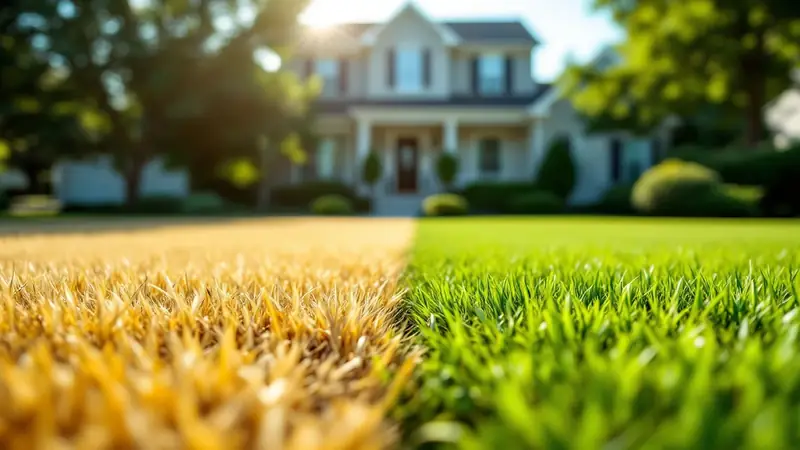
How to get rid of armyworms: pour soapy water over 1 square yard, count the caterpillars, and treat at 3 or more per square foot with a lawn label listing armyworms, sprayed in the evening while larvae are under 3/4 inch. Established bermudagrass usually regrows.
Knowing how to get rid of armyworms comes down to three checks made in order: is it the fall armyworm, are there enough to matter, and are they still small. Fall armyworm, Spodoptera frugiperda, is the species Clemson and Texas A&M tie to most lawn damage, and Clemson HGIC 2159 says over 93 percent of its feeding happens after the fourth larval stage. At 6 or more per square foot, Texas A&M says the damage takes 2 to 3 days, which is why the count and the larval size, not the brown patch, decide the treatment.
Five extension services publish action thresholds in 3 different units: per square yard, per square foot and per sweep net, and a sixth says no threshold works. We converted all of them to larvae per square foot and set them beside 7 published soap-flush recipes, so one flush gives you a number to act on. We also read 16 EPA labels: the granules must be watered in at once, most sprays must stay dry for 24 hours, and none of the ranking pages we could read says which is which. White grubs are a different pest with a different test; our guide to lawn grubs covers the dig-and-count method, because soap does not bring grubs up.
This page summarizes extension research and EPA labels; it is not a product endorsement. The label is the law: the product you buy must list armyworms (or turf caterpillars) and lawns, and some states require a pesticide applicator license before anyone treats a lawn for pay.
Is it armyworms? What to look for
Look at the head first. UGA Extension Circular 1335 identifies fall armyworm by a pale, upside-down Y on the head capsule, and Alabama Extension ANR-0172 adds four dark spots on each body segment, arranged in a square on the last one. Check at dawn or dusk: larvae hide in the thatch through midday on a mowed lawn.
A smaller caterpillar with no Y on its head, a double row of dark spots and a silk-lined tunnel in the thatch is more likely a sod webworm, which UC IPM treats at 15 per square yard; our guide on how to get rid of sod webworms has that count and the labels that list it.
| Check | Fall armyworm sign | Source |
|---|---|---|
| Head | Light, inverted Y on a dark head capsule | Clemson HGIC 2159; UGA C1335 |
| Rear segment | 4 dark spots in a square on the last abdominal segment; 4 dots on the back of each segment | Alabama ANR-0172; NC State |
| Body | Green, brown or nearly black, with a wide dark stripe down each side | NC State |
| Full-grown length | 1 to 1.5 in (NC State, Clemson); up to 2 in (UGA, Iowa State) | NC State; Iowa State |
| First damage | Clear ‘windowpane’ leaf tips where young larvae scrape the green layer, often mistaken for drought | Texas A&M AgriLife, 2024; UT W1372 |
| Later damage | A brown band with a sharp line where the group is still feeding into green grass | NC State |
| Other clues | Birds and paper wasps working the lawn; green frass pellets in the thatch | Alabama ANR-0172 |
| Egg masses | Cottony, fuzzy patches of 50 to 200 eggs on siding, posts, flags or sheds beside the lawn | UGA C1335 |
| Look-alike | True armyworm, Mythimna unipuncta: survives winter in Virginia and is the main lawn armyworm in Utah | Virginia Tech SPES-357; Utah State |
The soap flush: how many armyworms is too many?
A soap flush irritates caterpillars so they crawl up where you can count them. Pour it at the edge of the brown area, onto green grass the larvae have not finished: Clemson says they surface within 10 minutes, and Texas A&M says about 1 minute. The recipes differ, so divide your count by the area you soaked. At these rates the soap is a survey tool, not a treatment, as our test of whether dish soap kills grass shows.
| Source | Soap | Water | Area soaked | Wait | Larvae per sq ft |
|---|---|---|---|---|---|
| Clemson HGIC 2159 (2025) | 1 to 2 tbsp lemon-scented dish detergent | 1 to 2 gal | 1 sq yd (9 sq ft) | Within 10 min | Count / 9 |
| Texas A&M AgriLife (2024) | 2 to 3 tbsp liquid dish detergent | 1 gal | 3 ft x 3 ft (9 sq ft) | About 1 min | Count / 9 |
| UC IPM drench test | 1 to 2 fl oz (2 to 4 tbsp) dish soap | 1 gal; 2 gal may be needed | 1 sq yd (9 sq ft) | Count within 10 min | Count / 9 |
| UT Extension W1372 (2026) | 1 to 2 tbsp dish soap | 1 gal | 2 ft x 2 ft (4 sq ft) | Not stated | Count / 4 |
| Alabama ANR-0172 | 2 tbsp dish soap | 1 gal | 1 to 2 sq ft | Not stated | Count / 1 or / 2 |
| Utah State | 2 tbsp lemon-scented detergent | 2 gal | 1 sq ft | Watch 5 to 8 min | Count / 1 |
| NC State Turf Bugs (2021) | Soapy water | Not stated | Not stated | Wait 3 to 5 min | n/a |
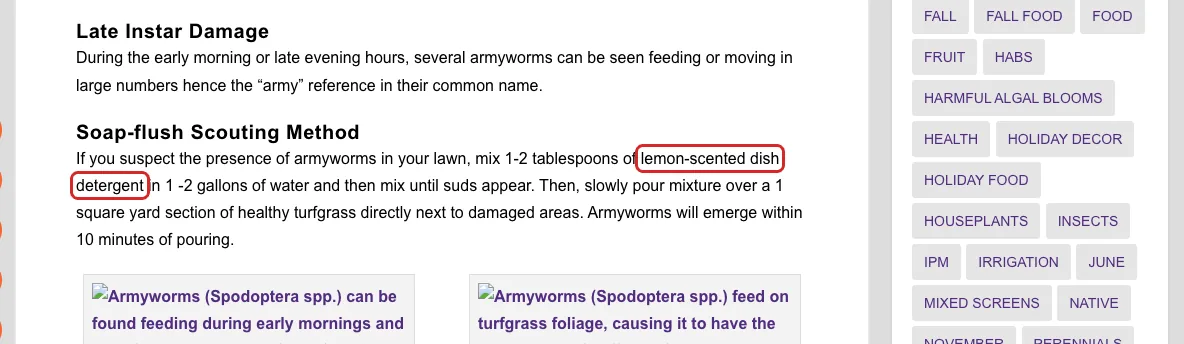
Texas A&M AgriLife gives the clearest homeowner scale: 1 to 2 per square foot is low and needs no action on a healthy lawn, 3 to 5 is medium and worth treating, and 6 or more can ruin a lawn in 2 to 3 days. Other services set the bar lower or higher, mostly because they wrote for turf managers, pastures or seedlings.
| Source and setting | Threshold as published | Larvae per sq ft | Action | Source |
|---|---|---|---|---|
| UC IPM, turfgrass guidelines | More than 5 larvae per sq yd | 0.56 | Treat | link |
| Utah State, turf | 10 to 15 larvae per sq yd with obvious damage | 1.1 to 1.7 | Treat | link |
| Texas A&M AgriLife, lawns (2024) | 1 to 2 per sq ft | 1 to 2 | Low: no immediate action on a healthy lawn | link |
| Nebraska CropWatch, lawns (2021, updated 2025) | 2 to 3 per sq ft | 2 to 3 | Generic lawn action threshold | link |
| LSU AgCenter, pastures (2023) | 2 or more per sq ft, or 1 per sweep | 2 | Start spraying | link |
| Texas A&M AgriLife, lawns (2024) | 3 to 5 per sq ft | 3 to 5 | Medium: consider treatment | link |
| Texas A&M AgriLife, lawns (2024) | 6 or more per sq ft | 6+ | Extreme: treat now; damage in 2 to 3 days | link |
| Nebraska CropWatch, forage seedings | 1 to 2 per sq ft | 1 to 2 | Can destroy seedlings | link |
| UGA Extension C1335 (2025) | No threshold correlates with damage | n/a | Count egg masses; 10 masses is about 1,000 larvae | link |
Lower the bar for new lawns. Iowa State says damage is worst in seedings and plantings under 1 year old, and NC State says new sod is more attractive to armyworms than established turf. On a lawn seeded this fall, 1 or 2 caterpillars per square foot is already worth treating; Nebraska CropWatch reports that density can wipe out forage seedlings.
Why larval size decides what to spray
Small larvae die easily and eat little; big ones do the damage and shrug off sprays. Texas A&M ENT-1007 says the last 2 of 5 larval stages eat 85 percent of all foliage. The Conserve SC label draws the line at 3/4 inch, and NC State Turf Bugs says the ideal target is about 1/2 inch.
At 1 to 1.5 inches the window is closing. NC State says large larvae are about to burrow in and pupate, so treat only while they are small, and UGA C1335 says pyrethroids may not control late stages. If most larvae are full-grown and the lawn is already brown, spot-treat the green edge and focus on watering. NC State Turf Bugs adds that sprays miss pupae in the soil, and the next small wave follows in 1 to 2 weeks.
1Is it a C-shaped white grub in the soil rather than a striped caterpillar on the blades?
YesGrubs: cut a 1 sq ft flap of sod and count; soap flushes do not bring grubs up. See our lawn grubs guide.
NoGo to the next question
2Does the caterpillar lack a pale inverted Y on its head?
YesNot a fall armyworm. True armyworms and cutworms also eat lawn blades (UC IPM, Utah State); the same flush and count apply, but check that your label lists that pest.
NoGo to the next question
3Did a flush over 1 sq yd (9 sq ft) bring up 18 or fewer larvae (2 per sq ft or less) on an established lawn?
YesHold off: Texas A&M calls 1 to 2 per sq ft low on a healthy lawn. Flush again in a few days. On new seed or sod, treat.
NoGo to the next question
4Are most larvae 1 inch or longer, with the lawn already brown?
YesLate: NC State says big larvae are near pupation and hard to kill. Spot-treat the green edge (chlorantraniliprole or Conserve SC at 1.2 fl oz per 1,000 sq ft), then water to save the crowns.
NoGo to the next question
5Do you want an organic option, with larvae under 3/4 inch?
YesSpinosad in the evening: Conserve SC 0.25 fl oz per 1,000 sq ft, or spinosad 0.5% SC at 2 fl oz per gallon, 3 gal per 1,000 sq ft. Bt only on first and second instars.
NoSpray a label that lists armyworms (bifenthrin, gamma-cyhalothrin or chlorantraniliprole) in the evening after mowing and a light watering; keep water and the mower off for 24 hours, or water granules in at once. Flush again a few days later.
What kills armyworms: 14 lawn labels compared
Pyrethroids are the fast, cheap option: Virginia Tech reports very good control of larvae with them in its turf trials. Iowa State and Ohio State BYGL both report pyrethroid resistance in some migrating populations, so if a pyrethroid spray does not give a quick kill, switch to chlorantraniliprole, a different class. Chlorantraniliprole is the active ingredient in Scotts GrubEx and in Acelepryn.
Swipe the table sideways to see every column.
| Product as labeled | EPA Reg. No. | Active ingredient | Lawn rate on label | Water and timing on label | Label date |
|---|---|---|---|---|---|
| Ortho BugClear Lawn Insect Killer Granules | 239-2765 | Bifenthrin 0.2% | 0.6 to 1.2 lb per 1,000 sq ft; 2.3 lb for 3-month residual (fall armyworm is on the 3-month list) | Water thoroughly immediately after; treat the entire lawn, not only the brown area | Mar. 24, 2025 |
| Ortho BugClear Insect Killer for Lawns & Landscapes Ready-to-Spray | 239-2718 | Bifenthrin 0.3% + zeta-cypermethrin 0.075% | 32 fl oz bottle per 5,300 sq ft of lawn (about 6 fl oz per 1,000) | Mow and water within 24 h before; mow again after 2 to 3 days; 4 to 6 weeks between applications | May 6, 2024 |
| Spectracide Triazicide Insect Killer for Lawns & Landscapes Concentrate (hose-end) | 9688-277 | Gamma-cyhalothrin 0.08% | 1 quart per 5,120 sq ft for surface insects (about 6.25 fl oz per 1,000) | Wet grass a few hours before; no watering or mowing for 24 h | June 29, 2016 |
| Spectracide Triazicide Insect Killer for Lawns Granules | 9688-250 | Gamma-cyhalothrin 0.05% | 0.8 lb per 1,000 sq ft | Water lightly immediately after | Oct. 26, 2022 |
| Hi-Yield Lawn Insect Granules II (also sold as Turf Ranger) | 7401-454 | Deltamethrin 0.1% | 2 to 3 lb per 1,000 sq ft | Water in with 1/2 inch immediately | Apr. 15, 2026 |
| Ortho Insecticide Granule, sold as Roundup For Lawns Bug Destroyer (239-2701-538) | 239-2701 | Chlorantraniliprole 0.06% + bifenthrin 0.115% | 4 lb per 1,000 sq ft (20 lb bag per 5,000 sq ft); 3-month control | Water in; max 2 applications a year | July 19, 2019 |
| Scotts Liquid GrubEx | 538-349 | Chlorantraniliprole 0.27% | 12.9 fl oz per 1,000 sq ft (32 fl oz per 2,500) | Irrigate immediately or let rain move it in; armyworms on the spring/summer list | Mar. 24, 2026 |
| Scotts GrubEx1 granules | 538-306 | Chlorantraniliprole 0.08% | 2.87 lb per 1,000 sq ft | Water in about 1 inch; 1 application a year | Jan. 11, 2012 (PPLS copy) |
| Acelepryn (professional) | 100-1489 | Chlorantraniliprole 18.4% | 0.05 to 0.09 fl oz per 1,000 sq ft for turf caterpillars | Preventive or after caterpillars seen; no water or mowing for 24 h | Jan. 11, 2024 |
| Conserve SC Turf and Ornamental (professional) | 62719-291 | Spinosad 11.6% | 0.25 fl oz per 1,000 sq ft for larvae under 3/4 in; 1.2 fl oz for larger | Early morning or late afternoon; no water or mowing for 12 to 24 h | Nov. 28, 2014 |
| Spinosad 0.5% SC, sold as Monterey Garden Insect Spray (62719-314-54705) | 62719-314 | Spinosad 0.5% | 2 fl oz per gallon, at least 3 gal of spray per 1,000 sq ft; small (under 3/4 in) armyworms only | Early morning or late afternoon; no water or mowing for 12 to 24 h | Nov. 3, 2026 |
| 10% Sevin Granules | 34704-289 | Carbaryl 10% | 2 lb per 1,000 sq ft | Residential lawns: commercial application only; water in immediately | Apr. 9, 2025 |
| DiPel DF | 73049-39 | Bacillus thuringiensis subsp. kurstaki 54% | Turf: 0.5 to 2.0 lb per acre | Lists armyworm and turf; UC IPM says Bt works on first and second instars only | Sept. 1, 2026 |
| SuperNeem 4.5-B (azadirachtin; Azatin O is a listed brand) | 70051-9 | Azadirachtin 4.5% | 0.75 to 9 fl oz per 1,000 sq ft | Commercial lawns and turf; optional 3 to 5 min irrigation, then no water for 2 days | Sept. 26, 2022 |
Read the water line before you buy. Every granule above must be watered in, from a light watering (Spectracide) to about 1 inch (GrubEx1), while most sprays need the grass to stay dry and unmowed for 12 to 24 hours so caterpillars eat the treated blades. Scotts Liquid GrubEx is the exception: its label says to irrigate right away. Clemson and UT Extension give the same 24-hour rule for sprays, and UT prefers liquids for coverage and faster action.
How to spray armyworms, step by step
- Flush 1 sq yd at the edge of the damage and convert the count to larvae per sq ft (table above).
- Mow if the grass is tall and collect the clippings (Iowa State); it lets spray reach the thatch.
- Water lightly several hours before spraying to bring larvae up (Alabama Extension).
- Spray in the early morning or evening, when larvae feed at the surface, using at least 1 gallon of spray per 1,000 sq ft (Alabama, Iowa State) or the volume your label sets: 3 gallons for spinosad 0.5% SC.
- Treat the green band ahead of the brown front as well as the damaged area; the Ortho 239-2765 label says to treat the whole lawn.
- Keep irrigation and the mower off for 24 hours after a spray, except Liquid GrubEx. Water granules in at once.
- Flush again a few days later: fewer caterpillars should surface (UGA C1335). Repeat only at the label’s interval.
For an organic route, spinosad and Bt both work only on young larvae. UC IPM says Bt should be used only on first and second instars and needs 2 days without irrigation, and Texas A&M ENT-1007 says its residue lasts 1 to 2 days on turf. Utah State lists Steinernema carpocapsae nematodes at 25 million per 1,000 sq ft, applied in the morning or evening with irrigation before and after.
- Product per application (mL)
- 178.6
- Product per application (teaspoons)
- 36.2
- Product per application (fl oz)
- 6.04
Default: 1,000 sq ft at the Ortho 239-2718 rate takes 178.6 mL (6.04 fl oz). Worked example: 5,000 sq ft takes 37 mL (1.25 fl oz) of Conserve SC for larvae under 3/4 inch, 177.5 mL (6 fl oz) for larger ones, and 887.2 mL (30 fl oz) of spinosad 0.5% SC in 15 gallons of water. Rates from the labels on this page, read Nov. 24, 2026. Granules are weighed in pounds: see the label table.
Worked example: a 5,000 sq ft bermudagrass lawn with larvae under 3/4 inch needs 37 mL (1.25 fl oz) of Conserve SC, or 30 fl oz of spinosad 0.5% SC mixed into 15 gallons of water. If larvae have passed 3/4 inch, Conserve’s label rate rises almost 5 times to 177.5 mL (6 fl oz).
Will grass come back after armyworms?
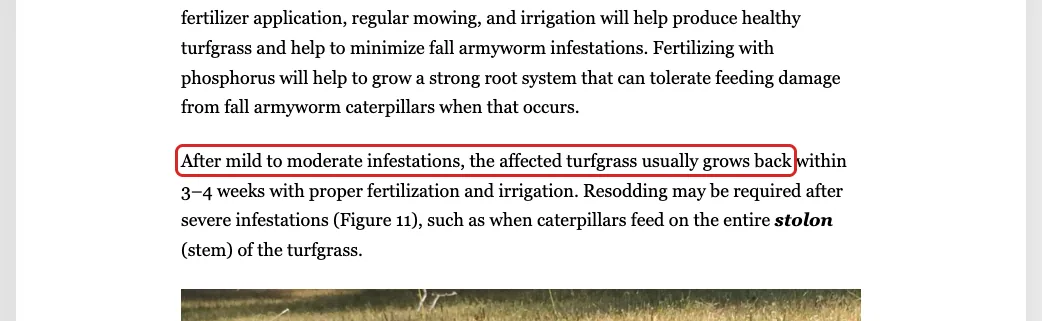
Usually, if the crowns survive. UGA C1335 says turf hit by a mild to moderate infestation grows back in 3 to 4 weeks with fertilizer and water, and resodding may be needed after severe feeding that reaches the stolons. Ohio State BYGL explains the risk: once the canopy is gone, the soil surface around the crowns can reach 120 to 130°F on a sunny day and cook them.
| Lawn | Armyworm pressure | Recovery outlook | Source |
|---|---|---|---|
| Bermudagrass | Preferred host when well fertilized (Alabama); ‘TifTuf’ tolerates more feeding (UGA) | Established turf rarely dies; regrows from rhizomes (UT W1372) | UT W1372; UGA C1335 |
| St. Augustinegrass | Susceptible (UGA) | Larvae eat leaves, not stolons; rain or irrigation can restore it in 1 to 2 weeks | Texas A&M School IPM, 2021 |
| Zoysiagrass | Lower infestation on ‘Zeon’, ‘Emerald’ and ‘Zenith’ (UGA); less attractive (UT) | Can still be hit as pressure rises | UGA C1335; NC State Turf Bugs |
| Centipedegrass | More infested than zoysia (UGA) | No separate figure; UGA’s 3 to 4 weeks for mild to moderate damage | UGA C1335 |
| Tall fescue | Damaged more than Kentucky bluegrass (Iowa State); late-summer heat slows regrowth (Virginia Tech) | Reseed or renovate if damage is extreme; endophyte-enhanced turf-type seed resists caterpillars (Ohio State) | Iowa State; Virginia Tech; Ohio State BYGL |
| Kentucky bluegrass | Less damage than tall fescue | Recovers with irrigation and fertilizer; overseed thin spots | Iowa State |
| New sod, any grass | More attractive and more susceptible (NC State) | Leaf loss cuts rooting; treat soon after installation when pressure is high | NC State; Virginia Tech; UT W1372 |
| New seedings under 1 year | Worst damage (Iowa State) | Seedlings may not survive; reseed in fall | Iowa State |
- Water damaged areas to keep crowns hydrated until green cover returns; Ohio State recommends watering them in the heat of the day.
- Feed 0.75 to 1 lb of slow-release nitrogen per 1,000 sq ft (Iowa State); our lawn fertilizer guide converts that to pounds of product.
- Wait 3 to 4 weeks before judging. Bare spots that stay brown after that need seed or sod.
- On cool-season lawns, fall is the seeding window; our guide on how to overseed a lawn covers rates and timing.
Warm-season owners can check regrowth habits in our bermudagrass and St. Augustinegrass guides. In the north, endophyte cultivars help: our tall fescue and perennial ryegrass pages list the leaf-feeding insects endophytes deter. Ohio State’s 2021 note warns against KY-31 tall fescue for lawns.
When armyworms show up, and how long they stay
Fall armyworms cannot survive a freeze. UGA C1335 says they stay active year-round only in south Florida, south Texas and northern Mexico, and moths ride storm fronts north each year; Ohio State says moths can travel 500 miles in 24 hours. Each larva feeds 2 to 3 weeks, so one wave passes in about 3 weeks, but new waves keep coming until a hard frost.
| State | When larvae appear | Generation time | Source |
|---|---|---|---|
| Texas | Can begin in June; outbreaks after early-fall rain | About 28 days egg to adult | Texas A&M 2024; ENT-1007 |
| Louisiana | Most common late July to early August; until the first killing frost | 2 to 4 days per larval stage | LSU AgCenter 2023 |
| Alabama | Reports start late July or early August; severe outbreaks as early as mid-April | 4 or more generations possible | Alabama ANR-0172 |
| Georgia | Caterpillars noticeable early July; recur July to September | At least 2 to 3 generations; about 4 weeks each in summer | UGA C1335 |
| South Carolina | Peak in summer | Life cycle in about 1 month; 3 or more generations | Clemson HGIC 2159 |
| North Carolina | Active June through October | Several generations | NC State Turf Bugs 2021 |
| Virginia | Peak mid-August to mid-September | 2 to 3 generations | Virginia Tech SPES-357 |
| Ohio | August and September | 50 to 60 days per cycle | Ohio State BYGL 2021 |
| Iowa | Moths blown in late August; caterpillars by mid-September | Not stated | Iowa State 2021 |
Outbreak years are irregular. Virginia Tech names 2018 and 2021 as recent high-population years, NC State Turf Bugs called 2021 an exceptionally busy year with damage more widespread than in the past, and Ohio State puts massive southern buildups at about every 3 to 5 years. Wet August and September weather helps egg survival, per Texas A&M.
Egg masses are the earliest warning. Iowa State says to scrape them off siding, posts and play sets and scrub the spot with soapy water rather than spray them. Utah State warns that overly maintained turf draws egg-laying females, so keep summer nitrogen to the recommended rate if armyworms hit your street last year; our lawn fertilizing calendar shows the cool-season and warm-season windows.
How we compiled this
On Nov. 24, 2026 we read 16 EPA-accepted labels from EPA’s Pesticide Product Label System (14 that list armyworms or turf caterpillars, 2 home Bt labels that do not) and 17 extension publications from Clemson, Texas A&M, Georgia, NC State, Alabama, Virginia Tech, Iowa State, Ohio State, Tennessee, UC IPM, Utah State, Nebraska and LSU. We did not run trials or test products. The per-square-foot conversions, the chart and the calculator are arithmetic on the published figures.
Frequently asked questions
What kills armyworms fast?
A contact spray in the evening while larvae are small: Clemson and Virginia Tech list pyrethroids such as bifenthrin and lambda-cyhalothrin. If caterpillars survive a pyrethroid, Iowa State and Ohio State suggest chlorantraniliprole. Keep water off the lawn for 24 hours after spraying.
Can a lawn recover from army worms?
Usually. UGA Extension says mild to moderate damage grows back in 3 to 4 weeks with fertilizer and water; resodding may be needed when stolons are eaten. New seedings and cool-season lawns hit in late summer recover worst.
Why are there so many army worms in my yard?
Each egg mass holds 50 to 200 eggs that hatch together (UGA), and one moth can lay as many as 1,000 eggs (NC State). Moths ride storm fronts north and lay on siding, posts and flags beside lush, fertilized grass.
How long do army worms stay in your yard?
Each wave feeds 2 to 3 weeks and then pupates in the soil (NC State). A summer generation takes about 4 weeks in Georgia, and new waves can follow until the first hard freeze kills them (UGA).
What are the first signs of armyworms?
Clear ‘windowpane’ leaf tips where young larvae scrape the green layer (Texas A&M), birds or paper wasps working the lawn, green frass pellets in the thatch (Alabama Extension), and fuzzy egg masses on siding or posts.
Sources
- Clemson HGIC (Gore), Armyworms: Identification, Damage, and Control in Turfgrass, HGIC 2159, Updated July 15, 2025. Accessed November 2026.
- Texas A&M AgriLife Today, Armyworms can be managed in lawns by following three helpful tips, Oct. 30, 2024. Accessed November 2026.
- University of Georgia Extension (Joseph et al.), Fall Armyworm in Georgia: Biology and Management in Turfgrass, C1335, June 17, 2025. Accessed November 2026.
- NC State Extension (Billeisen and Brandenburg), Fall Armyworms in Turf, Oct. 25, 2017. Accessed November 2026.
- NC State Turf Bugs, Fall Armyworm Q&A, Aug. 31, 2021. Accessed November 2026.
- Alabama Cooperative Extension (Kesheimer, Held and Cobb), Controlling Fall Armyworms on Lawns and Turf, ANR-0172, Mar. 24, 2021, modified Apr. 2025. Accessed November 2026.
- Virginia Cooperative Extension (Goatley, Kuhar and Del Pozo), Managing Fall Armyworms on Lawns, SPES-357, Aug. 2021, reviewed Sept. 2026. Accessed November 2026.
- Iowa State University Extension, Fall Armyworm Control in Home Lawns, Aug. 30, 2021. Accessed November 2026.
- Ohio State BYGL (Shetlar), Fall Armyworms March Across Ohio, Aug. 30, 2021. Accessed November 2026.
- University of Tennessee Extension (Gireesh, Bowling and Scott), Fall Armyworms, W1372, Jan. 2026. Accessed November 2026.
- UC Statewide IPM Program, Cutworms and Armyworms, Turfgrass Pest Management Guidelines, Text 09/09, table 12/16. Accessed November 2026.
- UC Statewide IPM Program, Healthy Lawns: Drench test, Current page. Accessed November 2026.
- Utah State University Extension, Armyworms and Cutworms in Turfgrass, Current page. Accessed November 2026.
- Nebraska Extension CropWatch, Fall Armyworms in Pastures, Alfalfa, Small Grains, Cover Crops and Lawns, Sept. 24, 2021, updated Sept. 5, 2025. Accessed November 2026.
- LSU AgCenter, Fall Armyworm Control on Turf and Grass Pastures, 2023. Accessed November 2026.
- Texas A&M AgriLife Extension (Sansone, Minzenmayer and Merchant), Armyworms in Turfgrass, ENT-1007, 2010, modified 2012. Accessed November 2026.
- Texas A&M School IPM, Be on the lookout for armyworms, Aug. 26, 2021. Accessed November 2026.
- U.S. EPA PPLS, Ortho BugClear Lawn Insect Killer Granules, EPA Reg. No. 239-2765, Mar. 24, 2025. Accessed November 2026.
- U.S. EPA PPLS, Ortho BugClear Insect Killer for Lawns and Landscapes, EPA Reg. No. 239-2718, May 6, 2024. Accessed November 2026.
- U.S. EPA PPLS, Chemsico Insecticide Concentrate 8G (Spectracide Triazicide), EPA Reg. No. 9688-277, June 29, 2016. Accessed November 2026.
- U.S. EPA PPLS, Chemsico Insecticide Granules 5G (Spectracide Triazicide granules), EPA Reg. No. 9688-250, Oct. 26, 2022. Accessed November 2026.
- U.S. EPA PPLS, Hi-Yield Lawn Insect Granules II, EPA Reg. No. 7401-454, Apr. 15, 2026. Accessed November 2026.
- U.S. EPA PPLS, Ortho Insecticide Granule (Roundup For Lawns Bug Destroyer), EPA Reg. No. 239-2701, July 19, 2019. Accessed November 2026.
- U.S. EPA PPLS, Scotts Liquid GrubEx, EPA Reg. No. 538-349, Mar. 24, 2026. Accessed November 2026.
- U.S. EPA PPLS, Scotts GrubEx, EPA Reg. No. 538-306, Jan. 11, 2012. Accessed November 2026.
- U.S. EPA PPLS, Acelepryn, EPA Reg. No. 100-1489, Jan. 11, 2024. Accessed November 2026.
- U.S. EPA PPLS, Conserve SC Turf and Ornamental, EPA Reg. No. 62719-291, Nov. 28, 2014. Accessed November 2026.
- U.S. EPA PPLS, Spinosad 0.5% SC (Monterey Garden Insect Spray), EPA Reg. No. 62719-314, Nov. 3, 2026. Accessed November 2026.
- U.S. EPA PPLS, 10% Sevin Granules, EPA Reg. No. 34704-289, Apr. 9, 2025. Accessed November 2026.
- U.S. EPA PPLS, DiPel DF, EPA Reg. No. 73049-39, Sept. 1, 2026. Accessed November 2026.
- U.S. EPA PPLS, SuperNeem 4.5-B, EPA Reg. No. 70051-9, Sept. 26, 2022. Accessed November 2026.
- U.S. EPA PPLS, Bonide Thuricide (Bt), EPA Reg. No. 4-226, Apr. 29, 2016. Accessed November 2026.
- U.S. EPA PPLS, Thuricide HPC for Home and Gardens, EPA Reg. No. 70051-65, Dec. 16, 2016. Accessed November 2026.