Perennial ryegrass (Lolium perenne) is a fast-sprouting, bunch-type cool-season lawn grass: it germinates in 3 to 7 days, mows at 1.5 to 2.5 inches, and persists in cool northern summers but usually dies in Southern heat.
Key takeaways
- In the latest completed national trial, the 2016 National Perennial Ryegrass Test, the standard check cultivar Linn averaged 3.3 for turf quality on a 1 to 9 scale, last of 114 entries, while Palmer Supreme, Fiesta Cinco, Furlong and Stellar 4GL led at 6.1 (NTEP report 22-12).
- Gray leaf spot is the cultivar decider in hot, humid areas: ratings at Adelphia, New Jersey ran from 1.0 (Linn) to 9.0 (Karma), and the 13 entries with GL in the name averaged 7.3 against 5.8 for the rest (NTEP Table 37; our arithmetic).
- Annual ryegrass is a different species, Lolium multiflorum, and federal seed rules separate the two with a 400-seed fluorescence test under ultraviolet light (7 CFR 201.58a).
- For winter color on dormant bermudagrass, extension rates run 5 to 10 lb of seed per 1,000 sq ft in Georgia (UGA), 8 to 10 lb in Mississippi (Mississippi State) and 12 to 15 lb in the Arizona desert (Arizona AZ1683).
- In a Kentucky bluegrass mix, keep perennial ryegrass near 15 percent by weight; at 25 percent or more the stand ends up dominated by ryegrass, and University of Kentucky says not to seed it with tall fescue (UK AGR-52).
- As of Oct. 29, 2026, a 50 lb bag of turf-type perennial ryegrass listed at $124.99 ($2.50 a pound) and a 50 lb bag of annual ryegrass at $39.99 ($0.80 a pound) at one national seller (Hancock Seed).
3 to 7 days to germinate, the fastest common lawn seed (UT W160-B)
114 entries rated 2017 to 2021 in NTEP’s latest completed perennial ryegrass trial; 65 sold in 2024
5 to 15 lb seed per 1,000 sq ft to overseed bermudagrass for winter (UGA to Arizona)
$0.80 vs $2.50 per lb, annual vs perennial ryegrass in 50 lb bags (Hancock Seed, Oct. 29, 2026)
| Key number | Value | Source |
|---|---|---|
| Botanical name; status in the lower 48 states | Lolium perenne L.; introduced (not native) | USDA PLANTS |
| Seeds per pound | About 247,000 | USDA NRCS Plant Guide |
| Days to germinate | 3 to 7 (UT); 5 to 7 (Penn State, UK) | UT W160-B; Penn State |
| Seeding rate, new lawn | 4 to 6 lb per 1,000 sq ft | UT W160-B; Rutgers FS584 |
| Seeding rate, winter overseeding of bermudagrass | 5 to 10 lb (GA, LA, VA); 8 to 10 (MS); 12 to 15 (AZ desert) | UGA; MSU; Arizona |
| Mowing height, home lawn | 1.5 to 2.5 in | Penn State |
| Nitrogen per growing season | About 3.0 lb per 1,000 sq ft (Pennsylvania); 4 to 8 lb (Pacific Northwest) | Penn State; Oregon State |
| Soil pH range | 5 to 8; best 6 to 7 | USDA NRCS |
| Share in a Kentucky bluegrass mix | 10 to 20 percent by weight | Penn State; Purdue AY-25 |
| Gray leaf spot weather | 70 to 95°F plus at least 14 hours of leaf wetness | NC State |
What is perennial ryegrass?
Perennial ryegrass is a cool-season bunch grass that the USDA PLANTS Database lists as introduced, not native, in the lower 48 states, Alaska and Hawaii. Lawns use it three ways: alone in cool, mild climates, as 10 to 20 percent of a Kentucky bluegrass mix, and as a winter cover sown over dormant bermudagrass in the South.
It spreads only by tillers. Penn State says the species “does not form rhizomes or stolons” (Penn State Extension), so a bare spot stays bare until it is reseeded. In exchange it is the fastest common lawn seed: 3 to 7 days to germinate in University of Tennessee tables (UT W160-B).
In a bluegrass and ryegrass mix, the bluegrass does the filling: it closed a 12-inch bare circle in about 21 months in a Kansas State trial, one of the measured rates in our guide to does grass spread on its own.
The climate fit is narrow. UC IPM’s 2017 profile rates it high for cold tolerance but moderately low for heat, shade and drought (UC IPM), and Oregon State calls it the dominant grass planted for lawns, sod and athletic fields west of the Cascade Mountains, where summers stay mild (Oregon State Beaver Turf). NC State says it is adapted as a stand-alone lawn only in the North Carolina mountains (NC State, Carolina Lawns). Other lawn species are profiled in our turf and trees section.
Those western ryegrass lawns are also where European crane fly larvae do the most harm: Oregon State EM 9296 reports thinning from February and total loss in wet spots by April and May, and our guide on how to get rid of crane fly larvae sets the count and treatment by month.
What does perennial ryegrass look like?
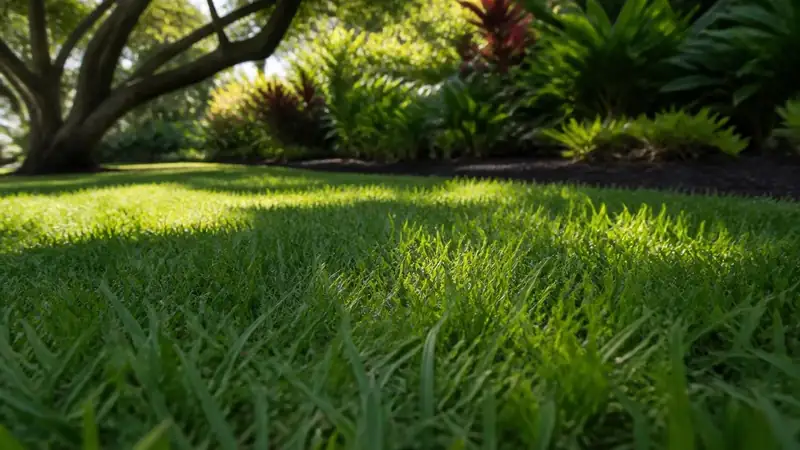
Perennial ryegrass has a bright green, sharply creased blade 2 to 5 mm wide, a smooth and glossy underside, leaves folded in the bud, small rudimentary auricles and a sheath that is usually reddish at the base (NC State Extension). Tilt a blade to the light: the shine on the underside is the fastest field check.
| Feature | Perennial ryegrass | Annual ryegrass | Tall fescue | Source |
|---|---|---|---|---|
| Leaf in the bud (vernation) | Folded | Rolled | Rolled | Penn State |
| Underside of the blade | Smooth, very glossy; prominent veins on top | Very glossy | Dull | Penn State; K-State |
| Auricles | Small, rudimentary, not clasping | Long, claw-like, clasping the stem | Absent (Penn State) or short and blunt (K-State) | Penn State; Purdue PPDL; K-State |
| Blade width | 2 to 5 mm | 5 to 7 mm (Florida description) | Not compared in these sources | NC State; UF/IFAS ENH14 |
| Base of the sheath | Usually reddish | Yellowish-green | Not listed | NC State; K-State |
| Seed | No awns | Awned (bristle at the tip) | Not applicable | USDA NRCS |
| Leaf margin | Smooth | Smooth | Rough | NC State; K-State |
What is the difference between annual and perennial ryegrass?
Annual ryegrass is a separate species, Lolium multiflorum, with wider, lighter green, coarser leaves that die once temperatures approach 80°F. Federal seed rules name annual, intermediate (Lolium × hybridum) and perennial ryegrass as three different kinds (7 CFR 201.2(h)), and a seed lab separates them by counting fluorescent seedlings under ultraviolet light.
| Trait | Perennial ryegrass | Intermediate ryegrass | Annual (Italian) ryegrass | Source |
|---|---|---|---|---|
| Federal kind name | Ryegrass, perennial: Lolium perenne | Ryegrass, intermediate: Lolium × hybridum | Ryegrass, annual or Italian: Lolium multiflorum | 7 CFR 201.2(h) |
| Texture and color | Fine, dark green, 2 to 4 mm leaves | Between the two | Coarse, medium green, 5 to 7 mm leaves | UF/IFAS ENH14 |
| Heat limit | Persists longer into spring | Lacks perennial ryegrass’s heat tolerance | Dies when temperatures exceed 80 to 85°F | UF/IFAS; Texas A&M |
| Use in a permanent lawn | Yes, in cool climates and mixes | Most behave much like one parent or the other (UGA) | “Never recommended” (NC State) | NC State; UGA |
| Spring transition out of bermudagrass | Slowest; may need removal | Easier than perennial | Usually dies out on its own | Texas A&M |
| Overseeding rate in Mississippi | 8 to 10 lb per 1,000 sq ft | Not given | Add 2 lb: 10 to 12 lb | MSU |
| 50 lb bag, Oct. 29, 2026 | $124.99 ($2.50/lb) | Not checked | $39.99 ($0.80/lb) | Hancock; Hancock |
The price gap is real. At those two listings, annual ryegrass costs 32 percent of the perennial price per pound, close to UF/IFAS’s rule of thumb that annual ryegrass runs about one-third the price (UF/IFAS ENH14) and a steeper discount than the 30 to 50 percent Texas A&M quotes (Texas A&M AgriLife).
Annual ryegrass in a permanent-lawn mix is the most common seed-bag mistake. Purdue’s diagnostic lab traced a spring wave of coarse, light green “invaders” in new lawns to annual ryegrass that survived a mild winter, and tells buyers to avoid mixes containing it (Purdue PPDL, 2023). Arizona’s turf specialist puts it bluntly: never mix annual and perennial ryegrass (University of Arizona, 1998).
How does a seed lab tell annual from perennial ryegrass?
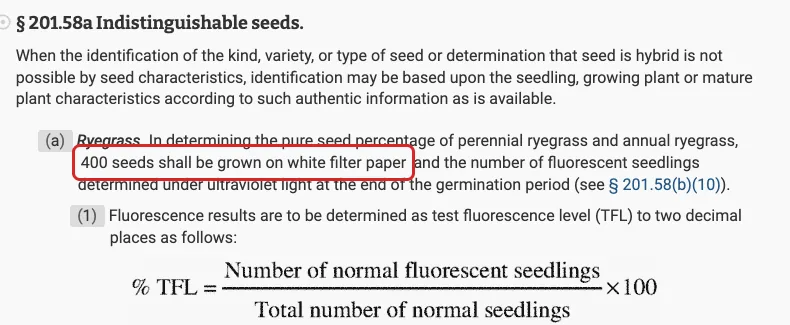
Under 7 CFR 201.58a(a), the lab grows 400 seeds on white filter paper and counts the seedlings that fluoresce under ultraviolet light. Unless a cultivar has a published fluorescence level, the rule treats perennial ryegrass as 0 percent fluorescent and annual as 100 percent, and the excess is reported as annual ryegrass.
The variety name is a separate question. 7 CFR 201.10(a) lists the kinds that must show a variety name or the words “Variety Not Stated”, and ryegrass is not on that list, while tall fescue is. A bag can therefore read “perennial ryegrass” with no cultivar named. Arizona’s 1998 tip sheet estimated that 90 of 100 bags of annual ryegrass did not name a variety (University of Arizona).
Is winter rye the same as ryegrass?
No. The seed listings near the top of an Oct. 29, 2026 Google search for “winter rye grass” sell cereal rye, Secale cereale, a grain crop that federal rules list as “Rye”, a separate kind from ryegrass (7 CFR 201.2(h)). Fedco lists it at 3 to 5 lb per 1,000 sq ft as a cover crop growing up to 5 feet tall (Fedco Seeds).
When Southern gardeners say “winter rye grass” for a lawn, they mean annual or perennial ryegrass sown into dormant bermudagrass at 5 to 10 lb per 1,000 sq ft (UGA). Check the kind name on the analysis tag: “Rye” means cereal rye, and “Ryegrass, perennial” or “Ryegrass, annual” means the lawn species.
Which perennial ryegrass varieties scored best in national trials?
In the 2016 National Perennial Ryegrass Test, rated from 2017 to 2021 at up to 23 trial locations, Palmer Supreme, Fiesta Cinco, Furlong and Stellar 4GL tied for the top turf quality score of 6.1 on a 1 to 9 scale (NTEP Appendix table). The trial mean was 5.6, and the standard Linn ranked last at 3.3.
Read the leaderboard as a band, not a ranking. NTEP’s least significant difference for the all-location quality mean is 0.3, and two entries differ only when the gap is larger than that. By that rule, 55 of the 114 entries, scoring 5.8 or higher, are statistically tied with the leaders, and 36 of those were sold commercially in 2024 (NTEP entries list).
Swipe the table sideways to see every column.
| Entry (experimental code) | Sponsor | Sold in 2024 | Turf quality, all sites | % of sites in top 25% | Transition zone (5 sites) | North Central (5 sites) | Gray leaf spot (NJ) | Winter kill (IL, MN) | Traffic (Amherst, MA) |
|---|---|---|---|---|---|---|---|---|---|
| Palmer Supreme (PPG-PR 421) | Proseeds Marketing | Yes | 6.1 | 69.6 | 6.1 | 6.1 | 8.3 | 6.2 | 6.2 |
| Fiesta Cinco (DLFPS-236/3554) | DLF Pickseed USA | Yes | 6.1 | 65.2 | 6.1 | 6.0 | 5.7 | 8.0 | 5.9 |
| Furlong (LTP-FCB) | Lebanon Seaboard Corp | Yes | 6.1 | 56.5 | 5.9 | 6.0 | 7.7 | 5.3 | 6.2 |
| Stellar 4GL (PPG-PR 424) | Mountain View Seeds | Yes | 6.1 | 56.5 | 5.8 | 6.0 | 7.7 | 6.3 | 6.3 |
| PPG-PR 372 | Columbia Seeds | No | 6.0 | 60.9 | 5.9 | 6.1 | 7.7 | 5.7 | 6.0 |
| Slugger 3GL (PPG-PR 343) | Mountain View Seeds | Yes | 6.0 | 60.9 | 6.0 | 5.9 | 8.7 | 6.8 | 6.1 |
| Mystique (DLFPS-236/3547) | DLF Pickseed USA | Yes | 6.0 | 56.5 | 5.9 | 6.0 | 7.7 | 7.2 | 6.0 |
| Gator Fore (DLFPS-236/3544) | DLF Pickseed USA | Yes | 6.0 | 52.2 | 6.0 | 6.1 | 8.0 | 5.5 | 6.1 |
| SR 4700 (DLFPS-236/3543) | DLF Pickseed USA | Yes | 6.0 | 52.2 | 5.8 | 5.9 | 7.0 | 5.5 | 6.2 |
| NP-2 | Pennington Seed | No | 6.0 | 47.8 | 5.6 | 6.1 | 8.3 | 7.0 | 5.9 |
| Portfolio (PPG-PR 423) | Columbia Seeds & Barenbrug USA | Yes | 6.0 | 47.8 | 5.7 | 6.1 | 8.7 | 6.8 | 5.7 |
| PL2 | SiteOne Landscape Supply | No | 6.0 | 43.5 | 5.9 | 6.0 | 7.7 | 6.3 | 5.8 |
| Revenge 2GLX (JR-197) | Barenbrug USA | Yes | 6.0 | 43.5 | 5.7 | 6.0 | 8.7 | 4.8 | 6.1 |
| NP-3 | Pennington Seed | No | 6.0 | 39.1 | 5.7 | 5.9 | 8.7 | 7.2 | 6.2 |
| PPG-PR 422 | Columbia Seeds | No | 6.0 | 39.1 | 5.8 | 5.9 | 8.3 | 7.2 | 5.7 |
| Linn | Standard | Yes | 3.3 | 0.0 | 3.2 | 3.0 | 1.0 | 3.2 | 3.2 |
| Mean of all 114 entries | 5.6 | 22.3 | 5.5 | 5.6 | 6.0 | 5.7 | 5.6 |
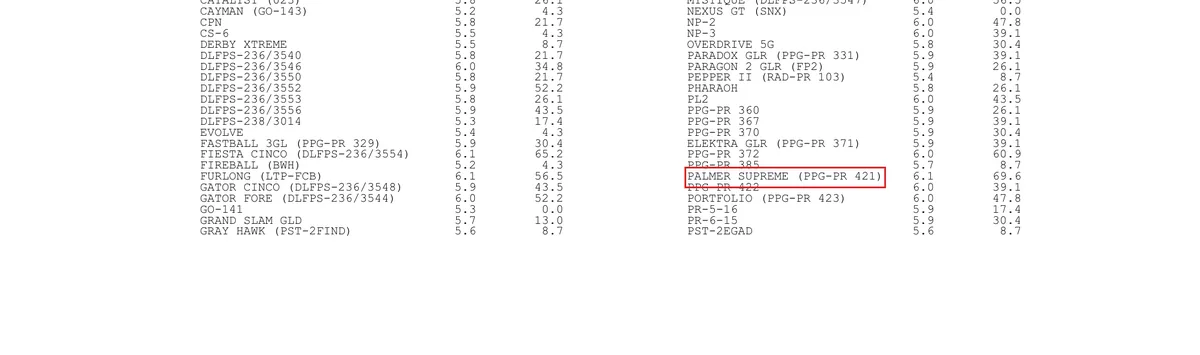
Regional scores reshuffle the order. Alloy, Furlong, Mystique, Palmer Supreme and Stellar 4GL led the 2 Northeast sites at 6.6 (NTEP Table 14), Elektra GLR, Fiesta Cinco, Helios and Palmer Supreme led the 5 transition-zone sites at 6.1 (Table 15), and Sunburst led the Amherst, Massachusetts traffic trial at 6.4 (Table 20). Pick from the column for your region, not the national mean.
A newer trial is running. The 2022 National Perennial Ryegrass Test has 83 entries, Linn again among them, and its 2025 progress report covers 17 locations (NTEP report 26-5; entries list). As of October 2026 it has no final report, so the 2016 test remains the latest complete multi-year data.
Which ryegrass cultivars resist gray leaf spot?
At Adelphia, New Jersey, the trial’s gray leaf spot site, ratings ran from 1.0 for Linn to 9.0 for Karma, with 26 entries at 8.0 or better and 17 at 3.0 or worse (NTEP Table 37). The least significant difference is 1.5 points, so a 9.0 and an 8.0 are not proven different, but a 7.7 and a 2.7 are.
| Group or entry | Gray leaf spot rating (1 to 9, 9 = no disease) | Source |
|---|---|---|
| 13 entries with GL in the name (mean) | 7.3 | NTEP Table 37; our arithmetic |
| 101 other entries (mean) | 5.8 | NTEP Table 37; our arithmetic |
| Slugger 3GL, Revenge 2GLX (best GL-named) | 8.7 | NTEP Table 37 |
| Grand Slam GLD (weakest GL-named) | 4.7 | NTEP Table 37 |
| Karma (best entry; one-third of Hancock’s Champion GQ blend) | 9.0 | NTEP; Hancock |
| Linn (standard) | 1.0 | NTEP Table 37 |
The GL suffix helps but does not guarantee. Named GL entries averaged 7.3 against 5.8 for the rest, yet Grand Slam GLD scored 4.7 and ASP0118GL 5.0. Purdue’s 2008 bulletin said no perennial ryegrass “can be considered resistant” (Purdue BP-107); NC State’s 2019 page says resistant cultivars are becoming available and points readers to NTEP data (NC State).
How winter-hardy is perennial ryegrass?
Winter survival is the second filter in the North. NTEP rated winter kill at Urbana, Illinois and St. Paul, Minnesota, where Fiesta Cinco led at 8.0 and Linn and Sunburst trailed at 3.2 (NTEP Table 42). The least significant difference is 4.0 points, so most entries cannot be separated statistically; only the extremes are meaningful.
Penn State adds that the species withstands low temperatures but “tends to be susceptible to ice damage” (Penn State), and the NRCS Plant Guide says it does not withstand hot, dry weather or severe winters (USDA NRCS). Where winters are harsh, a Kentucky bluegrass mix with about 15 percent ryegrass by weight (UK AGR-52) carries less risk than a ryegrass monostand.
Does perennial ryegrass come back every year?
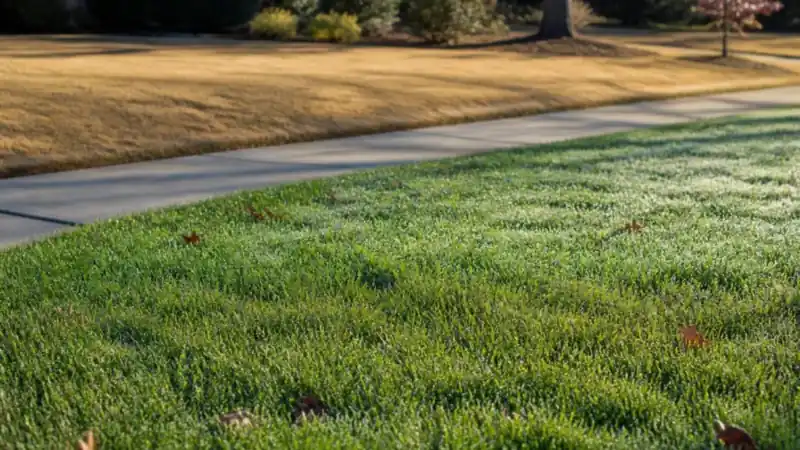
In cool, mild climates, yes. In the South it usually acts like an annual: in Arizona’s low desert, overseeded ryegrass should die out by mid-June (University of Arizona). NC State says it usually will not survive late-spring heat, though in the transition zone it can last through cool or wet summers and turn clumpy (NC State Extension).
| Where | What perennial ryegrass usually does | Source |
|---|---|---|
| Pacific Northwest, west of the Cascades | Permanent lawn grass; performs with 1 to 3 irrigations a week in most summers | Oregon State |
| Kentucky and the transition zone | Not recommended as a primary lawn grass: disease, clumping, poor persistence in warm summers | UK AGR-52 |
| North Carolina | Stand-alone lawn only in the mountains; never seeded alone in the rest of the state | NC State |
| Low-elevation Arizona desert | Overseeded into bermudagrass in October; bermudagrass resumes after 7 nights above 60°F | Arizona AZ1683 |
| Arizona above 4,500 ft | 20 percent of a mix with 60 percent Kentucky bluegrass; persists for years | University of Arizona |
| Florida | Temporary winter cover; must be reseeded each fall | UF/IFAS ENH14 |
How do you overseed a warm-season lawn with ryegrass for winter?
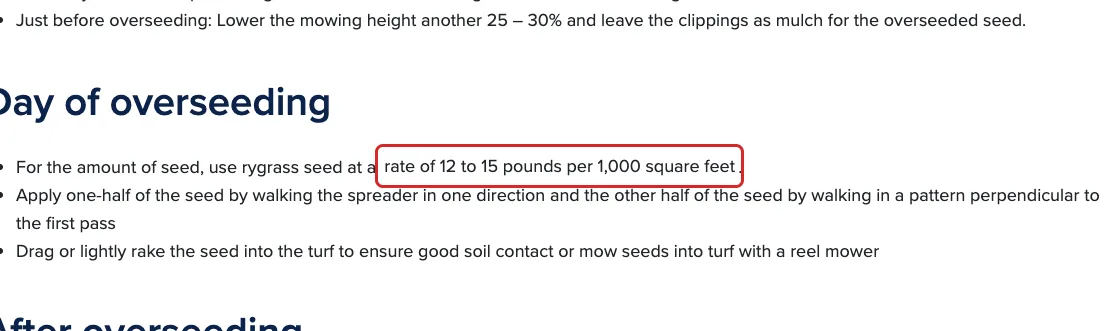
Sow perennial ryegrass into dormant or slowing bermudagrass at 5 to 10 lb per 1,000 sq ft when soil at 4 inches approaches 75°F and nights stay in the 50s, or 2 to 4 weeks before the first killing frost (UGA). Water lightly several times a day until seedlings emerge, then plan the spring transition before you seed.
Pro fields use the same pairing: the Super Bowl LX field at Levi’s Stadium was Bermuda overseeded with ryegrass, and Baltimore’s M&T Bank Stadium plays on a Bermuda and ryegrass mix, as our list of which NFL stadiums have real grass shows.
| Extension source | Perennial ryegrass rate (lb per 1,000 sq ft) | When to seed | Source date |
|---|---|---|---|
| UGA (Georgia) | 5 to 10 in lawns; 8 to 12 for athletic fields and golf | 4-in soil near 75°F, nights in the 50s, or 2 to 4 weeks before first killing frost | Nov. 2021 |
| LSU AgCenter (Louisiana) | 5 to 10; 8 called a sweet spot | Fall | Oct. 2025 |
| Virginia Cooperative Extension | 5 to 10 for lawns | Fall | 2021 |
| Mississippi State | 8 to 10 (annual ryegrass: add 2 lb) | Soil near 70°F, about mid-October | Oct. 2010 |
| University of Arizona (low desert) | 12 to 15 | October: days 80 to 85°F, nights about 55°F | Oct. 2015 |
| Texas A&M (sports fields) | 10 to 20 for wear tolerance | Soil dropping below 72°F, or 4 to 6 weeks before first frost | 2026 page |
| UF/IFAS ENH14 (archival) | 10 to 20; add 25 to 50% over thatch | North Florida October to early November; central Florida to early December | Rev. 2010 |
UGA explains the trade-off behind the spread: 10 lb gives a quick stand for fall use, while 5 lb gives a thin stand that fills in by spring (UGA). Our overseeding guide covers thickening cool-season lawns, a different job with half-rate seeding, and our bermudagrass guide covers the permanent lawn underneath.
Step by step: overseeding bermudagrass with perennial ryegrass
The sequence below combines the Arizona, Georgia, Florida and Mississippi publications. Each step carries the source’s number, because the sources differ on scalping and rates. Arizona says St. Augustinegrass and zoysiagrass are generally not suited (Arizona AZ1683) and Virginia overseeds only bermudagrass; Florida’s archival guide also covers St. Augustinegrass with a 3-inch mowing floor.
- 30 days before seeding, stop nitrogen on the bermudagrass; 14 days before, raise the mowing height 30 to 40 percent and cut irrigation 30 percent (Arizona AZ1683).
- Just before seeding, lower the mowing height 25 to 30 percent (Arizona), but do not scalp to the ground: Arizona and LSU both warn against it (LSU AgCenter). On St. Augustinegrass, Florida’s floor is 3 inches (UF/IFAS ENH14).
- Spread half the seed in one direction and half at right angles with a broadcast spreader, at the rate for your state from the table, then drag or broom the seed down to the soil (UF/IFAS).
- Water 3 to 4 times a day for the first 7 to 10 days, until seedlings emerge (Arizona); UGA caps the daily total at about 0.5 inch (UGA).
- Start mowing when the ryegrass reaches 2.75 to 3 inches, with a rotary mower set at 2.25 to 2.75 inches and sharp blades (Arizona).
- Fertilize after emergence, about 3 weeks after seeding, at up to 1 lb of nitrogen per 1,000 sq ft per month (UGA); Florida allows a second 1 lb application about 60 days after the first (UF/IFAS).
- In spring, stop fertilizing the ryegrass after February in South Florida or March in North Florida, water as little as the bermudagrass allows and keep mowing low (UF/IFAS ENH14).
Why is the spring transition the hard part?
Perennial ryegrass is bred to persist, so in a cool, wet spring it shades and outcompetes bermudagrass, which Texas A&M says starts growing once night soil temperatures stay above 50°F (Texas A&M). Mississippi State warns that overseeding a strong permanent lawn will delay spring green-up and can thin it (Mississippi State), and LSU advises against overseeding every year for the same reason (LSU AgCenter).
| Source | Spring trigger | What to do | Link |
|---|---|---|---|
| University of Arizona | Nights above 60°F for 7 straight nights (usually April to May) | Lower mowing height 35%; 0.25 lb N per 1,000 sq ft weekly; at 80% bermudagrass, verticut lightly | AZ1683 |
| UGA | Soil and night temperatures approach 65°F | Lower the mowing height as soil warms; soluble nitrogen once warm enough | UGA |
| Texas A&M | Night soil temperatures consistently above 50°F | Lower mowing height, cut irrigation, raise nitrogen; annual ryegrass: 1 to 1.5 lb N at green-up | Texas A&M |
| UF/IFAS (archival) | Spring | No fertilizer after February (South Florida) or March (North Florida); water sparingly; mow the ryegrass close weekly | ENH14 |
Chemical removal is the last resort. Texas A&M lists five sulfonylurea herbicides (flazasulfuron, metsulfuron, trifloxysulfuron, foramsulfuron and rimsulfuron) used on sports fields to remove ryegrass, each governed by its label (Texas A&M).
This page is general information, not pesticide advice. If you use an herbicide to remove overseeded ryegrass, the product label is the law: confirm the turf species, rate and timing on the label and your state’s applicator rules before applying.
How much perennial ryegrass belongs in a lawn seed mix?
Most extension services cap perennial ryegrass at 10 to 20 percent of a Kentucky bluegrass mix by weight, because its seedlings outgrow the slower bluegrass. University of Kentucky recommends about 15 percent and warns that 25 percent or more produces a stand dominated by ryegrass (UK AGR-52). Penn State caps it at 20 percent (Penn State).
| Source | Ryegrass share with Kentucky bluegrass | Mix seeding rate (lb per 1,000 sq ft) | Other rule |
|---|---|---|---|
| Purdue and Illinois AY-25-W | 10 to 15% | 3 to 4 | “Limit perennial ryegrass wherever possible”; avoid mixes with Linn or annual ryegrass |
| University of Kentucky AGR-52 | About 15% (about 1/4 lb with 1 3/4 lb bluegrass) | About 2 | 25% or more ends ryegrass-dominated; do not mix with tall or fine fescue |
| Penn State Lawn Establishment | 10 to 20% | 2 to 3 | Ryegrass alone: 4 to 5 lb |
| University of Arizona, high elevation | 20% (plus 20% fine fescue, 60% bluegrass) | Not given | Above 4,500 ft |
| NC State, Carolina Lawns | 40% (1 lb ryegrass with 1.5 lb bluegrass) | 2.5 | Mountain region mix |
Tall fescue mixes are the other question. Kentucky says tall fescue should not be mixed with perennial ryegrass because of texture and growth differences (UK AGR-52), and Penn State calls the two incompatible in appearance (Penn State). Our tall fescue guide covers fescue-only seeding.
How do you plant and care for a perennial ryegrass lawn?
Seed a new perennial ryegrass lawn at 4 to 6 lb per 1,000 sq ft in early fall (UT W160-B), expect sprouts in 3 to 7 days, mow at 1.5 to 2.5 inches with a sharp blade, and feed about 3 lb of nitrogen per 1,000 sq ft per season in a climate like Pennsylvania’s (Penn State).
| Task | Number | Source |
|---|---|---|
| New-lawn seeding rate | 4 to 6 lb per 1,000 sq ft (3 to 5 lb in Virginia) | UT W160-B; VCE |
| Germination | 3 to 7 days (UT); 5 to 7 days (Penn State, UK) | UT; UK |
| Mowing height | 1.5 to 2.5 in for lawns; 1 to 2 in where it is at its best (Oregon) | Penn State; Oregon State |
| Nitrogen | About 3.0 lb per 1,000 sq ft per season (PA); 2.5 to 3.5 lb in a bluegrass mix (NC mountains) | Penn State; NC State |
| Water | 1 to 3 irrigations a week in most Pacific Northwest summers | Oregon State |
| Shade | Partial shade at best; never rely on it for permanent shade turf | UC IPM; Oregon State |
| Thatch | Least thatch of the common cool-season lawn grasses | Oregon State |
| Endophyte level for insect resistance | 40 percent infection or higher | Purdue E-61 |
Sharp blades matter more than with most lawns. Penn State notes that some cultivars shred and leave a gray cast when cut with dull mowers (Penn State), and Kentucky rates the grass somewhat difficult to mow (UK AGR-52). Our guide to sharpening a lawn mower blade covers the fix. Seedbed steps are in how to plant grass seed, and day-by-day sprouting is in our germination time guide.
That matters most in late spring, when Purdue reports perennial ryegrass seedheads in full production; the timing, trigger and mowing response are covered in why grass goes to seed in spring.
What do endophytes in ryegrass seed do?
Many turf-type perennial ryegrass cultivars carry fungal endophytes that live inside the plant and deter leaf-feeding insects. Penn State lists 5: sod webworms, billbugs, fall armyworms, chinch bugs and greenbugs (Penn State). NTEP’s endophyte fact sheet says the protection does not extend to root feeders such as white grubs (NTEP endophyte information).
Endophytes help most against fall armyworms in late summer, when cool-season lawns regrow slowly, and our guide on getting rid of armyworms lists the per-square-foot threshold and the EPA labels for a lawn already under attack.
Purdue recommends endophyte infection of 40 percent or higher for insect resistance and warns that viability falls when seed is stored long or warm (Purdue E-61). The same fungi can sicken grazing animals: the NRCS Plant Guide links the ryegrass endophyte to ryegrass staggers in livestock (USDA NRCS), and Purdue says endophyte-enhanced turf should not be planted where livestock welfare is a concern. As a precaution, do not feed ryegrass lawn clippings to horses or cattle.
What are the downsides of perennial ryegrass?
The main downsides are summer disease, poor heat tolerance, no self-repair and clumping. University of Kentucky does not recommend it as a primary lawn grass because of disease, clumpiness and poor persistence in warm summers (UK AGR-52), and gray leaf spot can kill a stand in days when nights stay warm and leaves stay wet.
| Problem | Trigger or threshold | What extension sources advise | Source |
|---|---|---|---|
| Gray leaf spot | 70 to 95°F with at least 14 hours of continuous leaf wetness; most cases late July to September | Plant cultivars with high NTEP gray leaf spot ratings; no nitrogen in late spring or summer; collect clippings while active | NC State |
| Seedling susceptibility | Stands less than 1 year old | Avoid late-afternoon or early-evening irrigation; repair ruined stands with Kentucky bluegrass sod or seed | Purdue BP-107 |
| Summer decline | Late spring and summer heat in the South and transition zone | Use it in mixes, or as winter cover only | NC State; VCE |
| Clumping | Ryegrass outgrowing bluegrass in a mix; survivors in bermudagrass | Keep ryegrass under 25% of a bluegrass mix | UK AGR-52; Illinois Extension |
| No spreading | Bunch-type: no rhizomes or stolons | Reseed bare spots in fall | Penn State |
| Ragged mowing | Dull blades | Sharpen before the season and midseason | Penn State |
| Poa annua invasion | Linn plots carried 60% annual bluegrass in 2021 against a 10.6% trial mean | Choose current turf-type cultivars, not Linn | NTEP Table 43 |
How much does perennial ryegrass seed cost?
As of Oct. 29, 2026, turf-type perennial ryegrass listed at $2.50 to $3.80 a pound in 50 lb bags and $5.00 to $6.00 a pound in 5 and 10 lb bags at two online sellers, against $0.80 a pound for annual ryegrass. Bag size moves the price more than brand: the same Hancock seed costs 2.4 times as much per pound in a 5 lb bag.
| Product | Kind | Bag | Price | Per lb | Source |
|---|---|---|---|---|---|
| Hancock’s Perennial Ryegrass | Perennial (cultivar not named) | 5 lb | $29.99 | $6.00 | Hancock Seed |
| Hancock’s Perennial Ryegrass | Perennial | 10 lb | $49.99 | $5.00 | Hancock Seed |
| Hancock’s Perennial Ryegrass | Perennial | 25 lb | $99.99 | $4.00 | Hancock Seed |
| Hancock’s Perennial Ryegrass | Perennial | 50 lb | $124.99 | $2.50 | Hancock Seed |
| Champion GQ (Zoom, Monsieur, Karma) | Perennial blend, endophyte-enhanced | 50 lb | $129.99 | $2.60 | Hancock Seed |
| LESCO Double Eagle | Perennial blend | 10 lb | $49.99 | $5.00 | Lawn Synergy |
| LESCO Double Eagle | Perennial blend | 50 lb | $189.99 | $3.80 | Lawn Synergy |
| Hancock’s Perennial Forage Ryegrass | Perennial, forage type | 50 lb | $132.99 | $2.66 | Hancock Seed |
| Hancock’s Ryegrass Seed | Annual ryegrass | 50 lb | $39.99 | $0.80 | Hancock Seed |
Worked example: overseeding 5,000 sq ft of bermudagrass
Seed cost equals lawn area in thousands of square feet, times the rate, times the price per pound. For 5,000 sq ft at UGA’s 5 to 10 lb rate (UGA), that is 25 to 50 lb of perennial ryegrass: $62.50 to $125.00 at $2.50 a pound, or exactly one $124.99 bag at the top rate.
| Scenario (5,000 sq ft) | Rate (lb per 1,000 sq ft) | Seed needed | Price per lb | Seed cost | Rate source |
|---|---|---|---|---|---|
| Perennial ryegrass, light stand | 5 | 25 lb | $2.50 | $62.50 | UGA |
| Perennial ryegrass, full stand | 10 | 50 lb | $2.50 | $125.00 | UGA |
| Perennial ryegrass, Mississippi | 8 to 10 | 40 to 50 lb | $2.50 | $100.00 to $125.00 | MSU |
| Perennial ryegrass, Arizona desert | 12 to 15 | 60 to 75 lb | $2.50 | $150.00 to $187.50 | Arizona |
| Annual ryegrass, Mississippi (+2 lb) | 10 to 12 | 50 to 60 lb | $0.80 | $40.00 to $48.00 | MSU |
| Perennial ryegrass, premium blend | 10 | 50 lb | $3.80 | $190.00 | UGA |
- Seed at 5 lb per 1,000 sq ft (lb)
- 25.0
- Seed at 10 lb per 1,000 sq ft (lb)
- 50.0
- 50 lb bags at 10 lb per 1,000 sq ft
- 1
Low = low rate x $2.50 per lb (perennial, 50 lb bag) or $0.80 (annual); high = high rate x $3.80 per lb (premium perennial blend, 50 lb bag). Prices posted Oct. 29, 2026, before tax and shipping. Small bags cost up to $6.00 per lb.
Where do ryegrass guides disagree with primary sources?
Seller guides and older extension pages disagree on overseeding temperature, germination speed and disease resistance. The table sets 6 common claims beside the primary source we checked, with the date of both, so readers can see which number is newer and which comes from a trial rather than a product page.
| What a guide says | What the primary source says | Source |
|---|---|---|
| Overseed Southern lawns when nights drop near 65 to 70°F (Pennington) | Nights consistently in the 50s (UGA); nights about 55°F (Arizona) | UGA; Arizona AZ1683 |
| No perennial ryegrass cultivar can be considered resistant to gray leaf spot (Purdue, 2008) | 26 of 114 NTEP entries rated 8.0 or better on a 9-point scale at the New Jersey site, 2017 to 2021 | NTEP Table 37 |
| Ryegrass usually germinates in about 2 weeks when watered (Illinois Extension, 2011) | 3 to 7 days (UT); 5 to 7 days (Penn State); 3 to 4 days when overseeded (Texas A&M) | UT W160-B; Texas A&M |
| Winter rye and ryegrass are the same lawn seed | Rye (Secale cereale) and ryegrass (Lolium) are separate federal seed kinds | 7 CFR 201.2(h) |
| Any bag labeled perennial ryegrass names its cultivar | Ryegrass is not on the federal list of kinds that must show a variety or “Variety Not Stated” | 7 CFR 201.10(a) |
| Perennial ryegrass is heat tolerant (Penn State species page) | Little heat tolerance (UK); moderately low (UC IPM); usually dies in Southern summers (NC State) | UK; UC IPM; NC State |
Is perennial ryegrass the right grass for your lawn?
Perennial ryegrass fits three jobs: a permanent lawn where summers stay mild, a 10 to 20 percent share of a Kentucky bluegrass mix, and winter color on bermudagrass. It is a poor fit for shade, hot humid summers without fungicide support, or warm-season lawns other than bermudagrass. The table and flow apply the extension thresholds.
| If your situation is | Do this | Why (source) |
|---|---|---|
| Mild summers (Pacific Northwest, high elevation West) | Plant a turf-type perennial ryegrass or a ryegrass-heavy blend at 4 to 6 lb per 1,000 sq ft | Main permanent lawn grass west of the Cascades (Oregon State) |
| Cool-season lawn in the Midwest or Northeast | Use a Kentucky bluegrass mix with 10 to 20% perennial ryegrass | 25%+ turns ryegrass-dominated (UK AGR-52) |
| Hot, humid summers; transition zone | Choose tall fescue instead, or only cultivars rated 8.0+ for gray leaf spot | Disease and poor persistence (UK; NTEP) |
| Dormant bermudagrass, want winter color | Overseed 5 to 10 lb per 1,000 sq ft (12 to 15 in the low desert) | UGA; Arizona |
| Winter color, but an easy spring transition matters more | Use annual ryegrass at 10 to 12 lb | Dies out on its own (Texas A&M; MSU) |
| St. Augustinegrass, zoysiagrass or centipedegrass lawn | Do not overseed | Generally not suited (Arizona; VCE) |
| Shade under trees | Use a shade-tolerant mix instead of ryegrass | Never rely on ryegrass for permanent shade turf (Oregon State) |
| Horses or cattle graze the area | Avoid endophyte-enhanced turf seed | Ryegrass staggers (USDA NRCS; Purdue E-61) |
1Is your permanent lawn St. Augustinegrass, zoysiagrass or centipedegrass?
YesDo not overseed it with ryegrass (Arizona AZ1683; Virginia Cooperative Extension).
NoGo to the next question
2Is it dormant bermudagrass and you want a green winter lawn?
YesOverseed 5 to 10 lb per 1,000 sq ft (12 to 15 in the low desert); use annual ryegrass at 10 to 12 lb if an easy spring transition matters more (UGA; MSU; Arizona).
NoGo to the next question
3Does the area get heavy shade?
YesSkip ryegrass; it should never be relied on for permanent shade turf (Oregon State).
NoGo to the next question
4Do summers bring hot, humid nights (transition zone or South)?
YesPlant tall fescue, or limit ryegrass to cultivars rated 8.0+ for gray leaf spot in NTEP data.
NoGo to the next question
5Are summers mild, as west of the Cascades?
YesPlant a turf-type perennial ryegrass or blend at 4 to 6 lb per 1,000 sq ft (Oregon State; UT W160-B).
NoSeed a Kentucky bluegrass mix with about 15 percent perennial ryegrass by weight, and keep ryegrass under 25 percent (UK AGR-52).
Source: Arizona AZ1683; UGA; Mississippi State; Oregon State; UK AGR-52; NTEP
How we compiled this
We parsed 16 rating tables for all 114 entries in NTEP’s 2016 National Perennial Ryegrass Test final report (2017 to 2021 data) and joined them to NTEP’s entries list for sponsor and 2024 commercial status. We read 3 sections of federal seed regulations, 25 extension publications from 17 states, 2 USDA plant records and 6 seed-seller pages, with prices recorded on Oct. 29, 2026. We did not grow or test any grass.
| Question | Short answer | Source |
|---|---|---|
| Best-scoring cultivars | Palmer Supreme, Fiesta Cinco, Furlong, Stellar 4GL (6.1); 55 entries statistically tied | NTEP |
| New-lawn seed rate | 4 to 6 lb per 1,000 sq ft | UT W160-B |
| Winter overseeding rate | 5 to 10 lb (GA, LA, VA); 12 to 15 lb (AZ) | UGA; Arizona |
| Mowing height | 1.5 to 2.5 in | Penn State |
| Share of a bluegrass mix | About 15%; under 25% | UK AGR-52 |
| Seed price, 50 lb bag | $2.50 to $3.80 per lb (Oct. 29, 2026) | Hancock; Lawn Synergy |
Frequently asked questions
Is perennial ryegrass good for lawns?
Yes, where summers are mild or as 10 to 20 percent of a Kentucky bluegrass mix. Oregon State calls it the dominant lawn grass west of the Cascades. In hot, humid areas University of Kentucky does not recommend it as the primary grass (UK AGR-52).
Why avoid ryegrass?
Avoid it as a stand-alone lawn where summers are hot and humid. Gray leaf spot can thin a stand within days at 70 to 95°F with 14 hours of leaf wetness (NC State), and annual ryegrass in a permanent mix leaves coarse, light green clumps (Purdue PPDL).
Does perennial ryegrass die in the summer?
In the South and much of the transition zone, usually yes. NC State says it rarely survives late-spring heat, though cool or wet summers let clumps persist (NC State). In Arizona’s low desert, bermudagrass takes over after 7 nights above 60°F (Arizona AZ1683).
Can I just throw rye grass seed down?
Seed on thatch or tall grass mostly fails. UF/IFAS rakes out debris, mows lower and brooms the seed down to soil after spreading (UF/IFAS ENH14), then waters lightly; Arizona waters 3 to 4 times a day for the first 7 to 10 days (Arizona AZ1683).
Which is better, rye grass or fescue?
For a permanent transition-zone lawn, tall fescue usually is; University of Kentucky does not recommend ryegrass as a primary lawn grass (UK AGR-52). Ryegrass germinates faster, in 3 to 7 days, and UC IPM rates its wear tolerance highest of the cool-season grasses (UC IPM). Do not mix the two.
When should you put out winter rye grass?
When soil at 4 inches approaches 75°F and nights stay in the 50s, or 2 to 4 weeks before the first killing frost (UGA). That is about mid-October in much of Mississippi (Mississippi State) and October in Arizona’s low desert (Arizona).
What does rye grass look like when it sprouts?
Thin, bright green threads 3 to 7 days after seeding (UT W160-B), ahead of tall fescue (6 to 12 days) and Kentucky bluegrass (14 to 21). Leaves are folded in the bud and glossy underneath (Penn State); annual ryegrass seedlings have rolled leaves.
Sources
- National Turfgrass Evaluation Program (NTEP), 2016 National Perennial Ryegrass Test, 2017 to 2021 data, Final Report NTEP No. 22-12, Final report, 2017 to 2021 ratings. Accessed October 2026.
- NTEP, 2016 National Perennial Ryegrass Test, Appendix: Summary of Turfgrass Quality Ratings, 2017 to 2021, 2017 to 2021 ratings. Accessed October 2026.
- NTEP, 2016 National Perennial Ryegrass Test, Entries and Sponsors (commercial availability in 2024), Entries list. Accessed October 2026.
- NTEP, 2016 National Perennial Ryegrass Test final report, printable PDF (Appendix table, page 144), Final report. Accessed October 2026.
- NTEP, 2022 National Perennial Ryegrass Test, 2025 Data, Progress Report NTEP No. 26-5, 2025 data. Accessed October 2026.
- NTEP, 2022 National Perennial Ryegrass Test, Entries and Sponsors, Entries list, 2026. Accessed October 2026.
- NTEP, Endophyte information page, Undated page. Accessed October 2026.
- NTEP, Endophyte information (fact sheet, PDF), Undated. Accessed October 2026.
- USDA PLANTS Database, Lolium perenne L., perennial ryegrass, symbol LOPE, Current profile. Accessed October 2026.
- USDA NRCS, Plant Guide: Perennial Ryegrass, Lolium perenne, Edited 2008. Accessed October 2026.
- U.S. Code of Federal Regulations (eCFR), 7 CFR 201.2(h), Agricultural seeds (kind names), Current as of October 2026. Accessed October 2026.
- U.S. Code of Federal Regulations (eCFR), 7 CFR 201.58a(a), Ryegrass fluorescence test, Current as of October 2026. Accessed October 2026.
- U.S. Code of Federal Regulations (eCFR), 7 CFR 201.10, Variety labeling, Current as of October 2026. Accessed October 2026.
- University of Tennessee Extension, W160-B, Turfgrass Establishment: Seeding, October 2007. Accessed October 2026.
- Rutgers Cooperative Extension, FS584, Perennial Ryegrass for Lawns, February 2004. Accessed October 2026.
- Penn State Extension, The Cool-Season Turfgrasses: Identification, Updated Sept. 11, 2025. Accessed October 2026.
- Penn State Extension, Turfgrass Species for Pennsylvania, Updated Nov. 10, 2016. Accessed October 2026.
- Penn State Extension, Lawn Establishment, Table 1, Updated Sept. 19, 2025. Accessed October 2026.
- NC State Extension, Perennial Ryegrass (weed and turf identification), Aug. 22, 2022. Accessed October 2026.
- NC State Extension, Carolina Lawns, July 2, 2021. Accessed October 2026.
- NC State Extension, Gray Leaf Spot in Turf, Rev. Dec. 16, 2019. Accessed October 2026.
- Oregon State University, Beaver Turf, Perennial Ryegrass (Lolium perenne L.), Published Oct. 23, 2009. Accessed October 2026.
- UC Statewide IPM Program, UC Guide to Healthy Lawns: Perennial ryegrass, 2017. Accessed October 2026.
- University of Kentucky Cooperative Extension, AGR-52, Selecting the Right Grass for Your Kentucky Lawn, Issued Aug. 2019. Accessed October 2026.
- Kansas State University Research and Extension (J. Hoyle), MF2031, Turfgrass Identification, Professional Series, July 2017. Accessed October 2026.
- Purdue University and University of Illinois, AY-25-W, Purchasing Quality Grass Seed for Your Lawn, Rev. May 2006. Accessed October 2026.
- Purdue Extension, BP-107-W, Gray Leaf Spot on Perennial Ryegrass, April 2008. Accessed October 2026.
- Purdue Extension Entomology, E-61, Endophyte-Enhanced Turfgrasses, August 2016. Accessed October 2026.
- Purdue Plant and Pest Diagnostic Lab (G. Hardebeck), Annual Ryegrass is appearing in many new lawns this spring, May 29, 2023. Accessed October 2026.
- University of Illinois Extension, Home, Yard and Garden newsletter, Ryegrass in lawns, June 6, 2011. Accessed October 2026.
- University of Arizona Cooperative Extension (D. Kopec, K. Umeda), AZ1683, Overseeding Winter Grasses into Bermudagrass Turf, October 2015. Accessed October 2026.
- University of Arizona Turfgrass (D. Kopec), Ryegrass for Turf: More to Choose From, Turf Tips Vol. V, Issue 8, August 1998. Accessed October 2026.
- UGA Cooperative Extension, Colquitt County (C. Waltz), Managing Overseeded Grasses in Georgia, Nov. 4, 2021. Accessed October 2026.
- Mississippi State University Extension (W. Wells), Overseeding Southern Lawns, Turf Tips newsletter, Oct. 4, 2010. Accessed October 2026.
- LSU AgCenter, Here’s how you can enjoy a lush, green lawn this fall and winter, Oct. 6, 2025. Accessed October 2026.
- Virginia Cooperative Extension, Master Gardener Handbook, Chapter 11: Turfgrass, 2021 revision. Accessed October 2026.
- UF/IFAS Extension (L. Trenholm, J. B. Unruh), ENH14, Overseeding Florida Lawns for Winter Color (archival copy), Rev. Dec. 2010. Accessed October 2026.
- Texas A&M AgriLife Extension, The Need to Overseed, Page updated March 26, 2026. Accessed October 2026.
- Hancock Seed, Hancock’s Perennial Ryegrass Seed (product price page), Prices checked Oct. 29, 2026. Accessed October 2026.
- Hancock Seed, Champion GQ Perennial Ryegrass Seed (product price page), Prices checked Oct. 29, 2026. Accessed October 2026.
- Hancock Seed, Hancock’s Perennial Forage Ryegrass Seed (product price page), Prices checked Oct. 29, 2026. Accessed October 2026.
- Hancock Seed, Hancock’s Ryegrass Seed, annual ryegrass (product price page), Prices checked Oct. 29, 2026. Accessed October 2026.
- Lawn Synergy, LESCO Double Eagle Perennial Ryegrass Blend (product price page), Prices checked Oct. 29, 2026. Accessed October 2026.
- Fedco Seeds, Winter Rye, Organic (Secale cereale), item 8109, Prices checked Oct. 29, 2026. Accessed October 2026.
- Pennington Seed, All You Need to Know About Perennial Ryegrass, Page as of October 2026. Accessed October 2026.