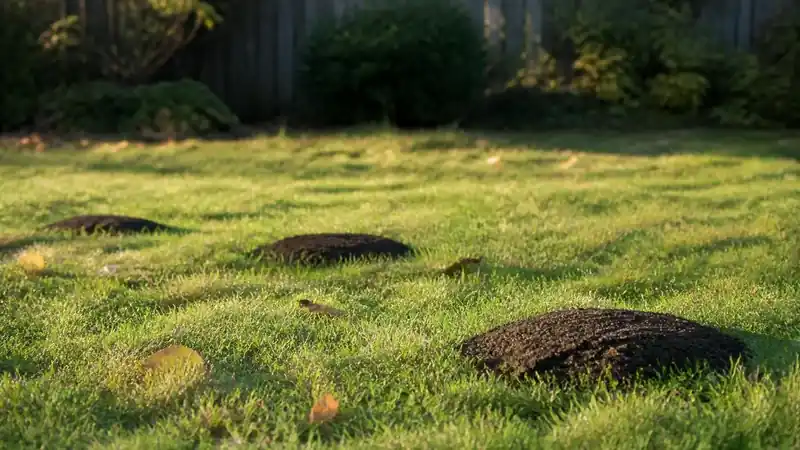
How to get rid of crane fly larvae: cut a 1-foot-square sod flap where wet turf is thinning, count the gray leatherjackets, and treat only above about 25 per square foot, preferably in fall or early winter, not April.
How to get rid of crane fly larvae is a timing problem more than a product problem. The larvae of the European crane fly (Tipula paludosa) and the marsh or common crane fly (T. oleracea), called leatherjackets, hatch in fall and eat grass roots and crowns all winter. Oregon State University Extension EM 9296 says thinning starts in February, wet low spots can be bare by April and May, and spring insecticide “will not prevent damage, because by then the majority of turfgrass destruction will have already occurred.”
Two things the top search results leave out change the plan. Field trials by Cornell entomologists in 2005 and 2006 found most insecticides 89 to 100 percent effective on young larvae in October 2005 but often under 60 percent on grown larvae in May. And as of November 2026, Washington allows neonicotinoids on lawns only as a licensed application (RCW 15.58.485), while New York bans imidacloprid on turf from Dec. 31, 2026 (ECL 33-1301(13)). The month plan below is split by region.
This page summarizes extension research, EPA labels and state law; it is not a product endorsement. The label is the law: follow the current label of the product you buy, and check whether your state requires a pesticide applicator license for lawn care before anyone treats a yard for pay.
Are they leatherjackets, grubs or caterpillars?
Dig at the edge of a thin patch, not in the bare middle, where UC IPM says the larvae have already left. Leatherjackets are gray to gray-brown, legless and tube-shaped, with no clear head and short finger-like points at the rear end; OSU puts full size at 1 to 1.5 inches by December. Cornell IPM says most live in the top 1.18 inches (3 cm) of soil and come up at night to chew crowns and blades.
| What you find | Legs and head | Damage pattern and season | Source |
|---|---|---|---|
| Leatherjacket (European or marsh crane fly larva) | No legs, no distinct head, tough gray skin, 1 to 1.5 in | Thinning from February, scalped or bare wet spots April and May; birds, skunks and raccoons digging | OSU EM 9296; Cornell IPM |
| White grub | C-shaped, dirty white body, brown head, 6 legs | Turf peels back like carpet; late summer to fall and again in spring | Penn State |
| Black cutworm | Caterpillar with legs | Small sunken spots; Cornell and Ohio State say leatherjacket feeding is often mistaken for it | Cornell IPM; Ohio State BYGL |
| Sod webworm | Spotted caterpillar with legs in a silk tunnel | Brown spots of chewed blades in July and August | sod webworm guide |
| Native crane fly larva | Looks the same as the invasive species | No turf damage; eats decaying thatch and organic matter | Ohio State BYGL |
Spongy turf that rolls up with the roots gone points to white grubs in the lawn instead. A leatherjacket in hand does not prove the invasive species: Ohio State says native crane fly larvae look alike and do no harm, and asks for male adults (blunt abdomen tip, no ovipositor) at its diagnostic clinic to confirm the species.
Which crane fly is in your region?
Only 2 of the crane flies in North America damage lawns, and Cornell counts more than 250 native species in New York alone. The 2 invasive ones differ by generation: T. paludosa has 1 a year and flies in late summer, T. oleracea has 2 and also flies in April and May. Spring swarms over a lawn therefore point to the marsh crane fly, which changes the treatment window.
| Region | Species and first records | Adults fly | Damage shows | Window extension names | Source |
|---|---|---|---|---|---|
| Pacific Northwest west of the Cascades (BC, WA, OR) | T. paludosa since 1965 in BC; T. oleracea found later | First 2 weeks of September (OSU); July to mid-October (PNW Handbook) | Thinning from February; loss in wet spots April and May | Scout November to January, treat in winter before damage | OSU EM 9296; PNW Handbook |
| East of the Cascades | Outbreaks in Spokane, WA and Bend, OR | Late summer | Spring | Same as west side | OSU EM 9296 |
| Northern California coast | Damaging levels in Humboldt and Del Norte counties only | Late summer and fall | March and April | Monitor in March | UC IPM |
| New York and Northeast | Both species, first found as turf pests in 2004 | Late July to early September; T. oleracea also late April to early May | Early to mid-May | Preventive September to October; curative in May; late fall if T. oleracea is present | Cornell IPM |
| Great Lakes (Ontario, Michigan, Ohio) | T. paludosa in Ontario in the late 1990s; T. oleracea trapped in Farmington Hills, MI in May 2005; swarms in northern Ohio | Spring and fall | Spring | Use the Northeast windows; confirm species first | Gelhaus 2005; Ohio State BYGL |
| Southeast | Not named as a damage region | Varies | Rare | Control rarely required in North Carolina | NC State |
Adults are not the target and are not mosquito hunters. OSU says the “mosquito hawk” and “skeeter eater” nicknames are wrong because the adults do not eat mosquitoes; the PNW Handbook says they only drink water and live 2 to 14 days, and Ohio State adds they cannot bite. Spraying adults on siding in September does nothing for the lawn; the eggs they lay hatch about 11 to 15 days later, and that hatch sets the fall treatment window.
Month by month: what the larvae are doing and what to do
The calendar below sets the Pacific Northwest cycle from OSU EM 9296 next to the New York cycle from Cornell IPM. Read across your month: the stage column tells you whether a count, an insecticide or a repair job fits, and why a product applied in the wrong month misses.
| Month | Pacific Northwest: stage | Pacific Northwest: action | New York and Great Lakes: stage | New York and Great Lakes: action |
|---|---|---|---|---|
| January | Larvae near full size, feeding under wet turf | Count; treat above threshold before damage shows | Third-instar (paludosa) and fourth-instar (oleracea) larvae overwinter | Nothing; soil frozen |
| February | Thinning begins | WSU: sample February or March, treat above 25 to 30 per sq ft | Overwintering | Nothing |
| March | Feeding speeds up | Last useful count; UC IPM samples in March | T. oleracea pupates | NE IPM: sample in March |
| April | Total loss in wet low spots begins | OSU: spring sprays will not prevent damage | T. oleracea adults emerge, lay second generation | Spring flights mean T. oleracea is present |
| May | Worst damage (April and May) | Mark bare areas for fall reseeding | Largest larvae, damage early to mid-May | Curative window; Cornell trial sprays May 12 and May 30 |
| June | Feeding over; UC IPM puts the nonfeeding pupal stage from about mid-May | Water 0.25 in 4 times a week from Memorial Day | Larvae stop feeding by mid-June, move deeper | Water and feed to regrow roots |
| July | Larvae rest in soil, then pupate | Keep summer irrigation | Adults begin late July | Note where adults rise from turf |
| August | Adults may begin emerging | Plan the fall count area | Adults and egg laying | Plan preventive treatment |
| September | Adults first 2 weeks; eggs mid-September | Cut irrigation around Labor Day; Acelepryn label window opens | Egg laying | Preventive window September to October |
| October | Eggs hatch early October | GrubEx fall window Oct. to Dec.; nematodes while soil is above 54°F | Young larvae; second oleracea flight late Sept. to early Oct. | Cornell trial sprays Oct. 6 to 16 |
| November | Small larvae (about 3/8 in) | Scout November to January; WSU treats above 25 to 30; Acelepryn label: higher rate in November | Young larvae | Late fall treatment hits both species |
| December | Larvae reach 1 to 1.5 in | Last month of the GrubEx label window (Oct. to Dec.) | Overwintering | Nothing |
How do you count leatherjackets, and how many are too many?
Count in November through January in the Northwest or in March in the Northeast, and sample 3 or 4 spots, since the Northeastern IPM Center notes heavy numbers in one place and none 15 feet away. Pick low, wet spots and areas damaged last year: OSU says adults return to the same wet ground each September.
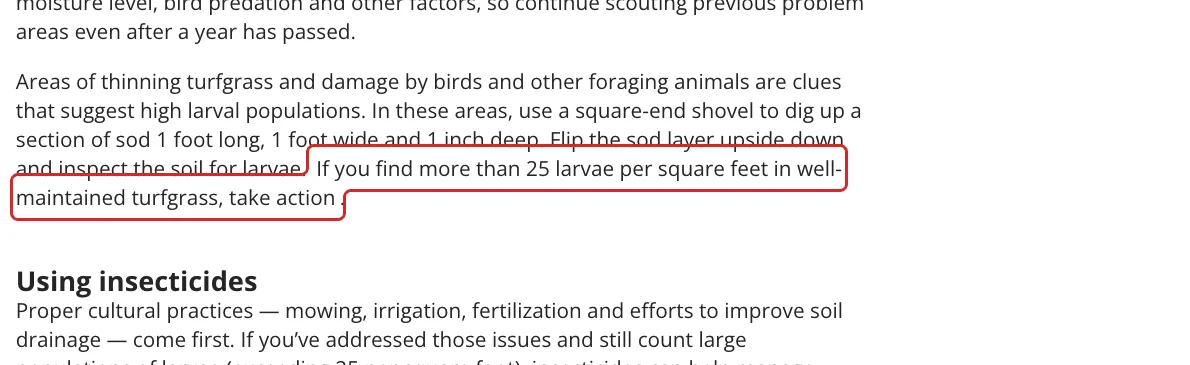
- Cut a square of sod 1 ft by 1 ft and 1 inch deep with a square-end spade and flip it over (OSU), or cut 6 by 6 inches, 1 to 2 inches deep (UC IPM).
- Pull apart the thatch and the top 2 inches of soil and count every gray, legless larva.
- Convert to larvae per square foot: a 6 by 6 inch square times 4, a 4-inch cup-cutter core times 11.5 (UC IPM).
- Average the spots and compare with the threshold for your turf below.
- Lay the sod back, press it down and water it in.
| Source and date | Region | Sample | Act when larvae per sq ft exceed |
|---|---|---|---|
| OSU EM 9296 (2020, reviewed 2024) | Oregon | 1 by 1 ft sod flap, 1 in deep | 25 in well-maintained turf |
| PNW Insect Management Handbook | Pacific Northwest | Shovel, top 2 in | 25 in well-maintained turf |
| WSU Hortsense | Washington | Spring, or mid-November to December | 25 to 30; well-established lawns rarely need treatment even above |
| UC IPM (cites Washington) | California | 4-in cup cutter or 6 by 6 in | Healthy turf withstood 40; unthrifty turf damaged at 15; Washington uses 25 to 50 |
| Northeastern IPM Center (2020) | Northeast | 6 by 6 in in March | 40 on healthy turf, 15 on stressed turf |
| Cornell NYS IPM fact sheet (2006) | New York | Cup cutter | 15 to 50 by turf health |
| Peck et al., GCM (2009) | New York | 4-in cores | 15 to 25 as a general threshold |
The calculator converts your count. The default, 7 larvae in a 6 by 6 inch square, works out to 28 per square foot: over OSU’s 25 for a well-kept lawn, under the 40 that UC IPM saw healthy turf withstand. A thin, wet, underfed lawn at that count is a treatment case; a dense lawn fed on OSU’s schedule may not be.
- Larvae per sq ft (OSU and PNW Handbook act above 25)
- 28.0
- Larvae per square meter
- 301
Default: 7 larvae in a 6 by 6 inch square = 28 per sq ft: over OSU's 25 for well-kept turf, under the 40 UC IPM saw healthy turf withstand. Average 3 or 4 samples before deciding.
| Larvae counted | Sample | Larvae per sq ft | Against OSU’s 25 |
|---|---|---|---|
| 3 | 1 by 1 ft sod flap | 3 | Well below |
| 7 | 6 by 6 in square | 28 | Just over |
| 3 | 4-in cup cutter | 34.5 | Over |
| 12 | 6 by 6 in square | 48 | Over even UC IPM’s 40 |
1Are the larvae you found legged caterpillars or C-shaped grubs with brown heads?
YesNot crane flies: use the sod webworm, armyworm or white grub counts instead (Penn State; Cornell IPM).
NoGo to the next question
2Is it April or May and the patch already bare?
YesToo late to save that turf (OSU EM 9296). Mark it, water and feed from Memorial Day, and reseed in late summer.
NoGo to the next question
3Is your average count under 25 larvae per sq ft on a well-kept lawn?
YesNo treatment. Cut irrigation around Labor Day and recount next November or March (OSU; PNW Handbook).
NoGo to the next question
4Is it September to December?
YesFall window: a chlorantraniliprole or bifenthrin product whose label lists crane fly larvae, or Steinernema carpocapsae nematodes while soil is above 54 F (Acelepryn and GrubEx labels; Peck 2009; Oestergaard 2006).
NoGo to the next question
5Is it January to March?
YesTreat once with a labeled product before damage shows; do not treat again in fall the same year (OSU; WSU).
NoRecount in 2 to 4 weeks; if numbers stay above threshold, plan a fall application for next season.
Fall or spring: when does treating crane fly larvae work?
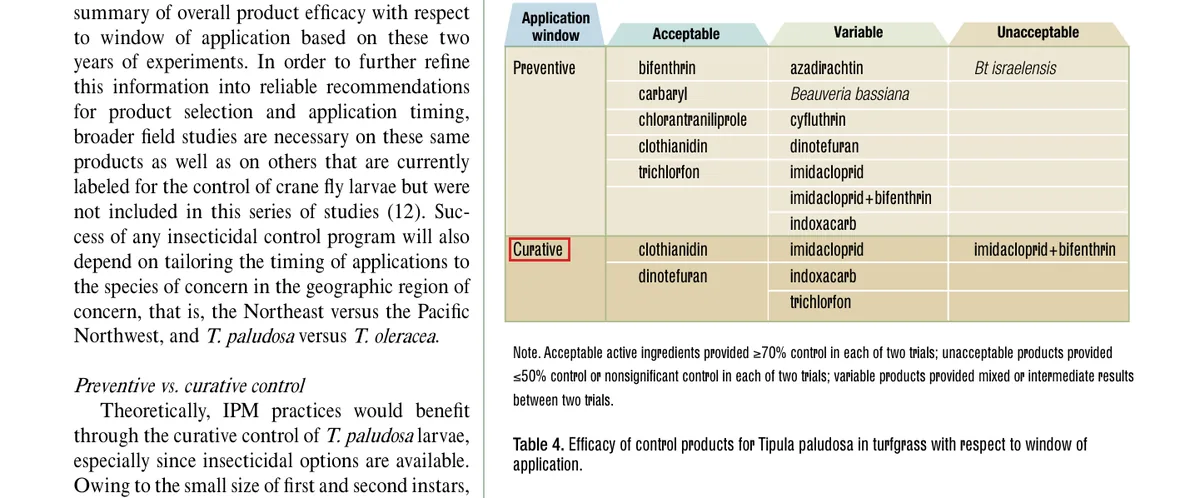
Fall, on the published field data. Peck, Olmstead and Morales treated golf course roughs in Niagara County, New York, with 22 formulations of 14 active ingredients in October (first and second instars) and in May (third and fourth instars), then counted larvae in 4-inch cores. Untreated plots held 10.2 to 34.8 larvae per square foot.
| Active ingredient | Fall, young larvae: % reduction | Spring, grown larvae: % reduction | Authors’ rating (Table 4) |
|---|---|---|---|
| Bifenthrin | 94.4 (2005); 94.9 (2006) | 16.7, not significant (2006) | Acceptable fall only |
| Carbaryl | 97.2 (2005); 70.1 (2006) | 39.1 (2006) | Acceptable fall only |
| Chlorantraniliprole | 100 at 3.6 oz ai/acre (2005); 80.4 (2006) | 56.8 at 4.0 oz ai/acre (2005) | Acceptable fall only |
| Clothianidin | 100 at 5.4 oz ai/acre (2005); 100 at 4.9 (2006) | 97.1 (2005); 70.9 to 78.6 (2006) | Acceptable both |
| Dinotefuran | 100 (2005); 62.5, not significant (2006) | 98.8 (2005); 83.7 (2006) | Variable fall, acceptable spring |
| Imidacloprid | 88.9 at 4.0 oz ai/acre (2005); 57.3, not significant (2006) | 59.6 (2005); 63.7 (2006) | Variable both |
| Indoxacarb | 100 (2005); 44.0 to 63.6, not significant (2006) | 94.1 (2005); 48.8 (2006) | Variable both |
| Trichlorfon | 91.7 (2005); 77.8 (2006) | 69.1 (2005); 61.6 (2006) | Acceptable fall, variable spring |
| Azadirachtin | 94.4 (2005); 39.6, not significant (2006) | 20.9, not significant (2005) | Variable fall |
| Beauveria bassiana | 83.3 (2005); 63.6, not significant (2006) | 29.2, not significant (2005) | Variable fall |
The fall rows reverse the spring advice on brand pages. Scotts’ crane fly page, ranking near the top for this search, says to treat “usually in early to mid-April” with Ortho BugClear Insect Killer for Lawns & Landscapes (bifenthrin plus zeta-cypermethrin, EPA Reg. No. 239-2718), and the Hi-Yield Lawn Insect Granules II label (EPA Reg. No. 7401-454) says to apply in early April. In the Cornell trial spring bifenthrin, at a quarter of the fall rate, gave 16.7 percent, not significantly different from no treatment; the same company’s Liquid GrubEx label (538-349) calls for “a dedicated fall application” against European crane fly.
Only 2 ingredients passed 70 percent in both spring trials, clothianidin and dinotefuran, and both are neonicotinoids: since 2026 homeowners may not apply them to Washington lawns, and New York has banned both on turf since Dec. 31, 2024. If you missed fall, WSU still treats a February or March count over 25 to 30, and says not to treat in both seasons in one year. Cornell adds that where T. oleracea is present, a late fall application hits both species and both generations.
Which products list crane fly larvae on the label?
We searched the EPA Pesticide Product Label System in November 2026 and opened 20 lawn and turf labels; 14 name crane fly or European crane fly larvae, and the 12 used on lawns are below. Timing words come straight from each label. Granules need water right after spreading: 1/2 inch on 7401-454, about 1 inch on GrubEx 538-306.
| Product (label name) | EPA Reg. No. | Active ingredient | Crane fly wording and timing on label | Lawn rate | Label PDF date |
|---|---|---|---|---|---|
| Ortho BugClear Lawn Insect Killer Granules | 239-2765 | Bifenthrin 0.2% | Lists “European crane fly larvae”; apply early or at first sign, water in at once | 0.6 to 1.2 lb per 1,000 sq ft | Mar. 24, 2025 |
| Ortho BugClear Insect Killer for Lawns & Landscapes | 239-2718 | Bifenthrin 0.3% + zeta-cypermethrin 0.075% | Pest table lists “European Crane (larvae)” | Per label | May 6, 2024 |
| GardenTech Sevin Insect Killer Lawn Granules II (F6130 G) | 101563-303 | Bifenthrin 0.115% + zeta-cypermethrin 0.029% (no carbaryl) | “Crane Flies (larvae)”; water thoroughly right after | 2 to 4 lb per 1,000 sq ft | Nov. 3, 2026 |
| Hi-Yield Lawn Insect Granules II | 7401-454 | Deltamethrin 0.1% | “Apply in early April when insects are young”; water in 1/2 in | 2 to 3 lb per 1,000 sq ft | Apr. 15, 2026 |
| Chemsico Insecticide Concentrate 8G | 9688-277 | Gamma-cyhalothrin 0.08% | Lists European crane flies | 1.5 fl oz (3 Tbsp) per gallon per 120 sq ft | June 29, 2016 |
| Scotts GrubEx (GrubEx III) | 538-306 | Chlorantraniliprole 0.08% | “Apply Fall [Oct to Dec] to control Crane fly larvae”; 1 application a year | 2.87 lb per 1,000 sq ft, water in about 1 in | Jan. 11, 2012 |
| Scotts Liquid GrubEx | 538-349 | Chlorantraniliprole 0.27% | “For European Crane Fly: Make a dedicated fall application”; not on waterlogged turf | Per label | Mar. 24, 2026 |
| BioAdvanced Season Long Grub Control Ready-to-Spray | 92564-20 | Imidacloprid 1.47% | “Apply early before … European crane fly larvae hatch”; neonicotinoid, see state rules | Treats 5,000 sq ft per bottle | Mar. 12, 2019 |
| Acelepryn (professional) | 100-1489 | Chlorantraniliprole 18.4% | “Apply between September and November”; higher rate in November | 8 to 16 fl oz per acre (0.18 to 0.37 fl oz per 1,000 sq ft) | Jan. 11, 2024 |
| Arena 50 WDG (professional) | 59639-152 | Clothianidin 50% | “In the spring, when larvae are mature but prior to pupation or in the fall prior to egg hatch”; neonicotinoid | Per label | July 23, 2021 |
| Provaunt (professional) | 100-1487 | Indoxacarb 30% | Lists European crane fly larvae | 6 to 12 oz product per acre | Aug. 21, 2020 |
| Merit 0.5 G (professional) | 101563-63 | Imidacloprid 0.5% | “Make application prior to egg hatch”; neonicotinoid | 1.2 to 1.8 lb per 1,000 sq ft | Oct. 25, 2016 |
The “Sevin” name has moved. GardenTech’s crane fly page, also near the top of this search, sells Sevin granules, but the current Lawn Granules II label (101563-303, accepted Nov. 3, 2026) lists bifenthrin and zeta-cypermethrin, not the carbaryl tested by Cornell. Compare active ingredients, not brand names, against the trial table.
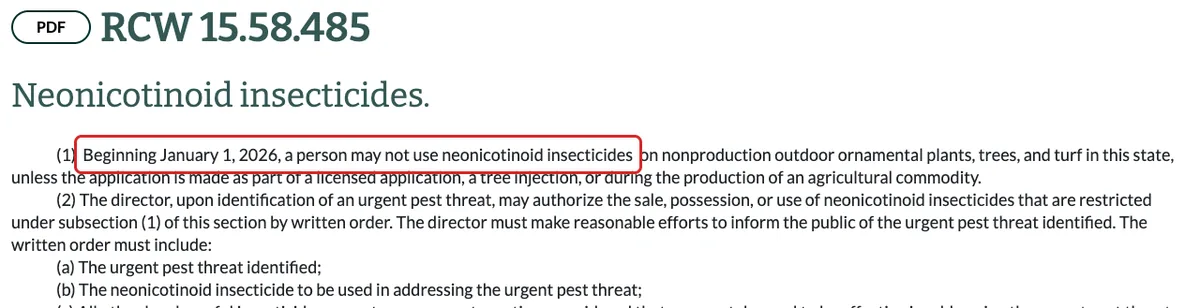
State limits on neonicotinoids in 2026
| State | Rule | Applies from | What it means for crane fly products | Source |
|---|---|---|---|---|
| Washington | No neonicotinoid use on nonproduction outdoor ornamentals, trees or turf unless a licensed application, tree injection or agricultural production | Jan. 1, 2026 | Homeowners may not apply imidacloprid (92564-20) or clothianidin to a lawn; a licensed applicator may | RCW 15.58.485 |
| New York | Unlawful to treat outdoor ornamental plants and turf with clothianidin or dinotefuran | Dec. 31, 2024 | Arena and Safari-type products are off lawns, licensed or not, unless DEC issues an emergency order | ECL 33-1301(13)(a)(2) |
| New York | Same ban for imidacloprid, thiamethoxam and acetamiprid | Dec. 31, 2026 | Imidacloprid lawn products (92564-20, Merit) end on turf after this date | ECL 33-1301(13)(a)(1) |
How to get rid of crane fly larvae without insecticide
Cultural steps come first in every extension source here, and in the Northwest they cost nothing. Eggs and young larvae need wet soil: the PNW Handbook says shutting turf irrigation off shortly after Labor Day in Oregon’s Willamette Valley often creates enough drought stress to cut populations without hurting the grass.
- Stop or cut irrigation around Labor Day, when adults look for wet soil to lay eggs (OSU). Our guide on when to stop watering the lawn has the fall cutoff by city.
- Fix standing water: OSU names French drains and drain tile with a catch basin or dry well. See how to build a French drain for trench depth and slope.
- Cut thatch, which UC IPM calls ideal habitat because larvae feed just below it; dethatching a lawn covers the timing.
- Leave the birds: WSU says starlings, robins and predatory insects often push numbers below damaging levels by spring, and UC IPM reports up to 50 percent winter losses from predators and other causes.
- Apply nematodes to young larvae in fall. In field trials Steinernema carpocapsae gave over 80 percent control of early instars in October at 0.5 million per square meter (about 46 million per 1,000 sq ft), while S. feltiae stayed under 50 percent and S. carpocapsae may be limited in soil below 54°F (Oestergaard et al., Biological Control 39, 2006). UC IPM rates spring S. feltiae drenches at up to 50 percent.
Spring biological options rate poorly in the same studies: the Oestergaard team got 0 to 32 percent from Bacillus thuringiensis israelensis on third and fourth instars, and the Cornell trial got 20.9 percent from azadirachtin in May. Skunk and raccoon digging in March is a sign of larvae, not a separate problem; tunnels and runways point to voles or moles instead.
Will the lawn grow back after crane fly damage?
Usually, if crowns survived. WSU says grass usually recovers once larvae stop feeding, though weeds can move into weak areas. OSU prescribes 0.25 inch of water 4 times a week (1 inch total) from Memorial Day to Labor Day, mowing weekly at 2 to 3 inches, and 1 lb of nitrogen per 1,000 sq ft in late May, late June, late September and late October.
That schedule is written for perennial ryegrass lawns west of the Cascades and Kentucky bluegrass east of them. Bare spots that stay brown into June need seed; reseed in late summer to early fall using our steps to overseed a lawn. The PNW Handbook warns that the Labor Day seeding window is also egg-laying time, so new seed on a site with past infestations may need a preventive application at seeding.
How we compiled this
We read 16 extension, research and statute documents (Oregon State, PNW Handbook, WSU, UC IPM, Cornell IPM’s current and 2006 fact sheets, the Cornell field trials published in 2009, Northeastern IPM Center, 2 Ohio State BYGL articles, NC State, Penn State, Gelhaus 2005, Oestergaard 2006, Washington RCW 15.58.485 and New York ECL 33-1301) and 20 EPA label PDFs in November 2026; 14 labels list crane fly larvae. We did not test products or count larvae ourselves. Thresholds are shown as each source published them; per-square-foot conversions use UC IPM’s multipliers.
Frequently asked questions
What kills crane fly larvae?
Labeled insecticides with bifenthrin, chlorantraniliprole, deltamethrin, gamma-cyhalothrin, indoxacarb or, where state law allows, imidacloprid and clothianidin. In Cornell’s trials most worked on young larvae in October; in May only clothianidin and dinotefuran passed 70 percent in both years. Steinernema carpocapsae nematodes reached over 80 percent on young larvae in fall.
Why are there so many crane flies in my yard?
Wet soil the previous fall and spring. Ohio State says egg and larval survival depends on soil moisture, so irrigated turf produces more crane flies, and swarms mean last year’s larvae survived. Most crane flies are native and harmless; only European and marsh crane fly larvae damage lawns.
Should I let crane flies live?
Yes. The adults live 2 to 14 days and only drink water (PNW Handbook), cannot bite (Ohio State) and do not eat mosquitoes (OSU). Spraying them does not protect the lawn; count larvae in winter or early spring instead.
What time of year do you treat leatherjackets?
Fall to early winter. Acelepryn’s label says September to November and Scotts GrubEx says October to December. OSU says winter applications before damage work best in the Northwest; Cornell names September to October preventive and May curative windows in New York.
How do I know if I have leatherjackets in my lawn?
Look for thinning, wet patches from February to May and birds or skunks digging, then cut a 1 by 1 ft sod flap and count gray, legless larvae about 1 to 1.5 inches long. Over 25 per square foot in a well-kept lawn is OSU’s action level.
Sources
- Oregon State University Extension (Kowalewski, Edmunds, McDonald, Braithwaite), Managing crane fly in lawns, EM 9296, Sept. 2020, reviewed 2024. Accessed November 2026.
- Pacific Northwest Pest Management Handbooks, Turfgrass: Crane fly, Current page. Accessed November 2026.
- Washington State University Hortsense, Lawn and Turf: European Crane Fly, Current page. Accessed November 2026.
- UC Statewide IPM Program, Crane Flies, Turfgrass Pest Management Guidelines, Current page. Accessed November 2026.
- Cornell IPM, European Crane Flies Tipula paludosa and Tipula oleracea, Ornamental IPM Fact Sheet, Current page. Accessed November 2026.
- Cornell NYS IPM (Peck), European crane fly (also known as leatherjackets), turfgrass fact sheet, 2006. Accessed November 2026.
- Peck, Olmstead and Morales, Golf Course Management, Insecticidal control of invasive crane flies in the northeastern U.S., March 2009. Accessed November 2026.
- Northeastern IPM Center and NYS IPM, European Crane Fly, Tipula oleracea and Tipula paludosa, Reviewed Feb. 2020. Accessed November 2026.
- Ohio State University BYGL, They’re Not Giant, Mutant Mosquitoes: They’re Crane Flies, Oct. 6, 2023. Accessed November 2026.
- Ohio State University BYGL, Spring Crane Flies: They’re Not Mutant Mosquitoes!, Apr. 29, 2026. Accessed November 2026.
- NC State Extension, Crane Fly Larvae in Turf, Current page. Accessed November 2026.
- Gelhaus, The Great Lakes Entomologist 38, The Crane-Fly Tipula (Tipula) oleracea Reported From Michigan, April 2005. Accessed November 2026.
- Oestergaard et al., Biological Control 39:525 to 531, Biological control of Tipula paludosa using entomopathogenic nematodes and Bacillus thuringiensis subsp. israelensis, Dec. 2006. Accessed November 2026.
- Penn State Extension, White Grubs in Home Lawns, Current page. Accessed November 2026.
- Washington State Legislature, RCW 15.58.485, Neonicotinoid insecticides, 2024 c 338. Accessed November 2026.
- New York State Senate, Open Legislation, Environmental Conservation Law 33-1301, Unlawful acts, Current text. Accessed November 2026.
- U.S. EPA PPLS, Ortho BugClear Lawn Insect Killer Granules, EPA Reg. No. 239-2765, Mar. 24, 2025. Accessed November 2026.
- U.S. EPA PPLS, Ortho BugClear Insect Killer for Lawns and Landscapes, EPA Reg. No. 239-2718, May 6, 2024. Accessed November 2026.
- U.S. EPA PPLS, F6130 G Insecticide (GardenTech Sevin Insect Killer Lawn Granules II), EPA Reg. No. 101563-303, Nov. 3, 2026. Accessed November 2026.
- U.S. EPA PPLS, Hi-Yield Lawn Insect Granules II, EPA Reg. No. 7401-454, Apr. 15, 2026. Accessed November 2026.
- U.S. EPA PPLS, Chemsico Insecticide Concentrate 8G, EPA Reg. No. 9688-277, June 29, 2016. Accessed November 2026.
- U.S. EPA PPLS, Scotts GrubEx (GrubEx III), EPA Reg. No. 538-306, Jan. 11, 2012. Accessed November 2026.
- U.S. EPA PPLS, Scotts Liquid GrubEx, EPA Reg. No. 538-349, Mar. 24, 2026. Accessed November 2026.
- U.S. EPA PPLS, Imidacloprid Concentrate Insecticide II (BioAdvanced Season Long Grub Control), EPA Reg. No. 92564-20, Mar. 12, 2019. Accessed November 2026.
- U.S. EPA PPLS, Acelepryn, EPA Reg. No. 100-1489, Jan. 11, 2024. Accessed November 2026.
- U.S. EPA PPLS, Arena 50 WDG, EPA Reg. No. 59639-152, July 23, 2021. Accessed November 2026.
- U.S. EPA PPLS, Provaunt, EPA Reg. No. 100-1487, Aug. 21, 2020. Accessed November 2026.
- U.S. EPA PPLS, Merit 0.5 G, EPA Reg. No. 101563-63, Oct. 25, 2016. Accessed November 2026.