How to get rid of sod webworms: soak 1 square yard at the edge of a brown patch with soapy water, count the caterpillars that surface, and spray a labeled insecticide at dusk only at 15 or more per square yard.
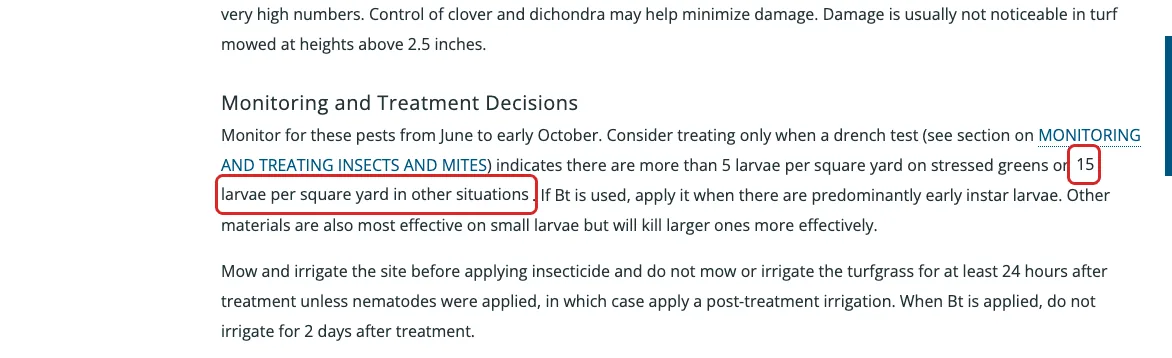
How to get rid of sod webworms starts with counting caterpillars, not moths. The tan moths that zigzag over the grass at dusk do no damage; their caterpillars chew blades off just above the crown at night and hide in silk-lined tunnels in the thatch by day (Penn State Extension). UC IPM treats only when a soap flush brings up more than 15 larvae per square yard on a lawn, and says turf mowed above 2.5 inches rarely shows damage at all.
The published thresholds disagree, and the top search results do not say so. Converted to one unit, 6 extension thresholds run from 9 larvae per square yard (UT Extension SP290-L) to 54, a 6-fold spread. Below, the temperate sod webworms of northern bluegrass and fescue lawns are split from the Gulf Coast tropical sod webworm, which runs on a different calendar, and 14 EPA labels are checked for which ones list sod webworms.
This page summarizes extension research and EPA labels; it is not a product endorsement. The label is the law: follow the current label of the product you buy, and check whether your state requires a pesticide applicator license for lawn care before anyone treats a yard for pay.
Moths flying over the lawn at dusk: is that the problem?
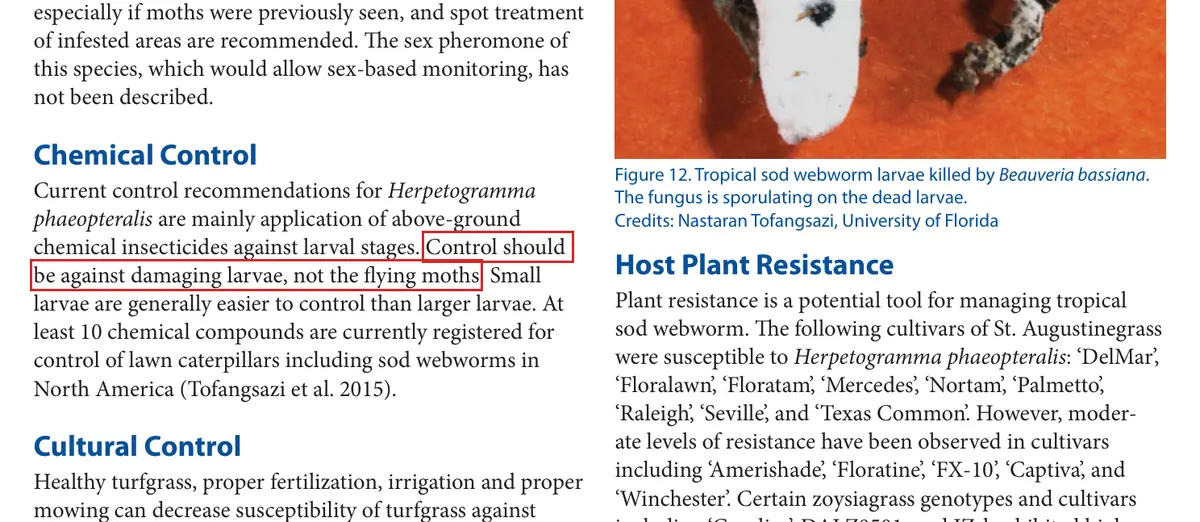
Not yet. Adult sod webworms only mate and drop eggs: Purdue E-61 says the adults do not feed on turf, and UF/IFAS EENY-541 says control “should be against damaging larvae, not the flying moths.” The moths are a calendar signal: UGA Circular 1156 says hatch follows the evening flights by 7 to 14 days, and Cornell Cooperative Extension of Suffolk County says to scout for larvae 2 weeks after you see the adults.
One label reads differently: Hi-Yield Lawn Insect Granules II (EPA Reg. No. 7401-454) allows treating the whole lawn when lawn moths “are noticed in large numbers at dusk.” Granules spread that day sit for 7 to 14 days before the first larva hatches, so mark the date and flush instead.
Is it sod webworms, armyworms, grubs or chinch bugs?
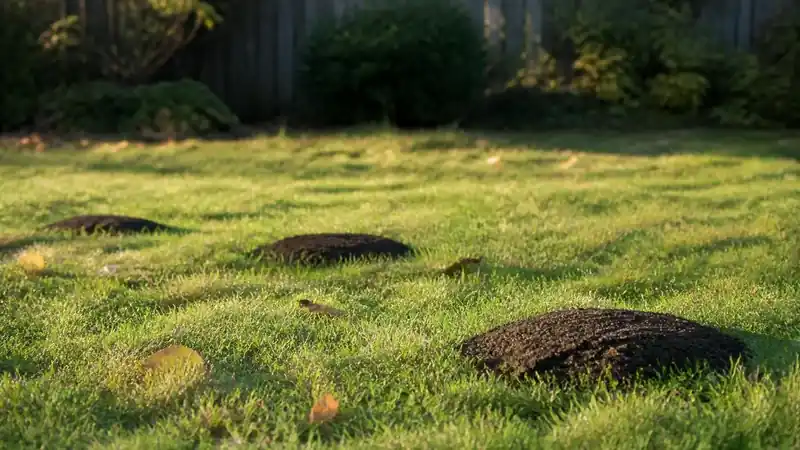
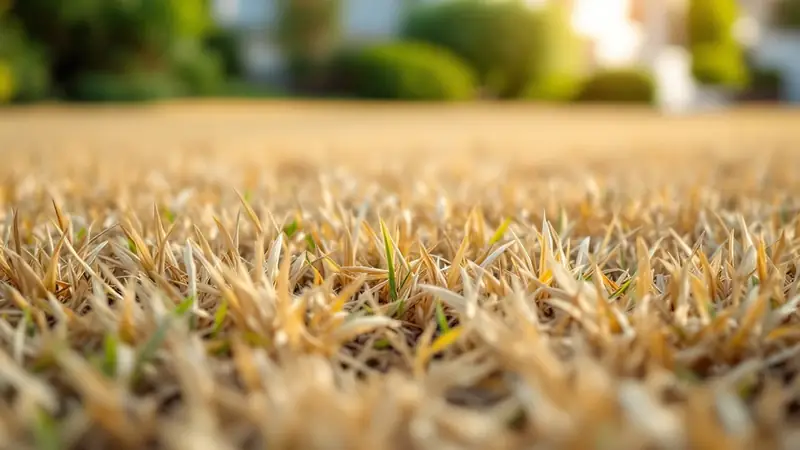
Look at the blades and the thatch at the edge of a brown spot, where green grass meets damaged grass. Sod webworm signs are notched or missing blades, moist green fecal pellets in the thatch and small silk tunnels; Penn State describes patches up to the size of a baseball, sometimes punched with pencil-size holes where birds dug for larvae. Cornell Suffolk adds a freshness test: green pellets mean the caterpillars are still there, brown pellets mean they have left.
| Pest | What you find | Damage pattern | Count that triggers action | Source |
|---|---|---|---|---|
| Sod webworms (Crambus, Parapediasia, Pediasia and others) | Cream to light brown caterpillars, 5/8 to 1 in, a double row of dark spots with bristles; C-curled in silk-lined tunnels | Baseball-size brown spots of close-cropped grass that merge; notched blades; green pellets; worst in July and August | 15 per sq yd on lawns (UC IPM); 3 to 4 per sq ft (NC State) | UC IPM; Penn State; NC State |
| Tropical sod webworm (Herpetogramma phaeopteralis) | Grayish-green caterpillars, 3/4 to 1 in, brown spots on each segment; curled below the blades by day | Clear “windows” chewed in blades first, then ragged, shorter grass and bright green droppings | No count published; UGA treats at first visible feeding damage | UF/IFAS; UGA C1156 |
| Fall armyworm | Caterpillars up to 1.5 in with a pale upside-down Y on the head | Large areas brown within days, late summer and fall | See the armyworm page | Clemson HGIC 2159 |
| White grubs | Dirty white, C-shaped grubs with a brown head and 6 legs in the root zone | Spongy turf that rolls back like carpet; skunks, crows or moles digging | See the grub page | Penn State |
| Southern chinch bug | Adults 1/5 in, black with white wings; nymphs orange with a white band; between leaf sheaths | Yellow then brown patches in sunny, dry St. Augustine; blades sucked dry, not chewed | See the chinch bug count on our St. Augustine grass guide | UF/IFAS Gardening Solutions |
A caterpillar over 1 inch with a Y on its head calls for our plan for getting rid of armyworms. Turf that peels up with the roots gone points to the white grub guide. A spot that yellowed first and has a dark green ring is a dog spot (Penn State); see fixing dog urine spots.
Temperate or tropical sod webworm: which one is in your lawn?
Your grass and your state answer this. Temperate sod webworms are a group of snout moths whose larvae chew Kentucky bluegrass, bentgrass and fine fescue in the North and transition zone. The tropical sod webworm is one species that UF/IFAS records from Florida, Georgia, Louisiana, Texas, Mississippi, Alabama and Hawaii, and UGA says it prefers bermudagrass and St. Augustinegrass. The two peak in different months, so the calendar for one is wrong for the other.
| Trait | Temperate sod webworms | Tropical sod webworm | Source |
|---|---|---|---|
| Species | Bluegrass sod webworm (Parapediasia teterrella), silver-striped (Fissicrambus mutabilis), larger sod webworm (Pediasia trisecta), Crambus spp. | Herpetogramma phaeopteralis | Penn State; UF EENY-541 |
| Grasses hit hardest | Kentucky bluegrass, bentgrass, fine fescue; ‘Tifdwarf’ bermuda in NC | St. Augustine, bermuda, centipede, zoysia, bahia, seashore paspalum | UC IPM; NC State; UGA C1156 |
| Damage season | July and August | August to October common in Louisiana; September to November peak in Georgia | Penn State; LSU AgCenter; UGA |
| Generations a year | 2 to 3, about 6 weeks each | 3 to 4 in south Florida; 2 or more in Louisiana | UT SP290-L; UF; LSU |
| Winter | Larvae overwinter in silk tubes and feed again in spring | Adults present year round in south Florida; does not survive winter in north Florida | Penn State; UF |
| Egg to hatch | 7 to 10 days | 3 to 4 days (UF); 10 to 14 days (UGA) | NC State; UF; UGA |
| Moth at rest | Wings rolled close around the body, tube-like | Wings held flat in a triangle | UGA C1156; UF |
| Grown larva | 5/8 to 1 in, pinkish to light brown, dark spots | About 11 mm (under 1/2 in) at the last instar per UF; UF/IFAS Gardening Solutions says 3/4 to 1 in | NC State; UF; UF/IFAS GS |
On Gulf Coast St. Augustine, flush from August through November; on tall fescue or bluegrass in the North, July and August. Northern lawns get a second moth flight from late July through August (Penn State), so a lawn treated in early July can need a second count.
How do you do a soap flush, and how many sod webworms are too many?
Mix dish soap into water, pour it over a measured patch at the edge of the damage, and count the caterpillars that wriggle up. Seven extension recipes differ by up to 4 times in soap strength, but all pour it on living turf. If the soil is dry, water the spot first (Cornell Suffolk); UT Extension pours inside a 4-square-foot wooden or metal frame so the area is exact.
| Source | Soap | Water | Area soaked | Wait | Soap per gallon |
|---|---|---|---|---|---|
| UGA C1156 | 1 oz dish detergent | 1 gal | 1 sq yd | Not stated | 2 tbsp |
| NC State | 1 oz soap (or 1 tbsp pyrethrin insecticide) | 1 gal | 1 sq yd | A few minutes | 2 tbsp |
| Cornell Suffolk | 1 oz lemon dish soap | 1 gal | Margin of damage | 20 min | 2 tbsp |
| LSU AgCenter | 1 tbsp lemon soap | 1 gal | 1 sq ft wet soil, 4 sq ft dry | 5 to 10 min | 1 tbsp |
| Penn State | 2 tbsp dishwashing liquid | 2 gal | 1 sq yd | Not stated | 1 tbsp |
| UT SP290-L | 2 tsp dishwashing liquid | 1 gal | 4 sq ft in a frame | About 10 min | 0.67 tbsp |
| Purdue Turf | 1 tbsp lemon Joy | 2 gal | 1 sq meter (10.8 sq ft) | 10 to 15 min | 0.5 tbsp |
Convert the count before comparing it with a threshold. One square yard is 9 square feet, so 4 larvae on UT’s 4-square-foot frame is 9 per square yard, and NC State’s “3 or 4 per square foot” is 27 to 36 per square yard.
| Source | Published threshold | Larvae per sq yd | Larvae per sq ft | Condition |
|---|---|---|---|---|
| UT Extension SP290-L | 4 to 6 per 4 sq ft | 9 to 13.5 | 1 to 1.5 | Good growing conditions; lower if turf is stressed |
| Penn State | 10 to 15 per sq yd | 10 to 15 | 1.1 to 1.7 | Soap flush guidance for home lawns |
| UC IPM 3365-T | More than 15 per sq yd | 15 | 1.7 | Lawns; 5 per sq yd on stressed golf greens |
| SDSU Extension | 15 or more per sq yd | 15 | 1.7 | Healthy lawns; no set number for stressed lawns |
| NC State | 3 or 4 per sq ft | 27 to 36 | 3 to 4 | Lawns |
| Penn State | 4 to 6 per sq ft | 36 to 54 | 4 to 6 | Suggested economic threshold, “can be variable” |
| UGA C1156 | First visible feeding damage | None given | None given | Tropical sod webworm, warm-season turf |
| Cornell Suffolk | Never in shade | None given | None given | Shaded lawn areas |
Use the low end when the lawn is stressed. UT Extension lowers its trigger for turf short of water or fertility, SDSU says far fewer larvae do real damage in drought, and Cornell Suffolk says fine fescue and perennial ryegrass are most likely to die. On a healthy, watered lawn, 15 per square yard is the line UC IPM, SDSU and the top of Penn State’s range share.
- Larvae per sq yd (UC IPM and SDSU treat at 15; UT at 9 to 13.5)
- 9.0
- Larvae per sq ft (NC State treats at 3 to 4)
- 1.00
Default: 4 larvae on a 4 sq ft frame = 9.0 per sq yd, 1.00 per sq ft: below the 15 per sq yd UC IPM and SDSU use for healthy lawns, at the low end of UT's 9 to 13.5. Average 2 or 3 flushes before deciding.
| You counted | On this area | Per sq yd | Per sq ft | Against 15 per sq yd |
|---|---|---|---|---|
| 4 | 4 sq ft (UT frame) | 9.0 | 1.00 | Below: re-flush in 7 days |
| 3 | 1 sq ft (LSU, wet soil) | 27.0 | 3.00 | Above |
| 12 | 1 sq yd (UGA, NC State, Penn State) | 12.0 | 1.33 | Below on healthy turf; at UT’s trigger if stressed |
| 20 | 1 sq meter (Purdue) | 16.7 | 1.86 | Above |
1Are you seeing only tan moths at dusk, with no thin or brown spots yet?
YesDo not spray moths. Note the date and flush 1 sq yd 7 to 14 days later (UGA C1156; Cornell Suffolk says 2 weeks).
NoGo to the next question
2Does the flush bring up caterpillars over 1 inch with a pale upside-down Y on the head?
YesArmyworms: use the armyworm count and labels (Clemson HGIC 2159).
NoGo to the next question
3Does the turf roll back like carpet, with C-shaped white grubs in the roots?
YesWhite grubs, not webworms: see the lawn grub guide (Penn State).
NoGo to the next question
4Is the damaged area in shade?
YesCornell Suffolk says sod webworm damage in shade never warrants treatment; look for disease or another cause.
NoGo to the next question
5Did 15 or more spotted caterpillars surface per sq yd, or 9 or more on drought-stressed turf?
YesSpray a product that lists sod webworms in late afternoon; no water or mowing for 24 hours (UC IPM; UT SP290-L).
NoBelow the threshold: water deeply, hold nitrogen to 1 lb per 1,000 sq ft or less per feeding, and flush again in 7 days.
Source: UGA C1156; Cornell Suffolk; Clemson HGIC 2159; Penn State; UC IPM 3365-T; UT SP290-L; LSU AgCenter
What kills sod webworms? 13 lawn labels that list them
Most lawn insecticides sold for caterpillars name sod webworms, but not all. We read 14 EPA labels in the Pesticide Product Label System; 13 list sod webworms or “lawn moths (sod webworms),” and 5 name the tropical sod webworm. The 10% Sevin Granules label (34704-289) lists armyworms and cutworms but not sod webworms, even though UGA names carbaryl among its options, so read the pest list on the bag you buy.
Swipe the table sideways to see every column.
| Product as labeled | EPA Reg. No. | Active ingredient | Webworm listing | Lawn rate on label | Water and mowing rule | Label date |
|---|---|---|---|---|---|---|
| Ortho BugClear Lawn Insect Killer Granules | 239-2765 | Bifenthrin 0.2% | Sod and tropical sod webworms (3-month list) | 0.6 to 1.2 lb per 1,000 sq ft; 2.3 lb for 3-month residual | Water thoroughly right after | Mar. 24, 2025 |
| Ortho BugClear Insect Killer for Lawns & Landscapes | 239-2718 | Bifenthrin 0.3% + zeta-cypermethrin 0.075% | Sod webworms; sod and tropical sod in the full list | 32 fl oz bottle per 5,300 sq ft | Mow and water within 24 h before; 4 to 6 weeks between uses | May 6, 2024 |
| Roundup For Lawns Bug Destroyer (Ortho Insecticide Granule) | 239-2701 | Chlorantraniliprole 0.06% + bifenthrin 0.115% | Sod, grass and tropical sod webworm | 4 lb per 1,000 sq ft | Water in; no more than 2 applications a year | July 19, 2019 |
| Spectracide Triazicide Insect Killer for Lawns & Landscapes Concentrate | 9688-277 | Gamma-cyhalothrin 0.08% | Lawn moths (sod webworms) | 1 quart per 5,120 sq ft | No watering or mowing for 24 h | June 29, 2016 |
| Spectracide Triazicide Insect Killer for Lawns Granules | 9688-250 | Gamma-cyhalothrin 0.05% | Lawn moths (sod webworms); grass and tropical sod webworms | 0.8 lb per 1,000 sq ft | Water in | Oct. 26, 2022 |
| Hi-Yield Lawn Insect Granules II | 7401-454 | Deltamethrin 0.1% | Sod webworms; treat when lawn moths appear in large numbers at dusk or at first damage | 2 to 3 lb per 1,000 sq ft | Water in with 1/2 inch | Apr. 15, 2026 |
| Scotts Liquid GrubEx | 538-349 | Chlorantraniliprole 0.27% | Sod webworms (spring and summer list) | 12.9 fl oz per 1,000 sq ft | Irrigate right after | Mar. 24, 2026 |
| Scotts GrubEx1 granules | 538-306 | Chlorantraniliprole 0.08% | Sod webworms (spring and summer list) | 2.87 lb per 1,000 sq ft | Water in about 1 inch; 1 application a year | Jan. 11, 2012 (PPLS copy) |
| Acelepryn (professional) | 100-1489 | Chlorantraniliprole 18.4% | Turf caterpillars including sod webworms | 0.05 to 0.09 fl oz per 1,000 sq ft; high rate under heavy pressure above 1 in mowing | Delay water and mowing 24 h | Jan. 11, 2024 |
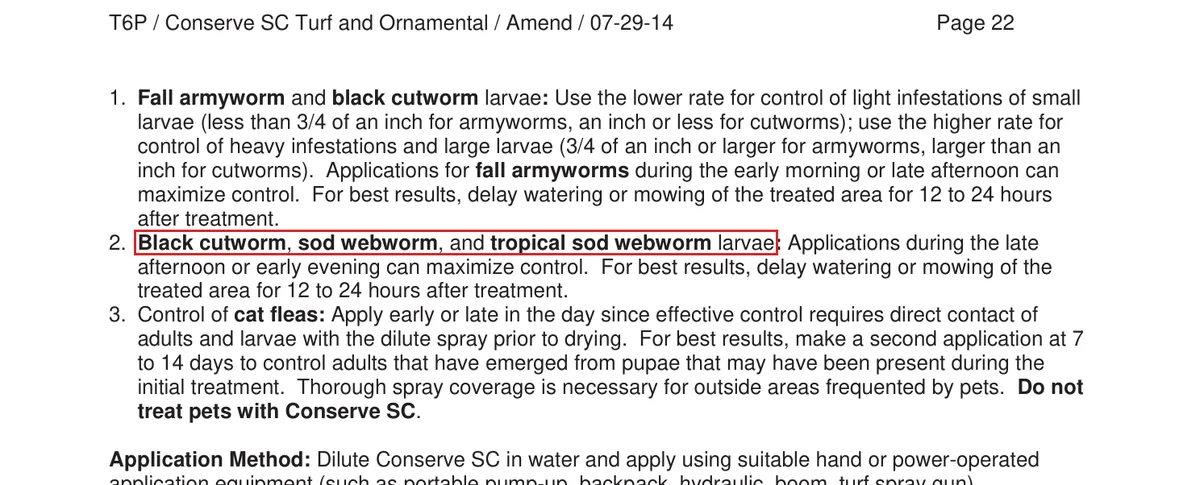
| Conserve SC Turf and Ornamental (professional) | 62719-291 | Spinosad 11.6% | Sod webworms including tropical | 0.25 fl oz per 1,000 sq ft | Late afternoon or early evening; delay water and mowing 12 to 24 h | Nov. 28, 2014 |
| Spinosad 0.5% SC (sold as Monterey Garden Insect Spray) | 62719-314 | Spinosad 0.5% | Sod webworm | Per-gallon rate on label; at least 3 gal of spray per 1,000 sq ft | Delay water and mowing 12 to 24 h | Nov. 3, 2026 |
| DiPel DF | 73049-39 | Bacillus thuringiensis subsp. kurstaki 54% | Sod webworm (Crambus spp.) | Turf: 0.5 to 2.0 lb per acre | UC IPM: no irrigation for 2 days; young larvae only | Sept. 1, 2026 |
| SuperNeem 4.5-B | 70051-9 | Azadirachtin 4.5% | Sod webworms (commercial lawns and turf) | 0.75 to 9 fl oz per 1,000 sq ft | Do not apply if rain is forecast within 24 h | Sept. 26, 2022 |
Pyrethroids (bifenthrin, gamma-cyhalothrin, deltamethrin) kill on contact; chlorantraniliprole lasts longer, and the Acelepryn label allows preventive use. UGA says every insecticide works better on first and second instars than on grown larvae. Professional bifenthrin concentrates such as Talstar GC are restricted use in Texas A&M SC-039 (2017 to 2018 edition); the products above are general use.
For lower-toxicity control, UC IPM calls Steinernema carpocapsae nematodes “a valuable control measure” and says Bt fails on late instars and breaks down in sunlight. Nematodes need moist soil and watering after application, the opposite of a spray. Cornell Suffolk says ants eat 90 percent of sod webworm eggs, one reason to skip spraying below the threshold.
How to treat sod webworms, step by step
- Confirm the count: flush 1 sq yd at the green edge of 2 or 3 damaged spots and average them (threshold table above).
- Mow the day you treat, at your normal height, and water the lawn if the soil is dry; UC IPM says to mow and irrigate before applying.
- Spray in late afternoon or early evening, when larvae come up to feed (Penn State; Conserve label). NC State suggests 6 gallons of spray mix per 1,000 sq ft unless the label sets a volume; spinosad 0.5% needs at least 3.
- Cover the damaged spots and the green turf around them: the Hi-Yield label says to treat the entire lawn evenly, and UGA prefers liquids to granules for coverage.
- Keep sprinklers and the mower off for 24 hours after a spray so the insecticide stays on the blades they eat (UC IPM; Purdue Turf). Cornell Suffolk caps any watering after that at 1/4 inch. The exceptions are granules and Liquid GrubEx, which the labels say to water in.
- Flush again before any repeat treatment. UGA repeats at 2 to 3 week intervals only while moth flights continue and new damage appears, and labels cap the number of applications (2 a year on 239-2701).
Will grass grow back after sod webworm damage?
Usually, because the larvae chew leaves and stems above the crown rather than the roots (Penn State; UC IPM Healthy Lawns). UF/IFAS Gardening Solutions says a lawn recovers on its own if it is not under other stress, and UGA says grass recovers when the infestation is not too severe. Steady watering and a light feeding help it outgrow the damage (SDSU Extension); LSU AgCenter caps any single feeding at 1 lb of nitrogen per 1,000 sq ft. Our guide on reviving dead grass covers the tug test for crowns that did not survive.
For the long run, change the grass. Penn State and Cornell Suffolk recommend overseeding with endophyte-enhanced perennial ryegrass, tall fescue or fine fescue, whose fungal partners repel sod webworms; our perennial ryegrass guide covers endophyte seed, and how to overseed a lawn covers seed rates and timing. In the South, UF/IFAS rates St. Augustine ‘Floratam’, ‘Palmetto’, ‘Raleigh’ and ‘Seville’ susceptible and ‘Captiva’, ‘Floratine’ and ‘Amerishade’ moderately resistant; zoysia ‘Cavalier’ shows high resistance. Our St. Augustine cultivar table lists the other traits.
How we compiled this
In November 2026 we read sod webworm publications from 11 extension services (listed in Sources) and 14 insecticide labels in EPA’s Pesticide Product Label System, then converted every flush recipe and threshold to per-gallon and per-square-yard units; the conversions are our arithmetic. We did not flush or treat any lawn ourselves.
Frequently asked questions
Will bifenthrin kill sod webworms?
Yes. Bifenthrin lawn products such as Ortho BugClear granules (239-2765) list sod and tropical sod webworms. Apply in the late afternoon and follow the watering rule: granules get watered in, sprays stay dry for 24 hours.
What are the white moths in my lawn?
Small whitish to tan moths that fly up in a short zigzag when you walk or mow are usually sod webworm adults, also called lawn moths. UC IPM describes them as about 3/4 inch long with a snout in front of the head. They do no damage; flush for caterpillars about 2 weeks later.
How do I get rid of sod webworms naturally?
Count first and do nothing below about 15 per square yard. Above it, Bt (DiPel DF lists sod webworm) and spinosad work on young larvae, and Steinernema carpocapsae nematodes work in moist thatch (UC IPM). A strong flush of 1 oz soap per gallon kills some caterpillars in a mild infestation (UGA).
Why do I have sod webworms?
Sunny, dry, heavily fed turf draws them. UGA and Penn State say they favor hot slopes and banks that are hard to water, UF/IFAS ties caterpillar outbreaks to excessive fertilizer, and UC IPM says thatch removal can help. See how to dethatch a lawn.
How do you get rid of webworms in trees?
Those are fall webworms, a different caterpillar that covers the outer branches of deciduous trees with webs in late summer. Purdue E-255 says to prune off small webs within reach and to use an insecticide such as Bt or Acelepryn only when there are too many webs to prune.
Sources
- UC Statewide IPM Program, Sod Webworms, Turfgrass Pest Management Guidelines, UC ANR Publication 3365-T, Text updated 09/09, treatment table 12/16. Accessed November 2026.
- UC Statewide IPM Program, Healthy Lawns: Lawn moths and sod webworms, 2017. Accessed November 2026.
- Penn State Extension, Sod Webworms in Home Lawns, Updated May 6, 2026. Accessed November 2026.
- NC State Extension, Sod Webworms in Turf, Oct. 25, 2017. Accessed November 2026.
- University of Tennessee Extension (Hale), Sod Webworms on Turfgrass, SP290-L, Undated PDF. Accessed November 2026.
- South Dakota State University Extension, Sod Webworms Causing Issues in Stressed Lawns, July 18, 2022. Accessed November 2026.
- Purdue University Turf Science, Sod webworms, Current page. Accessed November 2026.
- Purdue Extension Entomology, Integrated Management of Turfgrass Insects, E-61, Current page. Accessed November 2026.
- Purdue Extension Entomology, Fall Webworm, E-255, Current page. Accessed November 2026.
- Cornell Cooperative Extension of Suffolk County, Sod Webworms (fact sheet), Undated PDF. Accessed November 2026.
- UF/IFAS (Tofangsazi and Arthurs), Tropical Sod Webworm, EENY-541/IN968, Oct. 2012, revised Sept. 2015, reviewed Dec. 2018. Accessed November 2026.
- UF/IFAS Gardening Solutions, Tropical Sod Webworm, Current page. Accessed November 2026.
- UF/IFAS Gardening Solutions, Chinch Bugs, Current page. Accessed November 2026.
- University of Georgia Extension, Sod Webworms: Biology and Management in Turfgrass, Circular 1156, Mar. 30, 2022. Accessed November 2026.
- LSU AgCenter, Tropical Sod Webworm, Current page. Accessed November 2026.
- Clemson HGIC, Armyworms: Identification, Damage, and Control in Turfgrass, HGIC 2159, Updated July 15, 2025. Accessed November 2026.
- Penn State Extension, White Grubs in Home Lawns, Current page. Accessed November 2026.
- Texas A&M AgriLife Extension, Weed, Insect, and Disease Control in Turfgrass, SC-039, 2017 to 2018 edition. Accessed November 2026.
- U.S. EPA PPLS, Ortho BugClear Lawn Insect Killer Granules, EPA Reg. No. 239-2765, Mar. 24, 2025. Accessed November 2026.
- U.S. EPA PPLS, Ortho BugClear Insect Killer for Lawns and Landscapes, EPA Reg. No. 239-2718, May 6, 2024. Accessed November 2026.
- U.S. EPA PPLS, Ortho Insecticide Granule (Roundup For Lawns Bug Destroyer), EPA Reg. No. 239-2701, July 19, 2019. Accessed November 2026.
- U.S. EPA PPLS, Chemsico Insecticide Concentrate 8G (Spectracide Triazicide concentrate), EPA Reg. No. 9688-277, June 29, 2016. Accessed November 2026.
- U.S. EPA PPLS, Chemsico Insecticide Granules 5G (Spectracide Triazicide granules), EPA Reg. No. 9688-250, Oct. 26, 2022. Accessed November 2026.
- U.S. EPA PPLS, Hi-Yield Lawn Insect Granules II, EPA Reg. No. 7401-454, Apr. 15, 2026. Accessed November 2026.
- U.S. EPA PPLS, Scotts Liquid GrubEx, EPA Reg. No. 538-349, Mar. 24, 2026. Accessed November 2026.
- U.S. EPA PPLS, Scotts GrubEx, EPA Reg. No. 538-306, Jan. 11, 2012. Accessed November 2026.
- U.S. EPA PPLS, Acelepryn, EPA Reg. No. 100-1489, Jan. 11, 2024. Accessed November 2026.
- U.S. EPA PPLS, Conserve SC Turf and Ornamental, EPA Reg. No. 62719-291, Nov. 28, 2014. Accessed November 2026.
- U.S. EPA PPLS, Spinosad 0.5% SC (Monterey Garden Insect Spray), EPA Reg. No. 62719-314, Nov. 3, 2026. Accessed November 2026.
- U.S. EPA PPLS, DiPel DF, EPA Reg. No. 73049-39, Sept. 1, 2026. Accessed November 2026.
- U.S. EPA PPLS, SuperNeem 4.5-B, EPA Reg. No. 70051-9, Sept. 26, 2022. Accessed November 2026.
- U.S. EPA PPLS, 10% Sevin Granules, EPA Reg. No. 34704-289, Apr. 9, 2025. Accessed November 2026.