How to fix dog urine spots on lawn: within 8 hours, pour about 3 times the urine’s volume of water on the spot. If the grass is already dead, remove it with 0.5 to 1 inch of soil, then reseed or sod with matching grass.
Knowing how to fix dog urine spots on lawn grass comes down to two clocks: hours to dilute the urine, and weeks to regrow a dead spot. Every top result says to water the spot. The only published trial that timed it is a 1981 plot study in Loveland, Colorado: veterinarian A. Wayne Allard poured 150 mL of dog urine on Kentucky 31 fescue, followed it with 500 mL of tap water, and saw only a fertilizer effect when the water came at 0, 4 or 8 hours, a slight burn at 12 hours and a moderate burn at 24 hours (Allard, Canine Practice 8(2), 1981). No other top result gives those hours, and the table further down grades 18 fixes against this trial and the extension record.
Confirm it is urine first. Seal some dead grass in a plastic bag: urine releases an ammonia smell and fertilizer or salt spills do not (PNW Plant Disease Management Handbook, March 2026). Our guide to why grass turns yellow in spots, rings and stripes covers the other look-alikes, and the general seed, plug and sod steps for any bare patch are in our page on how to fix patchy grass.
This page covers lawn care, not veterinary care. Ask your veterinarian before adding salt, supplements or urine acidifiers to a dog’s food or water; Colorado State and Purdue both say the same.
What did the watering trial actually measure?
Allard ran six small studies on a mixed lawn “consisting mainly of” Kentucky 31 fescue, using urine from one dog with a specific gravity of 1.065, the strongest sample he tested. In the timing study, the 500 mL of water was about 3.3 times the urine’s volume. Purdue gives the same advice without a time limit, a watering can on the spot, and warns that it “may not completely eliminate a greening response” (Purdue AY-327).
| Treatment | Urine applied | Result on fescue |
|---|---|---|
| Water 500 mL right away | 150 mL | Fertilizer effect only (lush green, no browning) |
| Water 500 mL after 4 hours | 150 mL | Fertilizer effect only |
| Water 500 mL after 8 hours | 150 mL | Fertilizer effect only |
| Water 500 mL after 12 hours | 150 mL | Slight burn (grass returns within 30 days) |
| Water 500 mL after 1 day | 150 mL | Moderate burn (small brown spot after 30 days) |
| No water for 2 days | 15 mL | No effect |
| No water for 2 days | 30 mL | Slight burn |
| No water for 2 days | 60 mL | Moderate burn |
| No water for 2 days | 120 mL and 240 mL | Severe burn (large brown spot after 30 days) |
| Urine adjusted to pH 5.0, 6.0 or 8.0 | 150 mL | Severe burn at every pH; plain water at pH 5.0 or 8.0 had no effect |
| Dog given 550 mg DL-methionine, then urine collected | 150 mL | Moderate burn (specific gravity fell to 1.043) |
| Dog given 2 g salt, then urine collected | 150 mL | Slight burn (specific gravity fell to 1.040) |
Read it with its limits: one dog, one Colorado lawn, no statistics. We found no newer timing study, which is why NC State still says “within a few hours” without a number.
Why does one squat kill a 6-inch circle?
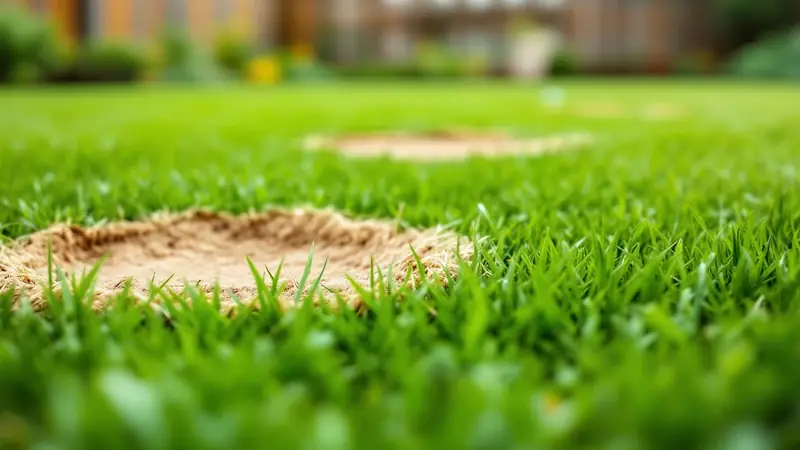
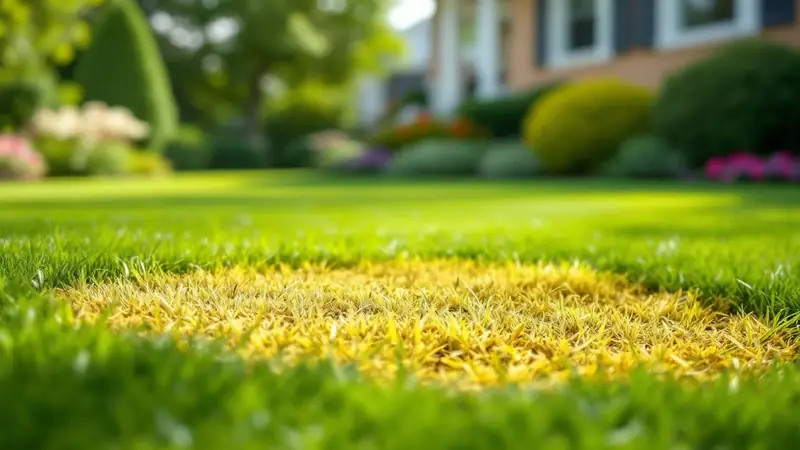
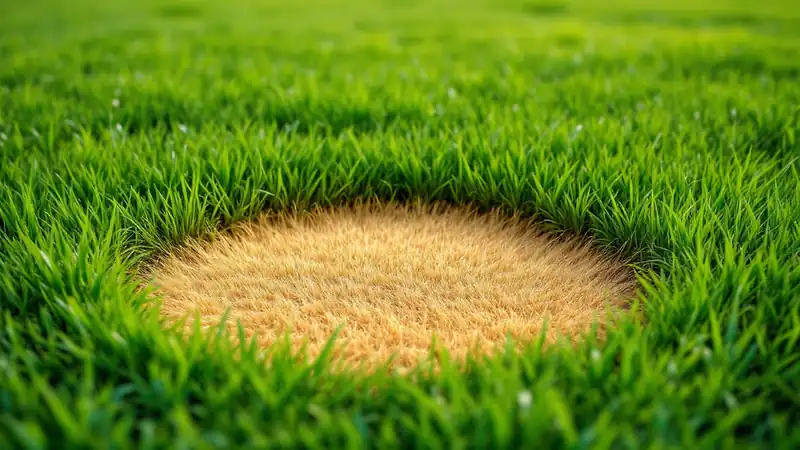
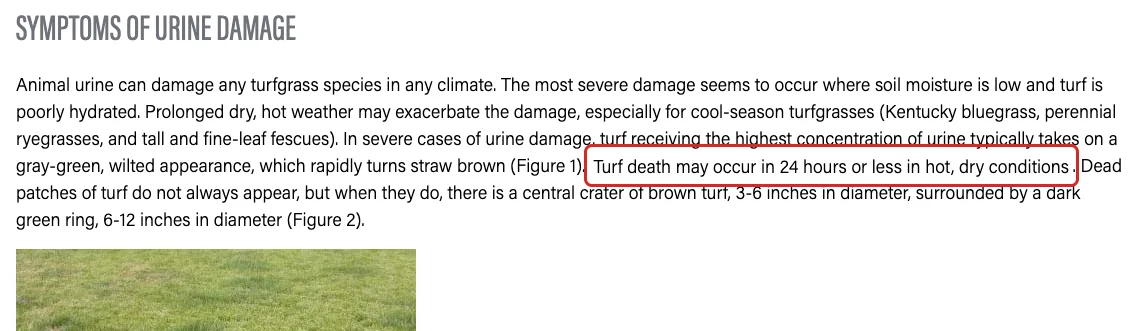
Purdue describes the classic spot as a dead crater 3 to 6 inches across inside a dark green ring 6 to 12 inches across, and says turf can die in 24 hours or less in hot, dry weather (Purdue AY-327). The ring is urine nitrogen at a feeding dose; the center got a dose many times higher.
To put a number on the dose, we used the simulated dog urine in a 2018 Crop Science study: 20 g of urea and 10 g of ammonium sulfate per liter, mixed to match the salinity (about 15 dS/m) and total nitrogen of dog urine (Chang, Huang and Li, Crop Science 58:917, 2018). That works out to about 11.4 g of nitrogen per liter. Purdue’s ceiling for one feeding is 1.0 lb of water-soluble nitrogen per 1,000 sq ft (Purdue AY-22).
| Urine in one spot | Nitrogen | lb N per 1,000 sq ft on a 12-inch circle | Same on an 8-inch circle | Times Purdue’s 1.0 lb cap (12-inch) | Allard’s result for that volume |
|---|---|---|---|---|---|
| 15 mL | 0.17 g | 0.48 | 1.1 | 0.5x | No effect |
| 30 mL | 0.34 g | 0.96 | 2.2 | 1.0x | Slight burn |
| 60 mL | 0.69 g | 1.93 | 4.3 | 1.9x | Moderate burn |
| 120 mL | 1.37 g | 3.86 | 8.7 | 3.9x | Severe burn |
| 150 mL | 1.72 g | 4.82 | 10.8 | 4.8x | Severe burn (Allard’s test dose) |
| 240 mL | 2.75 g | 7.71 | 17.4 | 7.7x | Severe burn |
The fit is close: 15 mL lands at about 0.5 lb, under Purdue’s cap, and did nothing in Allard’s plot; 30 mL lands at about 1 lb and gave a slight burn. A large dog’s full squat on an 8-inch circle can reach 10 lb or more, which is roughly the same mistake as spilling fertilizer, and our page on what over-fertilizing does to grass shows why. Use the calculator for your own volume and spot size.
- Nitrogen, lb per 1,000 sq ft (Purdue cap for one feeding: 1.0)
- 4.82
Default: 150 mL on a 12-inch circle = 4.82 lb N per 1,000 sq ft, about 5 times Purdue AY-22's 1.0 lb cap. mL x 11.45 g N per liter / 453.6 g per lb / spot area x 1,000. Real urine varies with diet and hydration. Water it in within 8 hours: in Allard's 1981 trial, 500 mL of water on 150 mL of urine left only a fertilizer effect.
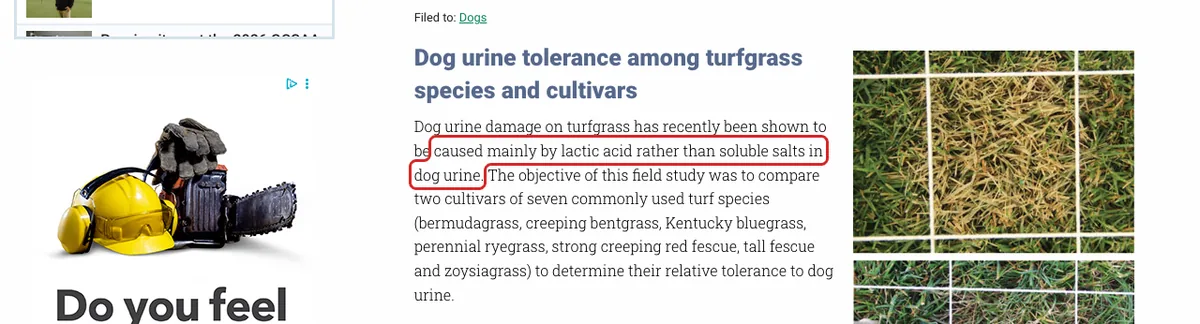
Nitrogen is not the whole story. The same 2018 study found the urea and ammonium sulfate solution caused only 5 to 12 percent leaf injury, while lactic acid at 3.5 g per liter caused 40 to 87 percent injury and symptoms like a urine patch (Chang 2018). NC State now calls lactic acid “the main culprit” and notes its level rises with exercise (NC State, Miller and McCauley, 2021). Either way, water dilutes every component at once.
Is the spot dead, burned, or just greener?
Tug the brown blades. If the crowns hold and white roots show, the grass is alive and needs water, not seed; Colorado State says to raise irrigation amount or frequency to dilute the salts so living turf can recover. If the blades lift out with no roots, the spot is dead. A green spot with no brown center is a fertilizer response: Colorado State says to raise nitrogen across the lawn so the spot blends in (Colorado State GardenNotes #553).
1Did the dog go within the last 8 hours?
YesPour about 3 times the urine's volume of water on it now: about 2 cups (500 mL) covers a 150 mL squat (Allard 1981).
NoGo to the next question
2Is the spot greener than the lawn, with no brown center?
YesNitrogen response only. Fertilize the whole lawn on schedule, up to 1.0 lb N per 1,000 sq ft per feeding, so it blends in (Colorado State; Purdue AY-22).
NoGo to the next question
3Is it brown but the blades hold and roots are white?
YesStill alive. Raise watering amount or frequency to flush salts so the turf can recover; reseed only if it dies (Colorado State).
NoGo to the next question
4Is the lawn bermudagrass, zoysiagrass or St. Augustinegrass?
YesFlush, then let runners fill in, or set sod plugs from a hidden corner for speed (NC State).
NoDead clumping grass: flush, cut out the sod and 0.5 to 1 inch of soil, and reseed with the lawn's own grass type (Colorado State).
Source: Allard 1981; Colorado State GardenNotes #553; NC State; Purdue AY-22
How do you repair a dead dog spot, step by step?
Dead spots in clumping grasses stay bare. Tall fescue and perennial ryegrass do not spread, so they must be seeded, plugged or sodded, while bermudagrass and zoysiagrass fill in on their own, as fast as a couple of weeks in active growth (NC State). The steps below are the dog-specific version; plug spacing and seed rates for every grass are in our patchy grass guide.
- Flush first. Soak the spot deeply before you dig; Colorado State says this dilutes salts where turf has died and makes reseeding more effective (Colorado State).
- Cut out the dead sod and 0.5 to 1 inch of soil, then loosen the base with a hand rake (Colorado State). Fill to grade with garden soil or topsoil; about 1 cubic foot covers 12 sq ft at 1 inch deep.
- Match the grass. In Kentucky bluegrass, spot-seed with perennial ryegrass (more effective) or bluegrass (marginally effective). In turf-type tall fescue, use turf-type tall fescue. Never use K31 tall fescue or annual ryegrass in either lawn (Colorado State). In bermudagrass or zoysiagrass, patch with sod or plugs cut from a hidden corner.
- Seed when it will grow. Scotts’ dog-spot mix label wants air at 60 to 80°F or soil at 55 to 70°F (Scotts product page). In late fall, our sibling page on whether it is too late to plant grass seed has the cutoff dates by city.
- Keep the surface moist and the dog off. Water daily until seedlings reach 2 inches, and keep pets off until the grass is 3 inches tall (Scotts label). The daily schedule is in our guide to watering new grass seed.
- Water every later squat on the repair within 8 hours, or the new grass takes the same dose that killed the old (Allard).
Which fixes work, and which do not?
We graded 18 fixes that appear in the results for this search against what extension services, veterinarians and the 2 urine studies measured. “Works” means a trial or at least 2 land-grant sources support it; “No evidence” means we found no trial and at least one university source says it fails or is unproven.
Swipe the table sideways to see every column.
| Fix | Claim | What the evidence shows | Verdict | Source |
|---|---|---|---|---|
| Pour water on the spot right after | Dilutes urine before it burns | Allard: 500 mL water on 150 mL urine at 0 to 8 hours left only a fertilizer effect; 12 hours, slight burn | Works (best evidence) | Allard 1981 |
| Deep-water a browned spot | Flushes salts so living grass recovers | Colorado State: raises recovery odds and dilutes salts before reseeding | Works if crowns are alive | Colorado State |
| Cut out dead sod plus 0.5 to 1 in soil, then reseed or sod | Removes salt-loaded soil | Colorado State GardenNotes #553 method | Works | Colorado State |
| Train the dog to a mulch or gravel potty area | No urine on turf | Colorado State: “the ONLY sure solution”; NC State: the best way | Works | Colorado State |
| Fertilize the whole lawn evenly | Hides green rings | Colorado State, Purdue and Penn State: masks greening; does not save dead centers | Partial: rings only | Purdue AY-22 |
| Plant tall fescue | Most urine-tolerant cool-season grass | Allard: fescue most resistant of 4; Li 2019 screen: tall fescue first among cool-season grasses | Partial: less damage, not none | NC State |
| Plant a tolerant cultivar | Some cultivars shrug off urine | Li screen: 10 cultivars lost under 15% color, but lactic acid stood in for urine | Promising, one screen | GCM, Jan. 2021 |
| Get the dog to drink more | More dilute urine | Colorado State: dilutes; NC State: offset by more frequent urination | Partial, low risk | NC State |
| Salt in the dog’s food | Dog drinks more, urine dilutes | Allard: 2 g salt cut burn from severe to slight; Colorado State warns of risk for older dogs and heart or kidney disease | Vet decision only | Colorado State |
| DL-methionine or other urine acidifiers | Lower urine pH stops burns | Allard: moderate burn vs severe, explained by a diuretic effect, not pH; Colorado State: urinary problems, bone effects in young dogs | Do not use for the lawn | Colorado State |
| Change urine pH with vinegar, juice or tomato juice | Acid urine burns grass | Allard: severe burn at pH 5.0, 6.0 and 8.0 alike; VCA: pH changes can cause crystals and stones | Myth | Allard 1981 |
| Dog Rocks in the water bowl | Filters impurities, no pH change | No published trial found; McGill OSS (2018): no evidence; NC State: filtering water has little if any benefit | No evidence | McGill OSS |
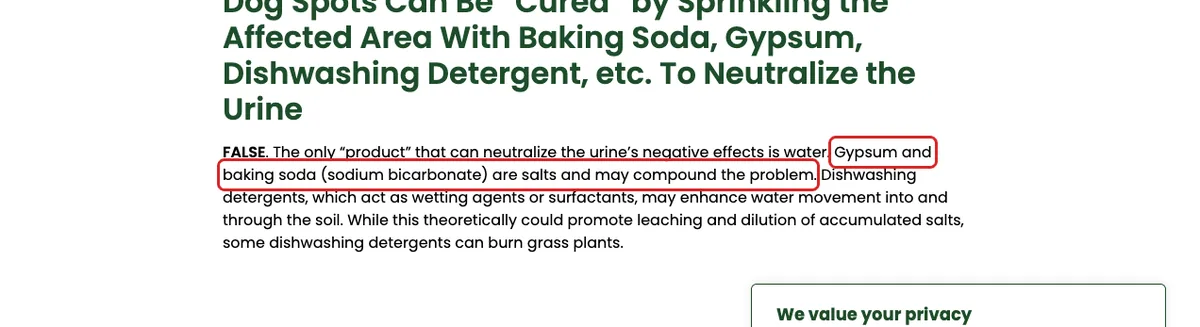
| Baking soda on the spot | Neutralizes urine | Colorado State: a salt that may compound the problem; Allard: pH 8.0 urine still burned | Makes it worse | Colorado State |
| Gypsum on the spot | Neutralizes urine salts | Colorado State: a salt that may compound the problem; NC State: not recommended | Makes it worse | Colorado State |
| Dish soap or detergent | Helps water flush salts | Colorado State: might aid leaching in theory; some detergents burn grass | Skip | Colorado State |
| Spray-on or granular urine “neutralizers” | Neutralize or prevent spots | Colorado State: no spray-on product proven; Purdue: repellents not proven | No evidence | Colorado State |
| Seed kits with a “salt neutralizer” | Neutralizer plus seed repairs spots | Scotts EZ Seed Dog Spot Repair: perennial ryegrass, fine fescue and bluegrass seed; no published test of the neutralizer found; NC State: kit seed often will not match warm-season lawns | Seed works; neutralizer unproven | Scotts |
| Anti-transpirant or water-repellent spray on grass | Leaf coating blocks urine | Becker and Li (NDSU): no protection on tall fescue or perennial ryegrass; TransFilm helped creeping red fescue up to 2 weeks | Does not work on most lawns | GCM, Jan. 2021 |
Dog Rocks and other water-bowl products
Dog Rocks’ own site says the rocks “filter out impurities” at one 200 g pack per 2 liters of water and make “no change to the pH balance” of urine or water (dogrocks.com, November 2026). We found no peer-reviewed trial of the product. Joe Schwarcz of McGill’s Office for Science and Society wrote in June 2018 that there is no evidence the rocks remove nitrates, no study showing drinking-water nitrate adds meaningfully to urine nitrogen, and that removing it would change urine nitrate insignificantly (McGill OSS).
Supplements and acidifiers
Allard’s own data is the source of the DL-methionine claim, and it cuts the other way: 550 mg (4.4 mg per kg) moved the burn from severe to moderate, and he credited a temporary diuretic effect, not pH. Colorado State says products sold to reduce urine alkalinity, including DL-methionine (Methio-Form), “may cause urinary system problems” and can affect calcium deposition in young dogs’ bones, and that no supplement has been proven to reduce spotting (Colorado State). VCA adds that restricting protein is not recommended for most dogs (VCA Animal Hospitals, Aug. 2026).
Which grasses tolerate dog urine best?
Tall fescue comes out on top among cool-season grasses in both studies, and Kentucky bluegrass near the bottom. Allard ranked fescue “the most resistant of the four main grasses grown in Colorado” and found Kentucky bluegrass “very susceptible”. A 2019 screen by Deying Li’s group at North Dakota State put bermudagrass and zoysiagrass ahead of every cool-season grass, then tall fescue, creeping red fescue, perennial ryegrass, Kentucky bluegrass and creeping bentgrass, in that order (GCM summary, January 2021).
| Grass | Allard 1981 (real urine, 4 plots) | Li et al. 2019 (lactic acid surrogate) | Growth habit and repair (NC State; Colorado State) | Our page |
|---|---|---|---|---|
| Tall fescue | Most resistant (as Kentucky 31) | Most tolerant cool-season grass | Clumps: reseed with turf-type tall fescue | tall fescue |
| Perennial ryegrass | More resistant than bluegrass | Third of 5 cool-season grasses | Best spot seed for a bluegrass lawn (Colorado State) | perennial ryegrass |
| Creeping red fescue | Not tested | Second of 5 cool-season grasses | Seed with fine fescue only (Colorado State) | None |
| Kentucky bluegrass | Very susceptible | Fourth of 5; PNW: more sensitive than other types | Spot-seed with ryegrass or bluegrass (Colorado State) | None |
| Creeping bentgrass | Not tested | Least tolerant | Not covered | None |
| Bermudagrass | Plot labeled “Cynodon sp. var. fairway (Fairway crested wheat)”: severe burn at every concentration | More tolerant than all cool-season grasses | Spreads: fills in, as little as a couple of weeks in active growth | bermudagrass |
| Zoysiagrass | Not tested | More tolerant than all cool-season grasses | Spreads, but recovers more slowly than bermudagrass | zoysiagrass |
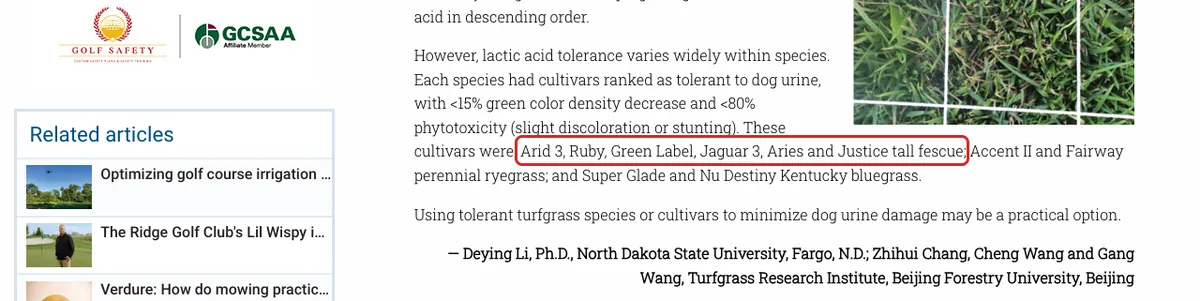
Within a species the spread is wide. Li’s group rated 10 cultivars tolerant, with under 15 percent loss of green color: Arid 3, Ruby, Green Label, Jaguar 3, Aries and Justice tall fescue; Accent II and Fairway perennial ryegrass; and Super Glade and Nu Destiny Kentucky bluegrass (GCM). The screen used lactic acid, not real urine, and GCM summarized it from 2019 and 2020 meeting abstracts (we found no full paper), so treat the list as a tie-breaker when you already plan to overseed, not a reason to renovate.
White clover is often sold as urine-proof. No land-grant trial we found measures that, and our clover lawn pros and cons page explains why traffic is the documented limit in a dog run.
How do you stop new spots from forming?
- Give the dog a non-turf spot. Mulch or gravel, with a post or other vertical object for a male dog to mark (Penn State). Colorado State calls this the only sure solution. Our mulch vs rock comparison covers depth and cost; skip cocoa hull mulch, whose theobromine our cedar mulch pros and cons page flags as a dog poisoning risk.
- Keep a full watering can by the door. Pour it on each squat within 8 hours, sooner in heat; Purdue says turf can die within 24 hours in hot, dry weather.
- Mow at 2 to 3 inches and water deeply in drought (Purdue AY-327). Dry soil concentrates salts and stressed turf dies faster.
- Fertilize on schedule, never extra on the spots. Up to 1.0 lb of water-soluble nitrogen per 1,000 sq ft per feeding (Purdue AY-22) keeps the lawn the same color as the urine rings.
- Watch the dormant months. Purdue says concentrated urine is “particularly damaging” in months when turf is not actively growing, such as early spring, so the water-can habit matters most then.
- Use turf where grass cannot win. A dog run worn to dirt is the case where our artificial turf vs real grass cost comparison favors turf.
How we compiled this
We read 14 primary documents in November 2026: Allard’s 1981 Canine Practice report (scanned original, Tables 1 to 6), the Chang 2018 Crop Science abstract, the GCM summary of 2 NDSU studies, extension pages from Colorado State, Purdue (AY-327, AY-22), NC State, Penn State and the PNW Handbook, VCA’s veterinary page, McGill OSS, the USDA crested wheatgrass guide, and the Dog Rocks and Scotts product pages. The nitrogen doses are our arithmetic, shown under the table; we did no field work.
Frequently asked questions
Will dog pee spots on grass grow back?
Spreading grasses usually do: NC State says bermudagrass and zoysiagrass fill in, in as little as a couple of weeks of active growth. Tall fescue and perennial ryegrass clump, so a dead spot stays bare until you seed or sod it.
What is the best product for repairing dog urine spots on grass?
Water and seed that matches your lawn. Colorado State says water is the only thing that neutralizes urine and no spray-on product is proven. A dog-spot seed kit works as seed; its “salt neutralizer” has no published test we could find (Scotts lists perennial ryegrass, fine fescue and bluegrass seed).
How do you fix dog urine spots on a lawn naturally?
Soak the spot within 8 hours with about 3 times the urine’s volume of water, which in Allard’s 1981 trial left only a fertilizer effect. For dead grass, remove it with 0.5 to 1 inch of soil and reseed. Skip baking soda and gypsum: both are salts.
Do Dog Rocks actually work?
We found no published trial. The maker says the rocks filter impurities without changing urine pH; McGill‘s Office for Science and Society found no evidence, and NC State says filtering a dog’s water has little if any benefit.
Why is there a green ring around the dead spot?
The edge gets a feeding dose of urine nitrogen while the center gets far more. Purdue describes a 3 to 6 inch brown crater inside a dark green ring 6 to 12 inches across. Fertilizing the whole lawn evenly makes the ring blend in.
Do female dogs kill grass more than males?
Their urine is not different; their posture is. Colorado State says squatting dogs of either sex cause most spots by emptying the bladder in one place, while leg-lifting males spread urine on vertical objects.
Sources
- A. Wayne Allard, D.V.M., Canine Practice, Lawn Burn from Dog Urine (scanned reprint), Vol. 8, No. 2, March to April 1981. Accessed November 2026.
- Colorado State University Extension, Dog Urine Damage on Lawns: Causes, Cures, and Prevention, GardenNotes #553, reviewed June 2025, updated Feb. 10, 2026. Accessed November 2026.
- Purdue Extension and University of Illinois, AY-327-W, Animal Urine Damage in Turf, current edition. Accessed November 2026.
- Purdue Extension, AY-22-W, Fertilizing Established Cool-season Lawns, current edition. Accessed November 2026.
- NC State Extension, Grady Miller and Ray McCauley, Dogs and Turfgrass Interactions, July 21, 2021. Accessed November 2026.
- Chang, Huang and Li, Crop Science 58(2):917 to 924, Lactic Acid is a Major Contributor to Dog Urine Injury in Cool-Season Lawn Species, March 2018. Accessed November 2026.
- GCM (GCSAA), Teresa Carson, Reducing turfgrass damage from dog urine (summaries of Li et al. and Becker and Li, NDSU), January 2021. Accessed November 2026.
- Pacific Northwest Plant Disease Management Handbook, Lawn and Turf: Dog Injury, revised March 2026. Accessed November 2026.
- Penn State Extension, Dogs vs. Lawns, updated July 19, 2026. Accessed November 2026.
- VCA Animal Hospitals, Urine Scalding on Grass, updated Aug. 18, 2026. Accessed November 2026.
- McGill Office for Science and Society, Joe Schwarcz, Can “Dog Rocks” stop dogs from staining my lawn?, June 7, 2018. Accessed November 2026.
- Dog Rocks, Product home page (claims and dosing ratio), checked November 2026. Accessed November 2026.
- ScottsMiracle-Gro, EZ Seed Dog Spot Repair Sun and Shade product page, checked November 2026. Accessed November 2026.
- USDA NRCS, Siberian Wheatgrass Plant Guide (crested and fairway wheatgrass types), current edition. Accessed November 2026.