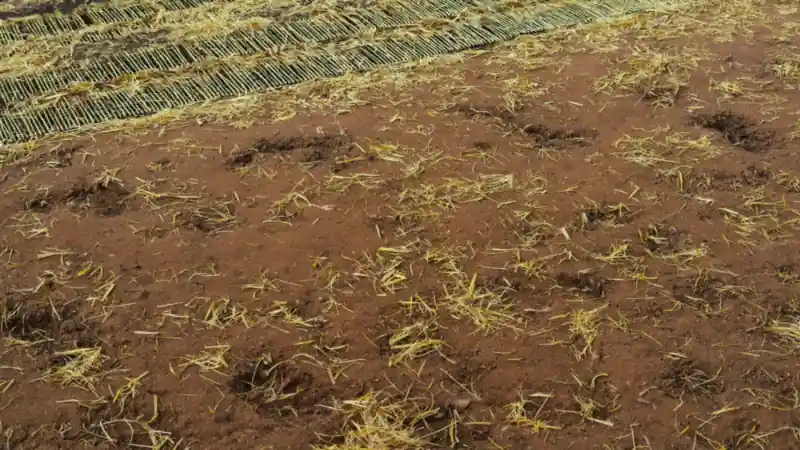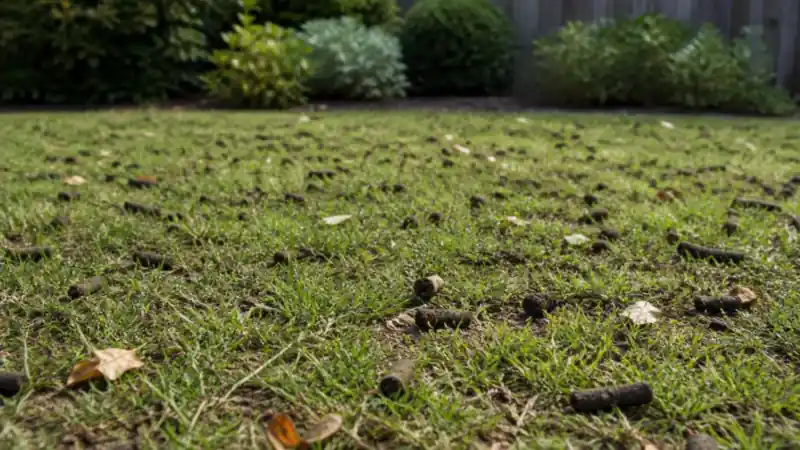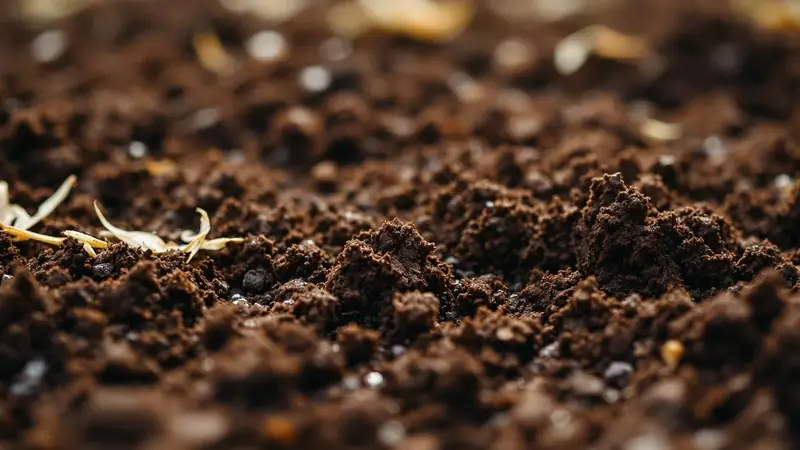
How often to water new grass seed: 2 light waterings a day, up to 4 in hot, windy weather, so the top 1/2 to 1 inch never dries. At 2 inches tall, water less often but deeper; after 2 or 3 mowings, about weekly.
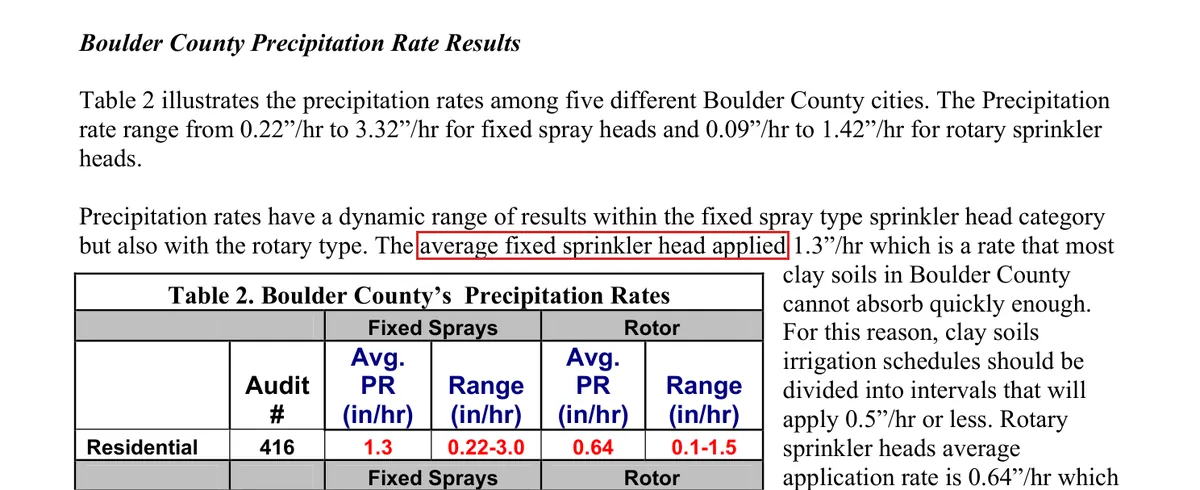
How often to water new grass seed is the easy half of the question; extension services agree on 2 to 4 light waterings a day (Iowa State Extension; Purdue AY-3). The hard half is how long to run the water, and minutes alone mean little. In 416 residential sprinkler audits in Boulder County, Colorado, fixed spray zones averaged 1.3 inches per hour but ranged from 0.22 to 3.0 (Slow the Flow Colorado audit paper, 2005). The common advice to water for 10 minutes could put down anywhere from about 0.04 to 0.5 inch, depending on the zone.
So this schedule is written in inches per watering, then converted to minutes for the sprinkler you actually own. Two tables do the conversion: minutes per watering at 4 measured sprinkler rates, and the most water bare, freshly seeded soil can take per hour before it puddles and floats seed away, by soil type and slope.
Watering schedule for new grass seed, stage by stage
Each stage starts on what the seedlings are doing, not on a date. Germination days come from University of Tennessee W160-B; our grass seed germination time guide lists them grass by grass. In a mix, keep the stage 2 schedule running until the slowest grass, usually Kentucky bluegrass, has come up.
| Stage | When | How often | How much | Target | Source |
|---|---|---|---|---|---|
| Seeding day | Day 0 | Once, right after you rake and roll | About 1/4 inch (UMD) | Wet the seed zone without puddles | UMD |
| Seed to sprouting | Cool-season seed 3 to 21 days; hulled bermuda and centipede 10 to 20 days (UT) | 2 light waterings a day; up to 4 if hot and windy (Iowa State); 2 to 4 (Purdue) | 1/8 to 1/4 inch a day in total (UT), split across the waterings | Top 0.5 to 1 inch never dries (Purdue AY-3) | Iowa State; Purdue AY-3; UT W160-B |
| Sprouted, under 2 inches tall | Through week 3 after seeding | Same 2 to 4 light waterings while the weather is dry | Same light amounts | Seedlings never wilt; surface stays dark | Purdue AY-7; Iowa State |
| Seedlings 1 to 2 inches tall | After sprouting; timing varies by grass and weather | Cut back gradually: once a day, then every 2 to 3 days | Rising toward 1/2 inch, about 300 gallons per 1,000 sq ft (UT) | Moisture follows roots down | Iowa State; UT W160-B |
| After 2 or 3 mowings | First mowing at 4 to 6 weeks (UMD) | Deep and infrequent; a thorough watering about once a week | Work up to about 1 inch per watering (UMD) | Top 4 to 6 inches moist; surface may dry between waterings | UMD; Iowa State; Purdue AY-3 |
Water the same day you seed. University of Maryland Extension says to irrigate seed immediately after planting with about 1/4 inch, and to avoid evening watering because leaves stay wet overnight. A light watering before seeding is optional; if the soil is dry and dusty, wet it a day ahead so it is firm, not muddy, when you rake.
The frequent schedule is about the soil surface, where the seed sits under 1/4 inch of soil. Purdue AY-3 says the seedbed should not be allowed to dry and asks for 2 to 4 waterings a day to keep the top 0.5 to 1.0 inch moist without saturating it. Clemson HGIC adds the penalty: if the surface dries after seeds swell and before roots form, many seedlings die.
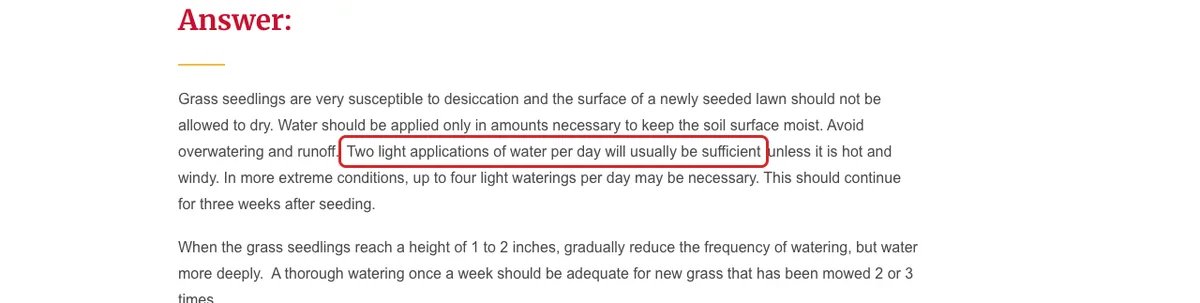
Tapering starts at 1 to 2 inches of growth (Iowa State) or 2 inches (Purdue). Drop one watering at a time and lengthen the rest; UT W160-B gives 1/2 inch, about 300 gallons per 1,000 sq ft, every 2 to 3 days as the in-between step. By the time the lawn has been mowed 2 or 3 times, it is on the established-lawn routine in our guide to the best time to water a lawn, and the first cut itself is covered in when to mow new grass.
Where the extension guides disagree
The guides agree on the pattern but not the numbers. The moisture depth they ask for runs from half an inch to 3 inches, and two of them size the water differently: UMD per watering, UT per day. At 2 to 4 waterings, UMD’s 1/4 inch each adds up to 1/2 to 1 inch a day, 2 to 8 times UT’s figure.
| Question | Answer given | Source |
|---|---|---|
| How deep to keep the soil moist | Top 0.5 to 1 inch | Purdue AY-3 |
| Top 1 inch | UMD | |
| 1 to 2 inches | Purdue AY-7 | |
| 2 to 3 inches | Clemson HGIC | |
| How much water | About 1/4 inch per watering | UMD |
| 1/8 to 1/4 inch per day | UT W160-B | |
| How long the frequent schedule lasts | 3 weeks after seeding | Iowa State |
| About 2 to 3 weeks | Clemson HGIC | |
| When to start cutting back | Seedlings 1 to 2 inches tall | Iowa State |
| Seedlings 2 inches tall | Purdue AY-3 |
Our reading: for seed sitting in the top 1/4 inch, the shallow targets (0.5 to 1 inch) are the ones that matter during germination. Use UT’s 1/8 to 1/4 inch a day as the total in cool or mild weather and the evaporation table below to size it up in heat.
How long to water new grass seed: inches first, then minutes
Minutes per watering = inches you want ÷ your sprinkler’s inches per hour × 60. The table runs that sum for 4 rates measured in the Boulder audits: the average fixed spray zone (1.3 in/hr), the average rotor zone (0.64 in/hr) and the slowest and fastest spray zones found (0.22 and 3.0 in/hr). Gallons are per 1,000 sq ft; 1 inch over 1,000 sq ft is 623 gallons.
| Water per watering | Gallons per 1,000 sq ft | Slowest spray zone, 0.22 in/hr | Rotor average, 0.64 in/hr | Spray average, 1.3 in/hr | Fastest spray zone, 3.0 in/hr |
|---|---|---|---|---|---|
| 1/8 inch | 78 | 34.1 | 11.7 | 5.8 | 2.5 |
| 1/4 inch | 156 | 68.2 | 23.4 | 11.5 | 5 |
| 1/2 inch | 312 | 136.4 | 46.9 | 23.1 | 10 |
| 1 inch | 623 | 272.7 | 93.8 | 46.2 | 20 |
Read across the 1/8 inch row and the problem with fixed-minute advice is plain: the same light watering takes 2.5 minutes on the fastest spray zone and 34 minutes on the slowest. A rotor zone needs about twice the run time of an average spray zone for the same water. Hose-end sprinklers have no published standard rate, so measure yours.
To measure your rate, use the catch-can method from UF/IFAS fact sheet ENH61:
- Set 5 to 10 identical straight-sided cans, 3 to 6 inches across (tuna or coffee cans), across one zone, or in a line from a hose-end sprinkler to the edge of its pattern.
- Run the water for exactly 15 minutes.
- Measure each can to the nearest 1/8 inch. If one can holds 1/2 inch or more while others are nearly empty, fix coverage before you seed.
- Average the depths and multiply by 4 to get inches per hour. A 1/4-inch average is 1 inch per hour.
- For any other test length, inches per hour = average depth ÷ minutes × 60 (Utah State Extension).
Enter that rate in the calculator, or pick one of the audit averages. The default, 1/8 inch through an average spray zone, is 5.8 minutes.
- Minutes per watering
- 5.8
Default: 1/8 inch through an average spray zone (1.3 in/hr) is 5.8 minutes. Seed stage: 1/8 to 1/4 inch a day in 2 to 4 waterings (UT, Iowa State). If water pools before the time is up, split the run into shorter cycles.
Why spray zones float seed away on bare soil
A new seedbed is bare soil, and bare soil takes water more slowly than soil under turf. Hunter Industries’ scheduling note lists the highest sprinkler rate each soil can absorb, bare and covered, by slope (Hunter, Scheduling Irrigation, Table 3). On flat bare silt loam the limit is 0.50 in/hr; on bare clay it is 0.15. The average spray zone in the Boulder audits applied 1.3.
| Soil | Bare, 0 to 5% slope (in/hr) | Bare, 5 to 8% slope | Bare, 12%+ slope | Average spray zone vs flat limit | Average rotor vs flat limit |
|---|---|---|---|---|---|
| Coarse sandy soil | 2.00 | 1.50 | 0.50 | 0.7x | 0.3x |
| Coarse sand over compact subsoil | 1.50 | 1.00 | 0.40 | 0.9x | 0.4x |
| Uniform light sandy loam | 1.00 | 0.80 | 0.40 | 1.3x | 0.6x |
| Light sandy loam over compact subsoil | 0.75 | 0.50 | 0.30 | 1.7x | 0.9x |
| Uniform silt loam | 0.50 | 0.40 | 0.20 | 2.6x | 1.3x |
| Silt loam over compact subsoil | 0.30 | 0.25 | 0.10 | 4.3x | 2.1x |
| Heavy clay or clay loam | 0.15 | 0.10 | 0.06 | 8.7x | 4.3x |
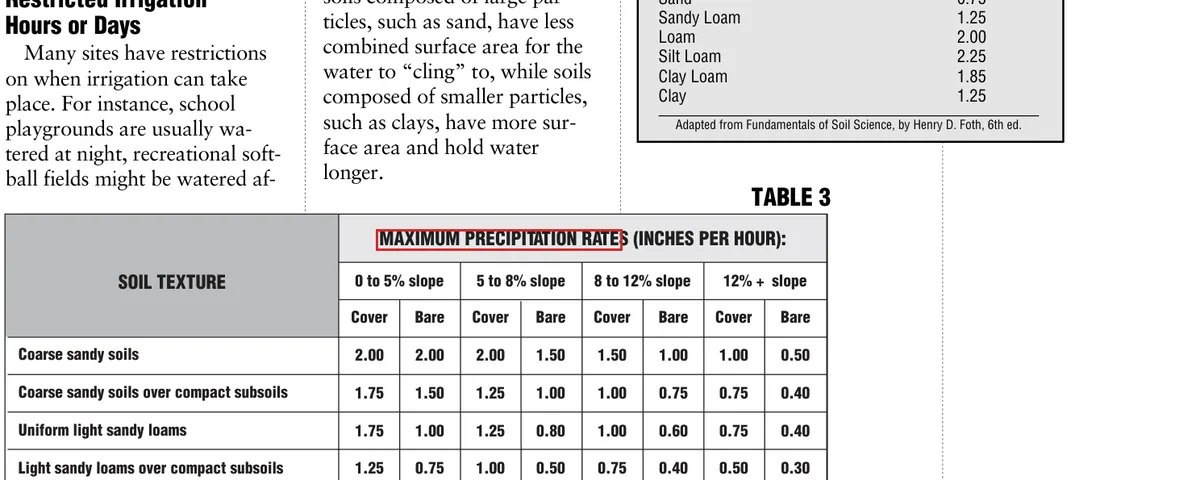
Any ratio above 1.0x means water can collect on the surface. On a seedbed that is where seed moves: UMD lists erosion of ungerminated seed, leaving bare areas, as a result of over-watering (UMD). The Boulder authors note that the average spray head’s 1.3 in/hr is more than most clay soils there can absorb and advise splitting clay-soil run times into intervals that apply 0.5 in/hr or less.
- Watch the first watering. If water pools or runs before the cycle ends, note the minute it started.
- Set each cycle to end just before that minute, and run it again once the surface water has soaked in, until the target depth is in.
- On slopes over 8 percent or on clay, switch to a lower-rate nozzle or a hose-end sprinkler you have measured, and cover seed with straw at 80 to 100 lb per 1,000 sq ft (Penn State).
- Long term, our guide on how to improve clay soil covers raising intake rates; steep banks belong on the erosion control methods page.
How many times a day: match the weather
While the surface is wet, it loses water at the full rate the weather allows; FAO Irrigation Paper 56 calls this the energy-limited stage of soil evaporation (FAO-56, Chapter 7). That makes daily evapotranspiration (ET) a fair yardstick for what a seedbed loses. Hunter’s Table 1 gives the maximum average daily loss by mid-summer climate type, and actual daily rates are usually lower.
| Climate type | Mid-summer highs, humidity | Max daily loss (in) | Per watering at 2 a day (in) | Per watering at 4 a day (in) | Spray-zone minutes at 4 a day |
|---|---|---|---|---|---|
| Cool humid | Under 70°F, over 50% humidity | 0.10 to 0.15 | 0.050 to 0.075 | 0.025 to 0.037 | 1.2 to 1.7 |
| Cool dry | Under 70°F, under 50% | 0.15 to 0.20 | 0.075 to 0.100 | 0.037 to 0.050 | 1.7 to 2.3 |
| Warm humid | 70 to 90°F, over 50% | 0.15 to 0.20 | 0.075 to 0.100 | 0.037 to 0.050 | 1.7 to 2.3 |
| Warm dry | 70 to 90°F, under 50% | 0.20 to 0.25 | 0.100 to 0.125 | 0.050 to 0.062 | 2.3 to 2.9 |
| Hot humid | Over 90°F, over 50% | 0.20 to 0.30 | 0.100 to 0.150 | 0.050 to 0.075 | 2.3 to 3.5 |
| Hot dry | Over 90°F, under 50% | 0.30 to 0.40 | 0.150 to 0.200 | 0.075 to 0.100 | 3.5 to 4.6 |
UT’s 1/8 to 1/4 inch a day matches the cool and warm rows. In hot, dry weather a seedbed can lose 0.30 to 0.40 inch a day, which is why Iowa State moves to 4 waterings when it is hot and windy: 4 waterings of about 0.08 to 0.10 inch each keep the surface wet without putting down more than bare soil can take. Spring and fall seedings sit near the cool rows, so 2 waterings often hold; check the soil surface at midday before adding a third.
Mulch cuts the count. Penn State Extension says irrigation can be reduced during rain, in cool and overcast weather and when the seedbed is properly mulched, and Clemson notes unmulched soil dries out quickly. Straw also hides seed from birds; our guide to keeping birds off grass seed rates the covers. On an overseeded lawn, seed in core-aeration holes stays moister than seed on a bare surface; see how to overseed a lawn.
Too much or too little: what the seedbed shows
1Is the soil surface pale or crusted by midday, or is seed still hard and dry after 7 days?
YesToo little. Add a watering (up to 4 a day) or spread straw at 80 to 100 lb per 1,000 sq ft.
NoGo to the next question
2Does water pool or run off before the cycle ends?
YesToo fast for bare soil. Shorten each cycle, repeat it once the water soaks in, or use a lower-rate sprinkler.
NoGo to the next question
3Has seed collected in lines or clumps, leaving bare streaks?
YesSeed has washed. Cut the rate, rake the clumps out lightly and reseed the streaks.
NoGo to the next question
4In warm, humid weather, are seedlings collapsing in patches, dark and slimy?
YesLikely damping-off. Stop evening watering, let standing water drain, skip extra fertilizer; reseed dead patches.
NoGo to the next question
5Are most seedlings 2 inches tall?
YesStart tapering: drop one watering at a time and lengthen the rest toward 1/2 inch.
NoKeep the current schedule and check the surface at midday.
Source: UMD Starting a New Lawn; Purdue AY-3; Penn State damping-off fact sheet; Hunter Table 3
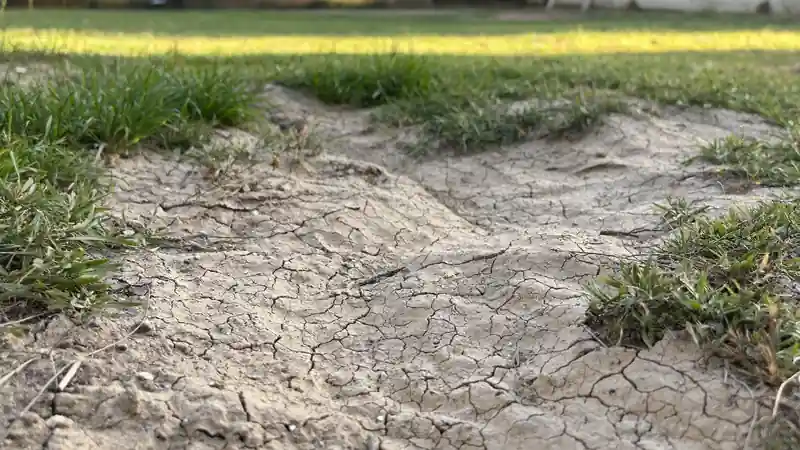
Under-watering shows first at the surface: pale, crusted soil by midday, and seed still hard and dry after 7 days of watering. UMD adds that compacted soil absorbs water slowly and is hard to re-wet once it dries, and that sandy soil dries faster than clay.
When the watering looks right and the seed still has not come up, the other causes, including soil temperature, seed depth, herbicide residue and old seed, are sorted in our page on why your grass seed is not growing.
Over-watering shows as puddles, seed collected in lines or clumps, and in warm weather, damping-off. Penn State describes seedlings that collapse in circular or irregular patches, often water-soaked and slimy, sometimes in streaks down slopes or swales, and says they rarely recover; the area usually has to be reseeded. Outbreaks track high heat and humidity, water-logged soil, heavy fertilizer and mulch and excessive seeding rates.
NC State Extension names Pythium as the main cause in warm or hot weather and Rhizoctonia in cool weather, and links the disease to long leaf wetness. Its fix matches the schedule above: light, frequent watering that keeps the seedbed moist but not saturated, and once seedlings emerge, fewer waterings so their leaves dry completely in between. Other lawn diseases are covered in our lawn fungus guide.
How we compiled this
On Nov. 9, 2026 we read 10 extension publications (Iowa State, Purdue AY-3 and AY-7, Tennessee W160-B and W161-F, Maryland, Penn State, Clemson, NC State and UF/IFAS ENH61), the Slow the Flow Colorado audit paper, Hunter Industries’ scheduling note and FAO Irrigation Paper 56, Chapter 7. Minutes, gallons, splits and ratios are our arithmetic. We ran no sprinkler tests and seeded no lawns.
Frequently asked questions
Can you overwater new grass seed?
Yes. Water that pools moves seed and leaves bare streaks (UMD), and water-logged soil in warm, humid weather favors damping-off, which kills seedlings in patches (Penn State). Keep each watering near 1/8 to 1/4 inch and stop the cycle when puddles form.
Can new grass seed go a day without water?
In cool, cloudy weather a missed watering may do no harm. Once seed has swollen and before roots form, a dry surface can kill many seedlings (Clemson HGIC). In heat and wind, where a seedbed can lose 0.30 to 0.40 inch a day (Hunter), skip no days.
What is the best time to water newly seeded grass?
Morning first, then late morning and early afternoon as needed. UMD says to avoid evening watering because leaves stay wet overnight, and NC State links long leaf wetness to damping-off. In hot, windy weather Iowa State allows up to 4 light waterings a day.
Is 30 minutes long enough to water grass seed?
It is usually too long for seed. Thirty minutes puts down about 0.65 inch on an average spray zone (1.3 in/hr) and 0.32 inch on an average rotor (0.64 in/hr), against UT’s 1/8 to 1/4 inch a day. Thirty-minute runs fit later, once seedlings are 2 inches tall.
Should I water grass seed right away?
Yes. UMD says to irrigate seed immediately after planting, with about 1/4 inch, then keep the top 1/2 to 1 inch moist (Purdue AY-3).
Sources
- Iowa State University Extension and Outreach, How should I water a newly seeded lawn?, June 9, 2026. Accessed November 2026.
- Purdue Extension, AY-3: Establishing Lawns From Seed, PDF. Accessed November 2026.
- Purdue Extension, AY-7: Irrigation Practices for Home Lawns, PDF. Accessed November 2026.
- University of Tennessee Extension, W160-B: Establishing a Lawn From Seed, PDF. Accessed November 2026.
- University of Tennessee Extension, W161-F: Irrigating Lawns, PDF. Accessed November 2026.
- University of Maryland Extension, Starting a New Lawn, Current online edition. Accessed November 2026.
- Penn State Extension, Lawn Establishment, Current online edition. Accessed November 2026.
- Penn State Extension, Turfgrass Diseases: Damping-off Diseases, Current online edition. Accessed November 2026.
- NC State Extension, Damping Off in Turf, Current online edition. Accessed November 2026.
- Clemson Cooperative Extension, HGIC, Lawn Establishment, Current online edition. Accessed November 2026.
- UF/IFAS Extension (Trenholm, Unruh, Cisar), ENH61: How to Calibrate Your Sprinkler System, Revised April 2009. Accessed November 2026.
- Utah State University Extension, Simple Sprinkler Performance Testing for Utah County, PDF. Accessed November 2026.
- Graham, T. and Lander, P., Irrigation Association, Slow the Flow Colorado Sprinkler Irrigation Audits, 2005. Accessed November 2026.
- Hunter Industries, Irrigation Notes: Scheduling Irrigation, PDF. Accessed November 2026.
- FAO, Irrigation and Drainage Paper 56, Chapter 7: Dual crop coefficient, 1998. Accessed November 2026.