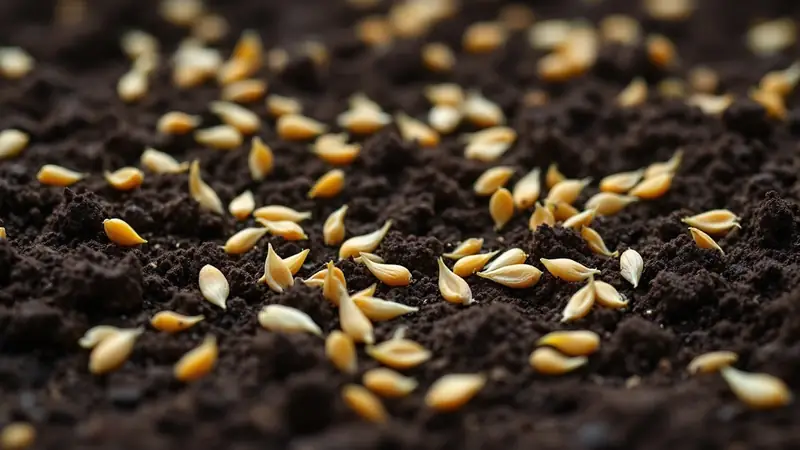
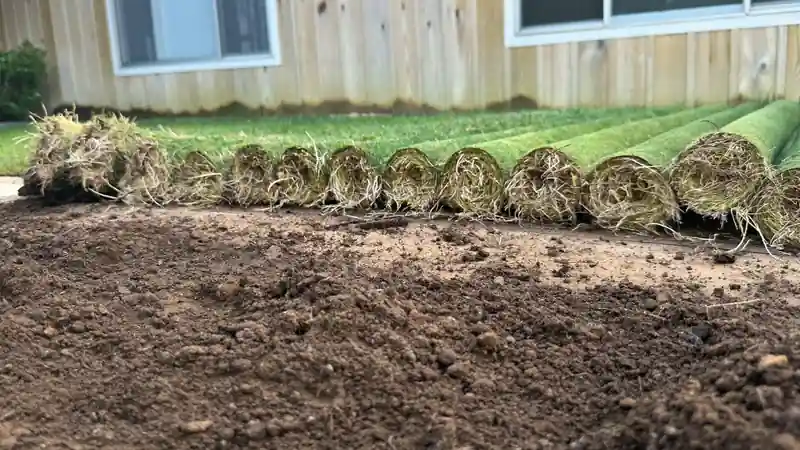
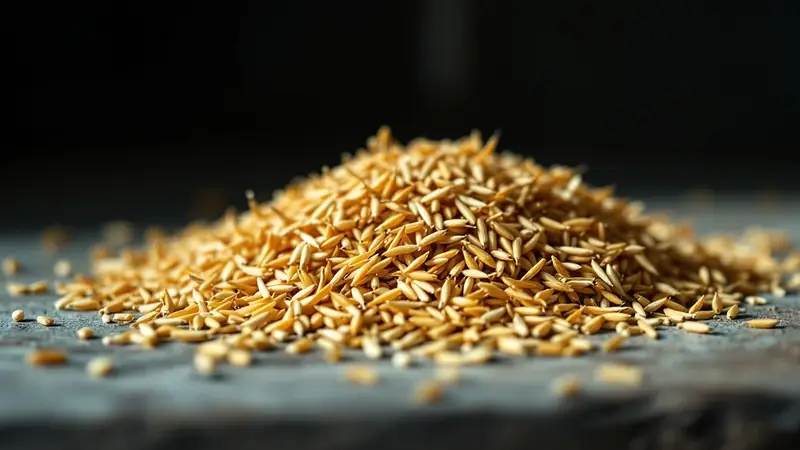
Why is my grass seed not growing? Most often it is not late yet, the soil is too cold, the seedbed dried out after the seed swelled, or a crabgrass preventer is still active. Count the days since sowing, then dig up a few seeds.
Why is my grass seed not growing has a different answer on day 6 than on day 30. Perennial ryegrass sprouts in 3 to 7 days, tall fescue in 6 to 12 and Kentucky bluegrass in 14 to 21, per University of Tennessee Extension W160-B. Federal seed labs give bluegrass 28 days before they stop counting (7 CFR 201.58). A bluegrass lawn that is bare at day 12 is on schedule; a ryegrass lawn bare at day 14 has a problem worth digging for. The full sprouting chart, week by week, is in our grass seed germination time guide.
The lawn-company pages and forum threads that rank for this question list watering, timing and soil prep. None we read gives a day to start worrying, checks the seed tag’s test date against state law, or names the herbicide labels that block seed for 3 to 12 months. This page does all three, then works 17 causes in the order a trowel, a soil thermometer and the tag can rule them out. If the bare spots sit under pines, needle cover and root competition are covered in our guide to growing grass under pine trees, and shade-tolerant species in grass that grows in shade; the University of Maryland says shaded turfgrass will struggle to germinate.
Is your grass seed late, or has it failed?
Start with the slowest grass in the bag. Mixes list each kind on the tag, and a 90 percent bluegrass, 10 percent ryegrass mix shows ryegrass in week 1 and bluegrass in week 3. Judge the mix by the bluegrass. The table pairs the field window with the federal lab test length, which is the point where a seed lab stops waiting (7 CFR 201.58 allows 2 extra days if seedlings are too small to judge).
| Grass | Field days to sprout (UT W160-B) | Federal lab test, final count day (7 CFR 201.58) | Germinates at | Dig and judge at |
|---|---|---|---|---|
| Perennial or annual ryegrass | 3 to 7 | 14 (first count day 5) | 50 to 70°F at 1 in. (UMD) | Day 14 |
| Tall fescue | 6 to 12 | 14 (first count day 5) | 50 to 70°F at 1 in. (UMD) | Day 14 |
| Fine fescues (chewings, red, sheep, hard) | 6 to 14 | 21 (first count day 7) | 50 to 70°F at 1 in. (UMD) | Day 21 |
| Kentucky bluegrass | 14 to 21 | 28 (first count day 10) | 50 to 70°F at 1 in. (UMD) | Day 28 |
| Bermudagrass, hulled | 10 to 20 | 21 (first count day 7) | 65°F soil (NC State) | Day 21 |
| Bermudagrass, unhulled | 14 to 21 or longer | 21; unhulled lab tests run 21 days after a 7-day prechill | 65°F soil (NC State) | Day 28 |
| Zoysia japonica (Japanese lawngrass) | 10 to 14 | 28 (first count day 10) | 68°F soil (Arkansas MP476) | Day 28 |
| Centipedegrass | 10 to 20 | Not listed in Table 2 | Air 68 to 95°F (UT) | Day 21 |
| Bahiagrass, Pensacola | 50 to 60% up within 30 days (UGA) | 28 (first count day 7) | Air 68 to 95°F (UT) | Day 30, and expect stragglers next year |
Only count days with the soil in range. Cool-season seed germinates best at 50 to 70°F measured about 1 inch deep (University of Maryland Extension); bermudagrass waits for 65°F soil (NC State Extension) and zoysia for 68°F (Arkansas MP476). A week of 45°F soil in late October adds nothing to the clock. Our soil temperature for planting guide shows how to take the reading and lists free state soil-temperature networks.
- Share of the field window used (percent)
- 117
Default: tall fescue 14 days after sowing in warm enough soil is at 117 percent, past the 12-day late end: dig and look. Under 100 percent, keep the top 1/2 to 1 inch moist and wait. Over 100 percent, compare with the lab final count in the table (14 days for ryegrass and tall fescue, 21 for fine fescues and bermudagrass, 28 for bluegrass and zoysia). Worked example: Kentucky bluegrass at day 14 reads 67 percent. If the soil was cold most days, the result is 0: count only warm days.
Worked example: tall fescue sown Sept. 10 with soil above 50°F every day reads 117 percent on Sept. 24, 14 days in, so it is past the 12-day late end and at its lab final count: dig. Kentucky bluegrass sown the same day reads 67 percent: wait another week.
How do you find the cause? Dig, measure, read the tag
Take a trowel, a soil thermometer and the seed bag. Cut a 2 inch deep slice of the seedbed in three places, including one low spot, and look at what the seed is doing. Germination begins as seeds take in water (UT W160-B); a seed that is swollen, split or showing a white root is alive and working. A seed that is still hard and dry after a week of watering points to the seedbed, not the seed. Answer the questions in order.
1Has the soil at 1 inch been below 50°F (cool-season seed) or 65°F (bermudagrass) most days since sowing?
YesToo cold: the germination clock has not started. Wait for warm soil, or let late-fall seed sit as a dormant seeding (Iowa State: soil 40°F or lower).
NoGo to the next question
2Is the day count still inside the grass's field window (7 days ryegrass, 12 tall fescue, 21 Kentucky bluegrass, 20 hulled bermudagrass)?
YesNot late yet. Keep the top 0.5 to 1 inch moist with 2 to 4 light waterings a day (Purdue AY-3) and wait.
NoGo to the next question
3Was a crabgrass preventer or weed-and-feed applied within its label's reseeding interval?
YesHerbicide residue. Wait out the label interval (3 to 4 weeks for Trimec Classic; 3 to 12 months for Dimension, Halts and Barricade), then reseed.
NoGo to the next question
4Dig 3 spots: is the seed missing, or piled in streaks and low spots?
YesBirds or washout. Reseed, rake it 1/4 inch under, roll, and cover with straw; water in shorter cycles.
NoGo to the next question
5Is the seed still hard and dry after a week of watering?
YesThe seedbed is drying out. Water more often, roll for seed-to-soil contact, and mulch with straw at 50 to 75 percent soil cover.
NoGo to the next question
6Is the seed sitting deeper than 1/2 inch?
YesToo deep. Reseed with no more than 1/2 inch of soil or 1/4 inch of compost or straw over it (Univ. of Maryland).
NoGo to the next question
7Did seedlings come up, then collapse in patches that look dark, water-soaked or slimy?
YesDamping off. Water less, keep to the bag's seeding rate, and send a sample to a diagnostic lab before choosing a fungicide.
NoGo to the next question
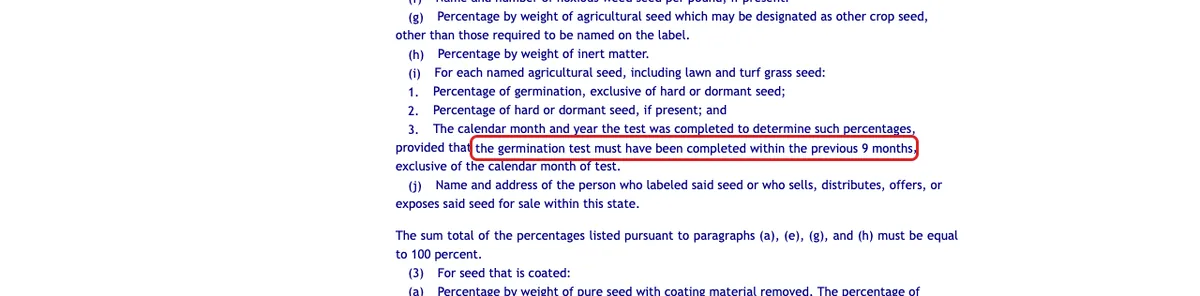
8Is the tag's test date over 9 months old, or the germination percent low?
YesWeak seed. Sprout-test 100 seeds from the bag, then reseed at a rate corrected for the count.
NoWarm, moist, shallow seed with no herbicide history and a current tag that is past its lab final count: reseed in the next window at the tag-corrected rate, and send a sample of the bag to a state seed lab if you have a lot of it left.
The 17 rows below are each tied to something you can see or measure. Moisture leads because it is the most common failure: Purdue AY-3 says seedlings are susceptible to desiccation and asks for 2 to 4 waterings a day so the top 0.5 to 1.0 inch stays moist. The schedule in inches and minutes is in our guide to watering new grass seed.
Swipe the table sideways to see every column.
| What you see | When | Likely cause | Check | Fix | Source |
|---|---|---|---|---|---|
| Nothing up, seed on the surface still hard and dry | Any day | Seedbed never stayed wet long enough to start germination | Press a finger into the top 1/2 inch at midday: pale, crusted or dusty means dry | 2 to 4 light waterings a day so the top 0.5 to 1.0 in. stays moist (Purdue); straw at 50 to 75% soil cover (UT W160-B) | Purdue AY-3 |
| Sprouts appeared, then shriveled in sunny or windy patches | Days 3 to 21 | Surface dried after the seed swelled; seedlings are susceptible to desiccation | Seedlings brown and crisp, soil dry underneath, no slime | Reseed the dead patches; water 2 to 4 times a day until seedlings reach 2 in. | Purdue AY-3 |
| Few or late sprouts; seed found well below the surface | Past the lab final count | Seed buried too deep: grass seed needs light | Dig a 2 in. slice with a trowel and measure how deep the seed sits | Reseed and cover with no more than 1/2 in. of soil or 1/4 in. of compost or straw | Univ. of Maryland |
| Seed visible on thatch or a crust, none in the soil | Week 1 onward | Poor seed-to-soil contact | Seed lifts off with a puff of air; soil underneath hard | Rake lightly, then roll with an empty water roller | Purdue AY-3 |
| Nothing up, cool-season seed, fall or early spring | Past the field window | Soil too cold to germinate | Soil thermometer at 1 in. at 8 a.m. for 3 days | Wait for 50 to 70°F soil, or dormant-seed once soil is 40°F or lower | Univ. of Maryland; Iowa State |
| Nothing up, bermudagrass or zoysia sown in early spring | Past day 21 | Soil too cold for warm-season seed | Soil thermometer reading | Wait for 65°F (bermudagrass) or 68°F (zoysia) | NC State; Arkansas MP476 |
| Thin bermudagrass stand after a heat wave | Midsummer | Too hot: hulled bermudagrass germination fell to 48% at 86/104°F nights and days | Check air highs near 104°F during the first 2 weeks | Reseed thin areas when highs drop back to the mid 90s or below | Evers and Parsons, 2009 |
| No grass in an even band or whole-lawn pattern; weeds also absent | Any day | Preemergence herbicide (crabgrass preventer) still active | Look up the product and date applied; read its reseeding line | Wait out the label interval (3 to 12 months, by product and rate), then reseed | Barricade 4FL; Dimension 2EW; Halts labels |
| Poor stand after a weed-and-feed or broadleaf spray | Within 4 weeks of spraying | Broadleaf herbicide residue | Product and date on your receipt | Trimec Classic: sow seed 3 to 4 weeks after application | Trimec Classic 2217-543 label |
| Seed gone, bare raked soil, birds feeding | Days 1 to 10 | Birds eating uncovered seed | Count seeds in a 4 x 4 in. square against a covered spot | Reseed, rake 1/4 in. under, roll, cover with straw or row cover | Univ. of Maryland |
| Seed piled in streaks, low spots or at the bottom of a slope | After heavy rain or long irrigation | Washout of ungerminated seed | Fan-shaped deposits of seed and soil | Reseed bare streaks; apply water in shorter cycles | Univ. of Maryland |
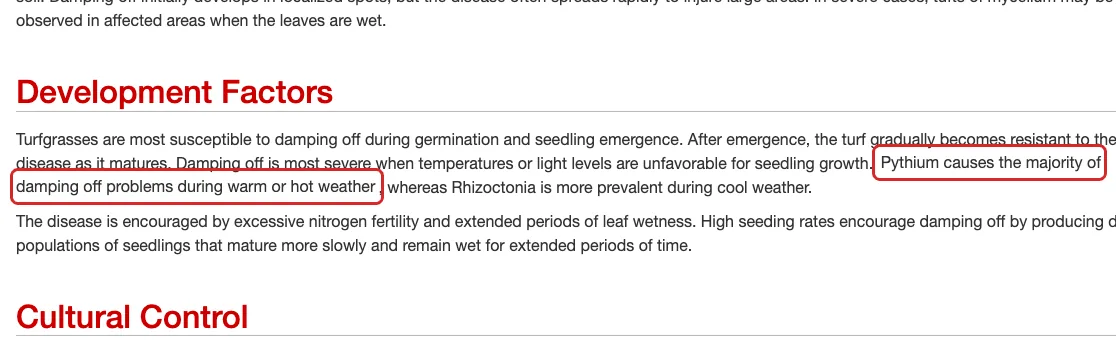
| Seedlings collapse in circular patches; dark, water-soaked, slimy; white cottony growth at dawn | Hot, humid weeks | Pythium damping off | Morning check for white mycelium; patches follow drainage paths | Cut back watering, keep recommended seeding rates, send a sample to a diagnostic lab | NC State; Penn State |
| Sparse emergence, seedlings wilt and twist in cool, wet weather | Cool spells | Rhizoctonia damping off (or Pythium before emergence) | Seedlings flaccid and twisted, then darken | Same cultural fixes; Rhizoctonia and Pythium need different fungicides | NC State |
| Stand dense but weak and patchy | Weeks 2 to 6 | Too much seed: dense, weak, disease-prone seedlings | Compare rate used with the bag rate (tall fescue 5 to 8 lb per 1,000 sq ft) | Do not add seed; water in the morning only | UT W160-B; NC State |
| Low or uneven germination everywhere, care looks right | Past the lab final count | Old seed or a low-germination lot | Tag test date: over 9 months in most state laws; germination percent | Sprout-test the rest of the bag before reseeding | Fla. Stat. 578.09; Va. Code 3.2-4015 |
| Bahiagrass half up at 30 days | Day 30 | Hard (water-resistant) seed coat, normal for bahiagrass | Tag lists hard or dormant seed percent | Keep watering; some seed comes up the next year | UGA B1362 |
| Seedlings turned white after a weed spray at seeding | 5 to 7 days after spraying | Mesotrione whitening, temporary | Tenacity or another mesotrione product used | No reseed needed; whitening lasts several weeks | Tenacity 100-1267 label |
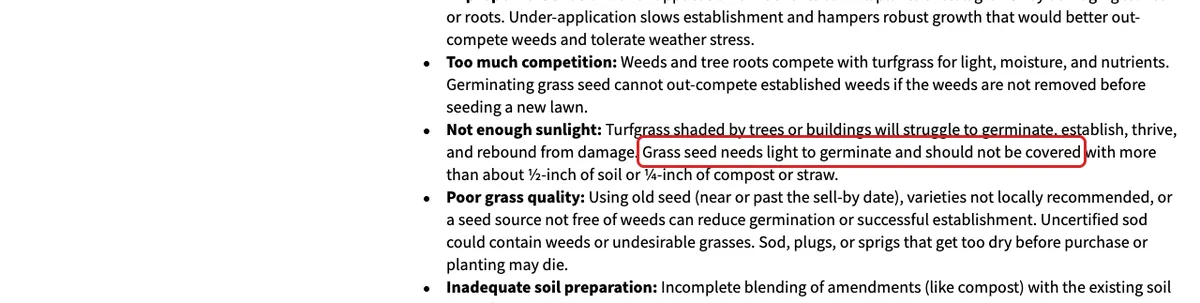
Depth fails more quietly than drying. The University of Maryland says grass seed needs light to germinate and should be covered by no more than about 1/2 inch of soil or 1/4 inch of compost or straw. Seed raked 1 inch deep into loose soil, or buried under a topdressing, comes up thin or not at all. Purdue AY-3 pairs a light raking with a light rolling for seed-to-soil contact, which presses seed in without burying it.
Missing seed is a separate branch. If a 4 by 4 inch square of raked soil holds almost no seed while a straw-covered strip next to it still does, birds took it; the 16 deterrents we rated are in how to keep birds from eating grass seed. Fan-shaped piles of seed at the bottom of a slope mean washout, which the University of Maryland lists as erosion of ungerminated grass seed from over-watering.
Too cold or too hot: what temperature does to germination
Cold stops the clock; heat cuts the count. In a Texas AgriLife germination study, hulled common bermudagrass held at 41°F nights and 59°F days germinated 0.5 percent in 28 days, against 93.0 percent at 68/86°F (Evers and Parsons, 2009). At 86/104°F, germination fell back to 48.0 percent. Unhulled seed, which still carries its hull, did best at 77/95°F with 77.5 percent.
For cool-season seed the fall deadline matters more than heat. The University of Maryland says ungerminated fall-sown grass seed dies over winter, except Kentucky bluegrass, while Iowa State Extension uses that cold on purpose: dormant seeding with soil at 40°F or lower keeps seed asleep until spring. Seed that missed the window is not always lost, but it will not sprout in November. City-by-city cutoffs are in our page on whether it is too late to plant grass seed.
Did a weed killer from earlier in the year stop it?
If an even band or the whole lawn stays bare, and the crabgrass is missing too, look back 12 months. Crabgrass preventers stop grass seed the same way they stop crabgrass. The Barricade 4FL label scales the wait with the rate: 4 months at 16 fl oz per acre, 6 months at 24 fl oz in the North, up to 12 months at 48 fl oz in the South. An April 1 application at the 24 fl oz rate therefore rules out a September seeding.
| Product (EPA Reg. No.) | Active ingredient | Seeding after use, per the label | If you applied it on April 1 |
|---|---|---|---|
| Barricade 4FL (100-1139) | Prodiamine | 4 months at 16 fl oz per acre; 6 months at 24 fl oz in the North; up to 12 months at 48 fl oz in the South | Seed no earlier than Aug. 1 at the lowest rate; Oct. 1 at 24 fl oz in the North |
| Dimension 2EW (62719-542) | Dithiopyr | Reseeding within 3 months of one application, or 4 months after a split program over 2 pt per acre, may inhibit establishment | July 1 for one application |
| Scotts Turf Builder with Halts (538-192) | Pendimethalin | Do not plant grass seed for 4 growing months | Aug. 1 at the earliest |
| Trimec Classic (2217-543) | 2,4-D, MCPP-p, dicamba | Grass seed can be sown 3 to 4 weeks after application | April 22 to April 29 |
| Tenacity (100-1267) | Mesotrione | Labeled at seeding for tolerant grasses; not fine fescue or blends over 20% fine or hard fescue | No wait for tolerant grasses |
| Siduron products (Tupersan and others) | Siduron | Last registrations cancelled; existing stocks sale allowed to Dec. 31, 2021 | Not a current option |
Pesticide use is regulated by the label, and the label is the law. This page is general information, not a pesticide recommendation: read the current label on your container, including its reseeding interval, and follow your state’s rules.
Older advice that only siduron (Tupersan) is safe at seeding, including Purdue AY-3, predates the product’s exit: EPA’s 2018 cancellation order ended the last 10 siduron registrations. Mesotrione is the current at-seeding option on its label. The Tenacity label also warns it may cause temporary whitening that appears 5 to 7 days after application and lasts several weeks, so white seedlings after a Tenacity spray are not a failed seeding. Our how to plant grass seed guide lists glyphosate and broadleaf product waits before you start.
What does the seed tag say about your seed?
The tag carries three dated numbers that explain many failures: the germination percent, the hard or dormant seed percent and the month the test was completed. Federal rules let Kentucky bluegrass, the fescues and ryegrasses ship interstate up to 15 months after that test, and most other seed 5 months (7 CFR 201.22). Florida, Virginia and Louisiana stop sales 9 months after the test month for most seed.
| Rule | Test date limit | What else the tag must show | Source |
|---|---|---|---|
| Federal Seed Act, interstate shipment | 5 months after the test month; 15 months for Kentucky bluegrass, tall, red, chewings and hard fescue, ryegrasses and bentgrasses; 24 months in hermetically sealed containers | Germination percent for each kind over 5% of the mix | 7 CFR 201.22; 7 CFR 201.20 |
| Florida | Within the previous 9 months, not counting the test month | Germination excluding hard or dormant seed, and hard or dormant seed separately | Fla. Stat. 578.09 |
| Virginia | 9 months; 15 months for cool-season lawn and turf seed, which may carry a sell-by date | Germination, hard seed percent, test month and year | Va. Code 3.2-4008 and 3.2-4015 |
| Louisiana | No sale more than 9 months after the test, not counting the test month | Germination label | La. Admin. Code tit. 7, XIII-131 |
Turn the tag into pure live seed (PLS), the share of the bag’s weight that can sprout: pure seed percent times germination. LSU AgCenter works an example of 54 percent pure seed at 85 percent germination, 45.9 percent PLS. A tall fescue bag tagged 97 percent pure and 85 percent germination is 82.5 percent PLS, so 7 lb spread per 1,000 sq ft puts down about 5.8 lb that can sprout. A bag that sat in a hot garage for two summers is no longer what the tag says; our page on whether old grass seed goes bad gives the 100-seed sprout test and the rate correction.
Hard seed is normal for some warm-season grasses and is listed separately on the tag (Fla. Stat. 578.09). UGA Extension B1362 says 50 to 60 percent of bahiagrass seed generally germinates within 30 days, because a waxy seed coat limits water uptake, and some does not come up until the following year. A half-green bahiagrass seeding at day 30 is on track.
Grass seed germinated, then died: damping off or drying?
Seedlings that came up and then collapsed point to two causes, and the pattern tells them apart. Drying kills in sunny, windy spots and on high ground, leaving crisp brown seedlings over dry soil. Damping off follows water: Penn State Extension describes seedlings that collapse in circular or irregular patches, often in drainage swales, look water-soaked and slimy, and can show white, fluffy mycelium on dewy mornings.
NC State Extension says Pythium causes most damping off in warm or hot weather and Rhizoctonia in cool weather, and that high seeding rates, excess nitrogen and long leaf wetness all encourage it. UT W160-B adds that Pythium is especially destructive when young plants in wet soil meet high temperatures. Before you buy a fungicide, send a sample to your state diagnostic lab: NC State notes Pythium and Rhizoctonia need different products.
Reseed only after the cause is fixed. For a cool-season lawn, the next window is late summer; Purdue AY-3 names Aug. 15 to Sept. 15 for northern Indiana and Illinois and calls spring seeding difficult. A stand that is thin rather than bare at 6 weeks needs overseeding at a reduced rate, not a full reseed.
How we compiled this
In November 2026 we read 2 sections of the Federal Seed Act regulations (7 CFR 201.22 and 201.58), 4 state seed laws, 6 EPA-stamped herbicide labels, 1 Federal Register cancellation order, 9 extension publications and 1 peer-reviewed germination study, then matched each failure cause to a check a homeowner can make. The “dig and judge” day is our editorial rule built from the lab and field windows. We seeded no lawns and ran no germination tests.
Frequently asked questions
What to do if grass seed does not germinate?
Find the cause before you reseed, or the second bag fails the same way. Check the day count against the grass’s lab final count (14 days for tall fescue, 28 for Kentucky bluegrass), take a soil temperature at 1 inch, dig for seed, and read the label of any crabgrass preventer used in the last 12 months.
How long will grass seed last on the ground without germination?
Dry seed that never took up water can wait for months: Iowa State’s dormant seeding sows it on 40°F or colder soil in late fall so it sprouts in spring. Seed that swelled and then dried out is different; Purdue AY-3 says seedlings are susceptible to desiccation, so many of those die.
Will grass seed still grow if not watered?
Some will if rain keeps the top 0.5 to 1.0 inch moist, but Purdue AY-3 asks for 2 to 4 waterings a day and the University of Maryland expects poorer germination without irrigation. In dry weather an unwatered seeding usually comes up thin and in low spots only.
How do I know if my grass seed is dead?
Dig up a few seeds from the top 1/4 inch. Swollen, split seed or a white root means it is germinating. Seed that is soft, dark or mushy has rotted. To test the rest of the bag, sprout 100 seeds on a damp towel and count at the grass’s lab final count day.
What should grass seed look like after 2 weeks?
Ryegrass should show thin green blades by day 7 and tall fescue by day 12 (UT W160-B). Kentucky bluegrass may still show nothing at 14 days; its field window runs to day 21 and its lab test to day 28, so wait before reseeding a bluegrass lawn.
Sources
- University of Tennessee Extension (T. Samples, J. Sorochan), W160-B, Turfgrass Establishment: Seeding, Undated PDF, posted Nov. 2023. Accessed November 2026.
- U.S. Department of Agriculture, Federal Seed Act regulations (eCFR), 7 CFR 201.58, Table 2: duration of germination tests, Current eCFR. Accessed November 2026.
- U.S. Department of Agriculture, Federal Seed Act regulations (eCFR), 7 CFR 201.22, Date of test, Current eCFR. Accessed November 2026.
- University of Maryland Extension, Starting a New Lawn, Updated March 16, 2026. Accessed November 2026.
- Purdue University and University of Illinois, AY-3-W, Establishing Turfgrass Areas From Seed, Undated. Accessed November 2026.
- Iowa State University Extension and Outreach, Seeding a New Lawn, Current page. Accessed November 2026.
- NC State Extension, Polk County Center, Establishing Bermudagrass Pasture, April 2023. Accessed November 2026.
- University of Arkansas Division of Agriculture, MP476, Establishing Seeded Zoysiagrass on Lawns and Golf Courses, Current PDF. Accessed November 2026.
- University of Georgia Extension, B1362, The Management and Use of Bahiagrass, Current page. Accessed November 2026.
- G. W. Evers and M. J. Parsons, Texas Journal of Agriculture and Natural Resources 22:74 to 80, Temperature Influence on Seeded Bermudagrass Germination, 2009. Accessed November 2026.
- U.S. EPA, Pesticide Product Label System, Barricade 4FL, EPA Reg. No. 100-1139, Stamped Feb. 21, 2024. Accessed November 2026.
- U.S. EPA, Pesticide Product Label System, Dimension 2EW, EPA Reg. No. 62719-542, Stamped July 2, 2021. Accessed November 2026.
- U.S. EPA, Pesticide Product Label System, Scotts Turf Builder with Halts, EPA Reg. No. 538-192, Stamped March 23, 2017. Accessed November 2026.
- U.S. EPA, Pesticide Product Label System, Trimec Classic Broadleaf Herbicide, EPA Reg. No. 2217-543, Stamped April 2, 2014. Accessed November 2026.
- U.S. EPA, Pesticide Product Label System, Tenacity Herbicide, EPA Reg. No. 100-1267, Stamped Sept. 28, 2022. Accessed November 2026.
- Federal Register, 83 FR (Nov. 15, 2018), Doc. 2018-24970, Product Cancellation Order for Certain Pesticide Registrations (Table 1A, siduron), Nov. 15, 2018. Accessed November 2026.
- Florida Legislature, Florida Statutes 578.09, Labeling requirements, 2026 statutes. Accessed November 2026.
- Virginia General Assembly, Code of Virginia, Title 3.2, Chapter 40 (3.2-4008, 3.2-4015), Current code. Accessed November 2026.
- Louisiana Administrative Code via Cornell LII, La. Admin. Code tit. 7, Pt. XIII, 131, Current code. Accessed November 2026.
- LSU AgCenter, Pay attention to seed analysis tag when buying grass seed, Current page. Accessed November 2026.
- NC State Extension TurfFiles, Damping Off in Turf, Current page. Accessed November 2026.
- Penn State Extension, Turfgrass Diseases: Damping-off Diseases (Pythium, Rhizoctonia and Fusarium spp.), Current page. Accessed November 2026.