How to keep birds from eating grass seed: rake it 1/4 inch into the soil, roll it, and cover it with 1 to 3 straw bales or a row cover per 1,000 sq ft until it sprouts. Tape and ultrasonic devices lack evidence.
How to keep birds from eating grass seed starts with a number most guides skip: at Tennessee Extension’s 5 to 8 lb rate, a tall fescue seeding puts about 1,029 to 1,646 seeds on every square foot (UT W160-B), using the USDA PLANTS count of 205,720 seeds per pound. The only controlled test of birds and lawn seed we found, a 2002 University of Wisconsin-Green Bay trial with 10 captive house sparrows, logged 688 feeding visits to bare seed against 145 to seed wrapped in a mulch coating (Marks, Japuntich and Howe, TurfGrass Trends). The same authors wrote that seed losses in turf settings are seldom reported, so no one has measured how much a backyard flock takes.
That gap shapes everything below. Hiding seed is backed by extension guidance and by the sparrow trial; scare devices are backed mostly by crop studies, and the better of those show birds getting used to them within weeks. The matrix rates 16 methods on that evidence and on cost per 1,000 sq ft at prices we checked on Nov. 8, 2026.
16 ways to keep birds off grass seed, rated on evidence and cost
Swipe the table sideways to see every column.
| Method | What it does | Evidence | Cost per 1,000 sq ft, Nov. 8, 2026 | Catch |
|---|---|---|---|---|
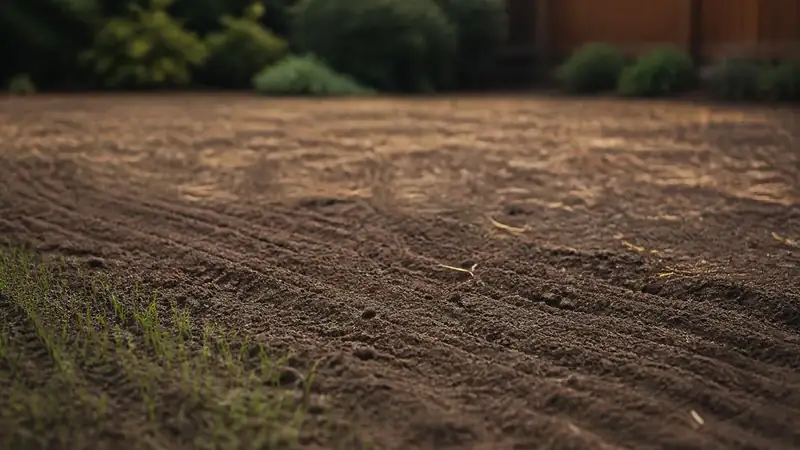
| Rake seed 1/4 in. under, then roll | Puts most seed out of sight | Strong: dragging covers most seed with about 1/4 in. of soil (Penn State); UMD says covering improves germination | $0 with a leaf rake you own | Over 1/2 in. of soil blocks the light seed needs (UMD) |
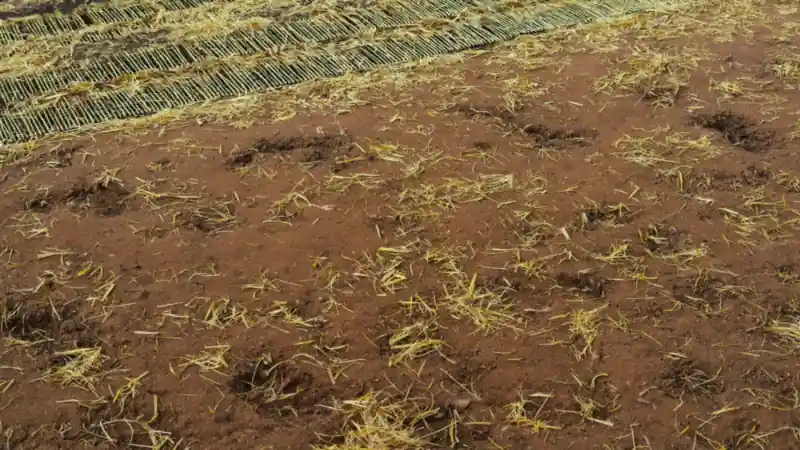
| Straw, 1 bale | Hides seed, holds moisture | Extension standard: a light cover that stays put (Purdue AY-3); one 50 lb bale covers about 1,000 sq ft (UT) | $11.95 (Kurtz Bros.) | Use straw, not hay: hay carries weed seed |
| Straw, 80 to 100 lb (about 3 bales) | Heavier cover where you cannot water often | Penn State and UMD rate; Kurtz Bros. sells 3 bales per 1,000 sq ft | $35.85 | Penn State: too much straw smothers seedlings and invites disease |
| Chopped straw with guar tackifier | Sticks to soil in wind | Maker coverage only: 1 bale per 500 sq ft (Kurtz Bros.); no bird trial | $27.98 (2 bales at $13.99) | No published test on birds |
| Peat moss or compost, 1/8 to 1/4 in. | Thin cover over seed | UT W160-B: gives many of straw’s benefits | 10.4 to 20.8 cu ft; compressed peat is $24 per 3 cu ft bale (Kurtz Bros.) | Keep it under 1/4 in. (UMD) |
| Floating row cover, Agribon AG-19 | Physical barrier, 85% light through | Recommended for hiding seed from birds (UMD); 0.55 oz per sq yd (Johnny’s) | $52.50 (two 10 x 50 ft rolls at $26.25), reusable | Staple the edges; lift it when grass pushes against it (UMD) |
| Cheesecloth, grade 10 | Barrier that biodegrades | UMD: open-weave cotton cheesecloth can be left in place | $83.26, prorated from $59.95 for 720 sq ft (BurlapFabric.com) | Rips in wind if not stapled |
| Burlap, 10 oz | Barrier | No bird trial; Penn State says remove covers soon after germination | $259.90 (two 40 in. x 50 yd rolls at $129.95, BurlapFabric.com) | Costliest cover; heavy weave shades seedlings |
| Erosion control blanket | Fiber mat stapled over seed | Built for slopes; snakes die in fixed plastic mesh (Kapfer and Paloski, 2011) | See our erosion guide | Pick loose-weave natural-fiber netting |
| Bird netting, 0.79 in. polypropylene | Barrier if raised above the soil | Most effective deterrent in orchards, but a wildlife hazard (Rivadeneira et al., 2018); UMD advises against mesh | $49.97, prorated from $69.96 for 1,400 sq ft (Tenax) | Entangles birds and snakes |
| Mulch-coated (encapsulated) seed | Seed hidden inside a coat | Sparrows made 688 feeding visits to bare seed vs 145 to coated (Marks et al., 2002) | See our grass seed cost page | Coating can be 35% of the bag weight, so fewer seeds per pound |
| Methyl anthranilate spray (Avian Control, EPA Reg. No. 88889-1) | Taste irritant on turf | Label covers lawns (EPA label); crop results mixed (Rivadeneira); no grass-seed trial found | $0.53 to $1.85 per spray, after $122.50 for a half gallon (Animal Traps and Supplies) | Repeat as long as birds persist (label) |
| Reflective tape | Flash and rustle | Weak: works until birds habituate (Rivadeneira); a 1989 cornfield study was titled “Reflecting tapes fail to reduce blackbird damage” | $13.51 per 25 ft roll (Bird-X Irri-Tape) | Use only with a cover |
| Ultrasonic repeller | Sound above 20 kHz | None: no bird species has shown sensitivity above 20 kHz (Beason, USDA NWRC, 2004) | Not worth any price | Birds cannot hear it |
| Feeder or decoy food elsewhere | Draws birds away | No turf trial found | Cost of the bird seed | Untested; may hold a flock nearby |
| Sow 10% extra seed | Replaces what is lost | Same logic as Penn State’s pure-live-seed correction (Penn State) | $1.40 to $3.99 for 0.7 lb of tall fescue | Penn State: overly dense stands raise disease and scalping |
Covers win on both counts. One $11.95 straw bale or $52.50 of reusable row cover protects 1,000 sq ft, while the evidence for tape, decoys and ultrasonic boxes ranges from short-lived to none. If you already own a rake and a lawn roller, the cheapest step on the list is free. Our step-by-step on how to plant grass seed covers soil prep and watering; this page sticks to birds.
Do birds eat enough grass seed to matter?
Sometimes, but the numbers favor you. In the Green Bay sparrow trial, 10 house sparrows caught in mist nets were caged singly in 12 sq ft pens and offered two trays for 10-minute rounds: a blend of 20 percent each Cannon and Kenblue Kentucky bluegrass, Silverlawn creeping red fescue, Raymond chewings fescue and SR4010 perennial ryegrass, bare in one tray and encapsulated in the other. Across 290 observations over 12 days, birds fed on the coated seed on about 21 percent as many visits.
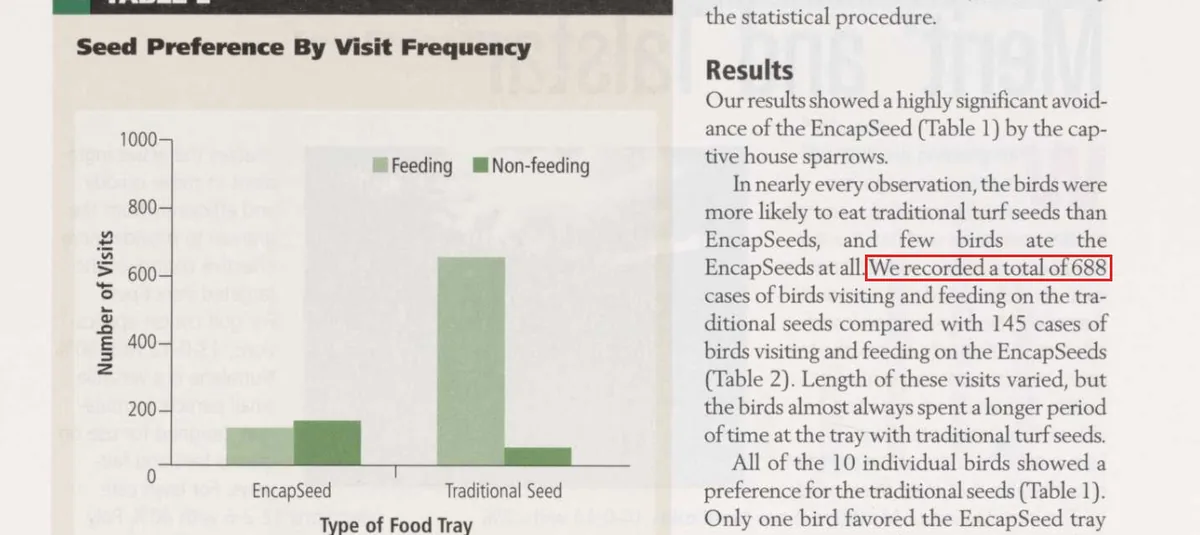
Read it with its limits: 10 captive birds, a choice between two trays, and one coating product (EncapSeed, a paper-fiber mulch coat with fertilizer). The authors called field testing the next step, and we found no later field trial on lawn seed. What it does show is a 4.7 to 1 preference for bare seed, which matches the extension advice to hide seed (UMD).
| Grass | Seeding rate, lb per 1,000 sq ft (UT) | Seeds per lb (USDA PLANTS) | Seeds per sq ft | Seeds per sq in. | Days to germinate (UT) |
|---|---|---|---|---|---|
| Kentucky bluegrass | 1.5 to 2 | 1,389,840 | 2,085 to 2,780 | 14.5 to 19.3 | 14 to 21 |
| Red (fine) fescue | 3 to 5 | 454,087 | 1,362 to 2,270 | 9.5 to 15.8 | 6 to 14 |
| Tall fescue | 5 to 8 | 205,720 | 1,029 to 1,646 | 7.1 to 11.4 | 6 to 12 |
| Perennial ryegrass | 4 to 6 | 240,400 | 962 to 1,442 | 6.7 to 10.0 | 3 to 7 |
| Bermudagrass, hulled | 0.5 to 1 (double for unhulled) | 2,071,120 | 1,036 to 2,071 | 7.2 to 14.4 | 10 to 20 (unhulled 14 to 21 or longer) |
Here is the worked case. A 5,000 sq ft tall fescue lawn at 7 lb per 1,000 sq ft takes 35 lb of seed, about 7.2 million seeds or 1,440 per square foot. If birds took 1 seed in 10, about 1,296 per square foot would remain, still above the 1,029 that UT’s low rate sows. Replacing that 10 percent costs 0.7 lb per 1,000 sq ft, or $1.40 to $3.99 at the per-pound prices on our grass seed cost page.
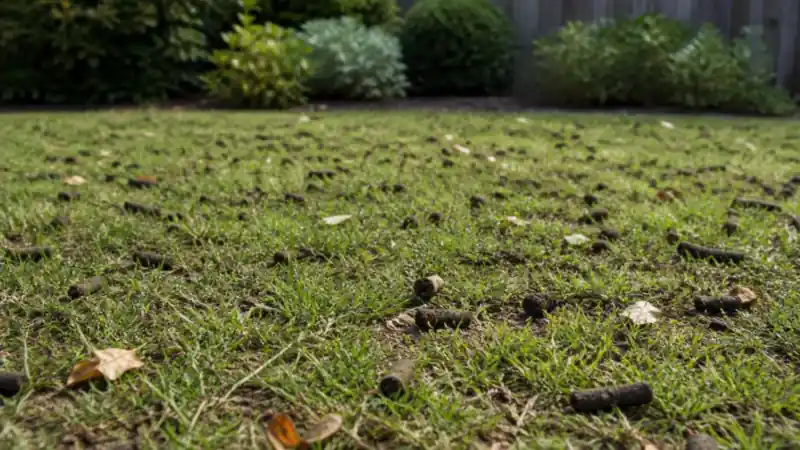
The damage that does show up is patchy: seed left on the surface where a flock feeds, or a slope where rain moves it. That is why every extension source here starts with soil contact. Penn State warns against just piling on more seed, because excessively dense stands bring disease and mower scalping, so cap any margin at about 10 percent.
Birds are one of four ways surface seed is lost; our guide to grass seed left on top of soil covers drying, washing and thatch as well.
Which birds eat grass seed, and which are hunting worms?
Seed eaters walk the seedbed; worm hunters probe it. The Missouri Department of Conservation says mourning doves eat mainly seeds and swallow them whole while walking yards, which makes them the likeliest seed takers on a new lawn. Robins look guilty but are not eating seed.
| Bird | What it eats (Missouri Dept. of Conservation) | Federal status | What that means for your seedbed |
|---|---|---|---|
| Mourning dove | Mainly seeds, swallowed whole, picked up while walking in yards | Protected (50 CFR 10.13) | Cover the seed; do not trap or harm |
| House sparrow | Grain crop and weed seeds, fruits, insects, crumbs | Not covered: family Passeridae (85 FR 21262) | The bird in the coated-seed trial; listed on the Avian Control label |
| House finch | Seeds of sunflowers, grasses and more; insects, berries, buds | Protected | Listed on the Avian Control label |
| Dark-eyed junco | Many kinds of seeds on or near the ground | Protected | A winter resident in Missouri, so it meets late-fall and dormant seedings |
| European starling | Grubs and soil animals it probes for; also berries and seeds | Not covered: family Sturnidae (85 FR 21262) | Probing often means grubs, not seed |
| American robin | Earthworms, grubs, other insects, fruits and berries | Protected | Not a seed eater; leave it alone |
| Rock pigeon | Not described on the MDC page | Not covered: on the nonnative list (85 FR 21262) | Listed on the Avian Control label |
The robin row answers a common question. MDC says robins run, stop and pull earthworms from the ground, and a freshly watered seedbed is soft enough to make that easy. Starlings that leave rows of small probe holes are after grubs; our lawn grubs page covers when grub counts justify treatment.
This page is general information, not legal or pesticide-use advice. Most native birds are protected under federal law and many state laws. The label is the law: use any repellent only on the sites and at the rates its EPA-accepted label lists.
Which cover should you use?
1Is the area steeper than 3:1 or does water run across it?
YesUse a stapled erosion blanket with loose-weave natural-fiber netting, or hydromulch. Skip loose straw.
NoGo to the next question
2Is it a patch under about 500 sq ft?
YesRake seed 1/4 in. under, then staple a row cover or cotton cheesecloth over it. Lift row cover when grass touches it.
NoGo to the next question
3Can you water only once a day or less?
YesSpread 80 to 100 lb of clean straw per 1,000 sq ft, thin enough that some soil shows.
NoGo to the next question
4Are doves or sparrows feeding on bare seed right now?
YesAdd straw or row cover now. Use tape only as an extra, and skip ultrasonic devices.
NoRake seed 1/4 in. under, roll, and spread 1 bale of straw per 1,000 sq ft. Keep it in place until the grass is up.
Extension services disagree on straw by a factor of 3. Purdue AY-3 calls 1 bale per 1,000 sq ft a light cover that will not have to be removed, Tennessee says one 50 lb bale covers about 1,000 sq ft with 50 to 75 percent of the soil hidden, and Penn State and Maryland use 80 to 100 lb. Purdue adds that mulch matters most where you cannot irrigate, so use 1 bale if you can water 2 to 4 times a day and go heavier if you cannot.
Row cover and cheesecloth are the barrier options UMD names for hiding seed from hungry birds. Tack the edges with landscape staples against wind, water straight through, and remove a row cover as soon as the young grass pushes up against it. Agribon AG-19 passes 85 percent of light at 0.55 oz per sq yd (Johnny’s Selected Seeds), and UMD says cotton cheesecloth, straw and excelsior biodegrade and can stay.
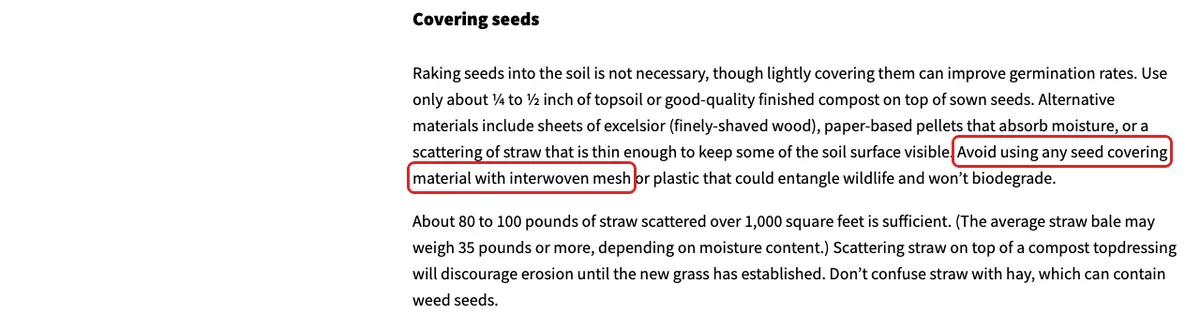
Skip plastic mesh on a lawn. UMD tells readers to avoid seed covers with interwoven mesh or plastic that could entangle wildlife, and Kapfer and Paloski documented Wisconsin cases in erosion matting, including 16 snakes cut free and 6 found dead along the Menominee River in mesh with roughly 1.27 to 1.90 sq cm openings.
On slopes, a stapled blanket or sprayed hydromulch does the job straw cannot. Our erosion control methods guide lists blanket classes by grade, and hydroseeding cost prices the sprayed option, which covers seed in a fiber slurry the moment it lands.
Do repellent sprays, reflective tape and noise work?
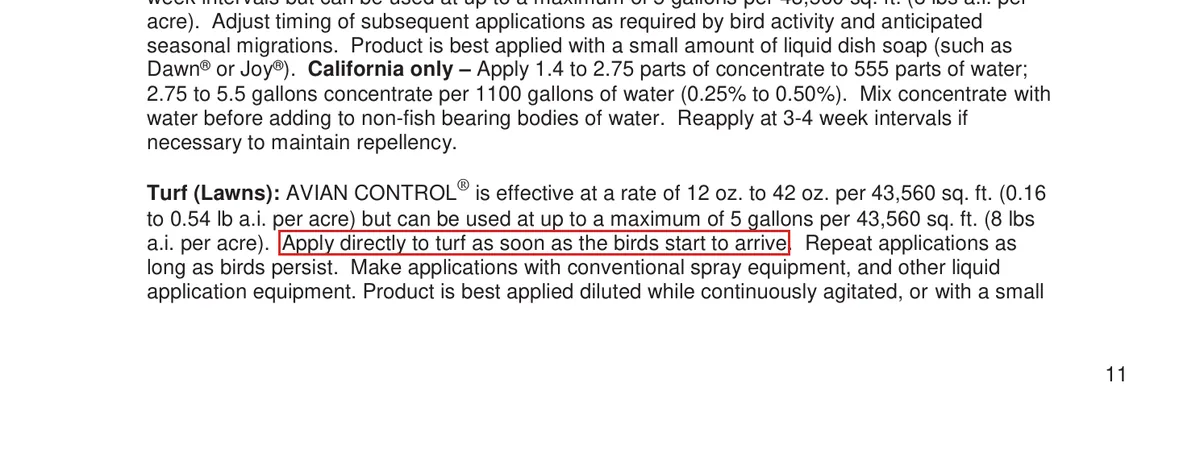
Only one product type here is an EPA-registered pesticide with lawns on its label. Avian Control, EPA Reg. No. 88889-1, is 20 percent methyl anthranilate. Its home-use directions list Turf (Lawns) at 12 to 42 fl oz per acre, about 0.28 to 0.96 fl oz per 1,000 sq ft, applied as birds arrive and repeated as long as they persist. Its target list names house sparrow, house finch, starlings, pigeons, grackles and crows; mourning doves are not on it.
The research is mixed. A 2018 Vertebrate Pest Conference review cites one study where methyl anthranilate cut grape and berry losses by 88 to 99 percent and another where it failed against fruit-eating birds in the northeastern U.S. We found no trial on lawn seed, and at $122.50 for a half gallon it costs more up front than straw for a typical yard.
Visual and sound scares fade. The same review says flashing lights, reflective tape, scarecrows and predator models work for a short time until birds habituate, and do best paired with netting or noise. A 1989 Wildlife Society Bulletin paper by Conover and Dolbeer was titled “Reflecting tapes fail to reduce blackbird damage to ripening cornfields.” A $13.51 roll of tape is fine as an extra for the 3 to 21 days seed sits exposed, never as the only defense.
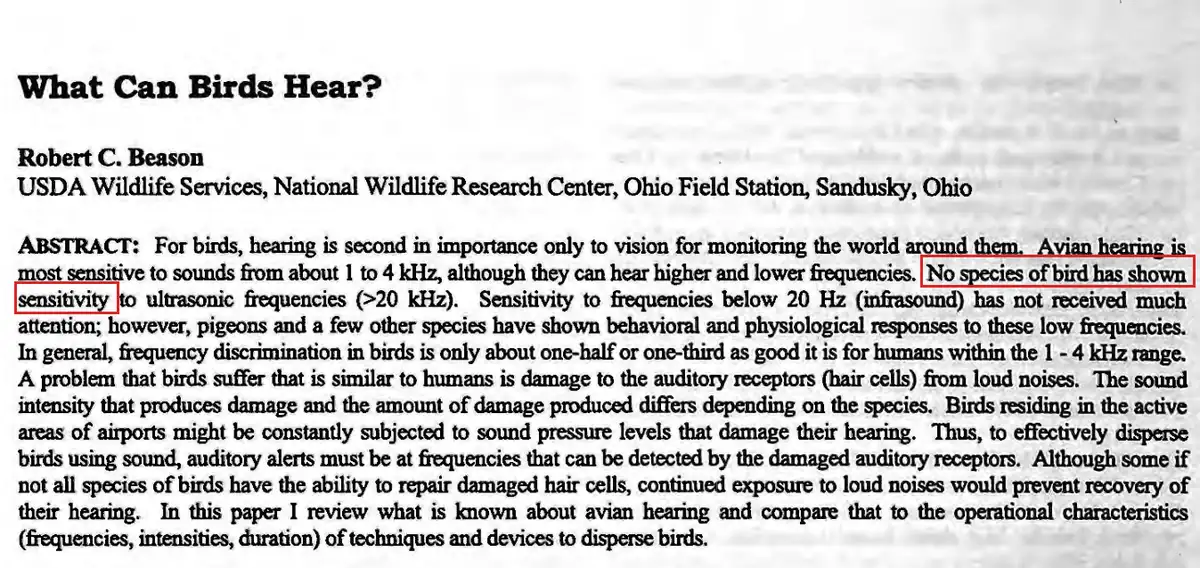
Ultrasonic boxes fail on physics. Robert Beason of the USDA National Wildlife Research Center found bird hearing most sensitive at 1 to 4 kHz and wrote that no bird species has shown sensitivity to ultrasonic frequencies above 20 kHz (Beason, 2004).
Does coated grass seed stop birds?
Only some coatings were tested. The sparrow trial used a thick mulch coat, and birds avoided it. Pennington’s Zenith zoysia label describes Penkoted seed differently: a coating that controls damping-off and other seedling diseases and attracts moisture, with no claim about birds.
Coatings also dilute the seed. One Pennington Smart Blend label says the bag contains up to 35 percent coating material and warns not to let children, pets or livestock reach the treated seed. At 35 percent coating, a pound holds about 0.65 lb of seed, so follow the bag rate, not a raw-seed rate. Coated seed prices sit on our grass seed cost page.
How long does grass seed need protecting?
Until it germinates and roots, which is 3 to 7 days for perennial ryegrass and 14 to 21 for Kentucky bluegrass in UT W160-B; unhulled bermudagrass can take 14 to 21 days or longer. Our grass seed germination time page has the days by grass and soil temperature. Straw at 1 bale per 1,000 sq ft can stay; lift row cover once grass presses against it (UMD).
Season changes the exposure. A fall seeding meets juncos, which MDC lists as a winter resident that forages for seeds on or near the ground, and a dormant seeding can sit for months before spring warmth. For overseeding into an existing lawn, the turf canopy hides some seed; our overseeding guide uses half the new-lawn rate.
Price your cover
- Straw bales, light cover (1 per 1,000 sq ft)
- 1.0
- Straw bales, heavy cover (3 per 1,000 sq ft)
- 3.0
- Row cover, 10 x 50 ft rolls
- 2.0
- Tall fescue seed at 7 lb per 1,000 sq ft (lb)
- 7.0
- Tall fescue seeds sown at that rate
- 1,440,000
Default: 1,000 sq ft of straw, $11.95 to $35.85. Prices checked Nov. 8, 2026; excludes tax, shipping and staples. Estimate only; the label is the law for any repellent.
The calculator multiplies your area by the per-square-foot range for one method at Nov. 8, 2026 prices. The default is 1,000 sq ft of straw at 1 to 3 bales, $11.95 to $35.85. Bales, row cover rolls and tall fescue seed counts are listed under the result.
How we compiled this
On Nov. 8, 2026 we read 5 extension publications, 1 controlled bird-feeding study, 3 Vertebrate Pest Conference and herpetology papers, 1 EPA-accepted label, 2 Pennington seed labels, the federal bird lists and 6 Missouri field guide pages, and pulled seed counts for 5 grasses from USDA PLANTS. Prices come from 8 retailer pages read the same day. Seeds per square foot and costs are our arithmetic. We ran no field trials and observed no birds.
Frequently asked questions
What can I put over grass seed to protect it from birds?
Clean straw at 1 bale per 1,000 sq ft (Purdue AY-3), a floating row cover or open-weave cotton cheesecloth stapled at the edges (UMD), or 1/8 to 1/4 inch of peat or compost (UT). Avoid plastic mesh, which can trap birds and snakes.
What smell do birds hate the most?
No scent has been shown to keep birds off lawn seed. The one registered lawn repellent we found, methyl anthranilate (Avian Control, EPA Reg. No. 88889-1), is a taste irritant sprayed on turf. USDA researcher Robert Beason ranks hearing second only to vision for birds.
Do robins eat grass seed?
Not as a rule. The Missouri Department of Conservation lists earthworms, grubs, other insects, fruits and berries as robin food. Robins on a new seedbed are usually pulling worms from the soft, watered soil.
Will birds eat grass seed with fertilizer?
We found no study showing fertilizer alone deters birds. The coated seed sparrows avoided in the 2002 Green Bay trial held fertilizer inside a thick mulch coat, so the coat, not the fertilizer, is what was tested.
How long do birds eat grass seed for?
Until it sprouts: about 3 to 7 days for perennial ryegrass, 6 to 12 for tall fescue and 14 to 21 for Kentucky bluegrass (UT W160-B). Keep it covered for that window.
Do birds like coated grass seed?
Less than bare seed in the one test we found: 10 captive house sparrows made 688 feeding visits to bare seed and 145 to mulch-coated seed. Thin fungicide coatings such as Penkote carry no bird claim on Pennington’s label.
Sources
- Marks, D.R., Japuntich, R.D. and Howe, R.W., Protective Seed Coating Aids Turf Establishment, TurfGrass Trends, June 2002. Accessed November 2026.
- University of Tennessee Extension, W160-B: Establishing a Lawn From Seed, PDF. Accessed November 2026.
- Purdue Extension, AY-3: Establishing Lawns From Seed, PDF. Accessed November 2026.
- Penn State Extension, Lawn Establishment, updated Sept. 19, 2025. Accessed November 2026.
- University of Maryland Extension, Starting a New Lawn, current page. Accessed November 2026.
- USDA NRCS PLANTS Database, Tall fescue characteristics: seed per pound (also POPR, LOPE, FERU2, CYDA), current database. Accessed November 2026.
- U.S. EPA, Accepted label, Avian Control Bird Repellent, EPA Reg. No. 88889-1, March 13, 2015. Accessed November 2026.
- Rivadeneira, P. et al., Proceedings of the Vertebrate Pest Conference 28, A Review of Bird Deterrents Used in Agriculture, 2018. Accessed November 2026.
- Beason, R.C., USDA APHIS Wildlife Services NWRC, Proceedings of the Vertebrate Pest Conference 21, What Can Birds Hear?, 2004. Accessed November 2026.
- Kapfer, J.M. and Paloski, R.A., Herpetological Conservation and Biology 6(1), On the Threat to Snakes of Mesh Deployed for Erosion Control and Wildlife Exclusion, 2011. Accessed November 2026.
- U.S. Fish and Wildlife Service, 85 FR 21262, List of Bird Species To Which the Migratory Bird Treaty Act Does Not Apply, April 16, 2020. Accessed November 2026.
- eCFR, 50 CFR 10.13, List of Migratory Birds, current text. Accessed November 2026.
- Missouri Department of Conservation, Field guide: mourning dove, house sparrow, house finch, dark-eyed junco, European starling, American robin, current pages. Accessed November 2026.
- Pennington Seed, Zenith Zoysia Grass Seed and Mulch label (Penkoted seed), label PDF. Accessed November 2026.
- Pennington Seed, Smart Blend Fall Overseeding Mixture label, 2018 label PDF. Accessed November 2026.
- Kurtz Bros., Straw Bale, $11.95; StrawMax Bale with Tackifier, $13.99; Peat Moss Bale, $24.00, checked Nov. 8, 2026. Accessed November 2026.
- Johnny’s Selected Seeds, Agribon+ AG-19, 10 x 50 ft row cover, $26.25, checked Nov. 8, 2026. Accessed November 2026.
- BurlapFabric.com, Grade 10 cheesecloth, 36 in. x 80 yd, $59.95, checked Nov. 8, 2026. Accessed November 2026.
- BurlapFabric.com, 40 in. burlap roll, 50 yd, 10 oz, $129.95, checked Nov. 8, 2026. Accessed November 2026.
- Tenax, Ornex LM bird netting, 14 x 100 ft, 0.79 in. mesh, $69.96, checked Nov. 8, 2026. Accessed November 2026.
- Animal Traps and Supplies, Avian Control 20% methyl anthranilate, 1/2 gal, $122.50, checked Nov. 8, 2026. Accessed November 2026.
- Bird-X, Irri-Tape, 25 ft roll, $13.51, checked Nov. 8, 2026. Accessed November 2026.