Will ammonia kill weeds? It burns the leaves it soaks, but it is not a weed killer: household ammonia has no label rate, perennial roots regrow, and one cup poured on a square foot carries 21 to 43 times a lawn feeding’s nitrogen.
Household ammonia is ammonia gas dissolved in water, typically 5 to 10 percent ammonia according to the CDC’s Agency for Toxic Substances and Disease Registry; one widely sold bottle, Parsons All-Purpose, lists 4 to 5 percent on its safety data sheet with a pH of 11 to 12. Poured on a weed, that alkaline solution scorches the green tissue it wets. What it leaves behind is nitrogen, the same nutrient in the nitrogen fertilizers sold for lawns.
None of the first-page results we read for this question does the arithmetic, so we did: a cup of 5 percent ammonia holds 9.7 g of nitrogen, a cup of 10 percent holds 19.5 g. Concentrated on 1 sq ft, that is 21 to 43 lb of nitrogen per 1,000 sq ft, against the 1.0 lb that Purdue Extension AY-22 sets as the limit for one quick-release lawn feeding. That is why the grass around a doused weed browns too, the same injury as a fertilizer spill that burns a lawn.
How much nitrogen is in a cup of household ammonia?
Our arithmetic: 1 US cup is 236.6 mL, household ammonia weighs about the same as water (specific gravity 0.99 to 1.00 on the Parsons SDS), and ammonia (NH3) is 82.2 percent nitrogen by mass. Multiply volume by strength by 0.822 and the table below follows. The last column is the area one cup would cover at Purdue’s 1.0 lb cap.
| Ammonia in the bottle | NH3 per cup | Nitrogen per cup | On 1 sq ft, as lb N per 1,000 sq ft | Times Purdue’s 1.0 lb cap | Area one cup feeds at the cap |
|---|---|---|---|---|---|
| 4% (low end, Parsons SDS) | 9.5 g | 7.8 g (0.017 lb) | 17.2 | 17x | 17 sq ft |
| 5% (low end, ATSDR range) | 11.8 g | 9.7 g (0.021 lb) | 21.4 | 21x | 21 sq ft |
| 6.7% (the online “2 parts ammonia to 1 part water” mix, from a 10% bottle) | 15.8 g | 13.0 g (0.029 lb) | 28.6 | 29x | 29 sq ft |
| 7.5% | 17.7 g | 14.6 g (0.032 lb) | 32.2 | 32x | 32 sq ft |
| 10% (high end, ATSDR range) | 23.7 g | 19.5 g (0.043 lb) | 42.9 | 43x | 43 sq ft |
Colorado State Extension’s Tony Koski ran the same check on a popular lawn tonic: half a cup of household ammonia sprayed over 250 sq ft supplies about 0.1 lb of N per 1,000 sq ft (CSU Extension, 2013). Our formula gives 0.04 to 0.09 lb for that recipe at 5 to 10 percent strength, so the two estimates agree. Spread thin, ammonia is a weak fertilizer; poured on one spot, it is a heavy overdose.
- Nitrogen, lb per 1,000 sq ft (Purdue cap for one quick-release feeding: 1.0)
- 21.45
- Nitrogen, grams per sq ft
- 9.73
Default: 1 cup of 5% ammonia on 1 sq ft = 21.45 lb N per 1,000 sq ft, 21 times Purdue AY-22's 1.0 lb cap. Cups x 236.6 mL x strength x 0.822 (N share of NH3), treating the liquid as 1 g per mL. Check the percentage on your bottle's SDS.
Why the leaves brown and the roots come back
Two things injure the plant. Free ammonia is toxic to plant tissue, and Illinois Extension notes the toxic form increases when the mix or the soil is alkaline (pH 7 or higher), which a pH 11 to 12 cleaner guarantees. Farm data show the same pattern underground: Nebraska CropWatch reports that anhydrous ammonia can damage germinating seed when the band is within 4 to 6 inches of the row, and that it raises soil pH sharply around the band, which can injure nearby roots.
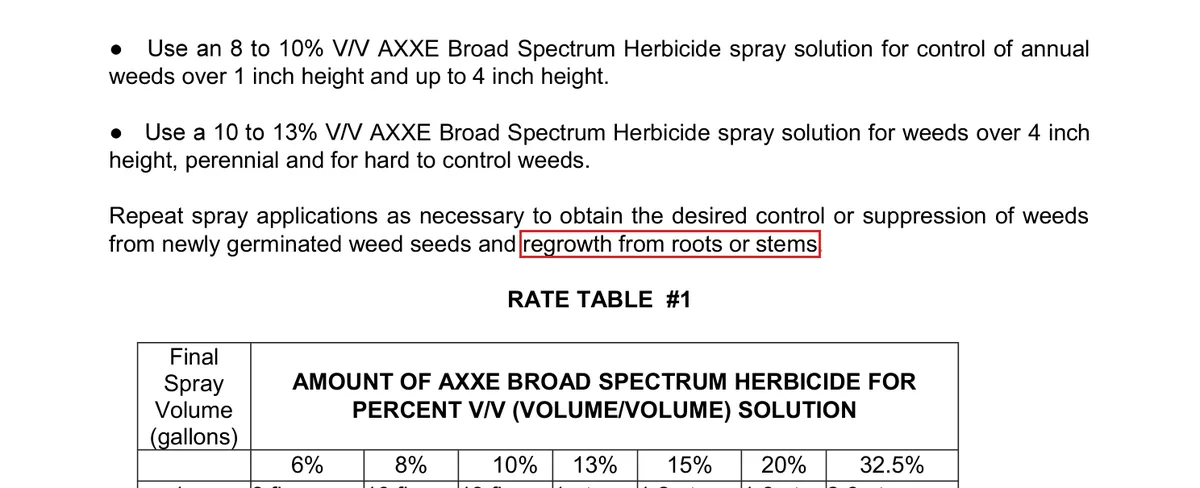
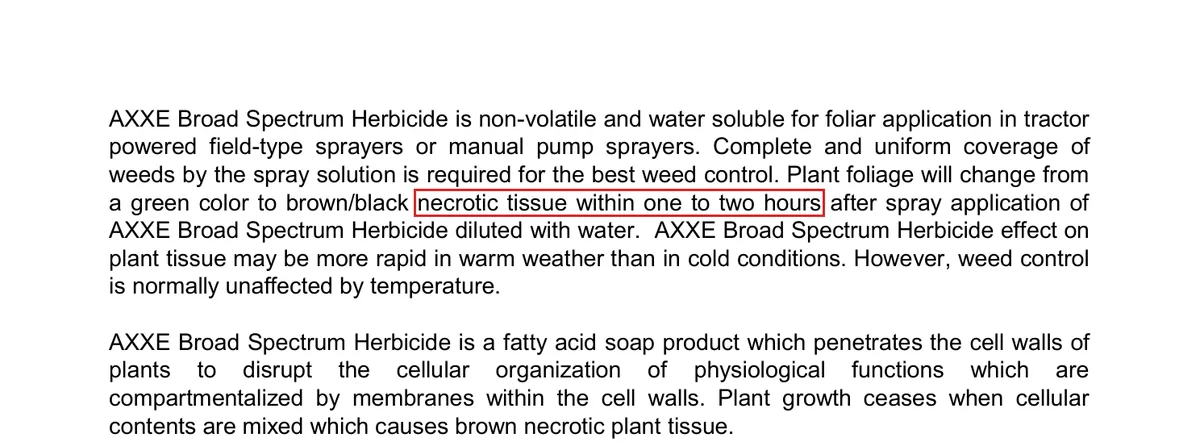
That injury is local and short-lived. Illinois points out that ammonia vaporizes from an open mix, and soil microbes turn what stays into plant-available nitrogen. A dandelion taproot or a bindweed rhizome outside the burned zone is then sitting in fertilized soil. Even the registered ammonium-based contact herbicides admit this: the AXXE label (EPA Reg. No. 70299-23) tells users to repeat sprays for “regrowth from roots or stems”, and NC State’s Scythe and Axxe factsheet says older annual and perennial weeds keep living stems after the foliage dies.
We found no extension or university trial that sprayed household-strength ammonia on lawn or garden weeds and measured kill or regrowth. Every “kills to the root” or “permanently” claim we found in the results traces back to recipe posts, not data.
Household ammonia vs the ammonium products that are registered
“Ammonia” or “ammonium” appears on several bottles in a garden center, and most of them do something different. The table below lists 10, with what the California pesticide label database or the EPA-stamped label says. In the herbicides that work fastest, the fatty acid does the killing: a gallon of AXXE mixed at its 6 percent rate holds about 7.2 g of nitrogen, less than one cup of 5 percent cleaner (our arithmetic: 0.198 lb ammonium nonanoate at 8.0 percent N).
| Product | Active ingredient | Strength | What it does to weeds | Regrowth | Registered as a herbicide? | Source |
|---|---|---|---|---|---|---|
| Household ammonia (e.g. Parsons All-Purpose) | Ammonia in water | 4 to 10% | Burns wetted leaves; leftover N feeds what survives | Not studied; label gives no weed rate | No. Not on the 40 CFR 152.25(f) minimum-risk list | Parsons SDS; eCFR |
| AXXE Broad Spectrum Herbicide (70299-23) | Ammonium nonanoate | 40% concentrate, 3.3 lb/gal; spray 6 to 13% v/v | Leaves turn brown/black in 1 to 2 hours | Label: repeat for regrowth from roots or stems | Yes, agricultural and residential sublabels | EPA label |
| BioSafe Weed & Grass Killer (70299-25) | Ammonium nonanoate | 40% concentrate; spray 6 to 13% v/v by weed height | Same 1 to 2 hour burndown; spot sprays allowed in turf and ornamentals | Label: repeat for regrowth | Yes, residential | Label via WSU PICOL |
| Ortho GroundClear Organics Weed & Grass Killer (239-2754) | Ammonium nonanoate | 40% concentrate | Contact, non-selective weed and grass killer | Contact only; EPA lists no soil activity for this active | Yes, active in California | CDPR record |
| FL-AN405F (79766-4) | Ammonium nonanoate | 5% ready to use, 0.42 lb/gal | Contact spray or burndown of weeds and grasses | Contact only; non-systemic per EPA | Yes | EPA label |
| Finale (7969-444) | Glufosinate-ammonium | 11.33%, 1 lb ai/gal | Annual and perennial broadleaves, grasses, sedges; symptoms in 2 to 4 days | Label: regrowth may occur; delay turf seeding 7 days | Yes, professional | EPA label |
| Spray-grade ammonium sulfate (AMS) | Ammonium sulfate | 8.5 to 17 lb per 100 gal of spray | Nothing alone; offsets hard-water calcium and magnesium that weaken glyphosate | Not a herbicide | Adjuvant on glyphosate labels | Iowa State; Crop Protection Network |
| Ammate X-NI | Ammonium sulfamate | Brush and stump killer | Contact herbicide for woody plants and perennials | Not applicable | No longer: discontinued by DuPont in 1988 | EXTOXNET, 1996 |
| Anhydrous ammonia | NH3, 82% N | Injected farm fertilizer | Injures seed and roots near the band (high pH) | Not a weed control | No (fertilizer) | UNL CropWatch |
| Hinder (5481-508) | Ammonium soaps of fatty acids | Repellent | Repels deer; does not kill weeds | Not applicable | Registered as a repellent | EPA SLN file |
EPA’s 2006 ammonium nonanoate fact sheet described sprays of up to 6.0 percent by weight of the first 40 percent product, Racer; AXXE’s current weed-height table runs from 6 to 8 percent v/v for weeds 1 inch or less to 10 to 13 percent above 4 inches. These products still do only what household ammonia does to the top of a perennial, faster and at a known dose. For lawn weeds that need a selective herbicide, our guide to choosing a lawn weed killer by label lists which ones spare turf.
What happens if you pour ammonia on grass?
Dilute, it greens; concentrated, it burns. Spread at the CSU tonic rate the grass gets about 0.1 lb of N per 1,000 sq ft, a small fraction of a Purdue feeding of 0.33 to 1.0 lb, and Koski still calls household ammonia “not a safe (for plants anyway) fertilizer source”. Poured from the bottle, a cup on a 1 sq ft spot is 17 to 43 times the cap, which leaves a brown patch.
If you spilled ammonia on a lawn, soak the spot with water right away to dilute it, then judge it after 7 to 10 days, the time Purdue gives turf to respond to ammonium nitrogen. Grass with firm crowns usually pushes new leaves; turf that pulls up with no roots needs reseeding, the steps our fertilizer burn repair guide lays out.
Is it legal to use ammonia as a weed killer?
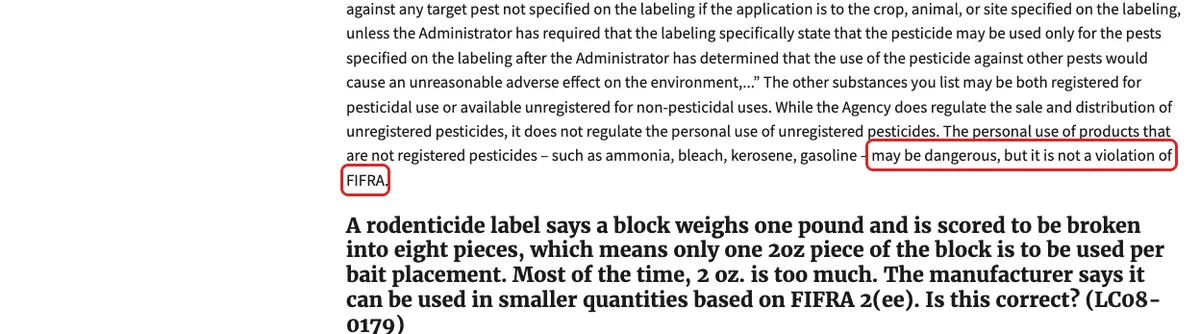
For a homeowner, federal law does not forbid it. In its pesticide labeling questions and answers, EPA states that the personal use of products that are not registered pesticides, naming ammonia, bleach, kerosene and gasoline, may be dangerous but is not a violation of FIFRA (EPA, updated April 13, 2026). The limits fall on everyone else.
- Selling it as a weed killer: 7 U.S.C. 136j(a)(1)(A) makes it unlawful to sell or distribute an unregistered pesticide, and ammonia is not among the active ingredients allowed in exempt minimum-risk products at 40 CFR 152.25(f).
- Spraying it for pay: UF/IFAS EP580 says it is illegal for commercial applicators to apply homemade herbicides as part of a landscape contract, and most states require a license for any weed control done for hire; our pesticide applicator license guide for lawn care lists the rules by state.
- State and local rules can be stricter than FIFRA, so check with your state pesticide agency before treating near water or on property you do not own.
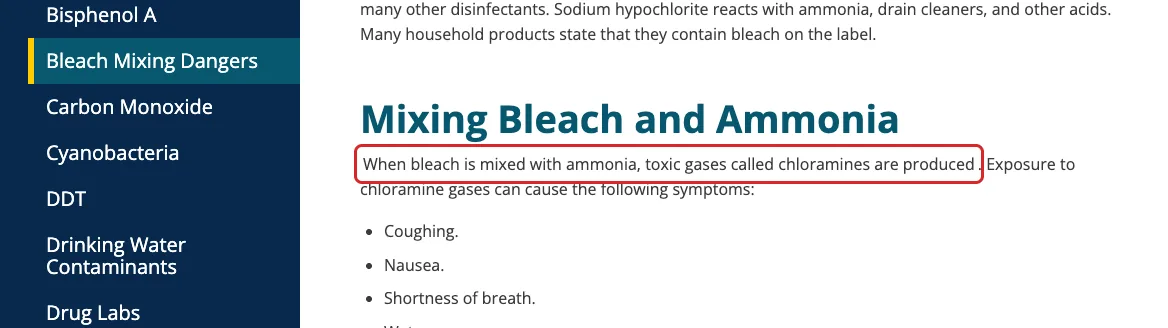
Never mix ammonia with bleach, in a sprayer or a bucket. The Washington State Department of Health says the combination produces chloramine gases that cause coughing, shortness of breath, chest pain and, at worst, pneumonia and fluid in the lungs. Our page on what bleach does to weeds and grass quotes a bleach label warning against ammonia for the same reason. If anyone breathes the fumes, call Poison Control at 1-800-222-1222.
Ammonia weed killer claims, checked
| Claim in recipe posts | What the primary source says | Source |
|---|---|---|
| Ammonia kills weeds “to the root” and stops regrowth | Even registered ammonium nonanoate labels say to repeat sprays for regrowth from roots or stems | AXXE label; NC State |
| A 2:1 ammonia and water spray is a safe natural herbicide | A cup of that mix from a 10% bottle holds 13.0 g N, 29 times Purdue’s cap on 1 sq ft; Illinois says household ammonia is not recommended for the garden | Our arithmetic; Illinois Extension |
| Ammonium sulfate in the sprayer kills weeds by itself | It is an adjuvant at 8.5 to 17 lb per 100 gal that offsets hard water for glyphosate | Iowa State |
| Using ammonia on weeds is a federal crime | Personal use of an unregistered product is not a FIFRA violation; selling one or spraying it for hire is restricted | EPA; UF/IFAS |
| Ammonia is a free lawn fertilizer | Half a cup over 250 sq ft is about 0.1 lb N per 1,000 sq ft, and brand strengths vary | CSU Extension |
1Is bleach, or a bleach cleaner, in the same sprayer, bucket or patch?
YesStop. Bleach plus ammonia makes chloramine gas (Washington DOH). Rinse the equipment separately; call Poison Control at 1-800-222-1222 if anyone breathed fumes.
NoGo to the next question
2Is the weed in a lawn or touching plants you want to keep?
YesSkip ammonia: it burns grass too. Use a selective lawn herbicide labeled for that weed and your grass.
NoGo to the next question
3Are you spraying for a customer or under a landscape contract?
YesUse only an EPA-registered product under your state applicator license (UF/IFAS EP580).
NoGo to the next question
4Is it a perennial with a taproot or runners (dandelion, bindweed, nutsedge)?
YesContact burns, ammonia included, leave the root. Dig it out or use a systemic herbicide at the label rate.
NoGo to the next question
5Is it a small annual seedling in a crack, gravel or bare ground?
YesHand-pull, pour boiling water, or use a registered ammonium nonanoate spray at its label rate (6 to 8% v/v for weeds 1 inch or less).
NoPull it or mulch over it; household ammonia gives no measured dose and adds nitrogen.
Source: AXXE label 70299-23; NC State; UF/IFAS EP580; Washington State DOH
For weeds in cracks and gravel, a registered contact spray at the label rate, boiling water or hand pulling gives the same top kill without the nitrogen; what vinegar weed killers burn and miss covers the acetic acid option. For perennials, only a systemic herbicide moves into the root; our explainer on contact versus systemic herbicides shows which groups do that. On lawn weeds, fertilizer alone does not kill weeds at lawn rates, ammonia included. Lime is a separate question, covered in our check of whether lime kills weeds.
This page is general information, not legal, medical or pesticide advice. The label is the law: follow the rate, site list and protective equipment on the registered product in your hand.
How we compiled this
In November 2026 we read 24 primary documents: EPA-stamped labels for AXXE, FL-AN405F and Finale, the BioSafe label on WSU PICOL, California DPR records for 10 ammonium nonanoate products, EPA’s 2006 ammonium nonanoate fact sheet, EPA’s labeling Q&A, 40 CFR 152.25 and 7 U.S.C. 136j, the Parsons SDS, ATSDR, Washington and New York health departments, and extension pages from Illinois, Colorado State, Purdue, Nebraska, Iowa State, NC State and UF/IFAS, plus the Crop Protection Network, EXTOXNET and EPA’s Hinder file. Nitrogen figures are our arithmetic from those inputs. We ran no tests; recipe posts were read only for the claims they make.
Frequently asked questions
Is vinegar or ammonia better for killing weeds?
Neither kills roots. Vinegar is the one sold as a registered herbicide: our vinegar weed killer analysis finds 20 percent acetic acid controls most young broadleaf weeds, while household ammonia has no herbicide label and leaves 9.7 to 19.5 g of nitrogen per cup. For a registered ammonium option, ammonium nonanoate browns leaves in 1 to 2 hours (AXXE label).
Does ammonia kill weeds permanently?
No published trial shows it. Perennials such as dandelion regrow from roots, and even registered ammonium nonanoate labels, such as AXXE, tell users to repeat sprays for regrowth. Permanent control of perennials takes a systemic herbicide at the label rate, repeated as the label allows, or removing the root.
What happens if you pour ammonia on grass?
Full strength, a cup on 1 sq ft is 17 to 43 times Purdue’s 1.0 lb nitrogen cap, so the patch browns like a fertilizer spill. Water it in heavily at once. Diluted to tonic strength it adds about 0.1 lb of N per 1,000 sq ft.
What animals will ammonia keep away?
No household ammonia is registered as a repellent. The registered relative is Hinder (EPA Reg. No. 5481-508), ammonium soaps of fatty acids, which carries a deer repellent use (EPA SLN file, 2024). Keep pets away from ammonia products while in use, as the New York State Department of Health advises.
Can you still buy household ammonia?
Yes. Household ammonia is still sold as a cleaner; the Parsons SDS lists 4 to 5 percent ammonia. Its label covers cleaning, not weeds, so it gives no weed rate.
Sources
- CDC, Agency for Toxic Substances and Disease Registry, Public Health Statement for Ammonia, current page. Accessed November 2026.
- Brillo (Home Depot product document), Safety Data Sheet, Parsons All-Purpose Ammonia Cleaner, printed April 26, 2019. Accessed November 2026.
- University of Illinois Extension (C. Enroth), Household ammonia cleaner as a homemade fertilizer, Aug. 4, 2023. Accessed November 2026.
- Colorado State University Extension (T. Koski), Lawn Tonics, CO-Horts blog, April 16, 2013. Accessed November 2026.
- Purdue Extension, AY-22-W, Fertilizing Established Cool-season Lawns, current PDF. Accessed November 2026.
- University of Nebraska-Lincoln CropWatch, Fertilizer nitrogen injury, 2020. Accessed November 2026.
- BioSafe Systems, EPA Reg. No. 70299-23, AXXE Broad Spectrum Herbicide label, EPA stamped, Feb. 5, 2021. Accessed November 2026.
- BioSafe Systems, EPA Reg. No. 70299-25, BioSafe Weed Control / Weed & Grass Killer label (WSU PICOL), 2018 label file. Accessed November 2026.
- Falcon Lab, EPA Reg. No. 79766-4, FL-AN405F label, EPA stamped, May 19, 2011. Accessed November 2026.
- California Department of Pesticide Regulation, Product record, Ortho GroundClear Organics Collection Weed & Grass Killer1, 239-2754-ZA, printed Nov. 19, 2026. Accessed November 2026.
- California Department of Pesticide Regulation, Label database query, ammonium nonanoate (chem code 5963), active products, Nov. 19, 2026. Accessed November 2026.
- U.S. EPA, Ammonium nonanoate (031802) Fact Sheet, Nov. 2006. Accessed November 2026.
- NC State Extension, Scythe / Axxe pesticide factsheet, current page. Accessed November 2026.
- BASF, EPA Reg. No. 7969-444, Finale herbicide label, EPA stamped, March 17, 2021. Accessed November 2026.
- Iowa State University Extension, Glyphosate review, current page. Accessed November 2026.
- Crop Protection Network, Adjuvants with herbicides: when and why they are needed, current page. Accessed November 2026.
- EXTOXNET (Oregon State University), Ammonium sulfamate pesticide information profile, revised June 1996. Accessed November 2026.
- U.S. EPA / Georgia Dept. of Agriculture, Hinder (5481-508) FIFRA 24(c) SLN GA240003, Sept. 10, 2024. Accessed November 2026.
- U.S. EPA, Pesticide Labeling Questions & Answers, updated April 13, 2026. Accessed November 2026.
- eCFR, 40 CFR 152.25, Exemptions for pesticides of a character not requiring FIFRA regulation, current. Accessed November 2026.
- Legal Information Institute, 7 U.S.C. 136j, Unlawful acts (FIFRA section 12), current code. Accessed November 2026.
- UF/IFAS Extension (C. Marble, J. Neal, A. Senesac), EP580, Use of Glyphosate and Herbicide Alternatives for Weed Control in Florida Landscape Planting Beds, Jan. 22, 2020. Accessed November 2026.
- Washington State Department of Health, Bleach Mixing Dangers, current page. Accessed November 2026.
- New York State Department of Health, Ammonia, current page. Accessed November 2026.