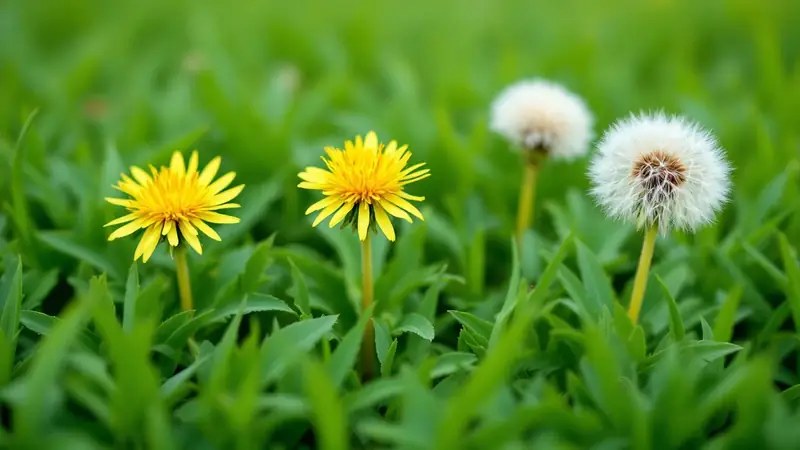
Are dandelions weeds? Only where they are unwanted. Botanically, the common dandelion (Taraxacum officinale) is a perennial flowering plant in the daisy family. Legally it is not a noxious weed: no federal list and none of 51 state seed-law lists names it.
So are dandelions weeds or flowers? Both words fit, and they answer different questions. We checked the legal side line by line: the federal noxious weed list in 7 CFR 360.200, the federal seed list in 7 CFR 201.16(b), and the January 2026 USDA State Noxious-Weed Seed Requirements for all 50 states and the District of Columbia. Dandelion appears on 0 of the 51 state lists. Quackgrass appears on 49, and Canada thistle on 47.
What makes the dandelion a weed is its biology, not a statute. One plant can set 50 to 150 seed heads a year averaging 250 seeds each (Cornell Weed Science), and a 1 inch root piece can grow a new plant (UC IPM). Which dandelion look-alikes share a lawn with it is covered in our common lawn weeds identification chart; this page weighs the label itself.
Are dandelions flowers or weeds?
A dandelion is a flower in the strict sense. Each yellow head is a composite of 100 to 300 ray florets on a hollow, leafless stalk 6 to 24 inches long (UC IPM Pest Notes), the same head structure as a daisy or sunflower in the Asteraceae family. USDA’s PLANTS Database files it as a perennial forb, native and introduced in the lower 48 states, Alaska and Canada.
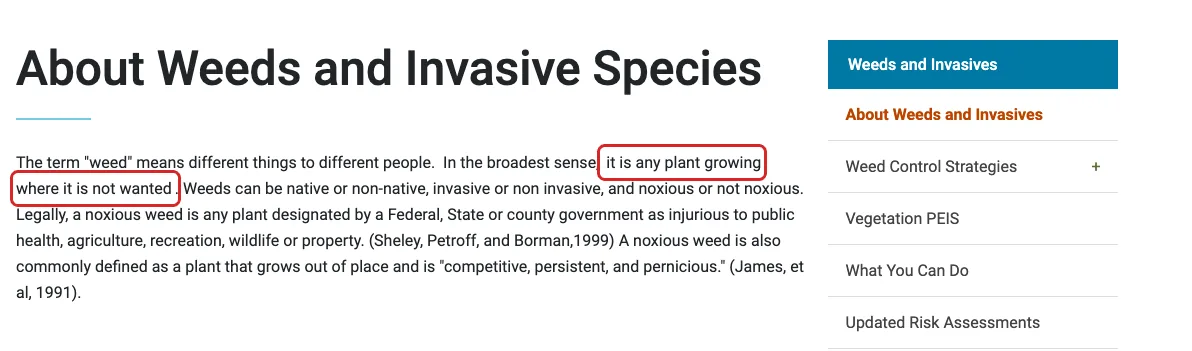
Weed is a job title, not a species. The Bureau of Land Management puts it plainly: in the broadest sense a weed is any plant growing where it is not wanted, and weeds can be native or non-native, invasive or not, noxious or not. A dandelion in a vegetable bed meets that test; the same plant in a meadow kept for early bees does not.
| Test | What it asks | Dandelion result | Source |
|---|---|---|---|
| Botany | Is it a flowering plant? | Yes: perennial forb, Asteraceae, heads of 100 to 300 florets | USDA PLANTS; UC IPM |
| Working definition | Is it growing where it is not wanted? | Depends on the site and the owner | BLM |
| Federal noxious weed list | Listed in 7 CFR 360.200? | No | eCFR, 7 CFR 360.200 |
| Federal Seed Act | Listed as a noxious-weed seed in 7 CFR 201.16(b)? | No | USDA AMS, Jan. 2026, p. 5 to 6 |
| State seed laws | On a state prohibited or restricted noxious-weed seed list? | 0 of 51 jurisdictions | USDA AMS, Jan. 2026 |
| USDA PLANTS legal status | Any state noxious status recorded? | None recorded | USDA PLANTS, TAOF |
| Native status | Native or introduced? | Both: native and introduced taxa in the lower 48, Alaska and Canada | USDA PLANTS |
Is the dandelion a noxious weed under U.S. law?
No. A noxious weed, in the Plant Protection Act definition at 7 CFR 360.100, is a plant that can injure crops, livestock, navigation, natural resources or public health, and APHIS lists the regulated taxa in 360.200. That list holds aquatic plants, dodders and species such as giant hogweed and cogongrass; Taraxacum is not on it.
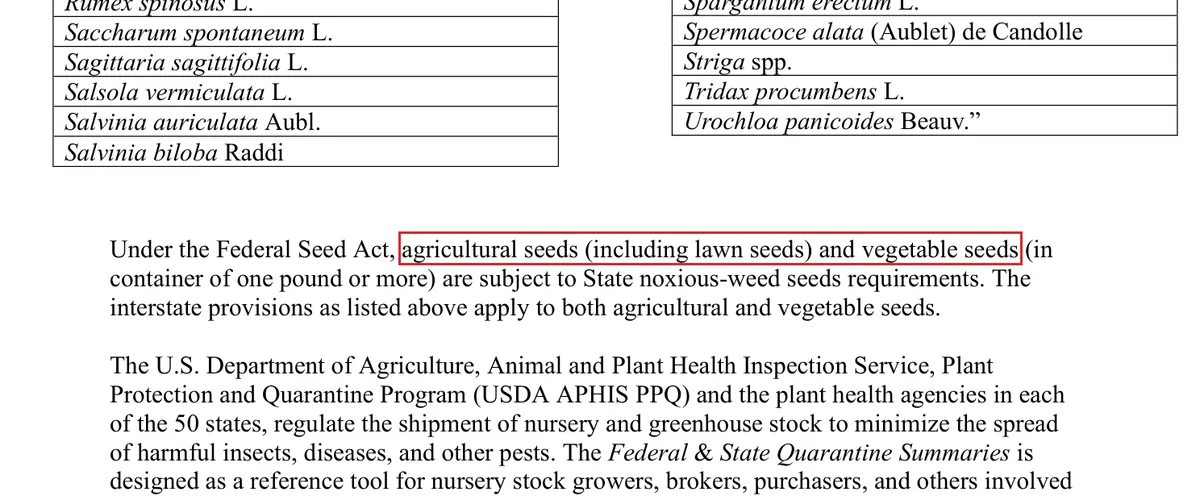
State seed laws are the stricter filter for homeowners, because the Federal Seed Act applies each state’s noxious-weed seed list to agricultural seed, including lawn seed, shipped into that state. We searched all 51 jurisdiction sections of the 173-page January 2026 AMS compilation for Taraxacum and for the word dandelion. Neither appears, so a bag of grass seed can legally contain dandelion seed if the label states the weed seed percentage.
Swipe the table sideways to see every column.
| Weed | Scientific name | State seed lists naming it | Where |
|---|---|---|---|
| Common dandelion | Taraxacum officinale | 0 of 51 | None |
| White clover | Trifolium repens | 0 of 51 | None |
| Ground ivy | Glechoma hederacea | 0 of 51 | None |
| Common chickweed | Stellaria media | 0 of 51 | None |
| Broadleaf plantain | Plantago major | 0 of 51 | None (Connecticut lists it only as an exemption) |
| Crabgrass | Digitaria sanguinalis, D. ischaemum | 1 of 51 | Nevada |
| Curly dock | Rumex crispus | 13 of 51 | 13 jurisdictions, e.g. Colorado, Florida, Illinois |
| Yellow nutsedge | Cyperus esculentus | 14 of 51 | 14 jurisdictions, e.g. California, Colorado, Connecticut |
| Wild garlic | Allium vineale | 15 of 51 | 15 jurisdictions, e.g. California, District Of Columbia, Hawaii |
| Annual bluegrass | Poa annua | 18 of 51 | 18 jurisdictions, e.g. Alaska, Arizona, Connecticut |
| Buckhorn plantain | Plantago lanceolata | 29 of 51 | 29 jurisdictions, e.g. Alabama, Arkansas, Colorado |
| Johnsongrass | Sorghum halepense | 31 of 51 | 31 jurisdictions, e.g. Alabama, Arizona, Arkansas |
| Perennial sowthistle | Sonchus arvensis | 28 of 51 | 28 jurisdictions, e.g. Alaska, California, Colorado |
| Canada thistle | Cirsium arvense | 47 of 51 | 47 jurisdictions, e.g. Alabama, Alaska, Arizona |
| Field bindweed | Convolvulus arvensis | 48 of 51 | 48 jurisdictions, e.g. Alabama, Alaska, Arizona |
| Quackgrass | Elymus repens (syn. Agropyron, Elytrigia) | 49 of 51 | 49 jurisdictions, e.g. Alabama, Alaska, Arizona |
The pattern is clear in the counts: the lawn weeds people fight hardest, dandelion and white clover, sit at 0, while creeping perennials that ruin crop fields sit near 50. Annual bluegrass reaches 18 mostly through lawn seed rules, such as New York’s prohibition of Poa annua in lawn seed. HOA covenants and local weed-height ordinances are separate; read your own documents for those.
Why are dandelions considered weeds?
Because they out-reproduce turf. North American common dandelions are triploid, so seeds form without fertilization (Cornell); a single plant can seed a lawn with no pollinator present. Seed germinates at the soil surface once soil reaches 50°F, faster near 77°F (UC IPM), which is exactly the bare, sunny gap a thin lawn leaves.
The taproot does the rest. It sits mostly in the top 6 to 18 inches (Oregon State EM 9510), regrows from a 1 inch piece, and the rosette sits below the mower blade, so mowing never kills it (UC IPM). Popular figures on both seeds and roots wander, so we set each claim against the measured source.
| Claim you will read | Where it appears | What the measured source says | Source |
|---|---|---|---|
| A flower makes up to 200 seeds a year | GreenView, read Nov. 2026 | 150 to 200 seeds per head, up to 10 heads per plant | UW-Madison Extension, rev. Sept. 2026 |
| Up to 20,000 viable seeds per plant | Oregon State EM 9510, Apr. 2025 | 50 to 150 heads a year at an average 250 seeds each: 12,500 to 37,500 seeds under good conditions | Cornell, citing Stewart-Wade 2002 |
| Seeds travel for miles | UC IPM | Model: 99.5% land within 11 yards; 0.01% pass 1,083 yards (1 km) | Cornell, citing Tackenberg 2003 |
| Seeds lie in the soil for years | Common in forums | 1 to 5 years, but few survive to the next season | Cornell |
| Roots go down 15 feet | MOFGA, 2007 | Usually 6 to 18 inches; maximum recorded about 6.5 ft (198 cm) | OSU; Cornell |
| Dandelions need bees to make seed | Common assumption | No: seeds develop asexually; insect visits may only trigger seed set | Cornell; UC IPM |
| Pulling the leaves kills it | Common assumption | Root pieces 1 inch long regrow | UC IPM |
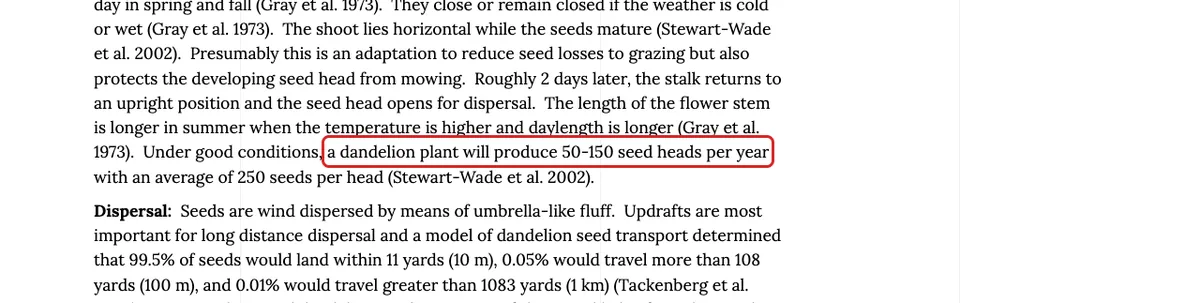
The arithmetic matters for anyone deciding to tolerate a few: 10 flowering plants at the Cornell low end of 50 heads and 250 seeds is 125,000 seeds a season, though most land within 11 yards of the parent. Deadheading before the puffball opens removes that seed; a few seeds turn viable as early as 3 days after the flower closes, most within 6 to 10 days (Cornell).
Do dandelions help bees?
Some, and the evidence cuts both ways. In 17 untreated lawns in Springfield, Massachusetts, researchers netted 5,331 bees of 111 species in 2013 and 2014, and dandelion and clover were the most abundant lawn flowers (Lerman and Milam 2016). University of Kentucky entomologists counted more than 2,100 pollinators from about 50 species on lawn dandelions and white clover (UK, Dec. 2014).
The pollen is the weak spot. Amino acid analysis found dandelion pollen low against honey bee needs in valine and isoleucine and short on leucine and arginine, which explains its reported poor brood rearing (Loper and Cohen 1987). In bee bread from 26 English hives, dandelion still correlated with higher protein content (Donkersley 2017), because bees mix it with other pollens. Oregon State sums it up as a snack, not a full meal (EM 9510).
If bees are the goal, keep dandelions as an April bridge and add native spring bloomers; our clover lawn trade-offs page covers the summer-flowering option. Spraying broadleaf herbicide removes both.
Are dandelions edible?
Yes: leaves, flowers and roots are all eaten (UW-Madison Extension). Per 100 g raw, USDA FoodData Central lists more calcium, vitamin A and vitamin K in dandelion greens than in spinach. Harvest only from ground with no herbicide or roadside runoff, and wash the leaves (OSU).
| Nutrient per 100 g raw | Dandelion greens | Spinach | Dandelion as % of spinach |
|---|---|---|---|
| Energy | 45 kcal | 23 kcal | 196% |
| Protein | 2.7 g | 2.86 g | 94% |
| Fiber | 3.5 g | 2.2 g | 159% |
| Calcium | 187 mg | 99 mg | 189% |
| Iron | 3.1 mg | 2.71 mg | 114% |
| Potassium | 397 mg | 558 mg | 71% |
| Vitamin C | 35 mg | 28.1 mg | 125% |
| Vitamin A (RAE) | 508 µg | 469 µg | 108% |
| Vitamin K | 778.4 µg | 482.9 µg | 161% |
The vitamin K line is the one with a medical catch. NIH sets adequate intake at 120 mcg a day for men and 90 mcg for women, and people on warfarin are told to keep vitamin K intake about the same each day (NIH ODS); 100 g of greens holds about 6.5 to 8.6 times those amounts. Ask your prescriber before adding them in quantity.
What do dandelions say about your lawn?
Mostly that the turf is thin. In competition, extra nitrogen and phosphorus favored grasses over dandelion, and dandelion needs more potassium than many grasses (Cornell). Soil at pH 7.1 grew 45 percent more dandelion weight and 67 percent more plants than soil at pH 6.2, so liming a lawn past the grass target can help the weed. Run a lawn soil test before adding anything.
For removal, our guide to killing dandelions without killing grass has 12 EPA labels and the fall timing; denser turf through adding nitrogen to lawn soil and overseeding thin spots keeps new seedlings out. In beds, 3 inches of mulch blocks seedlings (UC IPM).
1Are they in a vegetable or flower bed?
YesRemove: dig the taproot out, then hold 3 inches of mulch to block seedlings (UC IPM).
NoGo to the next question
2Does an HOA rule, lease or sports use call for uniform turf?
YesRemove: spot-treat in fall with a selective broadleaf label that lists your grass, or dig them.
NoGo to the next question
3Is less than half the lawn the grass you want?
YesRenovate rather than spray: fix pH, feed and reseed, since thin turf lets dandelions back in.
NoGo to the next question
4Do you plan to eat the greens or keep them for early bees?
YesKeep an unsprayed patch and deadhead flowers before the puffballs open.
NoTolerate a few: mow or pick flowers before they seed and thicken the grass with nitrogen and overseeding.
Source: UC IPM Pest Notes: Dandelions; Cornell Weed Science; Oregon State EM 9510
How we compiled this
On November 12, 2026 we searched the full text of 7 CFR 360.200 (eCFR), the Federal Seed Act list in 7 CFR 201.16(b) and the 173-page January 2026 USDA AMS State Noxious-Weed Seed Requirements for Taraxacum and dandelion, and counted 15 other lawn and farm weeds across the 51 state and D.C. sections by scientific name, checking each match by hand. Biology figures come from 5 university extension sources, pollinator figures from 3 peer-reviewed papers and 1 university release, and nutrition from USDA FoodData Central. We did not grow, test or survey anything.
Frequently asked questions
Do dandelions count as weeds?
In a lawn or garden where you do not want them, yes: a weed is any plant growing where it is not wanted (BLM). Legally they are not noxious weeds: they are absent from 7 CFR 360.200 and from all 51 state noxious-weed seed lists (USDA AMS, January 2026).
Are dandelions bad for my yard?
They do not damage the grass directly, but each plant can set 50 to 150 seed heads a year (Cornell), so a few become many in thin turf. They signal a weak stand more than a soil problem; a soil test and denser grass do more than any single spray.
Why shouldn’t you pick dandelions?
Picking the flowers is harmless and stops seed if done before the puffball opens. The reasons people give for leaving them are early-spring bee forage and edible greens; picking flowers does not remove the taproot, which regrows from a 1 inch piece (UC IPM).
Are dandelions native to the United States?
Both. USDA PLANTS records native and introduced dandelion taxa in the lower 48, Alaska and Canada (USDA PLANTS); the common lawn form came from Europe, brought over in the 1600s as an edible and medicinal plant (UMN Extension).
Are dandelions invasive?
They are not on any federal or state noxious list we checked, and USDA PLANTS records no noxious status for them. They spread aggressively in disturbed ground and lawns, which is why extension services such as UMN still treat them as a turf weed.
Sources
- USDA NRCS, PLANTS Database, Taraxacum officinale (TAOF) profile, Read Nov. 12, 2026. Accessed November 2026.
- U.S. Bureau of Land Management, About Weeds and Invasive Species, Current page. Accessed November 2026.
- eCFR, 7 CFR 360.200, Designation of noxious weeds, Current as of Nov. 2026. Accessed November 2026.
- eCFR, 7 CFR 360.100, Definitions (noxious weed), Current as of Nov. 2026. Accessed November 2026.
- USDA AMS Seed Regulatory and Testing Division, State Noxious-Weed Seed Requirements Recognized in the Administration of the Federal Seed Act (includes 7 CFR 201.16(b) list), January 2026. Accessed November 2026.
- Cornell University Weed Science, Weed profile: dandelion, Current page. Accessed November 2026.
- UC Statewide IPM Program, Pest Notes: Dandelions, Current page. Accessed November 2026.
- University of Minnesota Extension, Dandelions, Reviewed 2024. Accessed November 2026.
- UW-Madison Extension, Dandelion, Taraxacum officinale, Revised Sept. 2026. Accessed November 2026.
- Oregon State University Extension, EM 9510, Dandelions: Living with, or without, them, April 2025. Accessed November 2026.
- Loper and Cohen, Journal of Economic Entomology 80(1): 14 to 17, Amino acid content of dandelion pollen, a honey bee nutritional evaluation, 1987. Accessed November 2026.
- Donkersley and others, Oecologia, Nutritional composition of honey bee food stores vary with floral composition, 2017. Accessed November 2026.
- Lerman and Milam, Annals of the Entomological Society of America 109(5), Bee fauna and floral abundance within lawn-dominated suburban yards in Springfield, MA, 2016. Accessed November 2026.
- University of Kentucky College of Agriculture, UK researchers find pesky lawn weeds good for pollinators, Dec. 10, 2014. Accessed November 2026.
- USDA FoodData Central, SR Legacy: Dandelion greens, raw (FDC ID 169226) and Spinach, raw (FDC ID 168462); search the FDC ID on the site, April 2019. Accessed November 2026.
- NIH Office of Dietary Supplements, Vitamin K fact sheet for consumers, Current page. Accessed November 2026.
- MOFGA, Ten Things You Might Not Know About Dandelions (cited as the claim we compared), Summer 2007. Accessed November 2026.
- GreenView, Are Dandelions a Weed or a Useful Plant? (cited as the claim we compared), Read Nov. 2026. Accessed November 2026.