
How to kill trumpet vine: cut each stem near the soil and paint the fresh cut at once with undiluted 8% triclopyr or 41 to 50% glyphosate, then spray the regrowth in late September or October. Expect to retreat sprouts for several seasons.
How to kill trumpet vine (Campsis radicans, also called trumpet creeper) is a root problem, not a vine problem. Rootstock pieces 0.8 inch long send up shoots within 8 weeks, and shoots emerge from pieces buried 9 inches deep (Purdue Pest&Crop, 2006), so every sprout you yank leaves another starting point.
This plan gets herbicide into the roots: cut and paint every main stem, then spray the regrowth late in the season. We matched it to 8 EPA labels that name trumpet creeper and 12 trial results. One spray rarely ends it: in a Tennessee study, dicamba and triclopyr plus 2,4-D controlled the vine 86 to 97 percent at 2 months but 35 to 83 percent at 12 months (Beeler et al., 2012).
Trumpet creeper has opposite, pinnately compound leaves with 7 to 15 toothed leaflets (Purdue); for the 3-leaflet vine, see our guide to killing poison ivy vines, and our common lawn weeds identification guide for low creeping look-alikes.
This page is general information, not pesticide advice. The label is the law: use a product whose label lists trumpet creeper or your site, at the label rate.
Why pulling trumpet vine sprouts makes more of them
The woody rootstock keeps budding after each cut. In USDA greenhouse work, rootstock stripped of shoots every 3 weeks was not exhausted after 5 removals over 15 weeks, and 23 percent sprouted from 28 cm (11 inches) deep (Chachalis and Reddy, 2005). Smaller pieces made more shoots per centimeter of root (Edwards and Oliver, 2004).

Digging works only if you get it all: roots run mostly 1 to 2 feet down (Ask Extension, 2019), and deep tillage to about 18 inches did not reduce stems the next year in Mississippi fields (Reddy 2005, in Beeler et al.). Each plant also carries 20 to 40 pods of about 700 seeds, and 68 percent of surface seed germinated (same source), so clip green pods before they split (Ask Extension).
What the trials measured, and what each result changes in a yard (none tested a home lawn):
| Treatment tested | Result | Source | What it means for you |
|---|---|---|---|
| Rootstock pieces 0.8 in. long, buried 3 to 9 in. | Shoots in 8 weeks; emergence from 9 in. deep | Purdue Pest&Crop 2006, citing Edwards and Oliver 2004 | Snapped roots become new plants |
| Shoots removed every 3 weeks | Rootstock not depleted after 15 weeks; 23% sprouted from 11 in. deep | Chachalis and Reddy 2005 | Cutting or mowing alone takes years |
| Glyphosate 0.56 to 4.48 kg ai/ha on 4 to 6 leaf plants | 2.24 kg/ha or more: over 98% control, no regrowth from rootstock | Chachalis and Reddy, USDA ARS, 2004 | Use the full label rate |
| 2.5 cm (1 in.) simulated rain within 24 h of glyphosate | Activity fell by one-fifth | Chachalis and Reddy 2004 | Spray with a dry day ahead |
| Glyphosate vs. conventional herbicides, Virginia fields | Stems after 1 year: 30 to 66% of the start with glyphosate, 97 to 141% with conventional programs | Bradley et al., Weed Technology 2004 | Later-season glyphosate beat early sprays |
| Glyphosate early plus late in season, 3 years running | 2.7 to 0.9 stems per sq m | Reddy 2005, in Beeler et al. 2012 | Plan on repeat seasons |
| Deep tillage about 45 cm (18 in.) | No reduction the next year | Reddy 2005, in Beeler et al. 2012 | Rototilling spreads, not kills |
| Dicamba; triclopyr plus 2,4-D (Crossbow) | 86 to 97% at 2 months; 35 to 83% at 12 months (2,4-D alone included) | Beeler et al. 2012 | Judge results the next summer |
| Aminocyclopyrachlor-methyl, abandoned nursery | 77 to 93% at 12 months | Beeler et al. 2012 | Non-crop research result, not a garden product |
| Triclopyr plus 2,4-D at 1.5% v/v or 6 qt/acre | About 60 to 79% control | Purdue Pest&Crop 2006 | Expect regrowth after one spray |
| Dicamba 2 qt/acre, or 2,4-D plus dicamba, pasture | 60 to 100% control; a single application is “virtually impossible” to control it | University of Arkansas pasture guide | Retreat the next season |
| Glyphosate with adjuvants, greenhouse | Trumpet creeper more susceptible than redvine; only ammonium sulfate raised glyphosate efficacy | Chachalis et al., Weed Science 2001 | Do not pay for extra surfactants |
The trumpet vine kill plan by where it grows
Treat every main stem first. Roundup Ultra’s cut-stump directions say to apply “immediately” because “a delay in application could result in reduced performance” (EPA label 524-475, section 13.4).
| Where it grows | Method | Product or active and rate | EPA Reg. No. | Timing | Source |
|---|---|---|---|---|---|
| Main stems, any site | Cut near the soil; paint the cut, remaining stem and exposed roots | Triclopyr TEA 8.0% concentrate, undiluted | 239-2491 | When cut | Label, Aug. 2024 |
| Main stems, any site | Cut; cover the fresh cut with a paintbrush | Triclopyr TEA 8.8% concentrate, undiluted | 92564-80 | When cut | Label, Aug. 20, 2026 |
| Main stems, any site | Cut close to the soil; cover the cambium ring | Glyphosate 41%, 50 to 100% solution | 524-475 | Immediately; best in active growth and full leaf | Label section 13.4 |
| Stems too thick to paint evenly | Drill 4 to 5 holes in the fresh cut, fill with product | Glyphosate 50.2%, undiluted | 71995-25 | Immediately after cutting | Label, Jan. 2021 |
| Pole, metal fence or mature-bark trunk | Spray the vine up to 3 to 4 ft | Triclopyr 8.0% at 4 fl oz per gal | 239-2491 | Leafed out, actively growing | Label p. 7 |
| Pole, fence or mature-bark trunk | Cut vines to 3 to 4 ft, then spray them | Glyphosate 50.2% at 2.5 fl oz per gal | 71995-25 | Actively growing | Label |
| Green-barked tree, shrub or house wall | Cut at the base and treat as a stump; no spray | Either concentrate above, undiluted | 239-2491; 71995-25 | When cut | Label 239-2491 |
| Open patch or fence row | Spray regrowth to wet | Triclopyr 8.8% at 4 to 8 fl oz per gal; top rate “to achieve a year of control” | 92564-80 | Actively growing; retreat 28+ days | Label |
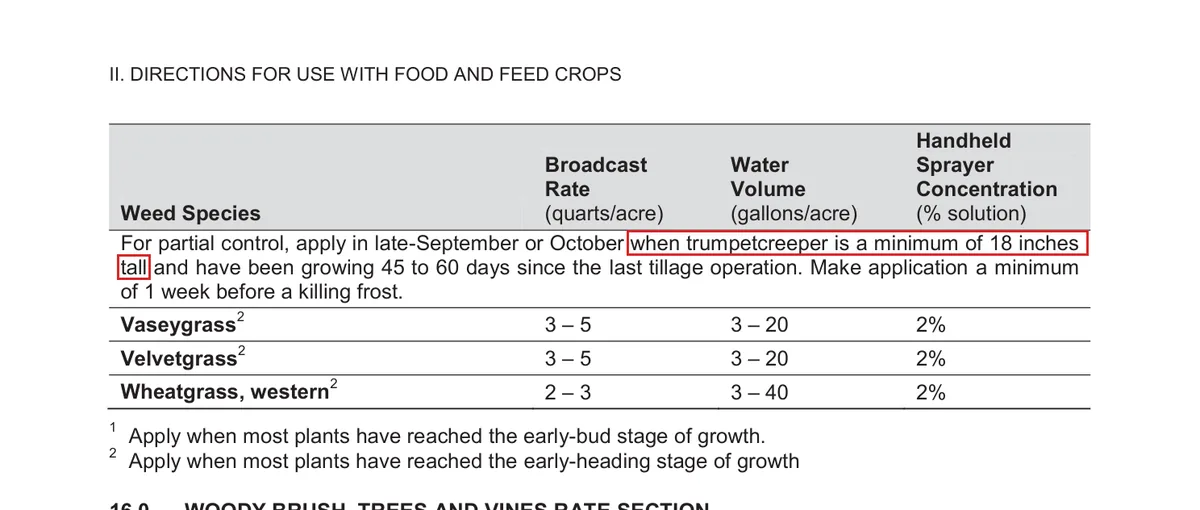
| Open patch or fence row | Spray regrowth to wet (partial control on label) | Glyphosate 41% at 2% (about 2.6 fl oz per gal) | 524-475 | Late Sept. or Oct., vine 18+ in., 1+ week before killing frost | Label PDF p. 118 |
| Woody stems under 6 in. (professional use) | Low-volume basal bark spray to 12 to 15 in. high | Triclopyr ester 60.45%, 20 to 30% in oil | 62719-527 | Any time, including winter | Garlon 4 Ultra label |
| Suckers in turf | Mow or cut every shoot; treat the mother vine | None | n/a | All season, for years | Chachalis and Reddy 2005 |
| Seed pods | Clip while green | None | n/a | Late summer | Ask Extension |
1Is it climbing a house wall, siding, a shrub or a green-barked tree?
YesCut every stem at the base and paint the cut at once with undiluted 8% triclopyr (239-2491 or 92564-80). Do not spray. Pull the dead top after 2 weeks or more.
NoGo to the next question
2Is it on a pole, metal fence or tree trunk with mature bark?
YesSpray the vine up to 3 to 4 ft with triclopyr at 4 fl oz per gallon (239-2491), or cut it to 3 to 4 ft and spray with glyphosate at 2.5 fl oz per gallon (71995-25). Paint thick stems instead.
NoGo to the next question
3Are the shoots coming up in lawn grass?
YesTreat the mother vine first, then mow the shoots. Wipe glyphosate onto a few with a paint brush at the label's wiper strength; it kills grass it touches (524-475). The Ortho lawn directions do not list trumpet creeper.
NoGo to the next question
4Are the shoots in a bed among plants you keep?
YesCut each shoot at the soil and paint the stub with undiluted concentrate; shield nearby plants with cardboard.
NoOpen patch or fence row: spray the regrowth to wet in late September or October, when it is 18 in. or taller and at least 1 week before a killing frost (524-475), or with triclopyr at 4 to 8 fl oz per gallon (92564-80). Check again next summer.
Step 1: cut and paint every main stem
- Cover your skin: some people get redness and itching from the leaves, hence the name cow-itch (NC State Extension).
- Cut each stem close to the soil (label 524-475) and leave the vine above the cut in place.
- Within 1 to 5 minutes (MSU Extension, via Ask Extension), paint the cut, the remaining stem and any exposed roots (label 239-2491) with undiluted 8.0 or 8.8 percent triclopyr, or 41 percent glyphosate at 50 to 100 percent.
- On thick stems, drill 4 to 5 holes into the fresh cut and fill them with undiluted 50.2 percent glyphosate (label 71995-25).
- Wait at least 2 weeks before pulling the dead top so the herbicide can move down (MSU Extension).
Suckers share the mother vine’s roots, so systemic products move both ways: treating a sucker can injure the parent (Ask Extension) or a neighbor’s vine across the fence (UMD Extension, Aug. 2025), a risk Roundup Ultra’s label notes for any plants sharing roots (524-475, section 13.4). Tree stumps take the same treatment in our guide on how to kill a tree stump.
Step 2: spray the regrowth in late summer or fall
Later sprays work better: in Virginia, glyphosate applied later in the season cut more stems than sprays at planting (Bradley et al. 2004). For partial control, the Roundup Ultra label says to spray trumpetcreeper in late September or October once it is 18 inches tall, at least 1 week before a killing frost (EPA label 524-475, PDF p. 118), and an MSU Extension volunteer says fall works while temperatures stay above 50°F (Ask Extension).
BioAdvanced Brush Killer Plus concentrate (92564-80) takes 4 to 8 fl oz per gallon, the top rate on mature plants “to achieve a year of control,” with 28 days between treatments and a cap of 17 fl oz per 500 sq ft a year on its Aug. 20, 2026 label (EPA label 92564-80). Ortho Brush-B-Gon (239-2491) caps the year at 5.4 fl oz per 100 sq ft (EPA label 239-2491).
Check the forecast: 1 inch of rain within 24 hours cut glyphosate activity on trumpet creeper by one-fifth (USDA ARS), while the Ortho triclopyr label says rain 2 hours later will not reduce effectiveness. Our guide on whether to spray weeds before or after rain explains the difference.
- 239-2491 concentrate, dense vine (fl oz)
- 12.0
- Mixed spray at that rate (gallons)
- 3.0
- 239-2491 concentrate, light vine (fl oz)
- 3.0
- 239-2491 most allowed per year (fl oz)
- 16.2
- 92564-80 most allowed per year (fl oz)
- 10.2
Default: 300 sq ft takes 12 fl oz of 239-2491 concentrate in 3 gallons of spray for dense growth, or 3 fl oz for light growth; the label caps the year at 16.2 fl oz. Worked example: 1,000 sq ft takes 40 fl oz in 10 gallons, with a 54 fl oz yearly cap. Rates from EPA labels 239-2491 (Aug. 2024) and 92564-80 (Aug. 20, 2026), read Nov. 24, 2026.
| Patch area | 239-2491, dense brush (4 fl oz per gal per 100 sq ft) | 239-2491, light brush (per 400 sq ft) | 239-2491 yearly cap | 92564-80 yearly cap (17 fl oz per 500 sq ft) |
|---|---|---|---|---|
| 100 sq ft | 4 fl oz in 1 gal | 1 fl oz | 5.4 fl oz | 3.4 fl oz |
| 300 sq ft (default) | 12 fl oz in 3 gal | 3 fl oz | 16.2 fl oz | 10.2 fl oz |
| 1,000 sq ft | 40 fl oz in 10 gal | 10 fl oz | 54 fl oz | 34 fl oz |
Then leave the sprayed vines for at least 2 weeks (MSU Extension). Field bindweed works the same way: our bindweed control schedule explains why cutting and spraying the same shoots cancel out.
Will Roundup kill trumpet vine?
It depends on the bottle. Roundup Concentrate (EPA Reg. No. 71995-64) holds triclopyr, fluazifop and diquat and no glyphosate (label, June 2023); Roundup Super Concentrate (71995-25) is 50.2 percent glyphosate and Roundup Ultra (524-475) 41 percent. All 3 list trumpetcreeper; our breakdown of what each Roundup bottle contains covers the rest.
Glyphosate works at the full rate. The USDA study’s 2.24 kg ai/ha threshold is roughly 2 quarts per acre of a 41 percent product (our conversion), the broadcast rate Roundup Ultra lists for trumpetcreeper. Yet in Virginia fields, stems a year later were still 30 to 66 percent of the starting count (Bradley et al. 2004), so plan a second fall.
Triclopyr spares grass (Texas A&M AquaPlant) but leaches more than glyphosate, which binds to soil (UMD Extension), and can persist in soil for several months (Ask Extension, 2023). See how systemic and contact herbicides differ and how long Roundup stays in soil before replanting.
Trumpet vine suckers in the lawn
Kill the mother vine first, then mow. Ortho Brush-B-Gon’s lawn directions (1 fl oz per 200 sq ft; not for bahia, bermuda, centipede, kikuyu or St. Augustine) do not list trumpet creeper (label 239-2491), and mowing slows suckers without killing them (Wildflower Center, 2012).
For a few suckers, wipe glyphosate onto the leaves with a paint brush, which Roundup Ultra’s label allows as a hand wiper; grass it touches dies (524-475). At a property line, cut shoots back rather than spray, because a systemic could kill the neighbor’s plant (UMD Extension).
Trumpet vine on a wall, fence or tree
The aerial rootlets can damage wood siding, shingles and mortar, and UF/IFAS says not to let the vine climb a house, wooden fence or living tree (UF/IFAS FP099). Cut it at the base, paint the stub and leave the top for at least 2 weeks before pulling it down.
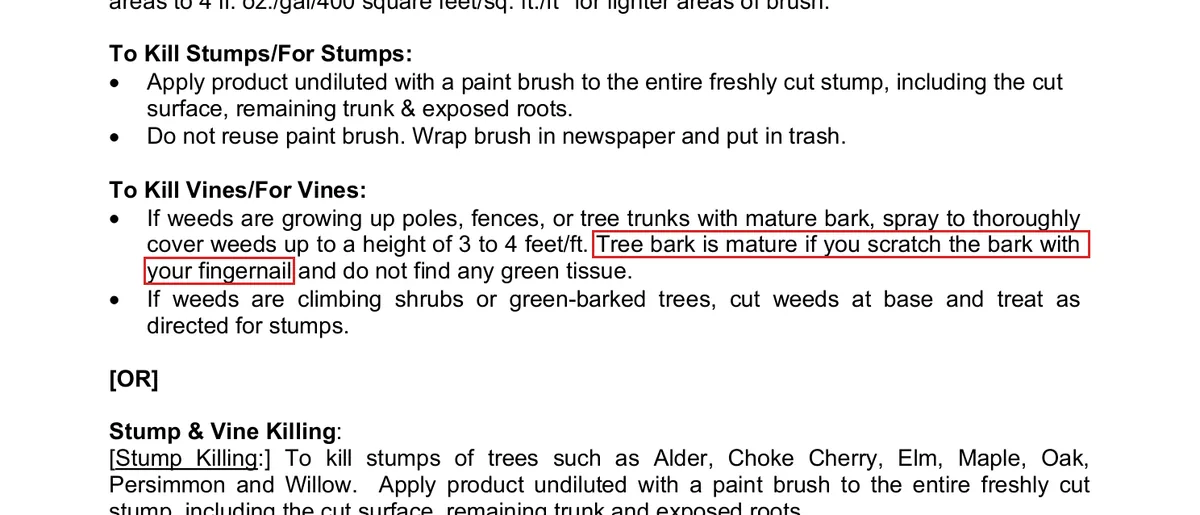
The Ortho label allows spraying up to 3 to 4 feet on poles, fences and trunks with mature bark (no green under a fingernail scratch); on shrubs and green-barked trees, cut and treat the stub (label 239-2491, p. 7). None of our sources tests a way to scrub dried rootlets off brick, the same gap our English ivy removal plan found.
What does not reach trumpet vine roots
Anything that only burns the leaves. Contact herbicides such as glufosinate gave aboveground control with little or no effect on rhizomes (Beeler et al., citing Reddy and Chachalis 2004), and UMD Extension says the same of boiling water, flame weeders and hand pulling (UMD HGIC, Aug. 2025).
| Method | What a guide says | What the primary source says | Our page |
|---|---|---|---|
| Boiling water | Gardening Know How: “effective” on 3 ft around the base | UMD Extension: “not an effective herbicide”; roots regrow | Boiling water on weeds |
| Vinegar | A garden.org forum thread: vinegar on the leaves | UMD: household vinegar “is not an herbicide”; pesticide-strength acetic acid is “very caustic” | Vinegar weed killer limits |
| Spraying herbicide at all | Wildflower Center expert, 2012: “Do NOT spray”; paint cut stems | Labels 92564-80 and 524-475 list trumpet creeper for foliar spray | Paint near plants you keep; spray open patches |
| Cutting suckers to starve roots | Ask Extension 2019: mow until roots run out | USDA: rootstock not depleted after 5 cuts in 15 weeks | Pair cutting with herbicide on the mother vine |
How we compiled this
In November 2026 we read 8 EPA product labels that list trumpet creeper (pulled from EPA’s label system, dated 2016 to Aug. 2026), 6 peer-reviewed papers or abstracts on Campsis radicans, the Purdue, Arkansas, NC State, UF/IFAS and Texas A&M extension pages and 5 Ask Extension answers, and copied every rate and percentage from those documents. The unit conversions, yearly caps and calculator are our arithmetic. We did not run any removal or spray trial.
Frequently asked questions
How deep are the roots of a trumpet vine?
An Ask Extension expert puts most roots 1 to 2 feet down (Ask Extension), but shoots still emerged from rootstock buried 9 inches (Purdue) and 23 percent sprouted from 11 inches in a USDA study (Chachalis and Reddy 2005).
What kills vines permanently?
A systemic herbicide that reaches the roots, applied more than once. For trumpet creeper that means cut-and-paint with undiluted triclopyr or glyphosate, then a fall spray on regrowth; Arkansas calls control with a single application “virtually impossible” (University of Arkansas).
How do you stop a trumpet vine from spreading?
Clip green seed pods, cut shoots that cross a property line (UMD HGIC) and remove suckers routinely. UF/IFAS recommends sturdy non-architectural supports such as metal fences or standalone arbors, away from houses and living trees (UF/IFAS FP099).
Will boiling water kill trumpet vine roots?
No. University of Maryland Extension says boiling water withers only the foliage it touches and “will not impact the roots, so the plant can easily regrow” (UMD HGIC, Aug. 2025).
Is trumpet vine poisonous to touch?
It can irritate skin. NC State Extension says some people get redness and itching after touching the leaves, hence the name cow-itch, and UF/IFAS lists contact dermatitis and toxicity if eaten (NC State; UF/IFAS).
Sources
- Purdue Extension (Nice, Johnson and Bauman), Trumpetcreeper, One Tough Plant, Pest&Crop 2006 Issue 4, 2006. Accessed November 2026.
- Chachalis and Reddy, USDA ARS, Factors Affecting Sprouting and Glyphosate Translocation in Rootstocks of Redvine and Trumpetcreeper, Weed Technology 19(1): 141 to 147, March 2005. Accessed November 2026.
- Edwards and Oliver, Emergence and Growth of Trumpetcreeper as Affected by Rootstock Size and Planting Depth, Weed Technology 18(3): 816 to 819, Sept. 2004. Accessed November 2026.
- Chachalis and Reddy, USDA ARS, Pelargonic Acid and Rainfall Effects on Toxicity, Absorption and Translocation of Glyphosate in Trumpetcreeper (publication summary), 2004. Accessed November 2026.
- Bradley, Hagood and Davis, Virginia Tech, Trumpetcreeper Control in Double-Crop Glyphosate-Resistant Soybean, Weed Technology 18: 298 to 303, 2004. Accessed November 2026.
- Beeler et al., University of Tennessee, Trumpetcreeper Control with Various Indole-3-Acetic Acid Mimics and Diflufenzopyr, HortTechnology 22(5): 677 to 681, Oct. 2012. Accessed November 2026.
- Chachalis, Reddy and Elmore, Characterization of Leaf Surface, Wax Composition, and Control of Redvine and Trumpetcreeper with Glyphosate, Weed Science, 2001. Accessed November 2026.
- University of Arkansas System Division of Agriculture, Trumpet creeper, pasture weed selection guide, current. Accessed November 2026.
- NC State Extension, Campsis radicans, Extension Gardener Plant Toolbox, current. Accessed November 2026.
- UF/IFAS Extension, Campsis radicans: Trumpet Vine, FP099, current. Accessed November 2026.
- Lady Bird Johnson Wildflower Center, Campsis radicans plant database entry, current. Accessed November 2026.
- Lady Bird Johnson Wildflower Center, Mr. Smarty Plants, Eradicating trumpet vine runners in Austin, Apr. 29, 2012. Accessed November 2026.
- University of Maryland Extension HGIC via Ask Extension, How to kill trumpet vine? #914671, Aug. 20, 2025. Accessed November 2026.
- MSU Extension volunteer via Ask Extension, Trumpet Vine Out of Control #917565, undated. Accessed November 2026.
- Ask Extension (Michigan), Trumpet Vine removal #842336, July 2023. Accessed November 2026.
- Ask Extension, Trumpet Vine Removal #551949, Apr. 15, 2019. Accessed November 2026.
- Ask Extension, trumpet vine sprouts #877176, undated. Accessed November 2026.
- Texas A&M AgriLife AquaPlant, How to Control Trumpet Vine, current. Accessed November 2026.
- U.S. EPA PPLS, Label, EPA Reg. No. 92564-80 (BioAdvanced Brush Killer Plus Concentrate, triclopyr TEA 8.8%), Aug. 20, 2026. Accessed November 2026.
- U.S. EPA PPLS, Label, EPA Reg. No. 239-2491 (Ortho Brush-B-Gon Brush Killer, triclopyr TEA 8.0%), Aug. 6, 2024. Accessed November 2026.
- U.S. EPA PPLS, Label, EPA Reg. No. 239-2587 (Ortho Max Poison Ivy & Tough Brush Killer ready to use, triclopyr TEA 0.7%), Apr. 24, 2024. Accessed November 2026.
- U.S. EPA PPLS, Master label, EPA Reg. No. 524-475 (Roundup Ultra, glyphosate 41%), Oct. 18, 2016. Accessed November 2026.
- U.S. EPA PPLS, Label, EPA Reg. No. 71995-25 (Roundup Super Concentrate, glyphosate 50.2%), Jan. 28, 2021. Accessed November 2026.
- U.S. EPA PPLS, Label, EPA Reg. No. 71995-64 (Roundup Concentrate, triclopyr, fluazifop and diquat), June 5, 2023. Accessed November 2026.
- U.S. EPA PPLS, Label, EPA Reg. No. 62719-527 (Garlon 4 Ultra, triclopyr butoxyethyl ester 60.45%), Sept. 23, 2019. Accessed November 2026.
- U.S. EPA PPLS, Label, EPA Reg. No. 4-491 (Bonide Stump and Vine Killer and others, glyphosate 18% plus diquat), June 30, 2026. Accessed November 2026.
- Gardening Know How, Tips To Get Rid Of Trumpet Vine In The Garden (cited for the claim checked above), undated. Accessed November 2026.