How to kill English ivy: cut tree vines at eye level and clear a 3 to 5 ft ring at the base; pull ground runners or spray regrowth at 3 to 5 new leaves with 2 to 5% glyphosate or triclopyr. Recheck for a year.
How to kill English ivy (Hedera helix) depends on where it grows: trunk, ground and wall each need a different cut, product and season. Waxy leaves are why sprays disappoint: Oregon State University calls their waxy layer “a barrier to foliar-applied herbicides, especially in the growing season” (OSU Extension EC 1595, 2008). In the only peer-reviewed spray trial we found, glyphosate at its top rate ranged from 69 to 98 percent control across 3 runs, and a metsulfuron treatment held at 97 percent or more (Yang et al., Auburn University, 2013).
Below, each site gets a plan with its rate, EPA Reg. No. and retreat interval, plus the 2025 and 2026 state sale bans and a labor calculator. Creeping charlie is a different plant with a similar name; see our guide to killing creeping charlie (ground ivy), and our identification guide to common lawn weeds for other look-alikes.
This page is general information, not pesticide or legal advice. The label is the law: read the whole label of the product you buy, and check your state’s rules before you spray near water or on forest land.
The English ivy removal plan by site
Do trees first, then the ground, then walls and fences. Rutgers Cooperative Extension notes English ivy “only produces fruit when allowed to climb up trees” (Rutgers, Oct. 2023), and birds such as starlings and robins spread the black berries (Oregon Department of Agriculture profile). Once the cut upper vine dies, it stops producing seed (OSU EM 9710).
Swipe the table sideways to see every column.
| Site | Method | Product or active | EPA Reg. No. | Timing | Result or retreat | Source |
|---|---|---|---|---|---|---|
| Tree trunk | Survival ring: cut every vine at eye level, peel down, clear 3 to 5 ft at the base | None (pruners, hand saw) | n/a | Any month; hot, dry weather dries the upper vine faster | Upper vine dies in several months; dig resprouts | OSU EM 9710; Clemson HGIC 2327 |
| Tree trunk, vine 0.5 in. or thicker | Cut low, paint the fresh cut on the rooted stub | Triclopyr TEA 8.8% concentrate, undiluted | 92564-80 | When cut | Label: vines on desirable plants are cut and treated as a stump | EPA label 92564-80, Feb. 2026 |
| Tree trunk or thick vine base | Cut-stem treatment | Glyphosate 25% solution, or 2,4-D 2% | Product label | Any season | Reported effective; no percentage given | OSU EC 1595 |
| Vine base (licensed or label-trained user) | Basal bark or cut stump, ready to use | Triclopyr butoxyethyl ester 13.6% (Pathfinder II) | 62719-176 | Per label | Rutgers calls basal bark with triclopyr ester effective | EPA label 62719-176, June 2026; Rutgers |
| Ground cover, small or mixed with plants you keep | Hand pull or roll up runners | None | n/a | After rain softens soil; winter spares dormant perennials | 300 to 1,300 hours per acre; repull for 1+ year | Clemson; OSU EC 1595 |
| Ground cover, solid stand | Mow or string trim, then smother with thick mulch, cardboard if practical | None | n/a | Any season | Roots resprout if left; recut as new growth appears | Rutgers |
| Ground cover, solid stand | Mow, then spray the flush at 3 to 5 new leaves | Glyphosate 2 to 3% solution | Product label | Spring flush; above 55 to 60°F | Repeat on missed or layered vines | Clemson HGIC 2327 |
| Ground cover, solid stand | Spray the flush at 3 to 5 new leaves | Triclopyr 2 to 5% solution | Product label | Spring flush; not above 85°F | Repeat on missed vines | Clemson HGIC 2327 |
| Ground cover in woods or beds with dormant natives | Foliar spray on sunny winter days | Glyphosate or triclopyr, 2 to 5% solution | Product label | Winter, sunny days; Rutgers says above 50°F | Up to 95% control, better than growing season | OSU EC 1595; Rutgers |
| Ground cover, homeowner ready-to-mix | Spray until wet, not dripping | Triclopyr TEA 8.8%, 4 to 8 fl oz per gallon | 92564-80 | When leafed out (ivy is evergreen) | Retreat 30+ days if regrowth; cap 17 fl oz per 500 sq ft a year | EPA label 92564-80 |
| Ground cover, ready to use | Spray to first drip | Triclopyr TEA 0.8% | 92564-81 | Actively growing | Rainfast 4 hours; retreat 30+ days | EPA label 92564-81 |
| Fence line | Free vines by hand, rake debris, repull sprouts | None | n/a | Any season | About 1 hour per 2 to 4 linear ft of established ivy | OSU EM 9710 |
| House wall or chimney | Cut stems at the base; let the upper growth die before pulling | None, or cut-and-paint as for trunks | 92564-80 (cut vines) | Any season | Rootlets can damage stucco, wood and mortar | Clemson HGIC 2327 |
1Is the ivy climbing a tree?
YesCut every vine at eye level, peel down, clear a 3 to 5 ft ring at the base and leave the upper vine to die (OSU EM 9710). Paint thick stubs with undiluted 8.8% triclopyr (label 92564-80). Do not spray the bark.
NoGo to the next question
2Is it on a house wall, chimney or fence?
YesCut the stems at the base and let the top die before pulling, so live rootlets do not tear mortar or paint (Clemson). Budget about 1 hour per 2 to 4 ft of fence (OSU EM 9710).
NoGo to the next question
3Is the ground patch small or mixed with plants you keep?
YesHand pull after rain, in winter if perennials are dormant; repull sprouts for a year or more (Clemson, OSU EC 1595).
NoGo to the next question
4Is it a solid carpet with nothing to save?
YesMow or string trim, then spray the regrowth at 3 to 5 new leaves with 2 to 3% glyphosate or 2 to 5% triclopyr, or smother it under thick mulch and cardboard (Clemson, Rutgers).
NoLarge woodland stands, ivy near water or forest land: hire a licensed applicator; Oregon State's 2008 bulletin says Oregon required notice to the Department of Forestry 15 days before herbicide use on forest land; check the current rule (OSU EC 1595).
Source: OSU Extension EM 9710 and EC 1595; Clemson HGIC 2327; Rutgers; EPA label 92564-80
How do you kill English ivy on a tree without hurting the tree?
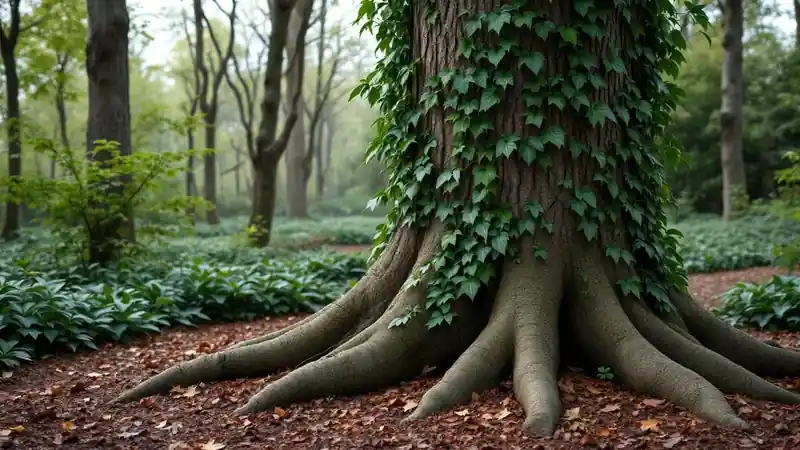
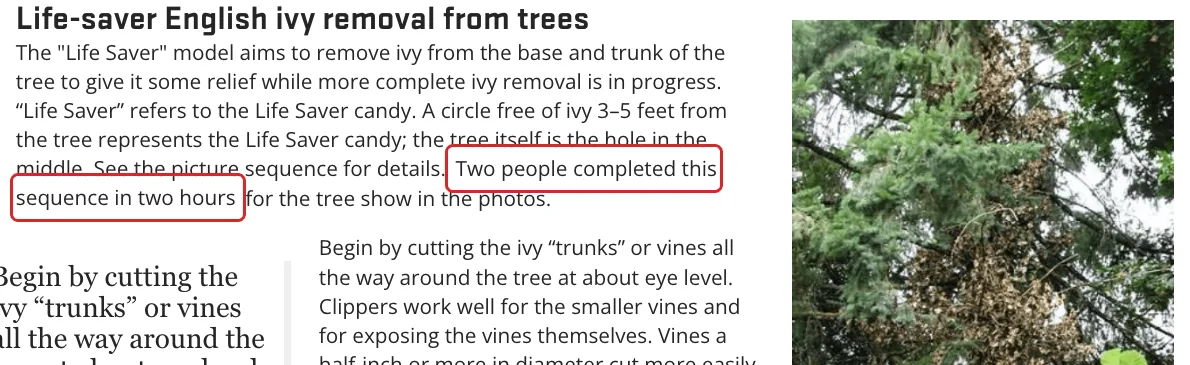
Cut, do not pull, and leave the upper vine to die in place. Oregon State calls this the “Life Saver”: an ivy-free circle 3 to 5 ft out from the trunk, with the tree as the hole in the middle. In its photo sequence, two people cleared one tree in 2 hours (OSU Extension EM 9710, reviewed 2026).
- Pry each vine away from the bark with a large flat-bladed screwdriver so you can reach it without nicking the trunk (Clemson HGIC 2327).
- Cut every vine all the way around the trunk at about eye level: clippers for thin stems, hand pruners for vines 1/2 inch or thicker, a small hand saw for larger ones (OSU EM 9710).
- Peel the vines downward from the cut to the ground, then pull the ivy back from the base at least 3 to 5 ft (OSU EM 9710).
- On vines too thick to pull, cut low and paint the rooted stub with an undiluted 8.8% triclopyr concentrate; label 92564-80 says vines growing on desirable plants are cut and treated as a stump (EPA Reg. No. 92564-80).
- Leave everything above the cut. It shrivels and drops its leaves over several months and falls in pieces over several years; meanwhile it is not producing seed (OSU EM 9710).
- Return every few weeks with a digging fork for resprouts inside the ring.
Keep spray off the trunk. Clemson says glyphosate “may penetrate the bark of many landscape trees, causing injury” (Clemson HGIC 2327); UGA Extension says triclopyr solutions should not be sprayed on mature bark because some species absorb it, though it treats mature brown bark as safe from glyphosate (UGA Extension C867). Paint only the cut ivy stub. A wood-chip ring 3 ft or more in radius, as in our guide to mulching around trees, makes resprouts easy to spot.
University of Maryland Extension says climbing vines, which can reach 60 ft or more, loosen bark, hold moisture against the trunk, add weight that breaks limbs in snow and ice, and harbor bacterial leaf scorch of maples, oaks and elms (UMD Extension, revised Jan. 2026). For dead ivy weighing down limbs over a roof, call an ISA-certified arborist rather than pulling it down yourself.
How do you get rid of English ivy on the ground?
Pull small patches and ivy tangled in plants you keep; smother or spray a solid carpet. Clemson says the strong, shallow stems pull up in long sections after rain, best in winter when perennials are dormant, and that the sap can cause dermatitis, so wear gloves and long sleeves (Clemson HGIC 2327).
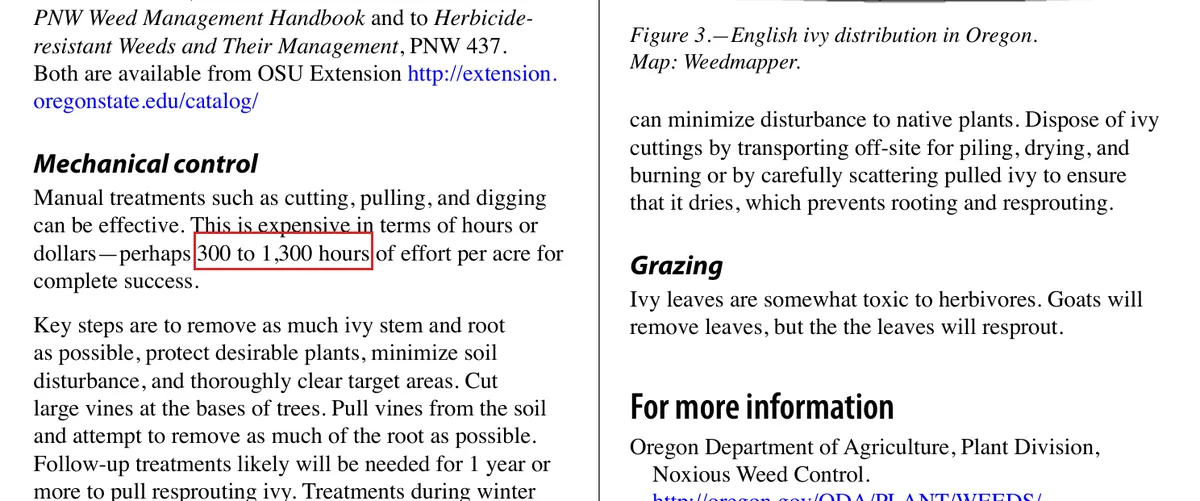
Oregon State puts complete manual removal at 300 to 1,300 hours of effort per acre (OSU EC 1595), which works out to about 33 to 145 sq ft per hour, and Oregon’s agriculture department reports removal costs of $3,000 per acre in some Oregon parks (ODA profile). Enter your area below.
- Hand removal, fast end (hours)
- 3.4
- Hand removal, slow end (hours)
- 14.9
- Triclopyr 92564-80 per spray at label coverage (fl oz)
- 4.0
- Most 92564-80 allowed per year (fl oz)
- 17.0
Default: 500 sq ft takes 3.4 to 14.9 hours to clear by hand (300 to 1,300 hours per acre, OSU EC 1595) and 4.0 fl oz of 92564-80 concentrate per spray, with a yearly cap of 17 fl oz. Worked example: 2,000 sq ft takes 13.8 to 59.7 hours. Product figures from the label coverage (32 fl oz per 4,000 sq ft) and cap (17 fl oz per 500 sq ft), read Nov. 21, 2026.
| Area | Hand removal, fast end (300 h/acre) | Hand removal, slow end (1,300 h/acre) | Triclopyr 92564-80 per spray at label coverage | 92564-80 yearly cap |
|---|---|---|---|---|
| 100 sq ft | 0.7 h | 3.0 h | 0.8 fl oz | 3.4 fl oz |
| 500 sq ft | 3.4 h | 14.9 h | 4.0 fl oz | 17 fl oz |
| 2,000 sq ft | 13.8 h | 59.7 h | 16 fl oz | 68 fl oz |
| 1 acre (43,560 sq ft) | 300 h | 1,300 h | 348 fl oz | 1,481 fl oz |
To smother instead, Rutgers suggests mowing, then a thick blanket of mulch plus cardboard, recutting new growth through the season because roots resprout (Rutgers). Rooted perennials pushed through 10 inches of mulch in the Cornell plots in our summary on whether mulch prevents weeds, so check edges monthly.
Spraying English ivy: beat the waxy leaf
Spray new leaves, not old ones. Clemson mows or string-trims the ivy and sprays the regrowth at 3 to 5 new leaves, before the waxy cuticle forms, using 2 to 3 percent glyphosate or 2 to 5 percent triclopyr, sprayed above 55 to 60°F, with triclopyr held back above 85°F to limit vapor drift (Clemson HGIC 2327). Rutgers adds a surfactant to get through the cuticle (Rutgers).
Glyphosate kills every plant it wets but has the least soil activity (Clemson), so it suits beds with shrubs you can shield; triclopyr spares grass, so it suits ivy running into a lawn. Both are systemic herbicides that move to the roots. Label 92564-81 is rainfast in 4 hours.
Few labels name English ivy. Of those we read, the BioAdvanced Brush Killer Plus labels (92564-80 and 92564-81) list it, though as bracketed optional text, so check the bottle; the Roundup Ultra master label (524-475) lists cape and German ivy but not Hedera helix (EPA label 524-475). Federal law allows a pest not named on the label when you apply to a site the label covers, at or below the label rate, unless the label limits use to the listed pests (7 U.S.C. 136(ee)).
Which herbicide kills English ivy best? The trial numbers
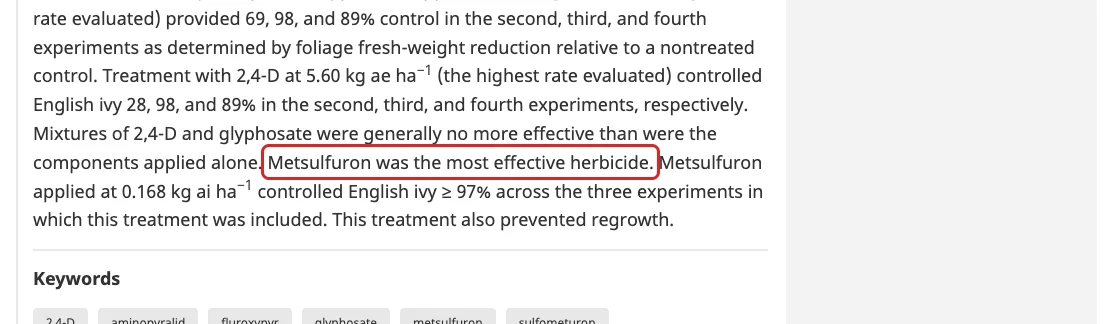
Auburn University researchers sprayed container-grown English ivy in 4 sequential experiments and measured foliage fresh-weight reduction against untreated plants. Aminopyralid at 1.34 and fluroxypyr at 0.71 kg ae/ha, more than twice their maximum registered rates, were ineffective; mixing 2,4-D with glyphosate did no better than either alone (Yang et al., Invasive Plant Science and Management 6(3): 411 to 415, 2013).
| Treatment (rate per hectare) | Experiment 2 | Experiment 3 | Experiment 4 | Regrowth |
|---|---|---|---|---|
| Glyphosate, 8.51 kg ae (highest rate tested) | 69% | 98% | 89% | Not reported in abstract |
| 2,4-D amine, 5.60 kg ae (highest rate tested) | 28% | 98% | 89% | Not reported in abstract |
| Metsulfuron, 0.168 kg ai | 97% or more in each of the 3 runs that included it | Prevented | ||
| Aminopyralid 1.34 kg ae; fluroxypyr 0.71 kg ae | Ineffective |
The same glyphosate rate gave 69 percent in one run and 98 in the next, on container-grown plants rather than layered field stands, which is why every guide plans a retreatment. We could not confirm a metsulfuron label that lists English ivy (EPA’s label search did not respond on Nov. 21, 2026), so treat it as a question for a licensed pesticide applicator.
Where the extension guides disagree on timing
| Question | Guide A | Guide B | What to do |
|---|---|---|---|
| Best season to spray | Spring, at 3 to 5 new leaves (Clemson) | Sunny winter days, up to 95% control (Oregon State) | Spray the spring flush near desirable plants that are leafing out; spray in winter where natives are dormant |
| Minimum temperature | Above 55 to 60°F (Clemson) | Above 50°F for winter foliar (Rutgers) | Use the warmer figure for glyphosate in cool weather |
| Glyphosate on tree bark | May penetrate bark of many landscape trees (Clemson) | No injury expected on mature brown bark; avoid green bark (UGA C867) | Paint only the cut ivy stub and keep spray off any trunk |
| Cut-stem mix | Undiluted 8.8% triclopyr (label 92564-80) | 25% glyphosate or 2% 2,4-D (Oregon State) | Follow the label of the product in hand; the label overrides the guide |
How do you remove English ivy from a brick wall or fence?
Cut the stems at the base and let the growth above die before you pull, as on trees. Clemson says the aerial rootlets “cement themselves” to surfaces and can damage stucco, wood or the mortar of brick homes, and the foliage traps moisture that causes rot (Clemson HGIC 2327).
Trumpet creeper climbs walls with aerial rootlets too, which UF/IFAS says can damage wood siding, shingles and mortar, but it also suckers from roots, so its wall cut is only the first step in our plan for how to kill trumpet vine at the root.
Oregon State estimates about 1 hour per 2 to 4 linear ft of fence under established ivy and warns the ivy may be holding up an old fence (OSU EM 9710). None of the 4 extension sources we read gives a tested method for removing rootlet residue from brick, so test any brush or cleaner on a hidden patch first.
Is English ivy invasive, and is it banned?
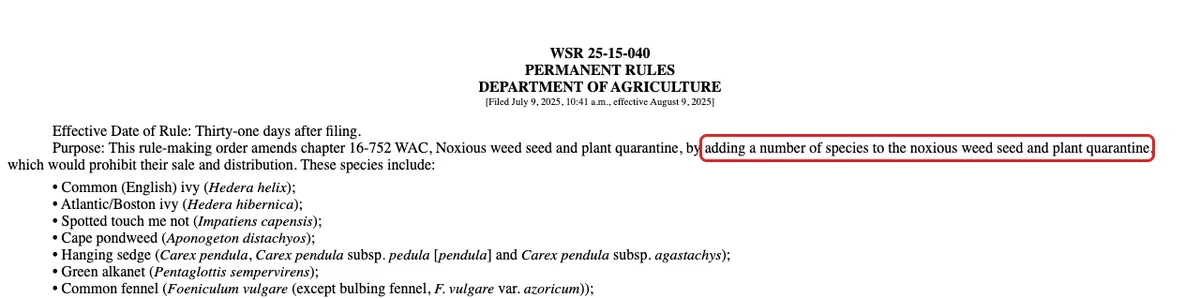
Yes, and four states have adopted sale restrictions. Washington added all cultivars of Hedera helix and Atlantic ivy (H. hibernica) to its noxious weed seed and plant quarantine effective Aug. 9, 2025 (WSR 25-15-040); Maryland’s prohibited list followed on July 15, 2026 (MDA regulations summary, July 2026).
| State | Rule | What it covers | Key dates | Source |
|---|---|---|---|---|
| Oregon | OAR 603-052-1200, “B” designated weed | Entry, transport, purchase, sale and propagation prohibited for English and Atlantic ivy | Rule last amended Oct. 1, 2024 | OAR 603-052-1200 |
| Washington | WAC 16-752-610 quarantine | Transport, buying, selling or distributing H. helix (all cultivars) and H. hibernica | Effective Aug. 9, 2025; amended Feb. 7, 2026 | WAC 16-752-610; WSR 25-15-040 |
| Washington | WAC 16-750-015, Class C noxious weed | 4 cultivars only: ‘Hibernica’, ‘Baltica’, ‘Pittsburgh’, ‘Star’ | Listed 2002 | WAC 16-750-015; WA NWCB |
| Maryland | Prohibited Invasive Plant List | H. helix and H. hibernica may not be added to stock after the effective date | Effective July 15, 2026; potted stock out by July 15, 2027; in-ground stock by July 15, 2028 | MDA summary, July 22, 2026 |
| New Jersey | Invasive Species Management Act | English ivy on the prohibited list | Propagation barred Jan. 1, 2027; sale and distribution barred Jan. 1, 2030, without an NJDEP permit | NJ Dept. of Agriculture |
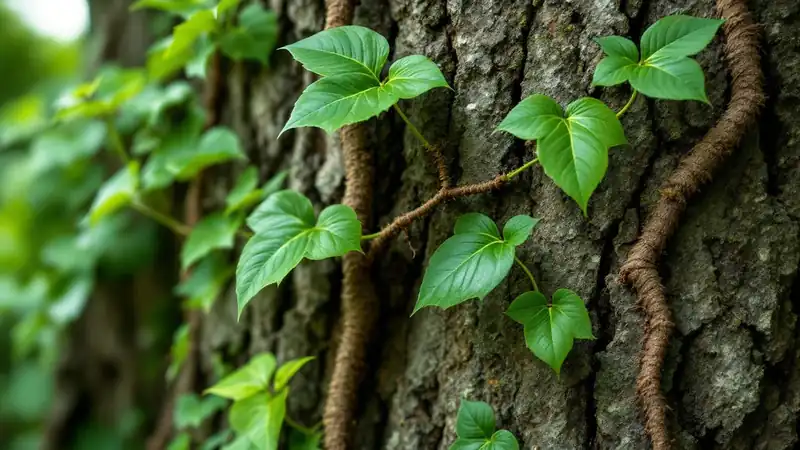
Juvenile ground growth has 3 to 5 lobed leaves; only the mature climbing form, with unlobed spade-shaped leaves, flowers and sets blue-black berries (UMD Extension). Clemson notes variegated houseplant ivies can revert to the fast all-green form outdoors. Once a slope is clear, our guide to erosion control for bare slopes covers what to plant.
How do you dispose of English ivy?
Not in the home compost. Oregon State “strongly discourages” it and suggests stacking cuttings roots-up until they go to a municipal yard-debris facility, whose heat breaks them down (OSU EM 9710); Rutgers says not to compost seeds or cuttings (Rutgers). Bag berried stems.
How we compiled this
We read 2 Oregon State Extension publications, Clemson HGIC 2327, Rutgers and University of Maryland Extension pages, the 2013 Auburn trial abstract, 4 EPA product labels and 6 state rule texts or agency summaries in November 2026, and copied every rate, date and percentage from those documents. Hours, fluid ounces and the calculator are our arithmetic on those figures. We did not run any removal or spray trial. NC State’s English ivy page and EPA’s label search did not load for us on Nov. 21, 2026.
Frequently asked questions
How do I permanently get rid of English ivy?
Cut every climbing vine at eye level, clear a 3 to 5 ft ring at each trunk, then pull or spray the ground layer. Oregon State expects follow-up pulling for 1 year or more; the winter sprays of 2 to 5% glyphosate or triclopyr its bulletin reports gave up to 95% control.
Does vinegar kill English ivy?
Not to the roots. Acetic acid is a contact herbicide that dries out the tissue it touches and does not move to the roots (NPIC), and none of the 4 extension guides we read lists it for English ivy. Our vinegar weed killer trial summary shows perennials regrowing after the burn.
Will Dawn dish soap kill ivy?
No. None of the extension guides or labels we read lists dish soap; Rutgers’ spray advice uses a commercial surfactant to get through the waxy cuticle, not soap (Rutgers). Our test summary on whether dish soap kills grass covers what it does to foliage.
What is the best killer for English ivy?
In Auburn’s 2013 trial, metsulfuron controlled 97% or more; glyphosate ranged from 69 to 98%. Clemson lists 2 to 3% glyphosate or 2 to 5% triclopyr on the new spring leaves; label 92564-80 names English ivy (as optional text) at 4 to 8 fl oz per gallon.
Will English ivy damage trees?
It can. University of Maryland Extension says climbing ivy loosens bark, holds moisture and adds limb-breaking weight; Oregon State notes climbing vines can eventually kill large overstory trees.
Sources
- Oregon State University Extension (McMahan and Brewer), Ivy removal in a home landscape, EM 9710, Revised Sept. 2008, reviewed 2026. Accessed November 2026.
- Oregon State University Extension, Invasive Weeds in Forest Land: English Ivy, EC 1595-E, Sept. 2008. Accessed November 2026.
- Clemson Cooperative Extension HGIC (Williamson), English Ivy Control, HGIC 2327, Reviewed Aug. 20, 2021. Accessed November 2026.
- Yang, Wehtje, Gilliam, McElroy and Sibley, Auburn University, English Ivy (Hedera helix) Control with Postemergence-Applied Herbicides, Invasive Plant Science and Management 6(3): 411 to 415, 2013. Accessed November 2026.
- Rutgers Cooperative Extension (Bakacs), October Invasive Plant of the Month: English ivy, Oct. 23, 2023, updated for 2026 law. Accessed November 2026.
- University of Maryland Extension (Talabac), English Ivy, Revised Jan. 2026. Accessed November 2026.
- Oregon Department of Agriculture, English ivy and Atlantic ivy weed profile, undated. Accessed November 2026.
- Oregon Administrative Rules via Cornell LII, OAR 603-052-1200, Quarantine; Noxious Weeds, Amended Oct. 1, 2024. Accessed November 2026.
- Washington State Legislature, WAC 16-752-610, Regulated articles, Amended effective Feb. 7, 2026. Accessed November 2026.
- Washington State Register, WSR 25-15-040, Department of Agriculture permanent rules, Filed July 9, 2025. Accessed November 2026.
- Washington State Legislature, WAC 16-750-015, State noxious weed list, Class C, Current 2026. Accessed November 2026.
- Washington State Noxious Weed Control Board, English Ivy, accessed 2026. Accessed November 2026.
- Maryland Department of Agriculture via NASDA, Summary of Plant Protection Regulations, Updated July 22, 2026. Accessed November 2026.
- New Jersey Department of Agriculture, Invasive Species: Prohibited Invasive Plant List, 2026. Accessed November 2026.
- U.S. EPA PPLS, Label, EPA Reg. No. 92564-80 (triclopyr TEA 8.8% concentrate), Feb. 6, 2026. Accessed November 2026.
- U.S. EPA PPLS, Label, EPA Reg. No. 92564-81 (triclopyr TEA 0.8% ready to use), Mar. 9, 2021. Accessed November 2026.
- U.S. EPA PPLS, Label, EPA Reg. No. 62719-176 (Pathfinder II), June 9, 2026. Accessed November 2026.
- U.S. EPA PPLS, Master label, EPA Reg. No. 524-475 (Roundup Ultra), Oct. 18, 2016. Accessed November 2026.
- U.S. Code via Cornell LII, 7 U.S.C. 136(ee), current. Accessed November 2026.
- National Pesticide Information Center, Vinegar (acetic acid) fact sheet, 2024. Accessed November 2026.
- UGA Extension, Controlling Poison Ivy in the Landscape, C867, current. Accessed November 2026.