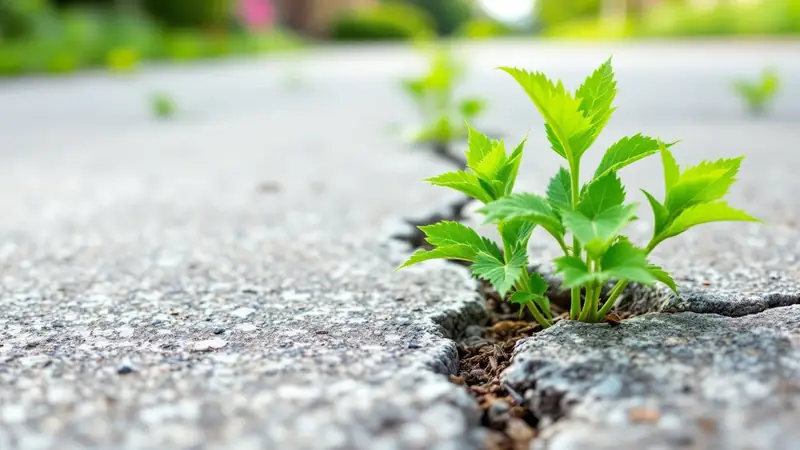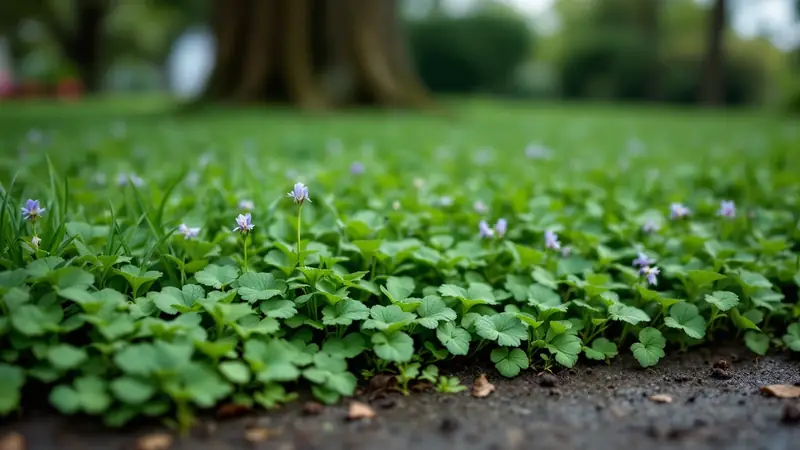
What kills creeping charlie best is triclopyr. In Purdue’s 3-year trial it cut ground ivy to 3 percent cover by June, against 53 percent untreated, beating fluroxypyr (7) and a 2,4-D three-way (19). Spray September through October and repeat once.
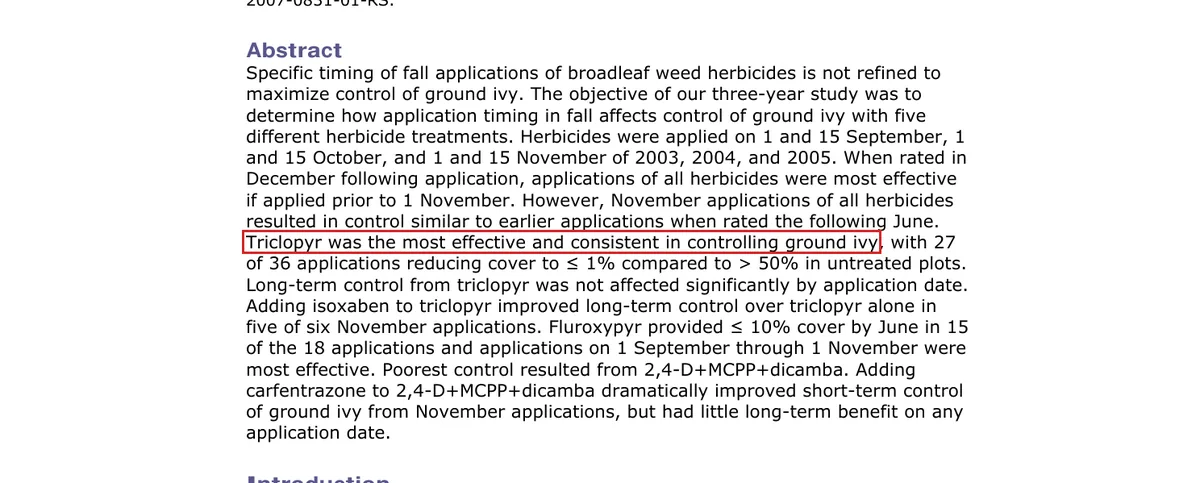
What kills creeping charlie (ground ivy, Glechoma hederacea) is a question with trial data behind it, and most answers skip the data. Purdue researchers sprayed five herbicide treatments on six fall dates for three years and rated the cover left the next June (Reicher and Weisenberger, Applied Turfgrass Science, 2007). Triclopyr won; the 2,4-D, MCPP and dicamba three-way that fills most store shelves came last. Our comparison of lawn weed killers by active ingredient reaches the same verdict from label weed tables.
Below, every control we could find a measured number for is ranked on one table: 4 herbicide mixes, borax, iron HEDTA and boron products, from Purdue, Wisconsin and Iowa State plots. A second table checks 12 EPA master labels for whether ground ivy is actually listed and which grasses each one forbids, because “but not grass” depends on your grass. If you are not sure the weed is ground ivy, check the square stems and scalloped leaves in our lawn weed identification guide first: henbit looks similar but does not form creeping mats.
Creeping charlie controls ranked by trial results
| Rank | Method | Measured result | Where and when | Catch |
|---|---|---|---|---|
| 1 | Triclopyr + isoxaben | 1% cover next June (untreated 53%) | Purdue, Ind., 2003 to 2006 | Two products; isoxaben improved 5 of 6 November sprays |
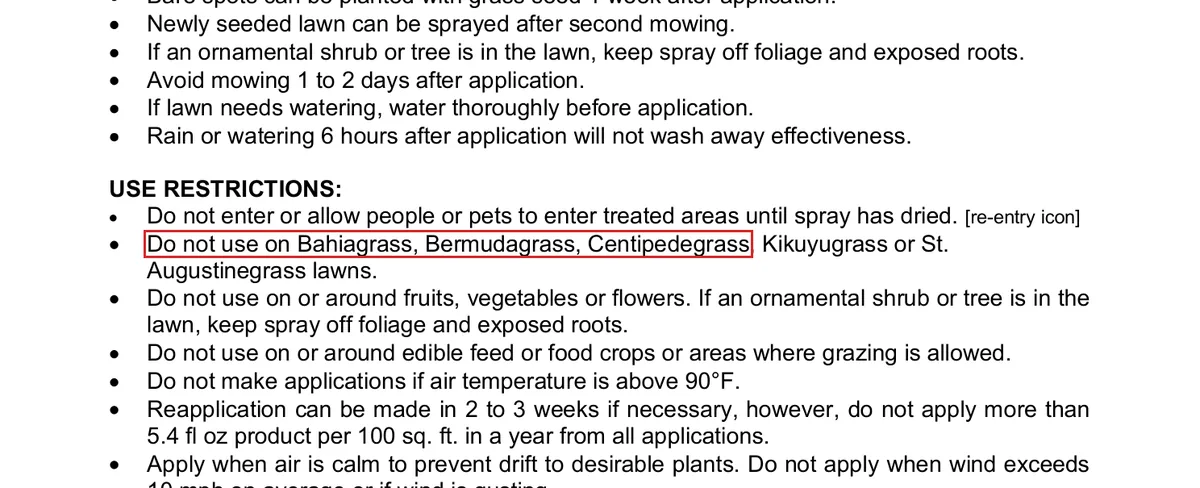
| 2 | Triclopyr alone, 1.12 kg/ha (about 1 lb/acre) | 3% cover next June; 27 of 36 triclopyr sprays held it at 1% or less | Purdue, Ind., 2003 to 2006 | Sold to homeowners (EPA 239-2491); cool-season, buffalo and zoysia lawns only |
| 3 | Fluroxypyr, 0.28 kg/ha | 7% cover next June; 15 of 18 sprays at 10% or less | Purdue, Ind., 2003 to 2006 | None of the 12 labels in our table contains it |
| 4 | Three-way + carfentrazone (SpeedZone) | 6% in December, 17% next June | Purdue, Ind., 2003 to 2006 | Faster December result, little long-term gain |
| 5 | Three-way (2,4-D + MCPP + dicamba) | 19% cover next June; the most inconsistent | Purdue, Ind., 2003 to 2006 | Best single date: Oct. 1 |
| 6 | Three-way (Triplet), fall | 98% control in April, 88% in June, 65% by Sept. 11 | Wisconsin, 1994 to 1995 | Control fades by the next fall |
| 7 | Liquid borax, 20 oz per 1,000 sq ft | 85% control or better in 1991 and 1992 | Iowa State, 1991 to 1992 | 30 to 40% turf injury 4 weeks out in 1991 |
| 8 | Liquid borax, Wisconsin repeat | 44%, 38%, then 21% control | Wisconsin, 1994 to 1995 | Failed to repeat the Iowa result |
| 9 | Boron products, high rate | 77% or more cover cut after 9 months | Purdue, 2023 | Unacceptable bluegrass injury |
| 10 | Iron HEDTA (Fiesta), high rate | 77% or more cover cut after 9 months | Purdue, 2023 | No turf injury |
| 11 | Hand pulling and digging | No percentage published | Iowa State, Penn State | Fails unless every stolon node comes out |
Read rows 1 to 5 as a head-to-head: same plots of ‘America’ Kentucky bluegrass, same sprayer, three years averaged. The other rows come from separate trials with different scales, so a 98 percent Wisconsin rating is not better than Purdue’s 3 percent cover. A 2017 Purdue and Tennessee poster agrees with the order: products containing 2,4-D, fluroxypyr, triclopyr, iodosulfuron, thiencarbazone or aminocyclopyrachlor gave the most control (above 53 percent), and the choice of herbicide mattered more than spring versus fall (Patton et al., ITRC 2017).
Why triclopyr beats the three-way on ground ivy
Ground ivy populations differ. Purdue’s earlier work found biotypes that varied markedly in their response to 2,4-D or triclopyr, and suggested low 2,4-D sensitivity in the trial plots explains why the three-way left 19 percent cover (Reicher and Weisenberger, citing Kohler et al. 2004). MCPP and dicamba were only marginally effective on their own. Iowa State says the same from the homeowner side: one population can be highly sensitive to 2,4-D and the next fairly tolerant, so alternate actives or buy a product with more than one (Iowa State Extension).
Wild violet grows in the same shaded turf and also needs triclopyr, but Purdue’s 2020 violet trial found the dose decides the result; our guide on how to get rid of wild violets in a lawn shows which products reach the 0.72 lb per acre that trial tied to 75 percent control.
The plant also fights back through its stems. Penn State lists poor movement of herbicide through the long stolon network to the crowns, plus strong regrowth, as the reasons sprays fail, and notes preemergence herbicides do not control it (Penn State Extension, Jan. 2026). Stolons can reach 2.5 feet (Illinois Extension), which is why one spray rarely finishes the job. In a 2000 survey of Indiana lawn care companies cited by the Purdue authors, 31 percent of customer lawns had ground ivy and 86 percent of the companies said repeat sprays were needed.
Mock strawberry, the yellow-flowered strawberry lookalike, creeps through the same damp shade on stolons that root at every node, but its labels point to a different spray: our guide on how to get rid of mock strawberry found that 5 of 14 lawn labels name it, all 2,4-D, MCPP and dicamba mixes.
Speed is not a kill either: in the Purdue plots, adding carfentrazone took December cover from 13 to 6 percent but left 17 percent by June. A plain 2,4-D product is the weakest buy: the Southern Ag 2,4-D Amine label (EPA Reg. No. 48273-4) does not list ground ivy at all, and our page on what 2,4-D kills and spares explains the gaps.
When is the best time to kill creeping charlie?
Spray between Sept. 1 and Nov. 1. In the Purdue trial, every date in that window held ground ivy to 9 percent cover or less the next June; Nov. 15 sprays left 25 percent, against 53 percent untreated. Iowa State plans 2 fall sprays: late September or early October, then a month later (Iowa State).
| Spray date | Cover left in December | Cover left next June |
|---|---|---|
| Sept. 1 | 2% | 8% |
| Sept. 15 | 2% | 7% |
| Oct. 1 | 1% | 3% |
| Oct. 15 | 4% | 4% |
| Nov. 1 | 16% | 9% |
| Nov. 15 | 34% | 25% |
| Untreated | 51% | 53% |
Two timing beliefs need a correction. Penn State and others advise spraying after the first frost; Purdue’s first killing frosts fell on Oct. 2, 2003, Oct. 5, 2004 and Nov. 9, 2005, and control trends were unaffected by spray date relative to frost. And early November sprays look like failures in December (16 percent cover) but catch up by June (9 percent), because cool-weather sprays act slowly. Do not respray in November just because the patch is still green.
Spring is second best, not useless. Illinois Extension lists mid-spring to early summer and mid to late fall as the windows (Illinois Extension, May 2026), and its 2001 advice was to spray in bloom, April to June, at mid 60s to low 80s°F with no rain for 24 hours (Illinois Extension, 2001). In Wisconsin, a spring Triplet spray gave 100 percent control on June 9 but 60 percent by Sept. 11, 1995.
What kills creeping charlie but not grass?
A selective broadleaf herbicide whose EPA label names ground ivy and your grass. Triclopyr is the strongest, but the Ortho triclopyr label (EPA Reg. No. 239-2491) allows only buffalograss, fescues, Kentucky bluegrass, ryegrass and zoysia and bars bahia, bermuda, centipede, kikuyu and St. Augustine. Southern lawns fall back to a three-way at a cut rate.
| Product (EPA Reg. No.) | Active ingredients | Ground ivy on label? | Rate per 1,000 sq ft | Grasses the label bars | Reseed wait; yearly limit |
|---|---|---|---|---|---|
| Ortho Weed B Gon Chickweed, Clover & Oxalis; also sold as Weed B Gon Creeping Charlie (Ground Ivy) Killer (239-2491) | Triclopyr TEA 8% | Yes | 5 fl oz (1 fl oz per 200 sq ft) | Bahia, bermuda, centipede, kikuyu, St. Augustine | 1 week; max 5.4 fl oz per 100 sq ft a year |
| Ortho WeedClear / Weed B Gon Weed Killer for Lawns (239-2744) | 2,4-D 8.66%, MCPP-p 2.13%, dicamba 0.37% | Yes | 4 fl oz cool-season; 2 fl oz bahia, bermuda, zoysia | Bentgrass, Floratam St. Augustine, carpetgrass | 3 to 4 weeks; 2 sprays a year, 30 days apart |
| Spectracide Weed Stop for Lawns (9688-342) | 2,4-D, MCPP-p, dicamba, sulfentrazone 0.18% | Yes | 4 fl oz cool-season; 1.5 to 2 fl oz warm-season | Floratam and Bitterblue St. Augustine | 3 to 4 weeks; 2 a year |
| Gordon’s Trimec Lawn Weed Killer (2217-539) | 2,4-D 7.59%, MCPP-p 1.83%, dicamba 0.84% | Yes | 4 fl oz; 2 fl oz centipede, St. Augustine | Floratam St. Augustine, carpetgrass | 3 to 4 weeks; 2 a year, 30 days apart |
| Roundup For Lawns1 Ready-To-Use (2217-917) | MCPA, quinclorac, dicamba, sulfentrazone | Yes | Up to 1 gal of RTU | St. Augustine, bahia, centipede, bentgrass | 4 weeks; 2 spot sprays, 21 days apart |
| Scotts Turf Builder Weed & Feed (538-333) | 2,4-D 1.22%, dicamba 0.081% granules | Yes | 2.82 lb | St. Augustine, bentgrass | 1 month; twice a year |
| Fiesta Turf Weed Killer (67702-26) | Iron HEDTA 26.52% | Yes, except in California | 25 to 50 fl oz (5 fl oz per gal, 5 to 10 gal) | Bentgrass; not above 85°F | Not stated; reapply in 3 to 6 weeks |
| SpeedZone EW, professional (2217-1053) | 2,4-D, MCPP-p, dicamba, carfentrazone | Yes | 1.1 to 1.8 fl oz cool-season | St. Augustine, bahia, centipede, short bentgrass | 1 week; 2 broadcasts a year |
| Turflon Ester Ultra, professional (62719-566) | Triclopyr BEE 60.45% | Yes | Spot 3/8 to 3/4 fl oz | Bahia, bentgrass, bermuda, centipede, St. Augustine | 3 weeks |
| Celsius WG, professional (432-1507) | Thiencarbazone, iodosulfuron, dicamba | Yes | 0.057 to 0.113 oz | Every cool-season grass, bahia | Varies by grass |
| Southern Ag 2,4-D Amine (48273-4) and Drive XLR8 quinclorac (7969-272) | 2,4-D alone; quinclorac alone | No | n/a | n/a | n/a |
Quinclorac, which some guides name for creeping charlie, earns no place on its own: the Drive XLR8 label weed list has no ground ivy, and the products that list it pair quinclorac with dicamba or MCPA. For St. Augustine, the only practical route is a three-way at 1 to 2 fl oz per 1,000 sq ft on a non-Floratam lawn, which is also how our clover control ladder for each lawn grass handles that grass.
1Is it growing in a flower or vegetable bed?
YesPull and dig after a soaking rain, bag every stem piece, or sponge-wipe a nonselective herbicide with plants covered (Iowa State). No lawn broadleaf spray in beds.
NoGo to the next question
2Is the lawn mostly creeping charlie, with little grass left?
YesStart over: glyphosate, then reseed in fall (Illinois Extension). Fix shade or wet soil first.
NoGo to the next question
3Is the lawn St. Augustine, centipede, bahia or bermuda?
YesSkip triclopyr; Ortho 239-2491 bars these grasses. Use a three-way whose label names ground ivy and your grass, at the warm-season rate (1 to 2 fl oz per 1,000 sq ft), never on Floratam unless listed.
NoGo to the next question
4Is it between Sept. 1 and Nov. 1?
YesSpray triclopyr (Ortho 239-2491, 5 fl oz per 1,000 sq ft) now and again in about a month, under the label's 5.4 fl oz per 100 sq ft yearly cap.
NoGo to the next question
5Is it spring, with the patch flowering (April to June)?
YesSpray now as a second-best window (Illinois Extension), then plan the main spray for September and October.
NoWait for September. Meanwhile mow at about 3 inches, overseed thin shade with fine fescue, and rake out runners while the soil is moist.
Source: Iowa State Extension; Illinois Extension; EPA label 239-2491; Reicher and Weisenberger 2007
How much product does your patch need?
Enter the area, pick a label, and the calculator gives concentrate per spray and for the two fall sprays Iowa State plans. Rates come straight from the labels in the table above; Fiesta needs 5 to 10 times more product than triclopyr because its label calls for 5 to 10 gallons of spray per 1,000 sq ft.
- Concentrate per spray (fl oz)
- 5.0
- Concentrate for 2 fall sprays (fl oz)
- 10.0
Default: 1,000 sq ft with Ortho 239-2491 needs 5 fl oz per spray and 10 fl oz for two fall sprays. Rates from EPA master labels; the package in hand governs.
| Label | Per 1,000 sq ft per spray | Two sprays | Yearly limit per 1,000 sq ft |
|---|---|---|---|
| Ortho triclopyr 239-2491 | 5 fl oz in 5 gal water | 10 fl oz | 54 fl oz cap |
| Three-way, cool-season rate (239-2744, 2217-539, 9688-342) | 4 fl oz | 8 fl oz | 8 fl oz seasonal cap (239-2744, 2217-539) |
| Three-way, bahia, bermuda or zoysia rate (239-2744) | 2 fl oz | 4 fl oz | Within label |
| Fiesta, low to high rate | 25 to 50 fl oz | 50 to 100 fl oz | Repeat after 3 to 6 weeks |
- Water the lawn a day ahead if it is dry; Gordon’s label asks for watering 24 hours before and none for 24 hours after (EPA 2217-539).
- Skip mowing for a few days before and after, so leaves are there to take up the spray (Illinois Extension, 2001).
- Spray on a calm day under 90°F (85°F for Fiesta), with no rain due that day (24 hours on Ortho WeedClear 239-2744); Ortho triclopyr is rainfast in 6 hours.
- Spray only until the leaves are wet, as the Ortho label puts it: 1 fl oz per gallon of water for each 200 sq ft.
- Repeat a month later in fall (Iowa State), or after 2 to 3 weeks on the triclopyr label, staying under its yearly cap.
- Wait out the reseed interval before overseeding bare spots: 1 week for triclopyr, 3 to 4 weeks for most three-ways.
Does borax kill creeping charlie?
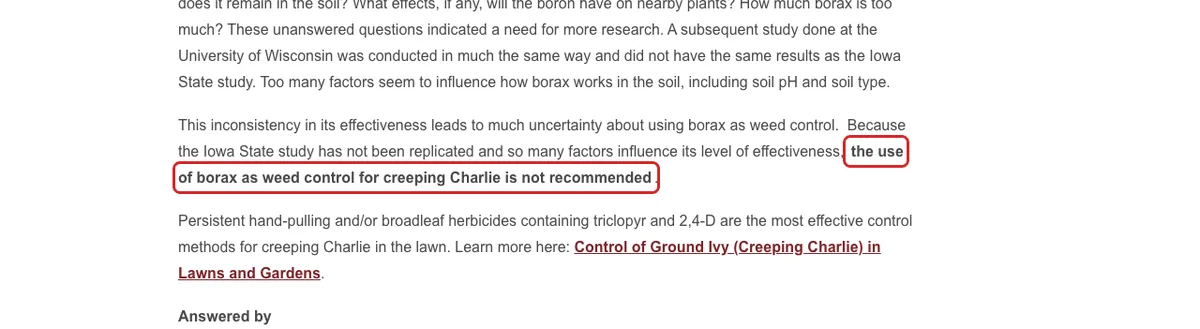
Sometimes, at a cost to the lawn, and no extension service we read recommends it. Iowa State’s own FAQ calls the use of borax on creeping charlie not recommended because its early 1990s study was never replicated (Iowa State, July 2024). That study found liquid borax at 20 oz per 1,000 sq ft gave 85 percent control or better, but caused 30 to 40 percent turf injury 4 weeks out in 1991 (Hatterman-Valenti, Owen and Christians, 1996).
Wisconsin’s repeat gave 20 to 60 percent control, and Stier warned boron “cannot be degraded” and can build to toxic levels in soil (UW-Madison, 1999). A 2023 Purdue study found all boron sources at high rates cut ground ivy 77 percent or more but injured Kentucky bluegrass to unacceptable levels; the high rate of iron HEDTA matched the control with no injury (Amgain, Beck and Patton, 2023). Borax is also not registered as an herbicide (Illinois Extension), so the box carries no lawn rate.
Kitchen remedies do worse. Vinegar and salt burn the leaves they touch, grass included, and leave the stolon nodes; our page on horticultural vinegar as a weed killer shows why acetic acid stops at the leaf. If you want a non-synthetic option, iron HEDTA is the one with 2023 trial data behind it.
Can you pull or choke out creeping charlie?
Pulling works in beds and on young patches only. Penn State says hand removal fails unless the stolons with nodes come out, and Iowa State says to pull after a soaking rain and remove the debris so pieces cannot reroot (Iowa State). University of Maryland Extension suggests dragging rooted stems up with a sturdy metal rake while the soil is moist (UMD Extension, Oct. 2026). In planted beds, no broadleaf lawn spray belongs near flowers; our flower bed weed control steps cover spot-wiping instead.
Henbit, the square-stemmed look-alike, is easier: it is a winter annual with a shallow taproot when young (Clemson HGIC), and our guide on getting rid of henbit times a September preemergent and a fall spray to its life cycle.
Choking it out means fixing the shade and wet soil it likes. Illinois advises shade-tolerant fine fescue mowed around 3 inches, fall overseeding, and mulch or shade plants where grass will not hold (Illinois Extension); our list of grass that grows in shade, ranked by hours of sun shows which seed to buy. Iowa State pairs herbicide with 3 to 4 lb of nitrogen per 1,000 sq ft a year on Kentucky bluegrass, split over late April or May, September and late October.
Under heavy shade, Penn State suggests trading turf for pachysandra, periwinkle or sweet woodruff. If the lawn is mostly creeping charlie, Illinois Extension says starting over with glyphosate and reseeding in fall may be easier; our steps for killing a lawn before replanting give the wait times. Whether feeding alone kills weeds is answered in our page on whether fertilizer kills weeds; Iowa State’s view is that nitrogen works alongside herbicide, not instead of it.
This page is general information, not pesticide advice. The label is the law: follow the rate, grass list and reseed interval on the package in your hand. Some places restrict lawn herbicides; Maryland’s Montgomery County bars most synthetic pesticides on lawns (UMD Extension).
How we compiled this
In November 2026 we read 4 field studies with published numbers (Purdue 2007, Iowa State 1996, Purdue 2023 and the Wisconsin data tabled by Stier in 1999), a 2017 conference abstract, 6 extension pages (Iowa State, Illinois, Penn State, Maryland) and 12 EPA master labels from the Pesticide Product Label System, searching each label’s text for ground ivy. We did not run plots or spray anything. The 2023 and 1996 papers were read at abstract level, so their rates beyond the abstract are not given. Rates in kg/ha are converted at 1 kg/ha = 0.892 lb/acre.
Frequently asked questions
What kills creeping Charlie permanently?
No single spray. In Purdue’s plots, triclopyr held cover at 1 percent or less in 27 of 36 applications, the closest to permanent measured, but Penn State says repeat sprays over several years may be needed. Pair two fall sprays with denser turf (Penn State).
Will Roundup kill creeping Charlie?
Glyphosate kills it and the grass with it, which is why Illinois Extension reserves it for starting over and reseeding in fall. Roundup For Lawns1 (EPA 2217-917) is a different, lawn-safe formula of MCPA, quinclorac, dicamba and sulfentrazone that lists ground ivy.
Is it too late to kill creeping Charlie in November?
Not if you spray by about Nov. 1. Purdue’s Nov. 1 sprays left 9 percent cover by June, close to September and October, while Nov. 15 sprays left 25 percent. Spray while leaves are green and the label’s temperature range allows.
How long does it take to get rid of creeping Charlie?
Plan on a full year. Purdue rated control the June after fall sprays, Iowa State plans 2 sprays a month apart, and Wisconsin’s best fall spray slipped from 98 percent in April to 65 percent by September, so expect a follow-up the next fall.
Does vinegar kill creeping Charlie?
It browns the leaves it touches, including grass, and the stolon nodes regrow; no trial we found measured it on ground ivy. Iron HEDTA is the non-synthetic option with data: 77 percent or more cover reduction at its high rate (Amgain et al. 2023).
Sources
- Purdue University / Applied Turfgrass Science, Reicher and Weisenberger, Herbicide Selection and Application Timing in the Fall Affects Control of Ground Ivy (doi:10.1094/ATS-2007-0831-01-RS), copy hosted by University of Nebraska turf program, Aug. 31, 2007. Accessed November 2026.
- Journal of Environmental Horticulture, Hatterman-Valenti, Owen and Christians, Ground Ivy Control in a Kentucky Bluegrass Turfgrass with Borax, 14(2):101-104, June 1996. Accessed November 2026.
- Agrosystems, Geosciences and Environment, Amgain, Beck and Patton, Ground ivy control with boron and iron in Kentucky bluegrass turf, 6(3), Aug. 7, 2023. Accessed November 2026.
- University of Wisconsin-Madison, J. C. Stier, Corn Gluten Meal and Other Natural Products for Weed Control in Turfgrass, December 1999. Accessed November 2026.
- 13th International Turfgrass Research Conference, Patton et al., Evaluation of Herbicides for Ground Ivy Control at Two Application Timings (poster 72), July 20, 2017. Accessed November 2026.
- Iowa State University Extension, Control of Ground Ivy (Creeping Charlie) in Lawns and Gardens, reviewed April 2024. Accessed November 2026.
- Iowa State University Extension, Can borax be used to control creeping Charlie in the lawn?, July 19, 2024. Accessed November 2026.
- Penn State Extension, Lawn and Turfgrass Weeds: Ground Ivy (Glechoma hederacea L.), Jan. 27, 2026. Accessed November 2026.
- University of Illinois Extension, Managing creeping Charlie in home landscapes, May 1, 2026. Accessed November 2026.
- University of Illinois Extension, Controlling Creeping Charlie (Home, Yard and Garden newsletter), Aug. 1, 2001. Accessed November 2026.
- University of Maryland Extension, Ground Ivy, Oct. 19, 2026. Accessed November 2026.
- U.S. EPA PPLS, Ortho Brush-B-Gon / Weed B Gon Chickweed, Clover and Oxalis Killer, EPA Reg. No. 239-2491, Aug. 6, 2024. Accessed November 2026.
- U.S. EPA PPLS, WBG 553 Concentrate (Ortho Weed B Gon Weed Killer for Lawns), EPA Reg. No. 239-2744, Aug. 23, 2023. Accessed November 2026.
- U.S. EPA PPLS, Chemsico Lawn Weed Killer Concentrate (Spectracide Weed Stop), EPA Reg. No. 9688-342, June 29, 2021. Accessed November 2026.
- U.S. EPA PPLS, Gordon’s BL 8000 Lawn Weed Killer (Trimec), EPA Reg. No. 2217-539, Aug. 6, 2021. Accessed November 2026.
- U.S. EPA PPLS, EH-1462 Herbicide (Roundup For Lawns1 RTU), EPA Reg. No. 2217-917, Sept. 10, 2025. Accessed November 2026.
- U.S. EPA PPLS, Turf Builder Weed and Feed 211, EPA Reg. No. 538-333, Sept. 17, 2026. Accessed November 2026.
- U.S. EPA PPLS, NEU1173H Concentrate (Fiesta Turf Weed Killer), EPA Reg. No. 67702-26, April 10, 2025. Accessed November 2026.
- U.S. EPA PPLS, EH-1681 Herbicide (SpeedZone EW), EPA Reg. No. 2217-1053, June 29, 2023. Accessed November 2026.
- U.S. EPA PPLS, Turflon Ester Ultra, EPA Reg. No. 62719-566, March 21, 2019. Accessed November 2026.
- U.S. EPA PPLS, Celsius WG Herbicide (now Envu 101563-141), Sept. 1, 2021. Accessed November 2026.
- U.S. EPA PPLS, Amine 4 D (Southern Ag 2,4-D Amine), EPA Reg. No. 48273-4, Sept. 29, 2008. Accessed November 2026.
- U.S. EPA PPLS, Drive XLR8 Herbicide, EPA Reg. No. 7969-272, Nov. 1, 2019. Accessed November 2026.