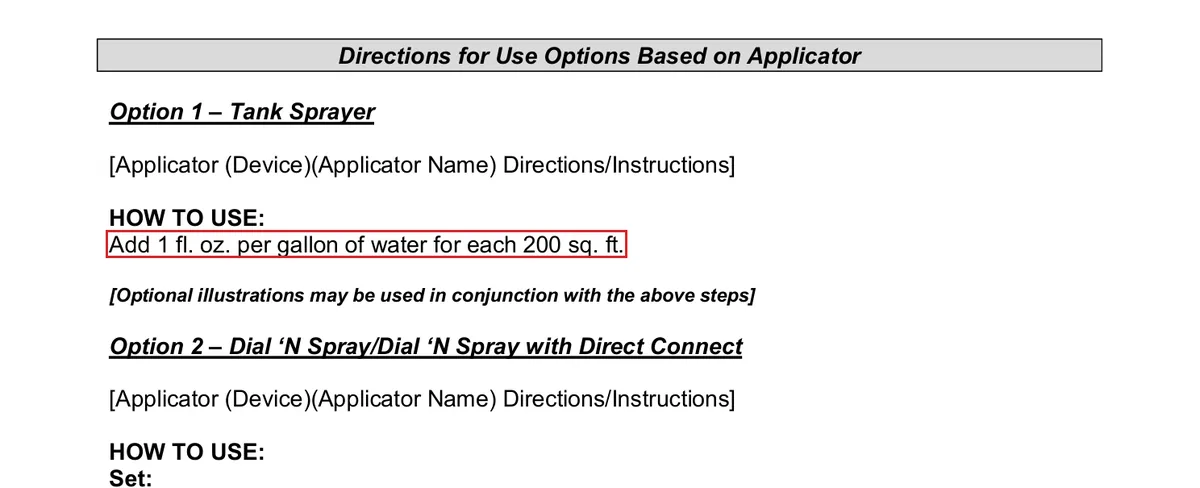
How to get rid of wild violets in lawn grass: spray triclopyr at 0.72 lb per acre or more (Ortho 239-2491 at 1 fl oz per 200 sq ft does it) in September or October, repeat in 3 to 4 weeks, and again next spring.
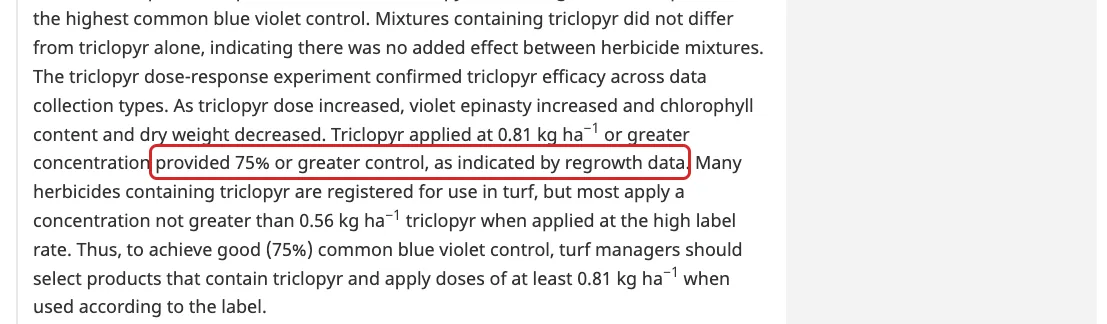
How to get rid of wild violets in lawn turf comes down to dose, not brand. In a Purdue University study published in Weed Technology in 2020, triclopyr was the only active that reliably moved common blue violet (Viola sororia): it caused 80 to 99 percent leaf twisting 21 days after spraying, against 28 percent or less for 2,4-D, MCPA, mecoprop, dichlorprop and quinclorac. Only 0.81 kg per hectare or more, about 0.72 lb of triclopyr acid per acre, gave 75 percent control measured by regrowth. The authors note that most turf products deliver no more than 0.50 lb at their highest label rate.
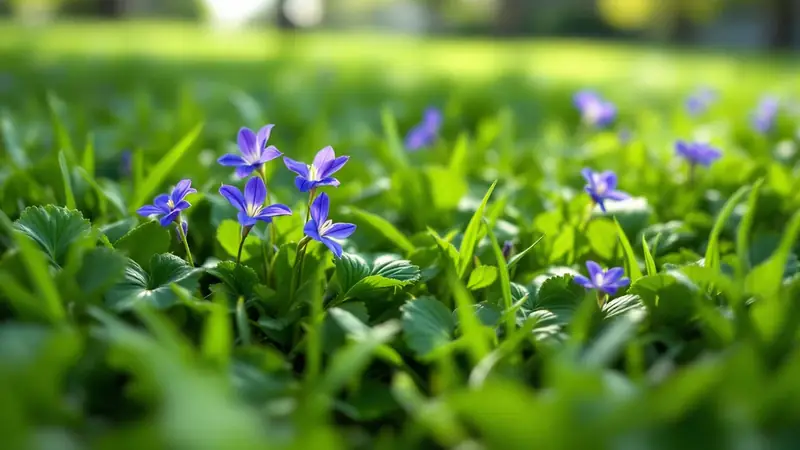
No top-ranking page checks the dose in the bottle. We did the arithmetic from 6 product labels that list wild violet: 2 deliver the Purdue dose in one spray, and Southern Living’s pick, Spurge Power, delivers about 0.13 lb, or 18 percent of it. If you are not sure the heart-shaped leaves are violets, compare them with ground ivy and oxalis in our lawn weed identification table.
This page summarizes EPA labels and university research; it is not a product endorsement. The label is the law: read the current label of the exact product you buy, and check whether your state requires a pesticide applicator license before anyone treats a lawn for pay.
What the wild violet trials actually measured
Four university trials put numbers on wild violet. They used different scales, timings and lengths, so compare rows for direction, not decimals. The longest-running timing data in the Purdue turf program note on ground ivy and violets is from ground ivy, a different weed, which matters for the timing advice below.
| Trial | Treatment | Result on wild violet | Catch | Source |
|---|---|---|---|---|
| Purdue, herbicide comparison (Patton et al., 2020) | 11 herbicide treatments, each at 1.12 kg ae/ha (1.0 lb/A); quinclorac 0.84 kg/ha | Triclopyr-containing treatments: 80 to 99% epinasty at 21 days; all others 28% or less. Triclopyr mixes no better than triclopyr alone | Abstract-level figures; full paper is paywalled | Weed Technology 34(4) |
| Purdue, triclopyr dose response (same paper) | Triclopyr at 0, 0.14, 0.28, 0.56, 0.84 and 1.12 kg/ha | 0.81 kg/ha (0.72 lb/A) or more gave 75% or greater control by regrowth | Most turf products apply 0.56 kg/ha (0.50 lb/A) or less at the high rate | Weed Technology 34(4) |
| Iowa State, Ames, Aug. 29, 2018 (Pease and Thoms) | Sure Power (2,4-D, triclopyr, fluroxypyr, flumioxazin) at 48 and 56 fl oz/A | 55% or more control at 3 days, nearly 90% by 7 days; Defendor (florasulam) never beat untreated | Shaded bluegrass dipped to 6.0 to 6.75 on a 9-point tolerance scale at 7 days; rated 56 days only; Nufarm funded it | ISRF18-36 |
| University of Tennessee, April 2017 and 2018 (Brosnan and Breeden) | Pyrimisulfan + penoxsulam on fertilizer granules, tall fescue | 70 + 70 g/ha: 89 to 91% control 4 to 8 weeks after; 35 + 35 g/ha: 51% or less; repeat sprays added nothing | Experimental code EH1580; short monitoring window | HortScience 54(5) |
| Purdue fall timing trials (ground ivy, not violet) | Triclopyr mid-September to mid-October | Almost 100% ground ivy control by the next June | Purdue: all of its work was on ground ivy and would likely apply to violet | Purdue Turf |
The Iowa result and the Purdue result do not conflict. Sure Power delivers only 0.11 lb of triclopyr per acre at its top rate, yet its four-way mix rated 55 percent control within 3 days; the Iowa rating stopped at 56 days, before rhizome regrowth shows. Purdue’s 75 percent figure came from regrowth, which is what decides whether violets are back in April.
Which products deliver enough triclopyr?
Divide the triclopyr acid printed on each label by its rate and you get pounds per acre per spray. We did that for 5 triclopyr products whose labels list wild violet, plus Ortho’s quinclorac mix for comparison. Our comparison of lawn weed killers by active ingredient covers the wider shelf; the table below covers only violet.
| Product (EPA Reg. No.) | Triclopyr acid in the bottle | Top single lawn rate | Triclopyr per acre per spray | Share of Purdue’s 0.72 lb dose | Lawn grasses on the label | Label |
|---|---|---|---|---|---|---|
| Turflon Ester Ultra (62719-566) | 4 lb/gal | 1 qt/A broadcast; 3/4 fl oz per 1,000 sq ft spot | 1.0 lb | 138% | Bluegrass, perennial ryegrass, tall fescue, zoysia; repeat at 4-week intervals | Mar. 21, 2019 |
| Ortho Weed B Gon Chickweed, Clover & Oxalis Killer (239-2491) | 0.49 lb/gal | 1 fl oz per gal per 200 sq ft (5 fl oz per 1,000) | 0.83 lb | 115% | Buffalograss, fescues, Kentucky bluegrass, ryegrass, zoysia; not bahia, bermuda, centipede, kikuyu, St. Augustine | Aug. 6, 2024 |
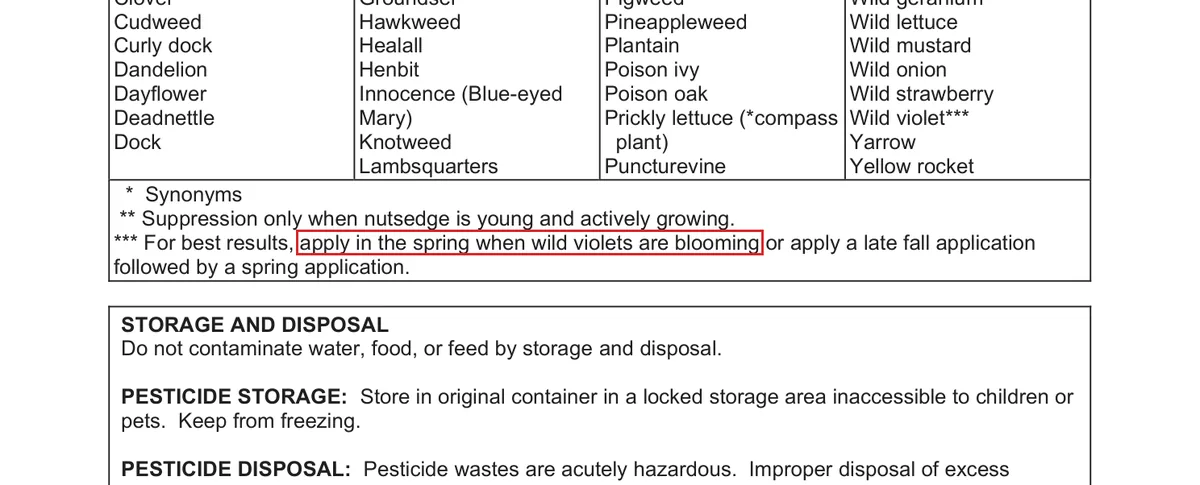
| TZone SE (2217-976) | 0.25 lb per 4 pt | 4 pt/A (1.5 fl oz per 1,000) | 0.25 lb | 35% | Cool-season grasses; dormant bermuda, zoysia, bahia at 2 to 2.25 pt/A; not St. Augustine | Aug. 21, 2024 |
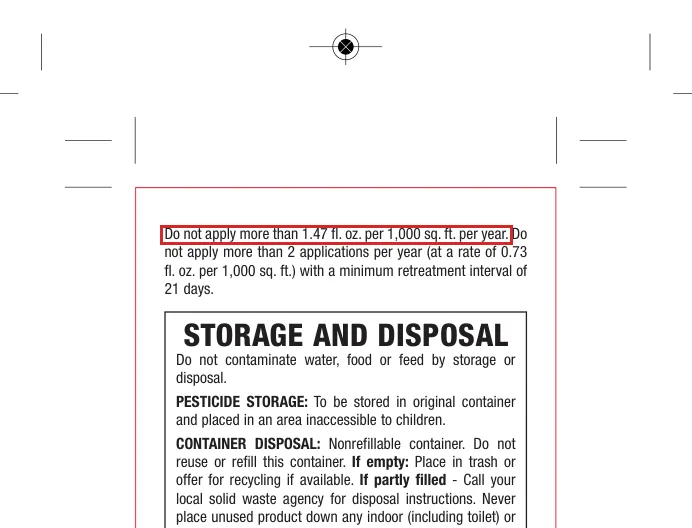
| Monterey Spurge Power (228-317-54705) | 0.3 lb/gal | 1.25 fl oz per 1,000 sq ft | 0.13 lb | 18% | Bluegrass, fescue, rye, bent, bahia, bermuda, zoysia; avoid centipede and St. Augustine | Jan. 22, 2021 (WSU PICOL copy) |
| Sure Power (228-741) | 0.11 lb per 3.5 pt | 3.5 pt/A | 0.11 lb | 15% | Kentucky bluegrass, perennial ryegrass, fescues; not centipede or St. Augustine | Nov. 13, 2026 |
| Ortho Weed B Gon MAX + Crabgrass Control (2217-896-239) | None (0.182 lb/gal quinclorac) | 6.4 fl oz per 1,000 sq ft | 0 lb (0.40 lb quinclorac, 1.0 lb 2,4-D) | 0% | Cool-season grasses, bermuda, zoysia; not centipede or St. Augustine | Jan. 21, 2026 |
The label caps change the plan as much as the dose. Spurge Power’s current label allows no more than 1.47 fl oz per 1,000 sq ft a year, which is one full-rate spray or 2 sprays at 0.73 fl oz, 21 days apart. TZone SE and Sure Power each allow 2 broadcast sprays a year, 28 days apart. The Ortho label lets you repeat in 2 to 3 weeks and caps yearly use at 5.4 fl oz per 100 sq ft, far above the 2 or 3 lawn sprays a violet program uses.
Measure the right amount for your patch
At the Ortho rate, a 1,000 sq ft area takes 5 fl oz (148 mL) of concentrate in 5 gallons of water; a 200 sq ft patch takes 1 fl oz, or 2 tablespoons, in 1 gallon. Turflon Ester Ultra is a 4 lb per gallon concentrate, so its spot rate is about one-seventh as much: 3/4 fl oz per 1,000 sq ft, or about 5.5 mL for a 250 sq ft patch. The 4 fl oz per gallon mix in our guide to killing poison ivy with the same 239-2491 concentrate is the brush rate, 4 times the lawn rate.
- Product per spray (mL)
- 147.9
- Product per spray (tablespoons)
- 10.00
- Product per spray (fl oz)
- 5.00
Default: 1,000 sq ft at the Ortho 239-2491 rate takes 147.9 mL (5 fl oz, 10 tablespoons) in about 5 gallons of water. Worked example: 250 sq ft of Turflon Ester Ultra at the spot rate takes 5.5 mL. Rates from the labels on this page, read Nov. 20, 2026; your container's label overrides this tool.
When to spray wild violets: fall, spring or both?
Fall is the usual answer, but its evidence is borrowed. Purdue’s fall data are on ground ivy, which multi-year Purdue trials cut to almost nothing by June with mid-September to mid-October triclopyr; our page on killing creeping charlie with fall triclopyr has those numbers. For violets, the TZone SE label says to spray in spring when violets are blooming, or late in fall followed by spring, and Illinois Extension gives mid-spring to early summer and/or mid to late fall.
- Mid-September to mid-October: spray while violets are green and air is under 90°F (Ortho label limit) or 85°F (Spurge Power label). Water a dry lawn first.
- Leave 6 hours without rain or sprinklers for the Ortho product and 24 hours without watering for Turflon Ester Ultra; our page on spraying weeds before or after rain has rain-free times for other labels.
- Skip mowing 1 to 2 days before and after (Ortho, Spurge Power).
- Repeat 3 to 4 weeks later on any leaves still flat and green: the Purdue note cites Iowa State violet work showing a second spray improves control, within each label’s interval.
- Spray again at spring bloom in April or May (Penn State dates the flowers), when TZone SE’s footnote says results are best.
- Reseed bare spots no sooner than 1 week (Ortho), 3 weeks (Turflon Ester Ultra) or 3 to 4 weeks (Spurge Power) after spraying.
St. Augustine, centipede and bermuda lawns
None of the 6 labels above lets you broadcast on St. Augustinegrass or centipedegrass; Spurge Power’s label says to avoid them unless injury can be tolerated. In those lawns, dig the clumps or spot-treat with glyphosate, which Missouri Botanical Garden notes will also kill the grass, and replug.
Bermuda and zoysia have more room. Kansas State turf specialists list metsulfuron, sulfentrazone plus metsulfuron and flazasulfuron as effective on wild violet in bermudagrass and zoysiagrass; check that the product label names wild violet before buying, because the Manor metsulfuron label (228-373) we read does not. Zoysia is also on the Ortho 239-2491 lawn label.
1Only a handful of clumps, or violets in a bed edge?
YesDig them in spring with a weeding fork, lifting every rhizome (Penn State: pulling without the rhizomes does not work).
NoGo to the next question
2Is the lawn St. Augustine or centipede?
YesNo label in our table allows a broadcast spray. Dig, or spot-kill with glyphosate (it kills the grass too) and replug.
NoGo to the next question
3Is the lawn bermuda or bahia?
YesOrtho 239-2491 and Turflon Ester Ultra bar these grasses. Use a label that lists your grass and wild violet, such as Spurge Power (weak dose) or a metsulfuron product K-State names for bermuda, and expect repeat sprays.
NoGo to the next question
4Do violets cover more than half the area?
YesKill the area in late summer, fix the soil and reseed in fall (Missouri Botanical Garden).
NoGo to the next question
5Do you want a fast brown-out before an event?
YesA flumioxazin or sulfentrazone mix such as Sure Power or TZone SE browns leaves within days (Iowa State: about 90% at 7 days), but carries 0.11 to 0.25 lb triclopyr; follow with a full-dose triclopyr spray.
NoCool-season lawn or zoysia: triclopyr at 0.72 lb/A or more (Ortho 239-2491 at 1 fl oz per gal per 200 sq ft, or Turflon Ester Ultra), mid-September to mid-October, repeat in 3 to 4 weeks, spray again at spring bloom.
Digging, smothering and thickening the turf
Hand removal does not work unless you dig out the rhizomes, says Penn State Extension, and preemergence herbicides give no suppression at all. Violets spread from thick, branching rhizomes, and in summer they set seed from petal-less flowers at the soil line that never open; the capsules fling seed outward and ants carry it further (Illinois Wildflowers).
- Dig in spring, when leaves and flowers mark every crown, with a garden knife, fork or hoe (University of Maine lists all 3), lifting the whole rhizome mat; any piece left can sprout.
- Smother patches past the dig-by-hand stage under cardboard or old carpet for a couple of seasons, extending past the edges, as University of Maine Extension suggests; this kills the grass too.
- Fix the light: Missouri Botanical Garden says fine fescues compete better than Kentucky bluegrass in shade; our list of grass that grows in shade, ranked by hours of sun picks the seed.
- Mow high and overseed thin turf in late summer, after the reseeding wait on your herbicide label.
Where violets cover more than half the lawn, Missouri Botanical Garden’s advice is to kill the whole area in late summer, improve the soil and reseed in fall; our steps for killing a lawn before replanting give the wait times.
Or keep them: what violets do for butterflies
Common blue violet is native and is the Illinois state wildflower (Illinois Extension). Its leaves feed the caterpillars of at least 5 fritillary butterflies, including the Diana, variegated, Aphrodite, meadow and silver-bordered fritillaries (Illinois Wildflowers). Under trees giving less than 2 hours of direct summer sun, where our shade guide finds no lawn grass recommended, a violet groundcover may be the lower-effort lawn.
Mock strawberry, which often shares that shade, makes no such case: it came from Asia as an ornamental, and our guide on getting rid of mock strawberry separates it from native wild strawberry and cinquefoil before any spray.
What popular guides say vs what the sources show
| Common advice | What the primary source says | Source |
|---|---|---|
| Spurge Power “actually KILLS violets” (Southern Living) | It delivers 0.13 lb triclopyr per acre at its top rate, 18% of the Purdue 75% dose, and its label allows about 1 full-rate spray a year | Spurge Power label |
| Spray in fall because violets are easiest then | Purdue’s fall data are on ground ivy; the TZone SE label prefers spring bloom or late fall plus spring | Purdue Turf; TZone SE label |
| Add quinclorac for a big boost (Purdue Turf note citing Michigan State, 2002) | Purdue’s 2020 trial found triclopyr + quinclorac no better than triclopyr alone | Patton et al. 2020 |
| Any product with triclopyr will do | Kansas State says use more than 0.5 lb ae/A; Purdue found 0.72 lb/A needed for 75% control | K-State; Patton et al. 2020 |
| A spring pre-emergent stops violets | Preemergence herbicides give no suppression or control | Penn State |
| Pull them by hand | Not effective unless the rhizomes are dug out | Penn State |
How we compiled this
On Nov. 20, 2026 we read 7 product labels, 6 EPA-stamped from the EPA Pesticide Product and Label System and 1 from Washington State University’s PICOL database, 3 trial reports (Purdue 2020 abstract, Iowa State 2018, Tennessee 2019) and 7 extension or botanical pages (Penn State, Purdue, Illinois, Kansas State, Maine, Missouri Botanical Garden, Illinois Wildflowers). Pounds of triclopyr per acre and shares of the Purdue dose are our arithmetic from label concentrations and rates. We did not test any product.
Frequently asked questions
What kills wild violets but not grass?
Triclopyr, used on a grass its label lists. Ortho’s 239-2491 concentrate and Turflon Ester Ultra (62719-566) both reach the 0.72 lb per acre dose Purdue tied to 75 percent control, on cool-season lawns and zoysia. Neither is labeled for St. Augustine or centipede.
Why is my yard full of wild violets?
Shade, moist fertile soil and thin turf. Penn State notes violets do well in moist, fertile soil in sun or shade, and they spread by rhizomes plus seed from flowers that never open, so a few plants become a patch within a few seasons.
Will wild violets choke out grass?
They take over where the grass is already thin, mostly in shade. Missouri Botanical Garden says the lasting fix is to improve the turf: reduce shade, improve drainage, water in dry spells and mow high, especially in shaded areas.
How do you get rid of wild violets naturally?
Dig each clump with its rhizomes, or smother patches with cardboard or carpet for a couple of seasons, as University of Maine Extension suggests. Smothering kills the grass under it, and any rhizome piece left behind can regrow.
How long does it take to kill wild violets?
More than one season. Purdue rated 80 to 99 percent leaf twisting 21 days after a triclopyr spray, but rhizomes regrow, and Penn State says repeat applications over the growing season and multiple years may be needed.
Sources
- Patton, Weisenberger and colleagues, Purdue University, Efficacy of triclopyr and synthetic auxin herbicide mixtures for common blue violet (Viola sororia) control, Weed Technology 34(4), 2020, doi:10.1017/wet.2020.50. Accessed November 2026.
- Penn State Extension, Lawn and Turfgrass Weeds: Wild Violet, Current page. Accessed November 2026.
- Purdue Turfgrass Science, Controlling ground ivy and/or violets, Current page. Accessed November 2026.
- Iowa State University (Pease and Thoms), Sure Power Turf Herbicide Evaluation, ISRF18-36, Trial 2018. Accessed November 2026.
- Brosnan and Breeden, University of Tennessee, Postemergence Weed Control in Warm-season Turfgrass with a Mixture of Pyrimisulfan and Penoxsulam, HortScience 54(5): 960 to 963, May 2019. Accessed November 2026.
- Kansas State University, Wild Violet Control, Aug. 2019. Accessed November 2026.
- University of Illinois Extension, Managing Violets, Current page. Accessed November 2026.
- Illinois Wildflowers, Common Blue Violet (Viola sororia), Current page. Accessed November 2026.
- Missouri Botanical Garden, Violets in Lawns, Current page. Accessed November 2026.
- University of Maine Cooperative Extension, What is the best method to get rid of wild violets without using harmful chemicals?, April 11, 2024. Accessed November 2026.
- U.S. EPA PPLS (The Scotts Company), Ortho Brush-B-Gon / Weed B Gon Chickweed, Clover & Oxalis Killer label, EPA Reg. No. 239-2491, Aug. 6, 2024. Accessed November 2026.
- U.S. EPA PPLS (Corteva), Turflon Ester Ultra label, EPA Reg. No. 62719-566, Mar. 21, 2019. Accessed November 2026.
- U.S. EPA PPLS (PBI-Gordon), EH-1527 Herbicide (TZone SE) label, EPA Reg. No. 2217-976, Aug. 21, 2024. Accessed November 2026.
- U.S. EPA PPLS (Nufarm), NUP-16011 Herbicide (Sure Power) label, EPA Reg. No. 228-741, Nov. 13, 2026. Accessed November 2026.
- U.S. EPA PPLS (PBI-Gordon for Scotts), EH-1437 Herbicide (Ortho Weed B Gon MAX + Crabgrass Control) label, EPA Reg. No. 2217-896, Jan. 21, 2026. Accessed November 2026.
- WSU PICOL (Lawn and Garden Products), Monterey Spurge Power label, EPA Reg. No. 228-317-54705, Jan. 22, 2021. Accessed November 2026.
- U.S. EPA PPLS (Nufarm), Manor Selective Herbicide label, EPA Reg. No. 228-373, May 10, 2019. Accessed November 2026.
- Southern Living, At Last! An Easy Way to Kill Violets (advice checked, not a data source), Current page. Accessed November 2026.